Ai Overview
Return on investment in cryptocurrency provides standardized metric comparing gains or losses relative to initial capital deployed, enabling assessment of whether digital asset holdings meet financial objectives. A $100 investment gaining $50 produces identical 50% ROI as $100,000 investment gaining $50,000, enabling standardized performance assessment. Positive ROI: Any percentage above 0% indicates profitable investment where current value exceeds initial cost.
What is ROI in crypto represents one of the most fundamental questions facing cryptocurrency investors seeking to measure investment performance and make informed portfolio decisions. Return on investment in cryptocurrency provides standardized metric comparing gains or losses relative to initial capital deployed, enabling assessment of whether digital asset holdings meet financial objectives. Understanding ROI in cryptocurrency proves essential for evaluating individual token performance, comparing alternatives, and determining when to hold, buy additional assets, or exit positions to optimize portfolio returns.
Cryptocurrency return on investment calculation appears deceptively simple on the surface, yet proper application requires understanding nuances including fee impacts, tax implications, multiple purchase scenarios, and time value considerations affecting actual realized returns. While positive ROI indicates profitable investments and negative ROI signals losses, interpreting these figures demands context around market conditions, holding periods, and risk-adjusted performance.
Professional crypto token development services help projects design sustainable tokenomics, creating long-term value appreciation that supports favorable investor returns.
Key Takeaways
- ROI Definition: ROI in cryptocurrency measures percentage gain or loss on investment by comparing current asset value against initial purchase cost, providing standardized performance metric across different tokens.
- Simple Formula Application: Calculate ROI by subtracting initial investment from current value, dividing by initial investment, then multiplying by 100 for percentage representation enabling easy comparison.
- Positive vs Negative ROI: Positive ROI indicates profitable investment with current value exceeding initial cost, while negative ROI signals losses where assets declined below purchase price.
- Performance Comparison Tool: ROI enables comparing multiple cryptocurrency investments identifying top performers and underperforming assets requiring portfolio rebalancing or exit strategies.
- Time Limitation Critical: Standard ROI calculation ignores investment duration, making 50% return over one month incomparable to identical return over five years without annualized adjustment.
- Fee Impact Significant: Transaction fees, network costs, exchange spreads, and withdrawal charges reduce actual ROI substantially, especially for frequent traders or smaller investment amounts.
- Risk Not Captured: ROI measures returns without accounting for risk exposure, potentially making volatile speculative investments appear attractive despite substantial downside probability.
- Complementary Metrics Needed: Effective investment analysis combines ROI with internal rate of return, risk assessment, market conditions, and fundamental analysis for comprehensive performance evaluation.
Defining ROI in Cryptocurrency
ROI in cryptocurrency functions as performance measurement tool quantifying how much profit or loss an investment generated relative to the amount initially invested. This metric provides percentage-based representation enabling investors to quickly assess whether cryptocurrency holdings are profitable and how returns compare across different assets or strategies.
What is ROI in Crypto Fundamentally
At its core, return on investment answers the question: “How much money did I make or lose compared to what I put in?” This fundamental financial metric translates raw gains or losses into percentage terms facilitating meaningful comparison regardless of investment size. A $100 investment gaining $50 produces identical 50% ROI as $100,000 investment gaining $50,000, enabling standardized performance assessment.
In cryptocurrency markets, ROI serves multiple critical functions. Traders use ROI to determine whether positions generate acceptable returns justifying capital allocation and risk exposure. Investors compare ROI across different cryptocurrencies identifying superior performers worthy of increased allocation. Project evaluators examine historical ROI patterns assessing token price stability and growth potential.
Understanding factors affecting token price helps contextualize ROI figures within broader market dynamics. Tokens demonstrating consistent positive ROI typically reflect strong fundamentals including growing adoption, technological development, and sustainable tokenomics supporting long-term value creation.
ROI Formula for Cryptocurrency
The mathematical formula calculating cryptocurrency ROI follows standard financial convention:
ROI = [(Current Value – Initial Investment) / Initial Investment] × 100
Breaking down the formula components:
- Current Value: Present market value of cryptocurrency holdings at time of calculation
- Initial Investment: Total capital deployed acquiring those holdings including purchase price and fees
- Difference: Subtracting initial investment from current value yields absolute profit or loss
- Division: Dividing by initial investment normalizes gain relative to investment size
- Percentage Conversion: Multiplying by 100 expresses result as percentage for easier interpretation
This straightforward calculation provides quick performance snapshot, though real-world application requires careful attention to all cost components and value considerations affecting actual returns realized.
Interpreting ROI Results
ROI percentage results carry specific meanings guiding investment decisions:
Positive ROI: Any percentage above 0% indicates profitable investment where current value exceeds initial cost. A 25% ROI means the investment gained 25% in value, while 100% ROI indicates doubling of original capital. Positive ROI generally signals successful investment though context regarding time period and market conditions matters.
Negative ROI: Percentages below 0% reflect losses where current value falls short of initial investment. A -30% ROI means the investment lost 30% of original value. Negative ROI typically prompts evaluation whether to hold hoping for recovery, realize losses for tax benefits, or exit to prevent further deterioration.
Zero ROI: Break-even scenario where current value exactly equals initial investment. While no profit was generated, capital preservation itself may represent success during bear markets where many assets decline substantially.
| Initial Investment | Current Value | Profit/Loss | ROI % |
|---|---|---|---|
| $10,000 | $25,000 | +$15,000 | +150% |
| $5,000 | $7,500 | +$2,500 | +50% |
| $20,000 | $20,000 | $0 | 0% |
| $8,000 | $6,000 | -$2,000 | -25% |
| $15,000 | $7,500 | -$7,500 | -50% |
Bitcoin ROI Calculation Example
Understanding how to calculate crypto ROI becomes clearer through practical examples demonstrating formula application to real cryptocurrency investments. Bitcoin, as the most established digital asset, provides familiar context for ROI calculation illustration.
Simple Bitcoin Investment Scenario
Consider an investor purchasing 1 Bitcoin at $40,000 in March 2024. By February 2026, Bitcoin trades at $90,000. Calculating the ROI proceeds as follows:
Step 1 – Identify Initial Investment:
Purchase Price: $40,000
Exchange Fee (0.5%): $200
Total Initial Investment: $40,200
Step 2 – Determine Current Value:
Current Bitcoin Price: $90,000
Estimated Selling Fee (0.5%): -$450
Net Current Value: $89,550
Step 3 – Calculate ROI:
Profit = $89,550 – $40,200 = $49,350
ROI = ($49,350 / $40,200) × 100 = 122.76%
This 122.76% ROI indicates the investment more than doubled over approximately two years. However, this calculation excludes potential tax liability which could reduce net returns by 15-37% depending on jurisdiction and holding period. According to cryptocurrency market data, Bitcoin has delivered average annual returns exceeding 100% historically, though with substantial volatility.
Multiple Purchase Scenario
More complex scenarios involve multiple purchases at different prices requiring weighted average cost basis calculation. Suppose an investor made three Bitcoin purchases:
- 0.5 BTC at $30,000 = $15,000
- 0.3 BTC at $50,000 = $15,000
- 0.2 BTC at $60,000 = $12,000
Total investment: $42,000 for 1 BTC
Average cost basis: $42,000 per Bitcoin
Current value at $90,000: $90,000
ROI: ($90,000 – $42,000) / $42,000 × 100 = 114.29%
This dollar-cost averaging approach often produces different ROI than single lump-sum purchases, typically reducing overall volatility and risk exposure.
Why ROI Matters for Crypto Investors
Measure cryptocurrency profitability through ROI provides critical benefits for portfolio management, strategic decision-making, and performance evaluation across diverse investment approaches.
Performance Assessment and Comparison
ROI enables objective performance assessment answering whether investments meet expectations and justify continued capital allocation. By comparing ROI across different cryptocurrencies, investors identify superior performers deserving increased allocation and underperformers requiring exit or rebalancing.
Portfolio-wide ROI calculation aggregating returns across all holdings provides overall performance snapshot. Investors can benchmark this total portfolio ROI against alternatives like stock market indices, bonds, or real estate determining whether cryptocurrency allocation generates competitive risk-adjusted returns.
Investment Decision Framework
ROI figures inform critical investment decisions including position sizing, rebalancing timing, and portfolio optimization. Assets consistently generating strong positive ROI warrant maintaining or increasing allocations, while persistent negative ROI signals need for strategic reassessment.
Understanding historical ROI patterns helps set realistic return expectations. New investors entering cryptocurrency often harbor unrealistic expectations of continuous exponential gains. Examining long-term ROI data reveals volatility cycles, correction periods, and recovery timelines providing grounded perspective for investment planning.
Cash Flow and Reinvestment Planning
Calculating ROI illuminates available capital for reinvestment or withdrawal. Positive ROI generating substantial profits enables taking partial profits while maintaining market exposure, rebalancing into other opportunities, or extracting gains for personal use without completely exiting positions.
Professional cryptocurrency portfolio management integrates ROI tracking with cash flow projections, tax planning, and strategic rebalancing ensuring portfolios remain aligned with financial goals and risk tolerance as market conditions evolve.
Limitations of ROI in Crypto
Despite widespread use and intuitive appeal, ROI in cryptocurrency carries significant limitations investors must understand to avoid poor decisions based on incomplete analysis.
Time Factor Ignored
The most critical ROI limitation involves ignoring investment duration. A 100% ROI achieved in three months represents vastly superior performance compared to identical 100% ROI requiring five years, yet both calculate identically using standard formula.
This temporal blindness makes comparing investments with different holding periods problematic. Annualized ROI or compound annual growth rate (CAGR) addresses this limitation by normalizing returns to annual basis enabling meaningful cross-period comparison. However, standard ROI calculations rarely include these adjustments.
Risk Not Accounted For
ROI measures returns without capturing risk exposure or volatility experienced reaching those returns. Two investments with identical 50% ROI may have dramatically different risk profiles, with one experiencing smooth appreciation while the other fluctuated wildly between 80% gains and 60% losses.
Cryptocurrency markets demonstrate extreme volatility making risk assessment critical. Smaller altcoins often generate eye-popping ROI figures during bull markets but carry substantial risk of complete loss during corrections. Relying solely on ROI without risk evaluation leads to overallocation to dangerous speculative positions.
Expenses Difficult to Track
Calculating accurate ROI requires accounting for all costs including trading fees, network gas fees, exchange spreads, withdrawal charges, and potential tax preparation expenses. These costs vary significantly across platforms and transaction types making comprehensive tracking challenging.
For active traders executing numerous transactions, cumulative fees substantially reduce nominal returns. A strategy generating 30% gross returns might net only 20% after fees, yet simplistic ROI calculations excluding these costs overstate actual performance. Implementing robust smart contract testing helps minimize technical failures causing unexpected losses affecting ROI.
Doesn’t Reflect Opportunity Cost
ROI analysis in isolation fails to address opportunity cost, returns foregone by choosing one investment over alternatives. A 20% cryptocurrency ROI appears attractive until comparing against stock market returning 35% during the same period, revealing underperformance relative to available alternatives.
Comprehensive investment analysis compares actual ROI against benchmarks appropriate for risk level undertaken. Cryptocurrency’s higher volatility demands higher returns justifying elevated risk compared to traditional assets offering more stable returns.
| ROI Limitation | Impact | Solution |
|---|---|---|
| Time Ignored | Cannot compare different holding periods | Use annualized ROI or CAGR |
| Risk Not Captured | Volatile paths to returns appear identical | Calculate Sharpe ratio, assess volatility |
| Fee Complexity | Understates actual costs reducing returns | Comprehensive expense tracking |
| No Opportunity Cost | Misses better alternative investments | Benchmark against relevant alternatives |
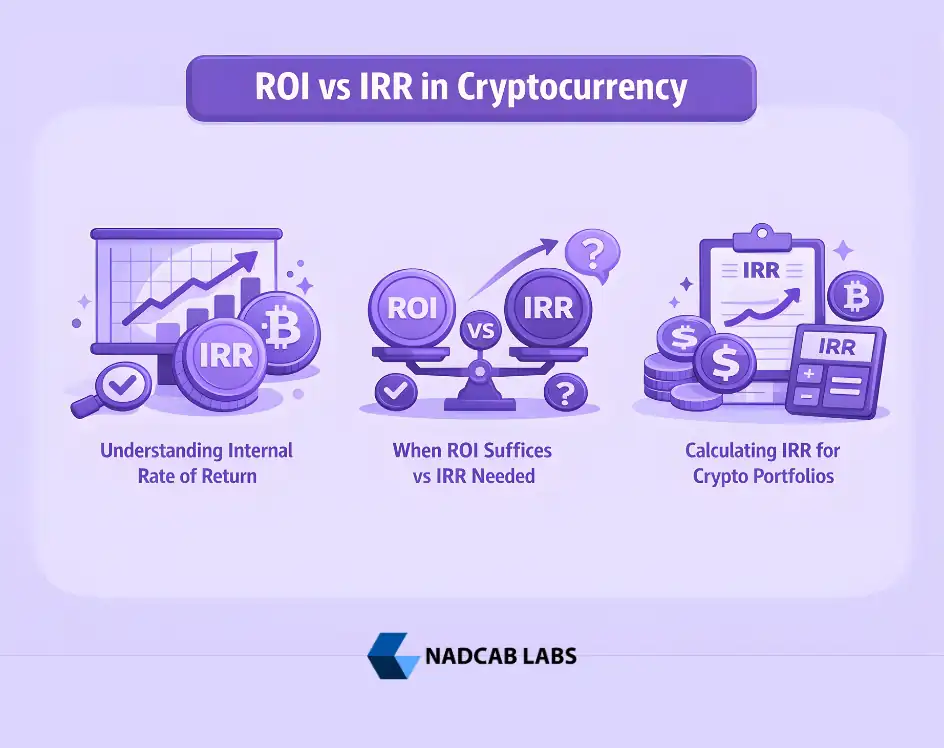
ROI vs IRR in Cryptocurrency
While ROI provides valuable performance snapshot, internal rate of return offers more sophisticated analysis accounting for time value of money and multiple cash flows throughout investment lifecycle.

Understanding Internal Rate of Return
Internal rate of return in crypto calculates the annualized return rate making net present value of all cash flows equal zero. Unlike ROI which simply compares endpoints, IRR considers timing of every transaction including additional investments, partial sales, staking income, and final liquidation.
IRR proves particularly valuable for cryptocurrency investments involving:
- Dollar-cost averaging with regular purchases
- Partial profit-taking or rebalancing sales
- Staking rewards or yield farming income
- Multi-year holding periods
- Complex portfolio management strategies
The calculation requires specialized software or spreadsheet functions given mathematical complexity, but modern portfolio trackers automate IRR calculation making it accessible for all investors.
When ROI Suffices vs IRR Needed
Simple ROI adequately measures performance for straightforward investments involving single purchase and eventual sale without interim cash flows. Quick comparisons, preliminary analysis, or situations requiring mental math favor ROI’s simplicity over IRR’s precision.
IRR becomes essential for accurate performance measurement when investments involve multiple transactions, extended holding periods, or income generation. Projects comparing coin vs token development cost against potential returns benefit from IRR analysis incorporating development expenses, token sales, and projected appreciation.
Research demonstrates IRR can differ from simple ROI by 20-50% for cryptocurrency holdings with frequent trading or staking income, highlighting the importance of appropriate metric selection for accurate performance assessment[2].
Calculating IRR for Crypto Portfolios
While IRR calculation involves complex mathematics beyond manual computation, understanding the process helps interpret results. IRR determination requires:
- Documenting all cash flows with precise dates
- Recording purchases, sales, fees, and income
- Entering data into portfolio tracking software
- Software iteratively solving for rate making NPV zero
- Result expressed as annualized percentage return
Popular cryptocurrency portfolio trackers including CoinTracking, Delta, and Kubera provide automated IRR calculation alongside traditional ROI metrics, enabling comprehensive performance analysis without manual computation burden.
Practical ROI Tracking Strategies
Effective crypto investment analysis requires systematic ROI tracking incorporating all relevant data points and automating calculations for portfolio-wide visibility.
Manual Tracking Approaches
Investors with limited holdings can maintain spreadsheets documenting:
- Purchase dates and prices for each transaction
- Transaction fees and associated costs
- Current holdings and market values
- Staking rewards or other income
- Realized gains from sales
Regular updates calculating total portfolio ROI provide performance snapshots enabling informed decision-making. However, manual tracking becomes impractical as portfolio complexity increases with multiple assets, exchanges, and transaction types.
Automated Portfolio Trackers
Cryptocurrency portfolio management platforms automate ROI calculation through exchange API integrations, transaction import, and real-time price feeds. These tools provide:
- Individual asset ROI tracking
- Total portfolio performance metrics
- Historical performance charts
- Tax reporting capabilities
- Alert systems for significant changes
Premium services typically charge $50-200 annually but save countless hours while improving accuracy compared to manual methods. The best crypto portfolio tracker for individual needs depends on asset diversity, trading frequency, and desired analytics depth.
Security and Privacy Considerations
Granting portfolio trackers exchange access or importing transaction data requires careful security evaluation. Use read-only API keys preventing withdrawals, enable two-factor authentication on all services, and limit data sharing to essential information protecting financial privacy.
Understanding upgradeable token contract security helps assess technical risks in DeFi protocols where portfolio tracking tools may integrate for yield monitoring and performance attribution.
Optimizing Crypto Investment Returns
Beyond measuring ROI, investors should implement strategies systematically improving returns while managing risks inherent to cryptocurrency markets.
Strategic Entry and Exit Timing
Market timing significantly impacts ROI, with purchases during fear phases and sales during euphoria typically generating superior returns compared to random entry points. While consistently timing tops and bottoms proves impossible, avoiding obviously overheated markets and taking profits during exuberance improves outcomes.
Dollar-cost averaging reduces timing risk by spreading purchases over time, naturally buying more units when prices are low and fewer when expensive. This systematic approach typically outperforms lump-sum investing for volatile assets like cryptocurrency.
Fee Minimization
Transaction costs directly reduce ROI making fee optimization important for maximizing net returns. Strategies include:
- Using exchanges with competitive fee structures
- Qualifying for volume-based fee discounts
- Timing transactions during low network congestion
- Minimizing unnecessary transfers between platforms
- Selecting cost-effective blockchain networks
For active traders, annual fees can accumulate to thousands of dollars representing substantial ROI drag requiring optimization.
Tax-Efficient Strategies
Tax implications substantially impact after-tax ROI with strategic approaches improving net returns. Holding cryptocurrencies longer than one year often qualifies for preferential long-term capital gains treatment. Tax-loss harvesting selling losing positions offsets gains elsewhere or carries forward to future years.
Crypto investment strategy guide principles emphasize after-tax returns as ultimate performance measure, with proper planning potentially improving net returns by 10-20% compared to tax-unconscious approaches.
Maximize Your Cryptocurrency Returns
Partner with experienced blockchain professionals to identify high-quality cryptocurrency projects with strong fundamentals supporting sustainable value appreciation and superior ROI performance.
Final Thoughts
What is ROI in crypto fundamentally represents performance measurement comparing current cryptocurrency value against initial investment, expressed as percentage enabling standardized comparison across different assets and strategies. Understanding ROI in cryptocurrency proves essential for evaluating whether investments meet financial objectives and how returns compare to alternatives.
The basic ROI formula, calculating percentage gain by dividing profit by initial investment, provides accessible framework for performance assessment. However, proper application requires accounting for all costs including fees and taxes while recognizing limitations around time factors, risk exposure, and opportunity costs not captured by simple ROI calculations.
Cryptocurrency return on investment serves as valuable metric when combined with complementary analysis including IRR for time-adjusted returns, risk assessment evaluating volatility exposure, and fundamental research validating investment quality. Successful investors integrate ROI tracking with strategic portfolio management, tax optimization, and disciplined rebalancing maintaining alignment with financial goals.
As cryptocurrency markets mature and institutional adoption expands, sophisticated performance measurement becomes increasingly important for competitive returns. Whether managing small personal holdings or substantial portfolios, understanding how to calculate, interpret, and optimize ROI provides foundation for informed decision-making navigating digital asset investments successfully over long term.
Frequently Asked Questions
Q1.What is roi in crypto?
ROI in cryptocurrency measures percentage gain or loss comparing current asset value against initial investment. calculated by subtracting initial cost from current value, dividing by initial cost, then multiplying by one hundred for percentage representation.
Q2.How calculate cryptocurrency roi?
Subtract initial investment from current value, divide result by initial investment, multiply by one hundred. include all fees and costs in initial investment. use current market value accounting for potential selling fees for accuracy.
Q3.What is good crypto roi?
Good roi depends on timeframe and market conditions. annual returns exceeding twenty to thirty percent generally indicate strong performance, though cryptocurrency volatility means returns vary dramatically across different periods and individual asset selection.
Q4.What are roi limitations?
ROI ignores investment duration making different holding periods incomparable, doesn’t account for risk exposure or volatility, struggles capturing all costs especially fees, and fails addressing opportunity costs of alternative investments foregone.
Q5.How track portfolio roi?
Use automated portfolio trackers connecting to exchanges via api, importing wallet transactions, calculating performance across all holdings. manual spreadsheets work for small portfolios but automation proves essential as complexity increases.
Q6.Do fees reduce roi?
Yes, transaction fees, network costs, exchange spreads, and withdrawal charges substantially reduce actual roi. cumulative fees for active traders can consume significant portions of nominal returns requiring comprehensive expense tracking for accuracy.
Explore Services
Related Services
Reviewed by

Aman Vaths
Founder of Nadcab Labs
Aman Vaths is the Founder & CTO of Nadcab Labs, a global digital engineering company delivering enterprise-grade solutions across AI, Web3, Blockchain, Big Data, Cloud, Cybersecurity, and Modern Application Development. With deep technical leadership and product innovation experience, Aman has positioned Nadcab Labs as one of the most advanced engineering companies driving the next era of intelligent, secure, and scalable software systems. Under his leadership, Nadcab Labs has built 2,000+ global projects across sectors including fintech, banking, healthcare, real estate, logistics, gaming, manufacturing, and next-generation DePIN networks. Aman’s strength lies in architecting high-performance systems, end-to-end platform engineering, and designing enterprise solutions that operate at global scale.