Ai Overview
Understanding the cost comparison of coin and token proves essential for blockchain projects determining optimal architecture for their digital asset strategy. Total security investment for serious token projects typically ranges $10,000-$75,000 depending on complexity and thoroughness desired. Professional blockchain audits cost $100,000-$500,000+ depending on codebase size and sophistication.
Understanding the cost comparison of coin and token proves essential for blockchain projects determining optimal architecture for their digital asset strategy. While both coins and tokens serve as cryptographic assets on blockchain networks, their development costs, technical requirements, and ongoing maintenance expenses differ dramatically. These financial distinctions significantly impact project budgets, timelines, and resource allocation decisions.
Creating a native blockchain coin requires building entire network infrastructure including consensus mechanisms, node software, security protocols, and peer-to-peer communication layers. Conversely, token development leverages existing blockchain platforms like Ethereum or Binance Smart Chain, dramatically reducing complexity and costs. This fundamental difference creates vast cost disparities ranging from thousands of dollars for basic tokens to millions for fully-featured blockchain coins with custom networks.
Key Takeaways
- Massive Cost Differential Exists: Basic token creation costs $1,000-$5,000 using platforms like Ethereum, while custom blockchain coin development ranges from $50,000 to several million dollars depending on complexity.
- Infrastructure Determines Expenses: Coins require building complete blockchain infrastructure including consensus mechanisms, node networks, and wallet software, while tokens leverage existing platforms eliminating these costs.
- Development Time Varies Significantly: Tokens deploy in days or weeks using smart contracts, whereas coins require months or years for blockchain development, testing, security audits, and network launch.
- Ongoing Costs Differ Substantially: Token maintenance involves smart contract updates and gas fees, while coins require continuous node operation, network security, protocol upgrades, and community support.
- Technical Complexity Impacts Pricing: Simple ERC-20 tokens cost minimally, advanced tokens with staking or governance features increase expenses, and coins with custom consensus or privacy features multiply costs exponentially.
- Team Requirements Vary Dramatically: Token projects may succeed with 2-3 developers, while coin launches typically require teams of 10-50+ including blockchain architects, cryptographers, security specialists, and network engineers.
- Security Audit Costs Scale: Token audits range $5,000-$50,000, while comprehensive coin security assessments including protocol analysis, network testing, and cryptographic review cost $100,000-$500,000+.
- Marketing and Exchange Listing Expenses: Token listing on decentralized exchanges costs minimally, centralized exchange listings range $50,000-$1 million, while coins face similar listing costs plus network promotion expenses.
Understanding Coins vs Tokens Cost Fundamentals
The cost comparison of coin and token begins with understanding fundamental architectural differences. Coins operate on independent blockchains as native currencies powering network operations, securing consensus, and facilitating transactions. Examples include Bitcoin on the Bitcoin blockchain, Ether on Ethereum, and BNB on BNB Chain. Creating coins requires developing complete blockchain infrastructure from consensus algorithms through peer-to-peer networking.
Tokens, conversely, are digital assets created on existing blockchain platforms using smart contracts. These programmable contracts define token properties including supply, transfer rules, and additional functionality without requiring separate blockchain infrastructure. Platforms like Ethereum, Binance Smart Chain, Solana, and Polygon enable token creation through standardized frameworks like ERC-20, BEP-20, or SPL token standards.
Infrastructure Requirements and Cost Implications
Coin development necessitates building blockchain architecture including consensus mechanism implementation, cryptographic security protocols, distributed ledger structure, peer-to-peer network communication, wallet software development, block explorer creation, and node deployment infrastructure. Each component requires specialized expertise and substantial development time.
Token creation leverages existing blockchain infrastructure, eliminating need for consensus mechanisms, network operations, or native wallet development. Developers write smart contracts defining token behavior, deploy to chosen blockchain platform, and rely on existing wallets, explorers, and infrastructure. This architectural simplicity dramatically reduces both initial and ongoing costs.
Development Complexity and Resource Allocation
Blockchain coin development demands multidisciplinary teams including blockchain architects designing network structure, cryptographers implementing security protocols, distributed systems engineers building consensus mechanisms, network engineers establishing node infrastructure, core developers writing protocol code, security specialists conducting audits, and DevOps teams managing deployment.
Token development requires significantly smaller teams typically consisting of smart contract developers writing token logic, blockchain developers integrating with platforms, and security auditors reviewing code. Simple tokens may require only 1-2 developers, while complex tokens with advanced features need 3-5 team members. This reduced team size directly translates to lower labor costs.
Detailed Cost Breakdown of Token Creation
Token creation costs vary based on complexity, features, platform selection, and development approach. Understanding these variables helps projects budget appropriately and select cost-effective strategies aligned with technical requirements and business objectives.
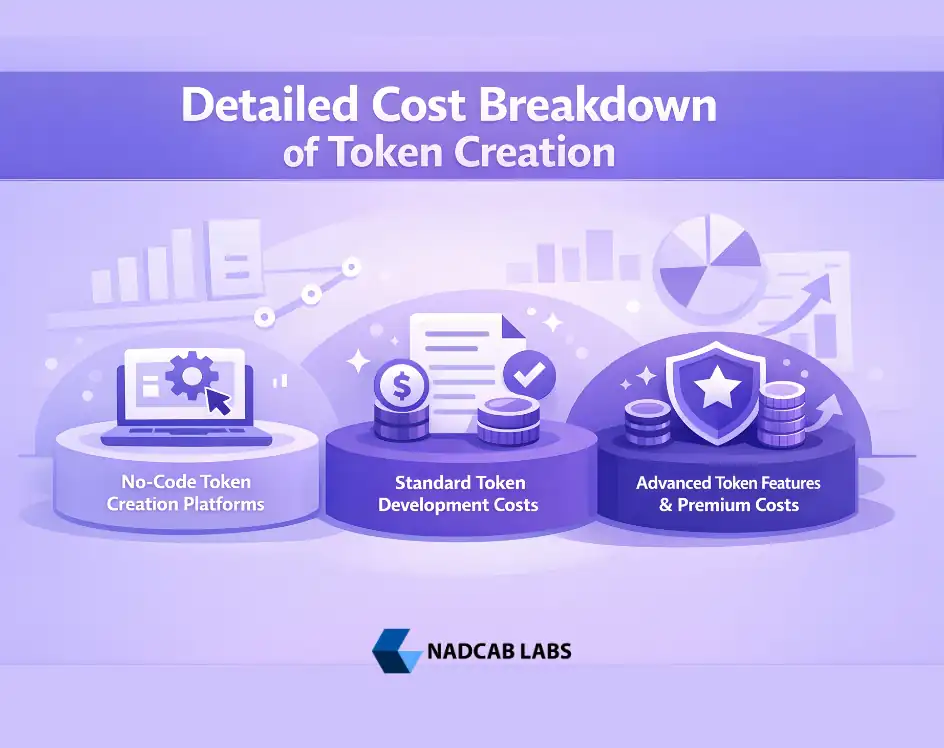
No-Code Token Creation Platforms
No-code token creation platforms enable users without programming knowledge to create basic tokens through web interfaces. Services like Token Factory, CoinTool, and platform-specific generators allow setting token name, symbol, total supply, and decimals through simple forms. These platforms typically charge $50-$500 per token depending on features and blockchain selected.
While extremely affordable and fast, no-code solutions offer limited customization and may not support advanced features like vesting schedules, staking mechanisms, or governance functions. They suit simple use cases like community tokens, loyalty programs, or educational projects but lack flexibility for complex tokenomics or specialized functionality.
Standard Token Development Costs
Professional token development using established standards like ERC-20 or BEP-20 provides greater customization while maintaining reasonable costs. Standard token creation typically ranges $1,000-$10,000 depending on feature complexity and developer rates. This includes smart contract development, testing, deployment to mainnet, and basic documentation.
Factors influencing cost within this range include token standard complexity, additional features beyond basic transfers, custom logic implementation, testing thoroughness, and development team location. Offshore development teams may charge $25-$75 per hour, while North American or European developers typically command $100-$250 per hour. For more detailed pricing, exploring crypto token cost analysis provides comprehensive breakdowns.
Advanced Token Features and Premium Costs
Tokens incorporating advanced functionality incur significantly higher development costs. Features like automated liquidity provision, reflection mechanisms distributing rewards to holders, deflationary burning algorithms, tiered staking systems, governance voting capabilities, cross-chain bridging, or NFT integration increase complexity substantially.
Advanced token development typically costs $10,000-$50,000 depending on feature combinations and implementation complexity. Projects requiring multiple advanced features, custom tokenomics models, or integration with DeFi protocols may reach $50,000-$100,000 for comprehensive development including extensive testing and optimization.
| Token Type | Features | Development Cost | Timeline |
|---|---|---|---|
| Basic ERC-20 | Transfer, approval, balance checking | $1,000 – $5,000 | 1-2 weeks |
| Mintable/Burnable | Supply management, access controls | $3,000 – $8,000 | 2-3 weeks |
| Governance Token | Voting, proposals, delegation | $8,000 – $20,000 | 3-5 weeks |
| Staking Token | Lock periods, rewards distribution | $10,000 – $25,000 | 4-6 weeks |
| DeFi Token | Liquidity pools, yield farming, governance | $20,000 – $50,000 | 6-10 weeks |
| Complex Multi-Feature | Multiple advanced features, custom logic | $50,000 – $100,000+ | 10-16 weeks |
Comprehensive Cost Analysis of Coin Development
Creating a native blockchain coin represents a substantially larger investment requiring comprehensive infrastructure development, extensive security measures, and ongoing network maintenance. Cost comparison of coin and token reveals coins typically cost 10-100 times more than tokens depending on technical sophistication and feature requirements.
Blockchain Fork Approach
The most cost-effective coin creation method involves forking existing blockchain codebases like Bitcoin, Litecoin, or Ethereum. This approach copies open-source code, modifies parameters like block times or consensus rules, and launches a new network. Forking costs typically range $50,000-$150,000 including code modifications, testing, initial node deployment, and basic wallet creation.
While significantly cheaper than building from scratch, forks inherit limitations of parent blockchains and may lack differentiation compelling user adoption. Successful forks require substantial modifications justifying separate network existence, marketing to attract miners or validators, and ongoing development distinguishing the project from its parent blockchain.
Custom Blockchain Development
Building entirely new blockchain architecture enables maximum flexibility implementing novel consensus mechanisms, privacy features, or specialized functionality. Custom development costs vary enormously from $200,000 for relatively simple chains to $5 million+ for complex platforms with advanced features.
A typical custom blockchain project requiring 6-12 months development with team of 10-15 specialists costs approximately $500,000-$2 million. This includes blockchain protocol development, consensus mechanism implementation, peer-to-peer networking, cryptographic security, wallet software, block explorer, node software, initial network deployment, security audits, and documentation. Major blockchain platforms like Ethereum or Cardano invested tens of millions in development over multiple years.
Ongoing Operational Expenses
Unlike tokens where ongoing costs remain minimal, coins require continuous investment in network infrastructure, security, and development. Network operation costs include running validator nodes, maintaining infrastructure, bandwidth and hosting expenses, security monitoring, and technical support. Depending on network size and decentralization, these expenses range from $10,000-$100,000+ monthly.
Protocol development continues post-launch with teams fixing bugs, implementing upgrades, optimizing performance, and adding features. Maintaining active development team costs $200,000-$1 million+ annually depending on team size and expertise level. Marketing, community management, and ecosystem development add additional ongoing expenses critical for network growth and sustainability.
| Development Approach | Initial Cost Range | Development Time | Team Size |
|---|---|---|---|
| Simple Fork | $50,000 – $150,000 | 2-4 months | 3-5 developers |
| Modified Fork | $150,000 – $500,000 | 4-8 months | 5-10 developers |
| Custom Blockchain | $500,000 – $2,000,000 | 6-12 months | 10-20 specialists |
| Advanced Platform | $2,000,000 – $5,000,000+ | 12-24+ months | 20-50+ specialists |
Security Audit and Compliance Costs
Security represents critical investment for both coins and tokens, though costs scale dramatically based on complexity. Professional security audits identify vulnerabilities preventing exploits that could destroy projects regardless of technical merit or business model strength.
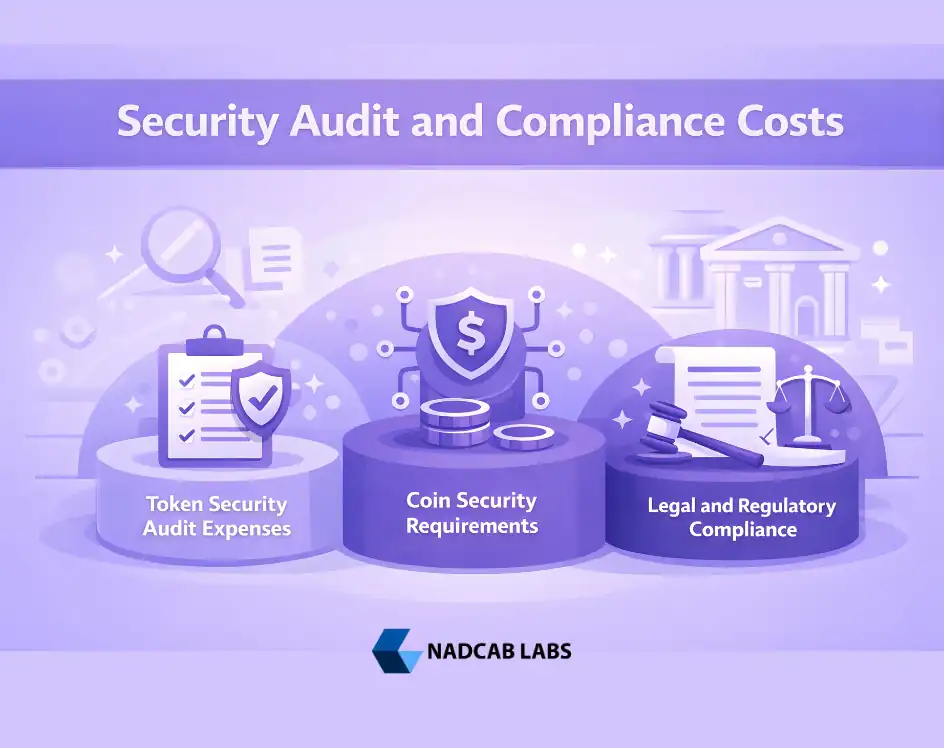
Token Security Audit Expenses
Token smart contract audits examine code for vulnerabilities including reentrancy attacks, integer overflows, access control failures, and logic errors. Reputable audit firms charge $5,000-$15,000 for basic ERC-20 token audits, $15,000-$30,000 for tokens with moderate complexity, and $30,000-$50,000+ for complex tokens with multiple features or custom implementations.
Comprehensive audits involve multiple rounds as developers fix identified issues. Projects should budget for 2-3 audit iterations plus potential bug bounty programs incentivizing external security researchers. Total security investment for serious token projects typically ranges $10,000-$75,000 depending on complexity and thoroughness desired.
Coin Security Requirements
Blockchain coin security audits prove substantially more expensive given increased attack surface and complexity. Comprehensive coin audits examine consensus mechanism security, cryptographic implementation correctness, network protocol vulnerabilities, wallet security, and economic attack vectors. Professional blockchain audits cost $100,000-$500,000+ depending on codebase size and sophistication.
Major blockchain launches often employ multiple independent audit firms providing redundant security reviews. Bug bounty programs for coin launches may offer $50,000-$1 million+ in potential rewards attracting top security researchers. Total security investment for serious blockchain projects can easily exceed $500,000-$1 million ensuring network integrity and user asset protection.
Legal and Regulatory Compliance
Legal compliance costs affect both coins and tokens though specific requirements vary by jurisdiction and asset classification. Understanding cryptocurrency legality across target markets helps projects budget appropriately for legal structuring, regulatory filings, and ongoing compliance.
Token legal opinions determining regulatory classification cost $5,000-$25,000 depending on jurisdictional complexity. Security token offerings requiring regulatory compliance add $50,000-$200,000+ in legal fees for registration, disclosure documents, and filing processes. Coins face similar legal costs plus potential licensing requirements for payment systems or financial services depending on intended functionality and regulatory treatment.
Marketing, Exchange Listing, and Launch Costs
Successfully launching coins or tokens requires investment beyond technical development in marketing, community building, and exchange listings enabling trading and liquidity.
Marketing and Community Development
Building awareness and community support requires consistent marketing investment. Basic marketing campaigns including website development, social media management, content creation, and community engagement cost $10,000-$50,000 for token launches. Coins requiring validator or miner recruitment plus user adoption face higher costs typically ranging $50,000-$500,000+ for comprehensive launch campaigns.
Ongoing marketing and community management represent continuous expenses essential for sustained growth. Monthly community management, content production, and promotional activities cost $5,000-$25,000 for tokens and $25,000-$100,000+ for blockchain platforms requiring active ecosystem development and partnership cultivation.
Exchange Listing Fees
Exchange listings enable trading, providing liquidity and price discovery. Decentralized exchange listings for tokens cost minimally—often just gas fees for liquidity pool creation ranging $100-$1,000 depending on blockchain congestion. However, meaningful liquidity provision may require $50,000-$500,000+ in paired assets ensuring adequate trading depth.
Centralized exchange listings vary enormously from free listings on smaller exchanges to $50,000-$1 million+ for top-tier platforms. Major exchanges like Binance, Coinbase, or Kraken conduct extensive due diligence examining project legitimacy, technical security, legal compliance, and market demand before listing decisions. According to industry reports, average centralized exchange listing costs range $50,000-$300,000 including application fees, listing charges, and market making requirements.
| Cost Category | Token Cost Range | Coin Cost Range |
|---|---|---|
| Initial Development | $1,000 – $100,000 | $50,000 – $5,000,000+ |
| Security Audits | $5,000 – $75,000 | $100,000 – $1,000,000+ |
| Legal Compliance | $5,000 – $200,000 | $25,000 – $500,000+ |
| Marketing Launch | $10,000 – $50,000 | $50,000 – $500,000+ |
| Exchange Listings | $100 – $500,000 | $50,000 – $1,000,000+ |
| Annual Maintenance | $5,000 – $100,000 | $200,000 – $2,000,000+ |
| Total First Year | $25,000 – $1,000,000 | $500,000 – $10,000,000+ |
Platform Selection and Associated Costs
Token creators must select blockchain platforms balancing transaction costs, development complexity, ecosystem maturity, and feature availability. Platform choice significantly impacts both initial development expenses and ongoing operational costs.
Ethereum and EVM-Compatible Chains
Ethereum remains the most established platform for token creation with extensive tooling, developer resources, and ecosystem support. However, high gas fees during network congestion can make deployment expensive, with smart contract deployment costing $500-$5,000+ depending on complexity and network conditions. EVM-compatible chains like Polygon, Binance Smart Chain, or Avalanche offer similar development experience with dramatically lower gas fees—often under $10 for deployment.
Development costs remain similar across EVM chains as code typically remains compatible. Primary differences involve gas fees for deployment and ongoing operations, with layer-2 solutions and alternative EVM chains providing substantial savings versus Ethereum mainnet.
Alternative Platforms
Platforms like Solana, Cardano, or Polkadot employ different architectures and programming languages affecting development costs. Solana offers extremely low transaction costs under $0.01 but requires learning Rust programming language potentially increasing development time and expense. Cardano’s Plutus or Polkadot’s Substrate framework similarly require specialized expertise potentially limiting developer availability and increasing costs.
Projects should evaluate platform selection considering development team expertise, target user base location, required transaction throughput, acceptable cost structures, and ecosystem compatibility. Working with experienced crypto token solutions providers helps navigate platform selection optimizing for project-specific requirements and constraints.
Hidden Costs and Unexpected Expenses
Beyond obvious development, security, and marketing costs, projects frequently encounter unexpected expenses impacting total budgets. Anticipating these hidden costs enables more accurate financial planning and prevents mid-project funding shortfalls.
Infrastructure and Operational Expenses
Token projects require ongoing infrastructure including websites, servers for data indexing, analytics platforms, and community management tools. These costs typically range $500-$5,000 monthly depending on user base size and feature complexity. Coin projects face substantially higher infrastructure costs maintaining node networks, block explorers, wallet backends, and development environments often exceeding $10,000-$50,000 monthly.
Regulatory and Legal Updates
Evolving regulatory landscapes require ongoing legal consultation ensuring continued compliance. Projects should budget $10,000-$50,000 annually for legal review of regulatory developments, policy updates, and compliance adjustments. Major regulatory changes may trigger significant additional expenses for restructuring, disclosure updates, or registration filings.
Team Expansion and Talent Acquisition
Successful projects typically require team expansion beyond initial development including community managers, business development personnel, additional developers, and support staff. Hiring costs including recruitment, onboarding, and compensation quickly accumulate, with each additional team member costing $50,000-$200,000+ annually depending on role and experience level.
Plan Your Blockchain Project Budget
Connect with experienced blockchain developers to receive detailed cost estimates, technical feasibility analysis, and strategic recommendations for coin or token development aligned with your project goals and budget constraints.
Cost-Benefit Analysis: When to Choose Coins vs Tokens
Understanding cost comparison of coin and token helps projects make informed architectural decisions balancing budget constraints against technical requirements and strategic objectives. Neither approach proves universally superior—optimal choice depends on specific use cases, resources, and goals.
When Tokens Make Financial Sense
Tokens represent cost-effective choice for projects requiring digital assets without needing independent blockchain infrastructure. Use cases well-suited for tokens include utility tokens providing platform access, governance tokens enabling community voting, reward tokens incentivizing behaviors, fundraising instruments for capital raising, and loyalty programs for customer engagement.
Projects with limited budgets under $500,000, tight timelines requiring launch within months, or primary focus on application functionality rather than blockchain innovation should strongly consider token approaches. Leveraging existing infrastructure accelerates development while preserving capital for product development, marketing, and growth initiatives.
When Coin Investment Justifies Costs
Creating independent blockchain coins justifies substantially higher investment when projects require novel consensus mechanisms, specialized privacy features, custom economic models, or complete ecosystem control. Projects building layer-1 blockchain platforms, developing new cryptographic approaches, creating application-specific chains, or establishing entirely new cryptocurrency paradigms necessitate coin development despite elevated costs.
Organizations with multi-million dollar budgets, long-term vision spanning years, technical teams with blockchain architecture expertise, and differentiated value propositions warranting new networks should consider coin development. The investment enables maximum flexibility and control at the cost of substantially increased complexity, expense, and development time.
Working with Professional Development Teams
Whether creating coins or tokens, partnering with experienced development teams significantly impacts costs, quality, and success probability. Professional coin and token service providers offer expertise navigating technical complexity while optimizing expenses.
In-House vs Outsourced Development
Building internal development teams provides maximum control and alignment but requires significant recruitment investment and long-term commitment. Fully-loaded costs for blockchain developers range $150,000-$300,000+ annually in developed markets. Assembling complete teams capable of coin development requires multiple senior specialists representing $1-3 million+ annual payroll.
Outsourcing to specialized firms offers faster initiation, proven expertise, and potentially lower costs especially for discrete projects like token creation. Reputable blockchain development firms charge $100-$250 per hour with project-based pricing providing cost certainty. Token projects might cost $10,000-$100,000 through outsourcing versus 6-12 months of internal team time plus ongoing employment costs.
Evaluating Development Partner Quality
Selecting development partners requires evaluating technical expertise through portfolio review, security track record examining previous audit results, communication capabilities ensuring clear collaboration, pricing transparency avoiding scope creep, and ongoing support availability for post-launch maintenance.
Requesting detailed proposals from multiple providers enables cost comparison while assessing approach quality. Lowest-cost options frequently prove expensive long-term through security vulnerabilities, poor code quality, or inadequate documentation. Investing in reputable partners with proven track records typically yields better outcomes despite potentially higher initial costs.
Final Thoughts
The cost comparison of coin and token reveals dramatic differences spanning order-of-magnitude variations based on architectural complexity, feature requirements, and operational scope. Tokens offer accessible entry points ranging from $1,000 for basic implementations to $100,000 for complex multi-feature solutions, while coins require substantially larger investments from $50,000 for simple forks to millions for custom blockchain platforms.
Beyond initial development, ongoing costs differ significantly with tokens requiring modest maintenance budgets versus coins demanding continuous investment in infrastructure, security, and development. Projects must carefully evaluate technical requirements, budget constraints, timeline expectations, and strategic objectives when choosing between coin and token approaches.
Success requires realistic financial planning accounting for development, security audits, legal compliance, marketing, exchange listings, and ongoing operations. Understanding total cost of ownership over multi-year horizons prevents mid-project funding crises while enabling informed architectural decisions. Whether creating tokens leveraging existing infrastructure or building novel blockchain coins, proper budgeting and experienced development partnerships prove essential for sustainable project execution and long-term success in the competitive cryptocurrency ecosystem.
Frequently Asked Questions
Q1.what costs more coins or tokens?
coins cost significantly more than tokens, ranging from $50,000 to millions for blockchain development versus $1,000-$100,000 for tokens. coins require complete infrastructure including consensus mechanisms, node networks, and ongoing maintenance substantially increasing expenses.
Q2.how much does token creation cost?
basic token creation costs $1,000-$5,000 using standard frameworks like erc-20, while advanced tokens with staking, governance, or defi features range $10,000-$100,000. costs vary based on complexity, platform selection, and developer rates.
Q3.why are coin development costs higher?
coins require building entire blockchain infrastructure including consensus mechanisms, peer-to-peer networks, cryptographic security, wallet software, and node deployment. this complexity demands larger teams, longer timelines, and extensive security auditing substantially increasing costs.
Q4.what are ongoing token maintenance costs?
token maintenance costs $5,000-$100,000 annually including smart contract updates, security monitoring, community management, marketing, and infrastructure. costs scale with project complexity, user base size, and feature additions over time.
Q5.how much do security audits cost?
token security audits range $5,000-$75,000 depending on complexity, while comprehensive blockchain coin audits cost $100,000-$1,000,000+. multiple audit rounds and bug bounty programs increase total security investment substantially.
Q6.what affects development timeline and cost?
complexity determines timelines and costs, with basic tokens deploying in weeks costing thousands, while custom blockchains require months to years costing millions. team expertise, feature requirements, and security thoroughness significantly impact expenses.
Explore Services
Related Services
Reviewed by

Aman Vaths
Founder of Nadcab Labs
Aman Vaths is the Founder & CTO of Nadcab Labs, a global digital engineering company delivering enterprise-grade solutions across AI, Web3, Blockchain, Big Data, Cloud, Cybersecurity, and Modern Application Development. With deep technical leadership and product innovation experience, Aman has positioned Nadcab Labs as one of the most advanced engineering companies driving the next era of intelligent, secure, and scalable software systems. Under his leadership, Nadcab Labs has built 2,000+ global projects across sectors including fintech, banking, healthcare, real estate, logistics, gaming, manufacturing, and next-generation DePIN networks. Aman’s strength lies in architecting high-performance systems, end-to-end platform engineering, and designing enterprise solutions that operate at global scale.