Ai Overview
The Binary MLM Plan is one of the most widely used compensation structures in modern network marketing. According to studies from Zion Market Research and WFDSA, the global MLM market is expected to reach $214 billion by the end of 2025 and is projected to maintain a steady growth rate of about 6. As per research from an intel market research study, the worldwide cryptocurrency MLM software development service market was valued at $284 million in 2024.
The Binary MLM Plan is one of the most widely used compensation structures in modern network marketing. Its foundation is very simple because every member creates only two legs on their network, known as the left leg and the right leg. This limited structure makes the system easy to manage and easier for new distributors to understand compared to complex multi leg models.
The biggest attraction of the binary plan is the way earnings are generated. Income depends on the matching business volume of both legs, which means a member earns only when both sides grow together. This creates a healthy environment for teamwork and balanced efforts within the network. It also supports rapid team expansion because even the spillover from uplines contributes to the growth of these two legs.
According to research published by Bäckman and Hanspal in 2022, nearly 118 million people worldwide were connected with MLM, highlighting how widespread the model has become across global markets. According to studies from Zion Market Research and WFDSA, the global MLM market is expected to reach $214 billion by the end of 2025 and is projected to maintain a steady growth rate of about 6.5% through 2034.
In this blog, we will explore the Binary MLM Plan in a simple and practical way. You will learn what it is, how it works, what terms are used, how earnings are calculated, and why so many companies prefer this model for scaling their network marketing business.
What Is a Binary MLM Plan?
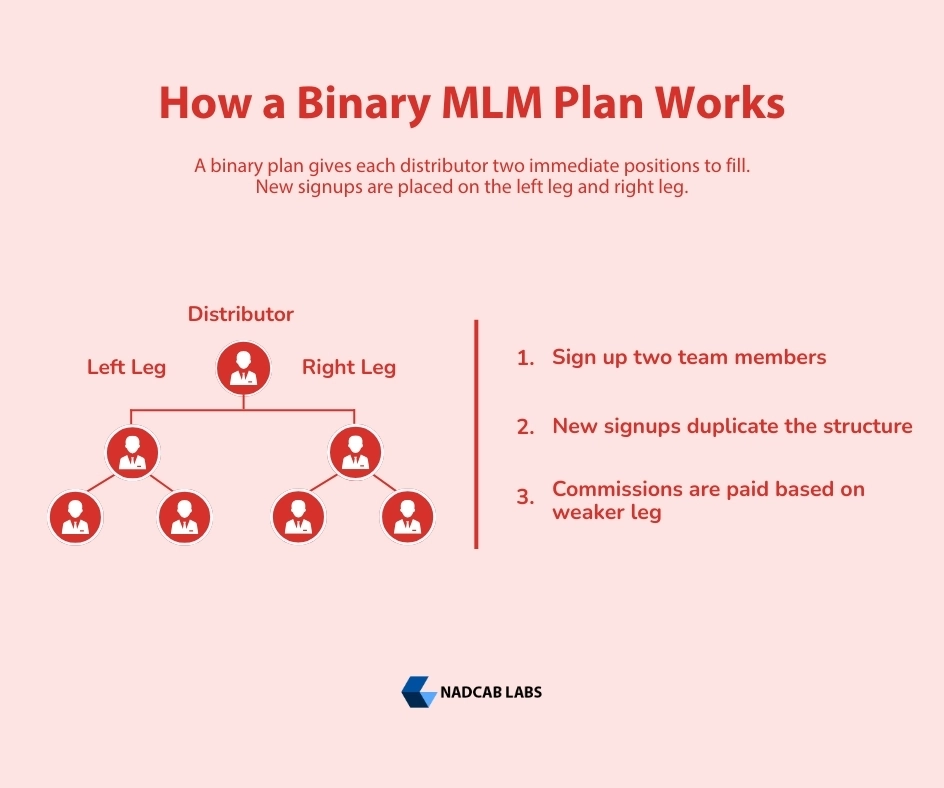
A Binary MLM Plan is a two-leg MLM structure where distributors build a left leg and a right leg. Commissions are generated through volume matching, and the company pays on the leg that produces lower sales volume. This model encourages teamwork and steady network growth.
For more information about what is MLM and how it works, you can explore the foundational concepts of multi-level marketing structures.
How a Binary MLM Plan Works?
A Binary MLM Plan, which is a type of multi-level marketing model, works on a simple structure where every member can recruit only two people, forming two sides of their network called the left leg and the right leg. Earnings depend on how well both sides grow and remain balanced. When both legs generate sales volume, the system compares them and pays commissions based on the leg with lower volume, also called the pay leg. This structure encourages members to build both sides consistently to unlock maximum rewards.
Basic Workflow
A binary plan generally follows this workflow:
- A distributor joins the network and receives two immediate positions to fill.
- One new member is placed on the left leg and another on the right leg.
- Every person who joins afterward continues the same structure by building their own left and right sides.
- Commissions are calculated from the business volume of the weaker leg.
- Once matching volume is detected, the payout is released and the remaining volume is carried forward for the next cycle.
As the network grows, this process repeats, creating a continuous earning flow. This predictable and symmetric structure makes binary plans beginner-friendly, easy to scale, and effective for building fast-growing teams.
Use Case 1: Simple Two-Leg Structure
Scenario: X Recruits Two Direct Members
Structure:
- Left Leg: A
- Right Leg: B
In a binary MLM structure, X earns commissions based on the sales volume of both legs, but the payout is always determined by the weaker leg.
Scenario 1: If A makes 5 sales and B makes 5 sales, X will receive commission on all 5 matched pairs.
Scenario 2: If A makes 5 sales but B makes 8 sales, X will still earn only on 5 matched pairs. The extra 3 sales from B carry forward for the next payout cycle. This encourages balanced growth on both legs.
Use Case 2: Expanded Network Structure
Scenario: Network Expansion with Multiple Levels
Suppose A recruits C and D while B recruits E and F. This structure helps us see how commissions flow from deeper levels.
How A & B Earn
A earns commission from matched sales between his left and right legs, which includes his own sales + C/D sales.
C + D sales = 5
Total left leg = 11B personal sales = 3
E + F sales = 4
Total right leg = 7
Here, A earns on the matched volume between his left and right leg totals, which follows the same weaker leg principle. B earns similarly from E/F and personal sales.
How X Earns
X’s payout is calculated based on the total volume of both primary legs (A and B).
B total = 7
X earns commission on 7 matched units, as B’s leg is weaker.
This shows that even if C/D and E/F generate sales, X’s payout depends on the weaker of the two main legs. The percentage of commission is set by the company or platform, which decides how much of the matched volume will be paid to each level.
Different Types of Binary MLM Plans
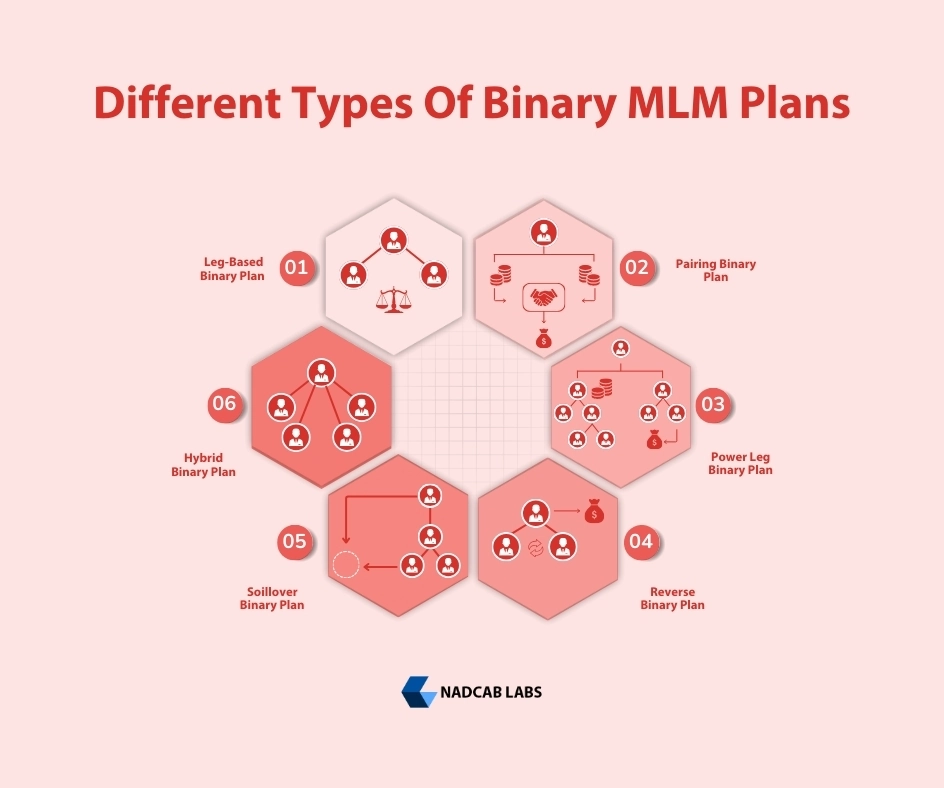
Binary MLM plans come in several variations, each designed to suit different business models and growth strategies. Learn more about MLM compensation plan types and how they work to understand the broader landscape. Each of these plans works on the basic binary structure but has unique rules for calculating commissions, handling sales, and encouraging network growth.
Type 1: Leg-Based Binary Plan
This is the classic binary plan where every distributor has a left leg and a right leg. Commissions are calculated based on the sales volume of the weaker leg, encouraging balanced growth on both sides. Leg-based binary plans are widely used in health, wellness, and lifestyle MLM businesses, where distributors recruit steadily and focus on building balanced teams. It is beginner-friendly and easy to manage.
Type 2: Pairing Binary Plan
In a pairing binary plan, commissions are earned when a pair of members from the left and right legs generate sales. The payout depends on how many matched pairs are completed. This structure is especially popular in digital and online service-based MLM companies because it enables rapid member pairing and consistent commission earnings.
Type 3: Power Leg Binary Plan
A power leg binary plan emphasizes one leg as a primary leg for earning higher commissions. The other leg is still needed to maintain balance, but more incentives are given for the strong leg. Used in industries like telecom, supplements, and fitness, where certain teams are more active and companies want to reward high-performing legs for their contribution.
Type 4: Reverse Binary Plan
In a reverse binary plan, commissions are calculated starting from the stronger leg, rather than the weaker leg. This helps companies push more sales from high-volume legs. Common in insurance, finance, and investment MLMs, where motivating top performers to generate larger volumes is critical.
Type 5: Spillover Binary Plan
Spillover occurs when uplines place new recruits under their downlines, automatically filling positions in the network. This helps weaker distributors earn commissions without directly recruiting. Spillover binary plans are seen in large-scale health and wellness MLMs and network marketing companies with deep hierarchies, making it easier for new members to benefit early.
Type 6: Hybrid Binary Plan
A hybrid binary plan combines elements from multiple binary structures, such as pairing, spillover, and power leg features, to create flexible earning opportunities. These plans are common in technology, crypto, and online education MLMs, where companies need flexibility to adapt to different team performances and sales strategies.
Features of a Binary MLM Plan
The Binary MLM Plan is designed around a straightforward structure, which makes it easy for beginners and professionals to work with. Here are the most important features that define this plan:
Two Team Structure
Every distributor builds a Left Team and a Right Team. This two-side system keeps the network simple and avoids the confusion of multiple frontline members.
Commission Based on Weaker Team
The commission is always calculated from the team that has generated less sales volume. This motivates distributors to develop both teams equally.
Unlimited Depth Growth
There is no limit on how deep the network can expand. New members can continue joining under each other without any restriction on levels.
Spillover Support from Uplines
If an upline adds a new member and one of their teams is already filled, the extra new recruit automatically moves to the downline’s team.
Carry Forward of Extra Volume
If one team produces more sales than the other, the extra volume does not get wasted. It is carried forward to the next cycle.
Fast and Balanced Team Expansion
Because everyone must develop only two team sides, the network expands very quickly while the weaker leg rule keeps the structure balanced.
Key Takeaways
- ✓Simple Structure: Binary plans use only two legs (left and right), making them easy for distributors to understand and manage.
- ✓Matching-Based Earnings: Commissions are calculated on the weaker leg, creating an incentive for balanced team development on both sides.
- ✓Spillover Benefits: Upline recruits can automatically fill lower-level positions, helping newer distributors without direct recruitment.
- ✓Unlimited Depth: Networks can grow infinitely deep, creating long-term earning potential for all participants.
- ✓Carry Forward Volume: Unmatched volume from the stronger leg carries to the next cycle, maintaining earning momentum.
- ✓Industry Adoption: Binary plans are used across health, wellness, tech, crypto, and finance sectors due to their versatility.
- ✓118 Million Users Globally: Research shows the widespread adoption of MLM structures, with binary being one of the most popular.
- ✓Market Growth: The MLM market is projected to reach $214 billion by 2025 with 6.5% annual growth through 2034.
- ✓Recruitment Dependency: Success in binary plans heavily relies on continuous recruitment, making volume primarily dependent on new joiners rather than retail sales.
- ✓Regulatory Scrutiny: The FTC closely monitors recruitment-focused commission structures, as these can indicate pyramid scheme characteristics.
Binary MLM Earning Types: How They Actually Work
A Binary MLM Plan offers multiple earning opportunities. Companies may customize the payout amounts, but the earning categories generally remain the same. The main types of Binary MLM earnings are as follows:
1. Direct Referral Commission
When you personally recruit someone who purchases a starter kit or joining package, you receive a direct referral commission. This bonus incentivizes recruitment over product sales, as you earn money upfront for bringing people into the system, regardless of whether those people will ever sell products to actual customers.
2. Pairing or Matching Bonus
The primary earning method in most binary plans is the pairing or matching bonus. When your left and right teams generate sales volume, the system matches these volumes based on whichever leg produced the lower amount and pays you a commission on that matched volume.
3. Team Sales Volume Income
You also earn commission based on the total sales volume generated by your entire downline network. However, what companies often do not emphasize clearly is that this “volume” includes both product sales and new recruit joining packages and inventory purchases.
In practice, most binary plans weigh recruitment very heavily because recruiting generates immediate and guaranteed volume, whereas actual retail sales to customers are unpredictable and frequently minimal. This creates a significant concern: if a company emphasizes building volume through recruitment far more than through selling products to non-participants outside the system, then the business is actually functioning as a recruitment scheme rather than a legitimate product sales company.
4. Spillover Income
Another earning opportunity comes from spillover income, which occurs when your upline recruits someone and places that person under your team. When this happens, that person’s sales volume counts toward your commissions even though you did not recruit them yourself.
5. Rank-Based or Leadership Bonuses
Companies often reward members with additional bonuses when they achieve certain milestones, such as reaching a specific team size, hitting a total sales volume target, or matching a certain number of commission cycles. These rank-based or leadership bonuses can appear quite attractive in company materials.
However, the mechanism behind these bonuses is designed to incentivize aggressive recruitment to reach higher ranks quickly. While companies prominently feature these bonuses in their marketing materials, the reality is that they are accessible only to a very small fraction of participants. The average person rarely achieves the high ranks necessary to earn significant bonuses.
6. Carry Forward Volume
When one team generates higher volume than the other, that excess volume is saved and carried forward to the next commission cycle, creating future matching opportunities. This structure sounds appealing because the company markets it as rewarding your ongoing effort and building toward tomorrow’s commission.
In reality, however, carry forward volume keeps people invested in a system that is not paying them today. It creates an illusion of progress and momentum while the majority of participants remain in financial limbo. Additionally, you should understand that this volume comes primarily from new recruits joining the system rather than from actual customer sales, which means the system remains dependent on constant recruitment to function.
Pros and Cons of Binary MLM Plans
Before choosing a binary system, it is important to understand both the advantages and limitations. Below is a clear comparison of the pros and cons:
| Pros of Binary MLM Plan | Cons of Binary MLM Plan |
|---|---|
| Helps distributors earn from deep downline levels | Income depends on matched sales, not total sales |
| Simple 2-leg structure makes training easier | One leg often grows faster than the other |
| Provides spillover benefit to support weaker members | Many new distributors need time to balance both legs |
| Encourages teamwork and collaboration | Requires consistent sales on both legs for regular income |
| Supports unlimited depth and long-term passive income | Not suitable for users who prefer individual performance-based earning |
| Flexible compensation rules for different industries | Heavy reliance on recruitment rather than retail sales |
How Is the Crypto Binary MLM Plan Shaping the Future of Blockchain Based Network Marketing?
The crypto industry is growing fast and many companies are now using new technology to make their network marketing systems more secure and transparent. As per research from an intel market research study, the worldwide cryptocurrency MLM software development service market was valued at $284 million in 2024. The market is expected to reach $314 million in 2025 and grow further to $549 million by 2031 with a steady growth rate of 9.6%. This shows that more businesses are shifting to blockchain based MLM solutions.
Blockchain-Powered Binary Plans
A crypto binary MLM plan uses modern blockchain features to manage the left and right leg structure in a clear and automated way. Every pair match and every commission is recorded on the blockchain which gives full trust and transparency to all users. Smart contracts help in automatic payouts and remove the chance of manual errors. This makes the binary plan more stable, safe and reliable.
Global Scalability and Innovation
Companies that use crypto MLM software with binary logic can scale their business across many countries without payment delays. They can offer fast crypto transactions, real time income tracking and secure wallet based rewards. As a leading crypto MLM software development service provider, our team builds custom systems for binary plans that include smart contracts, member dashboards, admin tools, wallet integration and complete tracking features. This helps businesses launch a modern, global and future-ready binary MLM platform.
Smart Contracts
Automated payouts eliminate manual errors and ensure instant commission distribution based on predefined conditions.
Transparency
All transactions and commissions are recorded on the blockchain, providing complete transparency to all users.
Wallet Integration
Secure cryptocurrency wallets allow distributors to manage and withdraw their earnings instantly.
Real-Time Tracking
Member dashboards provide live income updates, commission history, and team performance metrics.
Global Accessibility
Crypto-based systems eliminate geographical barriers and enable seamless international transactions.
Security
Blockchain technology ensures data security and prevents fraud in commission calculations and payouts.
Build Your Crypto Binary MLM Software with Experts
Looking to launch a secure and scalable Crypto Binary MLM platform? Work with skilled professionals to develop a powerful, automated, and high-performing system tailored to your business needs.
Final Words
The Binary MLM Plan is a very simple and powerful model that helps teams grow in a balanced and predictable way. It works on two legs which makes it easier for every distributor to understand their structure and focus on stable progress. When both legs generate sales together the system rewards teamwork and shared effort. This creates a positive environment where new distributors and experienced leaders can grow at the same time.
Through this guide you have learned how the binary plan works, how commissions are calculated, how sales from deep levels support income and why different industries use different types of binary plans. A well designed binary system can help companies scale their network faster and can help distributors build a strong team with long term earning potential. Success in this plan comes from developing both legs with equal effort and by helping the entire team grow together.
Frequently Asked Questions
Q1.What is the difference between a binary plan and a matrix plan?
A binary plan allows every distributor to create only two legs while a matrix plan limits the number of people on both the width and depth of the structure. The binary plan focuses on two strong teams while the matrix plan focuses on fixed positions that must be filled before deeper levels can grow.
Q2.What is a binary placement?
Binary placement refers to the position where a new member is added in the left leg or the right leg of a distributor. Each new recruit must be placed on one of the two sides because the binary plan works only with two team lines.
Q3.What is a binary bonus?
A binary bonus is the earning a distributor receives when the left leg and the right leg generate matching sales volume. The system compares both sides and pays the bonus on the side that has lower sales volume. This bonus is one of the main earning sources in a binary plan.
Q4.What is the most successful MLM?
There is no single MLM that is always the most successful because success depends on product quality, team performance and company management. However the MLM companies that provide real products, strong training systems and transparent compensation models usually perform better over the long term.
Q5.Does MLM include nonbinary?
MLM plans such as binary or matrix refer to team structures and not gender identities. The word nonbinary in MLM does not relate to gender. It simply describes how the network is built and how commissions are calculated.
Q6.What is the difference between a crypto binary plan and a normal binary plan?
A normal binary plan works with traditional products and manual payout tracking while a crypto binary plan uses blockchain technology to handle commissions. In a crypto binary plan all matching cycles, sales volume and payouts are recorded through smart contracts which makes the process transparent and tamper proof. Many companies prefer this because the system cannot be changed by anyone and every distributor can verify their earnings instantly.
Q7.Can a binary plan work with bitcoin MLM software?
Yes, a binary plan works very well with bitcoin MLM software. The software tracks sales and volume in bitcoin and processes payouts instantly to user wallets. This creates a transparent global friendly earning system where distributors can build teams anywhere in the world and receive payouts without delays.
Explore Services
Related Services
Reviewed by

Aman Vaths
Founder of Nadcab Labs
Aman Vaths is the Founder & CTO of Nadcab Labs, a global digital engineering company delivering enterprise-grade solutions across AI, Web3, Blockchain, Big Data, Cloud, Cybersecurity, and Modern Application Development. With deep technical leadership and product innovation experience, Aman has positioned Nadcab Labs as one of the most advanced engineering companies driving the next era of intelligent, secure, and scalable software systems. Under his leadership, Nadcab Labs has built 2,000+ global projects across sectors including fintech, banking, healthcare, real estate, logistics, gaming, manufacturing, and next-generation DePIN networks. Aman’s strength lies in architecting high-performance systems, end-to-end platform engineering, and designing enterprise solutions that operate at global scale.