Ai Overview
Multi level marketing businesses rely heavily on software to manage their distributor networks, track commissions, process payments, and maintain transparent operations. This choice impacts your budget, timeline, scalability, and ultimately your competitive position in the market. White label software lets you launch quickly, start recruiting distributors, and generate revenue while competitors are still in development phases.
Key Takeaways
- White label MLM software offers faster deployment (typically 2 to 4 weeks) with lower upfront costs, making it suitable for startups and businesses testing the MLM market.
- Custom MLM software provides complete ownership, unlimited scalability, and full brand control, which is better for established companies with specific operational needs.
- The cost difference can be significant. White label solutions start around $5,000 to $15,000 while custom development may range from $25,000 to $100,000 or more depending on complexity.
- Security and compliance requirements often determine the better choice. Businesses handling sensitive data or operating in regulated industries typically benefit from custom solutions.
- Long term ROI analysis matters more than initial investment. Custom software often delivers better returns over 3 to 5 years despite higher upfront costs.
- Partnering with an experienced development company like Nadcab Labs with 8+ years in MLM software development can help you make the right choice based on your specific business model.
Introduction
Multi level marketing businesses rely heavily on software to manage their distributor networks, track commissions, process payments, and maintain transparent operations. The software you choose becomes the backbone of your entire MLM operation. It handles everything from enrollment processes to complex compensation calculations.
When building or upgrading your MLM platform, you face a fundamental decision: should you go with white label MLM software or invest in custom MLM software development? This choice impacts your budget, timeline, scalability, and ultimately your competitive position in the market.
According to Wikipedia’s overview of multi level marketing, the direct selling industry generates over $180 billion globally each year. With such significant revenue at stake, having the right technology infrastructure is not just helpful but essential for survival and growth.
This article breaks down both options in detail, covering costs, benefits, drawbacks, and specific scenarios where each approach makes sense. By the end, you will have a clear understanding of which path aligns with your business goals and resources.
What Is White Label MLM Software?
White label MLM software is a pre built solution developed by a third party company that you can purchase, rebrand, and use as your own. The term white label comes from the practice of putting your own label on a generic product. Businesses looking for scalable and customizable white-label MLM software solutions often prefer platforms that support multiple compensation plans and quick deployment. In software terms, it means taking an existing platform and customizing its appearance to match your brand identity.
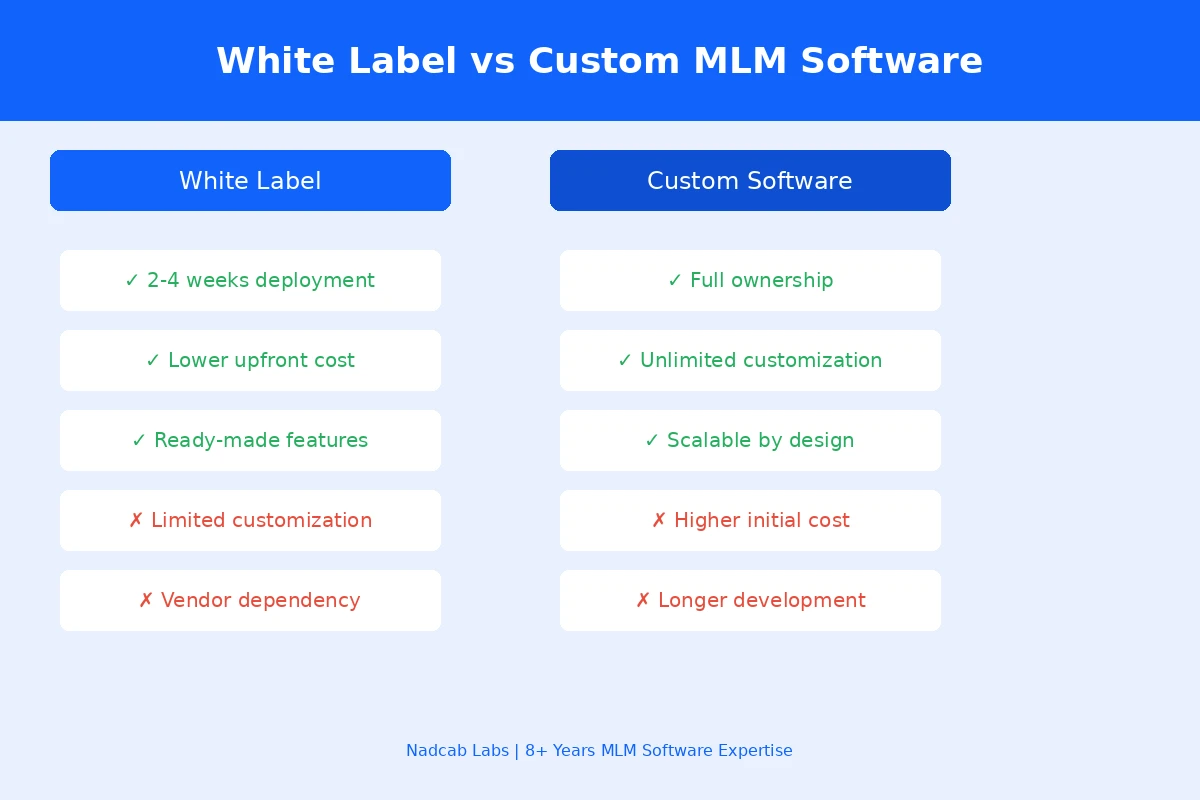
These solutions come with standard MLM features already developed and tested. You get a ready made platform with common functionalities like member registration, genealogy tree management, commission tracking, e-wallet systems, and reporting dashboards. The development company handles the technical work, and you focus on rebranding and deployment.
How It Works: You select a white label provider, choose from available features and compensation plan templates, add your branding elements like logos and color schemes, and launch. Most providers offer different packages based on feature sets and user limits. Some allow minor modifications while others provide the software strictly as is.
Common use cases include startup MLM companies entering the market quickly, businesses testing new compensation structures before committing to custom development, and organizations with limited technical resources or budgets. If you want to understand more about how different MLM business types and global regulations work, having a flexible software foundation becomes even more important.
What Is Custom MLM Software
Custom MLM software is built specifically for your business from the ground up. A development team works with you to understand your exact requirements, compensation plan details, workflow preferences, and integration needs. They then design and code a solution tailored to those specifications.
Unlike white label options, custom development gives you complete control over every feature and function. Want a unique commission structure that combines binary and matrix plans? Need specific integrations with your existing CRM or accounting software? Require advanced reporting capabilities for regulatory compliance in multiple countries? Custom development makes all of this possible.
The development process typically follows these stages:
- Discovery and Planning: Understanding your business model, target market, and technical requirements
- Design: Creating wireframes, user interface mockups, and system architecture
- Development: Writing code for frontend interfaces, backend logic, and database structures
- Testing: Quality assurance across devices, user acceptance testing, and security audits
- Deployment: Launching the platform and providing training
- Maintenance: Ongoing support, updates, and improvements
Companies that typically choose custom solutions include established MLM businesses with proven models, organizations with unique compensation plans, businesses operating in multiple countries with varying regulations, and enterprises requiring deep integrations with existing systems.
Key Differences: White Label vs Custom MLM Software
Understanding the fundamental differences between these two approaches helps you make an informed decision. The following comparison covers the main factors that affect your choice.
| Factor | White Label MLM Software | Custom MLM Software |
|---|---|---|
| Development Time | 2 to 4 weeks for setup and branding | 3 to 8 months depending on complexity |
| Initial Cost | $5,000 to $20,000 | $25,000 to $100,000+ |
| Customization Level | Limited to predefined options | Unlimited customization possible |
| Scalability | Bound by platform limitations | Designed for your growth trajectory |
| Ownership | Licensed use with vendor dependency | Full ownership of source code |
| Security Control | Depends on vendor protocols | Complete control over security measures |
| Ongoing Costs | Monthly or annual license fees | Maintenance costs only |
| Unique Features | Same features available to competitors | Proprietary features for competitive advantage |
Development Time: White label solutions can go live within weeks because the core development is already complete. Custom software requires months of planning, coding, and testing. For businesses with time sensitive launch requirements, this difference alone might determine the choice.
Cost Comparison: The upfront investment differs dramatically. However, calculating total cost of ownership over five years often shows a different picture. White label recurring fees accumulate, while custom software maintenance costs remain relatively stable.
Customization Flexibility: This is where the paths diverge most significantly. White label platforms offer configuration options within their existing framework. Custom development builds the framework around your specific needs. If your compensation plan has unique elements or your workflow differs from industry standards, custom development accommodates those requirements.
Pros and Cons of White Label MLM Software
Advantages
Faster Market Entry: Time to market can make or break an MLM business. White label software lets you launch quickly, start recruiting distributors, and generate revenue while competitors are still in development phases. For entrepreneurs testing a new concept, this speed provides valuable market validation.
Lower Initial Investment: Starting an MLM business involves many expenses beyond software. White label solutions reduce the technology budget, freeing capital for marketing, inventory, or distributor incentives. This lower barrier to entry makes MLM business ownership accessible to more entrepreneurs.
Proven Stability: White label platforms have typically been tested across multiple deployments. Bugs have been identified and fixed. Edge cases have been handled. You benefit from the collective feedback of previous users without paying for that development time.
Built in Features: Common MLM functionalities come ready to use. Genealogy management, commission calculations, payment processing, mobile apps, and reporting tools are typically included. You avoid the risk of overlooking important features during custom development.
Disadvantages
Limited Differentiation: Your competitors can purchase the same white label software. This makes it difficult to create a unique user experience or operational advantage through technology. Your platform may look and function similarly to dozens of other MLM companies.
Vendor Lock In: Reliance on the white label provider creates dependency. If they raise prices, discontinue support, or go out of business, your operations face disruption. Migrating to another platform later becomes complex and expensive.
Restricted Growth: As your business scales, you may outgrow the platform’s capabilities. Adding distributors beyond license limits incurs additional costs. Implementing new features requires waiting for the vendor to develop them or finding workarounds.
Branding Constraints: While you can add your logo and colors, deeper branding customization is often limited. The user interface, terminology, and workflow might not align perfectly with your brand identity or company culture.
Pros and Cons of Custom MLM Software
Advantages
Complete Ownership: You own the source code, database structures, and all intellectual property. This ownership provides freedom to modify, extend, or even license your software to others. No recurring fees to vendors, no restrictions on usage.
Unlimited Customization: Every aspect of the software can be tailored to your specifications. From complex hybrid compensation plans to specialized reporting for your industry, nothing is off the table. Your technology becomes a genuine competitive advantage.
Scalability by Design: Custom software is architected with your growth plans in mind. Whether you expect 10,000 distributors or 1 million, the system can be designed to handle that scale efficiently. No surprise limitations when your business takes off.
Integration Capabilities: Connect seamlessly with your existing tools and systems. CRM platforms, accounting software, inventory management, shipping providers, and payment gateways can all be integrated exactly as needed for your workflows.
Security Customization: Implement security measures specific to your requirements and regulatory environment. Healthcare related MLM businesses, financial services companies, or operations in privacy conscious regions can build compliance into the foundation.
Disadvantages
Higher Upfront Cost: Custom development requires significant initial investment. For startups with limited capital, this creates a substantial financial barrier. The investment needs to be justified by long term business projections.
Extended Development Timeline: Quality custom software takes time to build properly. Rush jobs lead to technical debt and problems down the road. Entrepreneurs eager to launch may find the waiting period frustrating.
Technical Decisions Required: You need to make choices about technologies, hosting infrastructure, security protocols, and architecture. Without technical expertise internally, these decisions require trusted advisors or development partners.
Maintenance Responsibility: After launch, you are responsible for updates, bug fixes, security patches, and improvements. This requires either an internal development team or an ongoing relationship with your development partner.
Build Your MLM Platform Today
Whether you need white label or custom MLM software, our team of experts with 8+ years of industry experience can guide you to the right solution for your business goals.
Which Option Is Better for Your Business?
The right choice depends on your specific circumstances. Here is guidance based on business stage and requirements.
Best Choice for Startups
New MLM businesses typically benefit from white label solutions. The lower cost preserves capital for critical early stage activities like product development and distributor recruitment. Quick deployment lets you validate your business model before making larger technology investments. If the concept proves successful, you can always migrate to custom software later with revenue generated from operations.
However, if your startup has strong funding and a truly unique compensation structure that existing platforms cannot support, starting with custom development might make sense. The key is honest assessment of whether your requirements genuinely cannot be met by existing solutions.
Best Choice for Growing MLM Companies
Businesses with proven models and predictable growth trajectories are prime candidates for custom development. At this stage, you understand your operational needs deeply. You have identified limitations in current systems and know exactly what features would improve efficiency and distributor experience.
Growing companies also have revenue to invest in technology that creates competitive advantages. Custom software can be a strategic asset that differentiates your opportunity from competitors still using generic platforms.
Best Choice for Enterprise Level MLM Firms
Large MLM operations almost universally require custom solutions. Enterprise needs include complex integrations with financial systems, multi country operations with localized compliance, advanced analytics and forecasting, and high transaction volumes that demand optimized performance.
At enterprise scale, technology becomes a core business function rather than just a tool. The investment in custom development is justified by operational efficiency, risk management, and competitive positioning.
Cost Comparison: White Label vs Custom MLM Software
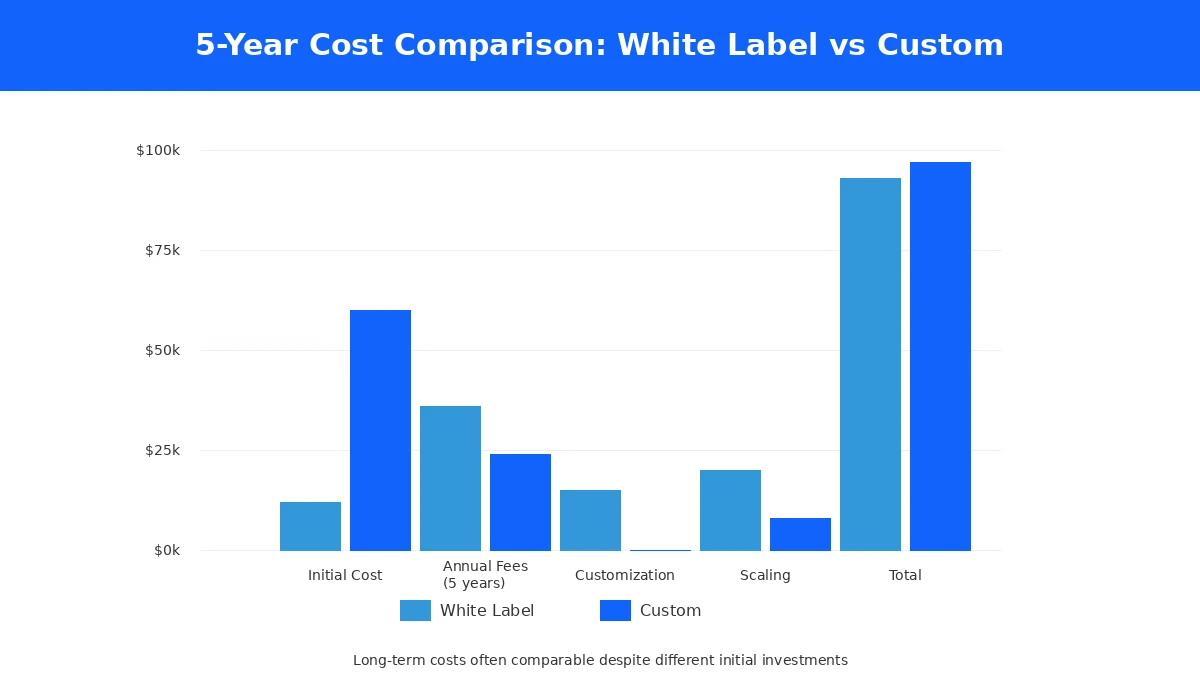
Understanding the full financial picture requires looking beyond initial costs. Here is a five year cost comparison for a mid sized MLM operation.
| Cost Category | White Label (5 Years) | Custom (5 Years) |
|---|---|---|
| Initial Development/License | $12,000 | $60,000 |
| Annual License/Maintenance Fees | $36,000 ($600/month) | $24,000 ($400/month) |
| Customization Requests | $15,000 | Included in development |
| Scale Related Upgrades | $20,000 | $8,000 |
| Integration Costs | $10,000 | $5,000 |
| Five Year Total | $93,000 | $97,000 |
The numbers above illustrate an important point. While white label appears cheaper initially, the gap narrows significantly over time. For larger operations or those requiring extensive customizations, custom development often proves more economical in the long run.
Hidden Costs to Watch:
- Transaction fees that scale with your business volume
- Premium support charges during critical issues
- Data migration costs if you switch platforms later
- Lost revenue during platform limitations or outages
- Opportunity cost of features you cannot implement
Real World Use Cases and Scenarios
Examining practical examples helps clarify when each approach works best.
Scenario 1: Health Supplement Startup
A new company launching a health supplement MLM with a standard binary compensation plan and 500 initial distributors. Budget is limited, and speed to market matters most.
Recommendation: White label MLM software. Standard binary plans are well supported by existing platforms. The lower cost preserves capital for inventory and marketing. Launch within 30 days and start building the business.
Scenario 2: Financial Services MLM
An established financial education company expanding into MLM distribution with compliance requirements across 12 states. They need integration with existing CRM and specific audit trail features.
Recommendation: Custom MLM software. Regulatory compliance in financial services requires precise control over data handling and reporting. The integrations with existing systems demand custom development. The company has revenue to invest in a solution built for their specific needs.
Scenario 3: Testing a New Market
An existing product company wants to test MLM distribution in a new geographic market before full commitment.
Recommendation: White label MLM software initially. Test the market response with minimal investment. If successful, commission custom development informed by real world operational data and distributor feedback. This approach is discussed in detail when exploring different types of MLM business structures.
Scenario 4: International Expansion
A successful domestic MLM company expanding to 15 countries with varying tax laws, currency requirements, and regulatory frameworks.
Recommendation: Custom MLM software. International operations require localization that most white label platforms cannot adequately provide. Tax calculations, payment processing, language support, and compliance features need to work seamlessly across all markets.
MLM Software Development Lifecycle
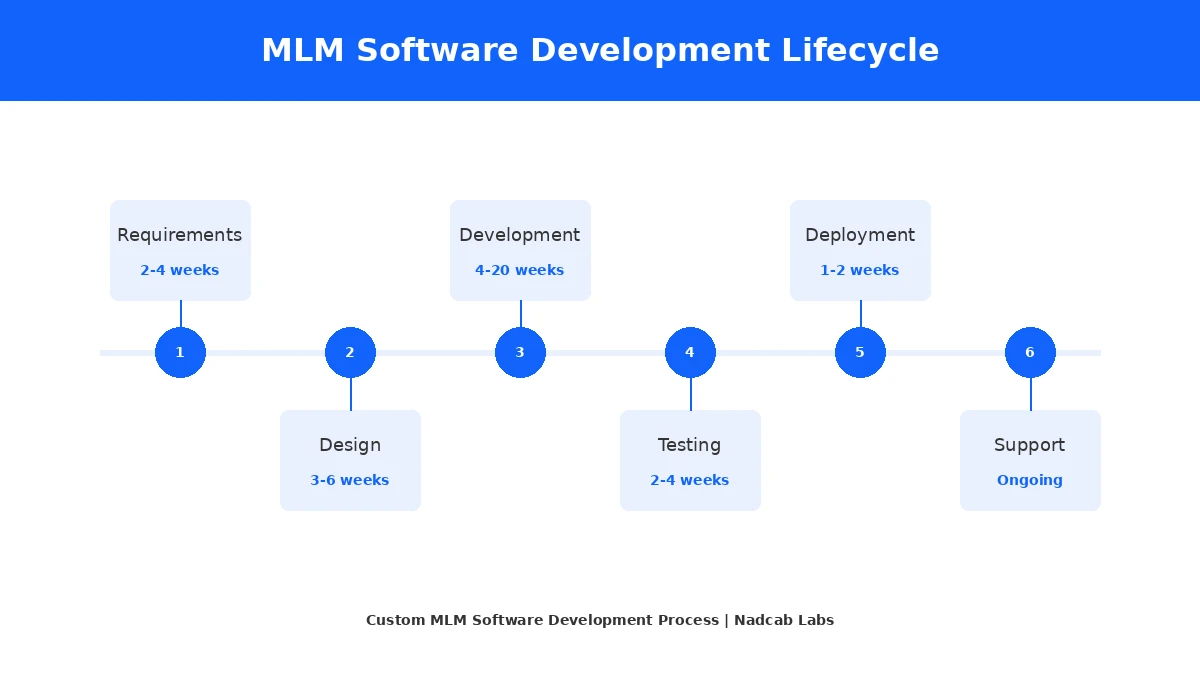
Whether choosing white label or custom, understanding the development process helps set realistic expectations.
Phase 1: Requirements Analysis (2 to 4 weeks)
Document compensation plan details, user roles, integration requirements, and compliance needs. This phase is critical. Incomplete requirements lead to costly changes later.
Phase 2: Design and Architecture (3 to 6 weeks for custom)
Create system architecture, database design, user interface mockups, and technical specifications. White label implementations skip this phase since the architecture exists.
Phase 3: Development and Configuration (4 to 20 weeks)
Build or configure the software. Custom development involves coding from scratch. White label involves configuration and branding within existing frameworks.
Phase 4: Testing (2 to 4 weeks)
Quality assurance testing, security audits, performance testing, and user acceptance testing. Never skip this phase regardless of time pressure.
Phase 5: Deployment and Training (1 to 2 weeks)
Launch the platform, migrate any existing data, and train administrators and key distributors on system usage.
Phase 6: Ongoing Support and Evolution
Monitor performance, address issues, implement improvements, and adapt to changing business needs.
How to Choose the Right MLM Software Partner
Your choice of development partner matters as much as the choice between white label and custom development. Here is what to evaluate.
Key Evaluation Criteria
Industry Experience: MLM software has unique requirements that general developers may not understand. Look for partners with specific MLM development history. At Nadcab Labs, our 8+ years of specialized experience in cryptocurrency MLM software development means we understand both the technology and the business model intricacies.
Portfolio and References: Review completed projects and speak with existing clients. Ask about their experience with support responsiveness, project management, and post launch relationship.
Technical Capabilities: Ensure the partner can handle your technical requirements. This includes compensation plan complexity, integration capabilities, security implementation, and scalability expertise.
Communication and Transparency: Clear communication throughout the project prevents misunderstandings and keeps development on track. Look for partners who provide regular updates and honest assessments of challenges.
Red Flags to Avoid
- Promises of unrealistically short development timelines
- Reluctance to provide references from previous MLM clients
- Unclear pricing with many potential additional charges
- No clear process for handling changes and new requirements
- Limited understanding of MLM compensation structures
Questions to Ask Potential Vendors
- How many MLM platforms have you built or deployed?
- Can you demonstrate handling my specific compensation plan type?
- What is included in ongoing support and what costs extra?
- How do you handle security and compliance requirements?
- What happens if we need to scale significantly?
- Can I speak with three current clients in similar industries?
Future Trends in MLM Software Development
The MLM software landscape continues evolving. Understanding these trends helps inform your technology decisions.
AI and Automation
Artificial intelligence is transforming how MLM businesses operate. AI powered lead scoring helps distributors focus on high potential prospects. Chatbots handle routine support questions, freeing staff for complex issues. Predictive analytics identify distributors at risk of leaving, enabling proactive retention efforts.
Custom software can incorporate AI features tailored to your specific use cases. White label platforms are beginning to add generic AI capabilities, though with less customization potential.
Blockchain Integration
Blockchain technology offers transparency benefits that align well with MLM’s trust challenges. Immutable transaction records, smart contract based commission calculations, and cryptocurrency payment options appeal to increasingly tech savvy distributors.
According to Wikipedia’s explanation of blockchain technology, decentralized ledgers provide transparency and security that traditional databases cannot match. For MLM businesses where trust is paramount, blockchain integration can be a significant differentiator.
Cloud Based Scalability
Cloud infrastructure enables MLM platforms to scale resources dynamically based on demand. During high activity periods like product launches or promotional events, systems can handle increased load without performance degradation. During quieter periods, resources scale down to control costs.
Both white label and custom solutions can leverage cloud infrastructure. However, custom software can be architected specifically for optimal cloud performance and cost efficiency.
Mobile First Design
Distributors increasingly manage their businesses entirely from mobile devices. Modern MLM software must provide full functionality on smartphones and tablets. This includes enrollment, order placement, commission viewing, team management, and training materials.
Expert Perspective: After developing MLM software solutions for over 8 years, we at Nadcab Labs have observed that the most successful implementations share common characteristics. They start with clear business requirements, choose technology that matches actual needs rather than perceived needs, and maintain flexibility for future growth. Whether white label or custom, the key is alignment between software capabilities and business goals.
Final Thoughts
Choosing between white label and custom MLM software is not about which option is universally better. It is about which option best serves your specific situation.
Choose white label MLM software when:
- You need to launch quickly with limited budget
- Your compensation plan follows standard industry structures
- You want to test market viability before larger investments
- Your technical requirements are straightforward
Choose custom MLM software when:
- You have unique compensation plans or operational workflows
- Integration with existing systems is critical
- Regulatory compliance requires specific features
- Long term cost efficiency matters more than initial savings
- Technology differentiation is part of your competitive strategy
Many successful MLM businesses start with white label solutions and graduate to custom development as they grow. This hybrid approach minimizes early risk while positioning for long term success.
Whatever path you choose, partner with experienced developers who understand the MLM industry. The right technology partner becomes a strategic asset, helping you navigate decisions and implement solutions that support your business objectives.
Nadcab Labs brings 8+ years of specialized MLM software development experience to every project. Whether you need guidance on choosing between white label and custom options, or you are ready to begin development, our team provides the expertise to build the right solution for your business.
Frequently Asked Questions
Q1.What is white label MLM software?
White label MLM software is a ready-made MLM platform developed by a third party that can be rebranded and launched quickly under your own company name.
Q2.Is white label MLM software good for startups?
Yes. White label MLM software is ideal for startups because it offers faster deployment, lower upfront costs, and minimal technical risk compared to custom development.
Q3.How is white label MLM software different from custom MLM software?
White label software comes with predefined features and limited customization, while custom MLM software is built from scratch with full control, scalability, and ownership.
Q4.What is the cost of white label MLM software?
White label MLM software typically costs between $5,000 and $15,000, depending on features, user limits, and licensing terms.
Q5.Can white label MLM software support different compensation plans?
Most white label MLM solutions support standard plans like binary, matrix, unlevel, and board plans, but complex or hybrid plans may require custom development.
Q6.Is white label MLM software scalable for long-term growth?
White label MLM software can support early growth, but scalability is limited by vendor architecture, licensing caps, and feature restrictions as your business expands.
Q7.Who owns the software in a white label MLM solution?
In a white label model, you license the software but do not own the source code. The original developer retains ownership and control over core functionality.
Q8.Is white label MLM software secure?
Security depends on the vendor. While most white label providers follow standard security practices, businesses handling sensitive or regulated data may prefer custom solutions.
Q9.Can I switch from white label MLM software to custom software later?
Yes. Many MLM businesses start with white label software and later migrate to custom MLM software once the business model is proven and revenue grows.
Q10.Which is better for long-term ROI: white label or custom MLM software?
White label MLM software has lower initial costs, but custom MLM software often delivers better ROI over 3–5 years due to ownership, scalability, and reduced dependency.
Explore Services
Related Services
Reviewed by

Aman Vaths
Founder of Nadcab Labs
Aman Vaths is the Founder & CTO of Nadcab Labs, a global digital engineering company delivering enterprise-grade solutions across AI, Web3, Blockchain, Big Data, Cloud, Cybersecurity, and Modern Application Development. With deep technical leadership and product innovation experience, Aman has positioned Nadcab Labs as one of the most advanced engineering companies driving the next era of intelligent, secure, and scalable software systems. Under his leadership, Nadcab Labs has built 2,000+ global projects across sectors including fintech, banking, healthcare, real estate, logistics, gaming, manufacturing, and next-generation DePIN networks. Aman’s strength lies in architecting high-performance systems, end-to-end platform engineering, and designing enterprise solutions that operate at global scale.