Ai Overview
Multi-level marketing has found a new home on the blockchain. A Ponzi-structured MLM contract typically lacks any external revenue source. The advertised commission might be 10% of referred purchases, but the actual payment deducts platform fees, gas reserves, token conversion spreads, and other charges. Nadcab Labs provides thorough smart contract audits that identify hidden risks before they cost you money.
Key Takeaways
- MLM smart contracts can hide Ponzi structures behind complex code that average investors cannot verify independently.
- Hidden admin privileges and backdoors allow contract owners to drain funds or manipulate payouts without warning.
- Fake liquidity pools and inflated reward systems create an illusion of profitability that collapses when new participants stop joining.
- Upgradeable proxy contracts pose serious risks as developers can change the entire contract logic after deployment.
- Red flags include unrealistic ROI promises, anonymous teams, missing audit reports, and pressure to recruit quickly.
- Prevention requires independent smart contract audits, due diligence on team credentials, and understanding tokenomics before investing.
- Working with experienced blockchain development partners like Nadcab Labs helps organizations build secure, transparent MLM systems.
Introduction to MLM Smart Contracts
Multi-level marketing has found a new home on the blockchain. What started as network marketing structures built on spreadsheets and manual tracking has evolved into automated systems running on smart contracts. These programs promise transparency, instant payouts, and decentralization. The reality, however, is more complicated.
Smart contracts are self-executing programs stored on blockchain networks. They run exactly as coded, without intermediaries or manual intervention. For MLM businesses, this means automated commission calculations, instant referral payments, and supposedly trustless operations. According to Wikipedia’s definition of smart contracts, these programs enforce the terms of an agreement automatically once predetermined conditions are met.
The adoption of blockchain-based MLM systems has grown substantially over the past five years. Projects on Ethereum, Binance Smart Chain, and Tron networks have attracted millions in participant funds. Yet with this growth comes an alarming increase in fraud. Bad actors have discovered that smart contract complexity provides cover for deceptive practices that traditional MLM regulations never anticipated.
Understanding how crypto MLM systems work is the first step toward recognizing when something is wrong. The technical nature of these platforms makes fraud detection difficult for average participants. Most investors cannot read Solidity code or analyze transaction patterns on block explorers. Fraudsters exploit this knowledge gap repeatedly.
This article examines the specific fraud patterns that plague MLM smart contracts. We will cover the technical mechanisms scammers use, the warning signs investors should watch for, and the prevention strategies that protect legitimate participants. Whether you are considering joining an MLM platform or building one, this information could save you from significant financial loss.
Evolution of MLM Models on Blockchain
Traditional multi-level marketing operated through centralized databases managed by corporate headquarters. Distributors trusted the company to calculate commissions correctly and pay on time. Disputes required arbitration through company channels. The system worked when companies acted honestly but offered little recourse when they did not.
Blockchain MLM promised to fix these trust issues. By encoding compensation plans into immutable smart contracts, participants could theoretically verify exactly how the system worked. No company could change the rules mid-game or withhold legitimate payments. The code was law.
Early blockchain MLM projects launched around 2017 during the initial coin offering boom. Many were crude implementations that simply tokenized existing pyramid structures. Regulators quickly shut down the most obvious scams, but the technology continued developing. By 2020, sophisticated MLM smart contracts featured complex referral trees, multiple commission types, and integrated token economies.
The history of blockchain technology shows a pattern where legitimate innovation attracts bad actors who exploit early adopters. MLM smart contracts followed this pattern precisely. As the technology matured, so did the fraud techniques used against it.
Today’s fraudulent MLM contracts are often indistinguishable from legitimate ones without expert analysis. They use the same programming patterns, similar interfaces, and comparable marketing materials. The differences hide in contract functions that casual observers never examine. This sophistication makes prevention far more challenging than it was during the early blockchain MLM era.
How MLM Smart Contracts Function
Before examining fraud patterns, we need to understand how legitimate MLM smart contracts operate. These systems typically include several interconnected components that manage participant registration, referral tracking, and commission distribution.
When a new participant joins, they send cryptocurrency to the contract address along with a referrer’s wallet address. The contract records this relationship in its storage, creating a node in the referral tree. This registration transaction is permanent and publicly visible on the blockchain.
Commission logic varies by compensation plan, but most contracts calculate payments based on position in the referral hierarchy. Direct referral bonuses pay when someone you personally recruited makes a purchase. Level bonuses pay percentages on activity from multiple generations below you. Binary systems pair participants and pay based on balanced volume between legs.
| Component | Function | Fraud Risk Level |
|---|---|---|
| Registration Module | Records new participants and referral relationships | Medium |
| Commission Calculator | Determines payout amounts based on compensation plan | High |
| Payout Distributor | Sends earned commissions to participant wallets | High |
| Token Handler | Manages native token minting, burning, and transfers | Critical |
| Admin Functions | Allows owner to update parameters and manage system | Critical |
Native tokens play a central role in most crypto MLM systems. Participants often receive commissions in project-specific tokens rather than established cryptocurrencies. The contract mints these tokens according to rules encoded in its logic. Token value depends entirely on market demand and the project’s economic design.
For a detailed technical breakdown of these systems, our guide on smart contract architecture for crypto MLM covers the programming patterns and design decisions involved.
Why MLM Smart Contracts Are Vulnerable to Fraud
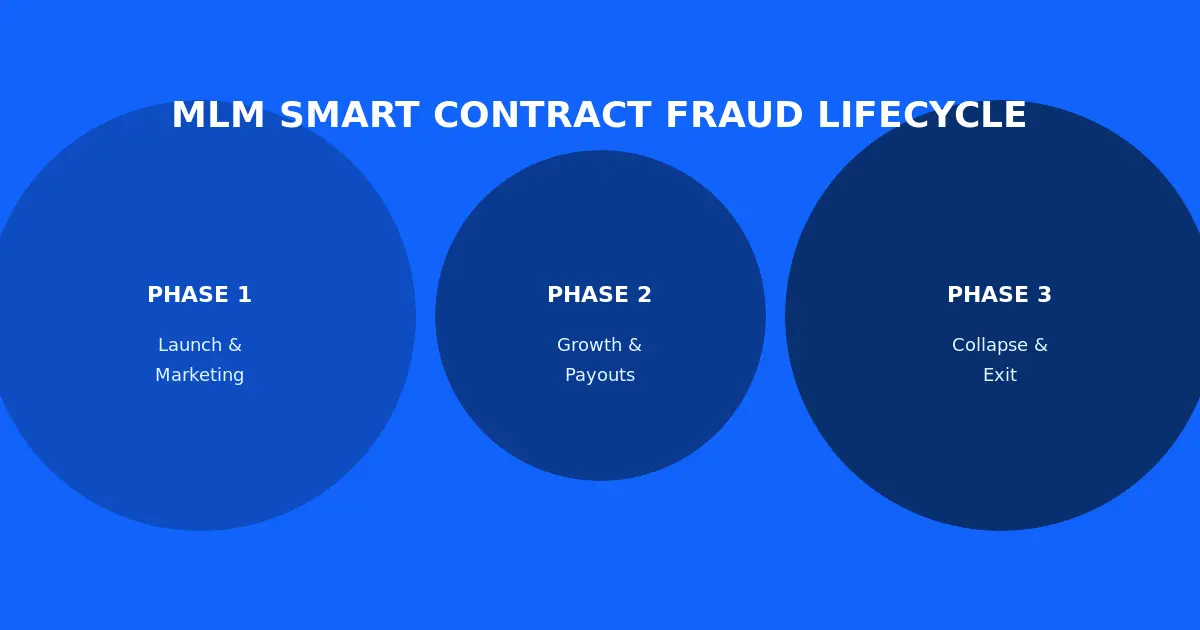
Several factors combine to make MLM smart contracts particularly susceptible to fraudulent manipulation. The first is complexity. Even simple compensation plans require hundreds of lines of code when implemented as smart contracts. Adding features like multiple commission types, rank qualifications, and token economics can push contracts into thousands of lines. This complexity provides hiding places for malicious code.
The second factor is the technical knowledge gap. Most MLM participants come from sales and networking backgrounds, not software development. They cannot evaluate smart contract code themselves. Many rely entirely on marketing claims about transparency and security without understanding what those terms actually mean in a blockchain context.
Third, the immutability that makes blockchain valuable also makes corrections impossible. Once participants send funds to a fraudulent contract, those funds cannot be recovered through technical means. There is no customer service number to call, no chargeback mechanism, no regulatory body with enforcement power over decentralized code.
Fourth, the pseudonymous nature of blockchain allows scammers to operate without revealing their identities. Project teams often use fake names and stock photos. When the fraud becomes apparent, the perpetrators disappear without consequence. This lack of accountability encourages more fraud attempts.
Finally, the MLM business model itself creates pressure that works against careful evaluation. Participants want to join early when potential earnings are highest. This urgency discourages thorough due diligence. Scammers exploit this psychology by creating artificial deadlines and emphasizing the cost of waiting.
Ponzi-Style Reward Distribution Patterns
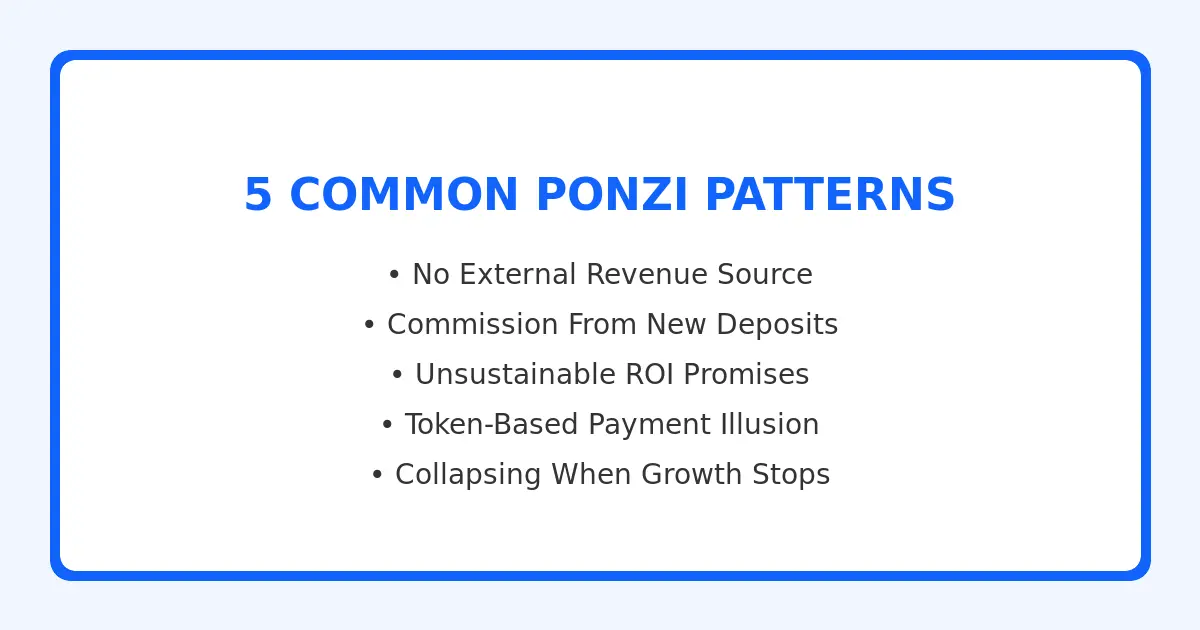
The most common fraud pattern in MLM smart contracts is the hidden Ponzi structure. These systems pay existing participants entirely from new participant deposits rather than from legitimate business activity. The math guarantees eventual collapse, but contract code can obscure this reality for months or years.
A Ponzi-structured MLM contract typically lacks any external revenue source. All funds come from registration fees, package purchases, or token investments made by participants. When someone earns a commission, that payment comes from money paid in by newer participants. The contract balance serves as a temporary pool that depletes as more payments go out than come in.
Smart contract code can disguise this structure through various techniques. Some contracts separate the payment pool into multiple wallets with different labels like marketing budget, development fund, and bonus reserve. The labels suggest diverse funding sources, but all the money ultimately comes from participant deposits.
Other contracts use token economics to create the illusion of sustainable returns. Participants receive native tokens as commissions. These tokens have value only because newer participants buy them to join the system. When new participant flow slows, token prices collapse and existing participants discover their earnings are worthless.
The sustainability of any MLM system depends on its compensation structure relative to actual value creation. Understanding ROI and profitability in crypto MLM systems helps participants evaluate whether promised returns are mathematically possible without eventual collapse.
At Nadcab Labs, our 8+ years of blockchain development experience has given us deep insight into sustainable tokenomics. We have reviewed countless MLM smart contracts and can often identify Ponzi structures within minutes by analyzing fund flow patterns and commission mathematics. This expertise helps our clients build systems that generate real value rather than simply redistributing participant funds.
Hidden Backdoors and Malicious Admin Controls
Even when compensation logic appears fair, hidden admin functions can give contract owners the ability to manipulate the system after deployment. These backdoors take several forms, each designed to extract value from participants while maintaining the appearance of legitimacy.
The most direct backdoor is an unrestricted withdrawal function that allows the contract owner to remove all deposited funds at any time. This function might be labeled something innocent like emergencyWithdraw or maintenanceTransfer. Without reading the code carefully, participants would never know it exists.
More subtle manipulations involve parameter changes. The contract might include functions that let the owner adjust commission percentages, qualification requirements, or payout frequencies. These changes can slowly shift the system against participants while maintaining plausible deniability that anything has changed.
Pause functions represent another risk. Legitimate contracts sometimes include the ability to pause operations during security incidents. However, malicious owners can use pause functions to freeze participant withdrawals while continuing to accept deposits. By the time participants realize something is wrong, their funds are trapped.
Ownership transfer mechanisms deserve scrutiny as well. Some contracts allow the owner to transfer control to another wallet address. This enables scammers to create the appearance of decentralization by transferring ownership to a seemingly independent party, who is actually still controlled by the original team.
Detecting these backdoors requires careful code review by qualified auditors. The blockchain development team at Nadcab Labs specifically examines admin functions during our security assessments. Our process identifies excessive permissions and recommends appropriate access controls that protect participants without eliminating necessary administrative capabilities.
Manipulated Referral and Commission Algorithms
Compensation plan manipulation takes advantage of the gap between what marketing materials promise and what code actually executes. Scammers design systems where the displayed commission structure differs significantly from the programmed calculations.
One common technique involves hidden fee deductions. The advertised commission might be 10% of referred purchases, but the actual payment deducts platform fees, gas reserves, token conversion spreads, and other charges. Participants receive far less than expected without understanding why.
Qualification manipulation presents another problem. Contracts can include undisclosed requirements that participants must meet before earning commissions. These might involve maintaining minimum account balances, achieving activity quotas, or holding tokens for specified periods. Participants who believe they qualify often discover they do not meet hidden criteria.
| Manipulation Type | Advertised vs Actual | Detection Difficulty |
|---|---|---|
| Hidden Fee Deductions | 10% commission vs 6% after fees | Medium |
| Qualification Requirements | All referrals count vs only active referrals | High |
| Skewed Distribution | Equal opportunity vs top-loaded rewards | High |
| Delayed Payouts | Instant payment vs 30-day holding period | Low |
| Rank Manipulation | Achievement-based vs admin-assigned | Medium |
Downline exploitation often favors early participants or those with special relationships to the development team. The compensation algorithm might include hardcoded addresses that receive preferential treatment. These privileged accounts earn higher percentages, skip qualification requirements, or receive payments before everyone else.
Rounding errors can also accumulate into significant fraud. Each commission calculation might round down by tiny amounts. Those fractions are redirected to accounts controlled by the contract owner. Over thousands of transactions, this silent theft adds up to substantial sums.
Fake Liquidity and Inflated Reward Pools
Liquidity illusions deceive participants about the actual financial health of MLM platforms. Fraudulent projects create appearances of substantial backing that do not reflect reality. When participants try to realize their earnings, they discover the promised liquidity does not exist.
One technique involves displaying contract balance figures that include locked or inaccessible funds. The dashboard might show millions in the reward pool, but most of that amount is committed to team tokens, marketing reserves, or long-term lockups that participants cannot access. The actual available liquidity is a fraction of the displayed total.
Token price manipulation creates another form of fake liquidity. Teams create trading pairs on decentralized exchanges with minimal real liquidity. They then execute wash trades to inflate reported trading volume and price. Participants see impressive price charts but cannot sell meaningful amounts without crashing the price.
Some projects add fake liquidity temporarily during promotional periods. The team injects borrowed funds to make the system appear healthy during audits or marketing pushes. Once new participants join based on these inflated numbers, the borrowed liquidity is removed. Late participants face withdrawal restrictions or worthless tokens.
Understanding true liquidity requires examining on-chain data directly rather than relying on platform dashboards. Block explorers show actual contract balances, exchange liquidity depths, and transaction histories. These primary sources reveal whether displayed numbers match blockchain reality.
Protect Your MLM Investment
Nadcab Labs provides thorough smart contract audits that identify hidden risks before they cost you money. Our 8+ years of blockchain expertise protects your investment.
Token Supply and Minting Fraud
Token economics present numerous opportunities for fraud in MLM smart contracts. The ability to create digital tokens from nothing makes supply manipulation particularly dangerous. Participants can lose substantial value through token-related schemes even when the MLM logic itself functions correctly.
Unlimited minting authority represents the most severe token risk. If contract owners can create new tokens without restriction, they can dilute existing holder value at will. Your percentage ownership decreases every time new tokens are minted. The advertised fixed supply might be a lie embedded in the token contract itself.
Artificial scarcity scams work in the opposite direction. Projects announce limited token supplies to create urgency and justify high prices. After early participants buy at inflated values, the team reveals hidden minting functions or releases tokens from supposed lockups. The artificial scarcity disappears, and prices collapse.
Pump and dump schemes coordinate with token release schedules. The team accumulates tokens through privileged early access or hidden minting. They then promote the project heavily to attract buyers. Once the token price rises sufficiently, insiders sell their holdings. The resulting price crash devastates participants who bought during the promotional phase.
Token burning claims require verification. Projects sometimes announce token burns to reduce supply and support prices. However, sending tokens to dead addresses does not necessarily remove them from circulation if the contract owner can recover them later. Legitimate burns use provably unrecoverable addresses and are verifiable on-chain.
Upgradeable Contract Abuse
Proxy contracts and upgradeability patterns introduce risks that many participants do not understand. These technical features allow developers to change contract logic after deployment. While upgradeability serves legitimate purposes, it also enables silent rule changes that harm participants.
A proxy contract separates storage from logic. User data and balances exist in one contract that never changes. The actual program code exists in a separate implementation contract. The proxy forwards all calls to whatever implementation address it currently points to. Changing that pointer changes the entire system’s behavior.
This architecture means the code you verify today might not be the code running tomorrow. A development team could publish a fair compensation plan, wait for participants to deposit funds, then upgrade to a version that transfers all funds to team wallets. The participants’ contract interactions remain unchanged, but the outcomes become completely different.
Time locks offer some protection against upgrade abuse. These mechanisms require a waiting period between announcing an upgrade and implementing it. Participants can evaluate proposed changes and withdraw funds if they disagree. However, time locks only help if participants actively monitor for upgrade announcements.
Multi-signature requirements add another layer of security. Rather than allowing a single owner to upgrade contracts, multi-sig governance requires several independent parties to approve changes. This distributes trust and reduces the risk of unilateral malicious upgrades. However, if all signers are controlled by the same entity, multi-sig provides only an illusion of security.
The fundamental understanding of blockchain technology and how it works helps participants recognize when upgradeability claims contradict blockchain’s core value proposition of immutability.
Fake Decentralization and Governance Claims
Decentralization promises attract participants who distrust centralized authorities. Fraudulent projects exploit this sentiment by claiming decentralized governance while maintaining complete central control. The technical reality often contradicts the marketing narrative entirely.
DAO structures frequently serve as decentralization theater. A project announces community governance through token voting. In practice, the team holds a majority of voting tokens or maintains admin keys that override any vote. Proposals pass or fail based on team preferences regardless of community input.
Smart contract ownership reveals true control. Even with a DAO facade, checking who owns the actual contract shows where power resides. If a single wallet or a small multi-sig controlled by team members owns the contracts, the decentralization claims are false. Real decentralization requires dispersed control that no single party can override.
Governance token distribution patterns expose fake decentralization. If team members, early investors, and affiliated parties hold most governance tokens, community members have no real influence. Token concentration data is publicly visible on block explorers but requires analysis to interpret meaningfully.
Protocol upgrades test decentralization claims. When changes benefit the team at participant expense and still pass through governance, the governance is not functioning as advertised. Genuine decentralization creates checks that prevent insider extraction even when insiders control governance tokens.
Security Weaknesses Enabling Fraud
Beyond intentional fraud, security vulnerabilities enable theft and manipulation even in projects launched with honest intentions. Poor coding practices, inadequate testing, and missing safeguards create openings that attackers exploit. Understanding these weaknesses helps participants evaluate project security.
Reentrancy attacks remain common despite years of awareness. These exploits allow attackers to repeatedly withdraw funds before the contract updates its balance records. A single vulnerability can drain an entire contract balance in seconds. The famous DAO hack in 2016 used reentrancy, yet developers continue making the same mistakes.
Access control failures allow unauthorized parties to call privileged functions. The contract might include powerful admin capabilities but fail to verify that only authorized addresses can invoke them. Anyone who discovers these unprotected functions can take control of the system.
| Vulnerability | Impact | Prevention Method |
|---|---|---|
| Reentrancy | Complete fund drainage | Check-effects-interactions pattern |
| Access Control Bypass | Unauthorized admin actions | Role-based access modifiers |
| Integer Overflow | Balance manipulation | SafeMath or Solidity 0.8+ |
| Oracle Manipulation | Price feed exploitation | Decentralized oracle networks |
| Front-running | Transaction order exploitation | Commit-reveal schemes |
External contract calls create dependency risks. If an MLM contract relies on external price oracles, token contracts, or exchange interfaces, vulnerabilities in those external contracts can compromise the MLM system. Attackers often target these dependencies rather than the main contract.
Poor audit practices leave vulnerabilities undetected. Many projects conduct superficial audits or skip them entirely. Even audited projects sometimes ignore findings or audit only portions of their code. A legitimate audit includes the entire codebase, documentation of all findings, and verification that critical issues were resolved.
Red Flags and Warning Signs for Investors
Identifying fraudulent MLM smart contracts requires attention to patterns that repeat across scam projects. While no single indicator proves fraud, multiple red flags appearing together should trigger serious caution. Experienced investors learn to recognize these warning signs before committing funds.
Unrealistic return promises top the list. Any project guaranteeing fixed daily or monthly returns is mathematically unsustainable without continuous new participant inflow. Legitimate investments involve risk. Promises of risk-free profits signal either misunderstanding or deliberate deception.
Anonymous or unverifiable teams raise immediate concerns. Legitimate developers stake their professional reputations on their projects. They provide verifiable identities, work histories, and contact information. Teams hiding behind cartoon avatars and pseudonyms can disappear without consequence when problems arise.
Missing or fake audits appear frequently in scam projects. Some projects display audit badges without actual reports. Others use fake auditor names or modify legitimate reports. Verifying audits requires checking directly with the auditing firm and confirming report authenticity. Our resource on questions to ask before hiring MLM software developers includes verification steps that protect against these deceptions.
| Red Flag | What It Suggests | Verification Action |
|---|---|---|
| Guaranteed Returns | Ponzi structure | Analyze fund flow mathematics |
| Anonymous Team | Exit scam risk | Research team backgrounds |
| No Source Code | Hidden malicious functions | Request code verification |
| Pressure Tactics | Avoiding due diligence | Take time regardless of urgency |
| Fake Social Proof | Manufactured legitimacy | Check testimonial authenticity |
| Unverified Audit | False security claims | Contact auditor directly |
Recruitment pressure over product value indicates pyramid structure. Legitimate MLM companies sell products or services with genuine utility independent of the compensation plan. When the primary discussion focuses on recruitment bonuses rather than product benefits, the economics likely depend on continuous participant growth rather than sustainable commerce.
Locked withdrawals or unexplained delays suggest liquidity problems. Healthy platforms process withdrawals promptly. Excuses involving network congestion, security upgrades, or technical difficulties often precede complete withdrawal freezes. Treat any withdrawal friction as a serious warning.
Prevention Strategies for Developers and Users
Preventing fraud in MLM smart contracts requires action from both developers building these systems and users participating in them. Each group has specific responsibilities and available tools for risk mitigation.
For developers, secure coding practices begin with following established patterns. OpenZeppelin contracts provide battle-tested implementations for common functions. Custom code should be minimal and thoroughly reviewed. Every function needs explicit access controls, and all external calls require careful handling.
Comprehensive testing catches many vulnerabilities before deployment. Test suites should cover normal operations, edge cases, and attack scenarios. Fuzzing tests random inputs to find unexpected failure modes. Formal verification mathematically proves certain properties hold under all conditions.
Independent audits provide external verification that internal teams cannot. Multiple audits from different firms catch issues that any single reviewer might miss. Publishing audit reports demonstrates commitment to transparency. Addressing all critical and high-severity findings before launch is non-negotiable.
Nadcab Labs brings over 8 years of blockchain development expertise to MLM smart contract security. Our team has analyzed hundreds of compensation plans and identified countless vulnerabilities. We work with projects from initial design through deployment and ongoing maintenance, building security into every phase rather than adding it as an afterthought.
For users, due diligence starts with basic research. Search for team member names, project history, and previous projects. Look for negative reviews, scam reports, or regulatory actions. Check social media accounts for authenticity indicators like account age, consistent activity, and genuine engagement.
Verify all claims independently. Read audit reports directly from auditor websites. Check contract code on block explorers against published documentation. Calculate whether promised returns are mathematically sustainable given the compensation structure. Trust verification over trust in claims.
Start with amounts you can afford to lose completely. Even legitimate projects carry risk. Testing with small amounts lets you verify that deposits, referrals, and withdrawals function as advertised before committing larger sums. Never invest emergency funds or borrowed money in MLM smart contracts.
Regulatory, Legal Risks, and Future Outlook
The regulatory landscape for blockchain MLM remains unclear in most jurisdictions. This ambiguity creates both opportunities for innovation and risks for participants. Understanding the legal context helps evaluate projects and anticipate potential problems.
Securities regulations pose the greatest legal risk for MLM tokens. If a token qualifies as a security under applicable law, the project must comply with registration requirements, disclosure obligations, and distribution restrictions. Many MLM tokens likely qualify as securities but operate as if they do not. Participants in unregistered securities offerings can face penalties alongside project operators.
Pyramid scheme laws apply to compensation structures regardless of blockchain involvement. If a system pays participants primarily for recruitment rather than product sales, it violates pyramid scheme prohibitions in most jurisdictions. Smart contract automation does not create exemption from these laws.
| Regulatory Area | Current Status | Future Direction |
|---|---|---|
| Securities Classification | Case-by-case enforcement | Clearer token classification rules |
| Pyramid Scheme Laws | Actively enforced | Extended to smart contract structures |
| Consumer Protection | Limited blockchain coverage | Expanded disclosure requirements |
| Cross-border Enforcement | Jurisdictional challenges | International cooperation frameworks |
Cross-border operations complicate enforcement. Smart contracts exist on global networks without physical location. Project teams can operate from jurisdictions with minimal regulation while targeting participants worldwide. This geographic arbitrage frustrates regulators but does not eliminate legal risk for participants in their home jurisdictions.
The future likely brings increased regulation and enforcement. Several jurisdictions have already taken action against blockchain MLM schemes. As understanding grows among regulators, scrutiny will intensify. Projects that build compliance into their design now will fare better than those scrambling to adapt later.
Industry self-regulation offers another path forward. Professional standards for smart contract development, mandatory audits, and ethical guidelines could raise barriers against fraud without requiring government intervention. Trade associations and certification programs might emerge to distinguish legitimate projects from scams.
The cryptocurrency MLM software market trends and forecast suggests continued growth in this sector despite regulatory uncertainty. Projects that prioritize compliance and security will capture increasing market share as participants become more sophisticated in evaluating options.
Technical innovations may also reduce fraud opportunities. Zero-knowledge proofs could enable compensation verification without exposing proprietary algorithms. Decentralized audit networks might provide continuous monitoring rather than point-in-time assessments. Reputation systems could track developer and project histories across platforms.
Final Thoughts
Fraud in MLM smart contracts represents a significant and growing problem that harms participants and damages the broader blockchain ecosystem’s reputation. The technical complexity of these systems creates cover for deception that traditional MLM regulation never anticipated. Ponzi structures, hidden backdoors, manipulated algorithms, fake liquidity, and token supply fraud all extract value from unsuspecting participants.
However, the same transparency that makes blockchain attractive also provides tools for detection and prevention. On-chain data reveals fund flows, token distributions, and governance concentrations. Code analysis exposes hidden functions and vulnerable patterns. Independent audits verify claims against reality.
Success in this space requires approaching MLM smart contracts with appropriate skepticism and thorough verification. Promises that sound too good to be true usually are. Anonymous teams, guaranteed returns, and missing audits should trigger immediate caution. Taking time for due diligence prevents costly mistakes.
For organizations building legitimate MLM systems, partnering with experienced blockchain developers protects both your business and your participants. Nadcab Labs has spent over 8 years developing secure smart contracts and conducting security assessments. Our expertise helps clients navigate technical challenges while building systems that deserve participant trust.
The blockchain MLM sector will continue evolving. Regulatory clarity will improve. Technical standards will mature. Projects that prioritize security and transparency today position themselves for long-term success. Those that cut corners or engage in deception face increasing risk of enforcement action and participant exodus.
Whether you are evaluating an MLM opportunity or building one, the principles remain the same. Verify independently. Understand what you are committing to. Work with qualified professionals. Build for sustainability rather than quick extraction. These practices protect value and build the foundation for legitimate blockchain commerce.
Frequently Asked Questions
Q1.What makes MLM smart contracts more vulnerable to fraud than traditional MLM systems?
MLM smart contracts are more vulnerable because their technical complexity hides malicious code that average participants cannot evaluate. Traditional MLM operates through company systems where regulators can examine records and enforce compliance. Smart contracts run autonomously on decentralized networks beyond regulatory reach. The pseudonymous nature of blockchain allows fraudsters to operate without revealing identities. Additionally, transactions are irreversible, so once funds are sent to a fraudulent contract, recovery is practically impossible without the perpetrator’s cooperation.
Q2.How can I verify if an MLM smart contract has been properly audited?
To verify a smart contract audit, first confirm the auditing firm’s legitimacy by checking their website, team credentials, and history of previous audits. Then locate the audit report directly on the auditor’s website rather than relying on links provided by the project. Compare the contract addresses in the report to the deployed contract addresses. Check that the audit covers the complete codebase, not just selected portions. Contact the auditing firm directly if you have doubts about report authenticity. Legitimate firms maintain public records of their audits.
Q3.What is the difference between a legitimate MLM compensation plan and a Ponzi scheme on blockchain?
A legitimate MLM compensation plan pays commissions from revenue generated by actual product or service sales to end consumers. The business can sustain itself indefinitely if product demand continues. A Ponzi scheme disguised as MLM pays participants entirely from new participant deposits with no genuine revenue source. It requires constant growth to meet obligations and mathematically must collapse when recruitment slows. Analyzing fund flows reveals the difference. If contract inflows come only from participant deposits and outflows are commission payments, that indicates Ponzi structure.
Q4.Can upgradeable smart contracts be safe for MLM participants?
Upgradeable smart contracts can be safe if proper safeguards exist. These safeguards include time locks that delay upgrades for days or weeks so participants can review changes and withdraw funds if they disagree. Multi-signature governance requiring multiple independent parties to approve upgrades adds protection. Transparent communication about upgrade plans builds trust. However, if a single entity controls upgrade authority without meaningful delays or oversight, participants face significant risk that the rules will change against their interests after they deposit funds.
Q5.What should I look for when evaluating an MLM project's tokenomics?
When evaluating tokenomics, examine total supply versus circulating supply to understand potential dilution. Check if minting functions allow unlimited token creation. Review vesting schedules for team and investor tokens to assess selling pressure risk. Analyze token distribution to determine if insiders hold concentrated positions. Examine utility that creates genuine demand beyond speculation. Calculate whether promised returns are sustainable given token emission rates and revenue sources. Look at liquidity depth on exchanges to understand if you can actually sell tokens at displayed prices.
Q6.How do regulatory authorities typically handle fraudulent MLM smart contracts?
Regulatory handling varies by jurisdiction and fraud severity. Securities regulators may classify tokens as unregistered securities and pursue enforcement against identifiable operators. Consumer protection agencies investigate deceptive practices and can issue warnings or bring fraud charges. Cross-border operations complicate enforcement since operators often base in jurisdictions with limited regulatory cooperation. Participants in some cases face penalties for participating in unregistered securities offerings. Recovery of funds is rare due to cryptocurrency’s irreversibility and operator anonymity. Prevention through due diligence remains more reliable than post-fraud enforcement.
Explore Services
Related Services
Reviewed by

Aman Vaths
Founder of Nadcab Labs
Aman Vaths is the Founder & CTO of Nadcab Labs, a global digital engineering company delivering enterprise-grade solutions across AI, Web3, Blockchain, Big Data, Cloud, Cybersecurity, and Modern Application Development. With deep technical leadership and product innovation experience, Aman has positioned Nadcab Labs as one of the most advanced engineering companies driving the next era of intelligent, secure, and scalable software systems. Under his leadership, Nadcab Labs has built 2,000+ global projects across sectors including fintech, banking, healthcare, real estate, logistics, gaming, manufacturing, and next-generation DePIN networks. Aman’s strength lies in architecting high-performance systems, end-to-end platform engineering, and designing enterprise solutions that operate at global scale.