Ai Overview
The crypto market has witnessed an unprecedented wave of token failures in recent years. According to CoinGecko data, over 53% of the nearly 20. 6 million of those collapses occurring in 2025 alone — representing 86% of all token deaths across that five-year period. Trust Wallet, for example, requires a minimum of 10,000 token holders, at least 15,000 transactions (excluding airdrop activity), and active listing on price tracking platforms like CoinMarketCap.
The crypto market has witnessed an unprecedented wave of token failures in recent years. According to CoinGecko data, over 53% of the nearly 20.2 million tokens launched between 2021 and 2025 are now defunct, with a staggering 11.6 million of those collapses occurring in 2025 alone — representing 86% of all token deaths across that five-year period.[1] Falling short of platform listing requirements, whether for Trust Wallet, CoinMarketCap, or centralized exchanges, is one of the most common obstacles token projects encounter. But failing to meet these benchmarks does not have to be the end of the road. With the right strategies, targeted execution, and expert guidance, projects can recover, strengthen their fundamentals, and achieve the visibility and liquidity needed for lasting success.
Key Takeaways
- Listing Benchmarks: Platforms like Trust Wallet require minimum 10,000 holders and 15,000 transactions before considering a token for listing.
- Market Reality: Over 80% of tokens launched in 2025 traded below their initial valuations, making strong fundamentals more critical than ever.
- Recovery Is Possible: Targeted marketing, community engagement, liquidity strategies, and continuous product improvement can bridge the gap between current metrics and listing requirements.
- Liquidity Matters: Insufficient trading volume deters investors and platforms alike, but proven techniques like liquidity mining and market maker partnerships can resolve this.
- Expert Support: Working with experienced blockchain partners significantly improves a token’s chances of meeting requirements and achieving sustainable growth.
Understanding Token Listing Requirements
Before exploring recovery strategies, it is essential to understand what platforms actually require. Different exchanges and wallet platforms maintain distinct listing criteria, but several common benchmarks appear across most of them. Trust Wallet, for example, requires a minimum of 10,000 token holders, at least 15,000 transactions (excluding airdrop activity), and active listing on price tracking platforms like CoinMarketCap. Centralized exchanges such as Binance, Coinbase, and KuCoin evaluate additional factors including whitepaper quality, team credibility, smart contract audits, regulatory compliance, and demonstrated community engagement.
Exchange listing fees also present a significant barrier. Centralized platforms charge anywhere from $20,000 to several hundred thousand dollars for listing, depending on the exchange’s reputation and reach. For early-stage projects with limited capital, these costs can seem prohibitive. However, understanding these requirements in detail is the first step toward building a roadmap that systematically addresses each benchmark through the strategic development of your token’s ecosystem.
What Happens When Your Token Falls Short
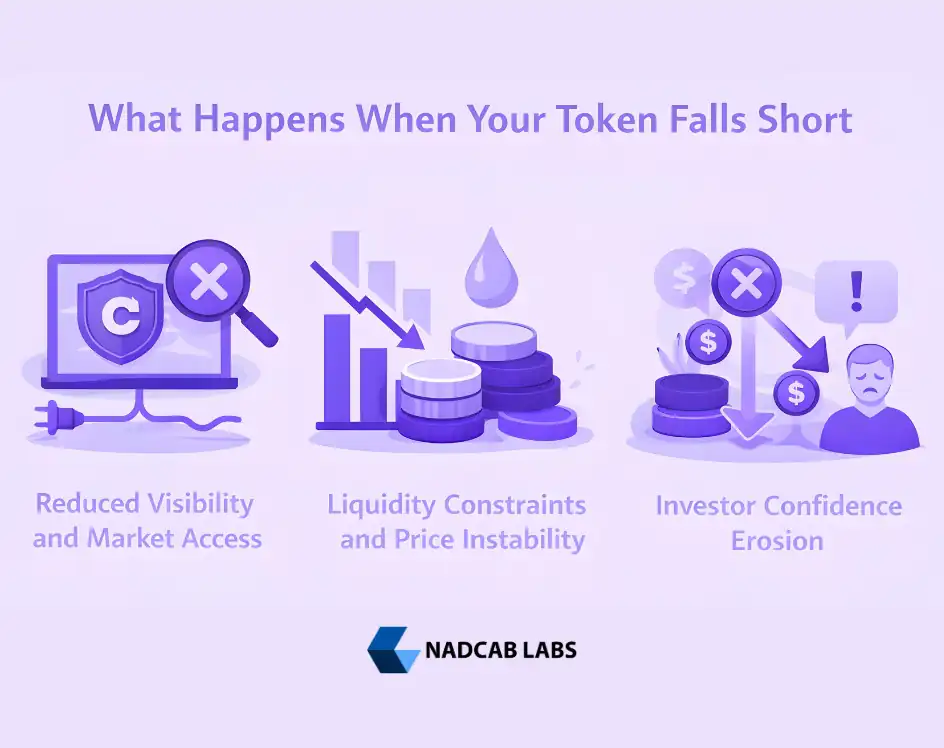
Reduced Visibility and Market Access
When a token fails to meet listing requirements, its most immediate consequence is limited visibility. Without presence on popular wallets and exchanges, potential investors simply cannot find your token. In a market where millions of tokens compete for attention, being absent from the platforms that traders use daily effectively renders your project invisible. This lack of exposure creates a downward spiral: fewer eyes lead to fewer transactions, fewer transactions mean fewer holders, and insufficient holders prevent the token from qualifying for the very listings that would solve these problems.
Liquidity Constraints and Price Instability
Tokens that fall short of listing criteria typically suffer from thin liquidity. Without sufficient trading volume, even modest buy or sell orders can cause dramatic price swings. This volatility discourages serious investors and institutional participants, who require predictable execution and minimal slippage. The development of healthy liquidity pools requires sustained trading activity, which is difficult to achieve without the exposure that major platform listings provide. Understanding the mechanics of LP Tokens and liquidity pool participation is essential for projects working to overcome this challenge.
Investor Confidence Erosion
Data from CryptoRank reveals that 93 out of 100 tokens listed on Binance in 2025 traded in the red, with a median return of just 0.22x. If even listed tokens struggle this severely, unlisted tokens face even steeper challenges in maintaining investor confidence. Without a visible listing and consistent trading activity, early supporters may lose faith in the project, leading to sell-offs that further depress price and volume metrics. This erosion of trust is one of the hardest problems to reverse, which is why proactive strategies are far more effective than reactive damage control.
Proven Strategies to Meet Listing Requirements
Targeted Marketing Campaigns
Effective marketing is the fastest way to expand your token’s reach and drive transaction growth. However, the approach must be strategic rather than scattershot. Begin with defining your target audience: retail crypto traders, DeFi participants, specific geographic markets, or niche communities aligned with your token’s utility. Allocate resources across social media campaigns on platforms like X (formerly Twitter), Telegram, and Reddit, where crypto communities are most active. Influencer partnerships can amplify visibility, but choose partners whose audiences align with your project’s values rather than simply selecting those with the highest follower counts.
Content marketing provides sustainable momentum. Regular blog posts, educational threads, video explainers, and AMAs (Ask Me Anything sessions) position your project as transparent and knowledgeable. Projects that maintained consistent communication during the 2025 market downturn were far more likely to retain their communities than those that went silent during difficult periods. For projects considering a decentralized exchange approach, understanding how a DEX Launch for New Token platforms work can open additional marketing and distribution channels.
Building a Strong Community
Community is the backbone of every successful token project. Platforms evaluate not just holder counts but the quality and engagement of the community behind a token. Building this requires consistent, genuine interaction. Establish active Telegram groups, Discord servers, and social media channels where your team regularly communicates updates, answers questions, and gathers feedback. Encourage participation through governance proposals, community votes, and reward programs that make members feel invested in the project’s direction.
The development of community-driven initiatives like ambassador programs, content creation contests, and referral rewards can organically expand your holder base. Projects that survived the brutal 2025 market typically shared common traits: transparent teams, clear compliance efforts, and a focus on solving specific problems rather than relying on hype alone. Transform your community members into advocates who genuinely believe in your project’s mission, and your holder and transaction metrics will grow naturally.
Enhancing Liquidity
Liquidity enhancement is critical for meeting trading volume requirements and attracting both investors and listing platforms. Several approaches can improve your token’s liquidity profile significantly. Liquidity mining programs incentivize users to provide assets to trading pools in exchange for token rewards, directly increasing available liquidity and trading activity. Partnerships with professional market makers can stabilize bid-ask spreads and ensure consistent order book depth, making your token more attractive to traders.
Cross-chain liquidity through Wrapped Tokens allows your token to be traded on multiple blockchain networks, expanding your addressable market beyond a single chain. Additionally, listing on decentralized exchanges like Uniswap, PancakeSwap, or Raydium provides immediate trading access while you work toward centralized exchange listings. These DEX listings also generate the transaction history and holder growth needed to qualify for more prominent platforms.
Struggling to Meet Token Listing Requirements?
Nadcab Labs helps token projects bridge the gap between current metrics and platform listing benchmarks through strategic marketing, liquidity solutions, community building, and technical optimization.
Strategic Partnerships and Integrations
Collaborating with established projects, DeFi protocols, and blockchain platforms can dramatically accelerate your token’s growth trajectory. Partnerships provide mutual exposure: your token gains access to an established user base, while the partner benefits from expanded utility within their ecosystem. Look for alignment in mission, technology, and audience rather than pursuing partnerships purely for publicity.
Integration with DeFi platforms adds tangible utility to your token. When users can stake, lend, borrow, or farm with your token, it creates genuine demand beyond speculation. Each DeFi interaction generates transactions and new holder addresses, directly contributing to the metrics that listing platforms evaluate. The development of strategic integration points with lending protocols, yield aggregators, and cross-chain bridges demonstrates that your token has real utility within the broader DeFi ecosystem.
Continuous Product Improvement
Token projects that treat their launch as the finish line almost always fail. Research from CoinDesk highlighted that many 2025 token failures occurred because tokens lacked sufficient utility — they became liquid before they were needed, widely held before communities formed, and traded before they served a meaningful purpose.[2] Continuous improvement means regularly shipping updates, adding features, expanding utility, and responding to community feedback. Publish transparent development roadmaps and deliver on milestones consistently.
Smart contract upgrades, new staking mechanisms, governance features, and ecosystem integrations demonstrate that your project is actively evolving. This ongoing development effort signals long-term commitment to both listing platforms and investors, distinguishing your project from the thousands of abandoned tokens that flood the market each year.
Lessons from the 2025 Token Market
The 2025 token landscape delivered harsh but valuable lessons. Q4 2025 alone saw 7.7 million token failures, triggered in part by the October 10 liquidation cascade that wiped out $19 billion in leveraged positions within 24 hours. The tokens that survived shared specific characteristics: transparent leadership, genuine utility, active community engagement, and sound tokenomics design with fair distribution models. Projects that relied on high fully-diluted valuations with low circulating floats — the “high FDV, low float” model — were disproportionately punished as insider unlocks flooded the market with sell pressure.
For projects whose tokens currently fall short of requirements, these lessons offer a clear blueprint. Prioritize genuine utility over speculative appeal. Design tokenomics that reward long-term holding rather than enabling quick exits. Maintain consistent communication regardless of market conditions. And invest in the technical development of your smart contracts, security audits, and ecosystem integrations that demonstrate substance behind your project’s promises.
Why Choose Nadcab Labs as Your Recovery Partner
Nadcab Labs specializes in empowering token projects to overcome listing challenges and achieve long-term market growth. Our comprehensive token development solutions are designed to support every stage of the recovery journey, from identifying the reasons behind a token’s underperformance to executing effective strategies that close the gap between current metrics and platform requirements.
Our services include targeted marketing campaign design and execution, community building across Telegram, Discord, and social media, liquidity enhancement through market maker partnerships and incentive programs, smart contract auditing and optimization, tokenomics review and restructuring, and strategic partnership development. With deep expertise in blockchain technology and a proven track record in token ecosystem growth, Nadcab Labs provides the technical excellence and strategic guidance needed to transform underperforming tokens into thriving, listing-ready projects.
Final Thoughts
Falling short of listing requirements is a common challenge, but it is not a death sentence for your token project. The crypto market rewards projects that combine genuine utility, strong community engagement, healthy liquidity, and continuous development with resilience and strategic thinking. By implementing targeted marketing campaigns, building authentic communities, enhancing liquidity through proven methods, forging strategic partnerships, and continuously improving your product, you can systematically meet and exceed the benchmarks set by listing platforms. With Nadcab Labs as your partner, your token gains access to the expertise and resources needed to navigate this journey successfully and achieve lasting growth in the competitive decentralized finance landscape.
Frequently Asked Questions
Q1.What are Trust Wallet listing requirements?
Trust Wallet requires a minimum of 10,000 token holders and 15,000 non-airdrop transactions, along with active listings on recognized price tracking platforms like CoinMarketCap, before approving any new token submissions.
Q2.How can tokens improve trading volume?
Tokens can boost trading volume through liquidity mining programs, professional market maker partnerships, decentralized exchange listings, cross-chain integrations, incentivized trading campaigns, and active community engagement that drives sustained organic transactions.
Q3.What is liquidity mining for tokens?
Liquidity mining rewards users with tokens for providing their assets to decentralized exchange liquidity pools, which increases available trading depth, reduces slippage, and generates consistent on-chain transaction activity for the project.
Q4.How important is community for tokens?
Community is essential because listing platforms evaluate holder engagement metrics, active participation drives organic transactions and holder growth, and loyal communities provide resilience during market downturns while enabling sustained long-term growth.
Q5.Can unlisted tokens still gain traction?
Yes, unlisted tokens can gain meaningful traction through decentralized exchange listings, targeted marketing campaigns, influencer partnerships, DeFi protocol integrations, and community-driven organic growth before pursuing listings on major centralized platforms.
Q6.What costs are involved in token listing?
Centralized exchange listing fees range from $20,000 to several hundred thousand dollars depending on the platform. Decentralized exchange listings require only smart contract deployment gas fees, typically a few hundred dollars on most networks.
Explore Services
Related Services
Reviewed by

Aman Vaths
Founder of Nadcab Labs
Aman Vaths is the Founder & CTO of Nadcab Labs, a global digital engineering company delivering enterprise-grade solutions across AI, Web3, Blockchain, Big Data, Cloud, Cybersecurity, and Modern Application Development. With deep technical leadership and product innovation experience, Aman has positioned Nadcab Labs as one of the most advanced engineering companies driving the next era of intelligent, secure, and scalable software systems. Under his leadership, Nadcab Labs has built 2,000+ global projects across sectors including fintech, banking, healthcare, real estate, logistics, gaming, manufacturing, and next-generation DePIN networks. Aman’s strength lies in architecting high-performance systems, end-to-end platform engineering, and designing enterprise solutions that operate at global scale.