Ai Overview
Decentralized exchanges have fundamentally reshaped how new tokens enter the crypto market. In 2025, DEX trading volume rose approximately 37%, with monthly averages exceeding $412 billion, while Uniswap alone processed over 915 million swaps and more than $1 trillion in total volume. DEX launch platforms now serve as the primary gateway for new tokens seeking market access, liquidity, and community traction — bypassing the lengthy approvals and high fees of centralized exchanges.
Decentralized exchanges have fundamentally reshaped how new tokens enter the crypto market. In 2025, DEX trading volume rose approximately 37%, with monthly averages exceeding $412 billion, while Uniswap alone processed over 915 million swaps and more than $1 trillion in total volume. DEX launch platforms now serve as the primary gateway for new tokens seeking market access, liquidity, and community traction — bypassing the lengthy approvals and high fees of centralized exchanges. For projects aiming to build momentum in the competitive DeFi ecosystem, understanding how DEX launches drive token growth is essential.
Key Takeaways
- DEX Launch Platforms: Provide structured infrastructure for listing and trading new tokens in decentralized environments without centralized gatekeepers.
- Liquidity Bootstrapping: Automated market makers and liquidity pools enable immediate trading availability upon token launch.
- Lower Barrier to Entry: DEX listing costs are significantly lower than centralized exchanges, making them accessible to startups and emerging projects.
- Community-Driven Growth: Governance mechanisms and farming incentives build active communities around newly launched tokens.
- Global Reach: Permissionless access means tokens are available to traders worldwide from the moment of launch.
- Security Through Decentralization: Peer-to-peer trading eliminates single points of failure inherent in centralized platforms.
What Are DEX Launch Platforms and How Do They Work?
DEX launch platforms are specialized decentralized exchange services designed to facilitate the listing, initial liquidity provisioning, and trading of new tokens. Unlike centralized exchanges where projects must negotiate listings, undergo extensive compliance reviews, and pay substantial fees, DEX platforms allow token issuers to create liquidity pools and make their tokens tradable almost immediately after smart contract deployment.
The core technology powering these platforms relies on automated market makers (AMMs), which use mathematical algorithms to determine token prices based on the ratio of assets held in liquidity pools. When a project launches a new token, it pairs it with an established asset like ETH, USDC, or SOL in a liquidity pool. Traders can then swap between the paired tokens, with prices adjusting algorithmically based on supply and demand. This eliminates the need for traditional order books and market makers.
The development of modern DEX launch infrastructure has introduced sophisticated features beyond basic token swaps. Concentrated liquidity models, pioneered by Uniswap V3, allow liquidity providers to allocate capital within specific price ranges for greater efficiency. Platforms like Raydium on Solana combine AMM functionality with central limit order books, while newer entrants offer customizable pool parameters through modular “hooks” that enable dynamic fee structures and automated liquidity management.[1]
From a technical perspective, DEX launch platforms handle smart contract deployment for liquidity pools, token pair creation, fee tier configuration, and integration with wallet providers like MetaMask, Trust Wallet, and Phantom. The entire process operates on-chain, meaning every transaction is recorded on the blockchain, providing full transparency and auditability.
How DEX Launches Drive New Token Growth
DEX launches have become a foundational strategy for modern token growth, combining rapid access, efficient liquidity, and community-driven momentum into a single launch framework.
Instant Market Access and Global Visibility
One of the most significant advantages of launching a token on a DEX is the speed of market access. Coinbase’s 2025 DEX trading integration demonstrated this shift perfectly — new Base-native tokens became available to millions of traders within an hour of being indexed on-chain, without waiting for traditional centralized exchange listings.[2] This permissionless model means that any project with a properly deployed smart contract can access a global trading audience immediately.
DEX platforms frequently list new tokens before centralized exchanges, attracting early liquidity and speculative volume. During the “onchain season” in late 2024 and into 2025, prominent crypto narratives including AI agent tokens and viral memecoins originated exclusively from decentralized liquidity pools on Solana and Base. These tokens were not initially available on centralized platforms, driving massive trader engagement directly on DEX infrastructure. For teams looking to Create crypto token assets that reach the market quickly, DEX launches offer unmatched speed and accessibility.
Liquidity Bootstrapping and Price Discovery
Liquidity is the lifeblood of any token’s market success. DEX launch platforms solve the cold-start liquidity problem through liquidity pools and bootstrapping mechanisms. When a project creates a pool pairing its token with an established asset, it provides the initial liquidity that enables trading from day one. As more traders and liquidity providers participate, the pool deepens, reducing slippage and improving the overall trading experience.
Advanced liquidity bootstrapping pools (LBPs) offer an even more refined approach. These pools start with a high token-to-base-asset ratio and gradually rebalance over time, creating a fair price discovery mechanism that discourages sniping and front-running. This approach, used by platforms like Balancer and Copper Launch, allows projects to distribute tokens broadly while establishing a market-driven price from the outset.
The development of concentrated liquidity models has further improved capital efficiency for DEX launches. Instead of spreading liquidity across all possible price ranges, providers can focus capital within active trading ranges, generating higher returns per dollar deployed. This innovation benefits both projects launching tokens and the liquidity providers supporting them.
Community Building and Governance
DEX launches naturally foster community engagement by making participants direct stakeholders in the token’s ecosystem. Token holders who provide liquidity earn trading fees, while many projects layer additional incentives through Token Seeding and yield farming programs that reward long-term participation. This creates a virtuous cycle: engaged community members provide liquidity, which attracts more traders, which generates more fees, which draws additional liquidity providers.
Governance mechanisms built into many DEX-launched tokens allow holders to vote on protocol decisions, feature priorities, and treasury allocations. This decentralized decision-making model builds deeper community investment than centralized alternatives, where token holders typically have no voice in project direction. Projects that leverage these governance tools effectively create loyal, self-sustaining communities that drive organic growth far beyond the initial launch phase.
Benefits of Using a DEX Launch Platform
DEX launch platforms offer a balanced combination of security, transparency, affordability, and open access, making them an ideal choice for projects entering decentralized markets.
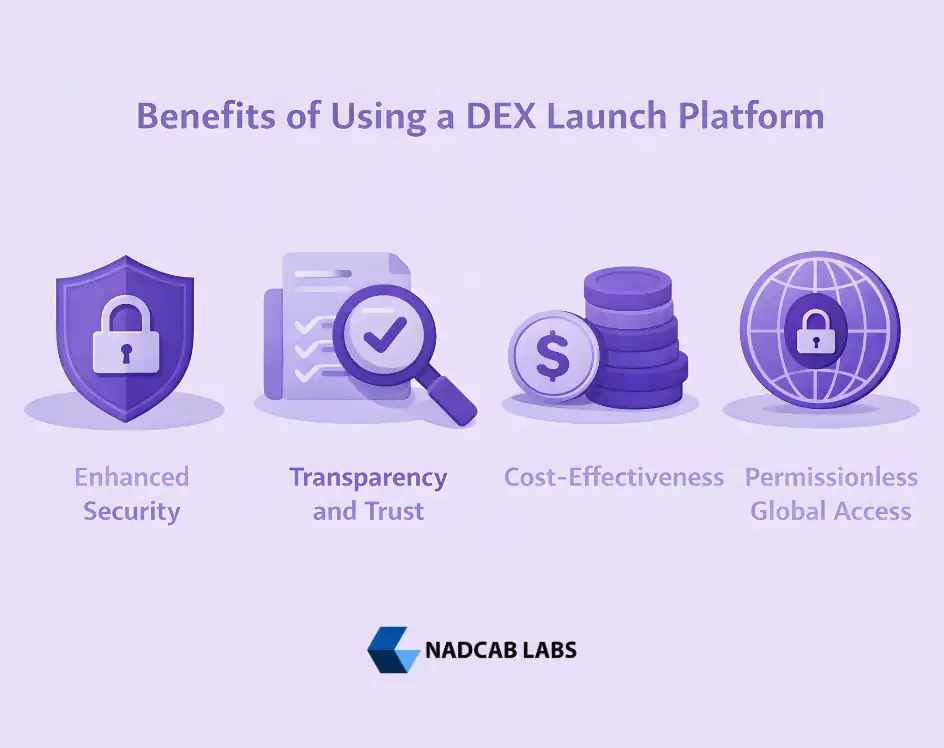
Enhanced Security
DEX platforms operate on a peer-to-peer model where users trade directly from their wallets without depositing funds into a centralized custodian. This eliminates the single point of failure that has led to billions in losses from centralized exchange hacks and collapses. Smart contracts execute trades automatically, and all transactions are verifiable on-chain. The Cetus DEX hack in May 2025, which resulted in approximately $223-260 million in losses, serves as a reminder that smart contract security and thorough auditing remain critical even in decentralized environments.
Transparency and Trust
Every transaction on a DEX launch platform is recorded on the blockchain, creating an immutable, publicly auditable record of all trading activity. This transparency extends to token supply, liquidity pool composition, and fee distribution. Understanding the difference between various Crypto Coin and Token types helps projects design launch strategies that align with their specific use cases and compliance requirements.
Cost-Effectiveness
Centralized exchange listings can cost anywhere from $50,000 to several million dollars, creating a significant barrier for early-stage projects. DEX launches, by contrast, require only the gas fees for deploying smart contracts and creating liquidity pools — often a few hundred dollars on Layer-2 networks or alternative chains like Solana and BNB Chain. This dramatic cost reduction makes DEX launches the most accessible path to market for projects with limited budgets.
Permissionless Global Access
DEX platforms are accessible to anyone with a crypto wallet and internet connection, regardless of geography. There are no account approvals, KYC requirements on most platforms, or regional restrictions. This permissionless nature means a token launched on a DEX immediately reaches a global audience, which is valuable for projects targeting international communities.
Challenges New Projects Face When Launching on a DEX
Technical Complexity and Smart Contract Risks
Launching on a DEX requires solid technical execution. Smart contracts must be properly coded, tested, and audited before deployment. Errors in contract logic can lead to exploitable vulnerabilities, locked funds, or unexpected token behavior. The development of secure smart contracts demands expertise in Solidity, Rust, or other blockchain programming languages, along with thorough testing on testnets before mainnet deployment. Projects without in-house blockchain engineering capabilities need experienced partners to handle these requirements.
Regulatory Uncertainty
The regulatory environment surrounding DEX-launched tokens remains intricate and differs widely across jurisdictions. Although the U.S. introduced the GENIUS Act in July 2025 to provide clearer oversight for stablecoins, comprehensive regulations governing token launches are still taking shape.[3] As a result, projects leveraging token development services must carefully evaluate factors such as securities classification, tax responsibilities, and compliance with anti-money laundering laws in the regions they aim to operate in.
Market Competition and Liquidity Challenges
The DeFi space is intensely competitive. With over 800 decentralized exchanges operating and thousands of new tokens launching regularly, standing out requires more than creating a liquidity pool. Projects must invest in marketing, community building, and strategic partnerships to attract initial liquidity and sustained trading volume.
Launch Your Token on a DEX with Confidence
Nadcab Labs provides end-to-end DEX launch solutions — from smart contract creation and liquidity pool setup to security auditing and post-launch optimization. Start your project with expert support.
Strategies for a Successful DEX Token Launch
Pre-Launch Preparation
Success begins well before the token goes live. Projects should complete comprehensive smart contract audits, finalize tokenomics including supply, distribution, vesting schedules, and emission rates, and build a community presence across Telegram, Discord, and social media platforms. Testnet deployment allows teams to identify and resolve issues before real assets are involved. The development of a detailed launch plan with clear milestones and contingency strategies ensures the team is prepared for every scenario.
Strategic Liquidity Provisioning
Initial liquidity depth directly impacts the trading experience and early price stability. Projects should allocate sufficient capital to create meaningful liquidity pools across the most appropriate fee tiers. Using liquidity bootstrapping pools helps achieve fair price discovery while distributing tokens broadly. After launch, incentivized farming programs encourage ongoing liquidity provision, ensuring the token maintains healthy trading conditions as adoption grows.
Post-Launch Growth and Community Engagement
The launch is just the starting point. Long-term growth requires continuous community engagement, regular project updates, responsive support, and strategic feature development. Monitoring on-chain metrics like trading volume, unique wallet interactions, and liquidity depth provides actionable insights for the ongoing development of your token’s market presence. Teams that maintain active communication and deliver on their roadmap commitments build the trust needed for sustainable growth.
Choose a Professional Partner for Your DEX Token Launch
Launching a token on a decentralized exchange requires deep expertise in DEX infrastructure, smart contract engineering, and token launch strategy. A professional team manages the complete lifecycle, from tokenomics design and smart contract creation to liquidity pool configuration, security auditing, and mainnet deployment, ensuring every technical and strategic element is optimized for success.
Comprehensive services typically include custom AMM integration, multi-chain deployment across networks such as Ethereum, Solana, BNB Chain, and Polygon, liquidity bootstrapping pool setup, and post-launch support including performance monitoring and protocol upgrades. A strong focus on security, transparency, and long-term ecosystem growth is essential for projects aiming to achieve sustained market presence and community adoption in decentralized finance.
Final Thoughts
DEX launch platforms have become the primary pathway for new tokens entering decentralized finance, offering speed, cost-effectiveness, global reach, and community-driven growth that centralized exchanges cannot match. As DEX trading volumes continue rising and infrastructure matures with concentrated liquidity and modular pool design, the advantages of decentralized launches will only grow. However, success demands careful technical execution, strategic liquidity planning, and ongoing community engagement. Partnering with Nadcab Labs ensures your project navigates DEX launch complexities with confidence and positions your token for sustained growth.
Frequently Asked Questions
Q1.What is a DEX launch platform?
A DEX launch platform provides decentralized infrastructure for listing and trading new tokens through automated market makers and liquidity pools, without requiring centralized exchange approvals or high listing fees.
Q2.How does DEX launching help token growth?
DEX launches provide instant global market access, permissionless trading, and community-driven liquidity bootstrapping that accelerates token visibility, trading volume, and organic adoption from day one.
Q3.What costs are involved in DEX launches?
DEX launches primarily require gas fees for smart contract deployment and liquidity pool creation, typically ranging from a few hundred dollars on Layer-2 networks to a few thousand on Ethereum mainnet.
Q4.Are DEX launches safe for new tokens?
DEX launches offer security through decentralization and on-chain transparency, but smart contract auditing, proper tokenomics design, and liquidity management are essential for minimizing risks effectively.
Q5.What is a liquidity bootstrapping pool?
A liquidity bootstrapping pool gradually rebalances token-to-base-asset ratios over time, creating fair price discovery during initial distribution while discouraging sniping and front-running by early participants.
Q6.How long does a DEX launch take?
Technical deployment can happen within hours, but thorough preparation including smart contract auditing, tokenomics finalization, community building, and marketing typically requires four to eight weeks beforehand.
Explore Services
Related Services
Reviewed by

Aman Vaths
Founder of Nadcab Labs
Aman Vaths is the Founder & CTO of Nadcab Labs, a global digital engineering company delivering enterprise-grade solutions across AI, Web3, Blockchain, Big Data, Cloud, Cybersecurity, and Modern Application Development. With deep technical leadership and product innovation experience, Aman has positioned Nadcab Labs as one of the most advanced engineering companies driving the next era of intelligent, secure, and scalable software systems. Under his leadership, Nadcab Labs has built 2,000+ global projects across sectors including fintech, banking, healthcare, real estate, logistics, gaming, manufacturing, and next-generation DePIN networks. Aman’s strength lies in architecting high-performance systems, end-to-end platform engineering, and designing enterprise solutions that operate at global scale.