Ai Overview
The global crypto exchange market is projected to surpass $180 billion by 2026. Daily trading volumes across major platforms regularly cross $100 billion. 1% fee creates substantial, consistent revenue. A custom-built exchange can reach a total cost of ownership of $1.
The global crypto exchange market is projected to surpass $180 billion by 2026. Daily trading volumes across major platforms regularly cross $100 billion. The businesses collecting fees on every one of those trades are crypto exchange owners — and many of them launched without building a single line of core infrastructure themselves. They used white label crypto exchange platforms instead. This blog explains exactly how that model works, where the money comes from, what it costs to start, and what risks owners need to manage.
Key Takeaways
- Ready Infrastructure: A white label crypto exchange comes with a matching engine, wallets, KYC/AML tools, and admin panel already built — owners focus on users and revenue, not development.
- Lower Entry Cost: White label platforms cost $150K–$300K over two years. Building from scratch reaches $1.2M–$2M over the same period.
- Multiple Revenue Streams: Exchange owners earn from trading fees, token listings, withdrawal charges, staking, margin trading, premium accounts, and API access simultaneously.
- Trading Fee Scale: A 0.1%–0.5% fee on high daily volumes compounds into millions annually, with no additional cost per transaction beyond infrastructure.
- Fast Time to Market: White label platforms can launch in weeks, not months — nearly 65% of new exchanges in 2025 used white label infrastructure to launch faster.
- Scalability: Owners can start with spot trading and add futures, staking, NFTs, and DeFi features as their user base grows — without switching platforms.
- Compliance Built In: Most white label providers include KYC/AML modules and can support licensing requirements across jurisdictions, reducing legal risk.
- Liquidity from Day One: Liquidity aggregators connect new exchanges to existing platforms like Binance and Kraken, ensuring traders have active order books on launch day.
- Profit Logic: The business model is simple — earn more in user fees than you pay the provider in licensing costs. Everything above that threshold is profit.
What Is a White Label Crypto Exchange?
A white label crypto exchange is a pre-built trading platform that a business buys or licenses from a technology provider, then customizes with its own branding, domain, and feature selections before launching it to users. The core system — order matching engine, wallet infrastructure, trade execution, security systems, and admin tools — is already built and tested.
The owner adds their logo, selects the cryptocurrencies to list, sets the fee structure, configures the user interface, and integrates any local compliance requirements. They then market the platform under their own brand. Users who sign up see the exchange as a standalone product. The fact that it runs on licensed white label infrastructure is not visible to traders.
This model exists because building a crypto exchange from the ground up requires a large technical team, 12 to 18 months of development time, and significant security investment before a single user can trade. White label removes all of that and lets business owners focus on the parts that actually drive revenue: acquiring users, setting competitive fees, and expanding the platform’s feature set over time. The foundation for starting a white label cryptocurrency exchange covers the legal, technical, and operational steps that new owners need to complete before going live.
Search Intent: What This Blog Answers
This blog targets informational search intent. People searching for “how white label crypto exchange owners make money” or “profitable white label crypto exchange” want to understand the actual revenue mechanics of this business — not a sales pitch. This content explains the income sources, cost structure, risks, and realistic scale of the white label exchange business model using factual data.
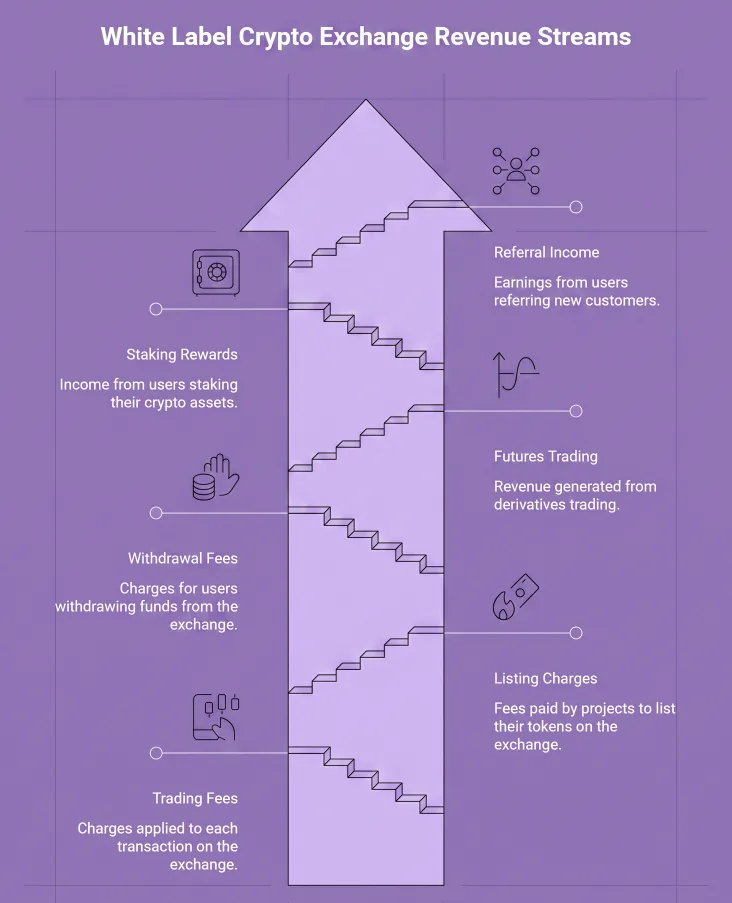
How White Label Crypto Exchange Owners Generate Revenue
A white label trading platform business earns from multiple revenue streams running at the same time. Each stream contributes to total income independently, which means the business does not rely on any single source.[1]
1. Trading Fees — The Primary Income Source
Every buy and sell order placed on the exchange generates a fee — typically between 0.1% and 0.5% of the transaction value. The fee is split between the maker (the trader who places an order) and the taker (the trader who fills it), often at different rates. At high daily volumes, even a 0.1% fee creates substantial, consistent revenue.
To put this in concrete terms: if an exchange processes $10 million in daily trading volume and charges an average fee of 0.2%, it earns $20,000 per day — or approximately $7.3 million per year — purely from spot trading fees. The fee revenue scales directly with volume and requires no additional per-trade cost to the exchange owner beyond infrastructure.
2. Token Listing Fees
New crypto projects consistently pay to list on exchanges with active user bases. Listing fees depend on the exchange’s reputation, user volume, and geographic reach. On established platforms, listing fees range from tens of thousands to hundreds of thousands of dollars per token. For a growing white label exchange building a track record, listing fees can represent a significant secondary income stream alongside trading fees.[2]
3. Withdrawal and Deposit Fees
Exchanges charge users a small fixed or percentage-based fee when they withdraw crypto to an external wallet or deposit fiat currency. These fees are separate from trading fees and add up steadily as the user base grows. Withdrawal fees also serve a practical purpose — they partially offset the gas or network fees the exchange itself pays when processing on-chain transactions.
4. Margin Trading and Futures
When users trade on margin (borrowing funds to increase their position size), the exchange earns interest on the borrowed amount. Futures trading platforms earn from funding rates — periodic payments between long and short position holders — as well as from the transaction fees on futures contracts. Futures often generate trading volumes several times higher than spot markets, which multiplies fee revenue significantly.[3]
Running a white label crypto exchange development platform with futures trading enabled requires real-time risk infrastructure and, in many jurisdictions, additional regulatory approvals. However, the revenue potential makes it one of the highest-value features an exchange owner can add after establishing a spot trading base.
5. Staking and Yield Services
Exchange owners can offer staking for proof-of-stake cryptocurrencies directly on their platform. The exchange receives the staking reward from the network and pays users a portion of it, keeping a spread as revenue. For example, if a network pays 8% annual staking rewards and the exchange pays users 6%, it retains 2% on all staked assets. As the total value staked grows, this revenue compounds automatically.
6. Premium Account Tiers and API Access
Many exchanges offer paid subscription tiers that give high-volume traders reduced fees, faster order execution, advanced charting tools, or priority customer support. Institutional traders and algorithmic trading firms often pay for dedicated API access that allows them to connect trading bots directly to the exchange’s order book. These subscription revenues are recurring and predictable, unlike fee income which fluctuates with market activity.[4]
7. Referral and Affiliate Programs
Exchange owners can run referral programs where existing users earn a percentage of the trading fees generated by users they refer. This reduces the exchange’s direct marketing cost while growing the user base. The referred users generate new fee revenue, and the referrer receives only a fraction of that — meaning the exchange retains the majority of the new income while paying users to do the user acquisition work.
White Label Crypto Exchange Revenue Streams
| Revenue Stream | How It Works | Typical Rate | Scales With |
|---|---|---|---|
| Trading Fees | Fee on every buy/sell order | 0.1% – 0.5% per trade | Trading volume |
| Token Listing Fees | One-time fee paid by new projects | $10K – $500K+ per listing | Exchange reputation |
| Withdrawal Fees | Fee per user withdrawal | Fixed or % of amount | Active user base |
| Margin / Futures Fees | Interest + funding rates on leveraged positions | 0.01% – 0.1% per position | Derivatives volume |
| Staking Spread | Difference between network reward and user payout | 1% – 3% spread | Total value staked |
| Premium Subscriptions | Paid tiers for advanced features and lower fees | $20 – $500/month per user | Premium user count |
| API Access Fees | Institutional / algo traders pay for direct access | Fixed monthly fee | Institutional clients |
| Referral Programs | Users bring new traders, exchange keeps majority of fees | 10% – 30% to referrer | Community growth |
What Does a White Label Exchange Cost to Launch?
The cost of launching a white label exchange is significantly lower than building one from scratch. A custom-built exchange can reach a total cost of ownership of $1.2 million to $2 million over two years when development, hosting, compliance, maintenance, and liquidity management are included. A white label platform averages $150,000 to $300,000 over the same period, covering all of the same categories.[5]
The white label provider charges either a flat monthly license fee, a percentage of revenue, or a combination of both. The business model for the exchange owner is direct: earn more from user fees than you pay the provider. Everything above that threshold is profit. Understanding the full cost comparison between these two approaches is covered in detail in the guide on white label vs custom crypto exchange development, including how costs shift as the platform scales.
In addition to the provider fee, exchange owners need to budget for regulatory licensing, marketing, liquidity setup, and customer support. Licensing jurisdiction matters. Fast-track options like Malta, Lithuania, and Seychelles have lower compliance costs. Higher-prestige jurisdictions like Singapore, UAE (VARA), and the EU (under MiCA) cost more but unlock access to institutional clients and broader markets.
White Label vs Custom Crypto Exchange: Cost Comparison
| Cost Factor | White Label Exchange | Custom-Built Exchange |
|---|---|---|
| Development Cost | Included in license | $500K – $1M+ |
| Time to Launch | 4 – 12 weeks | 12 – 18 months |
| Maintenance | Handled by provider | Requires in-house team |
| Security Audits | Often included or reduced cost | $50K – $200K separately |
| 2-Year Total Cost | $150K – $300K | $1.2M – $2M |
| Regulatory Tools | KYC/AML included | Must be built or integrated |
| Scalability | Modular — add features as needed | Requires additional development |
Why Entrepreneurs Choose White Label Over Building from Scratch
Nearly 65% of new exchanges that launched in 2025 used white label infrastructure. The reasons are practical, not just financial.[6]
Speed to Market
Every month spent in development is a month where competitors are acquiring users and building brand equity. A white label platform can launch in 4 to 12 weeks. A custom build takes 12 to 18 months minimum. In a market driven by first-mover advantage within a specific user segment or geography, this time difference is decisive.
Proven Technology
White label providers have already solved the hard engineering problems: high-frequency order matching, wallet security, multi-chain support, and real-time risk detection. These systems have been tested in live environments. A new exchange does not need to discover these failure points through its own users.
Liquidity from Launch
Empty order books are the main reason new exchanges fail. Users cannot trade if there are no counterparties. White label platforms connect to liquidity aggregators that pull order book depth from established exchanges like Binance and Kraken. This means the platform has active markets from the first day of operation, which is critical for user retention.[7]
Regulatory Readiness
Most white label providers include built-in KYC (Know Your Customer) and AML (Anti-Money Laundering) modules. In 2026, the EU’s MiCA regulation and equivalent frameworks in the US (FinCEN), UAE (VARA), and Singapore (MAS) require crypto businesses to meet specific compliance standards. Having compliance tools built into the platform reduces the time and cost of meeting these requirements compared to building them from the ground up.
Trend to Watch (2025–2026)
White label exchanges are evolving beyond simple trading platforms. In 2026, the most competitive platforms now integrate DeFi yield farming, Real-World Asset (RWA) tokenization trading, and AI-powered analytics that give traders automated market signals. Exchange owners who add these features early expand their revenue model beyond fees into ecosystem monetization — capturing value from every financial service a user accesses, not just from trades.
Risks Exchange Owners Must Manage
Regulatory Compliance Is Non-Negotiable
The moment a business runs a crypto exchange, it becomes a financial services provider. In the US, this likely requires a money transmitter license. In Europe, MiCA registration is mandatory for operating legally in member states. Other jurisdictions have equivalent requirements. Operating without the correct licenses creates legal liability that can shut down the business entirely regardless of how well the trading platform performs.
Security Is an Ongoing Responsibility
White label providers handle platform-level security, but exchange owners remain responsible for operational security — how funds are stored, how admin access is controlled, and how customer support responds to account compromise attempts. Using cold wallets for the majority of user funds, requiring multi-factor authentication, and conducting regular third-party security audits are minimum requirements for any exchange handling user assets.
Liquidity Management After Launch
Aggregated liquidity from day one is a starting point, not a permanent solution. As the exchange grows, owners need to actively manage market depth by partnering with market makers, offering competitive fee tiers for high-volume traders, and listing assets that attract active trading communities. Thin order books drive users to competitors, reducing fee revenue and platform credibility simultaneously.
Launch Your Own White Label Crypto Exchange
Nadcab Labs builds and deploys branded white label crypto exchange platforms — including matching engine, multi-wallet integration, KYC/AML modules, liquidity setup, and admin infrastructure configured for your target market and regulatory jurisdiction.
Frequently Asked Questions
Q1.How do white label exchange owners make money?
White label exchange owners earn from multiple streams: trading fees (0.1%–0.5% per transaction), token listing fees paid by new projects, withdrawal and deposit charges, margin trading interest, staking spreads, premium subscription plans, and API access fees for institutional traders. These revenue streams run simultaneously, so income does not depend on any single source.
Q2.How much does a white label exchange cost?
A white label crypto exchange costs approximately $150,000 to $300,000 over two years, covering licensing, maintenance, security, and scaling. Building a custom exchange from scratch reaches $1.2 million to $2 million over the same period. Additional costs include regulatory licensing fees, marketing, and liquidity management, which vary by jurisdiction and target market.
Q3.Is a white label crypto exchange profitable?
It can be. Profitability depends on trading volume, fee structure, and operating costs. An exchange processing $10 million in daily volume at 0.2% average fees earns approximately $7.3 million annually from trading fees alone. Margin trading, listings, and staking add further income. The business becomes profitable when total user fees exceed provider licensing costs and operating expenses.
Q4.How long does white label exchange launch take?
Most white label exchange platforms can be configured, branded, and launched in 4 to 12 weeks, depending on the complexity of customizations and the time required to complete regulatory licensing in the chosen jurisdiction. This compares to 12 to 18 months for a custom-built exchange and is the primary operational advantage of the white label model for new market entrants.
Q5.Do white label exchanges need regulatory licenses?
Yes. Any business operating a crypto exchange is legally classified as a financial services provider in most jurisdictions. In the EU, MiCA registration is required. In the US, a money transmitter license applies. Singapore, UAE, and other active crypto markets have equivalent frameworks. White label providers often include KYC/AML tools that simplify compliance, but the license itself must be obtained by the exchange owner.
Explore Services
Related Services
Reviewed by

Aman Vaths
Founder of Nadcab Labs
Aman Vaths is the Founder & CTO of Nadcab Labs, a global digital engineering company delivering enterprise-grade solutions across AI, Web3, Blockchain, Big Data, Cloud, Cybersecurity, and Modern Application Development. With deep technical leadership and product innovation experience, Aman has positioned Nadcab Labs as one of the most advanced engineering companies driving the next era of intelligent, secure, and scalable software systems. Under his leadership, Nadcab Labs has built 2,000+ global projects across sectors including fintech, banking, healthcare, real estate, logistics, gaming, manufacturing, and next-generation DePIN networks. Aman’s strength lies in architecting high-performance systems, end-to-end platform engineering, and designing enterprise solutions that operate at global scale.