Ai Overview
We are witnessing the most significant shift in internet architecture since the birth of the World Wide Web. Web2 introduced interactivity, social platforms, and user-generated content, but at a significant cost: centralized corporations captured the value while users provided the labor and data. Conflating them leads to strategic misalignment and poor technology investment decisions. The virtual economy has generated entirely new revenue categories that did not exist in the Web2 era.
Key Takeaways
- Web3 and metaverse technologies are converging to reshape the global digital economy, creating new opportunities across the USA, UK, UAE, and Canada.
- Blockchain technology serves as the foundational infrastructure enabling trust, ownership, and transparency in Web3 metaverse ecosystems.
- Decentralized web platforms empower users through digital identities, token-based governance, and peer-to-peer economic interactions without central authority.
- NFTs and digital assets are redefining ownership models in virtual worlds, enabling creators to monetize immersive digital experiences at scale.
- The metaverse ecosystem is projected to contribute trillions to the digital economy by 2030, with enterprise adoption accelerating across industries.
- Web3 applications are disrupting traditional banking, gaming, real estate, and retail sectors through smart contracts and decentralized finance protocols.
- Regulatory frameworks across the UK, UAE, and North America are gradually adapting to support compliant Web3 and metaverse operations.
- Security, scalability, and accessibility remain the top barriers to mainstream Web3 technology adoption among enterprise and consumer markets alike.
- AI integration within virtual reality ecosystems is accelerating metaverse immersion, enabling personalized, adaptive, and intelligent user experiences.
- Building a sustainable digital economy requires open standards, interoperability protocols, and cross-platform digital identity infrastructure.
Introduction to Web3 and Metaverse
We are witnessing the most significant shift in internet architecture since the birth of the World Wide Web. Over our eight-plus years of guiding enterprises across the USA, UK, UAE, and Canada through digital transformation journeys, our team has seen waves of change, but none as structurally fundamental as the simultaneous rise of Web3 and metaverse ecosystems. These two paradigms are not isolated trends; they are complementary forces rewriting how humans interact, transact, and create value in a digital economy that is expanding beyond physical borders. Web3 technology dismantles the centralized gatekeeping model of today’s internet, while the metaverse builds the immersive spatial layer where those decentralized interactions come alive. Together, they form the backbone of a new digital civilization, one that prioritizes user sovereignty, open ownership, and borderless economic participation. Understanding both concepts individually, as well as how they interlock, is no longer optional for forward-thinking businesses. It is a strategic imperative.
Evolution from Web1 to Web3
The internet’s evolution follows a clear trajectory from consumption to participation to ownership. Web1, spanning the early 1990s to mid-2000s, was a read-only network of static pages where users consumed information but contributed little. Web2 introduced interactivity, social platforms, and user-generated content, but at a significant cost: centralized corporations captured the value while users provided the labor and data. Platforms like social networks, search engines, and marketplaces became trillion-dollar businesses built on essentially free user participation. Web3 technology represents the logical correction to this imbalance. By embedding cryptographic ownership, decentralized governance, and programmable money directly into the internet’s protocol layer, Web3 returns value to the participants who generate it. For businesses in Canada’s growing tech sector or the UAE’s innovation-forward regulatory zones, Web3 represents a structural opportunity to build platforms that are competitive precisely because they share value with users rather than extracting it from them.
Understanding the Concept of the Metaverse
The metaverse is best understood not as a single platform but as a persistent, interconnected layer of virtual reality ecosystems where people can work, play, socialize, and transact. It is the spatial internet: a three-dimensional extension of today’s flat web, accessible through augmented and virtual reality hardware, standard browsers, and even mobile devices. Major enterprises in the UK financial sector are already piloting virtual boardrooms and training simulations, while retail brands in the USA are opening digital storefronts where customers try products before buying them in the physical world. The metaverse is not a future concept; it is an active construction site, with billions of dollars flowing into infrastructure, content, and platforms annually. What differentiates the current wave of metaverse building from earlier virtual worlds is the integration of blockchain technology, which enables true digital ownership, interoperability of assets across platforms, and real economic activity within virtual environments.
Why the Digital Economy is Rapidly Changing?
The digital economy is accelerating because the infrastructure for trust has fundamentally improved. Historically, digital commerce required intermediaries: banks to process payments, platforms to enforce contracts, and corporations to verify identities. Web3 technology replaces these intermediaries with cryptographic proofs, smart contracts, and decentralized protocols. Meanwhile, advancements in 5G connectivity, spatial computing hardware, and AI-driven content generation are making immersive digital experiences affordable and scalable. In the UAE, government-backed metaverse strategies are already positioning the country as a global hub for virtual economy activity. Canada’s regulatory clarity on digital assets is drawing blockchain entrepreneurs at record rates. The digital economy is changing not because of a single invention but because a cluster of complementary technologies, blockchain, AI, VR/AR, edge computing, and decentralized storage, have reached simultaneous maturity, creating a compounding effect that is transforming every industry sector.
What is Web3 Technology?
Web3 technology is the third generation of internet services built on decentralized protocols, enabling users to interact directly with digital infrastructure without relying on centralized servers or corporate intermediaries. At its core, Web3 is an internet where data ownership, financial rails, and identity verification are controlled by users through cryptographic keys rather than by platforms through passwords and terms of service. For enterprises operating across multiple jurisdictions, from London to Dubai to Toronto, Web3 offers compliance-friendly architectures that can embed regulatory logic directly into smart contracts, reducing operational overhead while increasing auditability.
Core Principles of Web3
Decentralization
- No single point of failure or control
- Distributed node networks globally
- Censorship-resistant data storage
- Community-driven protocol upgrades
Trustless & Permissionless
- Code enforces agreements automatically
- Open access without gatekeepers
- Transparent on-chain verification
- Self-sovereign digital identities
Native Digital Ownership
- Tokenized assets on public ledgers
- Transferable without platform permission
- Programmable value and royalties
- Cross-platform asset portability
Role of Blockchain Technology in Web3
Blockchain technology is the immutable ledger that makes Web3’s promises credible. Without a shared, tamper-resistant record of transactions and ownership, decentralization would be a theoretical concept without practical enforceability. Blockchain achieves consensus across thousands of geographically distributed nodes, ensuring that every asset transfer, identity verification, and governance vote is recorded permanently and transparently. For Web3 in supply chain applications, this is transformative: a product’s journey from manufacturer to consumer can be recorded on-chain, creating an auditable trail that eliminates counterfeiting, optimizes inventory logistics, and builds consumer trust. UK food retailers and UAE luxury goods exporters are already piloting blockchain-based provenance tracking systems that leverage Web3 infrastructure to provide real-time visibility across global supply networks. The immutability and transparency of blockchain are not just technical features; they are economic enablers that reduce friction and increase trust at institutional scale.
Smart Contracts and Decentralized Applications
Smart contracts are self-executing programs stored on blockchain networks that automatically enforce the terms of an agreement when predefined conditions are met. They eliminate the need for legal intermediaries in routine transactions, dramatically reducing costs and settlement times. Decentralized applications (dApps) are built on top of smart contract infrastructure, offering user interfaces to blockchain-powered services ranging from lending platforms and decentralized exchanges to gaming economies and professional credential verification systems. For enterprises in the USA’s fintech corridor and Canada’s growing DeFi ecosystem, smart contracts are already processing billions of dollars in value daily. The programmability of these contracts means that compliance rules, royalty distributions, escrow conditions, and governance votes can all be automated with cryptographic certainty, eliminating human error and reducing operational costs significantly across complex multi-party transactions.
Peer-to-Peer Networks and Digital Ownership
The peer-to-peer architecture of Web3 networks fundamentally changes the economics of digital interaction. When two parties can transact directly over a blockchain network without a platform extracting a fee for facilitating the connection, value flows more efficiently to the actual participants. Digital ownership in Web3 is verifiable, transferable, and composable: a user’s NFT collection, token holdings, and on-chain reputation can serve as portable identity credentials across dozens of different platforms. This is the “bring your own identity” model that makes the decentralized web genuinely user-centric. For creators and entrepreneurs in the UK creative economy, peer-to-peer ownership models mean that music rights, art royalties, and content licensing can be managed autonomously through smart contracts, without relying on intermediary labels, galleries, or publishing houses to honor their contractual obligations.
Understanding the Metaverse Ecosystem
The metaverse ecosystem is a layered technological and economic environment that combines virtual reality ecosystems, blockchain infrastructure, AI-driven content engines, and social interaction protocols. Understanding it requires looking at both its technical architecture and its economic logic. The metaverse is not a single company’s product; it is an emerging standard, much like the early internet, where multiple platforms are competing to establish interoperable norms that will eventually coalesce into a unified spatial web experience. For investors and enterprise leaders evaluating metaverse opportunities in the UAE or North American markets, understanding the ecosystem’s component layers is critical for identifying where durable value will be created.
Role of NFTs and Digital Assets in Metaverse
Non-fungible tokens (NFTs) are the ownership certificates of the metaverse. They represent verifiable, unique digital assets: virtual land parcels, avatar wearables, in-game items, art pieces, event tickets, and access passes that exist on blockchain networks and can be bought, sold, and displayed across compatible virtual platforms. What makes NFTs strategically important in the metaverse context is their interoperability potential: an avatar outfit purchased on one platform could theoretically be worn in an entirely different virtual world, provided both platforms adopt common metadata standards. UAE luxury brands like leading fashion houses are already issuing NFT-backed digital twins of physical products, allowing customers to own provably scarce digital versions that unlock exclusive experiences. This convergence of physical and digital ownership represents a profound shift in how brands create loyalty and how consumers assign value to their digital possessions within the broader metaverse ecosystem.
Immersive Digital Experiences and Virtual Reality
Immersive digital experiences are the product layer of the metaverse: concerts attended by avatars, virtual conferences with spatial audio, branded retail environments where customers walk through curated product displays, and educational simulations where medical students perform virtual surgeries. The quality and accessibility of these experiences are improving rapidly as hardware costs decline and rendering technology advances. Virtual reality ecosystems built on Web3 rails add a critical dimension that earlier VR experiments lacked: economic participation. Users in these environments are not just consumers; they are economic agents who earn, spend, and invest within virtual economies that have real monetary value. UK-based immersive entertainment studios are partnering with blockchain platforms to create experience economies where audience members earn token rewards for participation, shifting the entertainment business model from passive ticket sales to active economic engagement.
Web3 vs Metaverse: Key Differences Explained
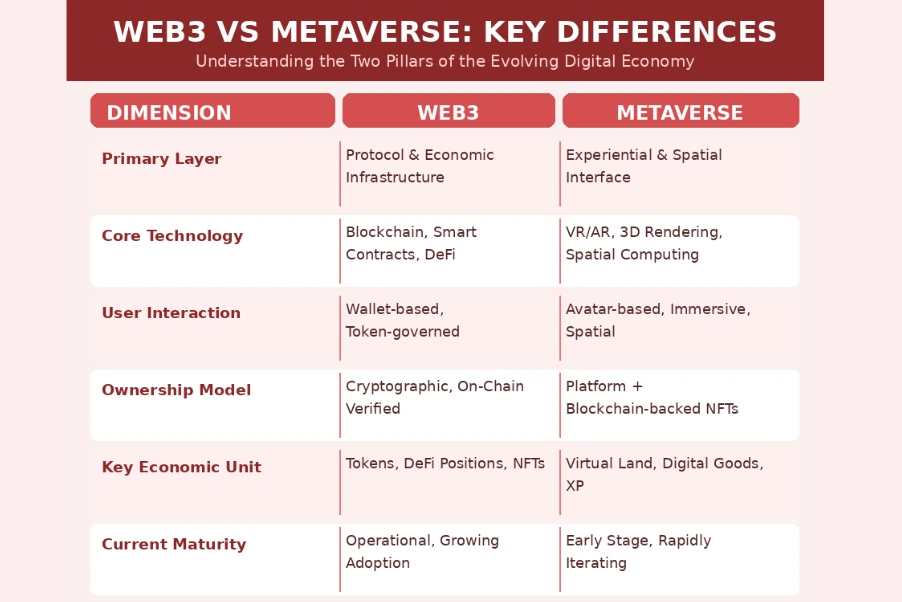
One of the most frequent questions we receive from enterprise clients across North America and the Gulf region is how to distinguish Web3 from the metaverse, and whether they need to adopt one, the other, or both. The answer requires understanding that these are not competing concepts but operating at different architectural layers. Web3 is the protocol and economic layer; the metaverse is the experiential and spatial layer. Web3 provides the rails for ownership and trust; the metaverse provides the stage on which that ownership is exercised. Conflating them leads to strategic misalignment and poor technology investment decisions.
Ownership and Governance Models
Ownership in Web3 is cryptographically absolute: the holder of a private key controls the asset, period. In the metaverse, ownership models are more nuanced, ranging from platform-defined items that exist only within one ecosystem to blockchain-backed NFTs that the user controls independently of any platform. Governance in Web3 typically operates through Decentralized Autonomous Organizations (DAOs), where token holders vote on protocol upgrades, treasury allocations, and community standards. Metaverse platforms are experimenting with similar governance models, empowering virtual land owners and active community members to shape the rules of their shared digital environments. For institutional investors in the UK and UAE evaluating these ecosystems, governance quality is increasingly a due diligence criterion, as poorly governed protocols present regulatory and financial risks that well-structured DAOs can mitigate through transparent on-chain decision-making processes.
Technology Stack Behind Web3 and Metaverse
The technology stacks powering Web3 and the metaverse overlap significantly at the infrastructure layer while diverging at the application layer. Both rely on decentralized storage solutions like IPFS and Filecoin for content persistence, and both leverage blockchain networks for asset ownership and economic transactions. Web3 applications are primarily built with Solidity smart contracts on Ethereum-compatible chains, with layer-2 scaling solutions addressing throughput limitations. The metaverse experience layer adds Unity and Unreal Engine-based 3D rendering, WebXR protocols for browser-based immersion, and spatial audio systems for realistic environment simulation. Understanding this technology stack is essential for Canadian and American technology teams scoping Web3 metaverse projects, as architectural decisions made early in the stack selection process have long-term implications for interoperability, user experience quality, and scalability costs.
The Connection Between Web3 and Metaverse
The relationship between Web3 and the metaverse is best understood through the lens of mutual dependency. The metaverse needs Web3 to be economically meaningful: without blockchain-backed ownership, virtual worlds are entertainment products rather than economic systems. Web3 needs the metaverse to be experientially compelling: without engaging spatial interfaces, blockchain applications remain inaccessible to mainstream users unfamiliar with wallet management and cryptographic keys. Their convergence creates something genuinely new: a user-owned internet where economic activity and social interaction happen in shared, persistent, three-dimensional digital spaces governed by transparent, community-controlled rules.
How Web3 Powers the Metaverse Ecosystem
Digital Ownership Layer
Blockchain ensures every virtual asset, from land parcels to avatar items, is provably owned by specific wallet addresses, creating a real economy within virtual worlds.
Decentralized Identity
Web3 digital identities allow users to carry their reputation, credentials, and assets across multiple metaverse platforms without re-registering or losing history.
Programmable Economies
Smart contracts automate in-metaverse commerce: royalty payments, rental agreements for virtual land, and play-to-earn reward distributions happen without manual intervention.
Governance & Community Control
DAOs allow metaverse communities to vote on platform rules, content moderation standards, and economic parameters, replacing corporate unilateral control with collective decision-making.
Creator Economy and User-Owned Platforms
The creator economy within Web3 metaverse environments is fundamentally different from the creator economy of Web2 social platforms. Rather than receiving a platform-controlled share of advertising revenue, Web3 creators own their content outright as tokenized assets and earn directly from their audience through NFT sales, token-gated communities, and on-chain royalty streams. This model is attracting significant creative talent from the UK’s digital arts community and North America’s entertainment sector. Platforms like Decentraland and The Sandbox, built on Web3 rails, enable architects, game designers, musicians, and brand strategists to build virtual venues, experiences, and products that generate sustainable revenue streams without platform permission or revenue share agreements. The user-owned platform model shifts competitive dynamics: creators choose platforms based on their economic terms rather than their audience size, incentivizing platforms to offer genuinely creator-friendly conditions to attract talent.
How Web3 and Metaverse are Transforming the Digital Economy?
The transformation catalyzed by Web3 and metaverse technologies is not incremental improvement of existing systems; it is structural disruption of fundamental economic relationships. Industries that relied on information asymmetry, geographic monopolies, and platform lock-in as competitive moats are finding these advantages eroded by transparent, interoperable, and user-controlled digital infrastructure. From finance to gaming to commerce to professional collaboration, the digital economy is being rewired from its foundation, and organizations that understand this shift are positioning themselves at the forefront of the next decade’s most significant value creation opportunities.
Impact on Banking and Financial Services
Decentralized finance protocols built on Web3 infrastructure are processing hundreds of billions of dollars in transaction volume annually, offering lending, borrowing, yield generation, and currency exchange services without traditional bank intermediaries. UK challenger banks are integrating Web3 wallets into their mobile applications, allowing customers to hold both fiat and digital assets in unified accounts. In the UAE, the Abu Dhabi Global Market has created regulatory sandboxes specifically designed to enable compliant DeFi operations, attracting global fintech innovators. Canadian pension funds and family offices are allocating portions of their portfolios to tokenized real-world assets, including infrastructure bonds and real estate securities, issued on Web3 platforms. The financial services transformation driven by blockchain technology is not about replacing banks wholesale; it is about making financial infrastructure more programmable, accessible, and efficient for both institutional and retail participants globally.
Transformation of Gaming and Entertainment
The gaming industry was among the first sectors to fully embrace the Web3 metaverse convergence, and the results are reshaping the economics of interactive entertainment. Play-to-earn models pioneered by games like Axie Infinity demonstrated that players could generate meaningful income through skill and participation in virtual economies. While early models faced sustainability challenges, the fundamental insight remains valid: games with tokenized economies create engaged communities with real financial stakes in the ecosystem’s success. Major gaming studios in the USA are launching blockchain-integrated titles where in-game items are NFTs that players truly own and can trade freely on open marketplaces. Virtual concerts, sports events, and entertainment experiences hosted in metaverse environments are drawing millions of concurrent attendees, creating new revenue streams for artists and promoters while offering fans immersive digital experiences previously impossible through flat-screen broadcasts.
Digital Commerce and NFT Marketplaces
Digital commerce in the Web3 metaverse context extends far beyond NFT art trading. It encompasses virtual fashion, digital real estate, branded experience environments, and utility tokens that grant access to products, services, and communities. NFT marketplaces have evolved from simple image trading platforms into sophisticated commerce infrastructure supporting complex royalty structures, fractional ownership, and collateralized lending against digital assets. UAE luxury retailers are issuing NFT-linked physical products where blockchain verification guarantees authenticity and provenance. UK streetwear brands are selling limited digital collections that unlock physical counterparts, bridging online exclusivity with physical fulfillment. North American e-commerce platforms are integrating NFT loyalty programs that give customers tradeable, transferable rewards with real secondary market value, fundamentally improving on the closed-loop points systems that dominated the previous decade of customer loyalty programs.
Future of Remote Work and Virtual Collaboration
Virtual collaboration in metaverse workspaces represents a compelling alternative to both physical offices and flat video conferencing tools. Companies like Meta, Microsoft, and various Web3 startups are building persistent virtual offices where avatars meet, collaborate on three-dimensional projects, and access decentralized tools without geographic constraints. Web3 integration adds powerful dimensions to this collaboration model: contributors can receive token-based compensation for their work, intellectual property created in virtual environments can be automatically attributed and monetized through smart contracts, and professional credentials can be verified on-chain without the friction of traditional background check processes. Canadian and UK remote-first companies are piloting metaverse headquarters that serve as cultural anchors for globally distributed teams, creating shared spatial identity without requiring physical co-location or the cultural flatness of traditional video call culture.
Business Opportunities in Web3 and Metaverse
The business opportunity landscape within Web3 and metaverse ecosystems is vast and rapidly differentiating across startup and enterprise segments. Over our eight years of advising clients from Silicon Valley to the City of London and Dubai’s DIFC, we have observed that the organizations capturing the most durable value are those that identify the specific layer of the Web3 metaverse stack where their existing competencies create a defensible advantage, rather than attempting to build everything from scratch. Strategic clarity about which layer to compete at, protocol, application, content, or experience, is the first and most critical business decision in this space.
Web3 Metaverse Model Selection Criteria
Assess Core Competency Fit
- Map existing tech strengths to Web3 stack layers
- Identify where blockchain adds genuine value
- Evaluate team readiness for cryptographic architecture
- Audit current data ownership and governance structures
Define Market & Revenue Model
- Choose between B2B infrastructure or B2C metaverse experience
- Model token economics for sustainable incentives
- Select target jurisdiction regulatory framework
- Identify Web3 vs metaverse revenue mix proportion
Build & Validate Iteratively
- Launch on testnet before mainnet deployment
- Community-test NFT and token mechanics early
- Run controlled pilots in one jurisdiction first
- Establish on-chain governance before scaling
New Revenue Models in Virtual Economy
The virtual economy has generated entirely new revenue categories that did not exist in the Web2 era. Virtual land appreciation and rental income within metaverse platforms mirror real-world real estate economics but with global accessibility and fractional ownership enabled through tokenization. Play-to-earn and create-to-earn models allow participants to generate income through skill, creativity, and participation rather than capital investment alone. Token-gated community access creates recurring subscription-equivalent revenue for creators without platform dependency. In-metaverse advertising and branded experience placements command premium rates because of their immersive engagement metrics compared to flat-screen alternatives. For enterprises in the UAE’s diversifying economy and Canada’s thriving digital sector, these new revenue models represent genuine economic diversification opportunities that leverage digital capabilities to access global virtual economy participants rather than being constrained by geographic market limitations.
Industry 4.0 and Digital Transformation
Web3 and metaverse technologies are emerging as critical components of Industry 4.0 strategy, particularly in manufacturing, logistics, and supply chain management sectors. Web3 in supply chain contexts enables unprecedented traceability: every material, component, and finished product can carry an on-chain identity that records its journey from raw material extraction through manufacturing, distribution, and final sale. This level of transparency reduces fraud, improves recall efficiency, and demonstrates sustainability credentials to increasingly demanding consumers in UK and North American markets. Digital twins of manufacturing facilities rendered in metaverse environments allow engineers to optimize production processes, simulate failure scenarios, and train workers in immersive virtual environments before engaging with physical machinery. The convergence of IoT sensor data with blockchain verification and metaverse visualization creates a powerful industrial intelligence stack that represents one of the most concrete near-term value propositions of the Web3 metaverse ecosystem for asset-heavy industries.
Challenges Facing Web3 and Metaverse Adoption
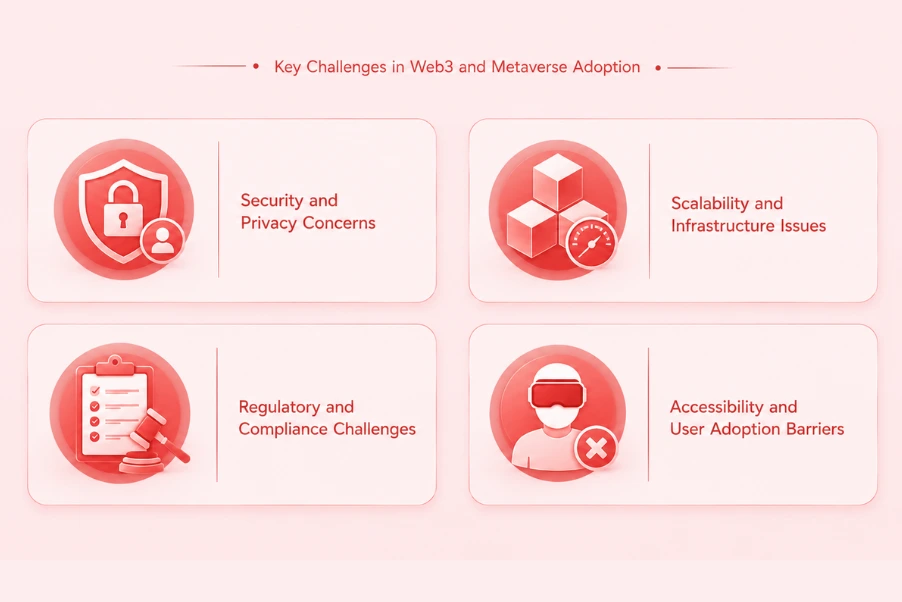
Candid assessment is a hallmark of trusted advisors. While the opportunities in Web3 and metaverse ecosystems are substantial, the challenges facing mainstream adoption are equally significant and must be honestly evaluated by any organization planning investments in this space. The gap between technological possibility and practical, scalable, user-friendly implementation remains considerable, and organizations that underestimate these friction points risk project failures that set back both their own initiatives and the broader ecosystem’s credibility. Understanding challenges as design constraints rather than barriers, however, is how experienced teams transform obstacles into competitive advantages.
Security and Privacy Concerns
Web3 security incidents have cost the ecosystem billions of dollars through smart contract exploits, bridge hacks, and phishing attacks targeting wallet holders. The irreversibility of blockchain transactions, a feature in legitimate use cases, becomes a catastrophic liability when exploits occur: there is no fraud department to call, no transaction reversal mechanism, no insurance backstop in most protocols. Privacy presents a paradox: the transparency that makes blockchain trustworthy also creates permanent, publicly visible financial records that may conflict with GDPR obligations in the UK and EU, creating genuine compliance tensions for enterprises operating in those jurisdictions. Metaverse environments introduce additional biometric and behavioral data collection risks as spatial computing hardware tracks eye movements, physical gestures, and emotional responses. Addressing these challenges requires defense-in-depth security architectures, zero-knowledge proof implementations for privacy-preserving verification, and proactive regulatory engagement rather than reactive compliance retrofitting.
Scalability and Infrastructure Issues
Current public blockchain networks face fundamental throughput constraints that limit their suitability for the millions of simultaneous transactions a fully realized metaverse economy would generate. Ethereum’s transition to proof-of-stake improved energy efficiency dramatically, but peak-period gas fees still create prohibitive friction for microtransaction-dependent applications. Layer-2 scaling solutions including optimistic rollups and zero-knowledge rollups address throughput significantly, but introduce additional complexity in user experience and asset bridging that creates onboarding challenges for mainstream audiences. Metaverse-specific infrastructure, including the edge computing networks required to render complex three-dimensional environments with acceptable latency, remains unevenly distributed globally, creating quality-of-experience disparities between users in high-bandwidth urban markets and those in less-connected regions, limiting the truly global accessibility that makes Web3’s value proposition compelling.
Regulatory and Compliance Challenges
The regulatory landscape for Web3 and metaverse operations is fragmented and rapidly evolving, creating significant compliance complexity for organizations operating across multiple jurisdictions. The USA’s enforcement-first approach to crypto regulation, the UK’s consultative framework, the UAE’s proactive licensing regime, and Canada’s evolving securities guidance create a patchwork of requirements that demand jurisdiction-specific legal strategy rather than a single unified compliance approach. Token classification remains particularly contentious: whether a governance token constitutes a security, a utility, or an entirely new asset class determines which regulatory framework applies and profoundly affects how the token can be marketed, sold, and used. Our teams working with clients across these four markets consistently find that regulatory clarity, even imperfect clarity, is preferable to regulatory ambiguity for enterprise planning purposes, and we advocate for proactive regulatory engagement over a wait-and-see posture.
Accessibility and User Adoption Barriers
Perhaps the most underappreciated challenge facing Web3 and metaverse adoption is the user experience gap between what these technologies can do and what everyday users can comfortably navigate. Wallet management, seed phrase security, gas fee estimation, token bridging, and smart contract interaction require a level of technical literacy that excludes the majority of potential users. Metaverse hardware, while improving rapidly, still requires headsets that are expensive and physically cumbersome for extended use. Onboarding flows for Web3 applications remain significantly more complex than comparable Web2 equivalents, creating high abandonment rates in early user cohorts. Bridging this accessibility gap through account abstraction, embedded wallet solutions, and intuitive metaverse interfaces that hide blockchain complexity behind familiar UX patterns is one of the field’s most commercially important design challenges, and organizations that solve it most elegantly will command disproportionate market share in the mainstream adoption phase.
Future of the Internet with Web3 and Metaverse
The future internet will be spatial, owned, and economically active. Drawing from our experience advising digital transformation initiatives across the USA, UK, UAE, and Canada, we observe consistent signals pointing toward a convergent future where the distinctions between the physical internet and the metaverse become increasingly blurred, and where Web3 ownership infrastructure becomes as foundational as TCP/IP is today. The organizations, communities, and nations that build this infrastructure thoughtfully, with attention to sustainability, accessibility, and governance integrity, will define the character of the digital economy for the coming generation.
Rise of Decentralized Web Platforms
Decentralized web platforms are gaining credibility and user bases as disillusionment with centralized platform practices grows among both creators and consumers. Decentralized social networks, storage systems, and content delivery networks are maturing rapidly, offering censorship resistance, data portability, and user-controlled monetization that centralized alternatives structurally cannot match. The decentralized web does not require abandoning convenience; it requires rebuilding convenient interfaces on top of decentralized infrastructure. As layer-2 scaling solutions reduce transaction costs to near-zero and account abstraction simplifies wallet interactions, the user experience gap between centralized and decentralized platforms will narrow substantially, removing the principal barrier to mainstream adoption of the decentralized web as the dominant mode of internet interaction globally.
AI Integration in Virtual Ecosystems
Artificial intelligence is becoming an indispensable layer within Web3 metaverse ecosystems, serving multiple critical functions simultaneously. AI generates the procedural content, non-player character behaviors, and adaptive environments that make large-scale metaverse worlds economically feasible to populate without requiring proportional numbers of human creators. On the Web3 side, AI agents are beginning to operate autonomously within blockchain ecosystems: managing DeFi positions, executing governance votes based on pre-defined parameters, and analyzing on-chain data to identify economic opportunities or security threats. The convergence of AI with blockchain creates AI agents that can own assets, earn income, and participate in governance, a genuinely novel economic entity class. For enterprises across North America and the Gulf region, this convergence opens possibilities for autonomous business processes that operate continuously without human oversight, creating efficiency gains previously achievable only through massive human workforce deployments.
Future Trends in Web3 Infrastructure
The infrastructure trends shaping Web3’s next evolution include cross-chain interoperability protocols that enable assets and data to move seamlessly between different blockchain networks without centralized bridges, which represent the current weakest security link in the Web3 ecosystem. Zero-knowledge proofs are moving from cryptographic novelty to production-grade technology, enabling privacy-preserving verification of identity, credentials, and financial information without exposing underlying sensitive data. Decentralized physical infrastructure networks (DePIN) are extending Web3 incentive models to real-world hardware: wireless networks, energy grids, and computing clusters operated by independent node operators who earn tokens for their contributions. Web3 in supply chain is benefiting directly from these infrastructure trends as IoT device networks recording physical world events are increasingly anchored to blockchain systems through oracle networks that provide tamper-resistant data feeds.
Building a Sustainable Digital Economy
Sustainability in the Web3 metaverse digital economy encompasses environmental, economic, and social dimensions that must be addressed together for long-term viability. Environmentally, the industry’s transition from energy-intensive proof-of-work consensus to proof-of-stake and other efficient alternatives has dramatically reduced the carbon footprint of major blockchain networks, with further gains expected as renewable energy integration with validator operations increases. Economically, sustainable tokenomics require value creation mechanisms that go beyond speculative appreciation, grounding token value in genuine utility, revenue sharing, and access rights that generate persistent demand independent of market sentiment cycles. Socially, sustainable digital economies must address inclusion: the populations with the greatest need for access to financial infrastructure, identity systems, and economic opportunity are often those with the lowest access to the hardware, connectivity, and technical literacy that current Web3 and metaverse applications require. Building inclusively is not only ethical; it is strategic, as the next billion users of these platforms will come from underserved markets where switching costs from legacy systems are lowest and value delivery potential is highest.
Final Thoughts
The convergence of Web3 and metaverse technologies represents more than a technical upgrade to the internet. It is a fundamental reordering of the economic relationships that govern how value is created, captured, and distributed in the digital age. Over our eight-plus years supporting blockchain and digital transformation initiatives across the USA, UK, UAE, and Canada, we have consistently observed that the organizations achieving durable success are those that approach these technologies as structural business strategy rather than marketing experimentation.
Blockchain technology provides the trust infrastructure, smart contracts automate the economic logic, digital identities enable portable participation, and the metaverse ecosystem provides the spatial canvas on which this new digital economy plays out in ways that are engaging, intuitive, and humanly meaningful. The challenges of security, scalability, regulation, and accessibility are real but surmountable, and the teams investing in solving them today are building the competitive advantages that will define market leadership tomorrow.
The question for forward-thinking organizations is no longer whether Web3 and metaverse technologies will reshape the digital economy. The evidence for that transformation is already visible in the financial flows, user adoption curves, and enterprise pilot programs proliferating across every major industry. The question is how quickly and effectively each organization will develop the capabilities, partnerships, and strategic clarity required to participate in this transformation as an architect rather than a spectator. The future of the digital economy is being built now. The organizations that build with intention and expertise will be the ones who define its shape.
Ready to Build Your Web3 Metaverse Strategy?
Partner with our team of blockchain architects to design, build, and launch compliant, scalable Web3 and metaverse solutions.
People Also Ask
Q1.What is the difference between Web3 and the metaverse?
Web3 and the metaverse operate at different layers of the internet stack. Web3 refers to the protocol and economic infrastructure layer powered by blockchain technology, enabling decentralized ownership, smart contracts, and token-based governance. The metaverse is the experiential and spatial interface layer: immersive virtual worlds where users interact through avatars. Web3 provides the economic rails; the metaverse provides the environment. Together they create a user-owned, economically active internet.
Q2.How does blockchain technology support the metaverse ecosystem?
Blockchain technology underpins the metaverse by providing verifiable, tamper-resistant ownership of digital assets such as virtual land, avatar wearables, and in-game items. Without blockchain, virtual assets exist only within a platform’s database and can be deleted or devalued at will. Blockchain ensures that NFTs and tokens are cryptographically owned by specific wallet addresses, enabling true digital ownership that persists independently of any single platform’s continued operation.
Q3.What are the main business opportunities in Web3 and metaverse?
Business opportunities span multiple layers: protocol infrastructure, application products, and experiential content. Startups can build decentralized finance tools, NFT marketplaces, and DAO governance frameworks. Enterprises can create branded virtual experiences, tokenized loyalty programs, and Web3-powered supply chain transparency systems. New revenue models including virtual land appreciation, token-gated access, creator royalties, and in-metaverse advertising are creating entirely new economic categories that did not exist in the Web2 era.
Q4.What challenges does Web3 face in mainstream adoption?
The four primary challenges are security, scalability, regulation, and accessibility. Smart contract exploits and wallet phishing remain costly threats. Network throughput limitations make microtransaction-heavy metaverse economies technically challenging at scale. Regulatory fragmentation across the USA, UK, UAE, and Canada creates compliance complexity. Most critically, the user experience gap between Web3 applications and mainstream consumer expectations, particularly around wallet management, creates high onboarding abandonment rates that limit mass adoption.
Q5.How are Web3 and metaverse transforming the digital economy?
They are transforming it by shifting value flows from platform intermediaries to direct participants. DeFi protocols replace bank services for lending and exchange. Play-to-earn gaming creates income from participation rather than just entertainment consumption. NFT marketplaces enable creator monetization without label, gallery, or publisher intermediaries. Virtual real estate creates new investment asset classes. Tokenized supply chains increase transparency and reduce fraud. Together these shifts represent a structural rewiring of digital economic relationships across every major industry sector.
Q6.What role do NFTs play in the metaverse ecosystem?
NFTs serve as the ownership certificates of the metaverse, representing unique, verifiable digital assets including virtual land parcels, avatar items, art pieces, event access passes, and branded digital products. Their blockchain backing means they are genuinely owned by their holders rather than licensed from a platform. Their interoperability potential allows assets purchased in one virtual world to potentially be used in another, creating cross-platform economies. Brands in the UAE and North America are using NFTs to bridge physical product authenticity with digital collectibility.
Explore Services
Related Services
Reviewed by

Naman Singh
Co-Founder & CEO, Nadcab Labs
Naman Singh is the Co-Founder and CEO of Nadcab Labs, where he drives the company’s vision, global growth, and strategic expansion in blockchain, fintech, and digital transformation. A serial entrepreneur, Naman brings deep hands-on experience in building, scaling, and commercializing technology-driven businesses. At Nadcab Labs, Naman works closely with enterprises, governments, and startups to design and implement secure, scalable, and business-ready Web3 and blockchain solutions. He specializes in transforming complex ideas into high-impact digital products aligned with real business objectives. Naman has led the development of end-to-end blockchain ecosystems, including token creation, smart contracts, DeFi and NFT platforms, payment infrastructures, and decentralized applications. His expertise extends to tokenomics design, regulatory alignment, compliance strategy, and go-to-market planning—helping projects become investor-ready and built for long-term sustainability. With a strong focus on real-world adoption, Naman believes in building blockchain solutions that deliver measurable value, solve practical problems, and unlock new growth opportunities for organizations worldwide.