Ai Overview
Web3 E-Commerce refers to commerce ecosystems built on decentralized blockchain infrastructure, where ownership, transactions, and governance are distributed among participants rather than controlled by a single corporation or platform. In the USA alone, surveys indicate that over 64% of digital consumers express concern about how their shopping data is used by major platforms. Fraud, chargebacks, and payment disputes cost global E-Commerce businesses an estimated $48 billion annually.
Key Takeaways
- Web3 E-Commerce replaces centralized platforms with blockchain-powered systems that give users true data ownership and eliminate unnecessary intermediaries.
- Smart contracts automate business transactions in real time, reducing processing costs by up to 60% and removing dependency on third-party payment processors.
- Businesses in the USA, UK, UAE, and Canada are integrating decentralized commerce platforms to access global markets with fewer regulatory and banking barriers.
- NFT-based loyalty programs and token-gated shopping experiences are creating new customer engagement models that traditional E-Commerce cannot replicate.
- Blockchain based commerce enhances supply chain transparency, allowing consumers to verify product origin, authenticity, and ethical sourcing at every stage.
- Cross-border digital commerce becomes significantly more efficient with Web3 payment solutions that settle transactions in seconds without currency conversion fees.
- Web3 marketplace platforms open new revenue streams including creator royalties, fractional ownership, and decentralized affiliate models for modern enterprises.
- Integration of AI with Web3 technology is enabling hyper-personalized shopping experiences powered by on-chain behavioral data that users voluntarily share.
- Scalability challenges and regulatory uncertainty remain the two biggest adoption barriers, but Layer-2 solutions and clearer frameworks are rapidly resolving these issues.
- Enterprises that partner with experienced Web3 developers now are gaining first-mover advantages in decentralized shopping ecosystems set to dominate the next decade.
The global digital commerce landscape is undergoing its most significant structural shift since the advent of the internet. Web3 E-Commerce is no longer a speculative concept discussed only in developer forums and blockchain conferences. It is actively reshaping how businesses in the USA, UK, UAE, and Canada conduct transactions, manage customer relationships, and build brand equity. With over eight years of hands-on experience guiding enterprises through digital transformations, our team has witnessed this evolution firsthand, and the momentum is undeniable.
From blockchain based commerce platforms that eliminate chargebacks to NFT-powered loyalty systems that transform customer retention, Web3 technology is introducing capabilities that traditional E-Commerce simply cannot match. This in-depth analysis explores every dimension of this transformation and provides actionable intelligence for business leaders ready to harness these opportunities.
What Is Web3 E-Commerce?
Web3 E-Commerce refers to commerce ecosystems built on decentralized blockchain infrastructure, where ownership, transactions, and governance are distributed among participants rather than controlled by a single corporation or platform. At its core, it combines decentralized finance principles with online retail, enabling peer-to-peer transactions secured by cryptography. Users interact through crypto wallets that serve simultaneously as identity credentials, payment instruments, and digital asset vaults. Unlike Web2 platforms where Amazon or Shopify holds all the power, Web3 in E-Commerce distributes this authority across the network. Businesses operating in this paradigm can accept cryptocurrency payments, issue NFT-based product certificates, and automate fulfillment through self-executing smart contracts. The result is a more equitable, transparent, and globally accessible commerce environment that is rapidly attracting attention from enterprises of all sizes.
How Web3 Differs From Traditional E-Commerce?
Traditional E-Commerce operates on a centralized model where platform operators control user data, payment processing, dispute resolution, and storefront policies. This creates systemic vulnerabilities including data breaches, arbitrary account suspensions, and high commission structures that erode merchant margins. Web3 E-Commerce solutions fundamentally restructure this relationship. Merchants interact directly with customers through smart contracts that enforce agreed terms without any intermediary. Customer data lives in the user’s own wallet, not on a corporate server susceptible to breaches. Payments settle in minutes rather than days, and there are no chargebacks in the traditional sense because blockchain transactions are final and cryptographically verified. For businesses in competitive markets like the UK and UAE, this structural advantage translates directly into lower operating costs and higher customer trust.
| Feature | Traditional E-Commerce | Web3 E-Commerce |
|---|---|---|
| Data Control | Platform-owned | User-owned wallet |
| Payment Settlement | 2-5 business days | Minutes to instant |
| Transaction Fees | 2-3% + fixed fees | Minimal gas fees |
| Transparency | Limited, proprietary | Full on-chain visibility |
| Cross-Border Commerce | Currency conversion, delays | Borderless crypto payments |
Key Technologies Behind Web3 Commerce
The technological stack powering Web3 E-Commerce is sophisticated yet increasingly accessible to enterprise teams working with skilled Web3 developers. Blockchain networks like Ethereum, Solana, and Polygon provide the foundational settlement layer where transactions are recorded immutably. Smart contracts automate complex business logic including escrow, loyalty point issuance, and royalty distribution. Decentralized storage protocols such as IPFS and Arweave ensure product data and digital assets remain permanently accessible. Layer-2 scaling solutions like Optimism and Arbitrum dramatically reduce transaction costs and increase throughput, making micro-transactions viable for retail scenarios. Crypto wallets such as MetaMask and Coinbase Wallet serve as the user interface layer, while decentralized identity protocols allow customers to maintain portable reputation across multiple platforms without repeatedly submitting personal information.
Why Businesses Are Moving Toward Web3 E-Commerce?
Growing Demand for Decentralized Platforms
Consumer trust in centralized platforms has been steadily eroding following high-profile data breaches, opaque algorithms, and arbitrary policy changes that affected millions of merchants. This dissatisfaction is driving substantial demand for decentralized E-Commerce platforms where no single entity holds disproportionate power. In the USA alone, surveys indicate that over 64% of digital consumers express concern about how their shopping data is used by major platforms. Decentralized shopping ecosystems address this directly by giving users cryptographic control over their information. For businesses, decentralized platforms eliminate the risk of sudden platform shutdowns or rule changes that can devastate revenue streams overnight. Web3 business solutions therefore represent both a philosophical alignment with user empowerment and a practical risk management strategy for forward-thinking enterprises. These developments also highlight several key advantages of e-commerce, including greater flexibility, broader customer reach, and the ability to adapt quickly to changing consumer expectations and digital trends.
Need for Transparent and Secure Transactions
Fraud, chargebacks, and payment disputes cost global E-Commerce businesses an estimated $48 billion annually. Web3 technology addresses this at the protocol level. Every transaction recorded on a public blockchain is immutable, timestamped, and cryptographically verified, creating an audit trail that is virtually impossible to manipulate. Smart contracts further enhance security by eliminating human discretion from payment release conditions. Payment only flows when predefined conditions are mathematically confirmed, removing opportunities for fraud or error. For high-value transactions common in the UAE luxury retail sector and Canadian real estate-adjacent commerce, this level of security is not merely attractive but essential. Businesses working with experienced Web3 developers to implement these systems report significant reductions in dispute rates and associated administrative overhead.
The Role of Digital Ownership in Online Commerce
Digital ownership is one of the most transformative concepts introduced by Web3 in E-Commerce. Traditionally, purchasing a digital product simply granted a license that could be revoked. Web3 technology enables true ownership through NFTs that represent unique, verifiable claims over digital and physical assets. When a customer purchases a limited-edition digital collectible from a UK fashion brand or a virtual item in a gaming ecosystem, they genuinely own that asset and can resell, transfer, or display it as they choose. This permanence creates entirely new consumer behaviors and economic models. Brands benefit because secondary market activity generates royalties through smart contract-encoded royalty percentages, creating a revenue stream that persists indefinitely after the initial sale. This is a paradigm shift that experienced Web3 E-Commerce teams help businesses architect from the ground up.
Core Business Drivers for Web3 Adoption
Cost Reduction
- Eliminate payment processor fees
- Automated smart contract operations
- Reduced dispute management costs
- Streamlined cross-border settlements
Customer Trust
- Immutable transaction records
- User data sovereignty
- Verifiable product authenticity
- Transparent supply chains
New Revenue
- NFT royalty income streams
- Token-gated premium access
- Decentralized affiliate models
- Fractional asset ownership
Major Ways Web3 E-Commerce Is Influencing Global Digital Businesses
Enhancing Customer Trust With Blockchain Technology
Blockchain based commerce creates an unprecedented level of transparency that fundamentally changes the trust dynamic between businesses and consumers. When a luxury goods retailer in the UAE records each product’s manufacturing journey on a public blockchain, consumers can independently verify authenticity without relying on the brand’s word alone. This third-party-free verification is extraordinarily powerful in markets where counterfeit goods are a significant problem. In practical terms, brands using blockchain provenance systems report up to 40% increases in customer confidence metrics. The UK fashion industry has begun piloting blockchain certificates of authenticity for high-end items, and early results show measurable improvements in customer lifetime value. Our team has implemented such solutions for retail clients in North America, and the operational benefits extend beyond trust into insurance, warranty management, and resale market optimization.
Enabling Faster Cryptocurrency Payments
Web3 payment solutions are making international commerce fundamentally faster and more cost-effective. A merchant in Canada receiving payment from a customer in the UAE no longer needs to wait five business days for bank clearance or pay 3-5% in currency conversion and wire transfer fees. Stablecoin payments like USDC settle in under two minutes with fees often below one cent. For businesses processing high volumes of cross-border digital commerce, this efficiency creates competitive advantages that compound over time. Payment processors built on blockchain rails also eliminate the chargeback mechanism that costs merchants billions annually. Once a blockchain transaction is confirmed, it cannot be reversed, removing a major fraud vector. Leading Web3 E-Commerce platforms are now integrating multi-chain payment acceptance, allowing customers to pay in their preferred currency while merchants receive settlement in their chosen stablecoin or fiat equivalent.[1]
Improving Supply Chain Transparency
Supply chain transparency has become a critical competitive differentiator as consumers increasingly demand to know where their products come from and how they were made. Web3 technology enables granular, tamper-proof supply chain records that follow a product from raw material sourcing through manufacturing, shipping, customs, and final delivery. Each step is recorded by the relevant party on a shared blockchain, creating a complete and verifiable history accessible to any stakeholder. UK grocery chains have begun using this technology to track food provenance, dramatically reducing the time needed to trace contamination sources from weeks to seconds. For global businesses managing complex multi-supplier networks across USA, UAE, and Canadian markets, this transparency also simplifies regulatory compliance reporting. Consumers can simply scan a product’s QR code to access its entire verifiable journey, creating a powerful trust signal at the point of purchase.
Creating Personalized Shopping Experiences
Personalization in Web3 E-Commerce operates on a fundamentally different model than its Web2 counterpart. Rather than relying on passive data collection that consumers find invasive, Web3 applications enable users to voluntarily share their on-chain purchase history and preferences in exchange for tangible benefits like loyalty tokens or exclusive access. This consent-based personalization model is more sustainable and legally robust, particularly given evolving privacy regulations in the UK and Canada. Merchants can analyze on-chain data to understand purchasing patterns across decentralized platforms and tailor offerings accordingly. Additionally, AI-powered recommendation engines are being integrated with Web3 wallets to provide contextually relevant suggestions based on a user’s complete digital commerce history. The result is a shopping experience that feels genuinely curated rather than algorithmically manipulative, significantly improving conversion rates and average order values for Web3 retail platforms.
Expanding Cross-Border Digital Commerce
Cross-border E-Commerce solutions powered by Web3 are removing barriers that have historically limited global trade to well-capitalized enterprises. A small artisan business in the UK can now sell directly to customers in the UAE, receiving stablecoin payment instantly without requiring a merchant account in either country or paying prohibitive international wire fees. Web3 payment infrastructure democratizes global commerce by treating every participant equally regardless of geography. Smart contracts enforce shipping conditions and release payment automatically upon delivery confirmation from decentralized oracles, protecting both buyer and seller without requiring a trusted escrow service. For Canadian businesses looking to access markets in Southeast Asia or the Middle East, this infrastructure represents a genuine competitive equalizer. Global enterprises that our team has worked with report that Web3-enabled cross-border commerce typically reduces transaction costs by 60-70% compared to traditional international payment rails while simultaneously improving settlement speed.
The Role of Smart Contracts in Web3 E-Commerce
Automating Business Transactions
Smart contracts are self-executing programs stored on the blockchain that automatically enforce agreed business terms when predetermined conditions are met. In a Web3 E-Commerce context, this means a customer’s payment is automatically released to a merchant when shipping confirmation is received from a decentralized logistics oracle, with no human intervention required. This automation eliminates the delays, errors, and costs associated with manual business processes. For subscription commerce models common in the USA software market, smart contracts handle recurring billing, access revocation, and plan upgrades flawlessly and transparently. Subscription renewals trigger automatically on schedule, access tokens are updated in real time, and failed payments trigger predefined grace period protocols, all without customer service intervention. The operational efficiency gains are substantial, typically reducing transaction processing overhead by 40-60% for businesses our team has implemented these solutions for.
Reducing Third-Party Dependencies
Every third-party intermediary in a traditional commerce transaction represents a cost center, a potential point of failure, and a privacy risk. Payment processors, escrow services, fraud detection providers, and dispute resolution platforms each extract fees and introduce latency. Smart contracts consolidate many of these functions into self-executing code that operates transparently and autonomously. A Web3 E-Commerce platform built by skilled Web3 developers can replace the combined functionality of multiple service providers with a single audited smart contract. This is particularly impactful for marketplaces connecting large numbers of buyers and sellers, where the aggregate cost of intermediary fees can constitute 15-20% of transaction value. Decentralized marketplaces built on blockchain infrastructure retain this value within the ecosystem, distributing it among participants through governance token mechanisms that reward platform contributors.
Increasing Operational Efficiency
Operational efficiency improvements from smart contract implementation extend well beyond payment processing. Inventory management systems integrated with blockchain can automatically trigger reorder smart contracts when stock levels fall below defined thresholds, creating a seamless and fully auditable procurement cycle. Returns and refund processes that typically involve multiple teams and days of processing can be encoded into smart contracts that initiate refunds automatically upon return confirmation, significantly improving customer satisfaction. For global enterprises managing operations across USA, UK, UAE, and Canadian markets simultaneously, the ability to standardize business logic in code that executes identically regardless of jurisdiction is an enormous operational advantage. Web3 business solutions that incorporate smart contract automation consistently demonstrate measurable ROI within the first year of deployment for mid-to-large scale enterprises.
How NFTs and Digital Assets Are Changing Online Business?
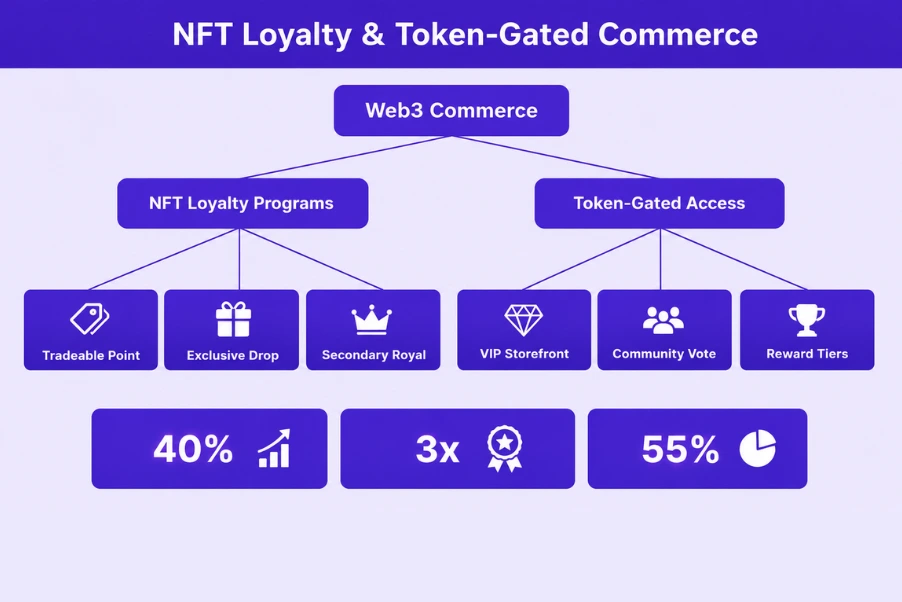
NFT-Based Loyalty and Membership Programs
Traditional loyalty programs suffer from endemic problems including point expiry, lack of transferability, and low perceived value that diminishes customer engagement over time. NFT-based loyalty systems built on Web3 technology solve these problems elegantly. When a customer earns a loyalty NFT, they receive a genuinely valuable digital asset that they own permanently, can trade on secondary markets, and can showcase as a badge of brand affiliation. Starbucks’ Odyssey program and Nike’s .Swoosh platform in the USA demonstrated that mainstream consumers enthusiastically engage with NFT loyalty systems when the value proposition is clearly communicated. For UK retailers and UAE luxury brands, NFT membership tiers create exclusivity that drives aspirational purchasing behavior. The secondary market activity generated by tradeable loyalty NFTs also creates organic brand awareness as buyers and sellers discuss their transactions publicly.
Digital Ownership in E-Commerce
The concept of genuine digital ownership is revolutionizing how businesses structure their product and content offerings. Before Web3 technology, buying a digital book, game, or software license granted usage rights that could be revoked at any time without recourse. NFT-backed digital ownership changes this equation entirely. Customers who purchase digital assets on Web3 platforms hold cryptographic proof of ownership that cannot be revoked by any central authority. This permanence enables entirely new business models including digital resale markets where original creators earn royalties on every secondary transaction through smart contract-encoded royalty clauses. Canadian digital publishers and USA gaming companies are pioneering these models, discovering that transparent ownership mechanics actually increase initial purchase rates because consumers trust that their investment holds lasting value rather than evaporating when a platform shuts down.
Token-Gated Shopping Experiences
Token-gated commerce is one of the most innovative applications emerging from the Web3 E-Commerce space. By requiring customers to hold specific NFTs or governance tokens to access exclusive products, discounts, or sales events, brands create powerful incentive structures that reward early adopters and loyal community members. This model has been successfully deployed by streetwear brands, luxury retailers, and digital content platforms globally. When a UAE fashion brand releases a limited drop exclusively to holders of their community NFT, the resulting scarcity drives both secondary market demand for the NFT and primary market excitement for the products. The exclusivity mechanics generate social media discussions that function as organic marketing. Web3 applications enabling token-gated experiences are increasingly accessible to mid-market businesses, not just large enterprises, thanks to no-code tools built by experienced Web3 retail platform companies.
Web3 E-Commerce Opportunities for Global Enterprises
New Revenue Models for Businesses
Web3 E-Commerce unlocks revenue models that are structurally impossible in traditional commerce ecosystems. Creator royalties encoded in smart contracts ensure that brands and artists earn a percentage of every secondary market sale indefinitely, transforming one-time transactions into ongoing revenue streams. Fractional ownership models allow businesses to tokenize high-value assets and sell fractional stakes to a broader customer base, democratizing access while raising capital efficiently. Governance token economies incentivize platform users to contribute to community growth in exchange for a share of platform revenue, aligning user and business incentives in ways that traditional loyalty programs cannot. For USA digital media companies, UK entertainment platforms, and UAE investment vehicles, these Web3 powered commerce models represent genuinely new approaches to monetization that compound value over time rather than depreciating like traditional product sales.
Building Decentralized Marketplaces
Web3 marketplace building represents one of the most compelling enterprise opportunities in the current digital commerce landscape. Unlike traditional marketplace platforms that require massive infrastructure investment and centralized moderation teams, decentralized marketplaces distribute these functions among community participants. Governance tokens give active marketplace contributors voting rights over platform policies, fee structures, and feature prioritization, creating self-organizing ecosystems that scale efficiently. For businesses looking to compete with established platforms in the UK, Canada, or USA markets, building a decentralized niche marketplace offers a differentiated value proposition that can attract both buyers and sellers who are dissatisfied with incumbent platform policies. Web3 marketplace building requires deep technical expertise, and partnering with an experienced Web3 development company ensures that critical decisions around token economics, smart contract architecture, and governance design are made correctly from the outset.
Better Customer Engagement Through Web3
Customer engagement in Web3 E-Commerce operates on principles of community co-ownership and genuine participation rather than passive consumption. When customers hold governance tokens, they have a direct stake in the platform’s success, creating emotional investment that dramatically exceeds anything achievable through traditional loyalty programs. Community events, collaborative product design processes facilitated through DAO voting, and exclusive NFT drops for top community contributors all create engagement mechanics that generate genuine brand affinity. Several Canadian and UK brands piloting these models report community engagement metrics three to five times higher than their traditional social media benchmarks. The key differentiator is that Web3 community members are not just followers, they are stakeholders who benefit financially when the platform succeeds, creating a powerful alignment of interests that transforms casual shoppers into brand advocates.
Web3 Platform Model Selection Criteria
Assess Business Scale
Evaluate transaction volume, user base size, and geographic distribution to select the appropriate blockchain layer and consensus mechanism for performance requirements.
Map Regulatory Environment
Identify compliance requirements in target markets (USA SEC guidance, UK FCA rules, UAE VARA regulations) to determine permissible token types and governance structures.
Define Token Economics
Design sustainable token utility, supply mechanics, and distribution schedules that align platform incentives with long-term business growth through Web3 business solutions.
Challenges Businesses Face in Adopting Web3 E-Commerce
Scalability and Performance Issues
Blockchain scalability remains a genuine technical challenge for high-volume retail applications. While Bitcoin processes approximately seven transactions per second and Ethereum’s mainnet handles around fifteen, a major retail event like a flash sale can demand thousands of transactions per second. Network congestion during peak periods leads to elevated gas fees that can make small-value transactions economically unviable. However, the Web3 technology ecosystem is addressing these limitations aggressively. Layer-2 solutions like Arbitrum and Polygon process thousands of transactions per second at fractional gas costs while inheriting the security guarantees of their underlying Layer-1 chains. Application-specific blockchains built with frameworks like the Cosmos SDK allow businesses to design networks optimized for their specific commerce use cases. Experienced Web3 developers guide clients through this technical landscape to select infrastructure that matches both current requirements and projected growth trajectories.
Regulatory and Compliance Concerns
The regulatory landscape for Web3 E-Commerce is evolving rapidly and varies significantly across jurisdictions. In the USA, the SEC’s evolving stance on token classifications creates uncertainty for businesses considering token-based commerce models. The UK’s FCA has developed a more structured framework for crypto asset businesses, while the UAE’s VARA (Virtual Assets Regulatory Authority) has established one of the world’s most progressive and comprehensive regulatory regimes, making Dubai an increasingly attractive base for Web3 commerce ventures. Canada’s approach through FINTRAC and provincial securities regulators adds another layer of compliance complexity for businesses operating across multiple markets. Navigating this landscape requires legal expertise specific to digital assets combined with technical knowledge of how compliance requirements translate into smart contract logic and platform design. Our team maintains regulatory monitoring across all major markets to keep client platforms compliant as frameworks evolve.
User Adoption and Technical Complexity
The user experience gap between traditional E-Commerce and Web3 platforms represents one of the most significant adoption barriers facing the industry. Mainstream consumers accustomed to one-click shopping on established platforms find the current Web3 onboarding process, which involves wallet creation, seed phrase management, and gas fee understanding, daunting. Research indicates that approximately 70% of potential Web3 users abandon the onboarding process before completing their first transaction. Solving this problem is a primary focus for leading Web3 E-Commerce teams. Progressive onboarding approaches that abstract technical complexity through account abstraction, social login wallets, and gasless transactions are dramatically improving conversion rates. By designing Web3 applications with UX principles borrowed from the best consumer Web2 products, businesses can achieve mass-market appeal without compromising the underlying blockchain advantages that make Web3 commerce compelling.
Future Trends of Web3 E-Commerce in Global Business
Integration of AI and Web3
The convergence of artificial intelligence and Web3 technology is producing a new category of intelligent decentralized commerce applications. AI models trained on publicly available on-chain behavioral data can identify purchasing patterns and recommend products with remarkable precision while respecting user privacy because the underlying data remains in the user’s wallet rather than on corporate servers. Autonomous AI agents are being deployed on blockchain networks to execute trading strategies, manage inventory procurement, and negotiate supplier contracts within predefined parameters, creating fully automated commerce operations that run around the clock without human oversight. For global enterprises, AI-powered smart contract auditing reduces security risks by identifying potential vulnerabilities before deployment. The combination of AI’s analytical power with Web3’s trustless infrastructure represents what leading Web3 developers consider the next frontier of digital commerce intelligence.
Growth of Metaverse Commerce
Metaverse commerce is transitioning from speculative concept to commercial reality as immersive 3D environments become more accessible and compelling. Brands including Nike, Gucci, and Samsung have already established presence in virtual commerce environments, generating millions in revenue through virtual product sales and immersive brand experiences. Web3 technology provides the essential ownership layer that makes metaverse commerce viable: when customers purchase virtual real estate, digital fashion items, or in-world experiences, NFT ownership certificates ensure their purchases have verifiable value and portability across compatible platforms. For businesses in the UK and UAE luxury sectors, metaverse showrooms eliminate the geographical constraints of physical retail while creating exclusivity through limited virtual inventory. As augmented reality and virtual reality hardware becomes more affordable, metaverse commerce will become a standard channel alongside websites and mobile applications.
The Future of Decentralized Digital Businesses
The trajectory of Web3 E-Commerce points toward a future where decentralized autonomous organizations operate significant commercial enterprises with governance distributed among token holders rather than concentrated in executive teams. This model, already being tested by innovative companies in the USA and Canada, aligns business incentives with community interests in unprecedented ways. Decentralized digital businesses will operate across borders without the friction of jurisdictional boundaries, process payments in digital currencies without banking dependencies, and distribute profits automatically through smart contracts based on contribution metrics. As regulatory frameworks mature and user experience barriers continue to fall, these models will become mainstream rather than experimental. Businesses that invest in understanding and building Web3 infrastructure today are establishing the expertise and community relationships that will define competitive advantage in the commerce landscape of the next decade.
Emerging Web3 Commerce Trends to Watch
AI + Web3 Commerce
- Autonomous AI trading agents
- Privacy-preserving personalization
- AI-powered contract auditing
- Predictive inventory management
Metaverse Markets
- Virtual brand flagship stores
- AR product try-before-buy
- Cross-platform digital assets
- Immersive product launches
DAO Commerce Models
- Community-governed platforms
- Automated profit distribution
- Decentralized product curation
- Token-funded expansion
Final Thoughts
Web3 E-Commerce is not a distant future technology. It is an operational reality reshaping how global digital businesses acquire customers, process transactions, manage supply chains, and create value. From blockchain based commerce solutions that eliminate fraud and accelerate settlement to NFT loyalty systems that transform casual buyers into brand stakeholders, the practical business benefits are demonstrable and measurable.
Enterprises in the USA, UK, UAE, and Canada that engage with Web3 technology now, informed by experienced Web3 developers and supported by robust Web3 business solutions, are building competitive advantages that will define their market positions for the decade ahead. The challenges of scalability, regulatory compliance, and user adoption are real but solvable with the right expertise and strategic approach.
As a team with over eight years of experience building decentralized commerce platforms for global clients, we have seen the transformative impact of Web3 solutions firsthand. The businesses that thrive in the next era of digital commerce will be those that understand these technologies deeply enough to deploy them strategically rather than reactively. The time to build that understanding and those capabilities is now.
Ready to Build Your Web3 Commerce Platform?
Partner with our expert Web3 developers to launch decentralized E-Commerce solutions that drive growth, trust, and global reach.
Frequently Asked Questions
Q1.What is Web3 e-commerce and how does it work?
Web3 e-commerce refers to digital commerce built on decentralized blockchain networks where transactions are executed automatically via smart contracts rather than managed by centralized platforms. Instead of relying on companies like Amazon or Shopify as intermediaries, buyers and sellers interact directly through blockchain protocols. Ownership is recorded on public ledgers, payments settle via cryptocurrency, and product records remain permanently verifiable. This model eliminates platform gatekeepers, reduces fees, and gives users genuine control over their data and digital assets.
Q2.How does blockchain technology improve e-commerce security?
Blockchain secures e-commerce by recording every transaction on an immutable distributed ledger that cannot be altered retroactively. Cryptographic wallet authentication replaces vulnerable username-password systems, eliminating most account takeover attack vectors. Smart contracts enforce payment and delivery terms automatically without requiring trust between parties. Because no single server holds all data, there is no central honeypot for hackers to target. This architecture significantly reduces fraud, chargebacks, and data breach risks compared to conventional payment and account management systems.
Q3.What role do NFTs play in Web3 e-commerce?
NFTs (non-fungible tokens) serve as verifiable digital ownership certificates in Web3 e-commerce, enabling genuine digital art ownership and asset ownership on public blockchains. Brands use NFTs for product authentication, loyalty program memberships, token-gated shopping access, and warranty management. Unlike traditional loyalty points that expire or become worthless if a company changes programs, NFT-based rewards are assets customers truly own and can transfer or resell. They also enable royalty automation, where creators receive automatic payment every time their work or product is resold in secondary markets.
Q4.How are smart contracts used in online business transactions?
Smart contracts are self-executing programs stored on blockchain networks that automatically enforce the terms of commercial agreements when predefined conditions are met. In e-commerce, they handle payment escrow, trigger fulfillment upon order confirmation, distribute royalties to multiple parties simultaneously, and manage subscription billing without manual intervention. When a customer completes a purchase, the smart contract simultaneously verifies payment, locks funds in escrow, initiates shipping workflows, and schedules automatic payment release upon delivery confirmation, compressing what traditionally required multiple systems and days into minutes.
Q5.How does Web3 enable cross-border e-commerce payments?
Web3 payment solutions using cryptocurrencies and stablecoins eliminate the traditional banking intermediaries that slow and expense international transactions. Conventional cross-border payments cost 2% to 7% in fees and take two to five business days to settle. Web3 payment rails settle in minutes at near-zero cost regardless of geographic origin or destination. Smart contracts handle currency conversion, compliance documentation, and tax calculation automatically. This makes international expansion commercially viable for small and medium businesses that previously found cross-border transaction costs prohibitive.
Explore Services
Related Services
Reviewed by

Aman Vaths
Founder of Nadcab Labs
Aman Vaths is the Founder & CTO of Nadcab Labs, a global digital engineering company delivering enterprise-grade solutions across AI, Web3, Blockchain, Big Data, Cloud, Cybersecurity, and Modern Application Development. With deep technical leadership and product innovation experience, Aman has positioned Nadcab Labs as one of the most advanced engineering companies driving the next era of intelligent, secure, and scalable software systems. Under his leadership, Nadcab Labs has built 2,000+ global projects across sectors including fintech, banking, healthcare, real estate, logistics, gaming, manufacturing, and next-generation DePIN networks. Aman’s strength lies in architecting high-performance systems, end-to-end platform engineering, and designing enterprise solutions that operate at global scale.