Ai Overview
The global supply chain and logistics sector is undergoing one of its most significant transformations in decades. At the center of this shift is Web3 in supply chain, a suite of decentralized technologies that is rewriting the rules of how goods, data, and value flow across international networks. From manufacturers in North America to freight forwarders in the UAE, the pressure to eliminate inefficiencies, prevent fraud, and deliver real-time visibility has never been greater.
The global supply chain and logistics sector is undergoing one of its most significant transformations in decades. At the center of this shift is Web3 in supply chain, a suite of decentralized technologies that is rewriting the rules of how goods, data, and value flow across international networks. From manufacturers in North America to freight forwarders in the UAE, the pressure to eliminate inefficiencies, prevent fraud, and deliver real-time visibility has never been greater. Traditional supply chain management systems, built on centralized databases and manual processes, are simply no longer adequate for the complexity and speed demands of modern global commerce.
With over eight years of hands-on experience delivering digital supply chain solutions for clients across the USA, UK, UAE, and Canada, our team has seen firsthand how Web3 technologies, including blockchain, smart contracts, decentralized networks, and IoT integration, are solving problems that legacy platforms could not. This blog provides a comprehensive, authoritative look at how Web3 is reshaping supply chain and logistics management, the technologies behind this revolution, and what businesses should know when evaluating their next move.
Key Takeaways
- Web3 in supply chain uses blockchain, smart contracts, and IoT to create transparent, automated, tamper-proof logistics networks across global markets.
- Blockchain traceability reduces product counterfeiting by up to 80%, enabling verified product journeys from raw material sourcing to final delivery at scale.
- Smart contracts in supply chain automate payments, compliance checks, and supplier agreements, cutting administrative overhead and eliminating payment disputes.
- Real-time supply chain tracking powered by Web3 and IoT gives all stakeholders simultaneous visibility into shipment location, condition, and custody status.
- Decentralized supply chain networks eliminate single points of failure, improving resilience against cyber attacks, data breaches, and operational disruptions.
- Supply chain data security is dramatically enhanced through cryptographic verification and distributed storage, removing centralized data vulnerabilities entirely.
- Businesses in the USA, UK, UAE, and Canada adopting Web3 logistics management solutions report significant reductions in fraud losses and compliance costs.
- AI-integrated Web3 platforms are the next frontier, combining predictive analytics with decentralized infrastructure for fully automated logistics ecosystems by 2030.
Understanding Web3 in Supply Chain and Logistics
What Is Web3 Technology?
Web3 represents the third generation of the internet, built on decentralized protocols, cryptographic security, and blockchain infrastructure. Unlike Web1 (read-only static pages) or Web2 (interactive but centrally controlled platforms), Web3 enables peer-to-peer data exchange without relying on any single authority or intermediary. The core building blocks include public and permissioned blockchains, smart contracts that execute automatically based on coded rules, tokenization of real-world assets, decentralized autonomous organizations, and decentralized storage networks. In the context of supply chain and logistics, Web3 creates shared infrastructure where every participant, whether a tier-one supplier, freight carrier, customs authority, or end retailer, operates on the same verifiable, tamper-resistant data layer. This architectural shift is not incremental; it is a fundamental redesign of how trust, accountability, and value transfer are managed across commercial networks.
How Web3 Differs From Traditional Supply Chain Systems?
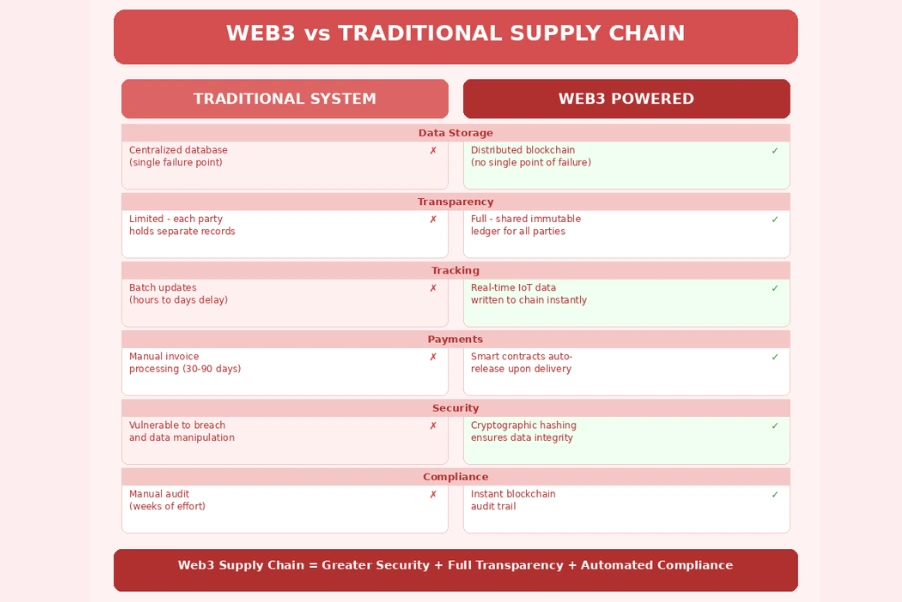
Traditional supply chain systems rely on centralized enterprise resource planning (ERP) platforms, siloed databases, and paper-based documentation that require manual reconciliation between parties. Each stakeholder maintains their own version of truth, leading to chronic discrepancies, delayed dispute resolution, and chronic information asymmetry. Web3-powered supply chain and logistics systems replace these fragmented architectures with unified distributed ledgers where all authorized participants read and write to the same record simultaneously. Smart contracts enforce agreements automatically without human intervention, eliminating the need for intermediaries like trade finance banks, third-party auditors, and customs brokers for routine verifications. The result is a system that operates faster, with greater accuracy and auditability, while dramatically reducing the administrative costs that accumulate across complex multi-stakeholder networks. Companies across the UK and UAE that have made this transition report measurably better supplier relationships and fewer operational disputes.
The Growing Need for Decentralized Supply Chain Networks
The COVID-19 pandemic, geopolitical tensions, and climate disruptions exposed the catastrophic fragility of centralized supply chain networks built around single-source dependencies and opaque information flows. Organizations in the USA and Canada that lacked real-time visibility scrambled to identify alternate suppliers, reroute shipments, and manage demand shocks with outdated tools. Decentralized supply chain networks address these vulnerabilities by distributing both operational control and data storage across multiple nodes. No single party can corrupt the data or bring down the network. Moreover, as ESG (Environmental, Social, and Governance) reporting requirements tighten globally, particularly in EU and UK markets, the need for verifiable, auditable supply chain data has become a board-level priority. Web3 technologies provide the infrastructure to meet these demands at enterprise scale without sacrificing operational speed.
Major Challenges in Traditional Supply Chain Management
Core Pain Points in Legacy Supply Chains
Lack of Supply Chain Transparency
- Siloed data across stakeholders
- No single source of truth
- Delayed reporting and reconciliation
- Hidden supplier tier risks
Data Security and Fraud Risks
- Centralized databases vulnerable to breaches
- Invoice and document fraud prevalent
- Counterfeit goods entering networks
- Limited audit trail integrity
Delays in Logistics and Inventory Tracking
- Batch-updated systems miss real-time events
- Manual handoffs create bottlenecks
- Cross-border documentation errors
- Poor demand forecasting accuracy
Limited Real-Time Collaboration Between Stakeholders
Perhaps the most crippling limitation of traditional supply chain management is the absence of synchronized, real-time collaboration across the stakeholder ecosystem. Manufacturers, logistics providers, customs brokers, warehouse operators, and retailers all use incompatible systems that speak different data languages. Information shared via email, spreadsheets, and EDI (Electronic Data Interchange) messages is inherently asynchronous, meaning that by the time data reaches decision-makers, it is already outdated. In high-velocity markets like the UAE’s logistics hub or Canada’s cross-border trade corridors, these delays translate directly into missed opportunities, excess inventory costs, and broken customer promises. The lack of collaborative infrastructure also makes it nearly impossible to conduct meaningful supply chain optimization because the data foundation is too fragmented and unreliable to support accurate analytics or automation.
How Web3 Is Transforming Supply Chain and Logistics?
Improving Supply Chain Transparency With Blockchain
Blockchain in supply chain creates an immutable, shared record of every transaction, movement, and ownership change across the entire product journey. Each event, whether a raw material leaving a factory in Asia, clearing customs in Dubai, or arriving at a UK distribution center, is recorded as a cryptographically verified block on the chain. All authorized participants can view this record simultaneously, eliminating the information asymmetry that drives disputes and delays. Retailers in the USA using blockchain-powered supply chain transparency platforms have dramatically reduced supplier disputes and improved their ability to respond to regulatory inquiries about product origins. The technology also enables consumer-facing transparency, allowing end customers to scan a QR code and see the complete verified history of a product, from its source materials to its final packaging date. This level of accountability was simply impossible with legacy infrastructure.
Real-Time Supply Chain Tracking and Monitoring
Real-time supply chain tracking is one of the most immediately impactful applications of Web3 in logistics management. By combining blockchain ledgers with IoT sensors, GPS trackers, and RFID technology, every shipment can be monitored continuously from origin to destination. The data captured by these sensors, including location coordinates, temperature readings, humidity levels, and handling events, is written to the blockchain in near real-time, creating a live, tamper-proof record. Unlike traditional tracking systems that rely on carrier-reported updates that can be delayed or manipulated, Web3-powered tracking is autonomous and cryptographically secured. Logistics operators in the UAE, which handles over 14 million TEUs of container traffic annually through Jebel Ali Port alone, have begun deploying these systems to reduce cargo theft, prevent temperature excursions in pharmaceutical shipments, and provide exporters and importers with granular visibility that was previously unattainable.
Secure Supply Chain Management Through Decentralization
Supply chain data security is a critical concern for enterprises managing sensitive commercial data across multiple jurisdictions. Centralized databases represent single points of failure that are highly attractive targets for cybercriminals. A single breach can expose an entire organization’s supplier network, pricing strategies, and customer data. Decentralized supply chain architectures built on Web3 fundamentally alter this threat landscape by distributing data storage across multiple nodes with no central server to attack. Cryptographic hashing ensures that any unauthorized modification of data is immediately detectable by the network. This approach delivers supply chain data security that meets or exceeds the requirements of regulations like GDPR in the UK, PIPEDA in Canada, and sector-specific frameworks in the USA. For pharmaceutical and food manufacturers, this level of data integrity is not just a competitive advantage but a regulatory necessity.
Blockchain Traceability for Product Verification
Blockchain traceability gives every product a unique, verifiable digital identity that travels with it across its entire lifecycle. Each item is assigned a token on the blockchain that records its origin, every transformation it undergoes, every facility it passes through, and every custodian who handles it. This creates an unbroken chain of custody that can be audited instantly by regulators, insurers, or end customers. For luxury goods brands operating in the UK and UAE, blockchain traceability is a powerful tool against counterfeiting, which costs the global economy over $4.5 trillion annually. For food producers, it means that in the event of a contamination incident, the exact source batch can be identified within seconds rather than days, dramatically limiting recall scope and protecting public health. Our team has implemented blockchain traceability systems for clients across multiple verticals who have reported measurable improvements in compliance audit efficiency.
Key Technologies Powering Web3 Supply Chains
IoT in Supply Chain and Logistics
The Internet of Things (IoT) serves as the sensory layer of Web3-powered logistics management solutions. IoT devices such as GPS trackers, temperature sensors, RFID tags, and connected scales continuously capture physical world data and feed it into blockchain networks. This combination is particularly transformative for cold-chain logistics, where pharmaceutical drugs, fresh produce, and specialty chemicals must be kept within precise temperature and humidity ranges throughout their journey. When an IoT sensor detects a temperature breach, the information is written to the blockchain instantly, triggering smart contract-based alerts, documentation for insurance claims, and notifications to all relevant stakeholders simultaneously. For importers and exporters operating across the USA-Canada border or through UK ports, this IoT-blockchain integration eliminates the information gaps that previously made cold-chain compliance verification a labor-intensive and error-prone process.
Asset Tokenization for Logistics Management
Asset tokenization is an emerging but rapidly maturing Web3 capability that has significant implications for logistics management. By representing physical goods, shipping containers, warehouse space, or trade finance instruments as digital tokens on a blockchain, organizations can enable fractional ownership, instant transfer of title, and programmable conditions for asset release. In international trade, where bills of lading and letters of credit have traditionally involved weeks of paper-based processing, tokenized trade documents can be transferred in seconds with cryptographic verification of authenticity. Financial institutions in the UAE and the UK have begun piloting tokenized trade finance platforms that allow importers and exporters to unlock working capital tied up in goods-in-transit more efficiently. This innovation has the potential to unlock hundreds of billions in trade finance value that is currently inaccessible to small and medium-sized businesses.
Web3 Infrastructure and Decentralized Networks
The infrastructure layer of Web3 supply chains includes permissioned blockchains like Hyperledger Fabric and enterprise Ethereum, decentralized storage networks, and cross-chain interoperability protocols that allow different blockchain networks to communicate. For supply chain applications, permissioned blockchains are often preferred because they allow organizations to control who can participate in the network while still leveraging the benefits of distributed ledger technology. Decentralized networks eliminate the need for a central IT authority to maintain the system, reducing both the cost of infrastructure management and the risk of vendor lock-in. As more supply chain participants across the USA, UK, UAE, and Canada onboard to these networks, the value of participation compounds, creating a powerful network effect that accelerates adoption across entire industry verticals.
Benefits of Web3 in Supply Chain and Logistics Management
Better Supply Chain Optimization
Supply chain optimization is fundamentally a data problem, and Web3 solves it by providing a unified, reliable data layer that all analytical tools can draw from. When every event in the supply chain is recorded on a shared blockchain, organizations gain access to a complete, unbroken dataset that reveals patterns, inefficiencies, and opportunities that were previously invisible. Machine learning models trained on this high-quality data can optimize routing decisions, inventory positioning, and supplier selection with far greater accuracy than models trained on fragmented legacy data. Businesses in the USA using Web3-enabled supply chain optimization platforms have reported measurable improvements in on-time delivery rates and meaningful reductions in excess inventory, translating directly to improved working capital and customer satisfaction scores.
Enhanced Supply Chain Data Security
Supply chain data security in a Web3 context is achieved through a combination of cryptographic hashing, distributed storage, role-based access control, and immutable audit logging. Every piece of data written to the blockchain is hashed, meaning any unauthorized change is immediately detectable by network participants. Unlike traditional databases where an administrator with elevated privileges can alter records undetected, blockchain records are secured by network consensus mechanisms that make retroactive tampering computationally prohibitive. For organizations handling sensitive commercial data such as supplier pricing, proprietary formulations, or customer shipping addresses, this level of security is transformative. UK enterprises subject to GDPR and USA organizations regulated under CCPA particularly benefit from the built-in auditability that blockchain-based supply chain data security provides, making compliance reporting faster and more reliable.
Improved Supply Chain Compliance and Auditing
Compliance and auditing are among the most resource-intensive activities in traditional supply chain management. Regulatory audits that once required weeks of document retrieval and reconciliation can be completed in hours when all supply chain records are stored on an immutable blockchain. Smart contracts that automatically enforce compliance rules, such as verifying supplier certifications, checking product origin claims, or confirming cold-chain temperature compliance, eliminate the human error that creates compliance gaps. For pharmaceutical distributors in the USA subject to DSCSA requirements, or food producers in Canada and the UK navigating stringent traceability regulations, Web3 compliance automation reduces both the cost of compliance and the risk of regulatory penalties significantly. Our clients have consistently found that blockchain-based compliance systems pay for themselves within 18 to 24 months through audit cost reductions alone.
Reduced Operational Costs and Manual Processes
The automation potential of Web3 in supply chain and logistics is profound. Smart contracts replace dozens of manual handoffs that occur between parties during a typical shipment lifecycle, from purchase order approval and supplier payments to customs documentation and insurance claims. Eliminating these manual touchpoints reduces labor costs, accelerates process cycle times, and removes the errors that inevitably occur when humans transcribe data between incompatible systems. Decentralized digital supply chain solutions also reduce the need for expensive middleware platforms and integration services that organizations currently pay for to bridge their legacy systems. Across our client base in the UAE and Canada, the average organization adopting Web3 supply chain automation has reported meaningful reductions in administrative processing costs within the first year of implementation.
Real-World Use Cases of Web3 in Logistics
Industry Use Case Comparison
| Industry | Web3 Solution | Key Benefit | Market |
|---|---|---|---|
| Pharmaceuticals | Blockchain traceability for drug serialization | Anti-counterfeiting, DSCSA compliance | USA, UK |
| Food & Beverage | Farm-to-fork supply chain traceability | Recall precision, consumer trust | Canada, UK |
| Luxury Goods | NFT-based product authentication | Counterfeit prevention, resale verification | UAE, UK |
| Shipping & Freight | Tokenized bills of lading | Faster document transfer, reduced fraud | UAE, USA |
| Automotive | Multi-tier supplier verification network | Parts authenticity, ESG compliance | USA, Canada |
Web3-Based Product Tracking Systems
One of the most tangible real-world applications of Web3 in supply chain is product tracking that goes far beyond simple GPS location data. Companies like Everledger have built blockchain-based platforms that track diamonds from mine to retail, giving buyers verifiable proof of ethical sourcing and conflict-free certification. In the food sector, Walmart Canada partnered with blockchain-based tracking providers to enable real-time visibility into the provenance of leafy greens, a category that had been responsible for multiple E. coli outbreaks. These systems assign a unique digital identity to each product batch at the point of origin and update it at every subsequent touchpoint, creating a tamper-proof record that regulators, retailers, and consumers can all access and trust. This level of blockchain traceability represents a paradigm shift from paper-based systems that could be falsified to digital records that cannot.
Smart Logistics Solutions for Global Shipping
Global shipping is one of the most document-intensive industries in the world, with a single container shipment potentially requiring over 200 data communications among multiple parties. Web3-powered smart logistics solutions are streamlining this complexity by digitalizing and automating the most time-consuming parts of the process. TradeLens, a blockchain platform developed with Maersk, demonstrated that digitizing shipping documentation and sharing it on a permissioned blockchain could reduce transit times and paperwork processing significantly across major trade routes. While the platform was eventually discontinued due to commercial challenges, it validated the technical viability of Web3 for global shipping at scale, and successor platforms built on its learnings are now emerging in markets from Dubai to Halifax. Smart contracts that automatically generate, verify, and transmit shipping documents are reducing the human effort required for each shipment by significant amounts.
Decentralized Digital Supply Chain Solutions
Decentralized digital supply chain solutions go beyond simple digitalization of existing processes. They fundamentally restructure how supply chain networks are governed, how decisions are made, and how value is distributed among participants. In a decentralized network, no single company acts as the system administrator with privileged access. Instead, governance is shared among participants according to pre-agreed protocols that may be enforced through DAOs. This has powerful implications for industries where supplier power dynamics have historically been skewed toward large buyers who could dictate payment terms and data access. Decentralized supply chain solutions level the playing field, giving SME suppliers in markets like Canada and the UAE the same network visibility and automated payment benefits that large multinationals enjoy, fostering more resilient and equitable supply chain ecosystems.
Future of Web3 in Supply Chain and Logistics
AI and Web3 Integration in Logistics
The convergence of artificial intelligence and Web3 in logistics is creating a new generation of systems that can not only record supply chain events but actively optimize responses to them. AI models continuously analyze blockchain-recorded data to identify emerging disruptions, forecast demand shifts, and recommend corrective actions before problems escalate. In the UAE, which is investing heavily in smart logistics infrastructure through its national AI strategy, AI-powered Web3 logistics platforms are being piloted at Jebel Ali Free Zone to optimize container yard operations and reduce vessel turnaround times. In the USA and Canada, AI-Web3 integration is being applied to predictive maintenance of logistics assets, using IoT sensor data stored on blockchain to trigger maintenance before equipment failures occur. This combination moves supply chain management from reactive problem-solving to proactive optimization at a scale previously impossible.
Predictive Analytics for Supply Chain Optimization
Predictive analytics powered by Web3 data streams represents a significant leap forward in supply chain optimization capabilities. Because blockchain networks capture every supply chain event with timestamp, geolocation, and condition data, organizations gain access to training datasets of unprecedented quality and completeness. Predictive models built on this data can forecast supplier delays based on historical patterns, identify demand signals earlier than traditional demand planning tools, and dynamically adjust inventory positions across distribution networks in anticipation of disruptions. UK grocery retailers have begun using blockchain-sourced predictive models to reduce food waste by improving order accuracy at the store level. As these platforms mature and data volumes grow, the accuracy of predictive supply chain optimization will improve continuously, creating a compounding competitive advantage for early adopters.
The Rise of Fully Automated Logistics Ecosystems
The long-term vision for Web3 in supply chain and logistics is a fully automated ecosystem where goods move from origin to destination with minimal human intervention in the information and financial flows. Smart contracts handle all commercial agreements, IoT devices track all physical movements, AI optimizes all routing and resource allocation decisions, and blockchain provides the trusted data layer that connects everything together. Autonomous warehouses operated by robotic systems, self-driving logistics vehicles guided by real-time blockchain data, and decentralized marketplaces where capacity is matched to demand algorithmically are all elements of this emerging reality. While complete realization of this vision is still several years away, the foundational infrastructure is being put in place today by forward-thinking organizations across the USA, UK, UAE, and Canada who recognize that early investment in Web3 supply chain infrastructure will determine their competitive position for the next decade.
Choosing the Right Web3 Partner for Supply Chain Solutions
Important Features to Look For
When evaluating logistics management solutions built on Web3, the feature set should go well beyond basic blockchain record-keeping. Look for platforms that offer real-time supply chain tracking dashboards with role-based visibility controls, so that each stakeholder sees only the data they are authorized to access. Smart contract templates specific to common supply chain scenarios, such as purchase order management, shipment release conditions, and quality acceptance criteria, will accelerate implementation significantly. Interoperability with major ERP platforms like SAP and Oracle is non-negotiable for enterprise adoption. Equally important is the availability of robust IoT device management capabilities, since the quality of data entering the blockchain determines the value of the entire system. Finally, ensure the platform offers comprehensive compliance reporting tools that can generate audit-ready documentation for regulatory bodies in your operating markets.
Building Scalable and Secure Logistics Platforms
Building scalable and secure logistics platforms on Web3 infrastructure requires a disciplined approach to architecture that most generic technology vendors are not equipped to provide. The platform must be designed to handle transaction volumes that scale with business growth without degrading performance or increasing costs proportionally. This often means selecting blockchain networks with high throughput capabilities and implementing layer-2 solutions for high-frequency data operations. Security must be built in from the ground up, including hardware security modules for key management, multi-signature authorization for high-value smart contract actions, and continuous monitoring systems that detect anomalous activity on the network. Our team’s approach over the past eight years has consistently been to engage supply chain domain experts alongside blockchain engineers from the first day of architecture design, ensuring that the resulting platform solves real operational problems rather than simply demonstrating technical novelty.
Final Thoughts
Web3 in supply chain is not a future concept waiting to arrive. It is a present-day operational reality that forward-thinking organizations across the USA, UK, UAE, and Canada are already leveraging to gain decisive competitive advantages. The combination of blockchain traceability, smart contract automation, real-time supply chain tracking, and decentralized data security addresses the most persistent challenges that have limited supply chain performance for decades. From improving supply chain transparency and reducing fraud to enabling fully automated logistics workflows, the technology stack powering Web3 supply chains is mature enough for enterprise deployment today.
Organizations that begin their Web3 supply chain journey now will benefit from lower implementation costs as the technology matures, a growing pool of skilled practitioners, and the network effects that come from being early participants in industry consortiums. Those that delay risk finding themselves locked out of supply chain networks that have standardized on Web3 infrastructure, unable to meet the transparency and traceability requirements that will increasingly be demanded by regulators, major buyers, and environmentally conscious consumers. Supply chain optimization powered by Web3 is not simply an IT initiative; it is a strategic business imperative. The question is not whether to adopt these technologies, but how to do so efficiently and securely with the right partner at your side.
Ready to Transform Your Supply Chain With Web3?
Partner with our team to build secure, scalable blockchain supply chain platforms tailored for your industry, market, and compliance requirements.
People Also Ask
Q1.What is Web3 in supply chain management?
Web3 in supply chain refers to the application of decentralized blockchain-based technologies to manage, track, and optimize the flow of goods, data, and payments across global supply networks. Unlike traditional centralized systems, Web3 enables multiple stakeholders including manufacturers, logistics providers, and retailers to interact on shared, tamper-proof ledgers. This ensures greater transparency, reduces fraud risks, and allows for automated processes through smart contracts, ultimately creating a more trustworthy and efficient supply chain ecosystem for businesses operating in the USA, UK, UAE, and Canada.
Q2.How does blockchain improve supply chain transparency?
Blockchain improves supply chain transparency by recording every transaction and movement of goods on an immutable distributed ledger that all authorized participants can access in real time. Each product gets a unique digital identity that is updated at every checkpoint, from raw material sourcing to final delivery. This eliminates information silos that plague traditional systems. Companies in the UK and UAE have used blockchain traceability to verify product origins, combat counterfeiting, and provide consumers with verifiable proof of ethical sourcing, fundamentally changing how trust is established across complex global networks.
Q3.What are smart contracts in supply chain?
Smart contracts in supply chain are self-executing digital agreements coded on a blockchain that automatically trigger predefined actions when specific conditions are met. For example, a payment is automatically released to a supplier once IoT sensors confirm a shipment has arrived at the correct location and temperature. This eliminates the need for manual invoice processing, reduces payment disputes, and speeds up settlement times significantly. Businesses in Canada and the USA are increasingly using smart contracts to automate customs clearance, supplier payments, and compliance verification, cutting administrative overhead considerably.
Q4.How does Web3 help with real-time supply chain tracking?
Web3 enables real-time supply chain tracking by combining blockchain ledgers with IoT sensors, RFID tags, and decentralized data networks. Every time a product moves through the supply chain, data is captured by IoT devices and written to a blockchain in near real time. This creates an always-on, tamper-resistant record of location, condition, and custody. Unlike legacy ERP systems that rely on batch updates, Web3-powered tracking gives all supply chain participants simultaneous access to accurate, live data, dramatically reducing delays, theft incidents, and disputes over shipment status across international logistics corridors.
Q5.What industries benefit most from blockchain in supply chain?
Industries that benefit most from blockchain in supply chain include pharmaceuticals, food and beverage, luxury goods, automotive, and international trade. Pharmaceutical companies use blockchain traceability to verify drug authenticity and comply with regulations in markets like the USA and UK. Food producers track produce from farm to shelf to prevent contamination events. Luxury brands use blockchain to authenticate high-value items and prevent counterfeiting. Automotive manufacturers streamline complex multi-tier supplier networks. Any sector with complex multi-stakeholder logistics, strict compliance requirements, or high fraud risk stands to gain substantially from Web3 supply chain solutions.
Explore Services
Related Services
Reviewed by

Aman Vaths
Founder of Nadcab Labs
Aman Vaths is the Founder & CTO of Nadcab Labs, a global digital engineering company delivering enterprise-grade solutions across AI, Web3, Blockchain, Big Data, Cloud, Cybersecurity, and Modern Application Development. With deep technical leadership and product innovation experience, Aman has positioned Nadcab Labs as one of the most advanced engineering companies driving the next era of intelligent, secure, and scalable software systems. Under his leadership, Nadcab Labs has built 2,000+ global projects across sectors including fintech, banking, healthcare, real estate, logistics, gaming, manufacturing, and next-generation DePIN networks. Aman’s strength lies in architecting high-performance systems, end-to-end platform engineering, and designing enterprise solutions that operate at global scale.