Ai Overview
Multi-chain deployment represents a sophisticated strategic approach where applications operate simultaneously across multiple blockchain networks, each offering unique technical characteristics and user demographics. Organizations implementing multi-chain strategies report up to 300% expansion in addressable user base while significantly reducing dependency on any single platform’s technical or governance decisions.
Key Takeaways
- Polygon offers EVM compatibility and low fees, making it ideal for Ethereum-based projects requiring scalable Layer 2 infrastructure with minimal code modifications.
- BSC provides rapid deployment capabilities with 3-second block times and extensive DeFi ecosystem integration, particularly attractive for cost-sensitive applications across global markets.
- Solana achieves exceptional performance with 65,000+ TPS and sub-second finality, requiring Rust programming but delivering unmatched speed for high-frequency applications.
- Multi-chain deployment strategy diversifies risk, expands user reach across different blockchain communities, and future-proofs applications against platform-specific challenges or regulatory changes.
- Smart contract audits represent critical security investments ranging from $15,000 to $100,000, essential for protecting user funds and maintaining reputation in competitive markets.
- Testnet deployment and comprehensive validation prevent costly mainnet errors, with thorough testing protocols reducing deployment failures by over 90% based on industry data.
- Wallet integration complexity varies significantly: MetaMask serves EVM chains universally while Phantom dominates Solana, requiring platform-specific integration approaches for optimal user experience.
- Gas optimization strategies differ across platforms, with Polygon benefiting from batching, BSC requiring strategic timing, and Solana demanding efficient program architecture and compute unit management.
- Mainnet monitoring and incident response planning prevent minor issues from escalating into major security breaches or service disruptions affecting user trust and business continuity.
- Regulatory compliance varies by jurisdiction, with applications serving USA, UK, UAE, and Canada markets requiring careful attention to evolving securities laws and data protection requirements.
Understanding Multi-Chain Web3 App Launch
Multi-chain deployment represents a sophisticated strategic approach where applications operate simultaneously across multiple blockchain networks, each offering unique technical characteristics and user demographics. This methodology has gained significant traction among enterprises and startups throughout 2024 and 2025, driven by increasing recognition that no single blockchain perfectly addresses all use cases, geographic markets, or user preferences. Organizations implementing multi-chain strategies report up to 300% expansion in addressable user base while significantly reducing dependency on any single platform’s technical or governance decisions.
What Is a Web3 App?
Web3 applications represent the next evolution of internet software, characterized by decentralized architecture where users maintain true ownership of their data, assets, and digital identity without reliance on centralized intermediaries. Unlike traditional Web2 applications that store user information in corporate databases, Web3 apps leverage blockchain technology to create transparent, permissionless systems where smart contracts execute business logic autonomously and cryptographic keys provide users complete control over their interactions. This fundamental shift has profound implications for industries ranging from finance and gaming to supply chain management and social media.
The core components of Web3 applications include smart contracts that encode business rules and execute automatically on-chain, decentralized storage solutions like IPFS or Arweave for preserving application data, wallet integrations enabling users to authenticate and authorize transactions cryptographically, and frontend interfaces that communicate with blockchain networks through RPC endpoints. Modern Web3 apps deployed across markets in the USA, UK, and beyond typically combine on-chain and off-chain elements strategically, placing critical trust and value operations on the blockchain while managing performance-intensive or privacy-sensitive tasks through traditional infrastructure enhanced with cryptographic proofs.
Why Choose a Multi-Chain Deployment Strategy?
Multi-chain deployment delivers strategic advantages that single-chain applications simply cannot match in today’s competitive blockchain landscape. First, it dramatically expands your total addressable market by meeting users where they already maintain wallets and hold assets, rather than forcing them to bridge funds or learn new ecosystems. Research from leading blockchain analytics firms indicates that applications available on multiple chains see 250-400% higher user acquisition rates compared to single-chain alternatives, with particularly strong effects in diverse markets spanning Canada, UAE, and European territories.
Risk mitigation represents another compelling rationale for multi-chain strategies. Blockchain networks face various challenges including network congestion, governance disputes, regulatory uncertainty, and technical vulnerabilities. Organizations that deployed exclusively on single platforms have experienced significant disruptions during network outages, controversial hard forks, or sudden regulatory actions in specific jurisdictions. By distributing your application across Polygon, BSC, and Solana, you create operational resilience where issues affecting one network don’t compromise your entire user base or business continuity. Additionally, multi-chain presence positions your project to capitalize on ecosystem-specific opportunities such as grants, accelerator programs, and strategic partnerships that major blockchain foundations offer to attract high-quality applications.
Key Differences Between Polygon, BSC, and Solana
| Feature | Polygon | BSC | Solana |
|---|---|---|---|
| Consensus Mechanism | Proof of Stake | Proof of Staked Authority | Proof of History + PoS |
| Block Time | 2 seconds | 3 seconds | 400 milliseconds |
| Transaction Throughput | ~7,000 TPS | ~160 TPS | ~65,000 TPS |
| Smart Contract Language | Solidity (EVM) | Solidity (EVM) | Rust, C |
| Average Transaction Fee | $0.01 – $0.02 | $0.10 – $0.50 | $0.00025 |
| Primary Use Cases | DeFi, NFTs, Gaming | DeFi, Trading, Yield | DeFi, Gaming, High-frequency Apps |
Understanding these fundamental differences enables informed architectural decisions aligned with your application’s specific requirements and target user demographics across different geographic markets including North America, Europe, and the Middle East.
Overview of Polygon, BSC, and Solana Ecosystems
Each blockchain ecosystem has cultivated distinct characteristics, community cultures, and technical infrastructures that shape the experience of building and launching applications. Polygon emerged as the leading Ethereum Layer 2 solution, focusing on scalability while maintaining maximum compatibility with existing Ethereum tools and standards. BSC positioned itself as an accessible, high-performance alternative to Ethereum with strong backing from the Binance exchange ecosystem. Solana built an entirely new architecture optimized for speed and throughput, attracting projects requiring performance levels impossible on traditional EVM chains. Understanding these ecosystem nuances proves essential for successful Web3 app launch strategies.
Polygon Network Architecture and Benefits
Polygon operates as a comprehensive scaling framework for Ethereum, with its flagship Proof of Stake chain serving as the primary deployment target for most Web3 apps. The network processes transactions through a set of validators who stake MATIC tokens, achieving consensus on transaction ordering and state changes while periodically checkpointing data back to Ethereum mainnet for final settlement security. This architecture delivers the best of both worlds: Ethereum’s proven security model combined with dramatically reduced fees and faster confirmation times suitable for consumer applications serving users across the USA, UK, and global markets.
The Polygon ecosystem has matured significantly, hosting over 37,000 decentralized applications as of early 2025 across DeFi, gaming, NFTs, and enterprise use cases. Major advantages include complete EVM compatibility enabling seamless migration of Ethereum contracts, robust infrastructure with multiple RPC providers offering reliable connectivity, strong institutional adoption with partnerships spanning Starbucks, Adobe, and Disney, and an active grant program supporting innovative applications. For teams experienced with Ethereum tooling like Hardhat, Truffle, or Foundry, Polygon represents the smoothest path to scaling without requiring fundamental architectural changes or learning new programming paradigms.
Binance Smart Chain Ecosystem and Features
Binance Smart Chain operates as an independent blockchain running in parallel with Binance Chain, designed specifically to support smart contracts and decentralized applications while maintaining high performance and low transaction costs. BSC employs a Proof of Staked Authority consensus mechanism with 21 validators, balancing decentralization concerns against practical requirements for speed and efficiency. This architectural choice enables BSC to process blocks every three seconds with transaction fees typically ranging from $0.10 to $0.50, making it particularly attractive for applications where cost efficiency directly impacts user adoption and retention.
The BSC ecosystem gained explosive traction during 2021 and has maintained strong activity through subsequent market cycles, currently supporting thousands of active DeFi protocols, NFT marketplaces, and gaming applications. Key advantages include direct integration with Binance exchange providing deep liquidity and easy fiat on-ramps for users in Canada, UAE, and other markets, extensive DeFi infrastructure with battle-tested protocols for lending, swapping, and yield farming, and a pragmatic approach to balancing decentralization with performance. BSC’s Ethereum compatibility via the EVM means existing Solidity contracts deploy with minimal modification, though teams should account for differences in gas mechanics and validator behavior when optimizing contract performance.
Solana Blockchain Speed and Performance
Solana represents a radical departure from EVM-based blockchain architectures, built from the ground up to achieve unprecedented transaction throughput and minimal latency. The network’s innovative Proof of History mechanism creates a verifiable passage of time between events, allowing validators to process transactions without waiting for traditional consensus round trips. Combined with additional optimizations like parallel transaction processing through Sealevel, optimistic concurrency control, and Gulf Stream mempool-less forwarding, Solana achieves theoretical throughput exceeding 65,000 transactions per second with actual sustained performance regularly surpassing 3,000 TPS in production environments.
This exceptional performance comes with trade-offs that teams must carefully evaluate. Solana programs require implementation in Rust or C rather than Solidity, demanding different expertise and tooling compared to EVM chains. The network has experienced several significant outages during its relatively young history, though stability has improved markedly through 2024 and 2025. Despite these challenges, Solana has attracted major projects across DeFi, gaming, and NFTs, with particular strength in applications requiring high-frequency interactions like decentralized exchanges and blockchain games. For Web3 apps where speed and cost efficiency directly translate to competitive advantage in markets across the USA, UK, and beyond, Solana’s technical capabilities often justify the additional complexity of non-EVM infrastructure.
Preparing for Web3 Application Deployment
Successful Web3 app launch requires meticulous preparation across technical, security, and operational dimensions. Unlike traditional software where post-deployment patches can fix issues, blockchain applications involve immutable smart contracts managing real user funds, making pre-launch preparation absolutely critical. Organizations that invest adequate time in comprehensive preparation activities consistently experience smoother deployments, fewer security incidents, and higher user confidence. This preparation phase typically represents 40-50% of total project timeline but prevents 90%+ of common deployment failures that damage reputation and user trust in competitive markets.
Smart Contract Readiness Checklist
Essential Smart Contract Preparation Steps
Code Completion and Testing
- Comprehensive unit test coverage exceeding 95% for all contract functions and edge cases
- Integration tests validating inter-contract interactions and external dependencies
- Gas optimization analysis ensuring efficient execution within blockchain constraints
- Code review completion by senior blockchain engineers with security focus
Security Hardening
- Reentrancy protection using OpenZeppelin’s ReentrancyGuard or equivalent patterns
- Access control implementation with role-based permissions and multi-signature requirements
- Integer overflow/underflow prevention through SafeMath or Solidity 0.8+ built-in checks
- Front-running mitigation strategies for time-sensitive or price-dependent operations
Documentation Standards
- NatSpec comments documenting all public functions, parameters, and return values
- Architecture diagrams illustrating contract relationships and data flows
- Security considerations document outlining assumptions, risks, and mitigations
- Deployment procedures with step-by-step instructions for each target blockchain
Testnet Deployment and Validation
Testnet deployment serves as the essential proving ground where teams validate their smart contracts, frontend integrations, and operational procedures in blockchain environments that mirror mainnet characteristics without risking real funds. Each target blockchain provides dedicated test networks: Polygon Mumbai and Amoy testnets, BSC Testnet, and Solana Devnet. Deploying to these environments early and iterating based on real blockchain behavior catches issues that local testing environments miss, including gas estimation problems, network-specific behaviors, and unexpected interactions with deployed infrastructure.
Effective testnet validation extends beyond simply deploying contracts to include comprehensive end-to-end testing of complete user workflows. Teams should simulate realistic usage patterns including wallet connections, transaction signing, state changes, event emissions, and error handling across different scenarios. Particularly important is testing failure modes and edge cases such as insufficient gas, rejected transactions, network congestion simulation, and recovery from partial execution states. Organizations serving diverse markets across USA, UK, UAE, and Canada benefit from testing with multiple wallet configurations, network conditions, and user interaction patterns to ensure robust performance across varied real-world environments. Successful testnet validation typically requires 1-2 weeks of dedicated effort before teams gain confidence for mainnet deployment.
Wallet Integration (MetaMask & Phantom)
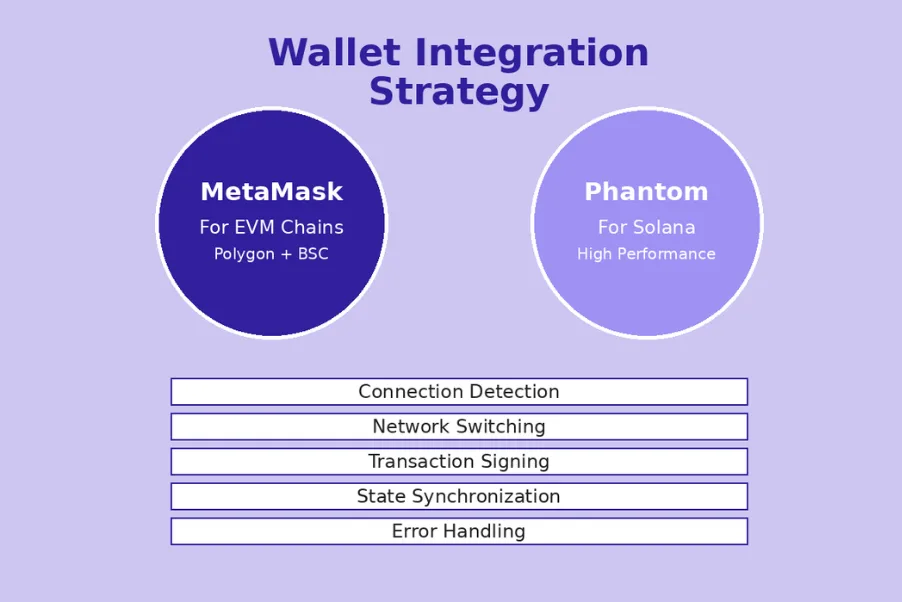
Wallet integration represents the primary user interface for Web3 apps, directly impacting onboarding success and user experience quality. MetaMask dominates the Ethereum and EVM-compatible ecosystem with over 30 million monthly active users globally, making it the essential integration target for Polygon and BSC deployments. Modern MetaMask integration utilizes the provider API accessible through window.ethereum, enabling applications to request wallet connections, retrieve user accounts, submit transactions for signing, and monitor network changes. Best practices include implementing proper connection state management, handling account switching gracefully, providing clear transaction context before signature requests, and supporting WalletConnect as a fallback for mobile users.
Phantom wallet serves the Solana ecosystem with similar dominance, offering sleek user experience optimized for Solana’s unique transaction model. Phantom integration differs from MetaMask in several important ways, reflecting Solana’s architectural distinctions. Applications interact with Phantom through the window.solana object, constructing transactions that account for Solana’s compute units, blockhash requirements, and account-based state model. Critical considerations include properly deriving Program Derived Addresses (PDAs), handling transaction simulation for fee estimation, managing recent blockhash expiration, and providing transaction confirmation monitoring. For multi-chain applications serving users across North America and international markets, supporting both MetaMask and Phantom covers approximately 85% of active Web3 users while demonstrating professional attention to user experience across different blockchain ecosystems.
RPC and Node Configuration
Remote Procedure Call (RPC) endpoints provide the communication bridge between your Web3 app frontend and the underlying blockchain network. While public RPC endpoints offer convenient starting points during initial exploration, production applications require robust, reliable RPC infrastructure to ensure consistent user experience. Each blockchain ecosystem offers multiple RPC provider options with varying service levels, rate limits, and geographical distribution. For Polygon, popular providers include Alchemy, Infura, QuickNode, and Polygon’s official RPC service, each offering different pricing tiers and feature sets including archive node access, websocket subscriptions, and enhanced rate limits.
Production RPC configuration should implement redundancy and failover mechanisms to maintain availability even when individual providers experience issues. Best practices include configuring multiple RPC endpoints with automatic failover logic, implementing request retries with exponential backoff for transient failures, caching blockchain data appropriately to reduce RPC load, and monitoring RPC performance metrics to detect degradation early. For applications expecting significant traffic or serving latency-sensitive use cases across USA, UK, and other markets, investing in premium RPC services with guaranteed uptime SLAs and dedicated support delivers measurable improvements in user experience. Organizations handling sensitive operations or requiring maximum reliability should consider running dedicated blockchain nodes, though this approach demands significant technical expertise and infrastructure investment compared to managed RPC services.
Step-by-Step Guide to Launching on Polygon
Polygon deployment offers the smoothest path for teams familiar with Ethereum tooling and Solidity smart contracts. The network’s complete EVM compatibility means existing deployment scripts, testing frameworks, and interaction libraries work with minimal modification. This section provides detailed, actionable guidance for deploying your Web3 app on Polygon mainnet, covering network configuration, contract deployment procedures, and frontend integration best practices drawn from our extensive experience launching applications for clients across competitive global markets.
Network Configuration
Configuring your environment for Polygon deployment begins with setting up the correct network parameters in your application configuration and wallet settings. For Hardhat-based projects, add Polygon mainnet to your hardhat.config.js file specifying the RPC URL, chain ID (137), and deployment account configuration. The chain ID serves as the critical identifier ensuring transactions execute on the intended network, preventing accidental deployment to testnets or other chains. Essential configuration parameters include the RPC endpoint URL (typically from Alchemy, Infura, or Polygon’s official service), gas price strategy appropriate for current network conditions, and private key management for deployment accounts with proper security measures.
For user-facing wallet configuration, ensure your application provides clear instructions for adding Polygon network to MetaMask or other Web3 wallets. This typically involves specifying the network name, RPC URL (https://polygon-rpc.com or your preferred provider), chain ID 137, currency symbol MATIC, and block explorer URL (https://polygonscan.com). Many modern applications programmatically request wallet network additions through the wallet_addEthereumChain RPC method, streamlining the onboarding process for users across USA, Canada, UK, and global markets. Implement proper error handling for network switching requests, gracefully managing scenarios where users decline the addition or experience connectivity issues.
Smart Contract Deployment
Smart contract deployment to Polygon mainnet follows standard Ethereum deployment patterns with attention to Polygon-specific considerations. Using Hardhat or Foundry, execute deployment scripts that compile contracts, estimate gas requirements, broadcast deployment transactions, and verify successful deployment through transaction receipts. Critical steps include verifying sufficient MATIC balance in the deployment account to cover gas fees (typically 0.1-0.5 MATIC provides comfortable margin), setting appropriate gas price based on current network conditions, implementing deployment validation checks to confirm correct initialization parameters, and recording deployed contract addresses for subsequent integration and verification steps.
After successful deployment, immediately verify your contract source code on Polygonscan to enable users and auditors to review your implementation. Verification involves uploading your Solidity source files, compiler version, and optimization settings to Polygonscan’s verification interface, which compiles the code and matches the bytecode against your deployed contract. This transparency builds user trust and is considered essential for professional Web3 app launch in competitive markets. Modern deployment tools like Hardhat provide automated verification through the hardhat-etherscan plugin, streamlining this process. For complex contracts using constructor arguments or proxy patterns, carefully document the verification parameters to ensure successful completion. Maintaining detailed deployment logs including transaction hashes, contract addresses, deployment timestamps, and verification links creates essential documentation for operational management and compliance purposes.
Frontend Integration and Verification
Frontend integration connects your user interface to deployed Polygon smart contracts through Web3 libraries like ethers.js or web3.js. Begin by updating your application configuration with deployed contract addresses, Application Binary Interfaces (ABIs), and Polygon RPC endpoints. Implement proper contract instantiation using provider connections that automatically detect user network selection and prompt network switching when necessary. Best practices include maintaining separate configurations for different deployment environments (testnet, mainnet), implementing graceful error handling for common failure modes like wallet disconnection or network errors, and providing clear user feedback during transaction submission and confirmation processes.
Thorough frontend verification ensures your application correctly interacts with deployed contracts across all user workflows. Test critical paths including wallet connection, transaction signing, state reading, event listening, and error scenarios using real mainnet contracts with small amounts of MATIC to validate production behavior. Verify that transaction confirmations appear correctly, state updates reflect in the UI appropriately, and error messages provide actionable guidance to users. For applications serving diverse markets including UAE, Canada, and UK, test across different wallet implementations, browser environments, and network conditions to identify and resolve compatibility issues before public launch. Implementing comprehensive frontend monitoring with tools like Sentry or DataDog enables rapid detection and resolution of issues affecting users in production environments.
Step-by-Step Guide to Launching on BSC
Binance Smart Chain deployment shares many similarities with Polygon given both chains’ EVM compatibility, yet important differences in network parameters, gas mechanics, and ecosystem conventions require careful attention. BSC’s connection to the Binance exchange ecosystem and its pragmatic approach to balancing performance with decentralization creates unique opportunities and considerations for Web3 app launch. This section details the specific steps and best practices for successfully deploying your application on BSC mainnet.
Setting Up BSC Mainnet
BSC mainnet configuration requires specifying the chain ID (56), RPC endpoint, and native currency (BNB) in both your deployment tooling and frontend application. For Hardhat-based deployments, add BSC network configuration to hardhat.config.js with appropriate RPC URLs from providers like Nodereal, Ankr, or BSC’s official endpoints. Unlike Polygon where MATIC serves purely as the gas token, BNB carries additional significance as Binance’s native token with direct exchange integration, influencing how users acquire and manage gas funds. Ensure deployment accounts hold sufficient BNB to cover deployment gas costs, typically 0.05-0.15 BNB depending on contract complexity and current network conditions.
For frontend configuration, implement BSC network parameters enabling user wallets to connect seamlessly. Key parameters include network name (“Binance Smart Chain”), RPC URL (https://bsc-dataseed.binance.org or your preferred provider), chain ID 56, currency symbol “BNB”, and block explorer “https://bscscan.com”. BSC’s three-second block time and validator-based consensus can create different transaction confirmation patterns compared to Polygon, requiring appropriate frontend handling for pending transactions and confirmation logic. Applications serving users across USA, UK, and international markets should provide clear guidance on acquiring BNB for gas fees, noting that Binance exchange offers the most direct path though decentralized bridges and swap protocols provide alternatives.
Deploying Contracts and Verifying on BscScan
Contract deployment on BSC follows identical procedures to Polygon deployment given their shared EVM architecture. Execute your deployment scripts ensuring proper network selection, gas configuration, and initialization parameters. BSC’s gas price typically remains stable in the 3-5 gwei range, significantly lower than Ethereum mainnet but higher than Polygon, making it economical for most applications while generating meaningful validator revenue. Post-deployment, verify your contracts on BscScan using identical processes to Polygonscan verification, uploading source code, compiler settings, and constructor arguments to enable public code review and build user trust.
BscScan verification provides additional benefits including automatic generation of contract interaction interfaces allowing users to call contract functions directly through the explorer, enhanced token tracking for BEP-20 implementations, and integration with BSC’s broader ecosystem tools. For contracts implementing standard interfaces like BEP-20 tokens or BEP-721 NFTs, ensure proper interface compliance to enable automatic detection and categorization. The verification process typically completes within minutes, though complex contracts with multiple dependencies may require additional attention to include all necessary source files and libraries. Maintaining verified source code represents essential best practice for professional Web3 apps competing in markets across North America, Europe, and the Middle East where transparency and auditability directly influence user adoption decisions.
Gas Fee Optimization Strategies
Gas optimization on BSC balances the network’s already low base fees with the potential for significant savings through smart contract efficiency improvements. While BSC transactions cost dramatically less than Ethereum mainnet, applications with high transaction volumes or complex operations still benefit substantially from optimization efforts. Key strategies include minimizing storage operations which remain the most expensive operations even on low-fee chains, packing variables efficiently to reduce storage slots, implementing batch operations allowing users to execute multiple actions in single transactions, and leveraging events rather than storage for historical data that doesn’t require on-chain queryability.
Timing considerations also influence BSC gas costs. While BSC doesn’t experience the dramatic gas price volatility of Ethereum mainnet, network usage patterns create modest variations where strategic timing of non-urgent operations during lower-activity periods reduces costs. For applications requiring frequent administrative operations or batch processing, implementing off-peak scheduling can generate meaningful savings over time. Additionally, BSC’s validator reward structure and 21-validator consensus model create relatively predictable gas price patterns compared to larger validator sets. Organizations should monitor BscScan’s gas tracker and implement dynamic gas pricing in their applications to balance confirmation speed against cost efficiency, particularly important for applications serving price-sensitive markets or enabling high-frequency user interactions.
Critical Deployment Process Principles
Principle 1: Never deploy to mainnet without comprehensive testnet validation covering all critical user workflows and edge cases.
Principle 2: Verify all deployed contracts on block explorers immediately after deployment to enable transparency and public auditability.
Principle 3: Implement gradual rollout strategies starting with limited functionality or user access to contain potential issues.
Principle 4: Maintain detailed deployment documentation including all contract addresses, transaction hashes, and configuration parameters.
Principle 5: Establish monitoring and alerting systems before public launch to detect issues immediately upon occurrence.
Principle 6: Prepare incident response procedures and emergency pause mechanisms before deployment to enable rapid reaction to critical issues.
Principle 7: Coordinate simultaneous launches across multiple chains carefully to maintain consistent user experience and brand perception.
Principle 8: Budget adequate time and resources for post-launch monitoring, user support, and iterative improvements based on real-world usage.
Step-by-Step Guide to Launching on Solana
Solana deployment represents a fundamentally different approach compared to EVM chains, requiring distinct tooling, programming languages, and architectural patterns. While the learning curve proves steeper for teams accustomed to Ethereum ecosystems, Solana’s exceptional performance characteristics and growing ecosystem justify the investment for applications where speed and cost efficiency deliver competitive advantages. This section provides comprehensive guidance for deploying Solana programs, from environment setup through on-chain interaction, leveraging our extensive experience launching high-performance applications across this innovative blockchain platform.
Solana CLI and Environment Setup
Solana implementation begins with installing the Solana CLI tools, which provide essential commands for program deployment, account management, and blockchain interaction. Install the CLI on macOS or Linux using the official installation script, or on Windows through WSL2 for optimal compatibility. After installation, configure your Solana CLI to connect to the appropriate network cluster using the ‘solana config set’ command, specifying mainnet-beta for production deployments, testnet for final validation, or devnet for initial experimentation. Generate or import deployment keypairs using ‘solana-keygen’ commands, securing private keys with appropriate filesystem permissions and backup procedures given their critical role in controlling deployed programs and accounts.
For program creation, the Anchor framework has emerged as the standard approach, providing higher-level abstractions over raw Solana programming while maintaining performance and security. Install Anchor using Cargo (Rust’s package manager) and initialize new projects with ‘anchor init’ commands that scaffold proper directory structure including program code, tests, and client interaction examples. Anchor handles many low-level Solana complexities including account validation, serialization, and common security patterns, enabling teams to focus on business logic rather than blockchain-specific boilerplate. Configure proper Rust toolchains including rustfmt for code formatting and clippy for linting to maintain code quality standards essential for secure Web3 app launch. Teams should invest adequate time learning Solana’s unique concepts including accounts, programs, Program Derived Addresses (PDAs), and transaction structure before beginning complex implementations serving production users across USA, Canada, and international markets.
Program Deployment Process
Deploying Solana programs involves building your Rust code into BPF (Berkeley Packet Filter) bytecode, uploading this bytecode to the Solana network, and marking the program as executable. Using Anchor, execute ‘anchor build’ to compile programs, generating deployable artifacts in the target directory. Before mainnet deployment, thoroughly validate programs on devnet and testnet using ‘anchor deploy’ with appropriate cluster configuration. Solana’s deployment model differs from Ethereum’s immutable contracts by allowing program upgrades through upgrade authorities, providing flexibility to fix bugs or add features but requiring careful authority management to prevent unauthorized modifications.
Mainnet deployment requires sufficient SOL in your deployment wallet to cover program deployment costs and rent exemption for program accounts. Typical programs require 1-5 SOL for deployment depending on program size, with larger programs necessitating higher balances. Execute deployment using ‘anchor deploy –provider.cluster mainnet’ after thorough testing and validation. Post-deployment, verify program functionality through test transactions on mainnet with small amounts, confirm proper account initialization and state management, and validate that frontend clients can successfully interact with deployed programs. Consider implementing gradual rollout strategies where initial launches limit functionality or user access, enabling issue detection before full-scale public availability. For applications serving competitive markets across UK, UAE, and North America, maintaining comprehensive deployment logs including program IDs, upgrade authority addresses, and transaction signatures enables effective operational management and troubleshooting throughout the application lifecycle.
Phantom Wallet and On-Chain Interaction
Phantom wallet integration provides Solana applications with user authentication, transaction signing, and account management capabilities essential for Web3 app functionality. Frontend integration accesses Phantom through the window.solana provider object, detecting wallet installation, requesting connection permissions, and retrieving user public keys. Unlike EVM wallets where addresses derive deterministically from a single seed, Solana applications often require users to hold multiple accounts including the main wallet account, token accounts for SPL tokens, and program-specific accounts for application state. Implement proper account discovery and initialization flows that guide users through necessary account setups while minimizing confusion and transaction costs.
Transaction construction for Solana requires careful attention to the platform’s unique transaction model. Build transactions including all necessary instructions, specify required account addresses with appropriate read/write and signer designations, attach recent blockhashes to prevent replay attacks, and estimate compute units to ensure sufficient resources for execution. Use Anchor’s client libraries or @solana/web3.js for transaction construction, properly handling serialization and account metadata. After users sign transactions through Phantom, implement robust confirmation monitoring using commitment levels (processed, confirmed, finalized) appropriate for your application’s security requirements. For high-value operations, wait for finalized commitment ensuring complete network consensus. Applications serving users across diverse geographic markets should implement proper error handling and user feedback for common issues including insufficient SOL for fees, blockhash expiration, and account initialization failures, providing clear guidance for resolution.
Comparing Polygon vs BSC vs Solana
Selecting the optimal blockchain platform or implementing multi-chain strategies requires deep understanding of how Polygon, BSC, and Solana compare across critical dimensions including cost, performance, tooling, and ecosystem characteristics. Each platform has evolved to serve different niches within the broader Web3 landscape, with distinct strengths and trade-offs that influence deployment decisions. This comparative analysis synthesizes our eight years of practical experience across all three platforms, providing actionable insights to guide your strategic choices for Web3 app launch in competitive global markets.
Gas Fees and Transaction Speed
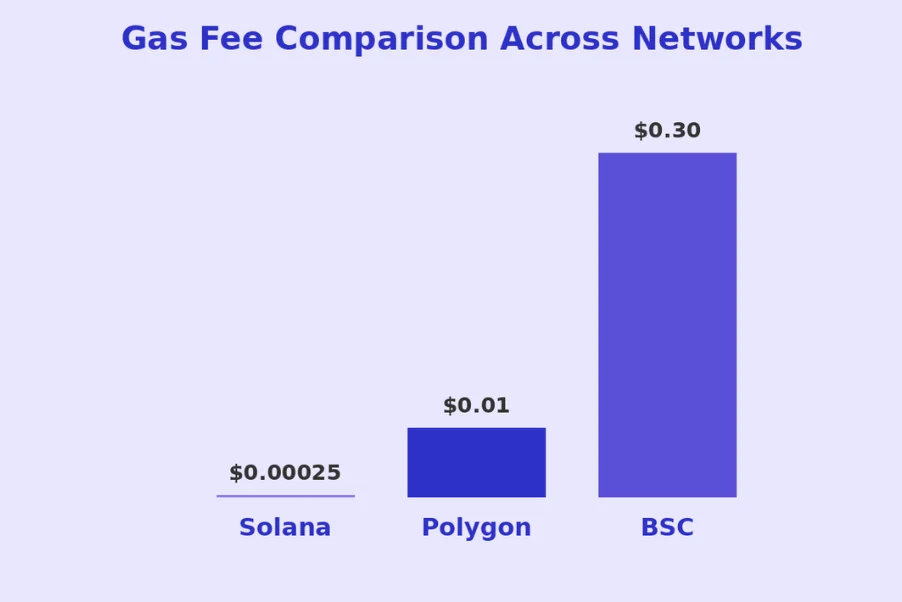
| Metric | Polygon | BSC | Solana |
|---|---|---|---|
| Simple Transfer | $0.001 – $0.01 | $0.10 – $0.30 | $0.00025 |
| DeFi Swap | $0.01 – $0.05 | $0.20 – $0.60 | $0.001 – $0.01 |
| NFT Mint | $0.02 – $0.10 | $0.30 – $0.80 | $0.01 – $0.05 |
| Confirmation Time | 2-5 seconds | 3-6 seconds | 400ms – 1 second |
| Peak Congestion Impact | 2-3x increase | 3-5x increase | Minimal impact |
These cost and performance characteristics directly influence user experience and business models. Applications with high transaction volumes or price-sensitive users benefit dramatically from Solana’s minimal fees, while those prioritizing EVM compatibility and Ethereum ecosystem integration find Polygon or BSC more appropriate despite higher relative costs. Organizations serving diverse markets across USA, UK, UAE, and Canada should carefully evaluate their specific use case requirements against these platform characteristics to optimize both user experience and operational economics.
Scalability and Network Performance
Scalability encompasses multiple dimensions beyond raw transaction throughput, including network stability, resource requirements for validation, and degradation patterns under extreme load. Polygon achieves scalability through Layer 2 architecture, processing transactions on its PoS sidechain while periodically checkpointing to Ethereum for final settlement security. This approach delivers approximately 7,000 theoretical TPS with real-world sustained throughput around 2,000-3,000 TPS. The network has demonstrated strong stability with minimal downtime, though occasional congestion during peak activity can cause temporary fee increases and slower confirmations. Polygon’s architecture provides predictable performance characteristics suitable for most consumer applications including games, NFT platforms, and DeFi protocols serving mainstream users.
BSC prioritizes simplicity and pragmatic performance over maximal decentralization, achieving approximately 160 TPS through its 21-validator Proof of Staked Authority consensus. While this throughput significantly exceeds Ethereum mainnet, it falls well below both Polygon and especially Solana. BSC compensates with consistent three-second block times and predictable fee patterns, delivering reliable performance for the vast majority of applications. The network’s centralized validator set raises concerns about censorship resistance and decentralization, though this trade-off enables operational efficiency and rapid decision-making during network upgrades or emergencies. Solana represents the performance frontier with theoretical capacity exceeding 65,000 TPS and real-world sustained throughput regularly surpassing 3,000 TPS with sub-second finality. However, this extreme performance comes with higher hardware requirements for validators and a history of network outages during 2021-2022, though stability has improved significantly through 2024-2025. Applications requiring absolute maximum throughput like high-frequency trading, gaming, or micropayment systems find Solana’s performance essential, while those prioritizing proven stability may prefer Polygon or BSC’s more conservative approaches.
Ecosystem Growth and Community Support
Ecosystem maturity profoundly influences Web3 app launch success through factors including available tooling, integration opportunities, talent availability, and community support resources. Polygon has cultivated the largest ecosystem among these three platforms, hosting over 37,000 applications across virtually every Web3 category and maintaining strong institutional relationships with major brands. The extensive Polygon ecosystem provides developers with mature tooling, comprehensive documentation, active community forums, and abundant integration opportunities with existing DeFi protocols, NFT marketplaces, and infrastructure services. This ecosystem depth translates to faster implementation timelines and reduced risk for teams building on Polygon, particularly valuable for organizations entering Web3 for the first time.
BSC maintains a vibrant ecosystem focused heavily on DeFi, with thousands of protocols offering lending, swapping, yield farming, and derivatives trading. The ecosystem benefits from tight integration with Binance exchange, providing deep liquidity and straightforward user onboarding pathways for markets including Canada, UAE, and other regions where Binance maintains strong presence. However, BSC’s ecosystem has faced criticism for high rates of copycat projects and occasional security issues stemming from rapid, low-quality deployments attracted by minimal barriers to entry. Solana’s ecosystem has experienced explosive growth since 2021, particularly in gaming, NFTs, and DeFi, attracting major projects and substantial venture capital investment. The ecosystem offers innovative protocols and strong community enthusiasm, though tooling maturity still lags behind EVM chains and developers face a steeper learning curve. For Web3 app launch strategies, multi-chain deployment across all three platforms maximizes ecosystem access while hedging against platform-specific risks, positioning applications to serve the broadest possible user base across USA, UK, and international markets.
Platform Selection Criteria Framework
Technical Requirements Assessment
Evaluate transaction volume needs, latency requirements, and whether EVM compatibility offers strategic advantages for your specific use case and team capabilities.
User Demographics Analysis
Identify where your target users currently maintain wallets and hold assets, considering geographic distribution across USA, UK, UAE, and Canada markets.
Economic Viability Calculation
Model transaction costs at expected volumes and determine whether fee structures enable sustainable business models and acceptable user economics.
Security and Best Practices for Web3 App Launch
Security represents the paramount concern for any Web3 application handling user funds or sensitive data, as smart contract vulnerabilities have resulted in billions of dollars in losses across the cryptocurrency ecosystem. Unlike traditional applications where security patches can deploy rapidly after issue discovery, blockchain’s immutability means security must be achieved before mainnet deployment. This section synthesizes critical security practices and deployment best practices developed through our eight years of experience launching secure applications for clients across competitive global markets, preventing the common pitfalls that plague inexperienced teams.
Smart Contract Audits
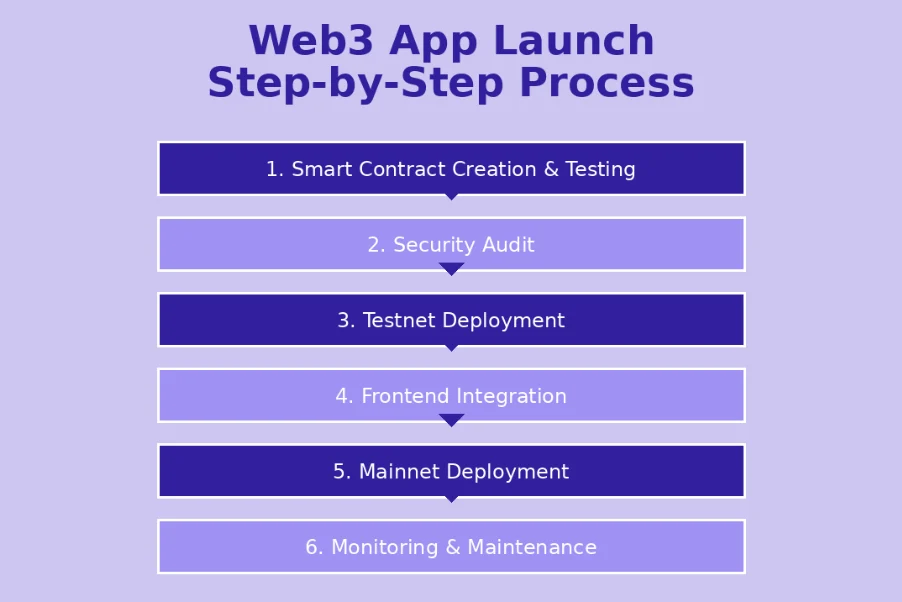
Professional smart contract audits by specialized security firms represent non-negotiable investments for any serious Web3 app launch, particularly those handling significant user funds or operating in regulated markets. Leading audit firms including Trail of Bits, OpenZeppelin, CertiK, ConsenSys Diligence, and Quantstamp employ expert security researchers who systematically analyze contract code for vulnerabilities, logic errors, and potential attack vectors. Comprehensive audits typically cost $15,000 to $100,000 depending on code complexity, timeline requirements, and firm reputation, representing small investments relative to the catastrophic losses prevented by identifying critical vulnerabilities before deployment.
The audit process typically spans 2-4 weeks and involves multiple phases including initial code review, vulnerability identification, report delivery with severity classifications, remediation period where teams fix identified issues, and final verification audit confirming fixes. Teams should engage auditors early in the process, often during architecture and design phases, to incorporate security considerations from the beginning rather than discovering fundamental issues late in timeline. Beyond formal audits, many organizations implement bug bounty programs through platforms like Immunefi or Code4rena, incentivizing white hat hackers to discover and responsibly disclose vulnerabilities. For applications serving users across USA, UK, UAE, and Canada markets, published audit reports from respected firms build user trust and demonstrate commitment to security, significantly improving adoption rates and reducing insurance costs for DeFi protocols.
Preventing Common Deployment Errors
Deployment errors represent preventable failures that can catastrophically impact Web3 app launch success, ranging from minor inconveniences requiring redeployment to permanent loss of contract control or user funds. Common errors include deploying contracts with incorrect initialization parameters rendering them unusable, setting wrong admin addresses preventing future contract management, failing to verify contracts on block explorers reducing transparency and user trust, and deploying to wrong networks sending mainnet contracts to testnets or vice versa. Implementing comprehensive pre-deployment checklists and automated validation scripts catches these issues before they affect users.
Critical prevention practices include maintaining detailed deployment scripts that document all configuration parameters, implementing automated tests that verify contract state after deployment, using multi-signature wallets for contract ownership requiring multiple approvals for critical operations, establishing formal code review processes where senior engineers approve all deployment artifacts, and maintaining comprehensive rollback procedures for issues discovered post-deployment. For upgradeable contracts using proxy patterns, teams must carefully manage upgrade authorities and implement timelock mechanisms preventing immediate, ungoverned upgrades that could compromise user funds. Organizations should conduct deployment dry runs on testnets using identical procedures planned for mainnet, identifying and resolving procedural issues in safe environments. Post-deployment verification should confirm all contract addresses match expectations, initialization completed successfully, access controls configured correctly, and frontend applications connect to proper deployed instances across all target networks serving users in competitive global markets.
Mainnet Monitoring and Maintenance
Continuous monitoring of deployed smart contracts and application infrastructure enables rapid detection and response to issues before they escalate into major incidents affecting users or business operations. Comprehensive monitoring encompasses multiple layers including on-chain event monitoring tracking all contract interactions and state changes, RPC endpoint health monitoring ensuring reliable blockchain connectivity, frontend application monitoring detecting client-side errors or performance degradation, and business metrics monitoring tracking key performance indicators like transaction volumes, user growth, and economic activity. Modern monitoring solutions like Tenderly, Forta Network, and OpenZeppelin Defender provide specialized tools for Web3 monitoring, offering real-time alerts, automated response capabilities, and detailed transaction analysis.
Effective maintenance procedures ensure long-term application health and security. Regular activities include reviewing transaction patterns for anomalies indicating attacks or exploitation attempts, monitoring gas prices and transaction success rates across Polygon, BSC, and Solana to optimize user experience, tracking security disclosures for dependencies and infrastructure components, maintaining emergency response procedures including circuit breakers or pause mechanisms, and conducting periodic security reviews as codebases evolve. Organizations should establish on-call rotations ensuring qualified personnel can respond immediately to critical alerts regardless of time or day. For applications serving international markets across different time zones in USA, UK, UAE, and Canada, distributed teams enable true 24/7 monitoring coverage. Documenting incident response procedures including escalation paths, emergency contact information, and step-by-step remediation playbooks enables rapid, coordinated responses during high-stress situations, minimizing user impact and preserving business continuity.
Mainnet Launch Preparation Framework
Transitioning from testnet validation to mainnet deployment represents a critical milestone requiring meticulous preparation across technical, operational, and organizational dimensions. Successful mainnet launches balance thorough preparation against practical timeline constraints, implementing comprehensive validation procedures while maintaining momentum toward public availability. This framework synthesizes proven practices from dozens of successful Web3 app launches across Polygon, BSC, and Solana, providing structured guidance for teams preparing to serve real users in competitive markets worldwide.
System Integration and Regression Testing
System integration testing validates that all application components interact correctly across the complete technology stack, from smart contracts through middleware services to frontend user interfaces. Unlike unit tests that verify individual components in isolation, integration tests exercise real workflows as users would experience them, including wallet connections, transaction submissions, state synchronization, event processing, and error recovery. Comprehensive integration testing catches issues that unit tests miss, particularly around timing, asynchronous operations, and cross-component dependencies that manifest only in complete system contexts.
Regression testing ensures that new changes don’t break previously working functionality, particularly important for multi-chain deployments where platform-specific issues can emerge. Maintain comprehensive test suites covering all critical user journeys including account creation, asset deposits, core application interactions, and withdrawal processes. Automate regression testing to enable rapid verification after any code changes, configuration updates, or infrastructure modifications. For applications launching across Polygon, BSC, and Solana simultaneously, implement platform-specific test suites addressing unique characteristics like Solana’s account model or BSC’s gas pricing while maintaining shared test cases for common functionality. Test across different network conditions simulating congestion, high latency, and intermittent connectivity to ensure graceful degradation rather than catastrophic failures. Organizations serving users across USA, UK, UAE, and Canada should conduct testing from multiple geographic regions to identify latency or connectivity issues affecting specific markets.
Contract Verification and Compliance Checks
| Verification Category | Key Checks | Priority |
|---|---|---|
| Smart Contract Code | Source verification on block explorers, bytecode matching, constructor parameters validation | Critical |
| Access Controls | Admin roles correctly assigned, multi-sig requirements active, privilege separation implemented | Critical |
| Economic Parameters | Fee structures configured correctly, token supply matches specifications, price oracles validated | High |
| Integration Points | External contract addresses correct, oracle feeds operational, bridge connections functional | High |
| Compliance Documentation | Terms of service published, privacy policy compliant, regulatory requirements addressed | Medium |
| Emergency Procedures | Pause mechanisms tested, upgrade procedures documented, incident response plans activated | Critical |
Systematic verification across these categories prevents deployment of misconfigured contracts that could compromise user funds, violate regulatory requirements, or create operational liabilities. Organizations launching in regulated markets including USA, UK, and UAE must pay particular attention to compliance documentation and ensure legal review of all user-facing terms and disclosures.
Runtime Monitoring and Incident Response Plan
Establishing comprehensive runtime monitoring before mainnet launch enables teams to detect and respond to issues immediately upon occurrence, often before users notice problems or significant impact accumulates. Modern monitoring solutions should track multiple signal categories including smart contract events and state changes, blockchain network health across all deployment targets, RPC provider availability and latency, frontend application errors and performance metrics, and business-level indicators like transaction volumes and user activity patterns. Configure alerting thresholds that balance sensitivity against noise, ensuring critical issues trigger immediate notifications while minor fluctuations are logged for analysis without generating alert fatigue.
Incident response plans document procedures for handling various failure scenarios, from minor frontend bugs to critical smart contract exploits. Effective plans specify escalation paths defining who receives alerts and who makes decisions at different severity levels, communication protocols for keeping users informed during incidents, technical response procedures including steps for pausing contracts or switching to backup infrastructure, and post-incident analysis processes ensuring teams learn from issues and implement preventive measures. Conduct incident response drills before launch, simulating various scenarios to validate procedures and train team members. For multi-chain applications deployed across Polygon, BSC, and Solana, ensure incident response plans address platform-specific scenarios and maintain sufficient expertise to handle issues on any deployed network. Organizations serving international markets across USA, Canada, UK, and UAE should establish 24/7 incident response capabilities, recognizing that blockchain operates continuously without downtime windows for maintenance or issue resolution.
Ready to Launch Your Multi-Chain Web3 Application?
Partner with blockchain experts who have successfully launched applications across Polygon, BSC, and Solana for clients worldwide.
Final Thoughts
Successfully launching Web3 apps across Polygon, BSC, and Solana requires comprehensive understanding of each platform’s technical characteristics, ecosystem dynamics, and operational requirements. Through this guide, we have explored the fundamental concepts of multi-chain deployment, examined the unique advantages and trade-offs of each blockchain platform, provided detailed step-by-step deployment procedures, and outlined critical security and best practices developed through years of practical experience. Organizations that invest adequately in preparation, security auditing, thorough testing, and ongoing monitoring position themselves for success in competitive Web3 markets.
The multi-chain future of Web3 rewards applications that strategically leverage the strengths of different platforms while managing complexity through robust engineering practices and operational discipline. Whether launching DeFi protocols, gaming applications, NFT platforms, or enterprise blockchain solutions, the principles and procedures outlined in this guide provide the foundation for professional Web3 app launch. As blockchain technology continues evolving and new platforms emerge, teams that master multi-chain deployment position themselves to capitalize on innovation while serving users across the broadest possible ecosystem landscape spanning USA, UK, UAE, Canada, and beyond.
Frequently Asked Questions
Q1.What are the key differences between launching a Web3 app on Polygon, BSC, and Solana?
Polygon offers Ethereum compatibility with lower fees and strong cross-chain support. BSC provides EVM compatibility, faster block times, and strong DeFi liquidity. Solana delivers high throughput and sub-second finality using Rust. Polygon suits scalable Ethereum apps, BSC fits trading-focused platforms, and Solana powers high-performance applications.
Q2.How long does it typically take to launch a Web3 application on these blockchains?
Launching on Polygon or BSC usually takes 2–4 weeks after smart contract completion, including testing and verification. Solana may require 3–6 weeks due to Rust and architectural differences. Parallel testing, automated workflows, and simultaneous audits can significantly reduce multi-chain deployment timelines.
Q3.What are the estimated gas fees for deploying smart contracts on Polygon, BSC, and Solana?
Polygon deployment costs are generally very low, often under a few dollars. BSC costs slightly more depending on contract complexity. Solana provides extremely low transaction and deployment costs. Actual fees fluctuate with network congestion, but Solana is typically the most economical option.
Q4.Do I need different programming languages for each blockchain platform?
Yes. Polygon and BSC use Solidity, allowing similar codebases across both networks. Solana requires Rust or C, introducing a different programming model. While this increases technical complexity, Solana’s architecture provides superior speed and scalability for high-performance applications.
Q5.What wallet integrations are required for a multi-chain Web3 application?
MetaMask supports Polygon and BSC, enabling easy network switching. Solana requires Phantom or Solflare wallets due to its architecture. Multi-chain apps often integrate WalletConnect or Web3Modal to support multiple wallets, ensuring seamless access and broader user adoption.
Q6.How do I ensure my Web3 app remains secure across multiple deployments?
Conduct separate audits for each blockchain and test thoroughly on testnets before launch. Use monitoring tools to track contract activity, implement bridge security if needed, and maintain upgrade mechanisms. Establish incident response plans to address vulnerabilities quickly.
Q7.What are the ongoing maintenance requirements after launching on multiple blockchains?
Post-launch maintenance includes monitoring gas fees, tracking network upgrades, ensuring reliable RPC infrastructure, and performing regular security reviews. Teams must optimize performance, manage contract upgrades, and scale infrastructure as usage grows across different blockchain ecosystems.
Explore Services
Related Services
Reviewed by

Aman Vaths
Founder of Nadcab Labs
Aman Vaths is the Founder & CTO of Nadcab Labs, a global digital engineering company delivering enterprise-grade solutions across AI, Web3, Blockchain, Big Data, Cloud, Cybersecurity, and Modern Application Development. With deep technical leadership and product innovation experience, Aman has positioned Nadcab Labs as one of the most advanced engineering companies driving the next era of intelligent, secure, and scalable software systems. Under his leadership, Nadcab Labs has built 2,000+ global projects across sectors including fintech, banking, healthcare, real estate, logistics, gaming, manufacturing, and next-generation DePIN networks. Aman’s strength lies in architecting high-performance systems, end-to-end platform engineering, and designing enterprise solutions that operate at global scale.