Ai Overview
Anti-Money Laundering (AML) and Know Your Customer (KYC) regulations have become the cornerstone of cryptocurrency compliance, transforming how digital asset businesses operate worldwide. The cryptocurrency sector faced over $927 million in AML-related fines during the first half of 2025 alone, making it the primary target for global regulators. According to Chainalysis, illicit cryptocurrency addresses received at least $154 billion in 2025, representing a 162% increase from the previous year.
Anti-Money Laundering (AML) and Know Your Customer (KYC) regulations have become the cornerstone of cryptocurrency compliance, transforming how digital asset businesses operate worldwide. The cryptocurrency sector faced over $927 million in AML-related fines during the first half of 2025 alone, making it the primary target for global regulators.[1] As crypto moves from the fringes to mainstream financial infrastructure, understanding AML and KYC requirements is no longer optional for exchanges, wallet providers, and anyone involved in token development or crypto token development. This comprehensive guide explains what AML and KYC mean for cryptocurrency, why these regulations matter, how they work in practice, and what the future holds for crypto compliance. The rapid development of regulatory frameworks reflects the urgency of protecting both consumers and the broader financial system from illicit actors exploiting digital assets.
Key Takeaways
- Record Enforcement: Crypto exchanges faced over $927 million in AML fines in H1 2025, with total AML/CFT penalties exceeding $1.1 billion.
- Illicit Activity Scale: Crypto crime reached $154 billion in 2025, a 162% increase from the previous year.
- FATF Travel Rule: 99 jurisdictions have passed or are drafting legislation requiring VASPs to share sender and recipient information.
- KYC Components: Customer identification, due diligence, and continuous monitoring form the three pillars of crypto KYC.
- Stablecoin Focus: 84% of illicit transaction volume now involves stablecoins, making them a regulatory priority.
- EU AMLA: The EU Anti-Money Laundering Authority began operations in July 2025, marking direct EU-wide supervision.
- Criminal Consequences: Non-compliance can result in multi-million dollar fines, license revocation, and criminal liability for executives.
What is AML and KYC in Crypto?
Anti-Money Laundering (AML) and Know Your Customer (KYC) are two interconnected compliance frameworks that work together to protect the cryptocurrency ecosystem from financial crime. While they serve different functions, they operate as a unified system where KYC provides the foundation and AML builds the protective structure on top. Understanding both concepts together is essential because effective crypto compliance requires seamless integration of identity verification (KYC) with ongoing transaction monitoring and reporting (AML).
Understanding AML (Anti-Money Laundering)
AML for cryptocurrency encompasses the laws, regulations, and procedures designed to prevent criminals from converting illegally obtained digital assets into legitimate funds. AML crypto compliance adapts traditional financial crime prevention frameworks to the unique characteristics of blockchain technology, including pseudonymity, borderless transactions, and decentralized networks. These specialized AML protocols reflect recognition that cryptocurrency presents both opportunities and risks for the global financial system. AML requirements for crypto exchanges include implementing risk-based customer due diligence, conducting ongoing transaction monitoring, screening against sanctions lists, and filing suspicious activity reports (SARs) when warranted.
Understanding KYC (Know Your Customer)
KYC for cryptocurrency refers to the identity verification procedures that Virtual Asset Service Providers (VASPs) must implement to confirm who their customers actually are. KYC forms the foundation of AML compliance by ensuring that crypto businesses can identify potentially suspicious actors before they access services. When users sign up for a crypto exchange, they typically provide personal information, government-issued identification, and proof of address as part of KYC verification. For anyone looking to create crypto token projects or launch new platforms, integrating these KYC procedures is fundamental to achieving regulatory approval. While KYC handles individual users, businesses onboarding through a VASP corporate trading desks, institutional clients, or partner exchanges require Kyb checks to verify legal entity status, UBOs, and sanctions exposure before access is granted.
How AML and KYC Work Together
The relationship between AML and KYC is hierarchical: KYC is a critical component within the broader AML framework. Think of KYC as the first line of defense that identifies who is entering your platform, while AML encompasses the entire system of monitoring, detecting, and reporting suspicious activity. Crypto development company teams building exchange platforms must integrate both mechanisms from the ground up. KYC provides the customer data that AML systems need to function effectively, enabling transaction monitoring to flag unusual patterns based on known customer profiles and risk assessments.
The scale of potential misuse underscores why both AML and KYC matter. According to Chainalysis, illicit cryptocurrency addresses received at least $154 billion in 2025, representing a 162% increase from the previous year.[2] While this represents less than 1% of total crypto transaction volume, the nominal figures highlight why robust compliance frameworks remain essential for industry legitimacy. Proper compliance implementation requires understanding both the regulatory landscape and the technical challenges unique to blockchain-based assets. Advanced KYC solutions have emerged rapidly in response to sophisticated fraud attempts, with deepfake attacks and synthetic identities threatening traditional verification methods and prompting crypto businesses to adopt biometric authentication, AI-driven fraud detection, and blockchain analytics tools.
Why AML and KYC Matter for Cryptocurrency
Strong AML and KYC foundations explain why these frameworks are essential, setting the stage for understanding their practical impact on the cryptocurrency ecosystem.
Preventing Financial Crime
Cryptocurrency’s pseudonymous nature and ease of cross-border transfer make it attractive for money laundering, terrorist financing, and sanctions evasion. AML and KYC frameworks create barriers that prevent bad actors from exploiting digital assets while preserving access for legitimate users. These protective measures enable cryptocurrency to integrate with traditional finance rather than operating as a parallel system vulnerable to criminal abuse. Understanding crypto token risks includes recognizing how weak compliance can expose projects to regulatory action and reputational damage.
Building Institutional Trust
Major financial institutions increasingly require their cryptocurrency partners to demonstrate robust compliance programs before engaging in business relationships. Banks routinely evaluate crypto exchanges’ AML frameworks before providing banking services, and institutional investors conduct compliance audits before deploying capital. Standardized compliance practices have opened doors for cryptocurrency businesses to access traditional financial infrastructure and institutional customer bases.
Avoiding Regulatory Penalties
Non-compliance carries severe consequences that can threaten business viability. In the highest-profile case of 2025, a major exchange pled guilty to operating an unlicensed money transmitting business and failing to maintain an effective AML program, facing penalties exceeding $500 million. Regulators identified a “growth at all costs” mentality where the platform onboarded millions of users without adequate KYC verification or sanctions screening. The lesson for crypto token development teams and exchange operators is clear: compliance cannot be sacrificed for user acquisition speed.
AML and KYC Regulations for Crypto
These regulations shape how crypto businesses operate globally, providing a structured compliance landscape that balances innovation with accountability and financial system integrity.
FATF Crypto AML Guidelines
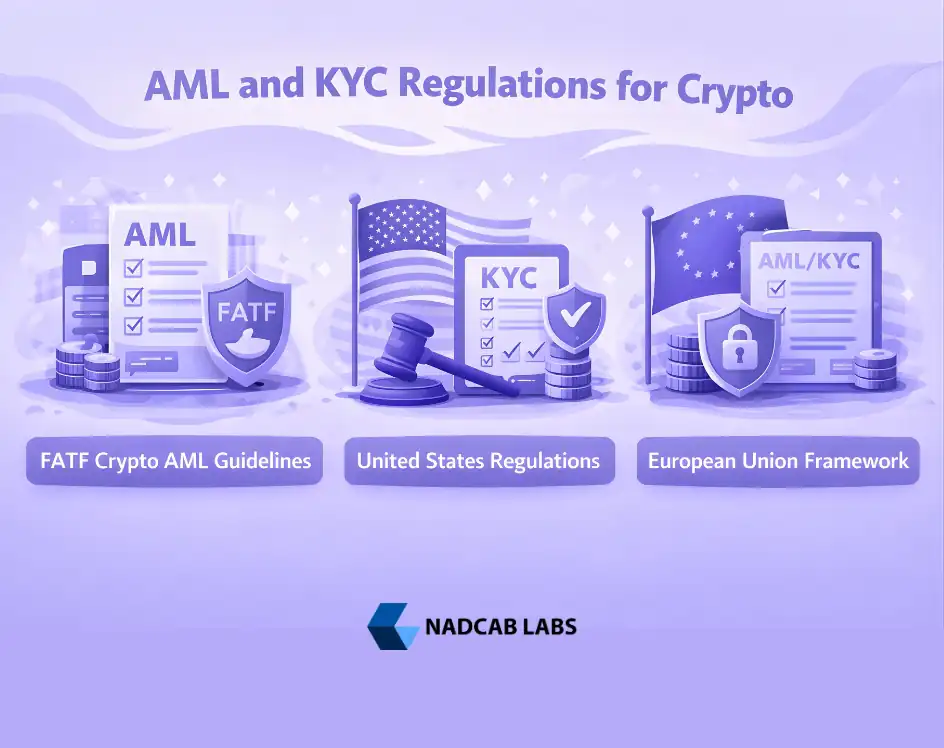
The Financial Action Task Force (FATF) sets global standards for AML compliance that member countries translate into national law. FATF’s Recommendation 15 specifically addresses virtual assets and VASPs, requiring them to implement the same preventive measures as traditional financial institutions. The FATF Travel Rule, based on Recommendation 16, requires VASPs to collect and transmit sender and recipient information for qualifying transactions. As of June 2025, 99 jurisdictions have passed or are drafting legislation implementing the Travel Rule, covering approximately 98% of the global virtual asset market.[3]
United States Regulations
In the U.S., the Bank Secrecy Act (BSA) forms the foundation of AML obligations for cryptocurrency businesses. The Financial Crimes Enforcement Network (FinCEN) requires crypto firms registered as Money Services Businesses (MSBs) to implement comprehensive AML programs including written policies, appointed compliance officers, independent audits, ongoing employee training, and risk-based customer monitoring. The development of clearer regulatory guidance under the current administration has provided more certainty for crypto businesses operating in the United States.
Know Your Customer (KYC) requirements under FinCEN regulations involve thorough identity verification, sanctions screening, and Enhanced Due Diligence (EDD) for high-risk customers. Suspicious Activity Reports (SARs) must be submitted for any suspected illicit transactions exceeding $5,000 within 30 days, with even stricter protocols in cases linked to potential terrorist financing. Failure to comply can lead to severe consequences, including multi-million dollar fines, loss of banking access, asset freezes, trading limitations, and even criminal liability for company executives. Any organization working with a token development company must integrate these regulatory requirements into their processes from the very beginning.
European Union Framework
The EU has implemented multiple Anti-Money Laundering Directives (AMLDs) that progressively extended requirements to cryptocurrency businesses. AMLD5 first brought crypto within scope, while AMLD6 harmonized definitions and expanded criminal liability. The Markets in Crypto-Assets (MiCA) regulation now provides a unified licensing framework for crypto-asset service providers (CASPs) across all member states.
The EU Anti-Money Laundering Authority (AMLA) officially began operations in Frankfurt in July 2025, marking the start of direct EU-wide supervision for high-risk entities. Under the Transfer of Funds Regulation (TFR), every crypto transfer between CASPs must include full sender and recipient details regardless of transaction size, representing one of the strictest implementations of the Travel Rule globally. This development signals the EU’s commitment to comprehensive crypto AML enforcement.
| Jurisdiction | Key Regulator | Travel Rule Threshold | Notable Requirements |
|---|---|---|---|
| United States | FinCEN | $3,000 | MSB registration, SAR filing |
| European Union | AMLA/National Authorities | €0 (all transfers) | MiCA licensing, TFR compliance |
| United Kingdom | FCA | £0 (all transfers) | FCA registration required |
| Singapore | MAS | SGD 1,500 | DTSP licensing restrictions |
How Crypto AML Works in Practice
In practice, crypto AML combines technology, policy, and oversight to translate regulatory requirements into day-to-day operational controls across platforms and services.
Transaction Monitoring
Effective crypto AML requires continuous monitoring of transactions to identify patterns indicative of money laundering or other financial crimes. Unlike traditional finance where transactions flow through intermediaries, blockchain transactions are publicly visible but pseudonymous, requiring specialized analytics to identify suspicious activity. Crypto wallet screening tools monitor the source and destination of cryptocurrencies, flagging transactions linked to known illicit addresses, darknet markets, sanctioned entities, or high-risk jurisdictions.
The development of blockchain analytics has transformed crypto compliance capabilities. Platforms like Chainalysis, Elliptic, and TRM Labs enable real-time risk scoring, suspicious activity detection, and investigation support. These tools can trace fund flows across multiple blockchains, identify connections to known criminal addresses, and generate the audit trails regulators require. For compliance teams, automated monitoring has replaced manual review processes that could not scale with transaction volumes.
Suspicious Activity Reporting
When monitoring systems identify potentially illicit activity, VASPs must investigate and, where warranted, file SARs with relevant authorities. SAR filing requirements vary by jurisdiction but generally apply when transactions suggest money laundering, terrorist financing, fraud, or other specified crimes. The information provided in SARs supports law enforcement investigations and contributes to broader intelligence about criminal networks operating in cryptocurrency.
Sanctions Screening
Sanctions compliance has become increasingly critical as geopolitical tensions rise. Crypto businesses must screen customers and transactions against sanctions lists maintained by bodies like the U.S. Office of Foreign Assets Control (OFAC), the UN, and the EU. The development of dynamic screening tools that update in real-time has become essential as sanctions designations change rapidly. Failure to screen against these lists can result in immediate and severe penalties, as demonstrated by eight-figure settlements OFAC has imposed in 2025.
AML Red Flags in Cryptocurrency
Crypto businesses must recognize warning signs that may indicate money laundering or other illicit activity. Transaction-related red flags include sudden spikes in activity from dormant accounts, rapid fund movement through multiple wallets, transfers with no clear economic purpose, and amounts inconsistent with customer profiles. Behavioral red flags include customer reluctance to provide KYC information, inconsistent or suspicious identity documents, and transactions involving high-risk jurisdictions with weak AML enforcement.
Technical red flags require specialized monitoring capabilities. The use of privacy coins, mixing services, or chain-hopping to obscure transaction trails suggests potential illicit intent. Geographic spoofing through VPNs or proxies to circumvent compliance controls represents a significant concern. Connections to known darknet markets, ransomware addresses, or gambling platforms warrant enhanced scrutiny. AI-powered detection systems help identify complex patterns that human analysts might miss.
Challenges in Crypto AML Compliance
These trends illustrate how crypto AML is evolving alongside technology and regulation, preparing the industry for more proactive, data-driven compliance approaches.
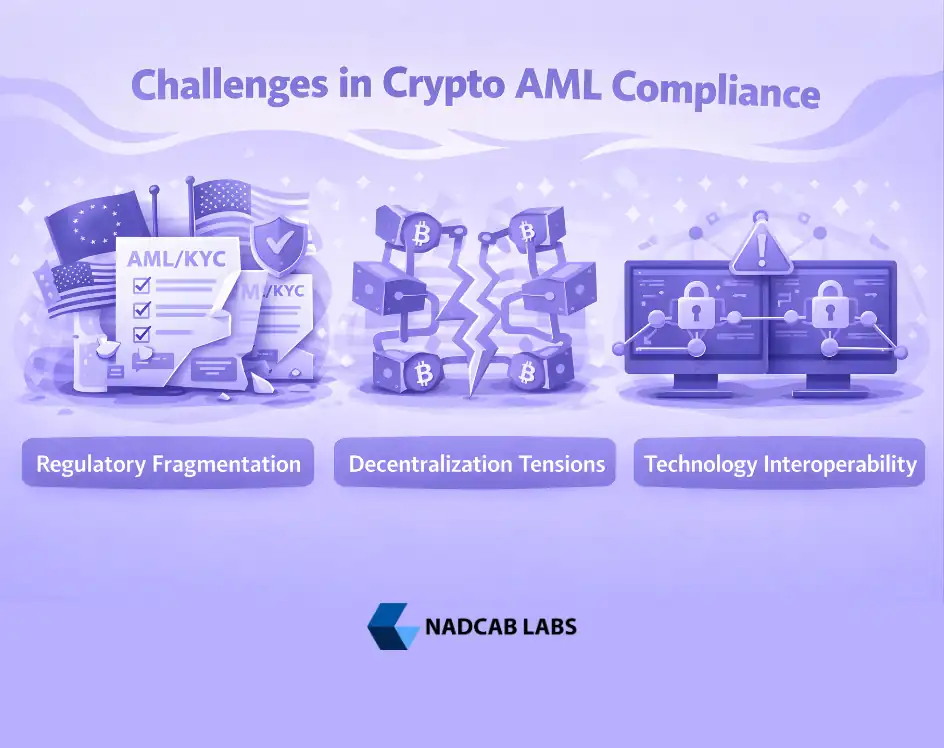
Regulatory Fragmentation
AML and KYC requirements vary significantly across jurisdictions, creating complexity for crypto businesses operating globally. Different countries impose varying thresholds, information requirements, and enforcement approaches. The “sunrise issue” in Travel Rule implementation, where some jurisdictions enforce requirements while counterparties operate in unregulated markets, complicates cross-border compliance. For those building coin and token solution projects, understanding this regulatory patchwork is essential for global market access.
Decentralization Tensions
The decentralized nature of many crypto protocols creates inherent tension with AML requirements designed for centralized intermediaries. DeFi protocols that operate without identifiable controlling parties present particular challenges for regulators. FATF’s 2025 report indicates that 48% of jurisdictions with advanced VASP regulation now require certain DeFi arrangements to be licensed, signaling increased scrutiny of decentralized platforms.[4]
Technology Interoperability
No single technical standard exists for Travel Rule data exchange, leading to fragmentation across different protocol providers. VASPs using incompatible systems face challenges sharing required information, potentially causing transaction rejections or compliance gaps. Industry initiatives like TRUST and TRISA aim to address interoperability, but widespread adoption remains incomplete. The development of standardized messaging frameworks aligned with ISO 20022 represents a priority for enabling seamless compliance across the ecosystem.
Emerging Trends in Crypto AML
These trends illustrate how crypto AML is evolving alongside technology and regulation, preparing the industry for more proactive, data-driven compliance approaches.
AI-Powered Compliance
Artificial intelligence and machine learning are transforming AML capabilities. AI-driven transaction monitoring can identify complex patterns across massive datasets that traditional rule-based systems miss. Predictive analytics help identify emerging risks before they materialize into compliance failures. However, regulators increasingly expect explainability in AI systems, meaning “black box” algorithms that cannot demonstrate their reasoning may create compliance liabilities.
Stablecoin Focus
Stablecoins have emerged as the dominant asset for illicit transactions, accounting for 84% of all illicit transaction volume in 2025. Their liquidity, price stability, and ease of cross-border transfer make them attractive for sanctions evasion and money laundering. FATF has identified stablecoins as a priority concern, and the development of specialized monitoring tools for stablecoin transactions has accelerated. Regulators are also exploring requirements for stablecoin issuers to implement freezing capabilities.
Real-Time Monitoring
The shift from batch processing to real-time transaction monitoring reflects both technological capability and regulatory expectation. Real-time systems can block suspicious transactions before completion rather than flagging them for later review. This development aligns with instant payment regulations like the EU’s requirement for PSPs to process euro instant payments within 10 seconds while maintaining compliance obligations.
Consequences of AML Non-Compliance
Crypto businesses that fail to implement adequate AML programs face escalating consequences. Financial penalties can reach hundreds of millions of dollars, as demonstrated by enforcement actions against major exchanges. License revocation or denial prevents continued operations in regulated markets. Criminal prosecution may result in imprisonment for executives who knowingly facilitate or ignore money laundering. Asset seizures can strip businesses of their operational capital. Banking relationships may be severed, cutting off access to fiat currencies essential for most crypto businesses.
Beyond direct penalties, reputational damage can permanently impair business prospects. Institutional customers avoid platforms with compliance failures, and retail users increasingly prefer exchanges with strong security and regulatory credentials. Creating a compliance-first culture, supported by adequate resources and technology, represents the most effective protection against these consequences.
Best Practices for Crypto AML Compliance
Effective AML compliance begins with risk assessment. Crypto businesses should evaluate their exposure based on products offered, customer types, geographic markets, and transaction patterns. This assessment informs the design of proportionate controls, with higher-risk activities warranting enhanced scrutiny. Regular updates ensure risk assessments reflect evolving threats and business changes.
Technology investment is essential. Automated KYC verification, real-time transaction monitoring, blockchain analytics, and sanctions screening tools enable compliance at scale. Integration between these systems prevents data silos that create blind spots. The development of unified compliance platforms that combine KYC, transaction monitoring, and sanctions screening in single solutions has simplified implementation for many businesses.
Governance structures must support compliance. A designated compliance officer with direct board access ensures issues receive appropriate attention. Regular training keeps staff informed about evolving requirements and threat patterns. Independent testing validates that controls function as designed. Documentation demonstrates compliance to regulators and supports defense against enforcement actions.
Final Thoughts
AML and KYC compliance has become fundamental to cryptocurrency’s integration with mainstream finance. The record enforcement actions of 2025, combined with the scale of crypto crime reaching $154 billion, underscore that regulators view digital asset businesses with the same expectations applied to traditional financial institutions. For crypto token development teams, exchange operators, and anyone building blockchain-based financial services, compliance is no longer a competitive differentiator but a prerequisite for operation.
The regulatory landscape continues evolving rapidly, with frameworks like the EU’s MiCA, the FATF Travel Rule, and national implementations creating comprehensive oversight across major markets. The development of sophisticated compliance technology enables businesses to meet these requirements efficiently, while failure to invest in proper systems risks catastrophic penalties. As cryptocurrency matures, those who embrace compliance as core infrastructure rather than burden will be positioned to capture the opportunities that institutional adoption and mainstream acceptance bring.
Frequently Asked Questions
Q1.What is AML in crypto?
AML (Anti-Money Laundering) in crypto refers to laws, regulations, and procedures that prevent criminals from converting illegally obtained cryptocurrency into legitimate funds. It includes transaction monitoring, suspicious activity reporting, and sanctions screening.
Q2.What is KYC in crypto?
KYC (Know Your Customer) in crypto involves identity verification procedures that exchanges and other VASPs implement to confirm customer identities. This includes collecting personal information, verifying government IDs, and assessing customer risk profiles.
Q3.What is the FATF Travel Rule for crypto?
The FATF Travel Rule requires VASPs to collect and share sender and recipient information when transferring virtual assets above specified thresholds. It ensures personal data “travels” with transactions to enable regulatory tracing.
Q4.What are the consequences of AML non-compliance?
Consequences include multi-million dollar fines, license revocation, criminal charges for executives, asset seizures, loss of banking services, and severe reputational damage that can destroy business viability.
Q5.What are AML red flags in cryptocurrency?
Red flags include sudden activity spikes from dormant accounts, rapid fund movement through multiple wallets, use of mixing services, geographic spoofing, connections to darknet markets, and customer reluctance to provide KYC information.
Q6.What is a VASP?
A VASP (Virtual Asset Service Provider) is a business that provides cryptocurrency services including exchanges, custodial wallet providers, OTC trading desks, and payment processors. VASPs are subject to AML/KYC requirements under FATF standards.
Explore Services
Related Services
Reviewed by

Aman Vaths
Founder of Nadcab Labs
Aman Vaths is the Founder & CTO of Nadcab Labs, a global digital engineering company delivering enterprise-grade solutions across AI, Web3, Blockchain, Big Data, Cloud, Cybersecurity, and Modern Application Development. With deep technical leadership and product innovation experience, Aman has positioned Nadcab Labs as one of the most advanced engineering companies driving the next era of intelligent, secure, and scalable software systems. Under his leadership, Nadcab Labs has built 2,000+ global projects across sectors including fintech, banking, healthcare, real estate, logistics, gaming, manufacturing, and next-generation DePIN networks. Aman’s strength lies in architecting high-performance systems, end-to-end platform engineering, and designing enterprise solutions that operate at global scale.