Ai Overview
establishing four-part criteria: monetary investment, common enterprise, profit expectation, and reliance on third-party efforts for returns. A Manhattan office building tokenized into 10,000 shares creates horizontal commonality as all holders benefit equally from rental income growth or suffer together from vacancy increases.
Key Takeaways
- Securities laws apply to tokenized real estate when tokens represent investment contracts triggering comprehensive regulatory compliance across USA UK UAE and Canadian jurisdictions.
- The Howey Test determines securities laws classification by evaluating monetary investment common enterprise profit expectation and reliance on third-party management efforts.
- Private placement exemptions including Regulation D and Regulation A+ enable token sales without full registration subject to strict investor qualification and disclosure requirements.
- Accredited investor verification demands documented proof of income or net worth thresholds protecting non-qualified participants from unsuitable high-risk investments.
- Disclosure obligations require comprehensive property information financial projections risk factors and management backgrounds enabling informed investor decisions before token purchases.
- Transfer restrictions enforce holding periods and buyer qualifications through smart contracts preventing unauthorized secondary trading violating exemption conditions.
- Broker-dealer registration applies to platforms facilitating token sales or secondary trading creating intermediary compliance obligations and investor protection requirements.
- AML and KYC procedures verify investor identities screen against sanctions lists and document fund sources preventing money laundering through property token transactions.
- Smart contract design must incorporate regulatory compliance logic including whitelist verification automated transfer restrictions and programmable disclosure delivery mechanisms.
- Ongoing reporting obligations continue post-offering through periodic financials material event notifications and tax documentation maintaining transparency and regulatory compliance throughout investment lifecycles.
Securities laws represent the foundational regulatory framework governing tokenized real estate offerings as digital property tokens typically constitute investment contracts subject to comprehensive registration, disclosure, and compliance requirements protecting investors from fraud and ensuring market integrity. The intersection of blockchain technology with traditional securities laws regulation creates complex compliance challenges where issuers must navigate decades-old legal frameworks designed for paper certificates applied to blockchain-native digital assets enabling fractional property ownership, enhanced liquidity, and automated compliance through smart contracts. This comprehensive analysis examines eighteen critical dimensions of securities law application to tokenized real estate drawing on eight years of hands-on experience structuring compliant offerings, analyzing regulatory frameworks, and advising issuers and investors across USA, UK, UAE, and Canadian markets where distinct securities laws regimes impose overlapping yet divergent requirements demanding sophisticated legal engineering and operational excellence.
Securities Laws Classification Tests for Tokenized Property
Securities classification tests determine whether tokenized property offerings trigger regulatory compliance by evaluating economic substance over technical form through established legal frameworks developed over decades of securities laws litigation and enforcement. The primary USA test emerges from SEC v. W.J. Howey Co. establishing four-part criteria: monetary investment, common enterprise, profit expectation, and reliance on third-party efforts for returns. Real estate tokenization typically satisfy all elements when investors purchase fractional ownership expecting rental income or appreciation generated by property managers rather than personal operational involvement. The common enterprise element proves in pooled funds where investor fortunes rise and fall together based on property performance. Profit expectations manifest through marketing materials emphasizing passive income potential and capital appreciation. Promoter efforts appear when professional management companies handle tenant relations, maintenance, leasing, and strategic decisions determining investment outcomes rather than individual holder actions.
International classification tests employ similar functional analysis focusing on investment contract characteristics rather than formalistic terminology. UK securities laws applies the “specified investment” definition under Financial Services and Markets Act encompassing shares, debentures, and instruments conferring property rights combined with profit sharing arrangements. UAE regulations reference “securities” including equity interests, debt instruments, and derivative contracts with ADGM and DIFC applying common securities laws principles analogous to USA frameworks. Canadian securities acts define “security” broadly including investment contracts, profit-sharing agreements, and beneficial interests in property where returns depend on third-party management. The consistent theme across jurisdictions examines economic reality: do token holders invest money expecting profits from others’ efforts? Affirmative answers trigger securities laws laws regardless of creative structuring attempts or alternative terminology. Classification determines applicable regulatory frameworks, exemption availability, disclosure obligations, and enforcement exposure making proper analysis essential before offering commencement across global tokenized real estate markets.
Applying the Howey Test to Fractional Real Estate Tokens
Applying the Howey Test to fractional real estate tokens requires systematic analysis of each criterion demonstrating how blockchain-based property ownership satisfies investment contract characteristics despite technological innovation in delivery mechanisms. The monetary investment element proves straightforwardly as purchasers exchange cryptocurrency, stablecoins, or fiat currency for tokens representing property interests establishing value transfer necessary for securities laws classification. Common enterprise manifests through horizontal commonality where investor returns correlate directly with property performance creating shared economic fortunes. A Manhattan office building tokenized into 10,000 shares creates horizontal commonality as all holders benefit equally from rental income growth or suffer together from vacancy increases. Vertical commonality may also appear through promoter-investor relationships where issuer profits from management fees tied to property performance aligning incentives through economic interdependence beyond mere arm’s-length transactions.
Profit expectation analysis examines investor motivations and offering marketing determining whether purchasers seek financial returns versus pure consumption utility. Marketing materials emphasizing rental yields, appreciation potential, or investment returns strongly indicate profit expectations triggering securities laws. The third-party effort prong evaluates whether returns depend predominantly on promoter managerial activities rather than individual investor actions. Property management by professional companies handling leasing, maintenance, renovations, and strategic decisions clearly satisfies this element as token holders remain passive beneficiaries without operational involvement. Even governance rights enabling holder voting on major decisions may not defeat securities laws classification if day-to-day management driving returns remains with professionals. The Howey analysis focuses on economic reality examining actual investor expectations, operational structures, and value creation mechanisms rather than superficial labeling or creative structuring attempts across securities laws jurisdictions globally.
When Real Estate Tokens Become Investment Contracts
Real estate tokens transform into investment contracts subject to securities laws when economic arrangements create passive investment opportunities where holders expect profits from third-party managerial efforts rather than personal operational involvement. The critical distinction separates consumer purchases of property usage rights from investor acquisitions of financial instruments promising returns. A token providing exclusive vacation home access for personal use without profit expectations likely avoids securities laws classification under current frameworks. Conversely, tokens marketed as passive income investments with professional management handling operations clearly constitute investment contracts triggering comprehensive regulatory compliance. The transformation occurs when offerings emphasize financial returns, distribute rental income proportionally to holdings, enable secondary market trading for liquidity, or structure governance minimizing holder operational burdens creating investor rather than owner-operator relationships characteristic of securities laws.
Specific circumstances definitively creating investment contract classification include fractional ownership of income-producing commercial properties where professional management companies handle tenant relations, fractional residential real estate marketed as turnkey investments with guaranteed rental returns managed by third parties, REIT-like tokenized funds pooling multiple properties under centralized management, and secondary market platforms enabling continuous trading emphasizing liquidity and price appreciation rather than use value. Securities laws analyze substance over form examining marketing materials, investor communications, operational structures, and economic reality rather than superficial documentation or creative terminology attempting classification avoidance. Courts consistently pierce formalistic structures revealing underlying investment contract characteristics when profit expectations and third-party management efforts dominate economic arrangements. The investment contract determination triggers cascading regulatory obligations across USA, UK, UAE, and Canadian securities laws laws demanding proactive compliance strategies before token offerings commence avoiding enforcement exposure and investor protection violations.
Cross-Border Securities Triggers in Tokenized Assets
Cross-border securities laws triggers activate when tokenized real estate offerings involve investors, issuers, or properties in multiple jurisdictions creating overlapping regulatory obligations across distinct national frameworks. USA securities laws assert extraterritorial jurisdiction when domestic investors participate, sales efforts occur within USA borders, or transactions involve domestic broker-dealers regardless of issuer location or property geography. The “conduct and effects” test evaluates whether offering conduct occurred in USA or produced effects on domestic markets or investors triggering regulatory applicability. UK Financial Conduct Authority asserts jurisdiction when offerings target UK investors, utilize UK intermediaries, or involve properties located within United Kingdom creating prospectus requirements or exemption compliance obligations. UAE financial regulators including DFSA and ADGM claim authority over offerings involving UAE-based investors, issuers, or property assets demanding compliance with local securities laws frameworks.
Canadian provincial securities laws regulators each maintain independent authority creating fragmented landscape where offerings must comply with applicable provincial acts in every jurisdiction where investors reside. The jurisdictional complexity multiplies when global platforms enable worldwide investor participation requiring simultaneous compliance across dozens of regulatory regimes each imposing distinct registration, disclosure, and operational requirements. Regulation S provides safe harbor for offshore offerings to non-USA persons implementing procedural safeguards preventing flowback into domestic markets. However, internet-based token offerings challenge traditional geographic boundaries as blockchain networks enable borderless transactions difficult to restrict based on investor location. Securities laws increasingly adopt functional approaches asserting jurisdiction based on investor harm, market effects, or conduct location rather than strict territorial limitations. The cross-border triggers demand sophisticated legal analysis mapping applicable regulatory frameworks, coordinating compliance across jurisdictions, and implementing geographic restrictions preventing unauthorized sales into problematic markets serving global tokenized real estate offerings.
Securities Compliance Implementation Lifecycle
Securities Classification Analysis
Apply Howey Test and jurisdictional classification frameworks determining whether tokens constitute securities laws triggering regulatory compliance obligations.
Exemption Strategy Selection
Identify applicable exemptions from registration including Regulation D, Regulation A+, or international equivalents matching offering characteristics and investor targets.
Disclosure Document Preparation
Draft comprehensive offering materials including private placement memorandums, risk disclosures, property details, and financial projections meeting regulatory standards.
KYC and Accreditation Verification
Implement investor verification procedures confirming accreditation status, identity documentation, AML screening, and source of funds compliance.
Smart Contract Compliance Integration
Deploy audited smart contracts encoding transfer restrictions, holding periods, whitelist verification, and automated compliance enforcement mechanisms.
Regulatory Filing and Notices
Submit Form D filings, Blue Sky notices, international registrations, and exemption documentation to applicable securities laws regulatory authorities.
Ongoing Compliance Monitoring
Maintain periodic reporting, financial statement delivery, material event notifications, and continuous regulatory compliance throughout investment lifecycle.
Audit and Enforcement Response
Conduct compliance audits, respond to regulatory inquiries, remediate identified deficiencies, and maintain documentation supporting exemption reliance.
Private Placement Exemptions for Property Token Issuers
Private placement exemptions provide the primary pathway for tokenized real estate offerings avoiding full securities laws registration requirements while maintaining investor access through carefully structured frameworks limiting public solicitation and requiring investor qualifications. Regulation D Rule 506(b) permits unlimited capital raising from accredited investors and up to 35 sophisticated non-accredited investors without general solicitation or advertising restrictions. The exemption demands reasonable steps to verify accreditation status, delivery of disclosure documents, and Form D filing within 15 days of first sale with state Blue Sky notice filings in investor domicile jurisdictions. Rule 506(c) removes non-accredited investor participation while permitting general solicitation and advertising provided issuers take reasonable steps to verify all purchasers meet accreditation thresholds through documentation review, third-party verification services, or reliance on professional certifications from CPAs or attorneys.
International private placement frameworks provide similar exemptions with jurisdictional variations requiring careful navigation. UK prospectus exemptions accommodate qualified investor offers, employee stock programs, and offerings below specified thresholds avoiding public disclosure obligations. UAE regulatory frameworks including DFSA and ADGM offer professional client exemptions and exempt offer regimes for sophisticated investors meeting financial thresholds or professional qualifications. Canadian accredited investor exemptions permit sales to individuals meeting income or asset tests, registered advisers, and financial institutions without prospectus requirements though demanding offering memorandum delivery and regulatory filings. The exemption strategies require strict compliance with specific conditions including investor limitations, solicitation restrictions, disclosure delivery, and ongoing reporting obligations. Violations jeopardize exemption reliance potentially requiring rescission offers to all purchasers with interest, civil penalties, and enforcement actions across securities laws jurisdictions. The private placement framework dominates tokenized real estate offerings providing compliant capital formation pathways balancing issuer needs against investor protection imperatives across global markets.[1]
Accredited Investor Rules in Real Estate Token Sales
Accredited investor rules establish qualification thresholds protecting non-qualified participants from unsuitable high-risk investments while enabling sophisticated investors to participate in private securities laws offerings including tokenized real estate without full registration protection mechanisms. USA Regulation D defines accredited investors as individuals with income exceeding $200,000 annually ($300,000 jointly) for previous two years with reasonable expectation of similar income continuing, or net worth exceeding $1 million excluding primary residence value. Professional qualifications including Series 7, 65, or 82 licenses confer accredited status regardless of financial thresholds recognizing securities industry expertise. Entities including corporations, partnerships, and trusts with assets exceeding $5 million, employee benefit plans with assets over $5 million, and banks or investment companies automatically qualify as accredited investors enabling institutional participation without individual threshold verification.
Verification procedures require issuers to take reasonable steps confirming accreditation status through documentation review rather than mere self-certification creating evidentiary standards protecting exemption reliance. Acceptable verification includes reviewing tax returns demonstrating income thresholds, brokerage statements or appraisals establishing net worth calculations, written confirmation from registered broker-dealers or investment advisers certifying accreditation, or reliance on third-party verification services specializing in investor qualification. International accreditation equivalents vary by jurisdiction with UK requiring net investable assets exceeding £250,000 or gross income over £100,000 annually for certified sophisticated investors. UAE frameworks establish professional client tests based on net worth, portfolio size, or professional qualifications. Canadian accredited investor definitions include individuals with net income exceeding CAD $200,000 ($300,000 jointly) or financial assets over CAD $1 million. The accreditation framework restricts tokenized real estate offerings to qualified participants deemed capable of evaluating risks and absorbing potential losses without regulatory oversight protections mandatory for public retail offerings across securities laws jurisdictions.
Disclosure Standards for Blockchain-Based RE Offerings
Disclosure standards for blockchain-based real estate offerings demand comprehensive information provision enabling investors to make informed decisions about property investments, technology risks, and regulatory uncertainties characterizing tokenized securities laws. Private placement memorandums must detail property descriptions including location, square footage, age, condition, current tenants, and historical performance metrics. Financial information encompasses purchase price, debt financing terms, projected cash flows with underlying assumptions, expense budgets, capital expenditure reserves, and exit strategy timelines with projected returns. Management backgrounds require detailed disclosure of sponsor experience, track records, compensation arrangements, conflicts of interest, and related-party transactions creating transparency around decision-maker qualifications and incentive structures. Risk factor sections must address property-specific risks including tenant concentration, deferred maintenance, environmental liabilities, market conditions, plus blockchain-specific risks including smart contract vulnerabilities, regulatory uncertainty, technology failures, and custody arrangements.
Securities laws require plain English disclosure accessible to target investor sophistication levels avoiding technical jargon obscuring material information affecting investment value. Blockchain technology explanations must clarify smart contract functionality, transfer restrictions, custody arrangements, and platform dependencies without assuming investor technical expertise. Regulatory status disclosure addresses securities laws classification, exemption reliance, ongoing compliance obligations, and potential regulatory changes threatening offering structures. Financial projections require clear identification of assumptions, sensitivity analysis showing various outcome scenarios, and prominent disclaimers emphasizing forward-looking statement uncertainty. The disclosure burden increases for Regulation A+ offerings requiring audited financials, management discussion and analysis, and continuous SEC reporting similar to public companies. Material omissions or misleading statements trigger anti-fraud liability under Section 10(b) and Rule 10b-5 regardless of exemption reliance creating strict accuracy standards across offering documents. The disclosure requirements balance investor information needs against practicality constraints ensuring tokenized real estate offerings provide transparency enabling informed participation decisions across USA, UK, UAE, and Canadian securities laws frameworks.
Exemption Framework Comparison
| Exemption Type | Capital Limit | Investor Requirements | Solicitation |
|---|---|---|---|
| Regulation D 506(b) | Unlimited | Accredited + up to 35 sophisticated | Prohibited |
| Regulation D 506(c) | Unlimited | Accredited only with verification | Permitted |
| Regulation A+ Tier 1 | $20 million annually | General public with investment limits | Permitted after qualification |
| Regulation A+ Tier 2 | $75 million annually | General public with 10% annual limit | Permitted after qualification |
| Regulation S | Unlimited | Non-USA persons only | Offshore only |
Transfer Restrictions and Secondary Trading Controls
Transfer restrictions and secondary trading controls implement securities laws requirements limiting token resales to qualified investors through compliant platforms preventing uncontrolled public distribution undermining exemption reliance. Regulation D Rule 506 offerings require 12-month holding periods before resales commence with subsequent trading limited to accredited investors, qualified institutional buyers, or exempted transactions under Rule 144 or other safe harbors. Smart contracts encode these restrictions automatically rejecting transfers violating holding period requirements or attempting sales to non-whitelisted addresses lacking verified accreditation status. The technological enforcement provides superior compliance certainty compared to traditional paper-based legends requiring manual verification and good-faith reliance on transferee representations. Blockchain immutability creates permanent audit trails documenting all transfer attempts, whitelist verifications, and compliance determinations supporting regulatory examinations or enforcement defense.
Secondary trading platforms facilitating tokenized real estate transactions must implement investor verification procedures confirming accreditation before enabling account access and trading capabilities. Alternative trading systems operating as broker-dealers or exempt markets provide compliant venues for continuous trading with automated compliance monitoring detecting unauthorized transactions or suspicious patterns warranting investigation. Lock-up agreements supplement smart contract restrictions preventing early transfers by sponsors, management, or large holders aligning long-term interests with minority investors. The transfer restriction framework balances investor liquidity desires against regulatory constraints ensuring secondary markets operate within legal boundaries. Violations risk exemption loss potentially requiring rescission offers to all holders, civil penalties from securities laws regulators, and private litigation from damaged investors. The restriction mechanisms prove essential for maintaining securities laws compliance throughout token lifecycles enabling limited liquidity while preventing transformation into unregistered public securities laws across USA, UK, UAE, and Canadian regulatory frameworks governing tokenized real estate secondary markets.
Role of Broker-Dealers in Tokenized Property Markets
Broker-dealers play critical intermediary roles in tokenized property markets facilitating compliant securities laws transactions through registered entities subject to comprehensive regulatory oversight protecting investor interests. Securities laws require broker-dealer registration when entities engage in securities business for compensation including soliciting purchasers, executing transactions, providing investment recommendations, or operating trading platforms connecting buyers and sellers. The registration triggers extensive obligations including SEC or equivalent international registration, membership in self-regulatory organizations like FINRA, maintenance of minimum capital requirements, implementation of anti-money laundering programs, supervisory systems monitoring employee conduct, and regular examinations by regulatory authorities. Broker-dealers provide essential functions including investor verification confirming accreditation status, suitability analysis ensuring investment appropriateness given client circumstances, transaction execution through compliant systems, and custody services safeguarding client assets according to customer protection rules.
The broker-dealer framework creates compliance challenges for tokenized real estate platforms as registration costs, operational requirements, and ongoing supervision burdens prove substantial often exceeding $1 million annually for full-service firms. Some platforms partner with registered broker-dealers providing securities laws functions while maintaining technology operations separately creating hybrid models combining regulatory compliance with blockchain innovation. Others structure as funding portals under Regulation Crowdfunding avoiding full broker-dealer registration while accepting limitations on services provided and capital raising amounts. Alternative trading systems register as broker-dealers operating electronic platforms matching tokenized securities laws buyers and sellers under Regulation ATS imposing specific operational and disclosure requirements. The broker-dealer determination demands careful analysis of platform functions, compensation arrangements, and investor interactions across securities laws frameworks. Unregistered broker-dealer activity triggers severe enforcement consequences including disgorgement of commissions, civil penalties, criminal prosecution, and transaction rescission rights for all affected investors. The intermediary framework ensures tokenized real estate trading occurs through regulated entities providing investor protections and market integrity safeguards across global securities markets.
Custody Requirements for Digital Real Estate Securities
Custody requirements for digital real estate securities impose strict safeguarding obligations on platforms maintaining control over investor tokens protecting against theft, loss, and misappropriation through comprehensive operational and technical controls. USA Investment Advisers Act Rule 206(4)-2 requires registered advisers with custody of client assets to maintain segregated accounts with qualified custodians, deliver periodic account statements, and undergo annual surprise examinations verifying asset existence and proper accounting. Qualified custodians include banks, broker-dealers, futures commission merchants, and foreign financial institutions meeting specific regulatory standards ensuring institutional-grade asset protection. Digital asset custody introduces novel challenges as private key control determines token ownership creating custody classification debates whether platform key management constitutes traditional custody triggering regulatory obligations or whether self-custody models enable exemption from comprehensive custodial frameworks.
Securities laws increasingly recognize digital asset custody requiring specialized operational controls including multi-signature wallet schemes preventing single-point-of-failure risks, hardware security modules protecting private keys from online attacks, cold storage solutions isolating majority assets from internet connectivity, insurance coverage protecting against theft or loss events, and regular third-party audits verifying proper segregation and accounting practices. Institutional custodians including Coinbase Custody, BitGo, and Anchorage provide regulated custody services meeting securities laws standards while supporting blockchain-native assets. The custody framework protects investors from platform insolvency scenarios where proper segregation ensures tokens remain investor property rather than estate assets available for general creditor claims. Bankruptcy remoteness proves critical for tokenized real estate as custody failures could expose investors to total loss despite underlying property value retention. The custody requirements continue evolving across USA, UK, UAE, and Canadian securities laws as regulators adapt traditional frameworks to digital asset characteristics balancing innovation accommodation with investor protection imperatives governing tokenized property custody arrangements.
AML and KYC Enforcement in Property Token Platforms
Anti-money laundering and know-your-customer enforcement in property token platforms implements comprehensive identity verification, transaction monitoring, and suspicious activity reporting preventing illicit finance flowing through tokenized real estate investments. Bank Secrecy Act requirements demand customer identification programs collecting names, addresses, dates of birth, and taxpayer identification numbers for all investors verified through government-issued documentation and third-party databases. Enhanced due diligence applies to politically exposed persons, high-risk jurisdictions, and transactions exceeding $10,000 reporting thresholds requiring additional documentation explaining fund sources, transaction purposes, and beneficial ownership structures. Ongoing monitoring screens customers against OFAC sanctions lists, international watchlists, and adverse media databases flagging potential terrorist financing, narcotics trafficking, or other criminal connections warranting investigation and potential suspicious activity report filing with FinCEN.
Cryptocurrency sources require additional diligence through blockchain analysis tools including Chainalysis, Elliptic, and TRM Labs tracing transaction histories identifying tainted funds from darknet markets, ransomware, sanctioned entities, or mixing services obscuring origins. Platforms must implement risk-based procedures calibrating verification intensity to customer profiles, transaction amounts, and jurisdiction risks balancing compliance effectiveness against user friction and operational costs. International AML frameworks including UK Money Laundering Regulations, UAE AML laws, and Canadian FINTRAC requirements impose similar customer verification, transaction monitoring, and reporting obligations creating consistent global standards. The AML and KYC framework proves essential for securities laws compliance as proper investor verification supports accreditation determinations, exemption reliance, and anti-fraud enforcement. Violations trigger severe penalties including civil fines reaching millions annually, criminal prosecution for willful violations, and reputational damage destroying platform credibility across tokenized real estate markets. The comprehensive compliance programs demand substantial investments in technology systems, personnel training, and ongoing monitoring protecting platforms from regulatory enforcement while preventing criminal exploitation of tokenized property investment channels.
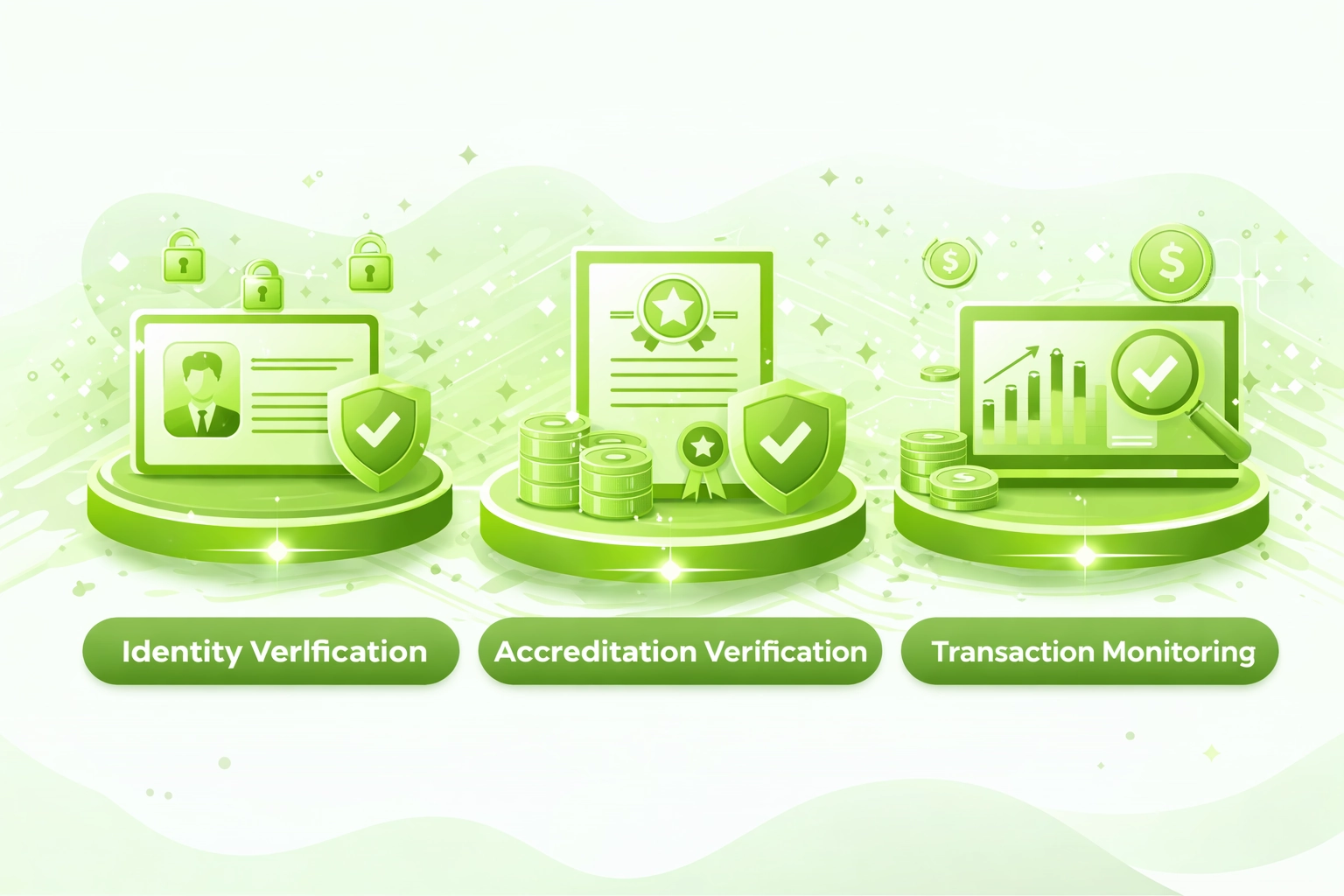 Essential Compliance Technology Components
Identity Verification
- Automated document authentication through Jumio or Onfido
- Biometric facial recognition matching government IDs
- Address verification via utility bills or bank statements
- Database cross-referencing confirming identity accuracy
Accreditation Verification
- Tax return review confirming income thresholds
- Brokerage statement analysis establishing net worth
- Third-party verification through VerifyInvestor services
- Professional certification from CPAs or attorneys
Transaction Monitoring
- Real-time transaction screening against sanctions lists
- Blockchain analysis tracing cryptocurrency sources
- Pattern detection identifying suspicious activity
- Automated reporting generating regulatory filings
Smart Contract Design for Regulatory Compliance
Smart contract design for regulatory compliance embeds securities laws requirements directly into token code enabling automated enforcement of transfer restrictions, investor qualifications, and disclosure delivery without manual intervention reducing compliance costs while improving accuracy. ERC-1400 and ERC-1404 token standards provide technical frameworks supporting compliant security token implementations with built-in transfer restriction enforcement, partition-based share class management, and standardized error messaging explaining rejected transactions. Whitelist functions maintain approved investor addresses verified through KYC and accreditation processes automatically rejecting transfers involving non-whitelisted recipients preventing unauthorized secondary trading. Time-lock mechanisms enforce holding period requirements calculating elapsed time from purchase dates blocking transfers before regulatory minimums expire under Regulation D or other exemption frameworks. Investment limit tracking for non-accredited Regulation A+ investors monitors aggregate purchases preventing individuals from exceeding 10% annual income or net worth thresholds through automated calculation and transaction rejection.
Geographic restriction filters prevent transfers to IP addresses or wallet addresses associated with prohibited countries implementing sanctions compliance and jurisdictional limitations avoiding inadvertent securities laws violations in restricted markets. Disclosure acknowledgment requirements force recipients to digitally sign confirmations before token reception ensuring regulatory disclosure delivery and investor awareness of material information. The smart contract automation provides superior compliance enforcement compared to manual processes prone to errors, delays, and inconsistent application across securities laws frameworks. However, implementation challenges include upgrade requirements when regulations change necessitating contract migration mechanisms, oracle dependencies for off-chain data verification creating centralization risks, and technical complexity requiring specialized blockchain engineering expertise. Progressive regulators increasingly recognize programmatic compliance benefits through safe harbor proposals and no-action letters accommodating technology-enabled rule enforcement. The smart contract design represents fundamental innovation in securities laws compliance enabling tokenized real estate automated regulatory adherence with unprecedented accuracy and efficiency across global digital asset markets.
Reg D, Reg S, and Global Offering Structures
Regulation D and Regulation S combined structures enable global tokenized real estate offerings simultaneously accessing USA accredited investors and international participants through coordinated exemption frameworks avoiding full registration requirements. Regulation D provides domestic private placement exemptions permitting unlimited capital raising from accredited investors subject to general solicitation restrictions under Rule 506(b) or enhanced verification requirements under Rule 506(c). Regulation S offers safe harbor for offshore offerings to non-USA persons implementing procedural safeguards preventing securities laws flowback into domestic markets including offshore transaction execution, no directed selling efforts in USA, and offering restrictions or legends preventing immediate resales to USA persons. The combined approach enables issuers to structure dual-track offerings marketing to USA accredited investors under Regulation D while simultaneously offering to international investors under Regulation S maximizing capital pool access across global markets.
Implementation requires careful coordination ensuring Regulation D and Regulation S offerings remain separate avoiding cross-contamination where general solicitation for offshore sales undermines USA private placement exemption reliance. Platforms implement geographic IP filtering, investor self-certification regarding USA person status, and separate offering documentation for domestic versus international participants maintaining regulatory separation. Category 2 and Category 3 Regulation S offerings impose varying restriction periods before USA resales commence with Category 3 requiring 12-month offshore seasoning for non-reporting issuer securities laws. The global offering structure proves particularly valuable for tokenized real estate as property assets may attract international investor interest while USA accredited investors provide substantial capital depth. However, complexity increases substantially as offerings must comply with securities laws in every jurisdiction where investors reside creating multi-jurisdictional compliance obligations across USA, UK, UAE, Canadian, and other international regulatory frameworks. The coordinated exemption strategy enables efficient global capital formation while maintaining securities laws compliance across diverse regulatory regimes governing international tokenized property offerings.
Investor Protection Rules in Tokenized RE Funds
Investor protection rules in tokenized real estate funds implement comprehensive safeguards preventing fraud, ensuring fair treatment, and maintaining market integrity through anti-manipulation provisions, fiduciary duties, and enforcement mechanisms. Securities Act Section 17(a) and Exchange Act Section 10(b) with Rule 10b-5 prohibit fraudulent conduct in securities transactions including material misrepresentations, omissions of material facts, and manipulative devices regardless of exemption reliance creating strict liability standards. Investment Advisers Act imposes fiduciary duties on registered advisers managing tokenized funds requiring best execution, disclosure of conflicts, reasonable care in investment selection, and priority of client interests over personal gain. The anti-fraud provisions apply to all securities transactions catching unregistered offerings attempting exemption avoidance through aggressive enforcement against platforms making misleading claims, omitting material risks, or operating Ponzi schemes disguised as legitimate tokenized real estate investments.
Additional protections include fair valuation requirements for illiquid tokenized holdings preventing inflated net asset value calculations enriching managers at investor expense, custody rules ensuring proper asset segregation protecting against theft or misappropriation, and governance provisions enabling investor input on material decisions affecting fund operations. Regulation A+ offerings provide enhanced protections including SEC qualification review examining disclosure adequacy, ongoing reporting requirements maintaining transparency, and bad actor disqualification preventing securities law violators from raising capital from retail investors. International frameworks including UK FCA conduct rules, UAE investor suitability requirements, and Canadian know-your-client obligations impose similar protective standards. The investor protection framework balances capital formation facilitation against fraud prevention ensuring tokenized real estate markets operate fairly protecting participants from misconduct while enabling legitimate innovation across securities laws jurisdictions. Enforcement mechanisms including SEC examinations, investor complaints, whistleblower programs, and private litigation provide multiple accountability pathways deterring violations and compensating harmed investors across USA, UK, UAE, and Canadian tokenized property markets.
Regulatory Compliance Checklist
| Compliance Category | Required Actions | Timeline | Enforcement Risk |
|---|---|---|---|
| Securities Classification | Apply Howey Test and obtain legal opinion | Before offering launch | Critical – Total offering shutdown |
| Exemption Selection | Choose Reg D, Reg A+, or international equivalent | Before marketing begins | High – Rescission liability |
| Investor Verification | Implement KYC and accreditation checks | Before accepting investments | High – Exemption failure |
| Disclosure Documents | Prepare PPM with comprehensive risk factors | Before investor solicitation | Critical – Anti-fraud liability |
| Regulatory Filings | File Form D and state Blue Sky notices | Within 15 days of first sale | Medium – Filing penalties |
| Ongoing Reporting | Deliver annual financials and material updates | Throughout investment lifecycle | Medium – Investor litigation |
On-Chain Governance vs Securities Law Obligations
On-chain governance mechanisms enabling token holder voting on property decisions must navigate securities laws obligations governing shareholder rights, proxy voting, and material information disclosure. Blockchain-based voting provides transparent democratic participation where token holders propose and approve major decisions including property sales, significant renovations, refinancing transactions, and management changes with immutable records documenting all votes and outcomes. Smart contracts automatically execute approved proposals eliminating implementation delays characteristic of traditional partnership governance requiring manual coordination. However, securities laws impose minimum disclosure requirements before shareholder votes ensuring investors receive material information necessary for informed decision-making. Proxy rules under Exchange Act Section 14(a) mandate delivery of proxy statements containing specific information about proposals, management recommendations, and voting procedures when soliciting shareholder approval for material transactions.
The tension between decentralized governance ideals and regulatory disclosure obligations creates implementation challenges where pure on-chain voting may violate securities laws absent proper information delivery and procedural compliance. Hybrid approaches combine blockchain voting infrastructure with regulatory disclosure through platform portals delivering proxy materials before vote commencement, minimum notice periods ensuring adequate deliberation time, and quorum requirements preventing small minorities from controlling outcomes. Fiduciary duty considerations arise when token holders vote on self-interested transactions requiring disclosure of conflicts, fairness opinions for related-party deals, and potential appraisal rights enabling dissenting holders to exit at fair value. The governance framework must balance operational efficiency benefits from automated execution against investor protection standards ensuring fair treatment and transparent processes. Securities laws recognize diverse governance structures accommodating innovation while maintaining core protections against self-dealing, inadequate disclosure, and oppression of minority interests across tokenized real estate investment frameworks serving USA, UK, UAE, and Canadian markets.
Tax Reporting Duties for Real Estate Token Holders
Tax reporting duties for real estate token holders create complex compliance obligations as digital assets intersect with property taxation frameworks requiring coordination between securities laws and tax regulations. Token holders receiving rental income distributions must report proportional shares on individual tax returns with SPV structures typically electing partnership taxation issuing Schedule K-1 forms documenting income, deductions, and credits passing through to investors. The K-1 preparation demands careful tracking of rental receipts, operating expenses, depreciation allocations, and debt financing reflecting each holder’s economic interest accurately. Capital gains obligations arise from token sales requiring basis calculations considering original purchase price, subsequent adjustments for income allocations and distributions, and holding period classification determining long-term versus short-term treatment. Cryptocurrency-denominated transactions create additional complexity as IRS treats digital currency as property requiring gain or loss recognition at transaction fair market values converted to USD for reporting purposes.
International tax considerations multiply when cross-border offerings involve non-resident investors subject to withholding requirements under FIRPTA for USA real property interests, treaty provisions potentially reducing double taxation, and foreign account reporting obligations through FBAR and FATCA when holdings exceed specified thresholds. UK investors report property income and gains through self-assessment with potential treaty benefits, UAE residents benefit from zero personal income tax though corporate structures face new regimes, and Canadian investors report worldwide income with foreign tax credit availability. The reporting burden proves substantial for diversified token portfolios across multiple properties and jurisdictions requiring sophisticated tax software or professional adviser assistance. Platforms increasingly provide automated tax reporting extracting transaction data from blockchain records generating preliminary calculations though accuracy depends on proper transaction categorization and holder-specific circumstances. The tax compliance complexity represents significant investor education challenge as many participants underestimate reporting obligations focusing solely on securities laws while neglecting parallel tax duties creating audit exposure and penalty risks across tokenized real estate holdings.
Securities Registration Compliance
Full registration with SEC or international equivalents requiring comprehensive disclosure, audited financials, ongoing reporting obligations.
Exemption-Based Offerings
Private placements under Regulation D or international equivalents limiting investors to accredited or sophisticated participants.
Mini-IPO Frameworks
Regulation A+ Tier 1 and Tier 2 offerings enabling retail participation with lighter disclosure than full registration.
Crowdfunding Portals
Regulation Crowdfunding enabling small offerings to general public through registered funding portals with strict limits.
Offshore Safe Harbors
Regulation S offerings to non-USA persons implementing procedural safeguards preventing domestic flowback and registration triggers.
Hybrid Multi-Jurisdictional
Combined strategies using multiple exemptions simultaneously accessing global investor pools through coordinated compliance frameworks.
Compliance Audits and Ongoing Reporting Mandates
Compliance audits and ongoing reporting mandates ensure continuous securities laws adherence throughout tokenized real estate investment lifecycles through periodic reviews, investor communications, and regulatory filings. Internal compliance audits examine investor verification procedures confirming KYC documentation completeness, accreditation verification accuracy, and AML screening effectiveness identifying deficiencies requiring remediation before regulatory examinations. Transfer restriction audits verify smart contract enforcement functionality testing whitelist accuracy, holding period calculations, and transaction rejection logic ensuring automated compliance operates correctly without bugs or vulnerabilities. Financial reporting audits review accounting treatments, valuation methodologies, and disclosure accuracy in periodic statements delivered to token holders confirming GAAP compliance and fair presentation of property performance and fund financial condition.
Ongoing reporting obligations include annual financial statement delivery to token holders providing updated property valuations, operating results, and distribution calculations. Material event notifications communicate significant developments including property damage, tenant defaults, regulatory actions, management changes, or refinancing transactions affecting investment value requiring prompt disclosure under securities laws anti-fraud provisions. Regulation A+ issuers file annual reports and semiannual updates with SEC maintaining public disclosure similar to Exchange Act reporting companies. Blue Sky compliance demands annual renewal filings in states where offerings continue with updated financial information and material change notifications. The reporting burden proves substantial requiring dedicated compliance personnel, accounting systems tracking token holder data, and legal oversight ensuring disclosure adequacy. Regulatory examinations by SEC or international equivalents review compliance procedures, offering documents, investor files, and operational practices identifying violations warranting corrective action or enforcement. The audit and reporting framework maintains accountability ensuring tokenized real estate platforms operate transparently with robust compliance programs protecting investors while satisfying securities laws obligations across USA, UK, UAE, and Canadian regulatory frameworks governing digital property securities.
Critical Securities Laws Compliance Principles
Principle 1: Substance over form governs securities classification regardless of creative terminology or technical delivery mechanisms used.
Principle 2: Exemption compliance demands strict adherence to specific conditions with violations jeopardizing entire offering structures.
Principle 3: Investor protection through comprehensive disclosure proves non-negotiable regardless of exemption framework or investor sophistication.
Principle 4: Anti-fraud provisions apply universally catching misleading statements or material omissions regardless of registration status.
Principle 5: Cross-border offerings multiply compliance complexity requiring coordination across multiple regulatory jurisdictions simultaneously.
Principle 6: Technology innovation provides compliance tools but cannot eliminate fundamental regulatory obligations under securities laws.
Principle 7: Ongoing compliance obligations continue post-offering through reporting, monitoring, and regulatory responsiveness throughout investment lifecycles.
Principle 8: Professional legal counsel proves essential given regulatory complexity and severe consequences from inadvertent violations.
Future Regulatory Trends in Tokenized Real Assets
Future regulatory trends in tokenized real assets suggest evolution toward comprehensive frameworks specifically addressing digital securities rather than analogical application of traditional rules designed for paper certificates. SEC Strategic Hub for Innovation and Financial Technology provides informal guidance and no-action letters for compliant approaches while formal rulemaking remains under consideration addressing custody standards, accreditation verification, transfer agent requirements, and broker-dealer obligations for digital asset platforms. International coordination through IOSCO and bilateral agreements enables consistent standards reducing regulatory arbitrage opportunities while maintaining investor protection across jurisdictions. Principles-based approaches gain traction accommodating technological innovation while maintaining core protections against fraud, manipulation, and unfair dealing. Regulatory sandboxes in UK, UAE, Singapore, and other progressive markets provide supervised testing environments enabling experimental structures informing future permanent frameworks.
The trajectory points toward regulatory clarity through dedicated digital asset frameworks rather than continued reliance on exemptions and no-action relief creating sustainable compliance pathways. Securities laws will likely retain fundamental principles including mandatory disclosure, anti-fraud prohibitions, and investor qualification requirements while adapting implementation mechanisms recognizing blockchain-native characteristics. Smart contract compliance enablement through safe harbors for programmatic rule enforcement encourages technology adoption improving compliance accuracy and reducing costs. The regulatory evolution balances innovation facilitation against investor protection maintaining securities laws core objectives while accommodating technological advancement transforming capital markets. Tokenized real estate compliance demands proactive engagement with evolving frameworks, continuous monitoring of regulatory developments, and adaptive compliance programs adjusting to changing requirements across USA, UK, UAE, and Canadian securities laws governing digital property investment markets. The future regulatory landscape promises greater certainty enabling mainstream institutional adoption while maintaining robust investor protections ensuring market integrity across global tokenized real estate ecosystems.
Navigate Tokenized Real Estate Securities Laws Compliance
Partner with experienced securities lawyers ensuring compliant tokenized real estate offerings meeting regulatory requirements across global markets.
Frequently Asked Questions
Q1.1. How do securities laws apply to tokenized real estate offerings?
Securities laws apply to tokenized real estate when tokens represent investment contracts offering profit expectations from third-party efforts, triggering regulatory compliance under the Howey Test. USA securities regulations require registration or exemption qualification through Regulation D, Regulation A+, or other frameworks before token sales commence. UK prospectus rules mandate FCA approval for public offerings while UAE DFSA and ADGM impose similar registration requirements for digital securities. Canadian provinces enforce individual securities acts requiring prospectus filing or exemption reliance. Tokenized property issuers must comply with disclosure standards, investor qualification verification, transfer restrictions, and ongoing reporting obligations identical to traditional securities. Non-compliance risks enforcement actions including cease-and-desist orders, civil penalties, criminal prosecution, and mandatory rescission offers to investors across jurisdictions.
Q2.2. What is the Howey Test and why does it matter for real estate tokens?
The Howey Test determines whether tokenized real estate constitutes an investment contract subject to securities laws by evaluating four criteria: monetary investment, common enterprise, profit expectation, and reliance on third-party efforts. Real estate tokens typically satisfy all elements when investors purchase fractional ownership expecting rental income or appreciation generated by property managers rather than personal effort. The test applies regardless of terminology used, meaning calling tokens “utility” or “access rights” provides no exemption if economic reality demonstrates investment contract characteristics. Courts analyze substance over form examining actual investor expectations, marketing materials, economic arrangements, and operational structures. Satisfying Howey triggers comprehensive securities regulation including registration requirements, exemption compliance, disclosure obligations, and anti-fraud provisions protecting investors across USA, UK, UAE, and Canadian markets where similar functional tests apply.
Q3.3. What exemptions allow tokenized real estate sales without full registration?
Regulation D Rule 506(b) and 506(c) provide private placement exemptions for accredited investor sales without general solicitation or with verified accreditation respectively, avoiding registration while imposing ongoing reporting duties. Regulation A+ permits mini-IPOs raising up to $75 million annually with lighter disclosure requirements than full registration appealing to retail-focused offerings. Regulation S enables offshore sales to non-USA persons without domestic registration. UK prospectus exemptions accommodate sophisticated investor placements, employee stock programs, and small offerings under specified thresholds. UAE regulatory sandboxes provide experimental frameworks testing innovative structures with temporary relief from standard requirements. Canadian accredited investor and offering memorandum exemptions facilitate private placements across provincial jurisdictions. Each exemption demands strict compliance with specific conditions including investor qualifications, offering limitations, disclosure standards, and filing requirements enforced through regulatory oversight.
Q4.4. What compliance obligations continue after tokenized real estate offerings close?
Ongoing compliance obligations include annual financial statement delivery to token holders, material event notifications about property developments affecting investment value, beneficial ownership reporting tracking shareholder composition, and tax reporting through K-1 or 1099 forms documenting distributions and transactions. Platforms must maintain current investor contact information, enforce transfer restrictions preventing unauthorized secondary trading, and monitor trading activity for manipulation or insider dealing. Regular compliance audits verify adherence to securities regulations, AML procedures, and custody requirements. Issuers file periodic reports with securities regulators updating offering status, investor counts, and capital raised. Smart contracts require ongoing monitoring ensuring automated compliance logic functions properly without bugs or vulnerabilities. Regulatory changes demand prompt adaptation updating policies, procedures, and technology systems maintaining continuous compliance across evolving frameworks governing tokenized securities in multiple jurisdictions.
Q5.5. How do securities laws regulate secondary trading of real estate tokens?
Securities laws impose transfer restrictions limiting secondary trading to qualified investors through registered platforms or exempted transactions preventing uncontrolled public distribution. Regulation D Rule 506 offerings require 12-month holding periods before resales commence with subsequent trading limited to accredited investors or exempted transactions. Alternative trading systems and broker-dealers facilitating secondary markets must register with regulatory authorities implementing investor verification, transaction monitoring, and compliance reporting. Smart contracts encode transfer restrictions automatically rejecting unauthorized transactions violating holding periods or buyer qualifications. Trading platforms implement KYC procedures verifying investor accreditation before enabling account access and transaction capabilities. Market surveillance detects suspicious activity including wash trading, manipulation, or insider dealing triggering investigation and potential enforcement actions. The regulatory framework balances investor liquidity desires against protection concerns ensuring secondary markets operate fairly and transparently serving qualified participants across compliant platforms.
Explore Services
Related Services
Reviewed by

Aman Vaths
Founder of Nadcab Labs
Aman Vaths is the Founder & CTO of Nadcab Labs, a global digital engineering company delivering enterprise-grade solutions across AI, Web3, Blockchain, Big Data, Cloud, Cybersecurity, and Modern Application Development. With deep technical leadership and product innovation experience, Aman has positioned Nadcab Labs as one of the most advanced engineering companies driving the next era of intelligent, secure, and scalable software systems. Under his leadership, Nadcab Labs has built 2,000+ global projects across sectors including fintech, banking, healthcare, real estate, logistics, gaming, manufacturing, and next-generation DePIN networks. Aman’s strength lies in architecting high-performance systems, end-to-end platform engineering, and designing enterprise solutions that operate at global scale.