Ai Overview
The transformation of property ownership through blockchain technology has introduced sophisticated legal and technical architectures that revolutionize how investors access real estate markets. The real estate tokenization SPV benefits from lower effective cost of capital when issuing debt tokens at rates below equity return expectations while maintaining control as equity holders retain governance rights.
Key Takeaways
- Real estate tokenization SPV structures provide legal isolation protecting tokenized properties from parent company liabilities while ensuring regulatory compliance across jurisdictions
- Jurisdiction selection balances regulatory clarity, tax efficiency, investor accessibility, and operational flexibility with Delaware and Singapore leading global markets
- Equity and debt token models serve different investor profiles with distinct risk-return characteristics requiring separate smart contract architectures
- End-to-end compliance workflows integrate KYC automation, securities registration, transfer restrictions, and ongoing reporting obligations into unified platforms
- Smart contract dividend distribution systems automate profit allocation while maintaining audit trails and tax reporting across multiple jurisdictions
- On-chain share registries synchronized with legal cap tables ensure transparent ownership records meeting both blockchain and securities law requirements
- Secondary market enablement requires careful navigation of trading restrictions, liquidity provider regulations, and alternative trading system compliance frameworks
- Cross-border tax structuring addresses withholding obligations, treaty benefits, and reporting requirements for international real estate token investors
- Governance rights encoding transforms traditional shareholder voting into on-chain proposal systems with verifiable execution and transparent decision tracking
- Multi-asset platforms scale through standardized real estate tokenization SPV templates, shared service providers, and modular smart contract architectures reducing per-property setup costs
Real Estate Tokenization SPV Structure End to End Setup Process
The transformation of property ownership through blockchain technology has introduced sophisticated legal and technical architectures that revolutionize how investors access real estate markets. Real estate tokenization represents more than digital certificate issuance; it requires comprehensive structuring that addresses securities regulations, asset protection, investor rights, and operational efficiency. Over eight years of working with property owners, institutional investors, and regulatory bodies across USA, UK, UAE, and Canada has revealed that successful tokenization hinges on proper real estate tokenization SPV architecture rather than blockchain selection alone.
Special Purpose Vehicles serve as the foundational legal wrapper for compliant property token offerings, creating necessary separation between assets and issuers while establishing clear ownership real estate tokenization SPV structures that satisfy both traditional real estate law and emerging digital securities frameworks. The complexity of implementing these real estate tokenization SPV structures spans corporate formation, regulatory classification, smart contract integration, investor onboarding automation, and ongoing compliance obligations that vary significantly across jurisdictions. Understanding the complete setup process enables real estate tokenization SPV platforms to launch compliant offerings that provide investors with transparent access to fractional property ownership while maintaining security, liquidity, and regulatory adherence throughout the asset lifecycle.
Strategic SPV Architecture for Property Token Issuance
The architectural design of Special Purpose Vehicles for tokenized real estate directly impacts investor protection, regulatory compliance, tax efficiency, and operational scalability. Single-asset real estate tokenization SPV provide maximum isolation by housing one property per entity, ensuring that performance issues, liabilities, or legal challenges affecting one asset cannot contaminate others in a portfolio. This real estate tokenization SPV structure appeals to institutional investors requiring clear asset segregation and simplifies bankruptcy remoteness, making it the preferred approach for high-value commercial properties where investors demand transparency into specific building performance metrics and financial statements.
Multi-asset real estate tokenization SPV aggregate several properties under one legal entity, reducing formation costs and operational complexity while enabling diversification benefits for smaller investors. This approach works best for residential portfolios where individual properties generate limited cash flow but collectively provide stable returns. The challenge lies in valuation complexity, as individual property performance becomes less transparent and investors hold fractional claims against a pooled asset base rather than specific buildings. Hybrid real estate tokenization SPV structures combine both approaches by creating master real estate tokenization SPV that own subsidiary SPVs, each holding distinct properties, providing diversification benefits while maintaining asset-level transparency and isolation.
 Critical Real Estate Tokenization SPV Design Components
Ownership Structure
Define equity classes, voting rights, economic interests, and transfer restrictions that align with securities regulations and investor expectations while enabling blockchain-based ownership recording.
Governance Framework
Establish decision-making protocols for property management, capital improvements, refinancing, and disposition that can be executed through smart contract voting mechanisms with proper quorum requirements.
Cash Flow Mechanics
Design distribution waterfalls specifying preferred returns, catch-up provisions, promote real estate tokenization SPV structures, and reserve allocations that smart contracts can execute automatically based on predefined performance triggers.
Jurisdiction Selection for Tokenized Real Estate SPVs
Jurisdiction selection for property token real estate tokenization SPV balances regulatory clarity, tax efficiency, corporate flexibility, and investor accessibility across target markets. Delaware leads USA formations with its Chancery Court system providing predictable legal interpretation of corporate disputes, well-established LLC statutes accommodating complex ownership real estate tokenization SPV structures, and recent blockchain-friendly amendments explicitly recognizing distributed ledger share records. Wyoming offers additional advantages including zero state income tax on pass-through entities, specific DAO and digital asset legislation, and perpetual corporate existence without annual reporting requirements that appeal to long-term real estate holdings.
International real estate tokenization SPV structures serve different strategic purposes based on investor composition and regulatory objectives. Singapore’s Variable Capital Company framework specifically addresses investment funds with tokenized shares, providing tax exemptions on qualifying investment income, clear MAS regulatory pathways, and strong intellectual property protections for blockchain technology. Cayman Islands real estate tokenization SPV eliminate capital gains taxes entirely while offering exempted company status that reduces reporting burdens, making them attractive for international investor pools despite increasing substance requirements. Dubai’s DIFC Special Purpose Companies provide MENA market access with English common law governance, UAE federal protections, and recently introduced virtual asset regulations creating comprehensive frameworks for compliant token offerings targeting Gulf region investors.
Jurisdiction Comparison for Real Estate Token SPVs
| Jurisdiction | Primary Benefits | Tax Treatment | Formation Time |
|---|---|---|---|
| Delaware LLC | Established legal precedent, blockchain-friendly statutes, Chancery Court expertise | Pass-through taxation, no Delaware tax on out-of-state property income | 1-3 business days |
| Wyoming DAO LLC | Specific DAO legislation, zero state income tax, minimal reporting requirements | No state income tax, favorable treatment of digital asset appreciation | 2-5 business days |
| Singapore VCC | MAS regulatory clarity, fund-specific real estate tokenization SPV structure, tax exemption schemes available | Tax-exempt on qualifying investment income, 17% corporate tax on others | 4-6 weeks |
| Cayman Exempted | Zero capital gains tax, international investor preference, flexible structuring | No direct taxation on income or capital gains, stamp duty on transfers | 3-4 weeks |
| Dubai DIFC SPC | MENA access, virtual asset framework, English common law foundation | Zero income tax, potential economic substance requirements | 2-3 weeks |
Legal Ring-Fencing and Asset Segregation Design
Legal ring-fencing creates protective barriers ensuring that liabilities, creditor claims, and legal judgments affecting parent companies or related entities cannot reach assets held within properly real estate tokenization SPV structured real estate tokenization SPV. This protection works bidirectionally; issues affecting the real estate tokenization SPV itself remain isolated from parent company operations and other properties. Achieving true bankruptcy remoteness requires meticulous attention to corporate formalities including separate bank accounts, independent decision-making processes, arm’s length transactions between entities, and clear documentation that the real estate tokenization SPV operates as a distinct legal person rather than merely an administrative division of a larger organization.
Asset segregation extends beyond legal real estate tokenization SPV structure into operational practice. The real estate tokenization SPV maintains dedicated property management agreements, insurance policies naming the real estate tokenization SPV as the insured party, separate legal counsel for major transactions, and independent tax filings that establish clear separation from affiliated entities. Financial records must demonstrate that the real estate tokenization SPV pays market-rate fees for services received from affiliates, avoids subsidizing or being subsidized by related parties, and maintains adequate capital to conduct its business without relying on parental guarantees or support. These practices prevent courts from piercing the corporate veil during disputes or bankruptcy proceedings, protecting token holders from claims that the real estate tokenization SPV merely serves as an alter ego of its sponsors.
Essential Ring-Fencing Implementation Steps
Separate Governance
Establish independent boards or managers without operational roles in affiliated entities, conduct separate meetings with minutes documenting real estate tokenization SPV-specific decisions, and maintain governance records proving autonomous operation.
Dedicated Banking
Open separate bank accounts exclusively for real estate tokenization SPV operations, prohibit commingling with parent funds, implement dual authorization for transfers, and maintain clear audit trails for every transaction flowing through real estate tokenization SPV accounts.
Independent Professionals
Retain separate legal counsel, accountants, and auditors who serve the real estate tokenization SPV exclusively without conflicting responsibilities to sponsors, ensuring professional advice prioritizes real estate tokenization SPV and token holder interests over related party considerations.
Equity vs Debt Token Modeling in SPV Structures
Equity tokens represent membership interests in the real estate tokenization SPV, providing holders with proportional ownership of underlying property assets, voting rights on major decisions, and claims to residual profits after debt service and operating expenses. These instruments appeal to investors seeking capital appreciation through property value increases and participate in unlimited upside potential if markets strengthen. Equity token holders bear maximum risk as junior claimants in capital real estate tokenization SPV structures, receiving distributions only after senior obligations are satisfied, making them suitable for investors with longer time horizons and higher risk tolerance who can weather market volatility in exchange for greater return potential.
Debt tokens function as digital bonds where the real estate tokenization SPV borrows capital from token holders in exchange for fixed interest payments and principal repayment at maturity regardless of property performance. These instruments provide predictable cash flows, senior claims on real estate tokenization SPV assets, and defined risk profiles that appeal to conservative investors prioritizing income over growth. The real estate tokenization SPV benefits from lower effective cost of capital when issuing debt tokens at rates below equity return expectations while maintaining control as equity holders retain governance rights. Hybrid real estate tokenization SPV structures combine both types, issuing preferred equity tokens with fixed dividend minimums plus participation rights in excess returns, creating middle-ground risk-return profiles that attract broader investor bases while optimizing capital efficiency across different market conditions and property types.[1]
Equity vs Debt Token Characteristics
| Feature | Equity Tokens | Debt Tokens |
|---|---|---|
| Legal Status | Membership interest in real estate tokenization SPV entity | Creditor claim against SPV |
| Return Profile | Variable distributions based on property performance | Fixed interest regardless of performance |
| Priority in Waterfall | Junior claim after debt service | Senior claim before equity distributions |
| Governance Rights | Voting on major decisions, manager selection | Limited protective covenants only |
| Maturity | Perpetual until property sale | Fixed term with principal repayment |
| Tax Treatment | Capital gains on appreciation, ordinary income on distributions | Interest income taxed as ordinary income |
Cap Table Engineering for Fractional Property Tokens
Capitalization table design for tokenized real estate requires balancing traditional corporate ownership records with blockchain-based token holder registries that update dynamically as secondary market trades occur. The challenge lies in maintaining a single source of truth that satisfies both securities law requirements for authoritative shareholder records and investor expectations for real-time on-chain ownership verification. Hybrid systems designate the blockchain as the official registry while maintaining parallel databases that provide richer ownership detail including beneficial owners behind custodial wallets, compliance status, accreditation verification dates, and transfer restriction expiration schedules that smart contracts alone cannot fully capture.
Token granularity decisions impact both investor accessibility and operational complexity. Platforms must choose between high token counts enabling low entry prices that democratize access versus lower counts that reduce distribution complexity and maintain meaningful ownership stakes. A million-dollar property tokenized into one million units allows one-dollar entry points but creates millions of individual investor relationships requiring KYC verification, tax reporting, and regulatory compliance. Alternative approaches set minimum investment thresholds of five thousand or ten thousand dollars, limiting token supply while ensuring each holder maintains economically significant positions that justify the administrative overhead of investor relations, distributions, and compliance obligations across thousands rather than millions of participants.
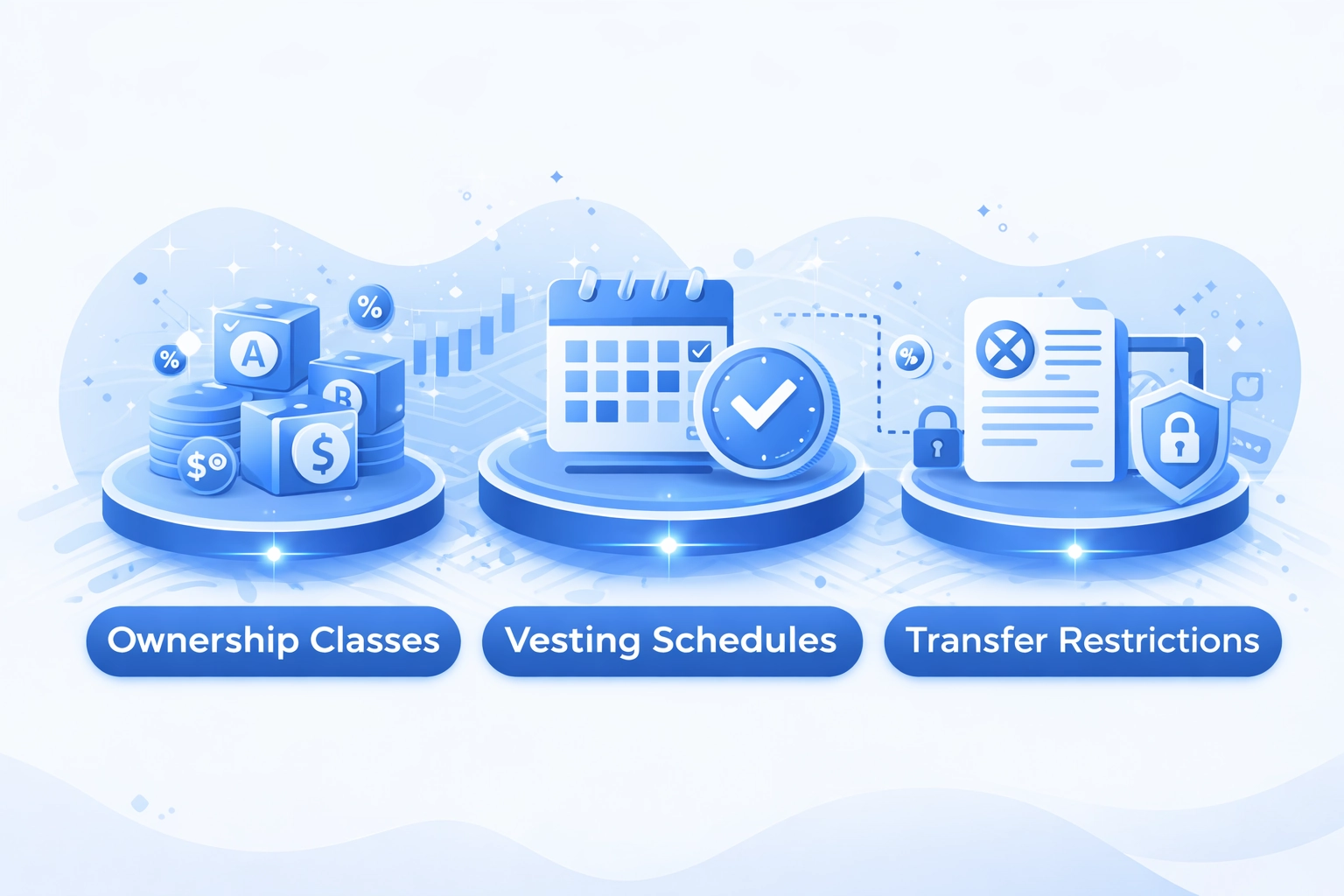
Critical Cap Table Components
Ownership Classes
- Common equity tokens with full voting and economic rights
- Preferred equity tokens with priority distributions and protective provisions
- Management tokens with enhanced governance rights but limited economic participation
Vesting Schedules
- Sponsor allocations vesting over 24-48 months aligned with property performance
- Employee incentive pools with service-based or milestone-based unlocking
- Early investor lockups preventing immediate secondary market flooding
Transfer Restrictions
- Securities law holding periods preventing transfers for 6-12 months post-issuance
- Accredited investor requirements limiting transfers to qualified purchasers only
- Right of first refusal clauses giving real estate tokenization SPV opportunity to repurchase before external sales
Regulatory Classification of Real Estate Security Tokens
Property tokens overwhelmingly qualify as securities under the Howey Test framework applied by USA regulators and parallel analyses in UK, UAE, and Canada. The investment of money in a common enterprise with reasonable expectation of profits derived from entrepreneurial or managerial efforts of others clearly applies when passive investors purchase fractional property interests managed by professional operators. This classification triggers comprehensive registration requirements, continuous disclosure obligations, and trading restrictions that shape every aspect of token offering design and ongoing compliance operations throughout the property holding period.
Registration exemptions provide practical pathways for compliant offerings without full public registration costs and timelines. Regulation D Rule 506(b) and 506(c) in the USA allow unlimited capital raising from accredited investors with general solicitation permitted under 506(c) upon enhanced verification. Regulation A+ enables up to seventy-five million dollars from both accredited and retail investors with lighter disclosure requirements than full registration. UK platforms utilize financial promotion exemptions and prospectus regulation carve-outs for qualified investors. Singapore’s private placement exemptions and Dubai’s qualified investor frameworks provide similar mechanisms. The choice depends on target investor base, capital needs, ongoing compliance capacity, and strategic goals around secondary market liquidity and public visibility of the offering.
Securities Exemption Options for Property Tokens
Reg D 506(b): Unlimited capital from accredited investors plus 35 sophisticated investors, no general solicitation, annual Form D filing, state blue sky exemptions available.
Reg D 506(c): Unlimited capital from verified accredited investors only, general solicitation permitted, enhanced verification requirements, broader marketing opportunities.
Reg A+ Tier 2: Up to 75 million dollars from retail and accredited investors, lighter disclosure than IPO, continuous reporting, trading on alternative platforms enabled.
Reg CF: Up to 5 million dollars from general public through registered intermediaries, extensive disclosure requirements, investment limits based on income and net worth.
Reg S: Offshore offerings to non-USA persons with no USA marketing, category 3 40-day distribution compliance period, useful for international investor targeting.
Section 4(a)(2): Private placements without specific rule framework, requires substantive relationship or sophistication, limited investors, no public solicitation, higher legal risk.
End-to-End Workflow for Compliant Token Offerings
The complete process of launching compliant property token offerings spans property acquisition, legal structuring, regulatory compliance, technology deployment, investor onboarding, and ongoing administration. Initial stages focus on property selection and due diligence including title verification, environmental assessments, zoning compliance, and financial modeling that establishes expected returns under various market scenarios. Simultaneously, legal teams real estate tokenization SPV structure the real estate tokenization SPV, select appropriate jurisdictions, draft operating agreements defining governance and distribution mechanics, and prepare offering documents meeting securities law disclosure requirements including risk factors, use of proceeds, management backgrounds, and detailed property information.
Technology deployment parallels legal preparation with smart contract coding implementing token economics, transfer restrictions, dividend distribution logic, and governance mechanisms. Security audits verify contract functionality and identify vulnerabilities before mainnet deployment. Custody integrations connect cold storage solutions protecting the majority of tokens with hot wallets facilitating distributions and investor withdrawals. Compliance automation systems integrate KYC/AML providers, accreditation verification services, sanctions screening databases, and ongoing monitoring tools that flag suspicious activities or investor status changes requiring additional review. Marketing campaigns target qualified investors through compliant channels, investor portal development enables self-service account management, and distribution execution transfers tokens to verified purchasers following payment confirmation and final compliance clearance.
Property Token Offering Lifecycle
Property Acquisition
Identify target properties, conduct due diligence including title searches and physical inspections, negotiate purchase terms, and real estate tokenization SPV structure acquisition through newly formed real estate tokenization SPV entity.
Legal Structuring
Form real estate tokenization SPV in chosen jurisdiction, draft operating agreements and offering documents, engage securities counsel for regulatory strategy, and prepare filing materials for exemption compliance.
Technology Deployment
Develop and audit smart contracts implementing token economics, deploy to mainnet, integrate custody solutions, and build investor portal with KYC automation and payment processing.
Marketing Campaign
Execute compliant marketing through approved channels, conduct investor webinars, distribute offering materials, and manage lead qualification and follow-up communications.
Investor Onboarding
Process KYC submissions, verify accreditation status, conduct AML screening, collect subscription agreements, and confirm payment receipt before token distribution.
Token Distribution
Execute smart contract minting, transfer tokens to verified investor wallets, update cap table records, and provide investors with access credentials and documentation.
Property Management
Manage ongoing property operations, collect rents, handle maintenance, pay expenses, calculate distributable cash flow, and execute automated dividend distributions.
Ongoing Compliance
File annual regulatory reports, distribute financial statements, issue tax documentation, maintain corporate formalities, and monitor secondary market trading for compliance violations.
On-Chain Share Registry Integration with SPV Records
Blockchain-based share registries provide transparent, tamper-resistant ownership records that update in real-time as tokens transfer between wallets, offering significant advantages over traditional systems requiring manual reconciliation and periodic updates. Smart contracts serve as the authoritative source of ownership information, automatically enforcing transfer restrictions, vesting schedules, and governance rights without human intervention. This automation reduces operational overhead while increasing accuracy and transparency, enabling investors to verify their holdings independently without relying on third-party registry agents or periodic statements that may become outdated between issuance dates.
Legal frameworks increasingly recognize blockchain registries as valid corporate records provided they meet specific technical and governance requirements. Delaware’s blockchain amendments explicitly authorize distributed ledger stock ledgers as official records of ownership. Wyoming permits blockchain share records for limited liability companies. International jurisdictions including Switzerland, Singapore, and Liechtenstein provide similar recognition. The critical requirement involves maintaining integrity through cryptographic verification, backup procedures, and governance processes ensuring the blockchain record remains the single authoritative source rather than one of multiple conflicting ledgers. Platforms implement dual-signature requirements for registry modifications, multi-party key management preventing unilateral changes, and transparent audit trails documenting every ownership modification with timestamps and transaction hashes providing irrefutable proof of historical ownership states.
Smart Contract Design for Dividend Distribution Logic
Automated dividend distribution through smart contracts eliminates manual payment processing while ensuring accurate proportional allocation based on token ownership at specified snapshot dates. The system requires careful design addressing gas efficiency, claim mechanics, withholding requirements, and edge cases including partial ownership periods and mid-distribution transfers. Push-based distributions where contracts automatically send funds to all holders become prohibitively expensive when token holder counts exceed several hundred addresses due to gas costs of executing thousands of individual transfers in single transactions. Pull-based systems where holders actively claim their distributions prove more scalable, shifting gas costs to individual claimants while enabling the contract to make funds available without executing expensive batch transfers.
Distribution waterfall logic encodes complex financial arrangements including preferred returns, catch-up provisions, and promote real estate tokenization SPV structures that govern how cash flows allocate across different token classes and stakeholder groups. Preferred equity holders receive their target return percentages before common holders participate in distributions. After satisfying preferred returns, catch-up provisions allow common holders to receive accelerated distributions until achieving parity or specified percentages relative to preferred holders. Remaining distributions then split according to final allocation percentages between classes. The contracts must handle scenarios where insufficient cash flow exists to fully satisfy preferred obligations, tracking cumulative shortfalls and ensuring proper catch-up calculations in subsequent periods when property performance improves and accumulated arrears can be addressed.
Snapshot Mechanism
Record token holder balances at specific block heights to determine distribution eligibility, preventing gaming through mid-distribution transfers while providing clear ownership records for allocation calculations.
Waterfall Calculation
Execute multi-tier distribution logic allocating cash to preferred holders first, then catch-up tiers, finally residual splits according to defined percentages encoded in contract parameters.
Claim Execution
Enable token holders to execute claim transactions pulling their proportional share from distribution pool, paying individual gas costs rather than burdening real estate tokenization SPV with expensive batch transfers.
Withholding Integration
Interface with off-chain tax systems tracking investor jurisdictions, calculating withholding obligations, segregating withheld amounts, and generating required reporting documentation for compliance.
Unclaimed Handling
Maintain unclaimed distribution pools allowing late claims while implementing expiration policies after reasonable periods, with expired funds reverting to real estate tokenization SPV reserves or proportionally redistributing to active participants.
Audit Trail
Record complete distribution history on-chain including total amounts distributed, per-token allocation calculations, individual claims, and remaining unclaimed balances providing transparent verification for all stakeholders.
Investor KYC/AML Automation in Property Token Sales
Know Your Customer and Anti-Money Laundering compliance represents non-negotiable requirements for securities offerings, demanding comprehensive identity verification, background screening, and ongoing monitoring throughout the investment lifecycle. Automation significantly reduces friction while maintaining regulatory adherence through integration with specialized service providers offering document verification, facial recognition matching, database screening against sanctions lists and politically exposed person registers, and continuous monitoring systems that flag status changes requiring additional review. These systems process passport scans, utility bills, and selfie photographs through optical character recognition and liveness detection algorithms, comparing extracted data against government databases and watchlists to confirm identities and assess risk profiles.
Accreditation verification adds complexity for USA offerings limiting participation to qualified investors meeting income or net worth thresholds. Manual processes requiring CPAs or attorneys to certify investor status create bottlenecks and increase costs. Automated systems leverage third-party verification services accessing tax records, credit reports, brokerage account statements, and other financial data with investor consent, programmatically determining accreditation status without requiring professional certifications for every participant. International investors require tailored approaches as accreditation concepts vary across jurisdictions. UK sophisticated investors demonstrate knowledge through examinations or certifications. Singapore accredited investors meet asset or income thresholds similar to USA standards. Dubai qualified investors satisfy higher net worth requirements. Platforms implement jurisdiction-specific verification flows automatically routing investors through appropriate processes based on declared residency and citizenship.
Structuring Revenue Waterfall and Profit Allocation
Revenue waterfall real estate tokenization SPV structures define the sequence and proportions in which cash flows allocate among various stakeholder groups including lenders, preferred equity holders, common equity holders, and sponsor promotes. Standard commercial real estate waterfalls begin with operating expenses and debt service as senior obligations, followed by preferred equity receiving target returns typically ranging from six to ten percent annually, then catch-up provisions allowing common equity to receive accelerated distributions until achieving parity with preferred returns, and finally residual splits where excess cash flows divide according to predetermined percentages between common equity and sponsor promotes rewarding successful property management and value creation.
Complexity arises in tracking cumulative distributions across multiple periods when insufficient cash flow exists to fully satisfy preferred returns in some quarters while excess distributions occur in others. The system must maintain running balances of cumulative preferred shortfalls, ensure proper catch-up calculations when cash flow improves, and correctly apply residual splits only after all prior tier obligations are satisfied. Tax considerations add another dimension as distribution timing affects investor returns and compliance obligations. Some real estate tokenization SPV structures implement quarterly distributions providing regular cash flow, while others retain earnings for property improvements or debt reduction, distributing larger amounts annually or upon property sale. The choice balances investor preferences for liquidity against tax efficiency and operational flexibility in managing property capital needs.
Custody, Escrow, and Trustee Layer Integration
Institutional-grade custody solutions provide secure storage for digital tokens representing property ownership, implementing multi-signature authorization requirements, cold storage protocols for majority holdings, and comprehensive insurance coverage protecting against theft, loss, or unauthorized access. Qualified custodians in USA must register with FinCEN and implement Bank Secrecy Act compliance programs including transaction monitoring and suspicious activity reporting. The custody layer separates operational hot wallets used for distributions and approved transfers from cold storage vaults holding reserve tokens offline in hardware security modules requiring physical access and multiple authorization levels for any movement.
Escrow mechanisms protect investor funds during token sale periods, holding subscription payments in segregated accounts until minimum raise thresholds are met and all closing conditions are satisfied. If offerings fail to reach minimum targets or material adverse changes occur before closing, escrowed funds return to investors automatically without sponsor access. Traditional escrow agents provide these services for fiat currency portions while smart contract escrow holds cryptocurrency contributions, releasing funds to real estate tokenization SPV accounts only after programmatic verification of completion conditions including minimum raise achievement, regulatory filing confirmations, and multi-party signature approvals. Trustee arrangements add another protective layer for debt token real estate tokenization SPV structures, appointing independent trustees representing bondholder interests with powers to enforce covenants, declare defaults, and pursue remedies if real estate tokenization SPV fail to meet obligations, mirroring traditional bond trustee roles adapted for tokenized debt instruments.
Secondary Market Enablement Under Securities Law
Secondary market trading provides liquidity allowing token holders to exit investments before property sale or maturity dates, significantly enhancing investment attractiveness compared to traditional illiquid real estate holdings. However, securities regulations impose strict limitations on resale activities including holding period requirements, transfer restrictions to qualified purchasers only, and prohibition against unregistered public trading. USA Regulation D offerings impose one-year holding periods before any resale can occur, with subsequent transfers limited to accredited investors unless the issuer registers securities or qualifies for another exemption. Alternative Trading Systems operating under Regulation ATS provide compliant secondary market venues, requiring broker-dealer registration and implementing investor qualification checks before enabling token transfers.
Smart contracts enforce transfer restrictions programmatically by checking investor qualification status against compliance databases before executing token movements between addresses. Whitelist systems maintain approved investor registries, rejecting transfer attempts to non-qualified addresses while allowing free trading among verified participants. Time-lock mechanisms prevent transfers before holding period expiration dates encoded in token metadata. International offerings face additional complexity as cross-border transfers trigger multiple jurisdictions’ securities laws. A UK investor selling to a Dubai purchaser must satisfy both FCA and DFSA requirements. Platforms implement jurisdiction-specific transfer rules checking both sender and recipient locations, automatically applying the most restrictive requirements when multi-jurisdictional trades occur, ensuring global compliance while maximizing liquidity within legal constraints.
Secondary Market Trading Frameworks
| Trading Venue Type | Regulatory Requirements | Investor Restrictions | Implementation Complexity |
|---|---|---|---|
| Peer-to-Peer Transfer | Smart contract transfer restrictions only, no intermediary needed | Both parties must be qualified investors on whitelist | Low – basic whitelist verification |
| Alternative Trading System | Broker-dealer registration, Regulation ATS compliance, FINRA membership | Accredited investors only, broker verification required | High – full regulatory framework |
| Bulletin Board | Matching service only, no execution, lighter compliance burden | Qualified investors, self-certification acceptable | Medium – facilitation without execution |
| National Exchange | Full securities registration, exchange listing standards, continuous disclosure | Open to retail investors, public trading | Very High – IPO-level requirements |
Tax Structuring for Cross-Border Token Investors
International real estate token offerings create complex tax implications as investors from multiple jurisdictions invest in real estate tokenization SPV holding properties in yet other locations. USA properties owned by foreign investors through real estate tokenization SPV may trigger FIRPTA withholding requirements on distributions and sales proceeds unless treaty exceptions apply. UK investors in offshore real estate tokenization SPV face deemed income rules. Dubai residents benefit from zero capital gains tax but must consider substance requirements. Canada imposes withholding on non-resident property income. Platforms must implement systems tracking investor tax residency, calculating jurisdiction-specific withholding obligations, segregating withheld amounts for remittance to appropriate authorities, and generating required tax documentation for investors and regulators across multiple countries.
Entity-level tax planning optimizes overall tax efficiency through careful jurisdiction selection and real estate tokenization SPV structure design. Pass-through entities like LLCs avoid corporate-level taxation while allowing income to flow directly to investors taxed at individual rates. REIT real estate tokenization SPV structures in USA provide tax advantages when ninety percent of income distributes to shareholders annually. Offshore real estate tokenization SPV in tax-neutral jurisdictions like Cayman Islands eliminate entity-level taxes but may trigger controlled foreign corporation rules for USA investors. The optimal real estate tokenization SPV structure depends on property location, investor composition, expected holding period, and exit strategy. Sophisticated offerings create blocker corporations or parallel fund real estate tokenization SPV structures accommodating different investor tax profiles, enabling tax-exempt institutions, foreign investors, and taxable USA individuals to invest side-by-side through tailored vehicles optimizing each group’s tax position while pooling capital for property acquisition and management.
Governance Rights Encoding in Property Tokens
Governance mechanisms transform traditional shareholder voting into on-chain proposal systems where token holders exercise decision rights through verifiable blockchain transactions rather than proxy voting cards and annual meeting attendance. Smart contracts encode voting rights proportional to token ownership, implement proposal submission and discussion periods, execute voting with transparent tallying visible to all participants, and automatically implement approved decisions when technically feasible. Major decisions requiring token holder approval typically include property refinancing, significant capital expenditures beyond budgeted amounts, manager replacement, disposition timing and pricing, and amendments to governing documents affecting investor rights or economic terms.
Delegation features allow token holders to assign voting power to representatives with subject matter expertise or time availability to actively participate in governance. This mirrors traditional proxy systems but operates continuously rather than only during scheduled meeting windows. Quorum requirements prevent small minorities from making binding decisions, typically requiring thirty to fifty percent participation for ordinary matters and higher thresholds for fundamental changes. Time-weighted voting gives longer-term holders enhanced influence rewarding commitment over short-term speculation. Quadratic voting balances influence by allocating votes as the square root of token holdings, preventing whale dominance while maintaining proportional representation. The optimal governance model depends on investor sophistication, property complexity, and desired balance between efficiency and democratic participation across diverse stakeholder groups with varying knowledge levels and investment horizons.
Valuation Frameworks for Tokenized Real Estate Assets
Accurate property valuation underpins compliant token offerings as securities regulations require fair pricing disclosure and prohibit fraudulent misrepresentation of asset values. Independent appraisals from licensed professionals provide third-party validation of property worth using comparable sales analysis, income capitalization approaches, and replacement cost methods adapted to specific property types and market conditions. Appraisals must occur within ninety days of offering launch to ensure values reflect current market conditions rather than outdated assessments potentially misleading investors about actual asset backing their token purchases.
Ongoing valuation updates maintain accurate net asset value calculations as property markets fluctuate, enabling fair pricing for secondary market transactions and transparency for existing holders tracking investment performance. Quarterly or annual revaluations balance accuracy against cost considerations, with more frequent updates justified for volatile markets or actively traded tokens where pricing transparency significantly impacts liquidity. Automated valuation models using machine learning algorithms analyzing comparable property transactions, market trends, and property-specific data provide cost-effective preliminary estimates between full appraisals. However, these automated systems supplement rather than replace professional appraisals for regulatory compliance and high-stakes decisions including refinancing, major capital raises, or property dispositions where precision matters more than update frequency or cost efficiency.
Compliance Reporting and Ongoing SPV Obligations
Securities exemptions impose continuing compliance obligations extending throughout the investment period rather than ending at token distribution. Annual reports provide updated financial information, management discussion of operations, and disclosure of material changes affecting investor interests. Form D amendments notify regulators of additional capital raises or material modifications to offering terms. Transfer agent reporting tracks secondary market transactions ensuring compliance with transfer restrictions and volume limitations. Failure to maintain ongoing compliance can result in loss of exemption status, rescission rights for investors, regulatory penalties, and potential criminal liability for willful violations.
real estate tokenization SPV corporate maintenance requires separate attention beyond securities reporting including annual state filings maintaining good standing, tax returns filed timely in all relevant jurisdictions, board meeting minutes documenting major decisions, financial statement preparation following GAAP standards, insurance policy renewals maintaining adequate coverage, and property management oversight ensuring operational compliance with lease terms and local regulations. Platforms serving multiple properties implement shared service arrangements where compliance teams handle recurring obligations across portfolio companies, achieving economies of scale while maintaining proper legal separation and avoiding commingling that could undermine bankruptcy remoteness protections. Automated workflow systems track filing deadlines, distribute tasks to appropriate personnel, and maintain comprehensive audit trails demonstrating proactive compliance management throughout the asset lifecycle from initial offering through eventual disposition and real estate tokenization SPV dissolution.
Ongoing Compliance Obligations Checklist
File annual financial reports with updated property valuations, income statements, balance sheets, and cash flow statements within ninety days of fiscal year end
Distribute quarterly investor updates detailing property performance, occupancy metrics, capital expenditures, and distribution calculations with supporting documentation
Issue annual tax documents including K-1 forms for USA investors, foreign investment reporting forms, and withholding statements by regulatory deadlines
Maintain current investor qualification records through annual reconfirmation of accreditation status and updated KYC information for compliance monitoring
Monitor secondary market transfers ensuring compliance with transfer restrictions, holding periods, and investor qualification requirements before approving token movements
File state annual reports and franchise taxes maintaining good standing in formation jurisdictions and states where properties are located
Conduct annual board meetings documenting major decisions, approving financial statements, and maintaining corporate formalities demonstrating independent operation
Update smart contract whitelists reflecting investor status changes, transfer approvals, and compliance clearances ensuring automated restrictions remain current
Scaling Multi-Asset Real Estate Token Platforms
Platforms targeting portfolio-scale operations across dozens or hundreds of properties must implement standardized processes reducing per-property setup costs while maintaining compliance quality. Template legal documents covering operating agreements, offering memoranda, and subscription documents enable rapid customization for new properties without drafting from scratch. Pre-negotiated relationships with service providers including appraisers, property managers, custodians, and audit firms provide volume pricing and expedited service. Shared technology infrastructure supports multiple real estate tokenization SPV through multi-tenant smart contract factories, unified investor portals managing cross-property holdings, and centralized compliance systems tracking obligations across entire portfolios.
Modular smart contract architectures separate common functionality including investor whitelisting, transfer restrictions, and governance voting into reusable libraries deployed once and referenced by property-specific token contracts. This approach reduces deployment costs, simplifies auditing as core logic requires verification only once, and enables rapid launches as new property tokens inherit battle-tested components. Master-feeder real estate tokenization SPV structures allow investors to buy into diversified portfolios through single investments while maintaining proper legal separation at the underlying real estate tokenization SPV level. The master fund holds interests in multiple feeder real estate tokenization SPV each owning individual properties, providing diversification benefits and operational efficiency while preserving asset isolation and transparency into underlying property performance that sophisticated investors demand for proper risk assessment and portfolio management.
Launch Your Compliant Real Estate Token Platform
Partner with experienced tokenization specialists to real estate tokenization SPV structure real estate tokenization SPV, deploy smart contracts, and navigate regulatory requirements for successful property token offerings.
People Also Ask
Q1.1: What is an SPV structure in real estate tokenization and why is it required?
A Special Purpose Vehicle in real estate tokenization is a legally isolated entity created specifically to hold and manage a single property or portfolio. It serves as a protective barrier between the underlying asset and the issuer’s broader operations. This structure is required because it provides investors with direct legal claim to specific assets rather than unsecured general claims against a company. The real estate tokenization SPV ensures that if the parent company faces bankruptcy or legal issues, the tokenized property remains protected and separate. Additionally, securities regulators in most jurisdictions mandate real estate tokenization SPV structures for compliant token offerings to ensure clear asset ownership, transparent cash flows, and proper investor protections under securities law frameworks.
Q2.2: How do equity tokens differ from debt tokens in SPV structures?
Equity tokens in real estate tokenization SPV structures represent fractional ownership stakes in the property-holding entity, entitling holders to proportional rental income, appreciation, and voting rights on major decisions. Debt tokens function as digital bonds where the real estate tokenization SPV borrows capital from token holders and pays fixed interest regardless of property performance. Equity tokens offer unlimited upside potential but carry higher risk if property values decline. Debt tokens provide predictable returns with senior claims on cash flows but cap potential gains. The choice depends on investor appetite, regulatory treatment, and capital structure goals. Many platforms issue both types to accommodate different investor profiles and optimize capital costs across various tranches.
Q3.3: Which jurisdictions are most favorable for tokenized real estate SPVs?
Delaware, Wyoming, and Nevada in the USA offer streamlined LLC formation with blockchain-friendly statutes and established case law for digital securities. Singapore provides clear regulatory guidance through MAS with tax-efficient structures for real estate investment vehicles. The Cayman Islands and British Virgin Islands remain popular for international investors seeking zero capital gains tax and flexible corporate structures. Dubai’s DIFC recently introduced comprehensive token regulations with fast-track licensing for compliant platforms. Luxembourg and Liechtenstein in Europe offer AIFM passporting rights and institutional-grade regulatory frameworks. The optimal jurisdiction depends on target investor locations, tax considerations, regulatory clarity, and operational flexibility required for your specific token offering structure.
Q4.4: What are the main compliance requirements for property token offerings?
All tokenized real estate offerings must register as securities or qualify for exemptions like Regulation D, Regulation A+, or international equivalents. This requires detailed offering documents, financial audits, legal opinions, and ongoing disclosure obligations. Investor accreditation verification through KYC/AML procedures is mandatory, with identity verification, source of funds checks, and sanctions screening. Transfer restrictions must be coded into smart contracts to prevent non-compliant secondary trading. The real estate tokenization SPV must maintain proper corporate governance with board meetings, financial reporting, and distribution calculations. Annual compliance includes tax filings, regulatory reporting to securities authorities, investor communications, and property valuations. Platforms must also implement cybersecurity standards, data protection protocols, and maintain required insurance coverage for both physical assets and digital operations.
Q5.5: How are dividends and profits distributed in tokenized real estate SPVs?
The real estate tokenization SPV collects rental income and other property revenues into designated bank accounts or blockchain treasury addresses. After deducting operating expenses, property management fees, debt service, and reserve allocations, net distributable income is calculated quarterly or monthly. Smart contracts automate proportional distribution to token holder wallet addresses based on their ownership percentage recorded on-chain. For equity tokens, distributions follow waterfall structures with preferred returns, catch-up provisions, and promote structures if applicable. Debt tokens receive fixed interest payments on predetermined schedules regardless of property performance. All distributions must comply with securities regulations requiring proper disclosure and reporting. The system integrates with tax reporting infrastructure to generate necessary documentation for investors across different jurisdictions, ensuring compliance with withholding requirements and treaty benefits.
Explore Services
Related Services
Reviewed by

Aman Vaths
Founder of Nadcab Labs
Aman Vaths is the Founder & CTO of Nadcab Labs, a global digital engineering company delivering enterprise-grade solutions across AI, Web3, Blockchain, Big Data, Cloud, Cybersecurity, and Modern Application Development. With deep technical leadership and product innovation experience, Aman has positioned Nadcab Labs as one of the most advanced engineering companies driving the next era of intelligent, secure, and scalable software systems. Under his leadership, Nadcab Labs has built 2,000+ global projects across sectors including fintech, banking, healthcare, real estate, logistics, gaming, manufacturing, and next-generation DePIN networks. Aman’s strength lies in architecting high-performance systems, end-to-end platform engineering, and designing enterprise solutions that operate at global scale.