Ai Overview
This phase demands expertise in modern JavaScript frameworks, responsive design principles, user experience optimization, accessibility standards, and performance engineering. 8% and reduced fraud risk compared to cards, though longer settlement times of 3 to 5 business days. Fees typically range from 2% to 4% depending on payment methods and amounts. Pricing typically follows per-verification models ranging from $0.
Key Takeaways
- The complete tokenized real estate platform timeline spans 12 to 18 months from initial planning through mainnet deployment, with distinct phases for regulatory compliance, technical development, and market testing across jurisdictions including the USA, UK, UAE, and Canada.
- Regulatory assessment and securities compliance constitute the most critical early-stage activities, requiring 2 to 3 months of dedicated legal review to navigate SEC, FCA, DFSA, and CSA requirements before any technical development begins.
- Blockchain network selection between Ethereum, Polygon, Avalanche, or Stellar significantly impacts long-term platform scalability, transaction costs, and regulatory compliance capabilities, making this decision pivotal during the technical planning phase.
- Digital contract for property tokenization requires specialized expertise in security token standards like ERC-1400, incorporating automated compliance checks, dividend distribution mechanisms, and investor rights management that can take 3 to 4 months to build and audit properly.
- KYC and AML framework implementation must be operational before any investor onboarding, with identity verification, accreditation checking, and sanctions screening integrated into both the registration flow and ongoing transaction monitoring systems.
- Security audits by reputable third-party firms are non-negotiable requirements that typically identify 20 to 50 vulnerabilities in initial smart contract code, with remediation and retesting adding 4 to 8 weeks to the pre-launch timeline.
- Beta testing with controlled investor groups provides essential feedback on user experience, transaction flows, and compliance processes, typically requiring 30 to 60 days before confident mainnet deployment with real assets and investor capital.
- Secondary market liquidity planning must begin during platform design, as investor exit options significantly influence token attractiveness, with partnerships for exchange listings or integrated peer-to-peer marketplaces requiring 2 to 4 months to establish.
- Post-launch platform governance including monitoring systems, customer support infrastructure, and compliance reporting mechanisms require dedicated operational budgets of $100,000 to $300,000 annually to maintain regulatory standing and investor trust.
- Global scaling involves replicating the regulatory approval process for each new jurisdiction, with country-specific compliance adaptations, local banking partnerships, and market-appropriate property sourcing extending the expansion timeline by 6 to 12 months per major market.
Frontend Development for Investor and Admin Dashboards
Frontend development for investor and admin dashboards transforms backend APIs and smart contracts into intuitive user interfaces during a 6 to 10 week phase producing web applications, mobile experiences, and administrative tools that investors and operators use daily. This phase demands expertise in modern JavaScript frameworks, responsive design principles, user experience optimization, accessibility standards, and performance engineering. Frontend quality determines first impressions, adoption rates, user satisfaction, and operational efficiency that directly impact platform success in the competitive tokenized real estate tokenization market across the USA, UK, UAE, and Canada.
Technology stack selection typically centers on React, Vue, or Angular frameworks providing component-based architectures, reactive data binding, and rich ecosystems of libraries accelerating development. React’s dominant market share, extensive community support, and corporate backing from Meta make it the default choice for most projects, though Vue offers gentler learning curves for smaller teams and Angular provides opinionated structure benefiting large organizations. TypeScript adoption adds static typing catching errors during development rather than production, improving code quality and maintainability as applications grow complex. State management libraries like Redux, MobX, or Zustand centralize application state, simplifying data flow through deeply nested component trees.
Investor dashboard design prioritizes clarity, simplicity, and task efficiency, recognizing that many users lack deep financial or technical expertise. The homepage displays portfolio overview with total investment value, current property allocations, recent transactions, and performance summaries at a glance. Property browsing interfaces showcase available investments with compelling imagery, key metrics like projected yields and minimum investments, location maps, and clear calls-to-action guiding users through purchase workflows. Portfolio management pages detail current holdings, property-specific performance, dividend history, and downloadable tax documents. Transaction history provides complete audit trails with filterable views, export capabilities, and status indicators distinguishing pending from completed operations. Account settings enable profile updates, KYC document resubmission, notification preferences, and security configurations like two-factor authentication.
Key Frontend Features by User Type
Investor Features
- Property marketplace with filtering
- One-click token purchases
- Real-time portfolio tracking
- Automated dividend notifications
- Secondary market trading
- Tax document downloads
- Performance analytics
Admin Features
- Property listing management
- KYC review queues
- Transaction monitoring
- Compliance alert dashboards
- Financial reporting tools
- User support interface
- Platform analytics
Property detail pages provide comprehensive information supporting investment decisions, balancing thoroughness with digestibility. Hero sections feature professional photography or renderings establishing visual appeal and property type. Key metrics display projected annual yields, minimum investments, funding progress, and investment deadlines in prominent positions. Location sections include interactive maps, neighborhood descriptions, nearby amenities, and market analysis. Financial tabs present detailed pro formas with revenue projections, operating expense breakdowns, debt structures, and return calculations under various scenarios. Documents sections house offering memorandums, operating agreements, property inspection reports, and appraisals with version histories and download tracking. Discussion areas enable investor questions with responses from property sponsors or platform representatives.
Investment workflow optimization reduces friction from property discovery through completed token purchase, maximizing conversion rates. Streamlined registration collects only essential information initially, deferring optional details until after first purchase. Progressive disclosure reveals complexity gradually, showing basic information by default with expandable sections for detailed specifications. One-click purchases enable returning investors to buy tokens without navigating multiple screens or re-entering payment information. Progress indicators show users where they are in multi-step processes like KYC verification or accreditation checking. Confirmation screens summarize pending transactions before final submission, preventing user errors from misunderstanding operation details. Email and SMS confirmations provide transaction receipts and next-step guidance.
Responsive design ensures optimal experiences across desktop monitors, tablets, and smartphones as investors increasingly access platforms via mobile devices. Mobile-first design approaches prioritize small screens during initial wireframing, then progressively enhance for larger displays rather than attempting to cram desktop layouts onto phones. Flexible grid systems adapt content layouts to available screen widths using CSS media queries triggering layout shifts at breakpoints. Touch-friendly interfaces provide adequately sized click targets, consider thumb reach on mobile devices, and support gesture navigation. Responsive images serve appropriately sized assets to different devices, avoiding unnecessary data transfer on mobile connections. Performance optimization becomes critical on mobile networks with potentially limited bandwidth and higher latency compared to broadband connections.
Accessibility implementation ensures platforms work for users with disabilities, meeting legal requirements under regulations like the Americans with Disabilities Act, UK Equality Act, and similar laws globally while expanding addressable markets. Semantic HTML uses appropriate elements conveying meaning to assistive technologies, with headings establishing content hierarchy, lists grouping related items, and buttons versus links distinguishing actions from navigation. ARIA attributes supplement native semantics when custom widgets don’t map to standard HTML elements. Keyboard navigation enables complete platform usage without mice, crucial for motor-impaired users and power users preferring keyboard efficiency. Color contrast meets WCAG standards ensuring text remains readable for vision-impaired users. Screen reader testing validates experiences for blind users navigating via audio feedback. Captions and transcripts make video and audio content accessible to deaf users. With tools like Invideo’s video captions generator, creating accurate captions and transcripts has become much faster and easier.
Performance optimization delivers fast loading times and responsive interactions essential for positive user experiences and search engine rankings. Code splitting breaks JavaScript bundles into smaller chunks loading on-demand rather than upfront, reducing initial page load times. Lazy loading defers image and component loading until needed, prioritizing above-the-fold content. Caching strategies leverage browser caching for static assets and service workers for offline functionality. Bundle optimization minimizes JavaScript through tree-shaking eliminating unused code, minification removing whitespace and shortening variable names, and compression using gzip or brotli. Image optimization uses appropriate formats like WebP, responsive sizing, and lazy loading. Performance budgets establish acceptable metrics, with continuous integration blocking deployments exceeding thresholds.
Admin dashboard sophistication enables efficient platform operation at scale as property counts and investor bases grow. Property management interfaces provide bulk upload capabilities for adding multiple listings simultaneously, template systems for standardizing property data entry, scheduling tools for coordinating marketing campaigns and launch dates, and workflow automation for common operational tasks. User management includes advanced search and filtering finding specific investors among thousands, bulk operations for sending communications or updating statuses, risk scoring highlighting users requiring enhanced monitoring, and activity timelines showing complete user interaction histories. Compliance dashboards aggregate pending reviews, display verification queues organized by priority, track SLA performance ensuring timely processing, and generate regulatory reports on demand.
Analytics and reporting capabilities provide platform operators with business intelligence informing strategic decisions. Investor analytics track acquisition channels identifying effective marketing investments, cohort analysis revealing retention patterns, funnel metrics highlighting conversion bottlenecks, and LTV calculations determining customer value justifying acquisition costs. Property analytics compare performance across portfolio, identify high-performing asset types guiding acquisition strategies, track funding velocities indicating market demand, and benchmark yields against market alternatives. Financial analytics display revenue trends, transaction volumes, fee earnings, and operational costs enabling profitability optimization. Dashboard visualization through charts and graphs makes data accessible to non-technical stakeholders.
Security implementation in frontend code prevents common web application vulnerabilities despite client-side code’s inherent exposure. Input validation and sanitization protects against XSS attacks by encoding user inputs before display and validating data formats before submission. CSRF protection includes anti-forgery tokens in state-changing requests preventing unauthorized commands from malicious sites. Secure authentication stores tokens in httpOnly cookies rather than localStorage preventing JavaScript access by injected scripts. Content Security Policy headers restrict script sources preventing execution of malicious code. Dependency management keeps third-party libraries updated addressing known vulnerabilities in popular packages. Regular security scanning using tools like npm audit or Snyk identifies vulnerable dependencies requiring updates.
The frontend development phase culminates in comprehensive testing including unit tests for component logic, integration tests for feature workflows, end-to-end tests simulating complete user journeys, visual regression testing catching unintended UI changes, and user acceptance testing with actual investors providing feedback on usability. Cross-browser testing validates functionality across Chrome, Firefox, Safari, and Edge. Cross-device testing confirms responsive behavior on various screen sizes. Performance testing measures load times, interaction responsiveness, and resource consumption under realistic conditions. Accessibility audits using tools like axe or Lighthouse identify compliance gaps requiring remediation before launch. This testing investment prevents post-launch bug fixes, support overhead, and user frustration undermining adoption in the tokenized real estate platform timeline.
Wallet Integration and Payment Gateway Setup
Wallet integration and payment gateway setup enables the critical conversion between traditional finance and blockchain during a 3 to 4 week phase establishing fiat onramps, cryptocurrency payment processing, wallet connectivity, and transaction management. This infrastructure determines how easily investors can fund purchases, how smoothly blockchain interactions function, and whether platforms successfully bridge the gap between familiar banking experiences and novel tokenization technology. Seamless wallet and payment integration directly influences conversion rates, user satisfaction, and mainstream adoption potential across target markets in the USA, UK, UAE, and Canada.
Cryptocurrency wallet integration enables users to connect existing wallets or utilize platform-provided custody solutions for managing digital assets. Web3 wallet connectivity supports popular browser extension wallets like MetaMask, Coinbase Wallet, or WalletConnect protocol enabling mobile wallet connections through QR code scanning. Connection flows guide users through wallet installations if needed, network configuration ensuring correct blockchain selection, and permission granting authorizing platform interactions. Account switching detection updates platform state when users change connected wallet addresses. Transaction signing requests present clear descriptions of pending operations with gas estimates, value transfers, and contract interactions enabling informed approval decisions. Platforms should support multiple wallet types accommodating diverse user preferences and technical comfort levels.
Custodial wallet solutions provide platform-managed wallets for users preferring traditional account experiences over self-custody responsibilities. Platform backend generates unique wallet addresses per user, securely storing private keys in hardware security modules or enterprise key management systems. User-friendly interfaces hide blockchain complexities, presenting familiar deposit, withdraw, and transfer operations without exposing private keys or gas fee concepts. Custodial approaches enable password recovery through traditional mechanisms rather than seed phrase backups that many users lose. However, custody introduces regulatory obligations as platforms control user funds, potential security risks if key storage is compromised, and philosophical concerns about decentralization when platforms hold significant token supplies. Most platforms ultimately support both custodial and non-custodial options letting users choose preferred approaches.
Payment Processing Options Comparison
Fiat payment gateways process credit cards, debit cards, ACH transfers, and wire transfers converting traditional currency into platform balances or stablecoins. Stripe dominates US and European markets with developer-friendly APIs, extensive documentation, competitive pricing around 2.9% plus $0.30 per credit card transaction, and comprehensive compliance handling including PCI-DSS certification. Plaid enables bank account linking and ACH processing with lower fees around 0.8% and reduced fraud risk compared to cards, though longer settlement times of 3 to 5 business days. Regional alternatives like Adyen provide better international coverage, while specialized crypto-payment processors like BitPay or CoinGate accept cryptocurrency payments converting to fiat if desired. Gateway selection should consider target markets, supported payment methods, fee structures, settlement timing, fraud protection, and developer experience affecting integration timeline.[1]
KYC-integrated fiat-to-crypto ramps combine identity verification with payment processing, enabling compliant onboarding without separate KYC and payment steps. Services like Wyre, MoonPay, Ramp Network, or Transak provide embeddable widgets handling complete user flows from identity document submission through payment processing and cryptocurrency delivery to user wallets. These providers maintain money transmitter licenses and banking relationships platforms would find expensive to establish independently. Fees typically range from 2% to 4% depending on payment methods and amounts. Integration involves embedding iframe widgets or redirecting to hosted pages, with webhooks notifying platforms when purchases complete. While convenient, these services introduce additional vendor dependencies and user data sharing requiring privacy policy disclosures.
Stablecoin integration enables dollar-denominated blockchain transactions avoiding cryptocurrency volatility complicating accounting and user understanding. USDC issued by Circle and USDT from Tether dominate with billions in circulation, broad exchange support, and regulatory clarity in key markets. Smart contracts easily integrate stablecoin transfers through standard ERC-20 interfaces. Dividend distributions in stablecoins provide predictable dollar amounts without exposure to ETH or other cryptocurrency price fluctuations. Property purchases priced in stablecoins avoid scenarios where token values change between purchase initiation and blockchain confirmation. Platforms must select which stablecoins to support, balancing ubiquity against regulatory preferences and custody complexity when supporting multiple assets.
Gas fee management prevents user confusion and abandonment when blockchain transaction costs fluctuate wildly during network congestion. Gas estimation APIs predict current costs helping users understand total expenses before transaction submission. Platform subsidization absorbs gas fees for users, treating them as customer acquisition costs rather than passing through to investors who might not understand blockchain economics. Gas price optimization uses lower gas settings for non-urgent transactions like dividend claims while paying premiums for time-sensitive operations like token purchases during limited-time offerings. Layer-2 scaling solutions like Polygon dramatically reduce gas costs, making fee concerns less prominent but introducing bridge complexity when users need to move assets between networks.
Transaction monitoring tracks payments and blockchain operations through their complete lifecycles providing users with status visibility and enabling platform troubleshooting. Payment tracking detects when credit card charges succeed, ACH transfers initiate, or cryptocurrency deposits arrive at platform addresses. Blockchain transaction monitoring follows submitted transactions from mempool pending status through block confirmation and finalization, detecting failures requiring resubmission with higher gas fees. Status update notifications keep users informed of progress, particularly for multi-day processes like ACH settlements or blockchain confirmations requiring dozens of blocks. Reconciliation processes match completed payments against credited platform balances, identifying discrepancies requiring investigation before users notice issues.
Ready to Launch Your Tokenized Real Estate Platform?
Partner with our experienced team to navigate the complete development journey from regulatory compliance to successful mainnet deployment in 2026.
Withdrawal processing enables investors to extract value by selling tokens and transferring proceeds to bank accounts or external cryptocurrency wallets. Withdrawal workflows verify user identity, ensure sufficient balances, apply any platform restrictions or regulatory holding periods, deduct applicable fees, and initiate transfers. Bank withdrawals use payment gateway ACH or wire capabilities sending fiat to linked accounts, typically processing within 1 to 5 business days depending on methods and banking partners. Cryptocurrency withdrawals transfer tokens or stablecoins to user-provided addresses after validating address formats preventing loss to typographical errors. Withdrawal limits prevent money laundering or platform liquidity drains, with higher amounts requiring additional verification or manual review by compliance teams.
Security measures protect payment processing from fraud, unauthorized access, and fund theft. PCI-DSS compliance for credit card handling requires secure data transmission, encrypted storage, access controls, and regular security assessments, typically addressed by using compliant payment processors rather than handling card data directly. Bank account tokenization stores reference tokens rather than actual account numbers, with gateways securely storing sensitive data in PCI-compliant vaults. Cryptocurrency private key protection uses hardware security modules, multi-signature requirements, time-delayed large transfers, and cold storage for majority of funds with only hot wallets maintaining operational amounts. Rate limiting prevents automated attacks attempting numerous small fraudulent transactions. Anomaly detection flags unusual patterns suggesting account takeover or money laundering requiring investigation before processing.
Testing payment integrations in sandbox environments prevents expensive errors in production while regulatory test account limitations. Payment processors provide test mode APIs accepting special card numbers or account credentials simulating various scenarios including successful payments, insufficient funds, expired cards, fraud triggers, and payment failures. Blockchain testnets like Goerli or Mumbai enable smart contract testing without risking real funds. End-to-end testing executes complete user flows from registration through investment using test payment methods and testnet tokens. Edge case testing validates handling of rare scenarios like network outages during payments, duplicate transaction submissions, or partial payment successes. Load testing confirms payment systems scale under heavy traffic during popular property launches attracting numerous simultaneous investors. The wallet and payment gateway setup phase concludes with production readiness confirming all systems function correctly before accepting real investor funds in the tokenized real estate platform timeline.[2]
Security Audits and Smart Contract Testing
Security audits and smart contract testing represent non-negotiable requirements consuming 4 to 8 weeks of the tokenized real estate platform timeline before mainnet deployment with real investor funds. This phase engages professional security firms to systematically review smart contract code, platform architecture, and operational procedures identifying vulnerabilities that could result in fund loss, regulatory violations, or platform compromise. Audit findings typically reveal 20 to 50 issues ranging from critical vulnerabilities enabling fund theft to informational suggestions improving code quality. Platforms that skip or rush security audits invite catastrophic failures destroying investor trust, attracting regulatory enforcement, and potentially bankrupting operations through unrecoverable losses.
Audit firm selection requires evaluating reputation, blockchain expertise, real estate security token experience, and availability within project timelines. Top-tier firms like Trail of Bits, ConsenSys Diligence, OpenZeppelin, Quantstamp, or CertiK command premium pricing from $25,000 to $150,000 depending on code complexity and audit depth, but provide credibility with institutional investors and regulators familiar with these names. Specialized security token auditors understand compliance requirements, transfer restrictions, and regulatory considerations beyond general smart contract expertise. Audit methodologies vary, with some firms emphasizing manual code review while others leverage automated analysis tools, and comprehensive audits combine both approaches. Availability timing requires early booking as demand for quality auditors exceeds supply, potentially extending platform timelines if auditors are fully scheduled months ahead.
Pre-audit preparation maximizes audit efficiency and finding quality by ensuring code is complete, well-documented, and thoroughly self-tested before external review begins. Code freeze policies prevent changes during audits that would invalidate already-reviewed sections. Comprehensive documentation including architecture diagrams, function specifications, design decisions, and known limitations helps auditors understand intended behavior distinguishing bugs from features. Complete test suites demonstrate that developers have already validated normal operation, allowing auditors to focus on edge cases and attack vectors rather than basic functionality. NatSpec comments in Solidity code explain complex logic, security assumptions, and invariant properties auditors should verify. The better prepared code is, the faster audits progress and the more deeply auditors can examine subtle vulnerabilities rather than spending time understanding basics.
Smart contract review methodology combines automated analysis tools, manual code reading, and adversarial thinking attempting to break systems. Static analysis tools like Slither, Mythril, or Manticore scan code for common vulnerability patterns including reentrancy, integer overflow, unprotected functions, and dangerous delegatecalls. Symbolic execution tools explore multiple execution paths checking whether invariants hold under all scenarios. Formal verification mathematically proves specific properties always hold, providing highest assurance for critical invariants like total supply conservation. Manual review remains essential as automated tools miss complex logic flaws, business logic errors, and novel attack vectors. Auditors think like attackers, asking how they might steal funds, manipulate governance, bypass restrictions, or cause operational failures, then verify those attacks are prevented.
| Severity Level | Impact | Typical Response | Examples |
|---|---|---|---|
| Critical | Direct fund loss, complete compromise | Must fix before launch | Reentrancy, unauthorized minting |
| High | Significant fund risk, major functional impact | Should fix before launch | Access control bypass, integer overflow |
| Medium | Conditional fund risk, operational issues | Fix recommended | Gas inefficiency, logic errors |
| Low | Minor issues, best practice deviations | Address if time permits | Missing events, code style |
| Informational | Code quality, documentation | Consider for future | Comments, naming conventions |
Platform architecture review extends beyond smart contracts to examine backend systems, API security, authentication mechanisms, database protections, and operational procedures. Infrastructure audits verify cloud configurations follow security best practices, with properly configured firewalls, encrypted storage, access controls, and logging. API audits test authentication bypass attempts, authorization flaws allowing access to others’ data, injection vulnerabilities in database queries, and rate limiting preventing abuse. Cryptographic review examines random number generation, encryption algorithm selection, key management procedures, and signing mechanisms. Operational security assesses procedures for private key custody, employee access controls, incident response plans, and disaster recovery capabilities.
Penetration testing complements audits through active exploitation attempts against running systems rather than just code review. Ethical hackers attempt SQL injection, cross-site scripting, CSRF attacks, privilege escalation, and other common web vulnerabilities. Infrastructure testing probes for misconfigured services, unpatched systems, weak credentials, and network segmentation failures. Social engineering tests whether employees can be manipulated into revealing sensitive information or granting unauthorized access. Physical security where applicable examines data center access controls, hardware security module protection, and backup media handling. Successful penetration tests identify real-world attack paths that theoretical code review might miss, providing concrete evidence of security gaps requiring remediation.
Finding remediation prioritizes issues by severity, addressing critical vulnerabilities immediately while scheduling lower-priority improvements for future releases. Critical findings block mainnet deployment until completely resolved and verified through re-audit. High severity issues should generally be addressed before launch though teams might accept residual risk if mitigating controls exist and business pressure is extreme. Medium and low findings provide improvement opportunities addressed based on available resources and risk tolerance. Remediation documentation explains what changed, why specific approaches were chosen, and how fixes were verified, creating audit trails for future reference and regulatory examination.
Re-audit verification confirms that fixes actually resolve identified issues without introducing new vulnerabilities. Auditors review changed code sections, verify tests covering previously vulnerable scenarios, and retest exploitation attempts confirming they now fail. Complete re-audits may be necessary if remediation involved extensive refactoring rather than targeted fixes, as large changes could introduce new issues. Platforms should budget time and budget for re-audits when planning the tokenized real estate platform timeline, as initial audit findings requiring substantial code changes are common rather than exceptional.
Bug bounty programs complement audits by crowdsourcing vulnerability discovery across the broader security community. Platforms offer financial rewards to anyone discovering and responsibly disclosing security issues, with payments scaled by severity from hundreds of dollars for low-impact findings to six figures for critical vulnerabilities. Bounty programs run continuously after launch, providing ongoing security monitoring as adversaries constantly evolve attack techniques. Managed platforms like HackerOne, Bugcrowd, or Immunefi handle researcher communication, finding validation, and payment processing, reducing operational burden compared to self-managed programs. Our agency’s experience across the USA, UK, UAE, and Canada shows that well-structured bug bounties identify issues missed by audits and demonstrate security commitment that builds investor confidence.
Audit report publication demonstrates transparency and security commitment to investors, regulators, and the broader community. Public reports detail methodology, findings, severities, remediation status, and auditor conclusions. Some platforms redact specific vulnerability details to prevent exploitation if issues remain partially unaddressed, balancing transparency against security. Report publication influences investor confidence, with professional audits from recognized firms becoming expected due diligence for sophisticated investors. However, audits don’t guarantee security, as novel vulnerabilities may exist, operational procedures could be flawed, or external systems might be compromised. Platforms should communicate that audits reduce but don’t eliminate all risk.
The security audit and testing phase concludes with comprehensive documentation of findings, remediations, outstanding issues, and risk acceptance decisions. This creates the foundation for confident mainnet deployment knowing that professional security experts have thoroughly examined systems and critical vulnerabilities have been addressed, substantially reducing though not eliminating the risk of security incidents that could devastate the platform and investors in the token.
Understanding the Goal of a Tokenized Property Platform
The tokenized real estate platform timeline begins with a fundamental understanding of what the platform aims to achieve in the rapidly evolving property investment landscape. At its core, a tokenized property platform leverages blockchain technology to fractionate ownership of real estate assets, converting traditional illiquid property investments into digital securities that can be traded with unprecedented efficiency. This transformation addresses several persistent challenges in real estate investing, including high capital requirements, limited liquidity, geographical restrictions, and opaque transaction processes.
After working with property developers, institutional investors, and technology innovators across the USA, UK, UAE, and Canada for over eight years, our agency has observed that successful platforms share common objectives that must be clearly defined during the planning phase. The primary goal centers on democratizing access to real estate investment opportunities by lowering minimum investment thresholds from hundreds of thousands of dollars to as little as $100 or $500, depending on regulatory frameworks and property values. This fractional approach opens premium commercial properties, luxury residential developments, and institutional-grade assets to retail investors who were previously excluded from these markets.
Beyond accessibility, tokenized real estate platforms aim to introduce liquidity into traditionally illiquid asset classes. While physical properties can take months to sell through conventional channels, tokenized representations enable investors to exit positions by selling tokens on secondary markets, potentially within minutes or hours. This liquidity premium transforms real estate from a long-term hold strategy into a more flexible investment vehicle that can respond to changing financial circumstances, market conditions, or portfolio rebalancing needs. However, platforms must balance liquidity goals with regulatory requirements that may restrict trading to accredited investors or impose holding periods.
Transparency represents another foundational goal that blockchain technology inherently supports. Every transaction, ownership change, and dividend distribution gets recorded immutably on the distributed ledger, creating an auditable trail that reduces fraud risk and enhances trust between property owners, platform operators, and investors. This transparency extends to property performance data, rental income reporting, maintenance expenses, and valuation updates, which can be made available in real-time dashboards rather than quarterly reports. Investors gain unprecedented visibility into their holdings, while platform operators benefit from reduced administrative overhead and dispute resolution costs.
The tokenized real estate platform timeline must also account for automation objectives enabled by smart contracts. These self-executing programs eliminate intermediaries in dividend distribution, automatically calculating and transferring rental income proportionally to token holders based on their ownership percentages. Smart contracts enforce compliance rules, ensuring only verified investors participate and that securities regulations are maintained throughout the token lifecycle. They facilitate voting mechanisms for major property decisions, with results automatically implemented based on token holder preferences weighted by ownership stakes. This automation reduces operational costs, minimizes human error, and scales more efficiently than manual property management processes.
Geographic expansion goals significantly influence platform design and the tokenized real estate platform timeline. A platform targeting only domestic investors in a single country faces different technical and regulatory requirements compared to one aiming for global reach across the USA, UK, UAE, and Canada. Cross-border platforms must navigate multiple securities regulators, accommodate different currencies and payment methods, address tax treaty implications, and potentially support multiple languages and cultural preferences. These complexity factors can extend development timelines by 30 to 50 percent but unlock substantially larger investor pools and property sourcing opportunities.
Cost efficiency objectives drive many tokenization initiatives, particularly for property developers seeking alternative capital raising methods. Traditional real estate financing through banks, private equity, or REITs involves substantial fees, lengthy approval processes, and restrictive terms. Tokenization platforms can reduce capital raising costs by 40 to 60 percent by eliminating multiple intermediaries, automating administrative tasks, and accessing broader investor bases that increase competition for allocations. However, platforms must invest significantly in technology infrastructure and regulatory compliance upfront before realizing these efficiency gains.
Investor protection goals must be embedded in platform design from the beginning, not retrofitted later. This includes robust KYC and AML processes that verify investor identities and screen for sanctions, fraud prevention systems that detect suspicious trading patterns, secure custody solutions for digital assets, insurance coverage for platform breaches or operational failures, and clear disclosure documents that explain risks associated with tokenized real estate investments. Platforms that prioritize investor protection build trust that translates into higher adoption rates, lower customer acquisition costs, and stronger regulatory relationships.
Understanding these multifaceted goals provides the foundation for every subsequent decision in the tokenized real estate platform timeline. Platforms that clearly articulate their objectives, target audiences, geographic scope, and differentiation strategy before beginning technical development consistently outperform those that rush into coding without strategic clarity. The planning phase typically requires 3 to 6 weeks of intensive stakeholder discussions, market analysis, and strategic documentation that guides all downstream activities.
Market Research and Property Use Case Validation
The tokenized real estate platform timeline advances with comprehensive market research that validates property use cases and identifies target investor segments. This phase typically spans 6 to 10 weeks and involves analyzing existing tokenization projects, surveying potential investors, interviewing property owners, and assessing competitive landscapes across target markets. Market research findings directly influence platform features, pricing models, property selection criteria, and go-to-market strategies that determine long-term viability.
Investor demand analysis constitutes the first research priority, examining which demographic segments show interest in tokenized real estate and what investment characteristics they prioritize. Our agency’s research across the USA, UK, UAE, and Canada reveals distinct investor profiles with varying preferences. Millennial and Gen Z investors typically favor lower minimum investments, mobile-first interfaces, and ESG-conscious property portfolios, while accredited investors and family offices prioritize institutional-grade assets, preferential terms, and direct property governance rights. Platforms must segment their target audiences and design features that address each group’s specific needs without creating operational complexity that undermines efficiency gains.
Property use case validation examines which asset types are most suitable for tokenization based on investor appeal, regulatory feasibility, and operational complexity. Commercial office buildings generate stable rental income and have established valuation methodologies, making them attractive for debt tokenization models. Luxury residential developments in prime locations like Dubai Marina, London’s Mayfair, or Manhattan’s Tribeca appeal to appreciation-focused investors seeking equity participation. Student housing and multifamily properties offer predictable cash flows with lower individual unit values that naturally support fractional ownership. Development projects provide higher return potential but require sophisticated risk disclosure and construction milestone tracking that complicates smart contract design.
Geographic market assessment evaluates which regions offer the most favorable conditions for platform launch and early growth. The USA provides the largest investor pool and most established securities regulations, but compliance costs are substantial and state-by-state variations create complexity. The UK offers a sophisticated financial services ecosystem and progressive regulators but has a smaller market size. The UAE, particularly Dubai, has emerged as a tokenization-friendly jurisdiction with the DFSA providing clear frameworks, but investor education remains necessary. Canada balances regulatory clarity with market size but faces provincial securities variations. Most successful platforms adopt a phased geographic expansion, launching in one core market before adding others as operational capabilities mature.
Competitive analysis identifies existing platforms, their strengths and weaknesses, market positioning, and gaps that new entrants can exploit. The tokenized real estate market has seen significant activity since 2018, with platforms like RealT focusing on single-family rental properties, Elevated Returns tokenizing luxury resorts, and Fundrise exploring blockchain integration for its existing REIT business. Each competitor’s approach provides lessons about what works, common pitfalls, regulatory strategies, and unmet investor needs. Platforms that differentiate through unique property access, superior user experience, lower fees, or specialized market focus tend to attract investors more effectively than me-too offerings.
Regulatory landscape mapping documents securities laws, licensing requirements, investor qualification rules, and compliance obligations in each target jurisdiction. This research directly informs the legal feasibility assessment phase that follows. In the USA, platforms must navigate SEC regulations including Regulation D for private placements, Regulation A for mini-IPOs, or Regulation Crowdfunding for smaller offerings. The UK requires FCA authorization and compliance with prospectus rules or exemptions. The UAE’s DFSA has issued specific guidance on security token offerings through its Investment Token framework. Canada requires provincial securities registration or prospectus exemptions. Understanding these requirements early prevents expensive pivots later when incompatible design choices surface during legal review.
Technology readiness assessment evaluates available blockchain platforms, development talent pools, infrastructure providers, and third-party services that will be integrated into the platform. This research identifies whether sufficient technical capabilities exist to execute the planned timeline or whether additional hiring, partnerships, or technology selection adjustments are necessary. The blockchain developer shortage in many markets can extend timelines by 2 to 4 months if specialized talent is unavailable locally and remote arrangements prove challenging.
Financial modeling projects platform economics including development costs, operating expenses, revenue sources, and breakeven thresholds. Revenue typically comes from initial token offering fees, transaction fees on secondary market trades, asset management fees on properties under administration, and potentially premium subscription tiers for enhanced features. Cost structures include ongoing blockchain transaction fees, compliance and legal expenses, customer support operations, technology infrastructure, and marketing expenditures. Platforms require 18 to 36 months to reach profitability in most cases, necessitating sufficient capital reserves or investor backing to sustain operations through the growth phase.
Stakeholder interviews with property developers, institutional investors, wealth managers, real estate brokers, and potential platform users provide qualitative insights that quantitative market data cannot capture. These conversations reveal pain points in current investment processes, skepticism about tokenization that must be addressed through education and trust-building, partnership opportunities that can accelerate market entry, and feature priorities that influence development roadmaps. Platforms that actively engage stakeholders during planning phases build relationships that translate into early adopters, strategic partnerships, and valuable feedback during beta testing.
The market research and validation phase culminates in a comprehensive document that articulates target markets, investor personas, property focus areas, competitive positioning, regulatory strategy, technology approach, and financial projections. This document becomes the reference point for all subsequent decisions in the tokenized real estate platform timeline, ensuring alignment among team members, investors, and partners as development progresses. Platforms that skip or rush this research phase frequently encounter strategic misalignments, market-product fit issues, or regulatory obstacles that require expensive corrections and timeline delays.
Legal Feasibility and Regulatory Assessment
The regulatory assessment phase represents the most critical component of the tokenized real estate platform timeline, typically requiring 8 to 12 weeks of intensive legal analysis before any technical development commences. This phase determines whether the planned platform model is legally viable in target jurisdictions, identifies required licenses and registrations, establishes compliance frameworks, and documents legal risks that must be mitigated through design choices or operational procedures. Platforms that underinvest in legal assessment frequently face regulatory enforcement actions, operational shutdowns, or costly remediation that far exceeds the initial legal consultation expenses they sought to avoid.
Securities law analysis forms the foundation of regulatory assessment, as tokenized real estate interests almost universally qualify as securities under the Howey Test in the USA or similar frameworks in other jurisdictions. In the United States, the Securities and Exchange Commission has consistently held that tokens representing ownership in real estate or rights to property income are investment contracts subject to federal securities laws. This classification triggers registration requirements under the Securities Act of 1933 unless a valid exemption applies. The most common exemptions include Regulation D Rule 506(b) for private placements to accredited investors, Rule 506(c) for general solicitation to verified accredited investors, Regulation A for offerings up to $75 million, and Regulation Crowdfunding for offerings up to $5 million.
Each exemption carries distinct requirements, benefits, and limitations that influence platform design. Regulation D 506(b) allows unlimited capital raising to accredited investors and up to 35 sophisticated investors without SEC registration, but prohibits general solicitation or advertising, limiting marketing to pre-existing relationships. Rule 506(c) permits general solicitation but requires verification that all investors meet accreditation thresholds, necessitating more robust KYC procedures. Regulation A requires SEC qualification of an offering statement similar to a prospectus and ongoing reporting obligations, but enables offerings to non-accredited investors and token listings on alternative trading systems. Regulation Crowdfunding has the lowest offering limit but allows broad retail participation through registered funding portals. Platform operators must select exemptions aligned with their target investor base, capital needs, and operational capabilities.
UK regulatory assessment focuses on Financial Conduct Authority requirements for security token offerings. The FCA considers most tokenized real estate as Specified Investments requiring authorization under the Financial Services and Markets Act. Platforms typically need FCA authorization as investment platforms, potentially including permissions for dealing in investments, arranging deals, or operating a multilateral trading facility if secondary trading is supported. The UK Prospectus Regulation requires a prospectus approved by the FCA for public offerings exceeding 8 million euros, though exemptions exist for qualified investors or offers below this threshold. The FCA’s recent guidance on cryptoassets and distributed ledger technology provides some clarity but continues evolving, requiring platforms to maintain close regulatory dialogue.
UAE regulatory frameworks, particularly those administered by the Dubai Financial Services Authority in the Dubai International Financial Centre, have emerged as relatively progressive for tokenization activities. The DFSA issued comprehensive guidance on Investment Tokens in 2020, establishing clear classification criteria and regulatory treatment. Tokenized real estate interests typically qualify as Investment Tokens subject to existing DIFC financial services regulations. Platforms require a DFSA license appropriate to their activities, such as Arranging Deals in Investments, Managing Assets, or Operating an Alternative Trading System. The DFSA’s principles-based approach provides flexibility but requires detailed business plans demonstrating adequate governance, risk management, technology infrastructure, and investor protection measures.
Canadian securities regulation operates provincially, with harmonization through the Canadian Securities Administrators but jurisdiction-specific compliance requirements. Most provinces require either prospectus filing or reliance on exemptions like the Accredited Investor Exemption or Offering Memorandum Exemption. Ontario, British Columbia, Alberta, and Quebec represent the largest markets with somewhat different regulatory approaches. Platforms operating nationally must obtain registration in each province where they have investors or rely on passport systems that recognize one primary regulator. The CSA has issued guidance on cryptocurrency offerings and continues developing frameworks for security tokens, creating some regulatory uncertainty that platforms must navigate carefully.
Anti-money laundering and counter-terrorism financing regulations apply to tokenized real estate platforms across all jurisdictions, imposing customer due diligence requirements, transaction monitoring obligations, and suspicious activity reporting duties. In the USA, platforms may need to register as Money Services Businesses with FinCEN and comply with the Bank Secrecy Act depending on their payment processing arrangements. UK platforms must comply with the Money Laundering, Terrorist Financing and Transfer of Funds Regulations 2017, implementing risk-based KYC procedures. UAE platforms in the DIFC follow DFSA’s AML regulations aligned with FATF recommendations. Canadian platforms must register as Money Services Businesses with FINTRAC and implement comprehensive AML programs. These requirements necessitate identity verification systems, ongoing monitoring for suspicious patterns, and internal compliance officers or consultants with AML expertise.
Data protection regulations add another compliance layer, particularly the EU’s General Data Protection Regulation which has extraterritorial effect when processing data of EU residents. Platforms must implement privacy-by-design principles, obtain explicit consent for data processing, enable data portability and erasure rights, and maintain detailed records of processing activities. The tension between blockchain’s immutability and GDPR’s right to erasure creates technical challenges that platforms must address through architectural choices like storing personal data off-chain with only hashes on blockchain. UK GDPR maintains similar requirements post-Brexit. Canada’s PIPEDA and provincial privacy laws impose comparable obligations. The USA lacks comprehensive federal data protection legislation but has state laws like CCPA in California that apply to platforms with significant user bases.
| Jurisdiction | Primary Regulator | Key Securities Law | Common Exemptions | Typical Timeline |
|---|---|---|---|---|
| USA | SEC | Securities Act of 1933 | Reg D 506(b/c), Reg A, Reg CF | 3-6 months |
| UK | FCA | FSMA 2000 | Qualified Investors, Private Placement | 4-8 months |
| UAE (DIFC) | DFSA | DIFC Markets Law | Professional Clients, Exempt Offers | 3-5 months |
| Canada | CSA (Provincial) | Provincial Securities Acts | Accredited Investor, Offering Memorandum | 4-7 months |
Tax implications require consultation with tax specialists familiar with both real estate and digital assets. Tokenization can trigger various tax consequences depending on structure, including capital gains on token appreciation, ordinary income from rental distributions, potential securities transaction taxes, and cross-border withholding requirements. The USA’s treatment of cryptocurrency transactions adds complexity when tokens trade on exchanges accepting crypto payments. UK stamp duty land tax and capital gains tax apply differently to tokenized versus direct property ownership. UAE offers favorable tax treatment with no capital gains or income tax in most Emirates, enhancing attractiveness for international investors. Canadian platforms must navigate federal and provincial tax rules, with particularly complex treatment in Quebec. Platforms must provide clear tax reporting to investors and potentially withhold taxes on distributions to comply with jurisdictional requirements.
Intellectual property protection for platform technology, branding, and business processes should be established during regulatory assessment. This includes trademark registration for platform names and logos, patent applications for novel technological innovations, copyright protection for software code and content, and trade secret measures for proprietary algorithms and business strategies. IP protection prevents competitors from copying distinctive elements and provides defensive tools if infringement claims arise. The process typically takes 3 to 6 months for trademark registration and 18 to 36 months for patent examination, making early filing essential to secure rights before public launch.
The regulatory assessment phase concludes with a comprehensive legal opinion or feasibility report documenting findings, recommended compliance strategies, licensing requirements, timeline estimates, and cost projections for legal work through platform launch. This document serves multiple purposes including informing technical architecture decisions, supporting fundraising discussions with investors, guiding operational policy development, and establishing baseline legal risk profiles. Platforms that invest $50,000 to $150,000 in comprehensive regulatory assessment during planning consistently experience smoother development processes, fewer costly pivots, and faster paths to regulatory approval compared to those that defer legal analysis until technical development is underway.
Property Due Diligence and Asset Structuring
Property due diligence and asset structuring consume 6 to 10 weeks of the tokenized real estate platform timeline and directly determine whether properties are suitable for tokenization, how they should be legally structured, and what information must be disclosed to investors. This phase involves evaluating physical property conditions, reviewing legal title and encumbrances, assessing financial performance and projections, structuring ownership vehicles, and preparing disclosure documents that meet securities regulations. Thorough due diligence protects both platform operators and investors from hidden liabilities, valuation disputes, and regulatory violations that can emerge when property quality issues surface after tokenization.
Physical property inspection by qualified surveyors, engineers, or inspectors identifies structural conditions, maintenance needs, environmental hazards, and code compliance issues that affect property value and investment risk. Commercial properties require specialized inspections for mechanical systems, roofing, facades, fire safety equipment, and accessibility compliance. , usually done by companies like Baltimore roofers. Residential properties need evaluation of foundations, electrical systems, plumbing, HVAC, and potential issues like mold or asbestos. Properties in markets like Dubai require assessments specific to desert climates including cooling system efficiency and building envelope performance. UK properties built before certain dates require asbestos surveys and energy performance certificates. Inspection reports inform valuation assumptions, identify immediate capital expenditure needs, and surface issues requiring remediation before tokenization or disclosure to investors.
Legal title review by real estate attorneys confirms ownership rights, identifies liens or encumbrances, verifies zoning compliance, reviews easements and restrictions, and assesses litigation risks. Title insurance provides protection against undisclosed claims but doesn’t eliminate the need for thorough review. Properties with unclear title chains, boundary disputes, or restrictive covenants may be unsuitable for tokenization until resolved. Cross-border properties require local legal counsel familiar with jurisdiction-specific property law nuances. In the USA, title searches examine county records going back decades. UK properties use Land Registry records with different title classes having varying guarantees. UAE properties in freehold areas require verification through Dubai Land Department or equivalent authorities. Canadian properties involve provincial land registry systems with varying historical documentation requirements.
Financial due diligence examines historical property performance including rent rolls, operating expenses, occupancy rates, tenant credit quality, lease terms, and cash flow stability. Audited financial statements provide the highest confidence but may not exist for smaller properties, requiring detailed review of bank statements, tax returns, and management reports. Rent rolls must be verified against actual lease agreements to confirm stated rents match contractual obligations. Operating expense analysis identifies whether historical costs represent normalized run rates or include one-time items. Tenant credit assessment evaluates default risk, particularly for properties with concentrated tenancy. Lease expirations require attention as upcoming renewals create income uncertainty. Net operating income calculations must be standardized to enable proper valuation and yield comparisons.
Property valuation establishes the baseline for token pricing and determines how many tokens will be issued representing the property value. Multiple valuation approaches provide confidence including comparable sales analysis, income capitalization method, and discounted cash flow models. Independent appraisals by certified professionals are typically required by securities regulations and provide third-party validation of management assertions. Valuation assumptions around rental growth rates, occupancy stabilization, capital expenditure requirements, and exit cap rates significantly impact conclusions and require careful scrutiny. Markets like Manhattan or central London have substantial comparable transaction data enabling confident valuations, while emerging markets or unique properties may have wider valuation ranges requiring conservative assumptions.
Ownership structure design determines the legal entity that will hold the property and issue tokens, significantly impacting tax treatment, liability protection, and operational flexibility. Special purpose vehicles established specifically to hold individual properties provide bankruptcy remoteness protecting investors if the platform operator encounters financial difficulty. Delaware limited liability companies are commonly used in the USA for their flexible operating agreements and established case law. UK structures might employ limited partnerships or property unit trusts depending on investor types. UAE structures could utilize DIFC-incorporated companies or offshore vehicles in jurisdictions like the Cayman Islands. Canadian structures consider federal and provincial implications with potentially different treatment in Quebec. Each jurisdiction’s entity selection involves balancing tax efficiency, operational simplicity, regulatory compliance, and investor familiarity with structure types.
Capital structure design determines how the property is financed, including debt levels, equity tranches, preferred returns, and profit distribution waterfalls. Pure equity structures give all investors proportional ownership and returns but provide no leverage amplification. Leveraged structures use property mortgages to enhance equity returns but introduce debt service obligations and default risk. Mezzanine or preferred equity tranches can provide senior investors with fixed returns and priority liquidation preferences while junior equity absorbs first losses and receives residual upside. Waterfalls specify how cash flows distribute among stakeholders, potentially providing platform operators or property sponsors with promoted interests after achieving investor return thresholds. These structural decisions directly influence token economics and appeal to different investor risk profiles.
Environmental assessments identify contamination, hazardous materials, or sustainability issues affecting property value and regulatory compliance. Phase I Environmental Site Assessments review historical usage and identify recognized environmental conditions requiring further investigation. Phase II assessments involve soil and groundwater testing if contamination is suspected. Properties with environmental liabilities may face cleanup costs, usage restrictions, or diminished values requiring disclosure to investors. Conversely, properties with strong sustainability credentials, green building certifications, or renewable energy systems may command valuation premiums and appeal to ESG-focused investors increasingly prominent in tokenized real estate markets.
Insurance coverage review confirms adequate property, liability, and loss of income protection exists and will remain in force after tokenization. Lenders typically require comprehensive coverage as loan conditions. Token investors need assurance that their capital is protected against property damage, tenant injuries, natural disasters, and other insurable risks. Umbrella policies provide additional liability protection beyond standard coverage limits. Cyber insurance is increasingly relevant for digital platforms managing tokenized assets. Force majeure events like pandemics, which impacted rental collections globally in 2020-2021, highlight the importance of business interruption coverage. Insurance costs must be factored into operating expense projections that determine distributable cash flows to token holders.
| Due Diligence Area | Key Activities | Typical Duration | Cost Range |
|---|---|---|---|
| Physical Inspection | Structural survey, systems evaluation, code compliance | 1-2 weeks | $5,000 – $15,000 |
| Legal Title Review | Title search, lien check, easement analysis | 2-3 weeks | $3,000 – $10,000 |
| Financial Analysis | Rent roll verification, expense review, cash flow modeling | 2-4 weeks | $10,000 – $25,000 |
| Property Valuation | Appraisal, comparable analysis, income capitalization | 2-3 weeks | $5,000 – $20,000 |
| Environmental Assessment | Phase I ESA, potential Phase II testing | 2-4 weeks | $3,000 – $15,000 |
| Insurance Review | Coverage analysis, adequacy assessment | 1 week | $2,000 – $5,000 |
Disclosure document preparation synthesizes due diligence findings into investor-facing materials meeting securities regulation requirements. In the USA, Private Placement Memorandums for Regulation D offerings or Offering Circulars for Regulation A must provide comprehensive information about the property, business plan, risk factors, management team, use of proceeds, and financial projections. UK platforms prepare prospectuses or exemption-qualifying documents with similar content. Risk factor sections must candidly discuss property-specific issues, market risks, liquidity constraints, regulatory uncertainties, and platform operational risks. Financial projections require reasonable assumptions with sensitivity analysis showing outcomes under different scenarios. These documents typically range from 50 to 150 pages depending on offering complexity and regulatory requirements.
Ongoing asset management planning establishes how the property will be operated post-tokenization, including management responsibility, maintenance budgets, capital improvement plans, reporting frequency, and decision-making processes for major matters. Some platforms self-manage properties while others engage third-party property managers, with trade-offs between control and operational burden. Token holder voting mechanisms must be defined for decisions like major renovations, refinancing, or property sales that materially affect investment economics. Quarterly or monthly financial reporting keeps investors informed of property performance, rental collections, expense variances, and value changes. Digital platforms enable real-time dashboards providing instant access to property data rather than waiting for periodic reports.
The property due diligence and asset structuring phase requires coordination among multiple specialists including surveyors, attorneys, accountants, appraisers, environmental consultants, and insurance advisors. Project management is essential to keep activities on track, prevent duplicative work, and ensure findings integrate coherently into disclosure documents and platform data systems. Platforms tokenizing multiple properties simultaneously can realize efficiencies through standardized due diligence checklists, template disclosure documents, and established vendor relationships, but initial property due diligence typically requires the full 6 to 10 week timeline as teams develop processes and templates.
Tokenization Model Selection (Equity, Debt, Hybrid)
Tokenization model selection fundamentally shapes investor returns, risk profiles, regulatory treatment, and platform economics throughout the tokenized real estate platform timeline. The three primary models are equity tokenization providing ownership stakes in properties, debt tokenization representing loans secured by real estate, and hybrid structures combining elements of both. This strategic decision typically requires 2 to 4 weeks of analysis considering property characteristics, investor preferences, regulatory implications, and platform operational capabilities. Once selected, the model influences smart contract design, compliance requirements, financial projections, and marketing messaging that cannot easily be changed without fundamental platform restructuring.
Equity tokenization provides investors with fractional ownership in real estate properties, entitling them to proportional shares of rental income, appreciation gains, and voting rights on major property decisions. This model most closely replicates traditional real estate investment where owners benefit from both cash flow and capital appreciation but bear full exposure to property value fluctuations. Equity tokens typically qualify as securities under regulations applicable to stocks or partnership interests, requiring compliance with offering registration requirements or exemptions. The appeal to investors lies in upside participation during real estate bull markets, passive income from rental distributions, and potential tax benefits from depreciation pass-through in certain structures. However, equity investors face higher risk than debt holders, including potential total loss if property values collapse or rental income fails to cover expenses.
Our agency’s experience across the USA, UK, UAE, and Canada indicates that equity tokenization works best for properties in markets with strong appreciation potential, established rental demand, and sophisticated investors seeking portfolio diversification beyond traditional stocks and bonds. Premium commercial properties in growth markets like Austin, Manchester, Dubai Marina, or Toronto typically attract equity investors willing to accept volatility in exchange for participation in property appreciation that can exceed 8 to 15 percent annually in favorable market conditions. Luxury residential developments appeal to wealth accumulation strategies where rental yield may be modest but appreciation potential is substantial. Student housing and multifamily properties provide more stable equity investments with predictable rental income and moderate appreciation, suiting investors seeking balanced risk-return profiles.
Debt tokenization represents loans secured by real estate mortgages, providing investors with fixed or floating interest payments and principal repayment at maturity without property ownership. This model transforms platforms into lending marketplaces where property owners or developers borrow capital for acquisitions, refinancing, or development, and investors provide debt capital in exchange for interest income. Debt tokens typically qualify as securities similar to bonds or notes, subject to registration requirements but often with more established regulatory precedents than equity tokens. The investor appeal centers on predictable income streams, priority claim to property cash flows ahead of equity holders, and downside protection through mortgage security that can be foreclosed if borrowers default. Returns are typically lower than equity upside but more stable, attracting conservative investors seeking income generation rather than speculative appreciation.
Debt tokenization succeeds with properties having stable cash flows that can reliably service interest payments, established property values supporting mortgage ratios, and borrowers with strong credit profiles reducing default risk. Office buildings with long-term leases to creditworthy tenants provide ideal collateral for debt tokenization. Industrial properties leased to logistics operators offer stable income securing debt obligations. Residential mortgages pooled into diversified portfolios spread risk across multiple properties similar to traditional mortgage-backed securities. Development projects require more sophisticated debt structures with construction milestones, interest reserves, and completion guarantees protecting lenders against project abandonment or cost overruns. Interest rates for tokenized debt typically range from 6 to 12 percent depending on loan-to-value ratios, property type, market location, and borrower credit quality.
Hybrid tokenization models combine equity and debt characteristics, offering investors base interest payments like bonds plus participation in property appreciation or profit-sharing arrangements. Preferred equity structures provide fixed or floating returns with priority over common equity but subordination to senior debt, creating a middle-risk position attractive to investors seeking better returns than pure debt without full equity volatility. Convertible structures allow debt tokens to convert into equity at predetermined triggers, giving lenders upside optionality if properties appreciate substantially. Participating debt grants lenders a percentage of property appreciation or refinancing proceeds beyond stated interest. These hybrids create more nuanced risk-return profiles appealing to diverse investor segments but add complexity to structure documentation, financial projections, and smart contract programming that calculates payments under multiple scenarios.
Regulatory implications vary significantly across tokenization models, influencing compliance costs, offering restrictions, and operational requirements. Equity tokens almost universally constitute securities requiring offering registration or exemptions, investor qualifications, and ongoing reporting obligations. Debt tokens similarly require securities compliance but may benefit from more established bond regulation frameworks providing clearer guidance on permissible structures and marketing approaches. Hybrid structures face heightened regulatory scrutiny as authorities assess whether embedded optionality creates additional securities that require separate treatment. Platforms must consult securities counsel to confirm model selection aligns with intended regulatory strategy, particularly when targeting multiple jurisdictions with potentially different classification approaches.
Tax treatment differs materially between models, affecting investor net returns and platform structure design. Equity investors typically receive qualified dividend treatment on rental distributions in the USA, potentially eligible for lower tax rates than ordinary income. Pass-through structures like partnerships enable depreciation and loss deductions flowing to investors. Capital gains on token appreciation may qualify for long-term treatment if held sufficiently long. UK equity investors face income tax on distributions and capital gains tax on appreciation, with reliefs potentially available. UAE offers favorable tax treatment with no income or capital gains tax in most Emirates. Debt investors receive interest income taxed as ordinary income, generally at higher rates than equity dividends. Hybrid structures create complicated tax reporting requiring specialized support for investors and platforms.
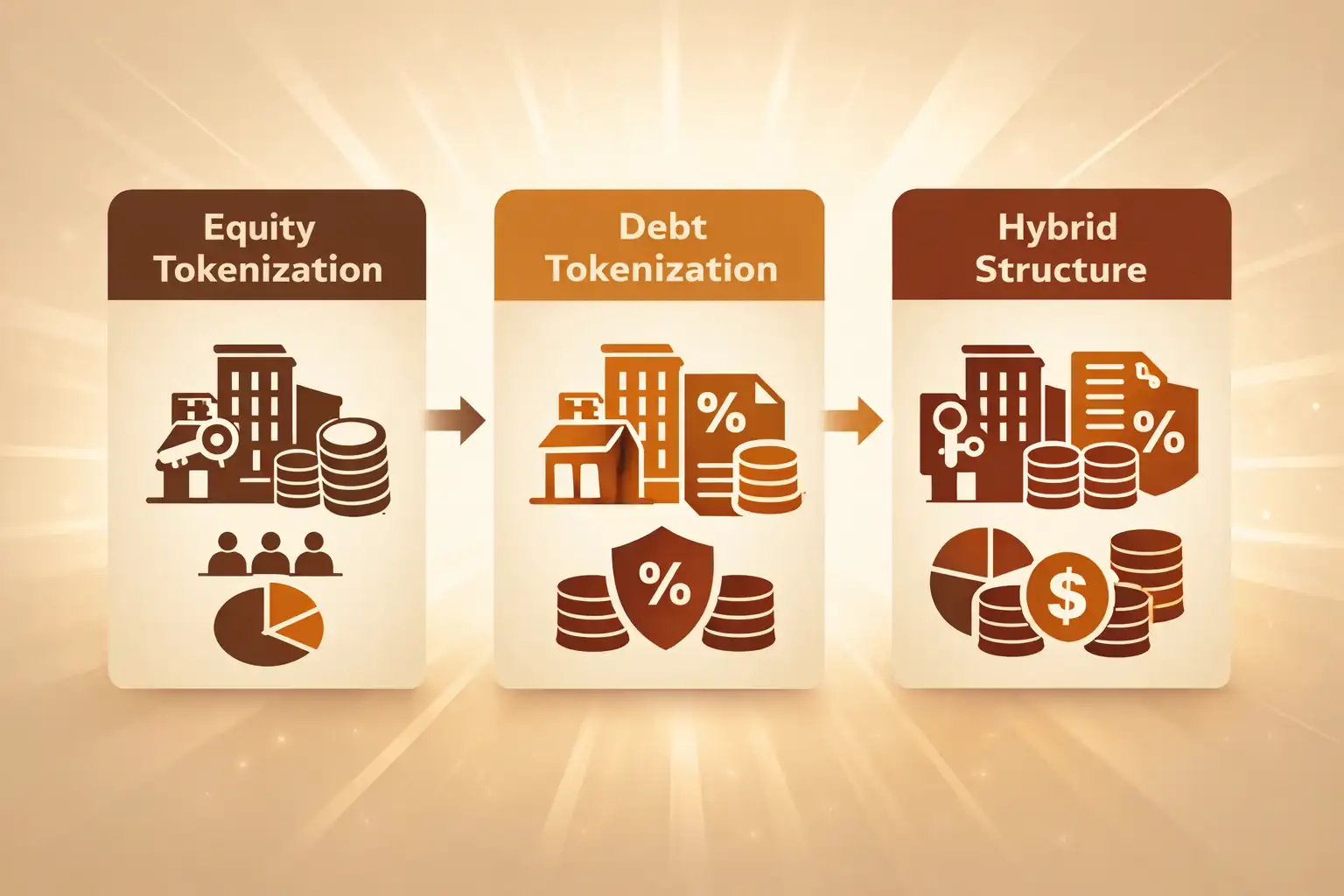
| Model Type | Investor Rights | Return Profile | Risk Level | Best Use Cases |
|---|---|---|---|---|
| Equity Tokenization | Ownership, voting, appreciation | Variable, potentially high | Higher | Growth markets, appreciation focus |
| Debt Tokenization | Interest payments, priority claim | Fixed, predictable | Lower | Income generation, stability |
| Hybrid Structure | Fixed return plus upside participation | Moderate with upside | Medium | Balanced risk-return, diversified |
Operational complexity increases with model sophistication, impacting platform development timelines and ongoing administration costs. Equity tokenization requires systems calculating proportional rent distributions, tracking property appreciation for NAV updates, implementing voting mechanisms for major decisions, and providing detailed performance reports that equity investors expect. Debt tokenization needs interest calculation engines accommodating various rate structures, principal amortization schedules, default monitoring with collection procedures, and potentially mortgage servicing capabilities if platforms originate loans directly. Hybrid structures combine requirements from both models plus logic handling conversion triggers, participation calculations, and waterfall distributions that may prioritize certain investor classes over others in different scenarios.
Investor education requirements differ across models, as potential token buyers must understand investment mechanics, risks, and expected returns before committing capital. Equity tokenization parallels stock investing concepts familiar to many investors, though fractional real estate ownership nuances require explanation. Debt tokenization resembles bond investing but with real estate collateral specifics that investors must appreciate, including foreclosure processes, collateral valuation volatility, and borrower default scenarios. Hybrid structures present the greatest education challenge, requiring clear explanations of how base returns combine with upside participation, when conversion rights activate, and how various scenarios affect investor outcomes. Platforms that invest in comprehensive education materials, FAQ sections, explainer videos, and customer support capabilities enhance investor confidence and reduce compliance risks from unsuitable investment recommendations.
Model selection should align with platform competitive positioning and differentiation strategy. Markets already have multiple equity tokenization platforms, suggesting new entrants might differentiate through debt or hybrid approaches that address underserved segments. Alternatively, platforms might specialize in particular equity niches like student housing or industrial properties rather than competing across all asset classes. Geographic focus can provide differentiation, with platforms specializing in UAE properties distinguishing themselves from USA-focused competitors. Model decisions influence everything from regulatory approvals required to marketing messages resonating with target investors, making this choice among the most consequential in the entire tokenized real estate platform timeline.
Blockchain Network Selection and Technical Planning
Blockchain network selection represents a foundational technical decision in the tokenized real estate platform timeline that impacts transaction costs, processing speeds, security levels, regulatory compliance capabilities, and long-term scalability. This phase typically requires 3 to 4 weeks of evaluation comparing public blockchains like Ethereum, Polygon, Avalanche, and Stellar against private or consortium networks, considering trade-offs among decentralization, performance, developer ecosystems, and infrastructure maturity. Once selected, the blockchain choice influences smart contract languages, development tools, security audit requirements, and integration approaches that would be costly to change after platform launch.
Ethereum maintains its position as the leading blockchain for security token issuance, with the most mature ecosystem, extensive developer community, established token standards like ERC-20 and ERC-1400, and the deepest liquidity pools for digital asset trading. Its transition to proof-of-stake consensus has reduced energy consumption concerns while improving transaction finality times. However, Ethereum main chain transaction costs can reach $5 to $50 during network congestion, making frequent small transactions economically infeasible. Gas fees create user experience friction when investors pay more in transaction costs than they receive in small dividend distributions. Despite these limitations, Ethereum’s security track record, institutional adoption, and regulatory familiarity make it the default choice for many tokenized real estate platforms, particularly those prioritizing credibility and interoperability with existing decentralized finance infrastructure.
Polygon emerged as a popular Ethereum scaling solution, offering layer-2 capabilities that maintain compatibility with Ethereum smart contracts and tools while dramatically reducing transaction costs to pennies and increasing throughput to thousands of transactions per second. Platforms deploy on Polygon can leverage existing Ethereum frameworks, security tools, and wallet integrations while avoiding high gas fees that plague Ethereum mainnet. Polygon’s proof-of-stake consensus provides fast block times under 3 seconds, enabling responsive user experiences. The trade-off involves accepting somewhat lower decentralization compared to Ethereum’s thousands of validators, though Polygon’s validator set still provides meaningful security. Our agency frequently recommends Polygon for platforms prioritizing cost efficiency and performance while maintaining Ethereum ecosystem benefits, particularly for applications expecting high transaction volumes from frequent dividend distributions or active secondary market trading.
Avalanche positions itself as a high-throughput blockchain capable of processing over 4,500 transactions per second with sub-second finality, appealing to platforms requiring enterprise-grade performance. Its subnet architecture enables customizable blockchain networks with application-specific rules, governance structures, and compliance requirements, potentially valuable for regulated tokenized real estate platforms needing fine-grained control. Avalanche’s AVAX token serves as the native currency for transaction fees and staking, with costs significantly lower than Ethereum. The platform supports Solidity smart contracts through its C-Chain Ethereum Virtual Machine compatibility, easing developer onboarding. However, Avalanche’s ecosystem remains smaller than Ethereum’s, with fewer available tools, security auditors, and third-party integrations requiring more custom development.
Stellar focuses on cross-border payments and asset tokenization with built-in compliance features attractive for regulated applications. Its consensus protocol achieves transaction confirmation in 3 to 5 seconds with minimal energy consumption, processing thousands of transactions per second at fractions of a cent each. Stellar’s native multi-currency support and distributed exchange enable seamless token trading without requiring external decentralized exchanges. Compliance features include account-level controls for whitelisting, blacklisting, and conditional transfers that help platforms enforce securities regulations. However, Stellar’s smart contract capabilities through Soroban are less mature than Ethereum’s, potentially limiting complex tokenomics or automated governance features. Platforms prioritizing payment efficiency and built-in compliance over sophisticated smart contract logic might favor Stellar, particularly for cross-border tokenization spanning the USA, UK, UAE, and Canada.
Private or consortium blockchains like Hyperledger Fabric or Corda offer permissioned networks where participation is controlled, providing privacy, performance, and governance advantages for enterprise applications. These platforms enable confidential transactions invisible to outside observers, important for commercial real estate deals involving sensitive tenant information or purchase prices. Consortium governance allows industry participants to collectively manage network rules without relying on decentralized validator sets. Performance can exceed public blockchains without congestion concerns. However, private chains sacrifice decentralization benefits, reducing censorship resistance and trust minimization that blockchain technology promises. Investors may question whether private blockchain tokenization provides meaningful advantages over traditional databases with cryptographic security. Regulatory treatment remains uncertain, with some authorities viewing permissioned chains more favorably while others see them as missing the point of blockchain technology.
Security considerations loom large in blockchain selection, as vulnerabilities or exploits can result in catastrophic loss of investor funds and permanent reputation damage. Ethereum’s extensive battle-testing over years of operation and hundreds of billions of dollars secured provides confidence in its foundational security, though smart contract vulnerabilities remain a concern addressed through thorough auditing. Newer chains like Polygon and Avalanche have shorter track records with potentially undiscovered vulnerabilities, requiring careful evaluation of security architectures, consensus mechanisms, and historical incident responses. Private chains shift security responsibility to network operators rather than relying on decentralized consensus, necessitating robust infrastructure security, access controls, and disaster recovery procedures. Platforms must assess security at both blockchain infrastructure and application smart contract levels, with different chains presenting different risk profiles requiring different mitigation strategies.
| Blockchain | Transaction Cost | Speed (Finality) | Ecosystem Maturity | Best For |
|---|---|---|---|---|
| Ethereum | $5-50 per tx | 12-15 seconds | Most Mature | Maximum credibility, institutional focus |
| Polygon | $0.01-0.10 per tx | 2-3 seconds | Mature | Cost efficiency, high transaction volume |
| Avalanche | $0.50-2.00 per tx | Under 2 seconds | Growing | Performance, custom subnets |
| Stellar | $0.00001 per tx | 3-5 seconds | Moderate | Cross-border, built-in compliance |
Developer ecosystem evaluation examines the availability of skilled developers, development frameworks, testing tools, security audit services, and documentation quality supporting each blockchain. Ethereum’s ecosystem dwarfs competitors with tens of thousands of developers, comprehensive documentation, extensive Stack Overflow discussions, and mature frameworks like Hardhat and Truffle. Finding Solidity developers is relatively straightforward, though competition for talent remains intense. Polygon inherits Ethereum’s tools through EVM compatibility. Avalanche offers Ethereum-compatible development plus native capabilities requiring additional learning. Stellar’s ecosystem is smaller with steeper learning curves for developers unfamiliar with its unique architecture. Platforms should assess whether internal development teams have relevant blockchain expertise or whether hiring, training, or outsourcing will be necessary, factoring these timeline and cost implications into blockchain selection.
Regulatory acceptance varies across blockchains, with some jurisdictions or regulators viewing certain chains more favorably than others. Ethereum’s established presence and institutional adoption make it more familiar to regulators in the USA, UK, and Canada. Some financial institutions and compliance officers view permissionless public blockchains with skepticism, potentially favoring private chains offering more control. The UAE’s progressive stance on blockchain technology applies broadly across platforms, though DFSA guidance emphasizes technology-agnostic regulation focusing on activity rather than infrastructure. Platforms should consider whether blockchain choice facilitates or complicates regulatory discussions, licensing applications, and compliance demonstrations required in the tokenized real estate platform timeline.
Inter-operability considerations determine whether tokens can move across blockchains or integrate with external systems like decentralized exchanges, lending protocols, or traditional financial infrastructure. Ethereum’s extensive DeFi ecosystem enables token holders to use their holdings as collateral for loans, provide liquidity to earn fees, or trade across numerous exchanges without platform intermediation. Cross-chain bridges enable asset transfers between Ethereum, Polygon, Avalanche, and other networks, though bridge security remains an evolving concern after several high-profile exploits. Platforms should consider whether interoperability enhances value propositions through expanded liquidity options or creates uncontrollable risks from external protocol vulnerabilities.
Future scalability planning evaluates whether the selected blockchain can accommodate platform growth from initial launch with one or two properties to potentially hundreds of properties and thousands of investors. Layer-1 blockchains like Ethereum and Avalanche provide different scalability paths than layer-2 solutions like Polygon. Platforms experiencing rapid growth may need to migrate from layer-2 to layer-1 or implement hybrid approaches splitting functionality across chains. These migrations introduce technical complexity and user disruption, making it preferable to select blockchains capable of supporting long-term ambitions rather than requiring costly transitions later. Technical architecture should incorporate abstraction layers that minimize blockchain-specific dependencies, enabling potential future migrations if blockchain landscape changes dramatically.
The blockchain selection decision concludes with documentation explaining the rationale, architecture diagrams showing how platform components interact with blockchain infrastructure, development environment setup procedures, and timeline estimates for blockchain-specific development tasks. This technical planning phase feeds directly into smart contract design and platform architecture work that follows in the tokenized real estate platform timeline.
Platform Architecture and System Design Phase
Platform architecture and system design establish the technical blueprint for the tokenized real estate platform, defining how components interact, data flows through systems, security boundaries protect sensitive information, and scalability provisions accommodate growth. This phase typically consumes 4 to 6 weeks in the tokenized real estate platform timeline and produces comprehensive architecture documents, database schemas, API specifications, infrastructure diagrams, and technology stack selections that guide all subsequent development work. Well-designed architecture enables efficient development, facilitates future enhancements, supports security requirements, and prevents costly refactoring when design flaws surface under production loads.
System architecture decisions begin with determining whether the platform follows a monolithic, microservices, or hybrid approach. Monolithic architectures integrate all functionality into a single codebase and deployment unit, simplifying initial development and reducing operational complexity for small teams. However, monoliths become difficult to maintain as platforms grow, with changes requiring full system redeployment and scalability limited to vertical scaling of entire applications. Microservices architectures decompose platforms into independent services handling distinct functions like user management, KYC processing, smart contract interaction, payment processing, and reporting, with each service deployed and scaled independently. This approach provides better scalability, enables technology diversity across services, and allows teams to work independently, but introduces operational complexity managing multiple deployments, inter-service communication, and distributed data consistency.
Our agency typically recommends starting with a well-structured monolith for the initial tokenized real estate platform launch, then selectively extracting microservices as specific scalability or organizational needs emerge. This pragmatic approach accelerates time-to-market while maintaining architectural options for future evolution. Key services that often warrant early separation include KYC verification, which may integrate with third-party providers and handle sensitive personal information requiring extra security isolation, smart contract interaction, which involves blockchain-specific logic better isolated from business logic, and payment processing, which must meet PCI compliance standards necessitating strict boundaries from other platform components.
Database architecture determines how property data, user information, transaction history, and operational data are stored, queried, and protected. Relational databases like PostgreSQL or MySQL provide ACID transactions, complex querying capabilities, and mature tooling suitable for structured data including user profiles, property details, financial transactions, and compliance records. Document databases like MongoDB offer schema flexibility for evolving data models and horizontal scalability for high-volume reads, potentially useful for unstructured property documents, user activity logs, or analytics data. Blockchain serves as an immutable ledger for ownership records and critical transactions, but should not be treated as a general-purpose database given query limitations and storage costs. Hybrid approaches use relational databases for transactional data, document stores for unstructured content, caching layers like Redis for frequently accessed data, and blockchain for ownership truth.
API architecture defines how the frontend applications, mobile apps, and external systems interact with platform backend services. RESTful APIs remain the dominant approach, using HTTP methods and JSON payloads with straightforward implementation and broad client support. GraphQL offers more flexible querying, enabling clients to request exactly the data they need in single requests rather than multiple REST endpoints, reducing network overhead and simplifying frontend development. WebSocket connections provide real-time updates for live property data, transaction notifications, and dashboard refreshes without constant polling. API design should prioritize versioning strategies allowing backward compatibility as platforms evolve, authentication and authorization protecting sensitive operations, rate limiting preventing abuse, and comprehensive documentation accelerating third-party integration efforts.
Security architecture establishes defense-in-depth protections including network segmentation, identity and access management, encryption at rest and in transit, secrets management, and intrusion detection. Zero-trust principles assume breach and verify every access request regardless of origin. Key management systems protect blockchain private keys, API credentials, and encryption keys using hardware security modules or managed services like AWS KMS. Regular security assessments, penetration testing, and vulnerability scanning identify weaknesses before attackers exploit them. Incident response procedures define detection, containment, eradication, and recovery steps if security events occur. Compliance requirements from regulations like GDPR, PCI-DSS for payment data, and securities rules for investor information inform architecture choices ensuring data residency, retention, access logging, and breach notification capabilities exist from launch.
Integration architecture maps connections to external systems including blockchain networks, KYC providers, payment processors, banking partners, property data sources, tax reporting services, and notification systems. Integration patterns include direct API calls for real-time interactions, message queues for asynchronous processing, webhooks for event-driven updates, and batch file transfers for bulk data exchange. Each integration point requires error handling, retry logic, monitoring, and fallback procedures when external services fail. Third-party service selection should consider reliability track records, SLA commitments, pricing models, documentation quality, and vendor lock-in risks. Our experience across the USA, UK, UAE, and Canada shows that banking integrations pose particular challenges given varying regulatory requirements, slower traditional financial institution processes, and conservative risk appetites regarding cryptocurrency-adjacent businesses.
Frontend architecture determines whether web applications, mobile apps, or both serve investors and administrators. Modern single-page applications built with React, Vue, or Angular provide responsive experiences with complex interactivity required for property browsing, portfolio management, and transaction execution. Progressive web applications enable mobile-like experiences through web browsers, reducing development costs compared to native iOS and Android apps while providing installation capabilities and offline functionality. Native mobile apps deliver optimal user experiences, platform-specific features like biometric authentication, and credibility through app store presence, but require separate codebases for iOS and Android increasing development costs 40 to 60 percent. Most platforms launch with web applications first, then add native mobile apps as user bases grow and budgets allow.
Deployment architecture covers hosting infrastructure, continuous integration and delivery pipelines, environment management, monitoring, and scaling strategies. Cloud providers like AWS, Google Cloud, or Azure offer managed services reducing operational overhead compared to self-hosted infrastructure, with pay-as-you-grow pricing aligning costs with platform growth. Container orchestration using Kubernetes or managed services like AWS ECS enables consistent deployments across development, staging, and production environments. Infrastructure-as-code using Terraform or CloudFormation versions infrastructure configurations enabling reproducible deployments and disaster recovery. Monitoring solutions track application performance, error rates, resource utilization, and business metrics providing visibility into system health and user behavior. Auto-scaling policies automatically adjust compute resources based on demand, handling traffic spikes during popular property launches without over-provisioning during quiet periods.
| Architecture Layer | Key Components | Technology Options | Critical Considerations |
|---|---|---|---|
| Presentation Layer | Web app, mobile apps, admin dashboards | React, Vue, React Native, Swift | User experience, responsiveness, accessibility |
| Application Layer | Business logic, APIs, authentication | Node.js, Python, Go, Java | Scalability, maintainability, security |
| Data Layer | Databases, caching, file storage | PostgreSQL, MongoDB, Redis, S3 | Data integrity, performance, backup |
| Blockchain Layer | Smart contracts, wallet integration, indexing | Ethereum, Polygon, Web3.js, The Graph | Transaction costs, reliability, security audits |
| Integration Layer | KYC, payments, notifications, reporting | Stripe, Plaid, SendGrid, Twilio | Vendor reliability, compliance, costs |
| Infrastructure Layer | Hosting, CDN, monitoring, security | AWS, Google Cloud, Datadog, Cloudflare | Uptime, disaster recovery, scaling |
Data flow documentation traces how information moves through the platform from user actions through business logic to blockchain transactions and back to user interfaces. Critical flows include user registration with KYC verification, token purchase with payment processing and blockchain minting, dividend distribution calculating payments and executing transfers, secondary market trades matching buyers with sellers and updating blockchain ownership, and compliance reporting aggregating data for regulatory submissions. Documenting these flows identifies integration points, error handling requirements, performance bottlenecks, and security checkpoints that must be implemented during development.
Technology stack selection balances developer productivity, community support, performance requirements, hiring considerations, and long-term maintainability. Backend choices typically center on Node.js for JavaScript-everywhere development with extensive libraries, Python for data science integration and clean syntax, Go for performance-critical components and concurrency, or Java for enterprise environments with established processes. Frontend frameworks include React for its ecosystem and job market, Vue for faster learning curves, or Angular for opinionated structure benefiting larger teams. Smart contract uses Solidity for Ethereum-compatible chains with the most extensive tooling, or platform-specific languages for other blockchains. DevOps tools encompass Docker for containerization, Kubernetes for orchestration, GitHub Actions or GitLab CI for continuous integration, and Terraform for infrastructure provisioning. Stack decisions should prioritize team capabilities and hiring markets over chasing newest technologies lacking proven track records.
Documentation deliverables from the architecture phase include high-level architecture diagrams showing system components and interactions, detailed component specifications defining responsibilities and interfaces, database schemas with entity relationships and indexing strategies, API specifications documenting endpoints with request/response formats, security architecture describing protection mechanisms and compliance controls, deployment architecture showing infrastructure layout and scaling approaches, and integration diagrams mapping external system connections. These documents guide development teams, support security audits, facilitate onboarding new team members, and provide reference material when troubleshooting production issues. Architecture that exists only in developers’ heads creates knowledge silos, succession risks, and inconsistent implementations as teams grow.
The platform architecture and system design phase concludes with technical review meetings involving development leads, security specialists, DevOps engineers, and product managers to validate design decisions against requirements, identify gaps or weaknesses requiring iteration, and achieve consensus on approaches before committing to implementation. Changes made during design cost hours or days of rework, while changes during development cost weeks, and changes in production cost months along with potential security vulnerabilities or data corruption. Investing adequate time in thoughtful architecture substantially improves downstream development efficiency and platform quality in the tokenized real estate platform timeline.
Smart Contract Design for Property Tokenization
Smart contract design represents the most critical technical component in the tokenized real estate platform timeline, as these self-executing programs encode property ownership rules, automate dividend distributions, enforce regulatory compliance, and manage token transfers without intermediaries. This phase typically requires 3 to 5 weeks of intensive design work producing detailed specifications, pseudo-code logic flows, state diagrams, event schemas, and security requirement documents that guide subsequent smart contract coding. Errors in smart contract design can create permanent vulnerabilities, regulatory non-compliance, or operational limitations that cannot be corrected without expensive token migrations or platform shutdowns.
Core smart contract architecture decisions begin with determining whether to deploy separate contracts for each tokenized property or use a single factory contract managing multiple properties. Individual property contracts provide clear separation of concerns, enabling property-specific rules, independent upgradability, and isolated failure domains where one contract’s bugs don’t affect others. However, this approach creates deployment and management overhead, with dozens or hundreds of contracts requiring monitoring and upgrades. Factory patterns deploy contract instances from template logic, reducing deployment gas costs and simplifying upgrades through proxy patterns that delegate to shared implementation contracts. The trade-off involves increased complexity in the factory contract itself, potential cross-property effects if shared logic has vulnerabilities, and architecture that may be harder for third-party auditors to verify.
Token standard selection fundamentally shapes smart contract design, with ERC-20 providing basic fungible token functionality, ERC-1400 offering security token features specifically designed for regulated assets, and custom standards potentially addressing unique requirements. ERC-20’s simplicity and ubiquitous wallet support make it attractive, but it lacks built-in compliance controls for restricting transfers to verified investors, forcing these checks into custom wrapper logic prone to bypass exploits. ERC-1400 builds compliance directly into the token standard, defining document management for disclosure materials, partition support for different token classes, and granular transfer controls checking investor eligibility before allowing movements. However, ERC-1400’s complexity and lower adoption mean fewer wallet integrations, exchange listings, and developer familiarity increasing development time. Our agency typically recommends ERC-1400 for platforms prioritizing regulatory compliance in the USA, UK, UAE, and Canada, accepting the implementation complexity in exchange for purpose-built security token capabilities.
Ownership tracking logic determines how contracts record token balances, maintain investor registries, and handle fractional ownership calculations. Standard balance mappings track token quantities for each address, but property tokenization requires additional metadata including investor accreditation status, jurisdiction residency affecting tax treatment, acquisition dates determining capital gains holding periods, and potentially different share classes with varying rights. Smart contracts must calculate ownership percentages accurately even with many decimal places, avoiding rounding errors that accumulate over numerous transactions. Events must emit detailed logs whenever balances change, enabling off-chain systems to reconstruct complete ownership histories and generate reports for investors, auditors, and regulators.
Dividend distribution mechanisms automate income payments from rental operations, requiring smart contracts to calculate each token holder’s proportional share, execute transfers efficiently, and handle edge cases like token transfers during distribution periods. Snapshot-based distributions record eligible holders at specific block numbers, then calculate payments against those balances even if tokens subsequently trade. This approach prevents gaming where recipients sell immediately after receiving distributions or buyers purchase expecting imminent payments their purchase price already reflects. Gas-efficient distribution methods batch payments or use withdrawal patterns where investors claim distributions individually rather than contract pushing to potentially thousands of addresses in single transactions exceeding block gas limits. Contracts must handle partial distributions when available funds cannot cover full payments, distributions in various tokens or stablecoins, and year-end tax reporting requirements.
Compliance enforcement represents the most complex aspect of security token smart contracts, implementing restrictions on who can hold tokens, when transfers are allowed, and what information must be verified before transactions proceed. Investor whitelisting maintains approved addresses that passed KYC and accreditation verification, blocking transfers to non-approved recipients. Transfer agents or compliance administrators can add or remove whitelist entries, revoke tokens from non-compliant holders, or freeze addresses during investigations. Jurisdiction checks prevent sales to investors in countries where securities are not registered. Lock-up periods enforce holding requirements preventing immediate resale of tokens purchased in private placements. Transfer restrictions may apply different rules to primary issuance versus secondary trading, with exemptions for certain transactions like inheritance transfers or qualified institutional transfers.
Governance mechanisms enable token holders to vote on major property decisions including capital improvements, refinancing, property sales, or management changes. Voting power is typically proportional to token holdings, though some structures provide different voting rights to different share classes. Proposal submission, voting periods, quorum requirements, and execution thresholds must be encoded in contracts. On-chain governance executes approved proposals automatically through contract calls, eliminating manual implementation and reducing execution risk. Off-chain governance uses contracts only to record votes, with proposal execution happening through traditional mechanisms. Delegation allows token holders to assign voting rights to representatives without transferring underlying tokens. Time-locked voting prevents last-minute vote manipulation by requiring vote commitments before proposal outcomes are clear.
Upgrade strategies address the reality that smart contracts will need modifications to fix bugs, add features, or adapt to changing regulations, yet blockchain’s immutability prevents directly editing deployed code. Proxy patterns separate contract storage from logic, with proxy contracts delegating calls to implementation contracts that can be swapped for new versions while maintaining data continuity. Transparent proxy patterns prevent function collision between proxy and implementation contracts. UUPS (Universal Upgradeable Proxy Standard) optimizes gas costs by moving upgrade logic into implementation contracts. Multi-signature or time-locked upgrade authorization prevents unilateral changes, requiring multiple administrators or mandatory waiting periods before upgrades activate. Despite upgrade capabilities, platforms should design contracts assuming upgrades will be rare and expensive, minimizing reliance on post-launch fixes through thorough pre-deployment testing.
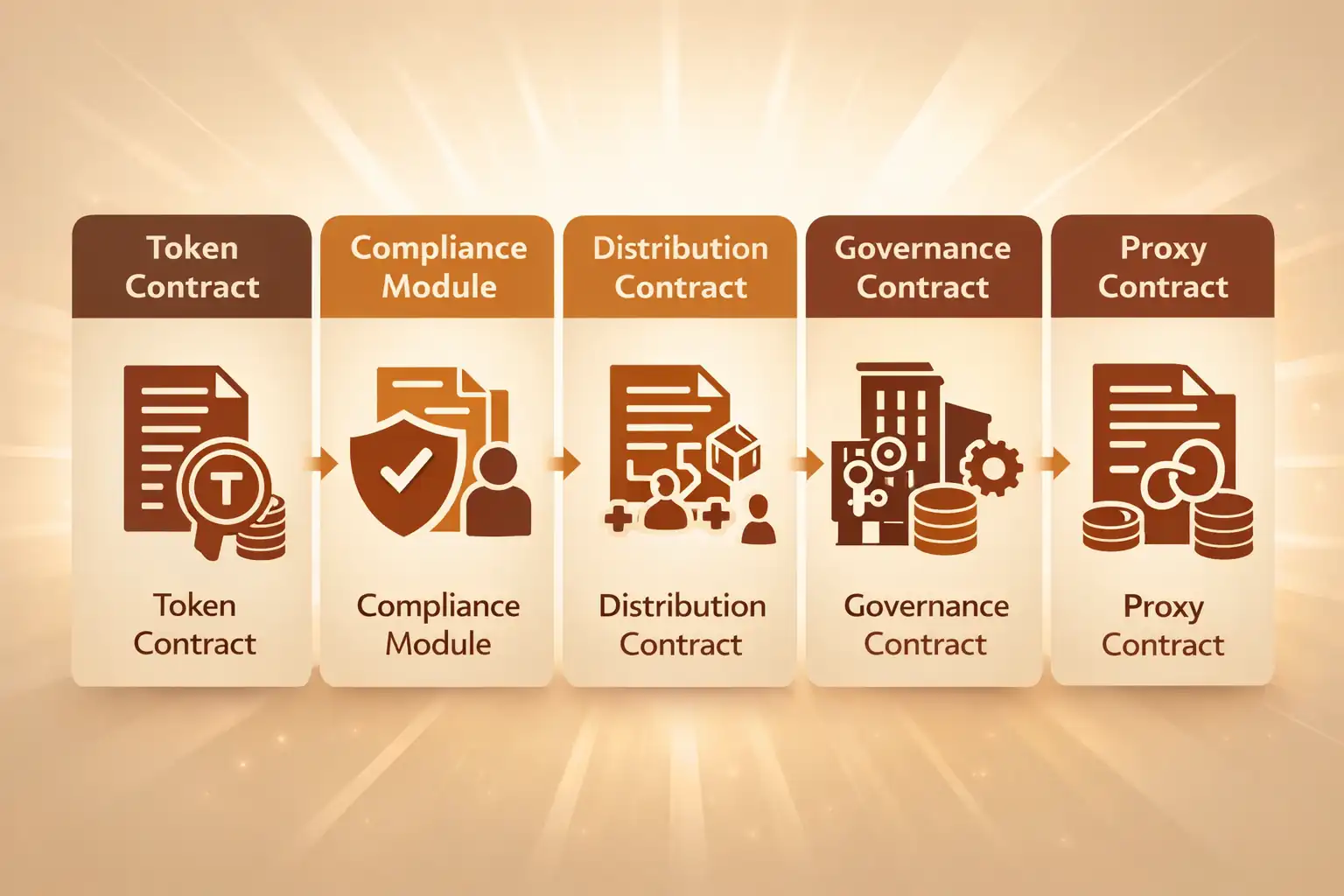
| Contract Component | Primary Functions | Security Risks | Mitigation Strategies |
|---|---|---|---|
| Token Contract | Minting, burning, transfers, balances | Unauthorized minting, integer overflow | Access controls, SafeMath libraries, audits |
| Compliance Module | Whitelist management, transfer restrictions | Bypass exploits, admin abuse | Multi-sig admin, comprehensive testing |
| Distribution Contract | Dividend calculations, payment execution | Rounding errors, reentrancy attacks | Fixed-point math, checks-effects-interactions |
| Governance Contract | Proposal creation, voting, execution | Vote manipulation, execution exploits | Time locks, quorum requirements, testing |
| Proxy Contract | Delegation, upgradeability | Storage collisions, unauthorized upgrades | Standard patterns, multi-sig upgrades |
Emergency controls enable administrators to respond to discovered vulnerabilities, regulatory orders, or operational crises without waiting for governance processes that might take days or weeks. Pause functionality stops all token transfers preventing further losses if exploits are detected, with unpause requiring multi-signature authorization after issues are resolved. Emergency withdrawal allows contract administrators to extract funds to secure addresses if contract vulnerabilities threaten theft. Circuit breakers automatically halt operations if abnormal patterns are detected such as unusually large transfers or rapid balance changes suggesting attacks. These powerful controls create centralization risks and potential abuse vectors, requiring careful balance between security responsiveness and decentralization principles.
Gas optimization reduces transaction costs for users and platform operators, particularly important on Ethereum mainnet where complex contract interactions can cost $50 to $200 during network congestion. Storage optimization minimizes state variables and uses efficient data structures, as storage operations consume 20,000 gas compared to 3 gas for memory operations. Batch operations combine multiple actions into single transactions when possible. Events replace storage for data only needed by off-chain systems. Library usage shares common code across contracts. However, optimization must not compromise security or readability, as prematurely optimized contracts are harder to audit and more likely to contain subtle vulnerabilities. Our agency recommends building clear, secure contracts first, then optimizing specific hot paths identified through profiling rather than premature over-optimization.
Error handling and edge case management prevent contracts from entering inconsistent states or silently failing in unexpected scenarios. Solidity’s require statements validate preconditions before state changes, reverting transactions if conditions fail. Detailed error messages help users and developers understand failures. Checks-effects-interactions patterns update state before external calls preventing reentrancy attacks. Integer overflow protections using SafeMath or Solidity 0.8+ built-in checks prevent arithmetic errors that historically caused major exploits. Null address checks reject transfers to zero address burning tokens unintentionally. Edge cases like self-transfers, transfers of zero amounts, or operations during contract initialization require explicit handling preventing undefined behavior.
The smart contract design phase concludes with comprehensive specification documents detailing every function signature, state variable, event, modifier, and access control mechanism. These specifications guide implementation while providing audit trails for security reviews and regulatory examinations. Design reviews involving multiple developers, security specialists, and legal advisors identify issues before costly coding begins. Well-designed smart contracts form the immutable foundation of tokenized real estate platforms, making this phase among the most important investments in the entire tokenized real estate platform timeline.
Token Standards and Compliance Logic Implementation
Token standards and compliance logic implementation transforms smart contract designs into executable code during a 4 to 6 week development phase that demands specialized blockchain expertise, rigorous testing practices, and security-first development methodologies. This phase produces the actual smart contract code deployed to blockchain networks, automated test suites validating functionality under thousands of scenarios, deployment scripts managing contract initialization, and documentation enabling future maintenance. The quality of implementation directly determines platform security, regulatory compliance, operational reliability, and investor trust throughout the tokenized real estate platform timeline.
ERC-1400 implementation requires understanding the standard’s architecture including document management, partition support for different security classes, and controller operations enabling authorized administrators to force transfers when legally required. The standard defines interfaces for checking transfer validity before execution, enabling contracts to reject non-compliant transfers before state changes occur. Document management functions associate offering documents, operating agreements, and disclosure materials with security tokens, creating immutable proof of what information investors received. Partition support enables single contracts to manage multiple security classes with different voting rights, dividend priorities, or transfer restrictions, reducing deployment costs compared to separate contracts for each class.
Transfer validation logic implements the complex rules determining when token movements are permitted, checking investor whitelist status, jurisdiction restrictions, transfer lock-up periods, volume limits, and other conditions before allowing transfers. The canTransfer function enables preflight checks letting users know if proposed transfers will succeed before submitting costly transactions that might fail. Validation logic must be gas-efficient as it executes on every transfer, potentially thousands of times daily as trading volume grows. Detailed reason codes explain why transfers fail, helping users understand whether issues stem from insufficient balance, compliance restrictions, or temporary conditions like lock-up periods that will expire. Our agency emphasizes comprehensive transfer validation testing covering normal cases, boundary conditions, and adversarial scenarios attempting to bypass restrictions.
Need Expert Guidance Through Regulatory Compliance?
Our 8+ years of experience navigating SEC, FCA, DFSA, and CSA requirements ensures your platform meets all regulatory standards across USA, UK, UAE, and Canada markets.
Whitelist management functionality enables compliance administrators to add verified investors, remove non-compliant holders, update investor attributes like accreditation status or jurisdiction, and manage exemptions for specific transfers. Role-based access controls ensure only authorized personnel can modify whitelist state, with multi-signature requirements preventing unilateral changes by single administrators. Whitelist operations emit detailed events creating audit trails of every modification with timestamps, administrator identities, and justifications. Bulk update capabilities enable efficient onboarding of multiple investors simultaneously, important during crowdfunding campaigns or property launches attracting hundreds of investors. However, bulk operations must not exceed block gas limits, requiring batching strategies for very large investor bases.
Smart Contract Lifecycle
Phase 1: Requirements
Define token economics, compliance rules, governance mechanisms, and integration requirements with detailed specifications.
Duration: 2-3 weeks
Phase 2: Implementation
Write Solidity code following best practices, implement security patterns, and build comprehensive test suites.
Duration: 3-4 weeks
Phase 3: Testing
Execute unit tests, integration tests, and scenario testing covering normal and edge cases across test networks.
Duration: 2-3 weeks
Phase 4: Audit & Deploy
Professional security audits, remediation of findings, deployment to mainnet with initialization and verification.
Duration: 4-6 weeks
Dividend distribution implementation requires precise calculation logic that allocates rental income proportionally to token holders based on balances at snapshot times. Fixed-point arithmetic prevents rounding errors that could accumulate to significant discrepancies over time, with contracts tracking remaining fractions and distributing them fairly in subsequent periods. Snapshot mechanisms record eligible investors and balances at specific block numbers, preventing manipulation where investors buy just before distributions to receive payments their purchase price already reflects. Distribution contracts must handle multiple token types including stablecoins like USDC for simplified accounting or native tokens like ETH. Withdrawal patterns are often more gas-efficient than push distributions to many addresses, letting investors claim their distributions individually rather than contract iterating through thousands of recipients.
Governance implementation enables token holder participation in major property decisions through on-chain voting mechanisms. Proposal submission functions allow qualifying token holders to submit governance actions with detailed descriptions, execution parameters, and voting deadlines. Voting functions record votes weighted by token holdings, with support for yes, no, and abstain positions. Delegation enables busy investors to assign voting rights to trusted representatives without transferring underlying tokens. Time-locked execution prevents immediate implementation of passed proposals, giving token holders opportunity to exit if they disagree with governance decisions before they take effect. Quorum requirements ensure sufficient participation before proposals pass, while supermajority thresholds protect minority interests on major decisions like property sales or management changes.
Upgrade proxy implementation enables contract modifications after deployment while maintaining state continuity and token addresses. Transparent proxy patterns separate proxy storage from implementation logic, preventing storage collisions between proxy and implementation contracts. Initialization functions replace constructors for upgradeable contracts, with protections preventing re-initialization by attackers. Upgrade authorization requires multi-signature approval from multiple administrators or token holder governance votes, preventing unilateral changes. Time-delayed upgrades provide advance notice before activations, enabling token holders to react if disagreeing with changes. Despite upgrade capabilities, platforms should minimize reliance on post-deployment modifications through thorough pre-launch testing, as upgrades introduce risks and undermine immutability benefits that blockchain technology provides.
Testing infrastructure development parallels smart contract implementation, with comprehensive test suites providing confidence that contracts behave correctly under diverse scenarios. Unit tests verify individual function behavior in isolation, covering normal inputs, boundary cases, and invalid parameters that should trigger errors. Integration tests validate interactions between multiple contracts, ensuring dividend distributions, governance proposals, and compliance checks work correctly across contract boundaries. Scenario tests simulate complete user journeys from investor registration through token purchase, dividend receipt, secondary trading, and governance voting. Invariant tests verify critical properties always hold regardless of operation sequences, such as total token supply equaling sum of individual balances. Coverage tools measure what percentage of code paths tests exercise, with 95%+ coverage recommended before mainnet deployment.
Gas profiling identifies expensive operations requiring optimization before deployment, particularly important for platforms using Ethereum mainnet where transaction costs directly impact user experience and platform economics. Profiling reveals which functions consume excessive gas, enabling targeted optimization through algorithm improvements, storage layout changes, or splitting single operations across multiple transactions. Common optimization opportunities include replacing storage reads with memory operations where possible, using events instead of storage for historical data, batching multiple operations into single transactions, and minimizing unnecessary state updates. However, optimizations must not sacrifice security or readability, as overly clever code increases audit difficulty and vulnerability likelihood.
Security review processes incorporate multiple layers of validation including internal code review by developers not involved in original implementation, automated analysis using tools like Slither, MythX, or Echidna that detect common vulnerability patterns, and manual review by experienced security auditors who understand attack vectors specific to tokenized securities. Common vulnerabilities include reentrancy allowing recursive calls that drain funds, integer overflow or underflow corrupting balances, access control bypasses enabling unauthorized operations, front-running where attackers exploit transaction ordering, and gas griefing consuming resources without compensating platforms. Every identified issue requires assessment of severity, exploitation likelihood, and remediation priority, with critical vulnerabilities blocking deployment until resolved.
Deployment procedures establish processes for migrating tested contracts from development networks to production blockchains with proper initialization, verification, and backup. Deployment scripts automate contract compilation, constructor parameter configuration, transaction submission, and address recording preventing human error in manual processes. Contract verification publishes source code to block explorers like Etherscan, enabling public review and transparency that builds trust. Initialization transactions configure initial state including administrator addresses, whitelist settings, initial token allocations, and parameter values. Multi-signature wallets control critical contract permissions, requiring consensus among multiple parties before sensitive operations execute. Deployment checklists prevent omitting crucial steps, with sign-offs from developers, security reviewers, and legal advisors confirming readiness for production.
Documentation completeness ensures future developers can maintain contracts, auditors can verify security properties, and regulators can understand compliance mechanisms. Code comments explain complex logic, non-obvious design decisions, and security-sensitive sections requiring extra caution during modifications. Function documentation describes parameters, return values, state changes, event emissions, and error conditions. Architecture diagrams show contract relationships and data flows. Deployment guides detail network configurations, gas settings, and verification procedures. Incident response playbooks define procedures for handling discovered vulnerabilities, coordinating upgrades, or responding to regulatory inquiries. This documentation investment pays dividends throughout the platform lifecycle as teams expand, original developers transition, and operational complexity grows.
Investor Onboarding, KYC, and AML Framework Setup
Investor onboarding, KYC (Know Your Customer), and AML (Anti-Money Laundering) framework setup establishes the compliance infrastructure required before accepting any investor registrations in the tokenized real estate platform timeline. This phase typically requires 4 to 6 weeks encompassing vendor selection for identity verification services, integration of KYC/AML workflows into platform registration, accreditation verification processes for jurisdictions requiring qualified investors, sanctions screening against government lists, and ongoing monitoring systems detecting suspicious activity. Robust KYC/AML frameworks protect platforms from regulatory violations, reduce fraud risk, prevent money laundering, and demonstrate to regulators the seriousness with which platforms approach compliance obligations in the USA, UK, UAE, and Canada.
Identity verification establishes that users are who they claim to be through document checks, biometric validation, and database cross-referencing. Users submit government-issued identification documents like passports, driver’s licenses, or national ID cards, which verification systems analyze for authenticity indicators including security features, fonts, layouts, and hologram patterns that counterfeit documents often lack. Optical character recognition extracts data from documents, comparing submitted information against what documents contain to detect discrepancies suggesting fraud. Liveness detection using selfie videos or biometric scans confirms the person submitting documents matches the identity documents, preventing stolen or synthetic identities. Database checks cross-reference submitted information against government registries, credit bureaus, or commercial databases validating addresses, dates of birth, and identity linkages.
Document Verification
Automated analysis of government-issued IDs using AI-powered authenticity checks, OCR data extraction, and fraud detection algorithms.
Processing Time: 2-5 minutes
Biometric Validation
Liveness detection through selfie verification, facial recognition matching against ID photos, and anti-spoofing measures.
Processing Time: 1-3 minutes
Sanctions Screening
Real-time checks against OFAC, UN, EU, and local sanctions lists, PEP databases, and adverse media screening for risk indicators.
Processing Time: Instant
Accreditation Verification
Income verification through tax returns, net worth validation via bank statements, and professional certification checks for qualifying investors.
Processing Time: 1-3 business days
Third-party KYC providers like Onfido, Jumio, Veriff, or Sumsub offer turnkey identity verification services with APIs platforms integrate into registration workflows. These vendors maintain expertise in document forensics, fraud detection, and global identity standards that would be prohibitively expensive for platforms to develop internally. Pricing typically follows per-verification models ranging from $0.50 to $3.00 depending on verification depth, with volume discounts for high-throughput platforms. Vendor selection should consider success rates measuring what percentage of legitimate users pass verification on first attempts, false positive rates indicating how often real users are incorrectly rejected, coverage of document types and countries matching target investor demographics, and integration difficulty affecting development timeline. Our agency’s experience across the USA, UK, UAE, and Canada indicates that no single vendor excels in all markets, sometimes requiring multiple providers for comprehensive global coverage.
Accreditation verification confirms investors meet income or net worth thresholds qualifying them to purchase securities under exemptions like Regulation D Rule 506(c) in the USA. Investors provide documentation such as tax returns showing income exceeding $200,000 individually or $300,000 jointly for the past two years, bank or brokerage statements demonstrating net worth exceeding $1 million excluding primary residence, or professional certifications like CPA or attorney letters attesting to qualification. Third-party services like VerifyInvestor or North Capital automate accreditation checks, reviewing submitted documents and issuing verification certificates platforms can rely upon. Manual review by compliance officers provides additional validation for edge cases or complex situations. Accreditation status must be periodically refreshed as financial circumstances change, typically annually or before large investments.
Sanctions screening checks investors against lists of prohibited persons including the Office of Foreign Assets Control Specially Designated Nationals list in the USA, United Nations Security Council sanctions, European Union restrictive measures, and country-specific lists in the UK, UAE, and Canada. Screening must occur at registration and periodically thereafter as lists update frequently. Automated screening tools from vendors like Dow Jones, Refinitiv, or ComplyAdvantage match investor names, dates of birth, and addresses against sanctions databases, flagging potential matches for manual review. False positives occur frequently when common names match sanctioned individuals, requiring analysts to evaluate additional identifying information determining whether matches are true positives requiring account blocking or false alarms allowing normal processing.
Politically Exposed Person screening identifies individuals holding prominent public positions or their close associates who present heightened corruption and money laundering risks. PEPs include government officials, senior military officers, judges, politicians, and executives at state-owned enterprises. Enhanced due diligence applies to PEP investors including source of wealth verification, ongoing monitoring, and senior management approval before account opening. Jurisdiction-specific definitions vary, with some countries like the UK and Canada distinguishing between domestic PEPs requiring standard diligence and foreign PEPs necessitating enhanced procedures. Screening databases catalog millions of PEPs globally, though manual research supplements automated tools for thorough coverage.
Adverse media screening identifies investors associated with financial crimes, fraud, corruption, or other negative news suggesting elevated risk profiles. Screening tools scan thousands of media sources globally including traditional news outlets, government announcements, regulatory actions, and internet sources for mentions of investor names. Natural language processing analyzes article content determining whether mentions involve serious risk indicators or benign coverage. False positives abound when investor names match unrelated individuals in news articles, requiring analysts to evaluate context and relevance. Adverse findings trigger enhanced due diligence including requesting explanations from investors, verifying information accuracy, and potentially declining high-risk applicants.
Risk-based approach implementation tailors verification depth to investor risk profiles, allocating compliance resources efficiently while maintaining regulatory adherence. Low-risk investors in established jurisdictions with small investment amounts might complete simplified verification, while high-risk scenarios involving large transactions, complex ownership structures, or elevated-risk jurisdictions warrant enhanced diligence. Risk scoring algorithms consider factors including investor location, transaction sizes, source of funds, occupation, and beneficial ownership complexity, producing risk ratings guiding verification procedures. This approach balances user experience with compliance rigor, preventing excessive friction that deters legitimate investors while ensuring adequate protection against financial crime.
Ongoing monitoring continues after initial onboarding, detecting changes in investor circumstances, suspicious transaction patterns, or sanctions list updates affecting existing users. Transaction monitoring analyzes deposit amounts, investment patterns, withdrawal frequencies, and geographic flows identifying anomalies suggesting structuring, fraud, or money laundering. Rule-based systems flag transactions exceeding certain thresholds or exhibiting specific red flags, while machine learning models detect subtle patterns distinguishing normal behavior from suspicious activity. Periodic rescreening checks existing investors against updated sanctions lists, adverse media, and PEP databases. Continuous monitoring enables platforms to detect issues early before they escalate into significant regulatory problems or investor losses.
Reporting and record-keeping obligations require platforms to maintain detailed documentation of KYC/AML procedures, verification outcomes, risk assessments, and transaction monitoring findings. Suspicious Activity Reports must be filed with financial intelligence units like FinCEN in the USA, the National Crime Agency in the UK, or FINTRAC in Canada when transactions suggest possible criminal activity. Currency Transaction Reports document large cash transactions exceeding regulatory thresholds. Platforms must retain KYC documentation, transaction records, and compliance assessments for minimum periods typically ranging from 5 to 7 years, maintaining records in formats enabling easy retrieval during regulatory examinations or law enforcement investigations.
The KYC and AML framework setup phase concludes with comprehensive documentation including compliance policies detailing verification procedures, staff training programs ensuring personnel understand their obligations, technology integration confirming systems function correctly, and testing validating that workflows properly reject prohibited persons while approving legitimate investors. Platforms that establish robust compliance frameworks from the beginning avoid costly retrofitting, regulatory penalties, and reputation damage that undermine long-term success in the tokenized real estate platform timeline.
Backend Development and Blockchain Integration
Backend development and blockchain integration constitutes the longest single phase in the tokenized real estate platform timeline, typically requiring 8 to 12 weeks to build server-side infrastructure, implement business logic, integrate smart contracts, connect external services, and establish data management systems. This phase transforms architectural specifications and smart contract code into functioning platform capable of processing investor registrations, managing property data, executing token transactions, distributing dividends, and generating compliance reports. Backend quality directly determines platform reliability, security, performance, and operational efficiency that affect every user interaction throughout the platform lifecycle.
API development creates programmatic interfaces enabling frontend applications and external systems to interact with platform functionality through well-defined endpoints using RESTful or GraphQL patterns. Authentication endpoints handle user login, registration, password reset, and session management using industry-standard protocols like OAuth 2.0 or JWT tokens. Property endpoints provide listing data, financial performance metrics, ownership structures, and document access. Investment endpoints process token purchases, track portfolio holdings, display transaction history, and calculate returns. Administration endpoints enable platform operators to manage properties, review compliance status, process withdrawals, and generate reports. Each endpoint requires input validation preventing malformed requests, authorization checks ensuring users only access permitted resources, error handling providing meaningful feedback when operations fail, and logging creating audit trails for security monitoring and troubleshooting.
Blockchain integration layer abstracts smart contract interactions behind clean internal APIs, isolating blockchain complexities from business logic and enabling potential blockchain migrations without rewriting entire applications. Web3 libraries like ethers.js or web3.js provide JavaScript interfaces for calling smart contract functions, subscribing to events, and querying blockchain state. Connection management maintains reliable blockchain node connections, with fallback providers ensuring continued operation if primary nodes fail. Transaction building constructs properly formatted blockchain transactions with appropriate gas settings, from addresses, and parameter encoding. Transaction monitoring tracks submitted transactions through pending, confirmed, and finalized states, handling reorgs or failures gracefully. Event processing listens for smart contract events like token transfers or dividend distributions, updating platform databases to reflect blockchain state changes. This bidirectional synchronization ensures platform databases accurately mirror blockchain reality while providing fast queries impossible directly against blockchain.
Database design establishes schema structures storing users, properties, transactions, compliance records, and operational data using relational databases prioritizing data integrity and complex querying. User tables maintain profiles, authentication credentials, KYC status, accreditation verification, and preferences. Property tables store listings with detailed attributes, financial performance history, documents, and ownership structures. Investment tables record token purchases, current holdings, transaction history, and performance calculations. Compliance tables track verification outcomes, sanctions screening results, risk assessments, and monitoring alerts. Relationships between tables enforce referential integrity, with foreign keys ensuring data consistency and cascading updates maintaining synchronization. Indexes optimize frequent queries, balancing query performance against insertion overhead. Migrations enable schema evolution as requirements change, with version control tracking database structure changes over time.
Payment processing integration connects traditional financial systems with blockchain infrastructure, enabling fiat-to-token onramps critical for mainstream adoption. Payment gateway providers like Stripe, Plaid, or regional alternatives handle credit card processing, ACH transfers, or wire transfers converting fiat currency into platform credit or stablecoins. KYC-integrated ramps like Wyre, MoonPay, or Ramp Network combine identity verification with payment processing, ensuring compliance while streamlining user experience. Cryptocurrency payment processing accepts Bitcoin, Ethereum, or stablecoins from users already holding digital assets, with blockchain monitoring confirming receipt before crediting accounts. Wallet management systems generate unique deposit addresses per user, tracking incoming transactions and crediting balances appropriately. Reconciliation processes match payment confirmations against credited balances, identifying discrepancies requiring investigation.
Dividend distribution automation calculates investor payments, generates blockchain transactions, and records distributions in platform databases. Calculation engines determine each investor’s proportional share based on token holdings at snapshot times, applying any waterfall logic prioritizing certain share classes. Payment batching aggregates smaller distributions into efficient bulk transfers reducing transaction costs while ensuring timely delivery. Stablecoin distributions simplify accounting compared to native cryptocurrency volatility, with USDC or USDT providing dollar-denominated payments resistant to market fluctuations. Distribution confirmation tracking monitors blockchain transactions ensuring successful delivery, with retry logic handling temporary failures. Tax reporting generates 1099 forms or equivalent documents in the USA, UK, UAE, and Canada detailing investor income for regulatory submissions.
Property data management systems ingest financial performance data from property managers, calculate metrics like NOI and cap rates, generate investor reports, and maintain document libraries. Automated feeds from property management software like Yardi or AppFolio import rent rolls, expense ledgers, and occupancy data, minimizing manual entry errors. Calculation engines compute performance metrics, comparing actual results against projections and flagging significant variances. Report generation creates monthly or quarterly updates with financial summaries, property status updates, market commentary, and outlook projections. Document management stores offering materials, operating agreements, financial statements, and property updates with version control and access permissions based on investor status.
Notification system implementation delivers timely communications to investors across multiple channels including email, SMS, push notifications, and in-platform messaging. Transactional notifications confirm actions like token purchases, dividend receipts, or account changes. Marketing notifications announce new property offerings, platform updates, or educational content. Compliance notifications remind investors of required actions like annual accreditation refresh or tax document availability. Preference management lets investors control notification frequency and channel selection, respecting communication preferences while ensuring critical compliance messages reach all recipients. Template systems enable consistent messaging with dynamic content insertion, A/B testing optimization, and multi-language support for global investor bases.
Admin dashboard backend powers platform operator interfaces for managing properties, reviewing users, processing compliance issues, monitoring transactions, and analyzing business metrics. Property management endpoints enable adding new listings, updating financial data, uploading documents, and modifying token parameters. User management provides search and filtering capabilities, KYC review queues, accreditation status tracking, and account actions like suspensions or closures. Transaction monitoring displays pending operations, failed attempts, unusual patterns flagging for review, and reconciliation reports ensuring database matches blockchain state. Analytics engines aggregate data into business intelligence metrics tracking user acquisition, investment volumes, revenue generation, and operational efficiency informing strategic decisions.
The backend development phase emphasizes code quality practices including comprehensive testing at unit, integration, and end-to-end levels, code review processes catching defects and knowledge sharing, continuous integration automatically building and testing code changes, and documentation explaining architecture decisions, API specifications, and operational procedures. Platforms that invest in engineering excellence during backend development realize long-term benefits through reduced bug rates, easier feature additions, faster onboarding of new developers, and more reliable operations supporting investor trust and regulatory confidence throughout the tokenized real estate platform timeline.
Frequently Asked Questions
Q1.What is a tokenized real estate platform and how does it work?
A tokenized real estate platform is a digital infrastructure that converts physical property ownership into blockchain-based tokens, enabling fractional investment and trading. The platform uses smart contracts to automate property management, dividend distribution, and compliance checks. Investors purchase tokens representing shares in real estate assets, with ownership rights recorded immutably on the blockchain. This technology democratizes property investment by lowering entry barriers, improving liquidity through secondary markets, and providing transparent transaction records that enhance trust between property owners and investors globally.
Q2.How long does it take to launch a tokenized real estate platform from start to finish?
Launching a tokenized real estate platform typically takes 12 to 18 months from initial planning to full market deployment. This timeline includes 2-3 months for market research and regulatory assessment, 3-4 months for technical architecture and blockchain selection, 4-6 months for development and smart contract coding, 2-3 months for security audits and compliance reviews, and 1-2 months for beta testing before mainnet launch. The timeline can extend depending on regulatory complexity in target jurisdictions, the sophistication of features required, and the number of properties being tokenized at launch.
Q3.What are the main regulatory challenges when launching a tokenized real estate platform?
The primary regulatory challenges include securities compliance, as tokenized property often qualifies as securities requiring registration or exemptions. Platforms must navigate varying regulations across jurisdictions like the USA (SEC oversight), UK (FCA regulations), UAE (DFSA guidelines), and Canada (CSA requirements). Additional challenges include implementing robust KYC and AML procedures, establishing proper investor accreditation verification, ensuring cross-border transaction compliance, obtaining necessary licenses for operating as an investment platform, and maintaining ongoing reporting requirements. Legal frameworks continue evolving, requiring platforms to build adaptable compliance systems that can accommodate regulatory changes.
Q4.Which blockchain networks are best for tokenizing real estate assets?
Ethereum remains the most popular choice due to its mature ecosystem, extensive developer support, and established token standards like ERC-20 and ERC-1400 for security tokens. Polygon offers lower transaction costs while maintaining Ethereum compatibility, making it attractive for platforms prioritizing affordability. Avalanche provides high throughput and near-instant finality, suitable for high-volume trading platforms. Stellar focuses on cross-border transactions with built-in compliance features. The selection depends on factors including transaction speed requirements, cost considerations, regulatory compliance capabilities, ecosystem maturity, and the specific needs of target investors and properties.
Q5.What are the typical costs involved in building a tokenized real estate platform?
Building a tokenized real estate platform typically requires $250,000 to $800,000 in initial investment. Development costs range from $150,000 to $400,000 including blockchain integration, smart contracts, and frontend interfaces. Legal and compliance expenses account for $50,000 to $200,000 covering regulatory reviews, securities registration, and documentation. Security audits cost $30,000 to $100,000 for comprehensive smart contract testing. Infrastructure and hosting require $10,000 to $30,000 annually. Marketing and user acquisition budgets vary widely. Ongoing operational costs include maintenance, customer support, compliance monitoring, and platform updates totaling $100,000 to $300,000 annually.
Q6.Do I need a securities license to operate a tokenized real estate platform?
Whether you need a securities license depends on your jurisdiction and token structure. In the USA, platforms dealing with security tokens typically require broker-dealer registration or must partner with licensed entities. The UK requires FCA authorization for operating investment platforms. In the UAE, DFSA or FSRA licenses may be necessary depending on the emirate. Canada requires registration with provincial securities commissions. Many platforms obtain exemptions by limiting offerings to accredited investors or using Regulation Crowdfunding frameworks. Consulting with securities lawyers in each target market is essential, as non-compliance can result in severe penalties, operational shutdowns, and legal liability.
Q7.How do smart contracts automate property management in tokenized real estate?
Smart contracts automate property management by executing predefined rules without intermediaries. They automatically distribute rental income proportionally to token holders based on ownership percentages, eliminating manual payment processing. Contracts enforce compliance checks, ensuring only verified investors can participate. They manage voting mechanisms for major property decisions, with results executed automatically based on token holder preferences. Smart contracts handle token transfers, applying restrictions for accredited investor requirements or lock-up periods. They automate tax reporting by recording all transactions transparently. This automation reduces administrative costs, minimizes human error, ensures consistency, and provides real-time transparency to all stakeholders.
Q8.What is the difference between equity, debt, and hybrid tokenization models?
Equity tokenization gives investors ownership stakes in properties, entitling them to appreciation gains and rental income proportional to holdings. Investors participate in property decisions and bear market risk. Debt tokenization represents loans secured by real estate, where investors receive fixed interest payments with principal repayment at maturity, offering lower risk and predictable returns without property ownership. Hybrid models combine both structures, providing base interest payments like debt instruments while offering equity upside through profit participation or conversion rights. Model selection depends on investor preferences, property type, financing needs, regulatory considerations, and desired risk-return profiles.
Q9.How can tokenized real estate platforms ensure liquidity for investors?
Platforms ensure liquidity through integrated secondary marketplaces where token holders can trade their assets peer-to-peer without selling the underlying property. Market-making mechanisms provide continuous buy and sell quotes, reducing price volatility. Strategic partnerships with cryptocurrency exchanges expand trading venues and investor access. Implementing fractional ownership lowers investment minimums, attracting broader participation and increasing market depth. Regular dividend distributions maintain investor interest and provide cash flow even without selling tokens. Transparent pricing through real-time valuation updates helps establish fair market values. However, platforms must balance liquidity with regulatory requirements that may restrict trading to accredited investors.
Q10.What are the key technical components needed for a tokenized real estate platform?
Essential technical components include a blockchain network for recording ownership and transactions immutably. Smart contracts automate compliance, dividend distribution, and governance functions. A secure token issuance system creates and manages digital securities representing property shares. Robust KYC/AML verification systems ensure regulatory compliance and investor accreditation. User dashboards provide interfaces for buying tokens, tracking portfolio performance, and receiving updates. Wallet integration enables secure token storage and transfers. Payment gateways process fiat and cryptocurrency transactions. API connections integrate property data, valuation services, and banking systems. Security infrastructure protects against cyber threats. Analytics tools provide insights into platform performance and investor behavior.
Explore Services
Related Services
Reviewed by

Aman Vaths
Founder of Nadcab Labs
Aman Vaths is the Founder & CTO of Nadcab Labs, a global digital engineering company delivering enterprise-grade solutions across AI, Web3, Blockchain, Big Data, Cloud, Cybersecurity, and Modern Application Development. With deep technical leadership and product innovation experience, Aman has positioned Nadcab Labs as one of the most advanced engineering companies driving the next era of intelligent, secure, and scalable software systems. Under his leadership, Nadcab Labs has built 2,000+ global projects across sectors including fintech, banking, healthcare, real estate, logistics, gaming, manufacturing, and next-generation DePIN networks. Aman’s strength lies in architecting high-performance systems, end-to-end platform engineering, and designing enterprise solutions that operate at global scale.