Ai Overview
Vendor management is the process of handling all the relationships a business has with its suppliers, contractors, and service providers. According to a report by Zapro, around 84% of companies have experienced disruptions caused by third parties, and 70% do not have proper visibility into how vendors access their data. In the United States, markdowns account for roughly $300 billion in lost revenue. Businesses typically spend 25% to 35% of their budget on inventory carrying costs.
Key Takeaways
- The global vendor management software market was valued at USD 8.10 billion in 2023 and is expected to grow to USD 22.08 billion by 2032, at a CAGR of 11.79%, showing strong demand for vendor management system software across all industries.
- The inventory management software market was valued at USD 3.58 billion in 2024 and is projected to reach USD 7.14 billion by 2033, growing at a CAGR of 8.4%, with manufacturing holding over 22% of revenue share.
[1] - Cloud deployment captured 63.2% of the vendor management software market in 2024 and is growing at a 12.9% CAGR to 2030, showing a clear shift away from traditional on-premises systems.
[2] - U.S. retailers lose about $1.75 trillion every year due to poor inventory management practices, including stockouts, overstocking, and inaccurate demand forecasting.
[3] - Around 84% of companies report experiencing third-party disruptions, and 70% lack proper insight into vendor data access, making custom software for vendor management a growing necessity for businesses.
- Custom software for inventory management allows businesses to connect stock tracking with existing ERP, CRM, and accounting systems, removing data silos that off-the-shelf tools often create.
- Manufacturing held 37.3% of the vendor management software market share in 2024, showing that industries with complex multi-tier supply chains benefit most from vendor and inventory management software.
[4]
Every business, whether it is a small online store or a large manufacturing company, has to deal with two very important things: managing the people who supply goods (vendors) and keeping track of the products they have in stock (inventory). When these two things are not handled well, businesses face delays, waste money, lose customers, and fall behind their competitors.
For a long time, companies used spreadsheets, paper logs, or basic, ready-made software to handle these tasks. But as businesses have grown larger and supply chains have become more complicated, these old methods simply do not work anymore. That is why more and more businesses are now turning to custom software for vendor and inventory management. Custom software is built from scratch to match a company’s specific needs, workflows, and goals. Unlike generic tools that try to fit everyone, custom solutions are designed to fit just you.
In this blog, we will walk you through everything you need to know about custom software for vendor management and custom software for inventory management. We will cover what these solutions do, why they matter, how they are different from off-the-shelf tools, what features to look for, and how businesses across different industries are using them to grow smarter and faster. Let us get started.
What Is Vendor Management and Why Does It Matter?
Vendor management is the process of handling all the relationships a business has with its suppliers, contractors, and service providers. This includes everything from finding new vendors, checking their background, negotiating prices, signing contracts, tracking their performance, making payments, and renewing or ending agreements.
When a company works with dozens or even hundreds of vendors, managing all these activities manually becomes nearly impossible. One missed payment can damage a relationship. One overlooked contract renewal can lead to supply gaps. One vendor that does not meet quality standards can ruin your product line. According to a report by Zapro, around 84% of companies have experienced disruptions caused by third parties, and 70% do not have proper visibility into how vendors access their data. These are serious problems that affect revenue, reputation, and day-to-day operations.
A vendor management system software automates and organizes all of these tasks in one place. It gives businesses a clear, real-time view of every vendor relationship, helps them stay compliant with regulations, reduces manual errors, and speeds up decision-making. But here is the thing: not all businesses have the same vendor management needs. A hospital managing medical suppliers has very different requirements from a retail chain managing clothing vendors. That is where custom software for vendor management becomes essential.
What Is Inventory Management and Why Is It Critical?
Inventory management is about knowing exactly what products you have, where they are stored, how fast they are selling, and when you need to order more—making it a critical foundation for effective order management for ecommerce. It covers raw materials, work-in-progress items, and finished goods ready for sale.
Poor inventory management and inefficient software stock management processes are some of the biggest silent killers of business profitability. U.S. retailers alone lose about $1.75 trillion every year because of stock-related problems like out-of-stock items, overstocking, and inaccurate forecasting. Non-grocery retailers, on average, only sell about 60% of their stock at full price. The rest has to be marked down, which means lost revenue. In the United States, markdowns account for roughly $300 billion in lost revenue.
Inventory management software helps businesses track stock levels in real time, automate reorder points, forecast demand, manage warehouse locations, and connect inventory data with sales and accounting systems. Businesses that are already exploring financial automation tools or Stampli alternatives often realize that inventory visibility is equally important for controlling costs and improving overall efficiency. But just like with vendor management, every business handles inventory differently. A pharmaceutical company tracks expiration dates and batch numbers. A food business monitors temperature and shelf life. An electronics manufacturer manages thousands of SKUs across multiple warehouses. This is why custom software for inventory management is becoming the preferred choice for businesses that need something more than a one-size-fits-all solution.
Recommended Reading:
Supply Chain Digital Transformation: Visibility, Automation & Risk Control
Custom Software vs Off the Shelf Solutions: What Is the Difference?
Before we go deeper, it is important to understand the difference between custom-built software and off-the-shelf (ready-made) software. Both have their place, but they serve very different purposes.
Off-the-shelf software is pre-built and available for anyone to purchase and use. Think of tools like Zoho Inventory, QuickBooks Commerce, or TradeGecko. These tools come with a fixed set of features and are designed to work for a wide range of businesses. They are usually cheaper upfront and faster to set up. But they come with limitations. You often pay for features you do not need, cannot modify workflows to match how your team actually works, and face integration challenges with your existing systems.
Custom software, on the other hand, is built specifically for your business. Every feature, every workflow, every dashboard is designed around your actual processes. You own the software, you control its development, and you can modify it at any time. While the initial investment is higher, the long-term total cost of ownership is often lower because you are not paying recurring license fees for features you never use.
For businesses that have unique workflows, work in regulated industries, or manage complex supply chains, custom software for vendor management and custom software for inventory management make much more practical sense. They give you the flexibility to grow without being limited by someone else’s product roadmap.
The Growing Market for Vendor and Inventory Management Software
The numbers tell a clear story about why these solutions are in such high demand right now.
The global vendor management software market was valued at USD 8.10 billion in 2023 and is on track to reach USD 22.08 billion by 2032, growing at a compound annual growth rate (CAGR) of 11.79%. Cloud-based deployment is leading this growth, holding 63.2% of the market in 2024 and expanding at a 12.9% CAGR. Manufacturing companies are the biggest users, holding 37.3% of market share, followed by retail, financial services, and healthcare.
On the inventory side, the global inventory management software market was estimated at USD 3.58 billion in 2024 and is projected to reach USD 7.14 billion by 2033, growing at an 8.4% CAGR. North America holds about 34.9% of the global market, and manufacturing again leads by end-use industry with over 22% of revenue share. Small and medium enterprises are the fastest-growing segment, driven by the increasing affordability of cloud-based tools.
What does all of this mean? It means businesses of every size are recognizing that managing vendors and inventory with outdated methods is costing them too much money, time, and opportunity. The shift toward custom-built, cloud-based, and AI-powered solutions is not just a trend. It is a structural change in how businesses operate.
Vendor Management Software Market Overview
| Market Segment | Data Point | Key Details |
|---|---|---|
| Global Market Size (2023) | USD 8.10 Billion | Growing at 11.79% CAGR to reach USD 22.08 billion by 2032 |
| Cloud Deployment Share | 63.2% of Market (2024) | Expanding at 12.9% CAGR through 2030 due to lower upfront costs |
| Top Industry User | Manufacturing (37.3%) | Complex multi-tier supply chains require granular vendor visibility |
| Fastest Growing End User | Retail (11.2% CAGR) | Driven by omnichannel growth and private label expansion |
| Leading Region | North America (27.9%) | Asia Pacific is growing fastest at 13.2% CAGR through 2030 |
| SME Growth Rate | 11.9% CAGR | SaaS pricing models are making vendor software accessible to smaller firms |
| Enterprise Share | Large Enterprises (75.3%) | Large firms dominate current spending, but SMEs are catching up fast |
Core Features of Custom Software for Vendor Management
When you invest in custom software for vendor management, you get to decide exactly what features your system includes. Here are the most important ones that businesses typically need:
1. Vendor Onboarding and Registration
Custom software can automate the entire process of adding new vendors to your system. This includes collecting documents, verifying credentials, running background checks, and setting up contracts. Instead of chasing emails and filling out spreadsheets, everything happens in one centralized platform. New vendors can even fill out their own details through a self-service portal, which saves your team hours of manual work.
2. Contract Lifecycle Management
Every vendor relationship involves contracts, and managing them manually is a recipe for missed deadlines and legal risks. Custom vendor management system software can store all contracts in one place, send automatic reminders before expiration dates, track changes over time, and ensure compliance with your company’s policies. You can also set up approval workflows so that contracts go through the right people before they are signed.
3. Performance Tracking and Scorecards
How do you know if a vendor is doing a good job? Custom software lets you build vendor scorecards that track key metrics like delivery time, product quality, pricing accuracy, and responsiveness. You can set up automatic alerts when a vendor falls below your standards and use historical data to decide whether to continue, renegotiate, or end a relationship.
4. Compliance and Risk Monitoring
In industries like healthcare, finance, and food production, vendor compliance is not optional. Custom software can track certifications, insurance documents, safety records, and regulatory requirements for each vendor. It can flag vendors who are out of compliance and block orders until issues are resolved. This protects your business from legal liability and operational risk.
5. Payment and Invoice Processing
Processing vendor payments manually often leads to errors and delays. Custom software automates invoice matching, payment scheduling, and payment history tracking. It ensures that vendors get paid on time, which strengthens relationships and can even help you negotiate better terms through early payment discounts.
6. Communication and Collaboration Tools
Good vendor relationships require good communication. Custom software can include built-in messaging, document sharing, and task assignment tools that keep all vendor-related conversations in one place. This eliminates the back and forth of scattered emails and makes it easy to track who said what and when.
Core Features of Custom Software for Inventory Management
Just like vendor management, inventory management software needs to be built around your specific business operations. Here are the essential features that custom software for inventory management should include:
1. Real-Time Stock Tracking
The most basic and most important feature of any inventory management software is the ability to see exactly how much stock you have at any given moment. Custom software connects with barcode scanners, including ean barcode systems, RFID tags, and IoT devices to automatically update stock levels every time a product is received, moved, or sold. No more manual counting. No more guesswork.
2. Automated Reorder Points
Running out of stock is costly. So is ordering too much. Custom software lets you set minimum stock thresholds for every product. When inventory drops below a certain level, the system automatically creates a purchase order or sends an alert to your procurement team. This keeps your supply chain flowing without human error getting in the way.
3. Demand Forecasting
Modern inventory management software uses historical sales data, seasonal trends, and market signals to predict how much of each product you will need in the future. Custom solutions can be trained on your specific data, making these predictions much more accurate than generic tools. Better forecasting means fewer stockouts, fewer markdowns, and higher profit margins.
4. Multi-Location and Warehouse Management
If your business operates from more than one location, you need software that can track inventory across all of them. Custom software for inventory management lets you view stock levels by warehouse, transfer products between locations, and optimize storage space. You can also set up location-specific rules for picking, packing, and shipping.
5. Batch and Expiry Date Tracking
For businesses in food, pharmaceuticals, chemicals, or cosmetics, tracking batch numbers and expiration dates is critical. Custom software can enforce first-in-first-out (FIFO) or first expiry first out (FEFO) rules, automatically flag products nearing expiry, and generate compliance reports for audits and inspections.
6. Integration with Sales Channels
Today’s businesses sell through multiple channels: physical stores, websites, mobile apps, and third-party marketplaces. Custom inventory management software syncs stock levels across all these channels in real time, preventing overselling and ensuring customers always see accurate availability information.
Recommended Reading:
Why Combine Vendor and Inventory Management in One Custom System?
Many businesses treat vendor management and inventory management as separate functions. But in reality, they are deeply connected. When a vendor delivers products late, your inventory suffers. When your inventory data is inaccurate, you cannot give vendors the right purchase orders. When you switch vendors without updating your inventory system, chaos follows.
Building a combined vendor and inventory management software solution means your business gets a single source of truth. Here is what that looks like in practice:
When inventory drops below a set level, the system automatically identifies the best vendor based on price, delivery speed, and past performance, and then generates a purchase order. When a vendor delivers goods, the system updates inventory levels automatically and matches the delivery against the original order. When a vendor fails to meet quality standards, the system flags the affected inventory batch and triggers a review process.
This kind of end-to-end visibility eliminates the communication gaps between procurement and warehouse teams. It reduces errors, speeds up operations, and gives management a complete picture of supply chain health at any moment. Companies that connect their vendor and inventory processes in one system typically see lower procurement costs, fewer stockouts, faster order fulfillment, and stronger vendor relationships.
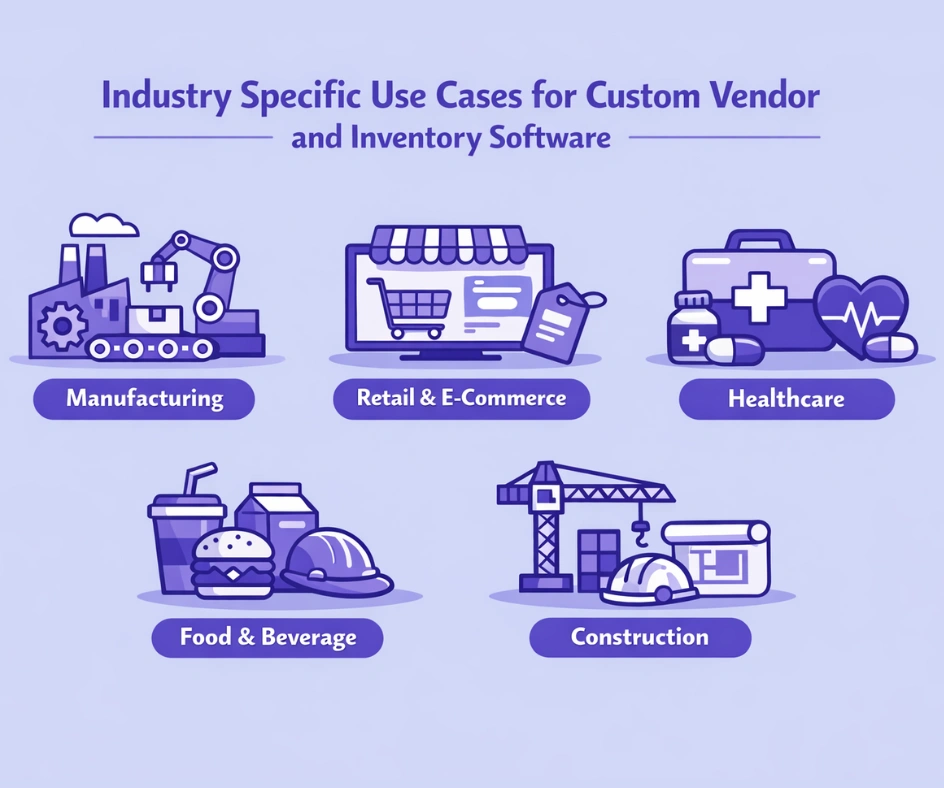
Industry Specific Use Cases for Custom Vendor and Inventory Software
One of the biggest advantages of custom software is that it can be tailored to the exact needs of your industry. Here are some examples of how different sectors use vendor and inventory management software:
1. Manufacturing
Manufacturers deal with complex, multi-tier supply chains. They need to track raw materials from multiple vendors, manage work-in-progress inventory on the factory floor, and ensure finished goods are ready for shipment. Custom software helps manufacturers synchronize their purchasing schedules with production timelines, reducing waste and preventing production delays. Manufacturing held 37.3% of the vendor management software market share in 2024, making it the industry with the highest adoption.
2. Retail and e-commerce
Retailers need to manage thousands of SKUs across physical stores, online channels, and third-party marketplaces. They also work with large numbers of vendors for different product categories. Custom software helps retailers maintain optimal stock levels across all channels, automate vendor reorders based on real-time sales data, and prevent the overstocking that leads to costly markdowns.
3. Healthcare
Hospitals and clinics manage critical supplies like medicines, surgical equipment, and protective gear. Running out of stock in a healthcare setting can put lives at risk. Custom vendor and inventory management software ensures that healthcare facilities always have the supplies they need, tracks expiration dates and batch numbers for compliance, and manages vendor certifications required by regulatory bodies.
4. Food and Beverage
The food industry faces unique challenges like perishable goods, strict safety regulations, and temperature-sensitive storage. Custom software tracks the entire journey of food products from farm to table, monitors storage conditions, enforces FIFO rules, and helps businesses meet food safety standards. Vendor performance tracking is also critical to ensure that suppliers maintain hygiene and quality standards.
5. Construction
Construction companies manage large quantities of materials from multiple vendors across different job sites. Custom software tracks which materials are at which site, monitors vendor delivery schedules, manages equipment rentals, and ensures that projects stay on budget and on schedule.
The Role of AI and Automation in Modern Vendor and Inventory Systems
Artificial intelligence and automation are transforming how businesses manage vendors and inventory. Custom software for vendor management now uses AI to predict vendor risks before they happen by analyzing patterns in delivery delays, quality issues, and financial stability. Automated vendor scorecards update in real time without anyone having to manually enter data.
On the inventory side, AI-powered demand forecasting is becoming the standard. Instead of relying on simple averages or gut feeling, businesses can now use machine learning models that consider hundreds of variables, including weather patterns, social media trends, economic indicators, and historical sales data, to predict exactly how much stock they need and when.
Automation also plays a huge role in reducing manual work. Tasks like creating purchase orders, sending payment reminders, updating stock levels, generating reports, and sending compliance alerts can all be automated. This frees up your team to focus on strategic work instead of repetitive data entry.
According to research, approximately 63% of new vendor management solutions launched recently include AI-driven features for automating supplier risk analysis and contract management. This is not a future trend. It is happening right now, and businesses that do not adopt these capabilities risk falling behind.
Inventory Management Software Market Overview
| Market Segment | Data Point | Key Details |
|---|---|---|
| Global Market Size (2024) | USD 3.58 Billion | Projected to reach USD 7.14 billion by 2033 at 8.4% CAGR |
| Cloud Deployment Share | 65.96% of Market (2024) | Growing at 14.2% CAGR as businesses prioritize subscription models |
| Top Industry User | Manufacturing (22%+ share) | Complex supply chains and real-time tracking drive demand |
| Fastest Growing End User | E commerce | Integration of 3D printing and cloud platforms is driving growth |
| Leading Region | North America (34.9%) | Asia Pacific expected to grow fastest at 10.2% CAGR through 2033 |
| Fastest Growing Segment | Small and Medium Enterprises | Cloud affordability and e-commerce expansion are fueling SME adoption |
| Annual Retail Losses (U.S.) | $1.75 Trillion | Due to stockouts, overstocking, and poor demand forecasting |
Steps to Building Custom Vendor and Inventory Management Software
If you are thinking about building custom software for your business, here is what the development process typically looks like:
1. Discovery and Requirements Gathering
This is the most important step. Your development partner sits down with your team to understand your current workflows, pain points, and goals. What are the biggest problems you face with vendors? Where does your inventory tracking break down? What data do you need to see on your dashboards? The answers to these questions shape the entire project.
2. Architecture and Design
Based on the requirements, the development team designs the system architecture, which means deciding what technologies to use, how data will flow between modules, what the user interface will look like, and how the system will integrate with your existing tools like ERPs, fixed asset accounting software, and CRMs.
3. Development in Phases
Custom software is typically built in phases using agile methodology. This means the team builds one module at a time (for example, vendor onboarding first, then inventory tracking, then reporting), tests it with your team, gets feedback, and makes improvements before moving to the next module. This approach reduces risk and ensures the final product actually meets your needs.
4. Integration and Data Migration
Your new software needs to connect with your existing systems. This might include your accounting software, warehouse management system, point of sale terminals, e-commerce platforms, or ERP system. The development team builds APIs and connectors to ensure data flows smoothly between all systems. If you are replacing an older system, your existing data also needs to be cleaned and migrated to the new platform.
5. Testing and Quality Assurance
Before going live, the software goes through extensive testing, including functional testing (does every feature work?), performance testing (can it handle your data volume?), security testing (is your data protected?), and user acceptance testing (does your team find it easy to use?).
6. Deployment and Training
Once everything is tested and approved, the software is deployed to your production environment. Your team receives training on how to use the system, and the development partner provides ongoing support to handle any issues that come up after launch.
7. Ongoing Maintenance and Updates
Software is never truly finished. Your business will evolve, regulations will change, and new technologies will emerge. A good development partner provides ongoing maintenance, bug fixes, and feature updates to keep your system running smoothly and growing with your business.
Recommended Reading:
The Hidden Costs of Not Using Custom Software
Many businesses hesitate to invest in custom software because of the upfront cost. But the cost of not investing is often much higher. Here is what poor vendor and inventory management actually costs businesses:
Businesses typically spend 25% to 35% of their budget on inventory carrying costs. When inventory is poorly managed, a large portion of that money is wasted on storing excess stock, managing obsolete products, and handling emergency orders. Unplanned downtime in asset-heavy industries costs hundreds of millions annually, with a significant portion tied to inventory issues like missing parts or delayed vendor deliveries.
Then there are the indirect costs. Employee morale drops when teams have to work with clunky, inefficient systems. Customer trust erodes when orders are delayed or items are out of stock. Vendor relationships suffer when payments are late or communication is poor. All of these problems compound over time, quietly eating away at your bottom line.
Custom software for vendor management and custom software for inventory management address all of these issues by giving you complete control over your processes, real-time visibility into your data, and the automation needed to eliminate manual errors. Moving beyond basic tools to a dedicated dealer management software system allows businesses to synchronize their quoting, ordering, and field service operations.
How to Choose the Right Development Partner
The success of your custom software project depends heavily on the team that builds it. Here are some things to look for when choosing a development partner for your vendor and inventory management software:
1. Industry Experience
Choose a team that understands your industry. A developer who has built software for manufacturing companies will understand supply chain workflows much better than one who has only worked on consumer apps.
2. Full Lifecycle Support
Look for a partner that handles everything from requirements gathering and design to development, testing, deployment, and ongoing maintenance. You do not want to deal with handoffs between multiple teams.
3. Integration Expertise
Your new software needs to work with your existing tools. Make sure your development partner has experience integrating with ERP systems, accounting software, warehouse management systems, and e-commerce platforms.
4. Transparency and Communication
Good development partners keep you informed at every stage. They provide regular updates, involve you in testing, and are transparent about timelines, budgets, and challenges.
5. Post Launch Support
Building the software is just the beginning. Make sure your partner offers ongoing support, bug fixes, performance monitoring, and feature updates after the launch.
Build Your Custom Vendor and Inventory Management Platform:
We bring deep expertise in custom software development, enterprise automation, and supply chain technology. Our team handles everything from requirements gathering and architecture design to full development, integration with existing systems, and post-launch support. Whether you need a vendor management system, an inventory tracking platform, or a combined solution, we build software that works exactly the way your business needs it to.
Final Thoughts
Managing vendors and inventory is at the heart of every business that deals with physical products or relies on external suppliers. When these processes are handled poorly, the costs are massive: lost revenue, wasted stock, broken vendor relationships, compliance failures, and missed growth opportunities. The numbers are clear. Retailers lose trillions in revenue each year because of poor inventory management. The vast majority of companies experience disruptions caused by third parties. And the market for vendor and inventory management software is growing rapidly because businesses know they need better tools.
Custom software for vendor and inventory management offers something that off-the-shelf tools simply cannot: a solution that fits your exact business needs. It connects your vendor relationships with your inventory operations in a single platform. It automates the repetitive tasks that drain your team’s time. It gives you real-time data so you can make faster, smarter decisions. And it grows with your business, without the limitations of someone else’s product roadmap.
Whether you are a manufacturer managing hundreds of suppliers, a retailer balancing stock across multiple channels, a healthcare organization tracking critical medical supplies, or a growing e-commerce brand trying to keep up with demand, custom-built vendor and inventory management software is not a luxury. It is a competitive necessity. The businesses that invest in these systems today are the ones that will be faster, leaner, and more profitable tomorrow.
Frequently Asked Questions
Q1.What is custom software for vendor management?
Custom software for vendor management is a tailor-made platform built to help businesses manage all their supplier relationships in one place. It covers vendor onboarding, contract tracking, performance monitoring, compliance checking, and payment processing, all designed around your specific business workflows instead of a generic template.
Q2.How does custom inventory software differ from ready-made tools?
Ready-made inventory tools come with fixed features that may not match your business processes. Custom software for inventory management is built specifically for your operations. It connects with your existing systems, follows your workflows, and includes only the features you actually need, which means better performance and lower long-term costs.
Q3.Can vendor and inventory management be combined in one system?
Yes. In fact, combining both in one platform is one of the biggest advantages of custom software. A unified vendor and inventory management software system connects purchasing with stock tracking, so when inventory drops, the system automatically finds the best vendor and creates a purchase order without manual intervention.
Q4.How long does it take to build custom management software?
The timeline depends on the scope and complexity of the project. A basic vendor management system might take 3 to 4 months, while a full-featured vendor and inventory management platform with integrations and AI capabilities could take 6 to 12 months. Agile development allows you to start using core features early while additional modules are still being built.
Q5.Is custom software suitable for small businesses?
Absolutely. Small and medium enterprises are the fastest-growing segment in the inventory management software market. Cloud-based custom solutions with modular architecture allow small businesses to start with basic features and add more as they grow, keeping costs manageable while still getting a solution that fits their needs.
Q6.What industries benefit most from custom vendor and inventory software?
Manufacturing, retail, e-commerce, healthcare, food and beverage, construction, and logistics are among the industries that benefit the most. Any business that manages multiple vendors, tracks physical inventory, or operates in a regulated environment will see significant value from a custom-built vendor management system software and inventory management solution.
Explore Services
Related Services
Reviewed by

Aman Vaths
Founder of Nadcab Labs
Aman Vaths is the Founder & CTO of Nadcab Labs, a global digital engineering company delivering enterprise-grade solutions across AI, Web3, Blockchain, Big Data, Cloud, Cybersecurity, and Modern Application Development. With deep technical leadership and product innovation experience, Aman has positioned Nadcab Labs as one of the most advanced engineering companies driving the next era of intelligent, secure, and scalable software systems. Under his leadership, Nadcab Labs has built 2,000+ global projects across sectors including fintech, banking, healthcare, real estate, logistics, gaming, manufacturing, and next-generation DePIN networks. Aman’s strength lies in architecting high-performance systems, end-to-end platform engineering, and designing enterprise solutions that operate at global scale.