Ai Overview
Automated DeFi lending protocols represent a transformative approach to real estate financing, combining blockchain technology with traditional property investment. Banks in London, Dubai, Toronto, and New York typically require 30-90 days to process commercial property loans, with fees consuming 2-5% of loan value. Protocols typically maintain 10-20% of deposits in liquid reserves, with automated mechanisms to increase rates and attract deposits when reserves fall below thresholds.
Key Takeaways
- Automated DeFi lending protocols eliminate intermediaries, enabling direct property-backed borrowing and lending across USA, UK, UAE, and Canada markets efficiently.
- Smart contracts automate loan origination, interest accrual, collateral monitoring, and liquidation workflows without manual intervention from financial institutions.
- Oracle networks provide real-time property valuations essential for accurate collateralization ratios and automated risk assessment in lending protocols.
- ERC-3643 and ERC-1400 security token standards enable compliant tokenization with embedded transfer restrictions for regulated real estate assets.
- Liquidity pools aggregate capital from multiple investors, providing borrowers instant access to funds backed by tokenized property collateral.
- Interest rate algorithms dynamically adjust based on pool utilization, ensuring market-driven pricing for real estate-backed loans globally.
- Automated liquidation mechanisms protect lender capital when collateral values decline below predefined health factor thresholds in volatile markets.
- Cross-chain bridges enable real estate token interoperability across Ethereum, Polygon, Avalanche, and other networks for expanded liquidity access.
- Multi-layered security including audits, formal verification, and insurance funds protect participants from smart contract vulnerabilities and exploits.
- Regulatory compliance frameworks integrate KYC/AML verification and jurisdiction-specific requirements into automated lending protocol architectures seamlessly.
Understanding Automated DeFi Lending in Real Estate Tokenization
Automated DeFi lending protocols represent a transformative approach to real estate financing, combining blockchain technology with traditional property investment. These systems enable property owners to unlock liquidity from tokenized real estate holdings without selling their assets, while investors gain access to property-backed yields through transparent smart contract mechanisms. The convergence of decentralized finance and real estate tokenization creates unprecedented opportunities for market participants across global jurisdictions.
Our agency has spent over eight years building automated DeFi lending protocols for institutional clients in the USA, UK, UAE, and Canada. This experience reveals that successful implementations require careful attention to both technical architecture and regulatory compliance. The protocols must handle complex workflows including property valuation, collateral management, interest calculations, and liquidation procedures entirely on-chain.
Real estate-backed DeFi lending differs fundamentally from traditional crypto lending because the underlying collateral connects to physical assets with legal ownership structures. This connection requires specialized oracle systems, legal wrappers, and compliance mechanisms that pure cryptocurrency lending platforms do not need. Understanding these distinctions is essential for building robust protocols that serve institutional and retail participants effectively.
Core Components of a DeFi Lending Protocol for Tokenized Real Estate
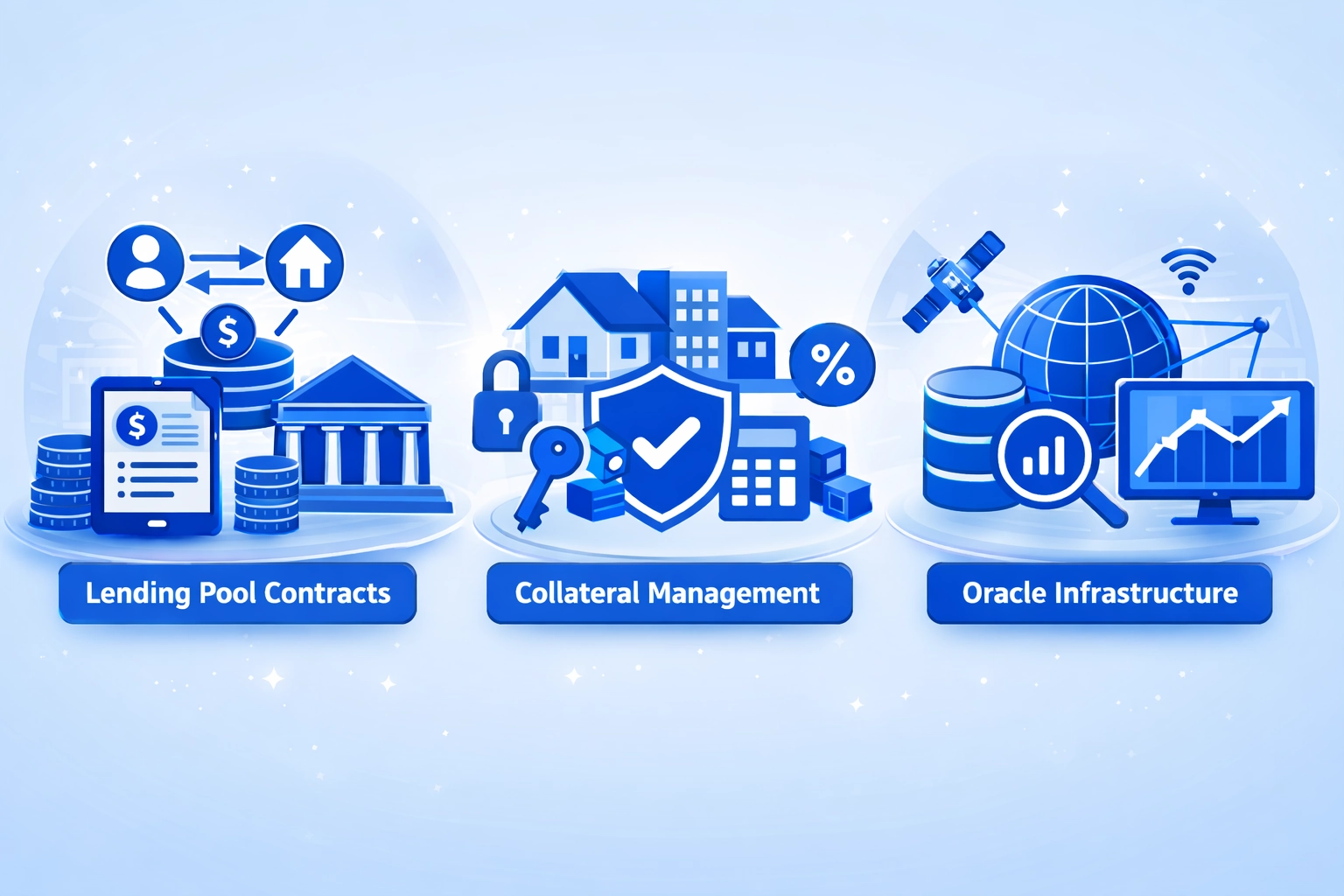
Building robust automated lending requires integrating multiple specialized components into a cohesive system architecture.
Lending Pool Contracts
- Aggregate lender capital efficiently
- Track individual deposit positions
- Calculate and distribute yields
- Manage liquidity reserves
Collateral Management
- Lock tokenized property assets
- Monitor health factor ratios
- Trigger liquidation workflows
- Handle partial withdrawals
Oracle Infrastructure
- Property valuation feeds
- Market price aggregation
- Interest rate benchmarks
- Compliance status updates
How Real-World Assets Are Converted into On-Chain Tokens
The tokenization process begins with legal structuring that creates a connection between blockchain tokens and physical property rights. Special Purpose Vehicles (SPVs) or trust structures hold title to real estate assets, with token holders receiving proportional ownership or economic interests in these entities. This legal framework enables DeFi protocols to treat tokenized property as valid collateral with enforceable claims.
Property documentation including titles, appraisals, insurance certificates, and rental agreements undergoes verification before tokenization. Professional service providers conduct due diligence ensuring assets meet lending protocol requirements. This verification data is often stored on IPFS or similar decentralized storage systems, with hash references recorded on-chain for immutable audit trails.
Token minting follows successful verification, creating digital representations of property ownership on blockchain networks. Protocols serving institutional investors in the USA and UK typically use permissioned token standards that embed compliance logic, ensuring only verified participants can hold and transfer these securities-like assets.
Smart Contract Architecture Behind Automated Lending Workflows
Automated DeFi lending protocols employ modular smart contract architectures separating concerns into specialized components. The lending pool contract manages deposits and withdrawals, while separate collateral contracts handle asset custody. Interest rate contracts implement pricing algorithms, and liquidation contracts execute recovery procedures. This separation enables upgrades to individual components without disrupting the entire system.
The proxy pattern enables protocol upgrades while maintaining state continuity and user positions. Transparent proxy implementations separate storage from logic, allowing governance to deploy improved contracts without requiring users to migrate funds. This architectural approach has become standard for DeFi protocols managing significant value across Ethereum, Polygon, and other EVM-compatible networks.
Event emission throughout contract execution creates comprehensive audit trails for regulatory compliance and dispute resolution. Every deposit, borrow, repayment, and liquidation generates indexed events that off-chain systems can monitor and analyze. This transparency distinguishes DeFi lending from traditional finance where transaction details remain opaque to market participants.
Token Standards Used in Real Estate-Backed DeFi Lending
Security token standards embed compliance logic directly into token contracts, ensuring regulatory requirements are enforced at the protocol level. Choosing appropriate standards impacts interoperability, compliance capabilities, and integration complexity.
| Token Standard | Key Features | Best Use Case |
|---|---|---|
| ERC-3643 | Identity registry, compliance rules, transfer restrictions | Regulated securities in USA, UK, EU |
| ERC-1400 | Partitioned balances, document management, operator controls | Complex ownership structures |
| ERC-20 | Simple transfers, wide compatibility, liquidity access | Utility tokens, receipt tokens |
| ERC-721 | Unique token IDs, metadata storage, ownership tracking | Individual property NFTs |
| ERC-1155 | Multi-token batching, efficient transfers, mixed assets | Portfolio tokenization |
Role of Oracles in Real Estate Valuation and Loan Automation
Oracle networks bridge the gap between off-chain property data and on-chain lending logic. Unlike cryptocurrency markets with continuous price feeds, real estate valuations require aggregating data from appraisals, comparable sales, rental income, and market indices. Specialized oracle providers in the USA, UK, and UAE have emerged to serve this growing market need with verified property data feeds.
Chainlink and other decentralized oracle networks now support real estate data through partnerships with professional appraisal firms and property data aggregators. These feeds update valuations based on market conditions, rental performance, and comparable transactions. Time-weighted average calculations smooth volatility while maintaining responsiveness to genuine market movements.
Oracle security remains critical for lending protocol safety. Manipulation of property valuations could enable borrowers to extract excess loans or trigger inappropriate liquidations. Multi-source aggregation, outlier filtering, and economic incentive alignment help ensure oracle data integrity for high-value real estate lending applications.
Automated Loan Origination in DeFi Real Estate Platforms
Automated loan origination platform eliminates manual underwriting delays that characterize traditional real estate lending. When borrowers deposit tokenized property collateral, smart contracts immediately verify token validity, check compliance status, and query oracle feeds for current valuations. Within seconds, borrowers receive their maximum borrowing capacity based on predetermined collateralization ratios and pool liquidity.
The origination workflow validates multiple conditions atomically before releasing funds. Identity verification confirms the borrower meets KYC requirements for their jurisdiction. Collateral checks ensure tokens represent valid, unencumbered property interests. Liquidity verification confirms sufficient pool reserves exist to fund the requested loan amount. All checks execute in a single transaction, providing instant certainty.
This automation enables 24/7 lending operations without human intervention. Property owners in Dubai can access loans backed by London real estate at midnight, receiving funds in minutes rather than weeks. This always-on availability represents a fundamental competitive advantage over traditional lenders bound by business hours and manual processes.
Interest Rate Logic in Real Estate-Backed DeFi Lending
Algorithmic interest rate models automatically adjust borrowing costs based on pool utilization, ensuring market-driven pricing without manual intervention. These models balance lender returns with borrower accessibility.[1]
| Utilization Rate | Borrow APR | Supply APY | Market Condition |
|---|---|---|---|
| 0-40% | 3-5% | 1.5-2.5% | Low demand, high liquidity |
| 40-70% | 5-8% | 2.5-5% | Balanced market |
| 70-90% | 8-15% | 5-12% | High demand |
| 90-100% | 15-50%+ | 12-40% | Critical liquidity shortage |
Risk Assessment Automation in DeFi Real Estate Lending
Automated risk assessment continuously monitors collateral health across all active loans. Smart contracts calculate health factors by comparing current collateral values against outstanding loan balances, factoring in accrued interest. When health factors approach liquidation thresholds, borrowers receive on-chain notifications and opportunities to add collateral or repay portions of their loans.
Property-specific risk parameters account for asset class volatility, liquidity characteristics, and market conditions. Commercial properties in prime USA and UK locations may receive more favorable risk weightings than speculative land investments. These parameters are established through governance proposals and can be adjusted as market conditions evolve.
Machine learning models increasingly complement on-chain risk monitoring, analyzing patterns that may indicate deteriorating collateral quality before traditional metrics reflect problems. These hybrid approaches combine blockchain transparency with sophisticated analytics for comprehensive risk management.
Default Handling and Liquidation Workflow for Tokenized Properties
1. Health Factor Monitoring
Smart contracts continuously track collateral values against loan balances, calculating real-time health factors.
2. Warning Threshold Alert
When health factor approaches 1.2, automated alerts notify borrowers to add collateral or repay loans.
3. Grace Period Initiation
Real estate protocols often provide 24-72 hour grace periods before liquidation execution begins.
4. Liquidation Trigger
Health factor below 1.0 enables liquidators to repay debt and claim collateral with liquidation bonus.
5. Dutch Auction Mechanism
Property tokens are sold through descending price auctions to maximize recovery for all stakeholders.
6. Debt Repayment
Liquidation proceeds first cover outstanding principal and interest owed to lending pool participants.
7. Surplus Distribution
Any remaining value after debt satisfaction returns to original borrower automatically via smart contract.
8. Position Settlement
All accounting records update atomically, clearing the loan position and releasing any remaining collateral.
Investor Participation Flow in Automated Lending Protocols
Investors participate in DeFi real estate lending by depositing stablecoins or other accepted assets into lending pools. Upon deposit, they receive interest-bearing tokens representing their pool share plus accumulated yields. These tokens can be held for passive income, used as collateral in other DeFi protocols, or transferred to other wallets, providing flexibility traditional real estate investments lack.
The participation process requires identity verification for pools accepting regulated real estate collateral. Investors from the USA, UK, UAE, and Canada complete KYC procedures through integrated verification providers before accessing lending markets. Once verified, investors can deposit and withdraw without further friction while maintaining compliance with local securities regulations.
Yield generation occurs continuously as borrowers pay interest on outstanding loans. Interest accrues directly to pool tokens, meaning investors see their token balances increase over time without claiming rewards. This automated compounding maximizes capital efficiency while simplifying tax reporting for participants across multiple jurisdictions.
Borrower Journey in Tokenized Real Estate Lending Platforms
Property owners begin their borrowing journey by tokenizing real estate assets through integrated tokenization workflows. This process involves legal structuring, property verification, and token minting on compatible blockchain networks. Once tokenized, property owners deposit tokens as collateral and immediately access borrowing capacity against their holdings without selling underlying assets.
Borrowing interfaces display real-time information including available credit lines, current interest rates, and collateral requirements. Borrowers select loan amounts within their capacity and receive funds in preferred stablecoins instantly. The entire process from collateral deposit to fund receipt completes in a single transaction, eliminating the weeks-long approval cycles traditional lenders require.
Ongoing loan management occurs through intuitive dashboards showing health factors, accrued interest, and repayment options. Borrowers can repay partially or fully at any time without prepayment penalties common in traditional mortgages. This flexibility enables sophisticated treasury management strategies for real estate investors operating across global markets.
Compliance and Legal Considerations in Real Estate DeFi Execution
Regulatory compliance varies significantly across jurisdictions, requiring protocols to implement flexible frameworks that adapt to local requirements while maintaining operational efficiency.
| Jurisdiction | Regulatory Body | Key Requirements | Investor Restrictions |
|---|---|---|---|
| USA | SEC / FINRA | Reg D, Reg A+, ATS registration | Accredited investor verification |
| UK | FCA | Security token classification, prospectus | Professional/sophisticated investors |
| UAE | DFSA / VARA / SCA | Virtual asset licensing, sandbox | Qualified investor thresholds |
| Canada | CSA / Provincial | Prospectus exemptions, dealer registration | Accredited investor or OM exemptions |
Security Layers in Automated Real Estate Lending Protocols
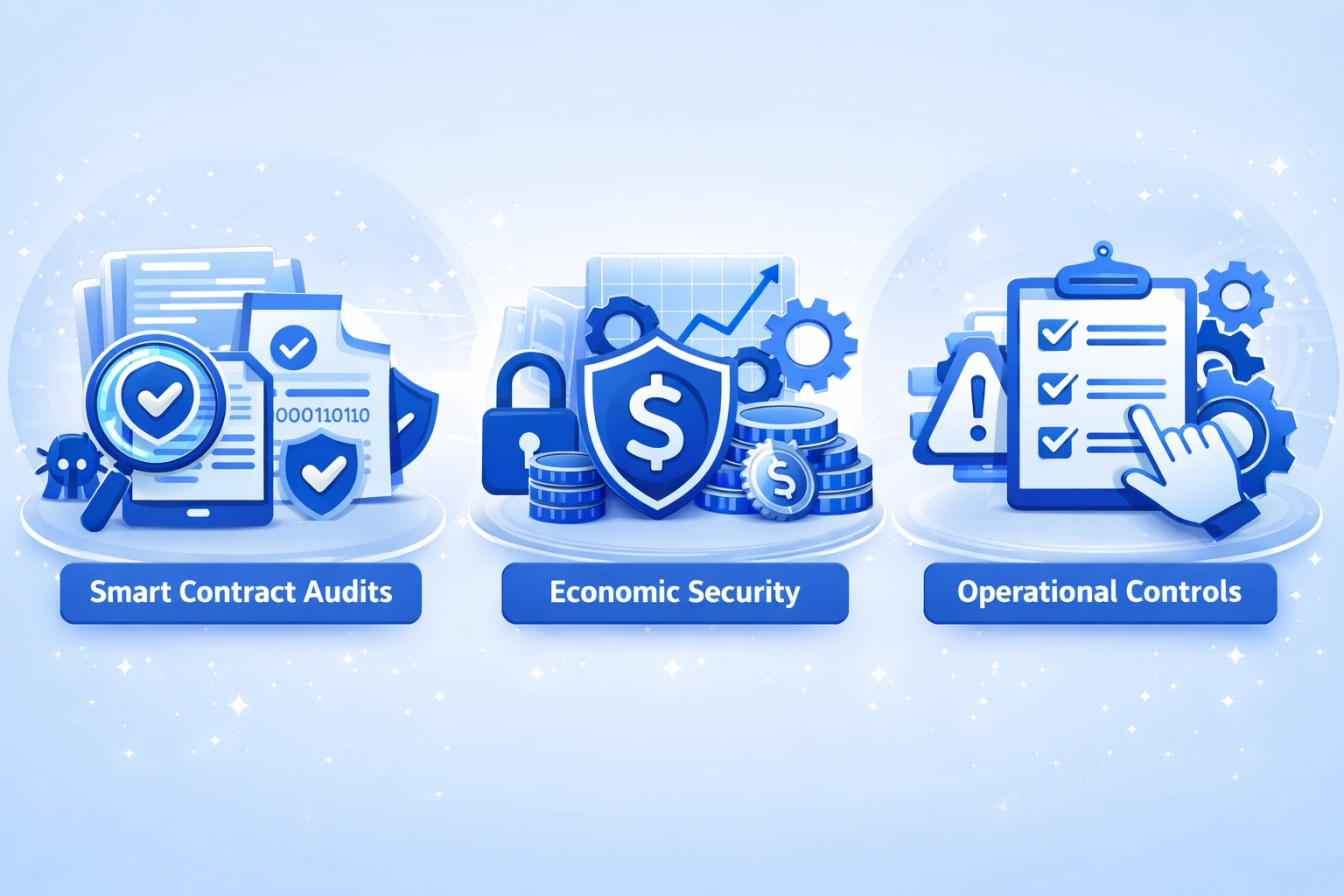
Multi-layered security architecture protects protocol participants from various attack vectors and operational risks.
Smart Contract Audits
Multiple independent audits from top-tier security firms verify contract logic before mainnet deployment.
Economic Security
Insurance funds, over-collateralization, and liquidation incentives protect against financial losses.
Operational Controls
Multi-sig governance, timelocks, and emergency pause mechanisms provide operational safeguards.
Cross-Chain Execution for Scalable Real Estate Tokenization
Cross-chain interoperability expands liquidity access for real estate-backed lending protocols beyond single network limitations. Bridge protocols enable tokenized properties on Ethereum to be used as collateral on Polygon, Avalanche, or other EVM-compatible chains where transaction costs may be lower. This flexibility attracts borrowers and lenders who prefer different network characteristics.
Layer 2 scaling solutions like Arbitrum and Optimism offer reduced gas costs while maintaining Ethereum security guarantees. Real estate lending protocols increasingly deploy on these networks, making smaller loans economically viable. A $50,000 loan that would cost $200 in Ethereum gas fees might cost only $2 on Arbitrum, dramatically improving accessibility.
Cross-chain messaging protocols enable coordinated operations across networks. Collateral locked on one chain can secure loans issued on another, with atomic settlement ensuring neither party faces counterparty risk. These capabilities enable truly global real estate lending markets that operate seamlessly across blockchain ecosystems.
Performance Metrics for DeFi Lending-Based Real Estate Platforms
Total Value Locked (TVL) measures protocol adoption by tracking aggregate collateral and deposits. Successful real estate DeFi protocols in 2026 manage hundreds of millions in TVL, demonstrating institutional confidence. Growth rates indicate market traction, with healthy protocols showing sustained increases rather than volatile spikes that suggest unsustainable incentive programs.
Utilization rates reveal capital efficiency across lending pools. Optimal utilization between 60-80% balances lender yields with withdrawal availability. Consistently low utilization may indicate insufficient borrower demand, while persistently high rates suggest capital constraints requiring attention from protocol governance.
Bad debt ratios track protocol risk management effectiveness. Well-designed liquidation mechanisms keep bad debt near zero, protecting lender capital. Historical bad debt performance provides crucial data for institutional due diligence, with protocols operating in the USA, UK, UAE, and Canada subject to heightened scrutiny from regulated investors.
Future Evolution of Automated DeFi Lending for Real-World Assets
Industry leaders anticipate significant advancements in automated DeFi lending protocols for real estate and other real-world assets.
Trend 1: AI-powered property valuation oracles will provide real-time, granular assessments for automated lending decisions.
Trend 2: Zero-knowledge proofs will enable compliant lending while preserving borrower privacy across jurisdictions.
Trend 3: Institutional-grade custody solutions will integrate natively with DeFi protocols for seamless participation.
Trend 4: Standardized real estate token formats will enable interoperability across lending protocols globally.
Trend 5: Regulatory sandboxes will accelerate compliant innovation in major financial centers worldwide.
Trend 6: Fractional rental income distribution will integrate directly with lending pool yield mechanisms.
Trend 7: Cross-asset collateralization will enable diversified portfolios backing individual loans.
Trend 8: Decentralized identity standards will streamline KYC across protocols while maintaining user sovereignty.
DeFi Real Estate Lending Governance Compliance Checklist
Protocol Security
- Multiple security audits completed
- Bug bounty program active
- Formal verification for critical functions
Legal Structure
- SPV/Trust structures established
- Securities compliance verified
- Cross-border legal opinions obtained
Investor Protection
- KYC/AML procedures implemented
- Insurance coverage secured
- Dispute resolution mechanisms defined
Operational Governance
- Multi-sig treasury controls
- Transparent upgrade processes
- Community governance participation
Launch Your Automated DeFi Real Estate Lending Platform with Experts!
Partner with our experienced team to build secure, compliant automated lending protocols for tokenized real estate serving global investors.
People Also Ask
Q1.1. What are automated DeFi lending protocols for real estate tokenization?
Automated DeFi lending protocols are blockchain-based systems that enable borrowers to use tokenized real estate as collateral for loans without traditional intermediaries. These protocols use smart contracts to automate loan origination, interest calculations, and repayment processing. Investors from the USA, UK, UAE, and Canada can participate as lenders, earning yields from property-backed lending pools while borrowers access liquidity against their tokenized property holdings.
Q2.2. How do DeFi lending protocols determine interest rates for real estate loans?
Interest rates in DeFi lending protocols are determined algorithmically based on supply and demand dynamics within liquidity pools. When borrowing demand increases, rates automatically rise to attract more lenders. Real estate-backed protocols also factor in collateral quality, loan-to-value ratios, and property valuations from oracle feeds. This automated approach ensures transparent, market-driven pricing without manual intervention from financial institutions.
Q3.3. What happens if a borrower defaults on a tokenized real estate loan?
When borrowers default, automated liquidation workflows execute predefined smart contract logic. The protocol monitors collateral health ratios continuously, and if values fall below thresholds, liquidation triggers automatically. Tokenized property shares are sold through decentralized exchanges or auction mechanisms to recover lender funds. This process ensures lenders are protected while maintaining system solvency across global DeFi platforms.
Q4.4. Are automated DeFi lending protocols for real estate legally compliant?
Compliance varies by jurisdiction, with protocols implementing KYC/AML verification, accredited investor checks, and securities regulations adherence. Platforms serving USA markets follow SEC guidelines, UK platforms comply with FCA requirements, UAE platforms align with DFSA and VARA frameworks, and Canadian platforms meet CSA standards. Legal wrappers like SPVs connect on-chain tokens to real-world property rights for regulatory clarity.
Q5.5. What are the risks of participating in DeFi real estate lending protocols?
Participants face smart contract vulnerabilities, oracle manipulation risks, liquidity crunches during market volatility, and regulatory uncertainty across jurisdictions. Real estate-specific risks include property devaluation, legal disputes over ownership, and illiquidity of underlying assets. Protocol risks include governance attacks, admin key compromises, and cross-chain bridge failures. Thorough due diligence and diversification strategies help mitigate these risks effectively.
Explore Services
Related Services
Reviewed by

Aman Vaths
Founder of Nadcab Labs
Aman Vaths is the Founder & CTO of Nadcab Labs, a global digital engineering company delivering enterprise-grade solutions across AI, Web3, Blockchain, Big Data, Cloud, Cybersecurity, and Modern Application Development. With deep technical leadership and product innovation experience, Aman has positioned Nadcab Labs as one of the most advanced engineering companies driving the next era of intelligent, secure, and scalable software systems. Under his leadership, Nadcab Labs has built 2,000+ global projects across sectors including fintech, banking, healthcare, real estate, logistics, gaming, manufacturing, and next-generation DePIN networks. Aman’s strength lies in architecting high-performance systems, end-to-end platform engineering, and designing enterprise solutions that operate at global scale.