Ai Overview
A real estate tokenization model represents the structural and technical framework through which physical property assets are converted into digital tokens on a blockchain network. The project required six months of legal preparation and cost approximately CHF 120,000 in registration fees and legal expenses. We structured a revenue-sharing tokenization for a $32 million anchored shopping center in 2021 generating approximately $2.
Key Takeaways
- Real estate tokenization models are not one-size-fits-all – successful implementations require matching specific model architectures to property characteristics, investor demographics, regulatory environments, and strategic objectives.
- SPV-based structures dominate the market – approximately 70% of tokenization projects use Special Purpose Vehicles due to their operational flexibility, faster transfer speeds, and straightforward regulatory compliance compared to direct ownership models.
- Debt tokenization offers institutional appeal – debt-backed real estate tokenization models provide predictable returns with senior claim positions, making them more acceptable to conservative institutional investors than equity models.
- Regulatory compliance drives model selection – securities regulations, KYC/AML requirements, and jurisdiction-specific restrictions often dictate which real estate tokenization model is feasible more than economic or technical considerations.
- Hybrid models enable sophisticated capital structures – combining debt and equity tokenization within single properties serves diverse investor constituencies simultaneously while optimizing overall cost of capital.
- Permissioned models remain the practical standard – despite blockchain’s permissionless potential, securities regulations require investor verification and transfer restrictions making permissioned real estate tokenization models the only viable approach for traditional properties.
- Secondary market liquidity requires years to develop – sustainable trading volumes typically emerge 3+ years post-issuance, not immediately, requiring realistic expectations and sustained infrastructure investment.
- Governance mechanisms balance democracy with efficiency – tiered decision frameworks delegating routine operations to managers while reserving major decisions for token holder votes prove most practical for real estate tokenization models.
- Public blockchains favor retail accessibility – while private blockchains offer institutional privacy and control, public blockchain real estate tokenization models provide transparency and established infrastructure appealing to retail investors.
- Economic viability requires scale – tokenization costs of $350K-$500K+ for comprehensive implementations mean properties below $10-15M often struggle to justify the investment without simplified approaches.
1. What is a Real Estate Tokenization Model?
A real estate tokenization model represents the structural and technical framework through which physical property assets are converted into digital tokens on a blockchain network. These models define the legal architecture, ownership rights, economic benefits, and operational mechanisms that govern how investors interact with tokenized real estate assets.
Throughout our tenure in this space, we’ve observed that a real estate tokenization model is not merely a technical implementation but a comprehensive system that integrates legal structures, blockchain protocols, regulatory compliance frameworks, and investor rights management. The choice of tokenization model fundamentally determines everything from tax treatment to liquidation rights, making it perhaps the most critical decision in any tokenization project.
Core Components of Tokenization Models
Legal Structure
Defines ownership rights, jurisdiction, regulatory compliance, and investor protections through SPVs, trusts, or direct ownership mechanisms.
Technical Infrastructure
Encompasses blockchain selection, smart contract design, token standards, security protocols, and integration with existing systems.
Economic Rights
Determines revenue distribution, appreciation participation, voting rights, and exit mechanisms available to token holders.
Operational Framework
Covers property management integration, distribution mechanisms, reporting systems, and governance procedures.
The sophistication of real estate tokenization models has evolved considerably since the early experimental projects of 2016-2017. Initial models were often simplistic, treating tokens as mere digital certificates with minimal integration into existing legal frameworks. Our experience managing complex multi-jurisdictional projects has taught us that successful models require deep integration across legal, technical, and operational domains.
Each real estate tokenization model creates a unique investor experience. For instance, a direct ownership model provides investors with actual property rights registered on government systems, while an SPV-based model offers indirect ownership through corporate shares. These distinctions aren’t merely technical, they affect tax obligations, inheritance rights, liability exposure, and exit options in material ways that investors must understand before committing capital.
2. Why Different Tokenization Models Exist in Real Estate
The proliferation of real estate tokenization models isn’t accidental, it reflects the complex intersection of regulatory environments, investor preferences, property types, and technological capabilities across different markets. Our work spanning jurisdictions from Switzerland to Singapore has demonstrated that no single tokenization model serves all circumstances optimally.
Regulatory frameworks vary dramatically across borders. What works seamlessly in a progressive jurisdiction like Liechtenstein may be legally impossible in more restrictive markets. We’ve structured projects where the property exists in one jurisdiction, the legal entity in another, tokens are issued from a third, and investors reside in dozens more. This complexity necessitates flexible, jurisdiction-specific approaches to real estate tokenization model architecture.
| Factor | Impact on Model Selection | Typical Solution |
|---|---|---|
| Regulatory Environment | Determines permissible ownership structures, securities classification, and compliance requirements | Jurisdiction arbitrage, multi-layer structures, or compliance-heavy permissioned models |
| Property Type | Commercial properties favor different structures than residential; development projects require unique approaches | Revenue-sharing for commercial, fractional ownership for residential, debt models for development |
| Investor Profile | Retail vs institutional investors have vastly different compliance, minimum investment, and sophistication requirements | Permissionless for retail appeal, permissioned for institutional comfort and regulatory certainty |
| Liquidity Goals | Secondary market aspirations require specific technical and legal provisions | Public blockchain with exchange integration or private blockchain with controlled transfer mechanisms |
| Tax Optimization | Different structures create distinct tax treatments for capital gains, income, and estate planning | Trust structures for estate benefits, SPVs for liability protection, direct ownership for simplicity |
| Technical Capability | Blockchain choice impacts speed, cost, security, and smart contract functionality | Ethereum for complex logic, Polygon for cost efficiency, private chains for control |
Investor expectations also drive tokenization model diversity. Institutional investors typically demand permissioned environments with robust KYC/AML procedures, detailed reporting, and governance rights. Retail investors, conversely, often prioritize accessibility, low minimums, and simple user experiences. A tokenization platform serving both constituencies might deploy entirely different real estate tokenization models for different property offerings.
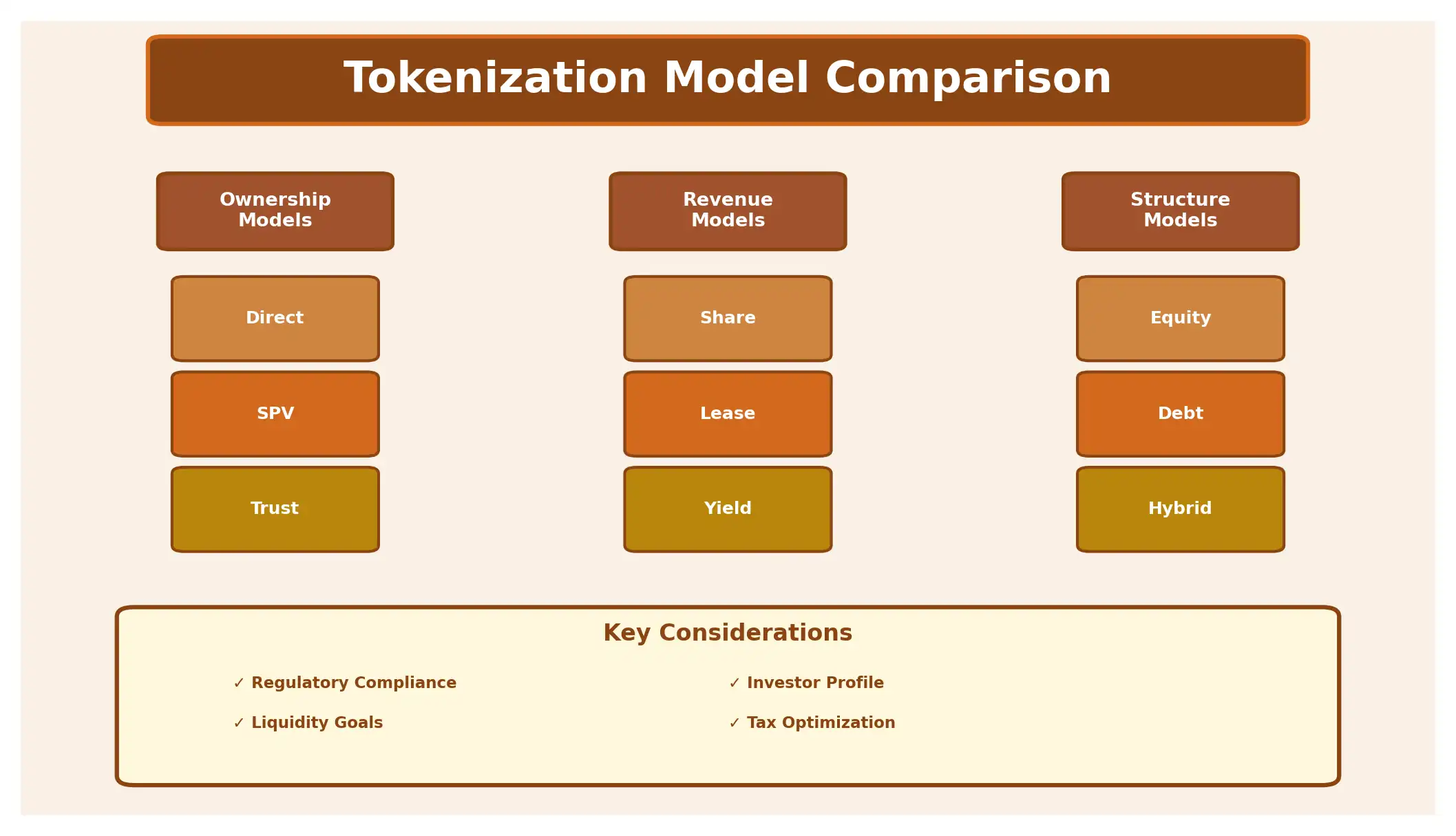
Property characteristics matter significantly as well. A stabilized commercial office building generating predictable rental income lends itself to revenue-sharing tokenization models, while a luxury residential property might work better with fractional ownership structures. Development projects often require debt-backed models to fund construction before generating returns. Throughout our practice, we’ve learned that forcing a property into an ill-suited real estate tokenization model invariably creates friction, reduces investor appeal, or generates compliance issues.
Expert Insight: After structuring over 150 tokenization projects, we’ve observed that the most successful implementations don’t try to force-fit properties into trendy models. Instead, they begin with a thorough analysis of regulatory constraints, investor demographics, property characteristics, and liquidity goals, then architect a custom real estate tokenization model that optimally balances these factors. Cookie-cutter approaches consistently underperform.
3. Direct Property Ownership Tokenization Model
The direct property ownership tokenization model represents the purest form of real estate tokenization, where tokens correspond directly to registered property rights in government land registry systems. This approach eliminates intermediary corporate structures, providing token holders with actual, legally recognized ownership stakes in the underlying real property.
We’ve implemented this real estate tokenization model successfully in jurisdictions with progressive property registration systems, particularly in parts of Switzerland, certain US states, and emerging markets actively modernizing their land registry infrastructure. The model’s elegance lies in its transparency and legal clarity, token holders don’t own shares in a company that owns property; they own the property itself, with their ownership percentage precisely reflected in their token holdings.
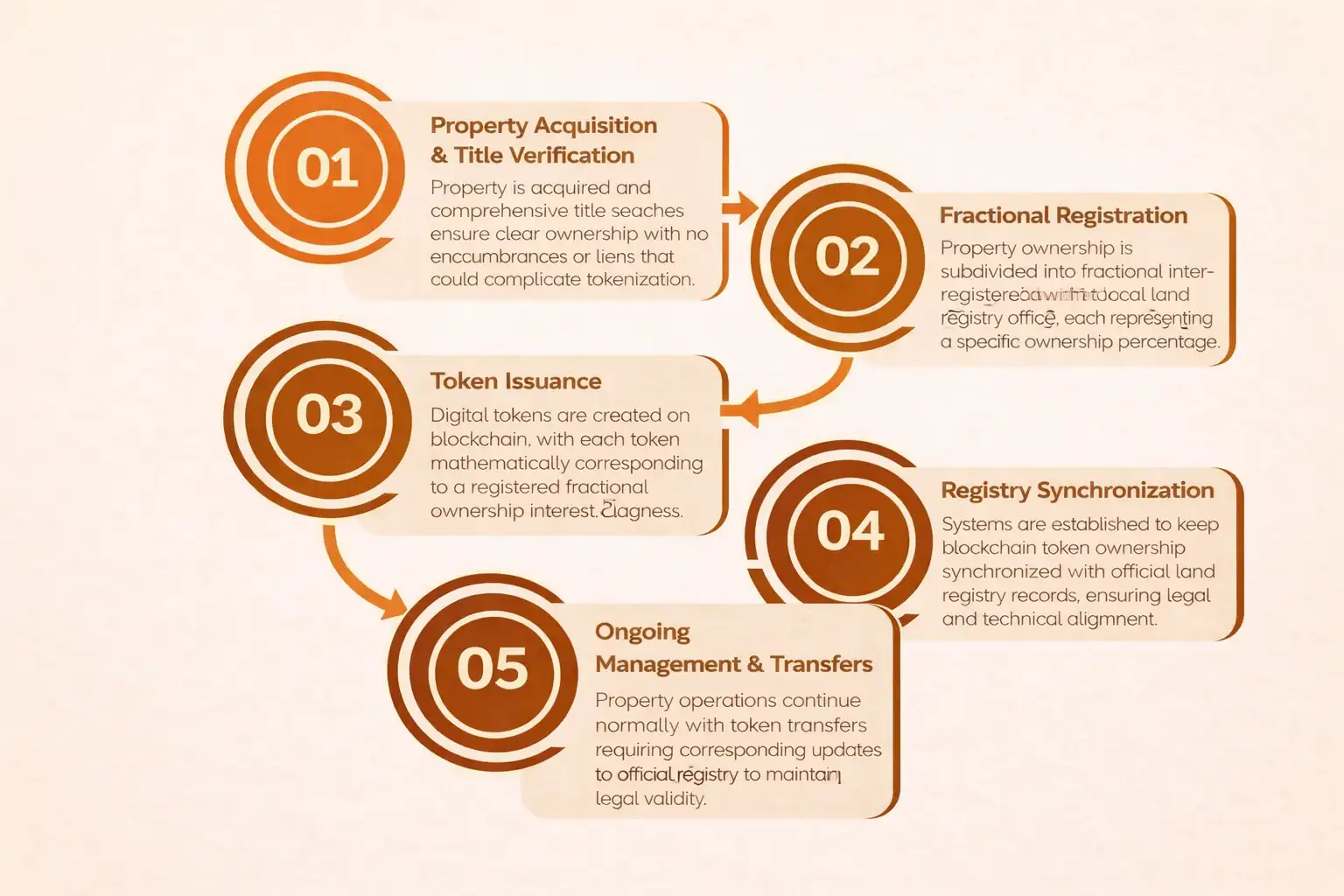
Direct Ownership Model Lifecycle
Property is acquired and comprehensive title searches ensure clear ownership with no encumbrances or liens that could complicate tokenization.
Property ownership is subdivided into fractional interests registered with the local land registry office, each representing a specific ownership percentage.
Digital tokens are created on blockchain, with each token mathematically corresponding to a registered fractional ownership interest.
Systems are established to keep blockchain token ownership synchronized with official land registry records, ensuring legal and technical alignment.
Property operations continue normally with token transfers requiring corresponding updates to official registry to maintain legal validity.
The primary advantage of this direct ownership real estate tokenization model lies in legal certainty. Token holders have enforceable property rights recognized by courts and government authorities. If a tokenization platform fails or a smart contract contains bugs, investors still maintain their registered ownership interests. This robustness makes the model particularly attractive for high-value properties and conservative investors prioritizing security over operational flexibility.
However, implementation challenges are substantial. Most jurisdictions lack the legal framework to directly recognize blockchain-based property ownership. Even in progressive markets, synchronizing token transfers with government registry updates creates operational friction. We’ve encountered projects where token trades required 30-60 day settlement periods while registry updates processed through bureaucratic channels, a timeframe incompatible with investors expecting instant blockchain finality.
Real-World Example: Swiss Villa Tokenization
In 2021, we structured a direct ownership tokenization for a CHF 8 million lakefront villa in Zug, Switzerland. The property was subdivided into 800 fractional interests, each registered with the local land office. Token holders received actual property ownership, appearing on official documents with their ownership percentage.
The project required six months of legal preparation and cost approximately CHF 120,000 in registration fees and legal expenses. However, the resulting structure provided investors with unambiguous property rights, simplified tax treatment as direct real estate ownership, and eliminated corporate maintenance costs. When one investor sought financing against their tokens, local banks recognized the ownership and extended mortgages something impossible with most real estate tokenization models.
This project demonstrated both the potential and limitations of direct ownership models. While legally robust and investor-friendly, the tokenization model required significant upfront investment, cooperative local authorities, and acceptance of slower transfer settlement times.
Governance also presents complexity in direct ownership structures. With potentially hundreds of registered co-owners, decision-making regarding property maintenance, improvements, or sales requires mechanisms for aggregating votes and implementing collective decisions. We typically recommend establishing a property manager with defined authority for operational decisions, reserving major decisions like sales or substantial renovations for token holder votes reaching specified thresholds.
4. SPV-Based Real Estate Tokenization Model
Special Purpose Vehicle (SPV) based tokenization has emerged as the most prevalent real estate tokenization model in contemporary practice, accounting for approximately 70% of projects we’ve structured over the past five years. This approach places property ownership within a dedicated legal entity typically an LLC, limited partnership, or similar corporate structure, then tokenizes ownership interests in that entity rather than the property directly.
The SPV-based real estate tokenization model offers remarkable flexibility and operational efficiency. By maintaining property ownership at the corporate level, this model circumvents the need for constant land registry updates as tokens trade. The SPV handles all property-related transactions, financing arrangements, and operational decisions, while token holders exercise their rights through corporate governance mechanisms rather than direct property rights.
| Aspect | Direct Ownership Model | SPV-Based Model |
|---|---|---|
| Ownership Type | Direct registered property rights | Indirect ownership through corporate shares/membership interests |
| Transfer Speed | Slow (requires registry updates, 30-90 days typical) | Fast (instant token transfers on blockchain) |
| Setup Complexity | Very high (requires registry cooperation, legal framework) | Moderate (standard corporate formation) |
| Ongoing Costs | Low (no corporate maintenance) | Moderate to high (annual filings, registered agent, compliance) |
| Liability Protection | Limited (direct owner liability possible) | Strong (corporate veil protection) |
| Financing Flexibility | Complex (multiple registered owners) | Straightforward (single corporate borrower) |
| Tax Treatment | Direct real estate ownership (potentially favorable) | Corporate ownership (may create additional tax layers) |
| Regulatory Clarity | High (clear property rights) | Moderate (securities regulations often apply) |
SPV structures prove particularly valuable for commercial properties with complex operational requirements. A tokenized office building generating rental income from multiple tenants, requiring ongoing maintenance, carrying debt financing, and facing periodic capital expenditure needs operates far more efficiently through an SPV-based real estate tokenization model. The corporate entity signs leases, engages contractors, maintains insurance, and handles all operational activities without requiring token holder involvement in routine decisions.
Jurisdiction selection for the SPV significantly impacts this tokenization model’s effectiveness. We typically favor Delaware LLCs for US-focused projects given the state’s well-developed corporate law and asset protection statutes. For international offerings, jurisdictions like the Cayman Islands, British Virgin Islands, Singapore, or Malta offer favorable regulatory environments, tax efficiency, and established frameworks for tokenized securities.
Key Structural Considerations in SPV Design
Multi-Layer Structures:
Complex projects often employ holding companies owning property SPVs, creating liability insulation, tax optimization opportunities, and flexibility for portfolio expansion. We’ve structured three-tier arrangements where a master SPV owns multiple property-specific SPVs, each tokenized separately while sharing administrative infrastructure.
Pass-Through Tax Treatment:
Structuring SPVs as pass-through entities (LLCs taxed as partnerships, for example) avoids double taxation while providing liability protection. This requires careful attention to partnership taxation rules, particularly concerning publicly traded partnerships and foreign investors.
Management Rights:
Operating agreements define manager authority, token holder voting rights, and decision thresholds. We typically recommend professional managers handling operations with token holder approval required for major decisions like property sales, refinancing, or significant capital expenditures exceeding defined thresholds.
Distribution Mechanisms:
Smart contracts can automate revenue distributions from the SPV to token holders, but integration with traditional banking requires careful design. We’ve implemented systems where rental income flows to distribution wallets, triggering automatic proportional allocations to token holder addresses on distribution dates.
Securities regulations frequently classify SPV ownership tokens as securities, triggering registration requirements or exemption compliance. The SEC in the United States, for instance, typically treats tokens representing SPV membership interests as securities subject to federal securities laws. This necessitates careful structuring using exemptions like Regulation D (Rule 506b or 506c) for private placements or Regulation A for public offerings with scaled disclosure requirements.
One significant advantage we’ve leveraged in SPV-based real estate tokenization models is the ability to create differentiated token classes with distinct rights. An SPV might issue Class A tokens with voting rights and preference on distributions, Class B tokens with enhanced profit participation but no voting power, and Class C debt tokens with fixed returns and liquidation priority. This flexibility enables sophisticated capital structures matching diverse investor preferences.
Case Study: Multi-Property Commercial Portfolio
We structured a $45 million tokenization for a portfolio of six commercial properties across three US states in 2022. A Delaware master SPV held six property-specific subsidiary SPVs, each owning one building. The master SPV issued tokens representing membership interests across the entire portfolio.
This real estate tokenization model provided several advantages. First, each property’s liability remained contained within its specific SPV, protecting the portfolio from individual property risks. Second, the master SPV could strategically dispose of individual properties without unwinding the entire tokenization we simply sold one subsidiary SPV while token holders maintained their interests in the remaining five properties. Third, the structure facilitated property-level financing with lenders comfortable taking security interests in individual SPVs without claims on the broader portfolio.
The project raised capital through a Regulation D 506c offering, allowing general solicitation to accredited investors. Smart contracts automated quarterly distributions, with rental income flowing from property managers through subsidiary SPVs to the master SPV, then distributed proportionally to token holders. The structure operated efficiently for three years before the portfolio was sold at a 34% gain, demonstrating this real estate tokenization model’s effectiveness for complex commercial investments.
5. Trust-Based Real Estate Tokenization Model
Trust-based tokenization models employ legal trusts as the holding vehicle for real estate assets, with tokens representing beneficial interests in the trust rather than direct property ownership or corporate shares. This real estate tokenization model offers unique advantages for estate planning, asset protection, and jurisdictional flexibility that make it particularly attractive for high-net-worth investors and international property holdings.
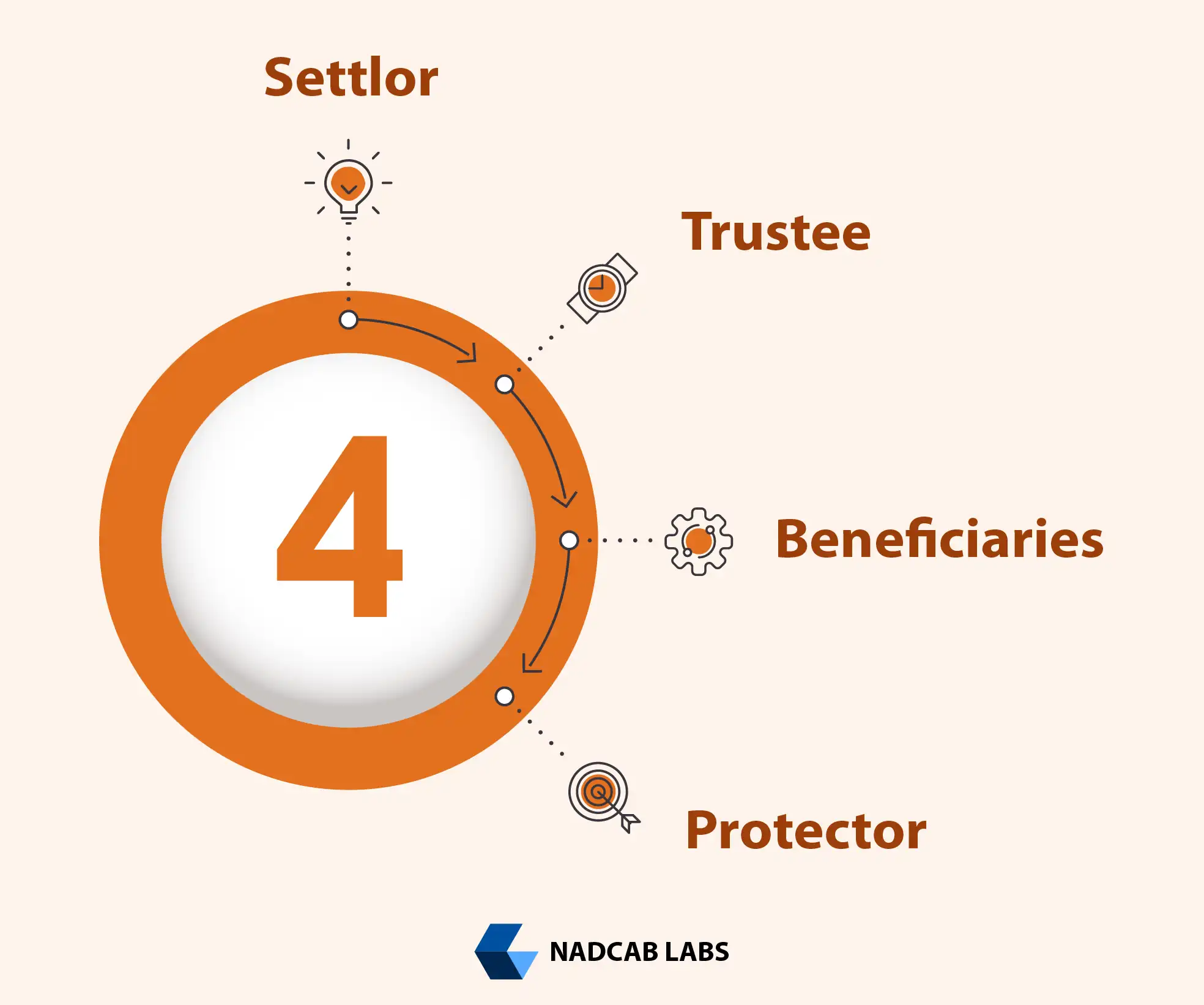
In our practice structuring trust-based tokenizations across common law jurisdictions, we’ve found this real estate tokenization model excels when investor protection, succession planning, and confidentiality represent primary concerns. The trustee holds legal title to property while token holders maintain equitable beneficial interests a separation that creates powerful asset protection and estate planning benefits unavailable in direct ownership or SPV structures.
Trust jurisdictions vary considerably in their suitability for tokenization. We’ve successfully implemented this trust-based real estate tokenization model in Jersey, Guernsey, the Cook Islands, Singapore, and certain US states with favorable trust laws. Each jurisdiction offers distinct advantages, Jersey trusts benefit from robust regulatory oversight and EU market access, Cook Islands trusts provide exceptional asset protection, while Singapore trusts offer tax efficiency and Asian market connectivity.
Structural Elements of Trust-Based Tokenization
Settlor
The party establishing the trust and transferring property into it. Often the original property owner or tokenization platform sponsor who structures the initial arrangement.
Trustee
Professional entity holding legal title and managing trust assets. Must be licensed in the trust jurisdiction and owes fiduciary duties to beneficiaries (token holders).
Beneficiaries
Token holders who possess beneficial interests in trust assets. Their rights are defined by the trust deed and represented by proportional token ownership.
Protector
Optional supervisory role monitoring trustee activities, approving major decisions, and protecting beneficiary interests. Often appointed to represent token holder collective interests.
One compelling advantage of this trust-based real estate tokenization model lies in succession planning. Unlike SPV shares or direct property interests that require probate and may face estate taxes, beneficial interests in certain trusts can pass to heirs outside probate proceedings with significant tax advantages. For international investors, this characteristic proves particularly valuable when holding property in foreign jurisdictions with complex inheritance laws.
Asset protection represents another major trust benefit. In properly structured jurisdictions, trust assets remain protected from settlor creditors after the trust becomes irrevocable. For tokenization, this means property held in trust stays protected from claims against the platform operator or original property owner a protection level difficult to achieve in corporate structures. We’ve seen this protection prove invaluable when tokenization platforms architecture face financial difficulties, with trust-held properties remaining secure for token holders.
Comparative Analysis: Trust vs SPV for International Property
When we structured tokenization for a £12 million London property with predominantly Asian investors in 2020, we compared trust-based and SPV-based real estate tokenization models extensively:
Ultimately, we selected a Jersey trust structure with a professional Channel Islands trustee. The trust held the London property while issuing tokenized beneficial interests to investors. This real estate tokenization model provided optimal tax efficiency for Asian investors, robust asset protection, and simplified succession planning, advantages that outweighed the slightly higher ongoing trustee fees compared to corporate administration costs.
Trust governance requires careful consideration in tokenization contexts. Traditional trusts vest significant discretion in trustees, potentially creating friction with blockchain’s decentralized ethos and token holder expectations for control. We address this by crafting trust deeds that limit trustee discretion for routine matters while requiring token holder votes (implemented through blockchain governance mechanisms) for major decisions. The trustee retains ultimate authority but exercises it according to token holder directives within defined parameters.
Regulatory treatment of trust-based tokens varies by jurisdiction. Some regulators classify beneficial interests as securities requiring registration or exemption compliance, while others treat them as property interests outside securities frameworks. In our experience, engagement with regulators during structure design proves essential we’ve successfully obtained regulatory clarity by presenting detailed trust deeds, token economics, and governance mechanisms before launch.
Expert Perspective: Trust-based real estate tokenization models excel for sophisticated, tax-conscious investors focused on wealth preservation and succession planning. While setup costs typically run 30-50% higher than comparable SPV structures due to professional trustee requirements and specialized legal work, the long-term benefits, particularly for international investors and multi-generational wealth planning, often justify the additional investment. This tokenization model represents our first choice for ultra-high-net-worth family office investments in tokenized real estate.
6. Revenue-Sharing Tokenization Model
Revenue-sharing tokenization models focus on distributing property income streams to token holders rather than providing ownership interests in the underlying asset. This real estate tokenization model mirrors traditional real estate investment trusts (REITs) and income-focused funds, making it conceptually familiar to investors while potentially offering more favorable regulatory treatment than equity-based models.
Throughout our work structuring income-focused tokenizations, we’ve found this real estate tokenization model particularly effective for stabilized commercial properties generating predictable cash flows, retail centers, office buildings, industrial facilities, and multi-family residential properties. The model’s appeal lies in its simplicity: investors purchase tokens representing rights to a proportional share of net operating income without the complexities of property ownership, voting rights, or exit considerations.
| Model Type | Income Rights | Appreciation Rights | Exit Rights | Best Use Case |
|---|---|---|---|---|
| Pure Revenue Sharing | Yes (proportional to tokens) | No | Secondary market only | Income-focused retail investors seeking regular distributions |
| Revenue + Appreciation | Yes | Yes (upon property sale) | Pro-rata proceeds at disposition | Balanced investors wanting both income and growth |
| Preferred Return Model | Yes (priority distribution) | Potentially (after hurdle) | Negotiated liquidation preference | Conservative investors prioritizing downside protection |
| Tiered Revenue Share | Yes (variable based on performance) | Often included | Aligned with equity holders | Sophisticated investors comfortable with performance-based returns |
Legal structuring of revenue-sharing tokenization models typically employs contractual arrangements or profit participation certificates rather than equity securities. This distinction carries significant regulatory implications, properly structured revenue rights may avoid securities classification in certain jurisdictions, reducing compliance burdens and expanding distribution possibilities. However, regulators increasingly scrutinize such structures, and many jurisdictions now treat revenue-sharing tokens as securities regardless of their formal legal structure.
We’ve implemented several variants of this real estate tokenization model, each suited to different property types and investor profiles. Pure revenue models provide only income distributions with no appreciation participation, making them attractive for income-focused retirees or institutions seeking yield. Hybrid models combine income rights with appreciation participation upon eventual property sale, offering balanced risk-return profiles similar to traditional real estate equity investments.
Revenue Distribution Mechanisms
Smart contracts enable automated, transparent revenue distribution with minimal administrative overhead. Our typical implementation follows this flow:
Net operating income flows from property management accounts to a designated smart contract address monthly or quarterly based on distribution schedule.
Contract validates receipt of funds, verifies amount against expected NOI parameters, and logs transaction on blockchain for transparency and auditability.
Contract calculates each token holder’s distribution based on their proportional token ownership at the snapshot date, accounting for any tokens locked or restricted.
Funds automatically transfer to token holder wallets in proportion to their holdings, with transaction fees typically deducted from distribution amounts.
Platform generates distribution reports showing NOI, expenses, per-token distribution amounts, and individual holder allocations for tax reporting and transparency.
Tax treatment of revenue-sharing tokens requires careful structuring. In many jurisdictions, distributions constitute ordinary income taxed at higher rates than capital gains. However, if structured as pass-through arrangements, investors might claim depreciation and other real estate tax benefits offsetting distributed income. We typically engage tax counsel in each relevant jurisdiction to optimize structures for investor tax efficiency.
Plan the Right Real Estate Tokenization Model!
Choosing the correct real estate tokenization model is critical for long-term success. From regulatory compliance and capital structure to liquidity timelines and investor expectations, each decision impacts performance, scalability, and risk.
One challenge we’ve encountered with pure revenue tokenization models concerns investor exit. Without appreciation participation or clear exit mechanisms, investors rely entirely on secondary market liquidity to realize value. If tokens trade at discounts due to limited liquidity, investors effectively suffer capital losses despite properties performing well and generating income. Hybrid models addressing this limitation by including both revenue rights and appreciation participation upon property sale typically prove more successful in attracting and retaining investors.
Case Implementation: Shopping Center Revenue Tokenization
We structured a revenue-sharing tokenization for a $32 million anchored shopping center in 2021 generating approximately $2.4 million annual NOI. Rather than tokenizing equity ownership, we created revenue participation certificates entitling holders to 70% of quarterly NOI distributions, with the remaining 30% retained by the property owner for management and reserves.
This real estate tokenization model issued 10 million tokens at $2.24 each, raising $22.4 million used to pay down existing mortgage debt and fund capital improvements. Token holders received quarterly distributions averaging 7.8% annually based on their proportional holdings. The property owner maintained 100% legal ownership, avoiding complications with existing lenders and preserving operational control.
From a regulatory perspective, we structured the offering under Regulation A+, allowing public solicitation with scaled disclosure requirements. The revenue certificates were classified as securities, but the structure avoided certain equity-related regulations since holders lacked voting rights, management participation, or ownership interests. The project successfully distributed over $3.2 million to token holders over three years before the owner exercised a call option, repurchasing all tokens at a predetermined formula based on trailing NOI, providing investors with both steady income and a modest exit premium.
This case demonstrated the revenue-sharing real estate tokenization model’s effectiveness for properties where ownership wants to raise capital, monetize income streams, and maintain operational control without diluting ownership or granting governance rights to token holders.
7. Debt-Backed Real Estate Tokenization Model
Debt-backed tokenization models represent loans secured by real estate rather than equity ownership or revenue rights. Token holders function as lenders receiving fixed or floating interest payments with principal repayment at maturity, positioned senior to equity holders in the capital structure. This conservative real estate tokenization model appeals to risk-averse investors seeking predictable returns with downside protection through property collateralization.
Our practice structuring debt tokenizations has grown substantially as institutional investors increasingly recognize this real estate tokenization model as a viable alternative to traditional real estate debt instruments. Debt tokens offer several compelling advantages over conventional mortgages: fractional participation enabling diversification across multiple properties with smaller capital commitments, blockchain-enabled secondary market trading providing liquidity unavailable in traditional real estate debt, and transparent on-chain servicing creating real-time visibility into payment status and collateral performance.
Debt Tokenization Structure Variants
Senior Debt Tokens
First lien position on property with priority claim on cash flows and liquidation proceeds. Offers lowest risk and returns, typically 5-8% annually. Loan-to-value ratios usually 50-65% providing substantial equity cushion. Appeals to conservative institutional investors and retirement-focused individuals.
Mezzanine Debt Tokens
Subordinate debt sitting between senior mortgages and equity, secured by pledges of ownership interests rather than direct property liens. Higher returns (9-15%) compensating for increased risk. Often includes equity participation or conversion rights. Attracts sophisticated investors seeking enhanced yield with moderate risk tolerance.
Bridge Loan Tokens
Short-term financing (12-36 months) for property acquisitions, renovations, or transitional situations awaiting permanent financing. Higher rates (8-12%) reflecting shorter duration and execution risk. Often includes origination fees and exit fees. Suits investors comfortable with active monitoring and relatively frequent turnover.
Construction Debt Tokens
Financing for ground-up development or major renovations with funds disbursed based on construction progress. Higher complexity and risk requiring active monitoring and construction expertise. Returns typically 10-15% reflecting development risk. Structured with completion guarantees, payment and performance bonds, and contingency reserves.
Legal documentation for debt tokenizations mirrors traditional loan documentation with blockchain-specific provisions. Promissory notes define principal amounts, interest rates, payment schedules, and default provisions. Mortgages or deeds of trust create security interests in the underlying property. Intercreditor agreements establish priority among multiple debt layers. Token subscription agreements govern investor rights, transfer restrictions, and remedies.
Smart contracts enhance this debt-backed real estate tokenization model through automated interest distributions, transparent payment tracking, and programmable default triggers. Our implementations typically include automated monthly or quarterly interest payments flowing directly to token holder wallets based on their proportional holdings. Payment history records on-chain create immutable audit trails, particularly valuable during workout situations or foreclosure proceedings where payment documentation becomes critical.
| Feature | Debt Tokens | Equity Tokens |
|---|---|---|
| Return Structure | Fixed or floating interest, predictable and contractual | Variable based on property performance and appreciation |
| Risk Profile | Lower risk, senior claim position, collateral protection | Higher risk, residual claim after debt service |
| Upside Participation | Limited or none (except mezzanine with participation) | Full participation in appreciation and profit |
| Governance Rights | None under normal circumstances, protective covenants only | Voting rights on major decisions, ongoing governance |
| Typical Duration | Fixed term (1-7 years) with defined maturity | Indefinite or until property sale/liquidation |
| Securities Classification | Often treated as debt securities, potentially less burdensome regulations | Almost always securities with full regulatory compliance requirements |
| Tax Treatment | Interest income, taxed as ordinary income | Combination of ordinary income (distributions) and capital gains (appreciation) |
Regulatory treatment of debt tokens varies but generally proves more straightforward than equity tokenization. Many jurisdictions exempt certain debt instruments from securities registration if they meet specific criteria regarding sophistication, minimum denominations, or private placement restrictions. However, debt tokens sold to retail investors through public offerings typically require full securities registration or exemption compliance.
Default management and workout procedures require careful advance planning in this tokenized debt real estate tokenization model. Traditional loans involve bilateral negotiations between a single lender and borrower. Tokenized debt involves potentially thousands of token holders requiring collective action mechanisms. We typically appoint a servicer or trustee with authority to manage defaults, negotiate workouts, and enforce remedies on behalf of token holders, with major decisions subject to token holder voting meeting specified thresholds.
Industry Observation: Debt tokenization represents perhaps the most institutionally acceptable form of real estate tokenization we’ve encountered. Traditional fixed-income investors understand debt structures, regulatory frameworks prove more accommodating than equity models, and blockchain technology adds genuine value through enhanced liquidity and operational efficiency. We’ve successfully placed debt tokens with pension funds, insurance companies, and sovereign wealth funds that remain hesitant toward equity tokenization, suggesting this debt-based real estate tokenization model may lead mainstream institutional adoption.
8. Equity vs Debt Tokenization: Key Structural Differences
The fundamental choice between equity and debt tokenization shapes every subsequent decision in a tokenization project. This distinction transcends simple return profiles it affects legal structures, regulatory treatment, investor rights, operational complexity, and long-term strategic flexibility. Our experience structuring both types of real estate tokenization models extensively reveals that success depends on matching model choice to specific project circumstances rather than following industry trends or platform capabilities.
Equity tokenization provides investors with ownership stakes, whether direct property interests, SPV shares, or trust beneficial interests entitling them to residual profits after debt service and expenses. Equity holders bear full property performance risk but capture unlimited upside from appreciation and operational improvements. This alignment of interests makes equity-based real estate tokenization models ideal when sponsors and investors share long-term value creation objectives.
Debt tokenization creates contractual obligations secured by property collateral, offering predictable returns independent of property performance above required debt service coverage. Debt holders enjoy downside protection through security interests and capital structure seniority but sacrifice appreciation participation. This risk-return profile suits income-focused investors prioritizing capital preservation and predictable cash flows over growth potential.
Strategic Considerations in Model Selection
Sponsor Objectives
Equity: Use when sponsor wants partners sharing value creation, maintains operational control, and offers meaningful upside participation.
Debt: Use when sponsor wants capital without ownership dilution, predictable financing costs, and no investor governance interference.
Investor Demographics
Equity: Attracts growth-oriented investors comfortable with volatility, longer hold periods, and active governance participation.
Debt: Appeals to income-focused, risk-averse investors seeking predictability, shorter durations, and passive investment posture.
Property Stage
Equity: Better for stabilized assets with proven cash flows, repositioning opportunities, or development projects where substantial upside exists.
Debt: Appropriate across all stages but particularly suitable for bridge financing, construction lending, or value-add projects with defined exit timelines.
Capital Structure Goals
Equity: Strengthens balance sheet, avoids fixed obligations, maintains financial flexibility for opportunistic acquisitions or market downturns.
Debt: Preserves equity value, provides leverage amplifying returns, maintains existing ownership while accessing growth capital.
Exit Strategy
Equity: Indefinite hold or sale when market timing and valuation optimize returns. Token holders benefit from appreciation timing decisions.
Debt: Fixed maturity or prepayment options provide certain exit dates. Token holders know return profile and duration at investment.
Regulatory Complexity
Equity: Often triggers comprehensive securities regulations, ongoing reporting requirements, and governance compliance obligations.
Debt: May benefit from exemptions or lighter regulatory treatment, though still subject to securities laws in most jurisdictions.
Tax implications differ substantially between these real estate tokenization models. Equity tokenization can provide access to real estate tax benefits including depreciation deductions, 1031 exchanges for tax-deferred property swaps, and favorable long-term capital gains treatment on appreciation. However, equity structures may create partnership taxation complexity, especially with international investors facing withholding requirements and foreign investment reporting obligations.
Debt tokenization typically generates ordinary interest income without real estate tax benefits but offers simpler tax reporting and fewer cross-border complications. Interest deductions benefit borrowers while lenders face straightforward income taxation. For international investors, properly structured debt often avoids or reduces withholding taxes compared to equity distributions, making debt tokens more tax-efficient for certain investor constituencies.
Practical Example: Office Building Capital Stack
Consider a $50 million Class A office building requiring $40 million in capital. The owner could structure this entirely through equity tokenization, or employ a hybrid capital stack combining different real estate tokenization models:
Pure Equity Approach:
Issue equity tokens representing 100% ownership requiring $40M investor capital. Token holders receive all net cash flow and appreciation. Returns variable but potentially 8-15% annually if property performs. Full governance rights to token holders. Higher risk but maximum upside potential.
Hybrid Debt-Equity Approach:
$25M senior debt tokenization at 60% LTV offering 6% fixed interest, 7-year term. $15M equity tokenization for remaining capital. Debt token holders get predictable 6% returns with senior claim. Equity token holders get residual cash flow (potentially 12-18% returns with leverage) and appreciation. Borrower maintains operational control. Diversified risk across investor types.
This example demonstrates how different real estate tokenization models can work complementarily within a single capital structure, serving different investor constituencies while optimizing overall cost of capital and risk allocation.
Market liquidity considerations often favor equity tokenization for secondary trading. Equity tokens typically experience more active secondary markets as growth-oriented investors frequently adjust portfolios, while debt tokens often trade less as fixed-income investors prefer holding to maturity. However, debt tokens enjoy more stable pricing tied to interest rate environments rather than volatile property valuations, potentially making them more suitable for liquidity-constrained platforms.
9. Fractional Ownership Tokenization Model Explained
Fractional ownership tokenization divides property into discrete ownership shares, allowing multiple investors to collectively own a single asset with each holding a proportional interest. While conceptually similar to traditional co-ownership arrangements like tenancy-in-common, blockchain technology transforms this fractional ownership real estate tokenization model by enabling micro-fractionalization, automated governance, instant transferability, and transparent record-keeping impossible in conventional structures.
We’ve implemented this fractional ownership tokenization model across property types from $500,000 residential condominiums to $100+ million commercial assets. The model’s versatility stems from its fundamental simplicity, each token represents a precise fractional interest in property ownership with all associated rights, obligations, and economic benefits. This transparency makes the fractional ownership real estate tokenization model particularly attractive to first-time real estate investors and those seeking diversification through small-dollar commitments across multiple properties.
Key Elements of Fractional Ownership Tokenization
Fractionalization Granularity
Properties can be divided into any number of fractions from tens to millions of shares. We typically recommend 10,000-1,000,000 tokens per property balancing meaningful minimum investments ($100-$1,000) against excessive fractionalization. Higher token counts enable broader investor bases but increase governance complexity and per-holder distribution costs.
Legal Ownership Registration
Fractional interests require legal recognition through property registry filings, SPV share structures, or trust arrangements. Direct fractional registration with land offices provides strongest ownership certainty but proves administratively intensive as tokens trade. SPV-based fractional ownership simplifies transfers by maintaining single registered owner while fractionalized interests represent corporate shares.
Rights and Obligations
Each fractional owner shares proportionally in income, appreciation, expenses, tax benefits, and liability exposure. Token holders typically receive pro-rata income distributions, vote on major decisions weighted by ownership percentage, and bear responsibility for property expenses and potential liabilities. Co-ownership agreements or operating agreements define these rights precisely.
Transfer Mechanisms
Blockchain enables instant peer-to-peer token transfers impossible in traditional fractional ownership requiring title company involvement and registry updates. However, securities regulations often restrict transfers, requiring buyers to meet accreditation standards, complete KYC/AML verification, or wait for hold period expirations. Transfer restrictions must be enforced through smart contract logic.
Use Rights and Occupancy
Fractional ownership raises questions about physical property use. Commercial properties typically generate rental income distributed to all owners. Residential fractional ownership may allocate use rights proportionally (each 10% owner gets 36 days annually) or operate as pure investments without occupancy rights. Clarity on use rights prevents disputes and aligns investor expectations.
This fractional ownership real estate tokenization model particularly benefits residential properties where individual ownership costs prove prohibitive. A $3 million vacation home becomes accessible to 30 investors contributing $100,000 each, or 300 investors at $10,000 each. This democratization expands the investor pool dramatically while providing property owners liquid exit opportunities unavailable when seeking single purchasers for high-value assets.
Governance in fractional ownership structures requires careful design balancing collective decision-making with operational efficiency. We typically implement tiered voting systems where routine operational decisions rest with appointed managers, mid-level decisions require simple majority votes, and major decisions like property sales demand supermajority approval (often 66-75% of ownership). Smart contracts can enforce these voting thresholds automatically, tallying token-weighted votes and executing decisions once thresholds are met.
| Decision Type | Approval Threshold | Implementation Method | Examples |
|---|---|---|---|
| Operational Decisions | Manager discretion, no vote required | Automatic execution by appointed property manager | Routine maintenance, tenant lease approvals, utility contracts, insurance renewals |
| Minor Capital | Simple majority (>50%) | 7-day voting period via platform, token-weighted | Capital improvements under $50K, property management changes, budget amendments <10% |
| Significant Decisions | Supermajority (66-75%) | 14-day voting period with detailed proposal | Major renovations, refinancing, special assessments, property manager termination |
| Extraordinary Decisions | Supermajority (75-80%) | 30-day voting period with third-party analysis | Property sale, major repositioning, structural changes to ownership agreement |
| Emergency Actions | Manager authority with subsequent ratification | Immediate execution, 30-day post-action vote to affirm | Emergency repairs, urgent legal actions, immediate threat response |
Minimum investment thresholds in this fractional ownership real estate tokenization model balance accessibility with practical governance. While blockchain theoretically enables $10 or $50 minimum investments, such micro-ownership creates challenges. Thousands of token holders make consensus difficult to achieve and expensive to administer. We typically recommend minimums of $1,000-$10,000 depending on total property value, striking balances between democratization and operational practicality.
Case Study: Luxury Resort Fractional Ownership
In 2023, we tokenized a $24 million beachfront resort property in the Caribbean, dividing ownership into 240,000 tokens offered at $100 each. The structure combined fractional ownership with use rights, token holders received proportional rental income distributions plus reserved access to the property for personal use.
Each 1,000 tokens (0.42% ownership) entitled holders to one week of annual occupancy plus pro-rata income from weeks they didn’t use. This real estate tokenization model appealed to both investors seeking Caribbean real estate exposure and vacation home buyers wanting flexible destination access without full ownership costs.
The project established a Cayman Islands SPV holding the property, with tokens representing fractional membership interests in the SPV. We implemented a tiered governance system where a professional management company handled operations, token holders voted on major capital improvements and management changes, and property sales required 75% supermajority approval.
Secondary market trading emerged organically as some investors sold tokens to access capital while others accumulated additional tokens to increase use rights. Token prices appreciated 23% over two years as the property underwent renovations increasing rental rates, demonstrating how this fractional ownership real estate tokenization model enables investors to participate in value creation while maintaining liquidity through token trading.
Tax treatment in fractional ownership mirrors direct property ownership when structured properly. Token holders may claim depreciation deductions, deduct proportional expenses, and qualify for 1031 exchange treatment when properties sell. However, complex partnership taxation rules apply when multiple investors own property together, requiring careful tax planning and potentially K-1 distributions for US investors.
10. Lease-Back and Rental Yield Tokenization Model
Lease-back and rental yield tokenization models separate property ownership from operational cash flows, creating investment structures focused purely on income generation rather than ownership rights or appreciation potential. This real estate tokenization model proves particularly effective for commercial properties where stabilized tenant leases provide predictable income streams ideal for yield-oriented investors seeking bond-like returns with real estate backing.
In lease-back arrangements, property owners sell assets to tokenization vehicles while simultaneously entering long-term leases to continue occupying and operating the properties. This strategy enables owners to unlock capital tied up in real estate while maintaining operational control. Token holders purchase these guaranteed lease income streams, receiving fixed returns backed by both tenant creditworthiness and underlying property collateral.
We’ve structured lease-back tokenizations for corporations seeking balance sheet optimization, retailers expanding footprints without capital-intensive property acquisitions, and industrial operators requiring large facilities but preferring to deploy capital into core business operations rather than real estate. These transactions typically involve credit-worthy tenants entering 10-20 year triple-net leases with predetermined rent escalations providing income certainty attractive to conservative investors.
Lease-Back Model Structure and Cash Flows
Rental yield tokenization without lease-back arrangements focuses on existing income-producing properties with diverse tenant bases. Rather than relying on a single lease-back tenant, these structures aggregate rental income from multiple tenants in apartment buildings, shopping centers, or office complexes. Token holders receive proportional shares of net rental income, typically with properties managed by professional third parties handling tenant relations, maintenance, and operations.
The primary investor appeal of this rental yield real estate tokenization model lies in predictable, bond-like income streams without active management responsibilities. Unlike fractional ownership models requiring governance participation, lease-back and rental yield structures position investors as passive income recipients. This simplicity resonates with retail investors unfamiliar with real estate operations and institutional investors seeking real estate exposure without operational complexity.
| Feature | Lease-Back Model | Multi-Tenant Rental Yield Model |
|---|---|---|
| Income Stability | Very high – single creditworthy tenant with long-term lease provides predictability | Moderate – diversified across multiple tenants but subject to turnover and vacancy |
| Default Risk | Concentrated tenant credit risk – single default disrupts all income | Diversified tenant risk – individual defaults have limited portfolio impact |
| Upside Potential | Limited to lease escalations (typically 2-3% annually) plus residual value | Higher potential through market rent growth, occupancy improvements, property appreciation |
| Management Intensity | Very low – tenant handles operations under triple-net lease | Moderate to high – requires active tenant management, leasing, maintenance coordination |
| Investor Profile | Conservative income seekers, retirees, capital preservation focused | Balanced investors seeking income plus growth, comfortable with moderate volatility |
| Best Property Types | Corporate headquarters, industrial facilities, single-tenant retail, specialized facilities | Multifamily apartments, shopping centers, multi-tenant office, diversified commercial |
Regulatory treatment of lease-back and rental yield tokens often depends on structural specifics. Pure income-right tokens without ownership or governance may receive more favorable treatment than equity securities in certain jurisdictions. However, most regulators view these as investment contracts meeting securities definitions, requiring registration or exemption compliance regardless of their characterization as lease rights rather than ownership interests.
One structural consideration in rental yield real estate tokenization models concerns expense allocation and capital reserves. Unlike lease-back models where triple-net leases pass all costs to tenants, multi-tenant properties incur operating expenses, capital expenditures, and vacancy costs reducing distributable income. We typically implement reserve accounts funded from gross revenue to cover major repairs, tenant improvements, and unexpected expenses, with only net income after reserves distributed to token holders.
Professional Insight: Lease-back and rental yield real estate tokenization models excel at bridging traditional fixed-income investing and real estate exposure. We’ve successfully marketed these structures to bond investors seeking higher yields with real asset backing, creating crossover appeal beyond typical real estate investor demographics. The key success factor lies in conservative underwriting, modeling income at stress scenarios rather than peak performance and maintaining substantial reserves for unexpected costs. Over-optimistic projections inevitably disappoint investors when vacancy, maintenance costs, or tenant defaults reduce distributions below expectations.
Real-World Application: Regional Pharmacy Chain Sale-Leaseback
A regional pharmacy chain with 22 locations approached us seeking capital for technology upgrades and market expansion without taking on traditional debt or diluting equity. We structured a sale-leaseback tokenization of their entire property portfolio valued at $67 million.
The pharmacy company sold all properties to a newly formed SPV, receiving $67 million in immediate capital. Simultaneously, they entered 20-year triple-net leases on all locations with 2.5% annual rent escalations. The SPV issued tokens to investors offering 7.2% annual yields backed by the pharmacy’s lease obligations and underlying property values.
Token holders received quarterly distributions with payments flowing automatically from the pharmacy to the SPV to token holder wallets. The pharmacy maintained complete operational control of their locations while freeing capital previously locked in real estate. Investors gained exposure to a diversified portfolio of pharmacy locations with income backed by both lease obligations and $67 million in real estate collateral.
This lease-back real estate tokenization model proved mutually beneficial, the pharmacy expanded successfully with the freed capital while token holders enjoyed stable 7.2% returns for five years before the portfolio was sold to a larger REIT at a 14% premium, providing investors with both steady income and modest capital appreciation at exit.
11. Hybrid Real Estate Tokenization Models
Hybrid tokenization models combine multiple approaches within single structures, creating sophisticated capital architectures that serve diverse investor constituencies simultaneously. Rather than choosing between debt or equity, ownership or revenue rights, hybrid real estate tokenization models strategically blend elements to optimize risk-return profiles, expand investor appeal, and create operational flexibility unavailable in pure models.
Throughout our advanced structuring work, we’ve found hybrid real estate tokenization models particularly valuable for large-scale projects requiring significant capital from multiple investor types. A major development project might employ senior debt tokens for conservative institutional investors, mezzanine debt tokens for moderate risk-takers, preferred equity tokens for balanced investors seeking enhanced yields, and common equity tokens for aggressive growth investors, all within a single integrated capital structure financing one property.
Common Hybrid Model Configurations
Debt-Equity Hybrid (Tiered Capital Stack)
Combines debt and equity tokens in layered structure with each tier having distinct risk-return characteristics. Senior debt provides stability, subordinate debt enhances yield, preferred equity offers moderate growth potential, and common equity captures upside.
Income-Appreciation Split
Separates current income rights from appreciation rights into distinct token classes. Income tokens receive all rental cash flows with no appreciation participation. Appreciation tokens receive minimal current distributions but capture full value growth at sale.
Voting-Nonvoting Hybrid
Issues separate token classes with identical economic rights but different governance rights. Voting tokens carry premium prices for control-oriented investors. Nonvoting tokens offer pure economic exposure at discounts for passive investors.
Geographic Diversification Hybrid
Master token representing diversified portfolio of properties with option for investors to acquire property-specific sub-tokens providing direct exposure to individual assets within portfolio while maintaining master token liquidity benefits.
The complexity of hybrid real estate tokenization models requires sophisticated legal structuring and technology implementation. Smart contracts must enforce waterfall distributions, voting rights, transfer restrictions, and governance procedures across multiple token classes simultaneously. Legal documentation must clearly define rights and priorities for each class while maintaining flexibility for future adjustments as properties perform and markets evolve.
One particularly effective hybrid approach we’ve implemented combines preferred return structures with equity participation. Preferred token holders receive priority distributions until achieving specified return thresholds (typically 6-8% annually), after which common equity holders begin participating in profits. This hybrid real estate tokenization model provides downside protection and predictable income for conservative investors while maintaining upside potential for aggressive equity holders willing to accept subordination.
| Capital Layer | Priority | Target Return | Risk Level | Typical Investor |
|---|---|---|---|---|
| Senior Debt Tokens | 1st (highest priority) | 5-7% fixed | Lowest | Pension funds, insurance companies, conservative institutions |
| Mezzanine Debt Tokens | 2nd | 9-13% fixed + potential equity kicker | Moderate | Yield-focused funds, accredited retail investors |
| Preferred Equity Tokens | 3rd | 10-15% preferred + appreciation upside | Moderate-High | Balanced funds, sophisticated individual investors |
| Common Equity Tokens | 4th (residual claim) | 15-25%+ variable, unlimited upside | Highest | Aggressive growth funds, sponsors, opportunistic investors |
| Sponsor Promote | Last (after hurdles) | 20-30% of profits above preferred returns | Highest (no capital at risk) | Property sponsors, developers, operators |
Marketing hybrid structures requires educational sophistication. Investors must understand multiple token classes, distribution waterfalls, priority structures, and the interplay between different layers. We’ve found success using visualization tools, interactive calculators showing returns under various scenarios, and detailed comparison matrices helping investors identify appropriate token classes for their risk-return preferences.
Complex Hybrid Case Study: Mixed-Use Development
We structured a $180 million ground-up mixed-use development in a major metropolitan market using a comprehensive hybrid real estate tokenization model serving seven distinct investor constituencies:
Layer 1 – Construction Senior Debt ($95M): Traditional bank financing at 65% LTC (loan-to-cost), not tokenized, providing base project funding.
Layer 2 – Mezzanine Debt Tokens ($25M): 24-month term at 12% interest, subordinate to construction loan, providing gap financing through construction period. Targeting institutional credit funds and sophisticated family offices.
Layer 3 – Preferred Equity Tokens ($35M): 15% preferred return cumulative, participating in profits after 15% IRR hurdle. Targeting opportunistic real estate funds and high-net-worth individuals.
Layer 4 – Common Equity Tokens ($25M): Residual profits after all senior layers satisfied, unlimited appreciation potential. Offered to sponsor insiders, developer principals, and aggressive growth investors.
Additionally, we separated residential and commercial components into distinct token series. Residential tokens provided exposure solely to the apartment tower cash flows and value, while commercial tokens isolated retail and office components. This allowed investors to express specific property type preferences while participating in the broader development.
This complex hybrid real estate tokenization model required 18 months to structure, nine separate legal agreements, and custom smart contracts managing distribution waterfalls across five token classes. However, the effort enabled comprehensive capital raising from diverse sources impossible with simpler structures. The project successfully raised all required equity capital and is currently under construction, with preferred and common equity tokens trading on secondary markets at premiums to original offering prices as construction progresses ahead of schedule.
Hybrid real estate tokenization models’ flexibility extends to exit strategies. Different token classes can have different exit timelines, allowing mezzanine debt to mature and repay while equity remains invested. Some structures include redemption provisions where operating cash flows gradually buy back senior classes over time, progressively simplifying capital structures as properties stabilize. This temporal dimension adds sophisticated portfolio management capabilities unavailable in single-class structures.
12. Permissioned vs Permissionless Tokenization Models
The choice between permissioned and permissionless tokenization fundamentally determines who can invest, how tokens transfer, and what regulatory obligations apply. This architectural decision profoundly impacts investor accessibility, secondary market liquidity, regulatory compliance complexity, and platform operational models, making it among the most consequential early decisions in any real estate tokenization model selection.
Permissioned real estate tokenization models restrict token ownership and transfers to verified participants meeting specified criteria typically accredited investor status, jurisdiction eligibility, and KYC/AML compliance. Smart contracts enforce these restrictions automatically, preventing unauthorized transfers and maintaining controlled investor bases compliant with securities regulations. This approach dominates institutional tokenization where regulatory compliance and investor suitability take precedence over broad accessibility.
Permissionless models allow unrestricted token ownership and transfer similar to public cryptocurrencies like Bitcoin or Ethereum. Any wallet address can hold and trade tokens without prior approval or verification. While theoretically democratizing access, permissionless real estate tokenization faces substantial regulatory challenges since most jurisdictions require investor accreditation and ongoing compliance for real estate securities.
Permissioned Model Implementation
Based on our extensive experience with permissioned systems, successful implementation requires several integrated components:
Identity Verification Layer
Integrated KYC/AML systems verifying investor identities, screening against sanctions lists, and establishing jurisdiction eligibility before wallet whitelisting. Typically outsourced to specialized providers like Jumio, Onfido, or Chainalysis.
Accreditation Verification
Systems confirming investors meet accreditation requirements through income verification, net worth documentation, professional licensing, or institutional status. Services like Verify Investor or North Capital automate this process while maintaining audit trails.
Smart Contract Access Controls
Token contracts with transfer restrictions embedded in code. Only wallets on approved whitelists can receive tokens. Attempted transfers to non-whitelisted addresses automatically revert, preventing unauthorized ownership.
Ongoing Monitoring
Continuous compliance monitoring checking wallet activities against regulatory requirements, identifying suspicious patterns, and flagging potential violations. Automated systems monitor transaction patterns while compliance teams investigate anomalies.
Reporting Infrastructure
Systems generating regulatory reports, investor communications, and audit documentation. Critical for securities compliance requiring annual reports, quarterly updates, and material event disclosures to token holders.
| Dimension | Permissioned Model | Permissionless Model |
|---|---|---|
| Investor Accessibility | Limited to verified, accredited investors in permitted jurisdictions | Open to anyone globally without restrictions or verification |
| Regulatory Compliance | High – meets securities regulations through access controls and monitoring | Very difficult – likely violates securities laws in most jurisdictions |
| Implementation Complexity | High – requires KYC/AML, whitelist management, ongoing monitoring systems | Low – standard token contracts without access restrictions |
| Secondary Market Liquidity | Moderate – limited to approved exchanges and qualified investors | Potentially high – can trade on any DEX or exchange without restrictions |
| Institutional Appeal | Strong – controlled environment meeting institutional compliance requirements | Weak – regulatory uncertainty and lack of controls deter institutions |
| Operational Costs | Higher – ongoing KYC, compliance monitoring, reporting infrastructure | Lower – minimal operational overhead beyond smart contract deployment |
| Legal Risk | Lower – proactive compliance reduces regulatory enforcement risk | Very high – likely securities violations expose projects to enforcement actions |
The reality of real estate tokenization is that truly permissionless models remain largely theoretical for traditional property assets. Real estate securities regulations in virtually all major jurisdictions require investor verification, transfer restrictions, and ongoing reporting requirements incompatible with fully open token systems. Attempts at permissionless real estate tokenization have consistently faced regulatory challenges, enforcement actions, or market failure due to institutional avoidance.
However, hybrid approaches attempt to capture permissionless benefits while maintaining regulatory compliance. Some projects launch as permissioned offerings to compliant investors, then transition to permissionless trading after statutory hold periods expire and tokens become freely tradeable. Others implement progressive decentralization where initial tight controls gradually relax as regulatory certainty increases and platforms mature.
Regulatory Reality Check: After eight years structuring real estate tokenization across multiple jurisdictions, we’ve yet to identify a viable path to fully permissionless tokenization for traditional real property that wouldn’t violate securities laws. The SEC, FCA, MAS, and other major regulators consistently treat real estate-backed tokens as securities requiring investor protection provisions fundamentally incompatible with permissionless systems. Projects pursuing permissionless models either operate in gray markets facing eventual enforcement, target properties in unregulated jurisdictions with limited investor protection, or represent speculative experiments rather than sustainable business models. For serious tokenization projects seeking institutional capital and long-term viability, permissioned real estate tokenization models remain the only practical approach.
Transfer agent integration represents a critical component of permissioned models. These entities maintain official shareholder registries, process transfers, ensure compliance with securities regulations, and provide issuer services like distribution processing and investor communications. In tokenized contexts, transfer agents validate blockchain transactions against official records, maintaining the legal link between tokens and underlying securities. Major providers like Pacific Stock Transfer, Computershare, and specialized crypto transfer agents like Tokensoft provide these services.
13. Public Blockchain vs Private Blockchain Tokenization Models
Blockchain selection profoundly impacts tokenization project operations, costs, investor accessibility, and long-term sustainability. The choice between public blockchains (Ethereum, Polygon, Avalanche) and private blockchains (Hyperledger, Corda, proprietary networks) reflects fundamental trade-offs between decentralization and control, transparency and privacy, accessibility and governance, each dimension carrying significant implications for which real estate tokenization model succeeds.
Public blockchains offer unparalleled transparency, established ecosystems, proven security through decentralization, and interoperability with existing DeFi infrastructure. These networks operate outside any single entity’s control, providing censorship resistance and operational certainty appealing to retail investors and crypto-native participants. However, public chains expose transaction details publicly, operate with immutable rules limiting customization, and charge variable transaction fees based on network congestion.
Private blockchains provide controlled environments where operators define participation rules, customize protocols for specific needs, maintain transaction privacy, and manage costs predictably. These advantages resonate strongly with institutional investors prioritizing confidentiality, compliance, and operational flexibility. Yet private chains sacrifice public blockchain’s transparency, require ongoing infrastructure maintenance, and lack established secondary market ecosystems, potentially limiting liquidity.
Decision Framework for Blockchain Selection
- Retail investor accessibility is priority
- Maximum transparency builds trust
- Integration with DeFi protocols desired
- Cost predictability less critical than openness
- Decentralization provides credibility
- Established secondary markets essential
- Long-term operational certainty valued
- Institutional investors dominate target market
- Transaction privacy legally required
- Custom governance rules needed
- Predictable, low transaction costs critical
- Regulatory compliance demands control
- Internal operations more important than public trading
- Proprietary technology provides competitive advantage
Our practice employs both approaches depending on project characteristics. Public blockchain implementations typically use Ethereum mainnet for high-value, internationally marketed offerings where decentralization and established ecosystems justify higher transaction costs. Layer-2 solutions like Polygon serve mid-market projects requiring public blockchain benefits with dramatically reduced fees. Private implementations utilize permissioned networks for institutional projects where confidentiality, custom workflows, and predictable costs outweigh public transparency advantages.
| Consideration | Public Blockchain | Private Blockchain | Hybrid Approach |
|---|---|---|---|
| Transaction Costs | Variable, potentially high during congestion ($5-$100+ per transaction) | Minimal, predictable (fractions of cents per transaction) | Private for operations, public for settlement |
| Transaction Privacy | Public visibility of all transfers and amounts (pseudonymous addresses) | Full confidentiality, visible only to authorized participants | Configurable privacy levels |
| Speed & Throughput | Moderate (Ethereum: 15 TPS, L2s: 2000+ TPS) | High (thousands to tens of thousands TPS possible) | High for internal ops, moderate for public settlement |
| Infrastructure Costs | Minimal – no infrastructure to maintain, pay per transaction | Significant – node hosting, maintenance, upgrades, security | Moderate – private infrastructure plus public network fees |
| Customization | Limited to smart contract capabilities within network rules | Extensive – can modify consensus, governance, transaction logic | Private chain customization with public chain standardization |
| Interoperability | High – established standards, wallet support, exchange integration | Limited – requires custom integration for external connectivity | Bridges enable cross-chain functionality |
| Regulatory Control | Difficult – immutable rules, censorship-resistant | Complete – operators control all aspects, can implement any compliance rules | Balanced – control where needed, decentralization where valued |
Hybrid architectures represent an increasingly popular approach combining public and private blockchain strengths within a single real estate tokenization model. These systems operate internal workflows on private networks providing privacy, speed, and cost efficiency while periodically settling to public blockchains for transparency and interoperability benefits. For example, daily property operations, investor communications, and distribution calculations might occur on private infrastructure with weekly or monthly state commitments to public chains creating immutable audit trails.
Layer-2 solutions have dramatically shifted public blockchain economics for real estate tokenization. Networks like Polygon, Optimism, and Arbitrum provide Ethereum security guarantees while reducing transaction costs by 100-1000x compared to mainnet. A token transfer costing $50 on Ethereum mainnet executes for $0.05 on Polygon making public blockchain economics viable for applications requiring frequent transactions like daily income distributions or active secondary trading.
Implementation Example: Dual-Chain Architecture
For a $150 million institutional real estate portfolio tokenization in 2022, we implemented a sophisticated dual-chain real estate tokenization model balancing public transparency with institutional requirements:
Private Chain Layer (Hyperledger Fabric): Maintained detailed investor records, processed daily income calculations, managed governance votes, handled internal compliance workflows, and provided instant free transfers for institutional participants. Full privacy with only authorized parties viewing transaction details.
Public Chain Layer (Ethereum): Weekly settlement batches aggregated all private chain activity into state commitments published on Ethereum mainnet. Each batch included cryptographic proofs enabling verification of private chain integrity without exposing confidential transaction details. Token balances periodically synchronized to public chain for interoperability with exchanges and DeFi protocols.
This hybrid real estate tokenization model provided institutions with required privacy and control while enabling retail investors to trade tokens on public exchanges with full blockchain transparency. The hybrid approach reduced operational costs by 90%+ compared to pure public implementation while maintaining credible decentralization through public chain settlement. Four years later, the system continues operating successfully with zero security incidents and high institutional satisfaction.
The blockchain selection decision often correlates with jurisdictional considerations. Projects in crypto-progressive jurisdictions like Switzerland, Singapore, or Wyoming may favor public blockchains given regulatory frameworks accommodating decentralized systems. Conversely, projects in more conservative markets or those targeting traditional financial institutions often default to private blockchains providing familiarity and control reminiscent of existing systems.
14. Compliance-Driven Tokenization Models (KYC & Jurisdiction)
Regulatory compliance represents perhaps the single most critical consideration in real estate tokenization, often dictating model selection, operational architecture, and go-to-market strategies more than any economic or technical factors. Securities regulations, anti-money laundering requirements, tax compliance obligations, and cross-border restrictions create complex webs of requirements that successful real estate tokenization models must navigate comprehensively.
Throughout our extensive compliance work spanning multiple jurisdictions, we’ve observed that projects treating compliance as an afterthought consistently face difficulties, regulatory inquiries, enforcement actions, investor protection issues, and market access limitations. Conversely, projects integrating compliance into foundational design decisions from inception operate smoothly, attract institutional capital, and scale sustainably across multiple markets.
Core Compliance Components
Know Your Customer (KYC)
Identity verification processes confirming investor identities through government-issued documentation, biometric verification, and database cross-checks. Required in virtually all jurisdictions for securities offerings. Implementation typically involves third-party KYC providers like Jumio, Onfido, or Sumsub integrated into investor onboarding flows.
Anti-Money Laundering (AML)
Ongoing monitoring for suspicious activity, source of funds verification, screening against sanctions lists (OFAC, UN, EU), and suspicious activity reporting. Requires continuous transaction monitoring systems analyzing patterns for potential money laundering or terrorist financing indicators.
Accreditation Verification
Confirmation that investors meet sophistication requirements for restricted securities offerings. US accredited investor standards require $1M+ net worth (excluding primary residence) or $200K+ annual income. Other jurisdictions have similar qualified investor definitions requiring verification and documentation.
Jurisdiction Restrictions
Blocking investors from prohibited jurisdictions due to sanctions (Iran, North Korea), regulatory restrictions, or offering limitations. Must be enforced at onboarding and through ongoing monitoring preventing unauthorized transfers to restricted regions.
Ongoing Reporting
Regular disclosures to investors and regulators including financial statements, property performance updates, material event notifications, and regulatory filings. Requirements vary dramatically by jurisdiction and offering structure but generally increase with broader public offerings.
Securities offering exemptions represent critical compliance pathways enabling real estate tokenization within regulatory frameworks. In the United States, Regulation D (Rules 506b and 506c) provides private placement exemptions for accredited investors, Regulation A offers scaled public offerings up to $75 million with reduced disclosure requirements, and Regulation CF enables crowdfunding up to $5 million from retail investors. Each exemption carries distinct requirements, investor limitations, and ongoing obligations that dramatically impact project structure and operations.
International compliance introduces additional complexity layers. A real estate tokenization model marketing globally must consider securities regulations in each target jurisdiction MiFID II in Europe, MAS frameworks in Singapore, SFC regulations in Hong Kong, and countless other regulatory regimes. The common approach involves establishing master offshore entities in favorable jurisdictions while creating subsidiary entities or distribution arrangements for specific markets requiring local presence.
| US Exemption | Investor Type | Raise Limit | Marketing Allowed | Ongoing Reporting |
|---|---|---|---|---|
| Reg D 506(b) | Accredited + up to 35 sophisticated non-accredited | Unlimited | No general solicitation permitted | Minimal – Form D filing only |
| Reg D 506(c) | Accredited investors only (verified) | Unlimited | Yes – general solicitation allowed | Minimal – Form D filing + verification records |
| Regulation A+ | Both accredited and non-accredited retail | $75M (Tier 2) | Yes – full public offering allowed | Significant – audited financials, annual reports, semi-annual reports |
| Regulation CF | General public (investment limits apply) | $5M annually | Yes – through approved platforms only | Annual reports required |
| Reg S | Non-US investors outside US | Unlimited | Yes – outside US only | None in US (foreign jurisdiction requirements apply) |
Tax compliance adds another dimension to compliance-driven real estate tokenization model design. Token holders may face income tax on distributions, capital gains tax on appreciation, and potentially foreign tax withholding on cross-border investments. Projects must issue appropriate tax documentation (1099s, K-1s for partnerships, foreign withholding certificates) and implement withholding systems where required. The complexity multiplies dramatically with international investor bases facing different tax treatments in each home jurisdiction.
Compliance Lesson Learned: In our early tokenization projects, we underestimated ongoing compliance costs and operational burdens. A project that seemed economically viable at $50K annual compliance costs became barely profitable when actual requirements reached $250K annually for multi-jurisdiction reporting, investor communications, regulatory filings, and compliance monitoring. Current best practice includes comprehensive compliance budgeting during feasibility analysis, typically allocating 15-25% of annual operational budgets to compliance activities for international offerings. Projects unable to support this compliance overhead should reconsider tokenization approaches or target single-jurisdiction implementations with lower requirements.
15. Governance and Voting-Enabled Tokenization Models
Governance mechanisms in tokenized real estate determine how collective ownership makes decisions, from routine operational matters to fundamental strategic choices about property management, capital improvements, refinancing, and eventual disposition. Well-designed governance systems balance efficiency with democratic participation, protecting minority token holder rights while enabling timely decision-making essential for effective property management.
Build Tokenization with Long-Term Vision!
Real estate tokenization succeeds when the model is designed for scale, compliance, and real market behavior. Aligning structure, governance, and investor access from the start helps avoid costly redesigns and ensures the asset remains investable as markets mature.
Traditional real estate ownership structures employ established governance frameworks corporate bylaws for company-owned properties, partnership agreements for joint ventures, and condominium associations for multi-unit residential. Tokenization enables more sophisticated, transparent, and automated governance through blockchain-based voting systems, but also introduces challenges around voter participation, quorum requirements, and execution of collective decisions across potentially thousands of dispersed token holders.
Governance Model Architectures
Direct Democracy Model
All token holders vote on all decisions proportional to ownership. Maximum democracy but operationally cumbersome for routine matters. Works best for smaller token holder populations (under 100) or major decisions requiring broad consensus.
Representative/Delegated Governance
Token holders elect representatives or delegate voting power to sophisticated participants making day-to-day decisions. Reduces voter fatigue while maintaining oversight through periodic elections and major decision requirements.
Tiered Decision Framework
Different decision types require different approval levels. Routine operations delegated to managers, significant decisions require majority votes, extraordinary decisions demand supermajorities. Most practical for real estate given varying decision importance.
Quadratic Voting Systems
Voting power scales quadratically with token holdings rather than linearly, reducing concentration of control by large holders. Experimental but potentially valuable for broader token holder engagement and minority protection.
Voter participation rates represent persistent governance challenges in tokenized real estate. Traditional corporate governance struggles with shareholder apathy; tokenized structures face similar issues despite blockchain’s reduced friction for voting. We consistently observe participation rates of 15-35% for routine proposals, rising to 45-65% for major decisions affecting property disposition or significant capital calls.
Quorum requirements balance democratic legitimacy with operational practicality. Setting quorums too high creates gridlock when participation falls short, while low quorums enable small minorities to control decisions. Our standard approach implements variable quorums 20-30% for routine matters, 40-50% for significant decisions, 60-75% for extraordinary actions like forced sales. Failed votes due to insufficient quorum typically trigger extended voting periods or alternative approval mechanisms preventing operational paralysis.
| Governance Challenge | Traditional Solution | Blockchain-Enhanced Solution |
|---|---|---|
| Low Voter Participation | Proxy voting, vote solicitation campaigns, reduced quorums over time | Delegated voting enabling passive holders to assign votes, mobile voting apps reducing friction, incentivized participation through voting rewards |
| Vote Buying / Manipulation | Legal restrictions on vote buying, disclosure requirements, enforcement actions | Snapshot voting at random blocks preventing last-minute token accumulation, time-weighted voting favoring long-term holders, quadratic mechanisms reducing concentration |
| Lack of Voter Education | Proxy statements, investor presentations, management recommendations | On-chain proposal discussions, expert analysis tools, scenario modeling showing vote outcome impacts, AI-powered voting assistants |
| Execution Delays | Board authority, management discretion, emergency provisions | Automatic execution via smart contracts upon vote completion, pre-authorized emergency response protocols, timeclocks for major decisions allowing override periods |
| Minority Protection | Supermajority requirements, class voting, appraisal rights, tag-along provisions | Codified supermajority requirements in smart contracts, class-based voting for different token types, automated buyout offers at fair value when thresholds met |
Smart contract execution of governance decisions represents blockchain governance’s most powerful feature. Once votes reach required thresholds, smart contracts automatically execute decisions, transferring funds for approved capital improvements, initiating property sales, or modifying operational parameters. This automation eliminates execution delays and ensures collective decisions translate immediately into action, though it also demands careful smart contract design preventing unintended outcomes from poorly specified proposals.
Emergency governance provisions prove essential for time-sensitive situations requiring immediate action without lengthy voting periods. Fire damage, urgent maintenance needs, legal threats, or market opportunities often demand responses faster than typical governance cycles permit. We typically grant property managers limited emergency authority with subsequent token holder ratification within 30 days, allowing rapid response while maintaining democratic accountability.
Governance Innovation Case Study
For a $42 million tokenized apartment complex with 3,200 token holders in 2023, we implemented an innovative governance system within this real estate tokenization model addressing participation challenges:
Delegated Voting Core: Token holders could delegate voting power to elected representatives or retain direct voting rights. Approximately 65% delegated votes, creating a 12-member governance council handling routine decisions while major actions still required broad token holder approval.
Participation Incentives: Active voters received small bonus distributions (0.5% APY premium) from a governance participation pool, materially increasing engagement. Participation rates rose from 22% to 54% after implementation.
Expertise Matching: Proposals were tagged by type (financial, legal, operational, environmental) and token holders with verified expertise in relevant areas received notifications and enhanced voting weights (1.5x) on their specialty proposals, improving decision quality.
This system operated successfully for two years, making 37 collective decisions including a major refinancing, HVAC system upgrades, and solar panel installation. Token holder satisfaction surveys showed 82% approval of governance processes compared to 45% in comparable traditionally managed properties demonstrating blockchain governance’s potential when thoughtfully designed.
16. Secondary Market and Liquidity-Focused Tokenization Models
Liquidity represents one of tokenization’s most compelling value propositions, the promise that fractional real estate investments historically locked up for years can trade actively on secondary markets, providing investors with exit options and price discovery mechanisms unavailable in traditional structures. However, achieving meaningful liquidity requires deliberate real estate tokenization model design, market-making infrastructure, and realistic expectations about trading volumes relative to traditional securities markets.
Throughout our work across numerous tokenization projects, we’ve observed enormous variance in secondary market success. Projects achieving consistent trading volumes share common characteristics: appropriate regulatory structures enabling broad trading, integration with established exchanges or market-making platforms, sufficient investor bases supporting both buy and sell sides, and property types with appeal to secondary market participants. Conversely, projects assuming tokenization automatically creates liquidity frequently disappoint as illiquid tokens fail to attract active trading despite blockchain infrastructure.
Secondary Market Infrastructure Options
Regulated Security Token Exchanges
Licensed alternative trading systems (ATS) or multilateral trading facilities (MTF) providing compliant secondary trading for security tokens. Examples include tZERO, INX, Archax. Offer regulatory certainty and institutional credibility but require listing approval and ongoing fees.
Peer-to-Peer Bulletin Boards
Platform-operated matching systems connecting buyers and sellers without operating as regulated exchanges. Lighter regulatory burden but less liquidity and price discovery. Often used as interim solutions before listing on formal exchanges.
Automated Market Makers (AMMs)
DeFi-style liquidity pools where tokens trade against stablecoins or other assets using algorithmic pricing. Provides continuous liquidity but introduces price volatility and requires substantial liquidity provision. Regulatory treatment remains unclear in most jurisdictions.
Professional Market Making
Dedicated market makers providing continuous bid-ask quotes, ensuring baseline liquidity. Most effective for maintaining orderly markets but requires ongoing costs ($5K-$25K monthly depending on token) and sufficiently valuable offerings justifying the expense.
Liquidity is not binary but exists on a spectrum. Trading volume, bid-ask spreads, price impact, and time-to-execution all contribute to practical liquidity. A token theoretically tradeable on an exchange but with weekly $10,000 volumes and 10% bid-ask spreads offers limited practical liquidity compared to traditional REITs trading millions daily with sub-1% spreads. Realistic liquidity expectations based on property size, investor base, and market infrastructure prevent disappointment.
Hold periods and transfer restrictions significantly impact secondary market development. Securities sold under Regulation D Rule 506 typically face 12-month holding periods before resale, while Regulation S offerings to non-US investors impose restrictions preventing immediate US resale. These limitations mean secondary markets often remain inactive for months post-issuance, then activate gradually as tokens become freely tradeable. Project marketing should communicate realistic timelines for liquidity development rather than implying immediate trading upon token distribution.
| Factor | Impact on Liquidity | Optimization Strategy |
|---|---|---|
| Offering Size | Larger offerings create deeper markets with more participants and better price discovery | Target minimum $10M+ for meaningful secondary trading; consider portfolios over single smaller properties |
| Investor Count | More diverse investor base increases natural buyer-seller matching frequency | Favor models enabling broad distribution (Reg A+, CF) over concentrated institutional holdings for retail liquidity |
| Property Type | Mainstream commercial properties attract broader interest than specialized or niche assets | Multifamily, office, retail trade more actively than specialized facilities like data centers or medical buildings |
| Transfer Restrictions | Tight restrictions on who can buy tokens severely limit secondary market participation | Balance compliance needs with accessibility; transition from accredited-only to broader eligibility post-hold periods where possible |
| Yield/Distributions | Regular income distributions maintain investor interest and attract yield-focused buyers | Consistent quarterly distributions make tokens more attractive than pure appreciation plays with no cash flow |
| Information Quality | Transparent reporting and property data enable informed trading and price discovery | Regular updates, detailed financials, third-party appraisals provide information foundation for active secondary markets |
Pricing mechanisms in secondary markets vary by infrastructure. Exchange-based trading uses traditional order books with continuous price discovery through buyer-seller matching. AMM approaches employ algorithmic pricing based on liquidity pool ratios. Bulletin board systems often use negotiated pricing between counterparties. Each approach creates different price dynamics, order book exchanges provide transparency but require two-sided liquidity, AMMs guarantee execution but introduce slippage, negotiated trades allow flexibility but lack standardization.
Tax treatment of secondary market trades requires careful consideration. In many jurisdictions, token sales trigger capital gains obligations, requiring investors to track cost basis and report gains/losses. Platforms should provide transaction history exports compatible with tax software, ideally including cost basis tracking. Some structures implement Section 1031 exchange compatibility for US investors, allowing tax-deferred swaps between tokenized properties under specific conditions.
Liquidity Reality Check: After facilitating secondary trading across numerous real estate tokenization models, we’ve learned that sustainable liquidity requires years to develop, not months. Typical patterns show minimal trading in months 0-12 (hold periods), sporadic activity in months 12-24 as early sellers emerge, and more consistent volumes only materializing in years 3+ as awareness grows and natural rebalancing occurs. Projects promising immediate liquid markets consistently underdeliver. Successful approaches set realistic expectations, invest in market-making infrastructure, maintain high-quality investor communications building confidence, and recognize that liquidity development is a multi-year journey requiring sustained effort and capital commitment.
17. Choosing the Right Real Estate Tokenization Model
Selecting the optimal real estate tokenization model represents a complex multi-variable optimization problem balancing regulatory requirements, investor preferences, property characteristics, cost structures, operational capabilities, and strategic objectives. No single tokenization model suits all circumstances, successful projects begin with comprehensive analysis of specific constraints and opportunities before committing to architectural decisions that will shape operations for years.
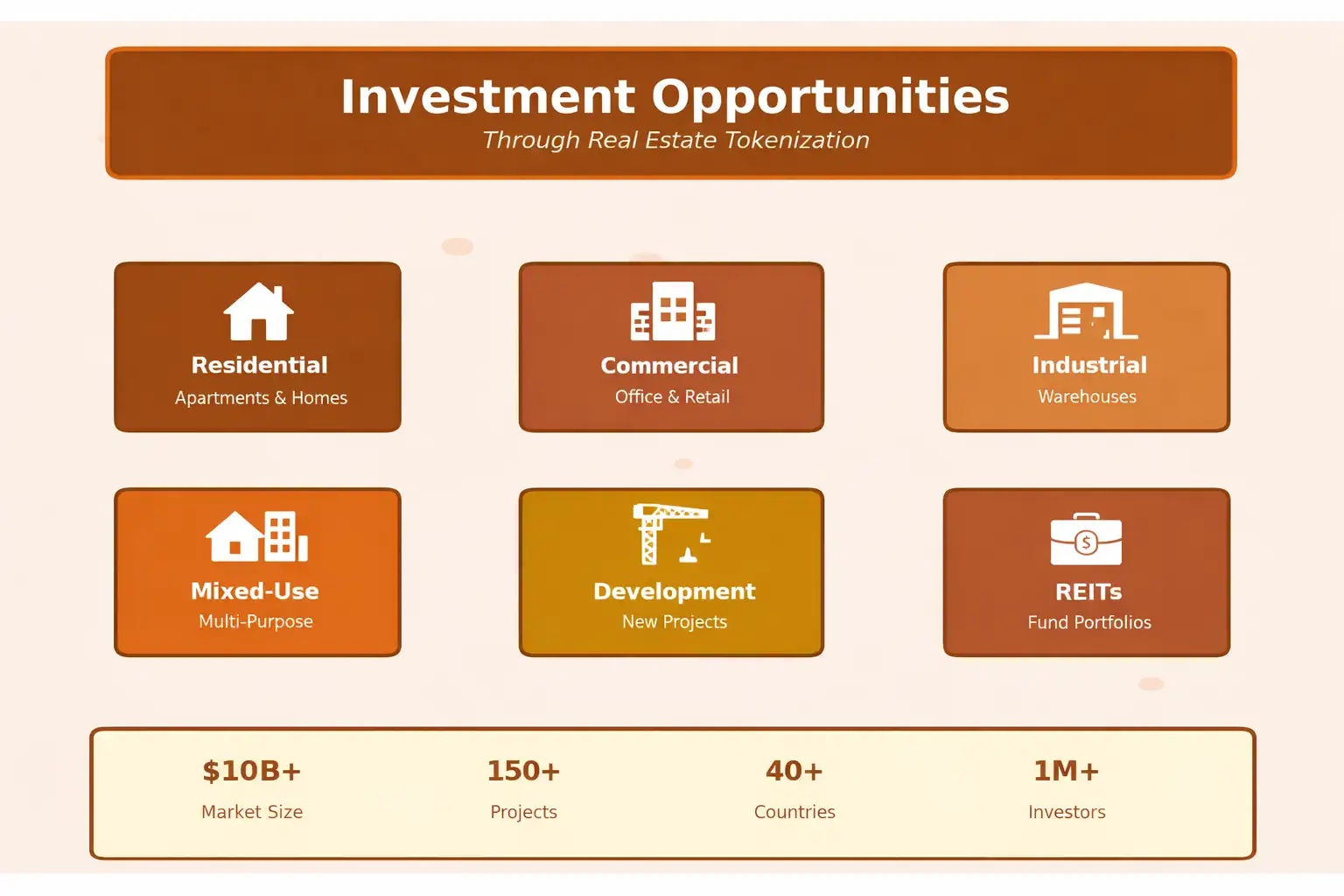
Based on our extensive experience across diverse projects, property types, and jurisdictions, we’ve developed a systematic framework for real estate tokenization model selection. This framework progresses through regulatory feasibility assessment, investor demographic analysis, property evaluation, cost-benefit modeling, and finally architectural design integrating all considerations into coherent structures optimizing achievable outcomes given real-world constraints.
Model Selection Framework
Phase 1: Regulatory Constraint Mapping
Identify jurisdictional requirements for property location, issuer domicile, and target investor markets. Determine available securities exemptions, transfer restrictions, ongoing reporting requirements, and compliance costs. This establishes the solution space within which real estate tokenization model design must operate.
Phase 2: Investor Profile Analysis
Define target investor constituencies institutional vs retail, domestic vs international, accredited vs general public, income-focused vs growth-oriented. Understand their preferences for risk-return profiles, liquidity needs, governance participation desires, and investment minimums. Real estate tokenization model choice must serve these investors effectively.
Phase 3: Property Characteristics Assessment
Evaluate property type, value, income stability, appreciation potential, operational complexity, and financing structure. Stabilized income properties favor different tokenization models than development projects; single-tenant buildings differ from multi-tenant complexes; small residential properties require distinct approaches from large commercial assets.
Phase 4: Economic Modeling
Project tokenization costs (legal, technical, compliance), ongoing operational expenses (reporting, platform fees, management), and revenue assumptions (capital raised, distribution requirements, exit scenarios). Ensure economic viability across reasonable outcome ranges before proceeding.
Phase 5: Strategic Objectives Alignment
Clarify sponsor goals, capital raising vs portfolio liquidity vs market experimentation. Determine priorities among control retention, cost minimization, liquidity maximization, regulatory certainty, and operational simplicity. These strategic objectives should drive real estate tokenization model trade-off decisions.
Phase 6: Model Architecture Design
Synthesize all prior analysis into specific model recommendations covering legal structure (SPV vs trust vs direct), capital structure (debt vs equity vs hybrid), blockchain selection (public vs private), governance frameworks, and liquidity infrastructure. Create detailed implementation roadmap with milestones, costs, and timelines.
| Scenario | Recommended Model | Rationale |
|---|---|---|
| $2M luxury vacation home, retail investors seeking fractional ownership with use rights | SPV-based fractional ownership, public blockchain (Polygon), Reg CF offering | Low value suits retail focus; use rights require clear fractional structure; Reg CF enables broad access; Polygon provides cost-effective transactions |
| $75M institutional office building, pension funds seeking stable income | Debt tokenization (senior mortgage), private blockchain, Reg D 506(b) to qualified purchasers | Large institutions prefer debt structures; private blockchain meets privacy needs; 506(b) allows solicitation to existing relationships without public offering |
| $35M apartment complex, balanced investor mix, emphasis on liquidity | SPV-based equity, public blockchain (Ethereum), Reg A+ offering, exchange listing | Reg A+ enables retail + accredited mix; public blockchain provides exchange compatibility; sufficient size justifies liquidity infrastructure costs |
| $150M development project, sophisticated investors comfortable with risk | Hybrid model: construction debt tokens + preferred equity + common equity, permissioned blockchain | Development risk suits tiered capital stack; different risk tranches serve diverse investors; permissioned system manages complex compliance |
| $500K international property, global investor base, minimal budget | Revenue-sharing model, public blockchain (Polygon), Reg S + select jurisdictions | Low value requires cost efficiency; revenue rights avoid complex ownership; Polygon reduces transaction costs; Reg S enables international focus without US registration |
Common real estate tokenization model selection mistakes we consistently observe include: choosing trendy approaches without regard to project-specific needs, underestimating ongoing compliance and operational costs, prioritizing technical sophistication over regulatory feasibility, ignoring investor preferences in favor of sponsor convenience, and failing to plan for secondary market liquidity from inception.
Successful model selection requires honest assessment of constraints and capabilities. A $5 million property cannot justify the $500K+ costs of comprehensive Reg A+ offerings with exchange listings, more modest approaches suit smaller deals. Conversely, $100 million institutional projects warrant sophisticated hybrid structures and premium infrastructure that would be excessive for smaller offerings. Matching real estate tokenization model complexity and cost to project scale ensures economic viability.
Decision Framework in Practice
When a commercial real estate firm approached us seeking to tokenize a $45 million retail center, we applied our framework systematically:
Regulatory Analysis: Property in California, sponsor in Delaware, targeting US accredited investors primarily. Reg D 506(c) offered best path unlimited raise size, general solicitation allowed, accredited-only requirement manageable.
Investor Profile: Target market: accredited retail (40%), family offices (35%), small institutions (25%). Income-focused given age demographics (55+ average). Moderate liquidity interest but not primary concern.
Property Assessment: Stabilized asset with 92% occupancy, strong anchor tenants, predictable 5.8% cash yield. Low operational complexity given triple-net lease structure. No near-term capital needs or repositioning plans.
Economic Modeling: $350K tokenization costs, $125K annual ongoing compliance and reporting, targeting $28M equity raise. Economics worked with 8-10% targeted returns to investors after all costs.
Strategic Objectives: Sponsor wanted to monetize equity while retaining operational control, access new investor bases, and test tokenization for future portfolio expansion.
Final Model: Delaware SPV holding property, equity tokens under Reg D 506(c), Polygon blockchain for cost efficiency, permissioned transfers enforcing accreditation, professional property management retained, quarterly distributions automated via smart contracts, secondary trading via security token exchange listing after 12-month hold period. This real estate tokenization model balanced all considerations optimally given specific project parameters.
Real estate tokenization model selection should not be viewed as permanent and immutable. Successful projects build flexibility for evolution, starting with restrictive structures mandated by early-stage regulations, then progressively liberalizing as tokens season, hold periods expire, and regulatory clarity improves. This progressive approach manages risk while positioning for enhanced functionality over time.
18. Future Evolution of Real Estate Tokenization Models
Real estate tokenization stands at the beginning of a multi-decade transformation that will fundamentally reshape property ownership, investment, and management. Based on our eight years in this space and observation of technological, regulatory, and market developments, we anticipate several key evolutionary trends that will define tokenization’s next chapter and create opportunities for innovative real estate tokenization model development.
Regulatory frameworks will continue maturing, providing greater clarity and potentially more accommodating structures for tokenized real estate. We’re already seeing jurisdictions like Switzerland, Singapore, and certain US states implement specific tokenization legislation addressing current gray areas. As regulators gain comfort with blockchain technology and observe successful implementations, expect reduced compliance burdens, clearer exemption pathways, and potentially new regulatory categories designed specifically for tokenized assets.
Emerging Trends Shaping Future Models
Artificial intelligence will optimize real estate tokenization model selection, automate compliance monitoring, provide predictive analytics for property performance, and enable dynamic governance adjusting parameters based on real-time conditions. AI-powered platforms could recommend optimal structures given input parameters, dramatically reducing design complexity.
Standardized token frameworks will enable seamless interoperability across platforms, exchanges, and jurisdictions. Tokens issued on one platform could trade on any compatible exchange, integrate with any compatible wallet, and interoperate with DeFi protocols universally dramatically expanding liquidity and functionality.
IoT integration will enable properties to interact directly with blockchain systems automatically collecting rent via smart locks, adjusting insurance coverage based on sensor data, triggering maintenance based on building systems monitoring, and providing real-time property data feeding token valuations.
Harmonization of regulations and emergence of international tokenization standards will facilitate truly global real estate investment. Investors worldwide could seamlessly invest in properties anywhere, with automated compliance, currency conversion, and tax withholding handled programmatically.
Tokenized real estate will integrate more deeply with decentralized finance, enabling use as collateral for loans, inclusion in yield-generating protocols, fractional reserve systems, and derivatives markets creating entirely new financial products built on real estate tokens as primitives.
Major REITs, pension funds, and sovereign wealth funds will increasingly tokenize portions of portfolios, bringing massive capital and operational sophistication to the space. This institutional validation will drive standardization, professionalization, and market maturation.
Technology evolution will enable increasingly sophisticated real estate tokenization models previously impractical due to cost or complexity. Layer-2 scaling solutions continue reducing transaction costs toward zero, making micro-transactions economically viable. Zero-knowledge proofs could provide privacy while maintaining regulatory compliance. Quantum-resistant cryptography will future-proof security. These technological advances will enable model innovations we can barely imagine today.
The democratization trajectory will continue, with minimum investments dropping from current $1,000-$10,000 levels toward $100-$500 as infrastructure costs decline and fractional investing becomes normalized. This will expand addressable markets dramatically, potentially bringing billions of retail investors into real estate markets previously accessible only to wealthy individuals and institutions. However, this democratization must balance accessibility with investor protection and operational practicality.
Predicted Market Development Timeline
2025-2027: Regulatory Clarity & Institutional Entry
Major jurisdictions finalize tokenization regulations. First institutional-grade platforms launch with full regulatory compliance. Early mainstream REIT tokenization initiatives. Market size: $50-100B tokenized real estate globally.
2027-2030: Infrastructure Maturation & Standardization
Interoperable token standards emerge. Secondary market liquidity improves meaningfully. DeFi integration accelerates. Cross-border tokenization becomes routine. Market size: $500B-$1T globally.
2030-2035: Mainstream Adoption & Innovation Explosion
Real estate tokenization models become standard practice for new real estate offerings. Existing properties increasingly tokenize for liquidity. Novel models emerge enabled by mature infrastructure. Institutional portfolios significantly tokenized. Market size: $5-10T globally.
2035+: Market Transformation Complete
Most institutional real estate exists in tokenized form. Retail investors hold diversified real estate portfolios globally through micro-fractional ownership. Traditional real estate investment structures become minority approaches. Market size: $20T+ of $300T+ global real estate market.
Challenges will persist despite optimistic trajectories. Regulatory fragmentation across jurisdictions will continue creating complexity. Technology risks including smart contract vulnerabilities, blockchain failures, and cybersecurity threats require ongoing vigilance. Market acceptance takes time many institutional investors and individual buyers remain skeptical of blockchain-based ownership. These headwinds will slow adoption compared to optimistic projections but won’t fundamentally derail the transformation.
Environmental, social, and governance (ESG) considerations will increasingly influence real estate tokenization models. Token structures incorporating sustainability metrics, social impact measurements, and strong governance could attract premium valuations as ESG investing dominates. Imagine tokens programmatically adjusting returns based on building energy efficiency improvements, or governance systems empowering communities through participatory ownership of local real estate.
Final Perspective from Eight Years in the Trenches
Real estate tokenization has progressed from speculative experiment to legitimate alternative investment infrastructure. We’ve participated in this evolution firsthand, navigating regulatory uncertainties, pioneering novel structures, learning from failures, and celebrating successes. The journey has taught us that tokenization is neither panacea nor fad, but rather a fundamental technological shift changing how property ownership works.
Success in this space requires deep expertise across disciplines, real estate fundamentals, securities law, blockchain technology, product design, and investor psychology. Projects treating tokenization as purely technical exercise consistently fail. Those integrating legal, operational, and human factors into holistic solutions thrive.
The real estate tokenization models described throughout this guide represent the current state of the art based on years of practical implementation. However, this field evolves rapidly. Models that seem optimal today may be superseded by innovations tomorrow. Successful practitioners maintain learning mindsets, stay abreast of regulatory developments, adopt emerging technologies judiciously, and above all, remain focused on delivering genuine value to property owners and investors.
The future of real estate is fractional, global, liquid, and tokenized. Understanding the real estate tokenization models enabling this future positions you to participate meaningfully in one of the most significant transformations in real estate’s long history.
Ready to explore tokenization for your real estate portfolio? Understanding these real estate tokenization models is just the beginning. Implementation requires careful planning, expert guidance, and commitment to compliance and investor success.
People Also Ask
Q1.What is the difference between equity and debt real estate tokenization models?
Equity tokenization provides investors with ownership stakes in the property, giving them rights to rental income, appreciation, and voting on major decisions. Token holders bear full performance risk but capture unlimited upside. Debt tokenization creates loan arrangements where token holders function as lenders receiving fixed interest payments with principal repayment at maturity, positioned senior to equity in the capital structure. Debt models offer predictable returns with collateral protection but limited appreciation participation, while equity models provide variable returns with full profit potential but higher risk.
Q2.How much does it cost to implement a real estate tokenization model?
Implementation costs vary significantly based on model complexity and regulatory requirements. Simple structures for smaller properties ($5-10M) typically cost $150K-$300K for legal, technical, and compliance setup. Comprehensive tokenizations for larger properties ($50M+) with multi-jurisdiction offerings, exchange listings, and sophisticated hybrid structures can cost $500K-$1M+ upfront. Ongoing annual costs for compliance, reporting, platform fees, and management typically range from $75K-$250K depending on investor count, jurisdictions served, and regulatory obligations. Properties under $10-15M often struggle to justify these costs without simplified approaches.
Q3.Which real estate tokenization model is best for retail investors?
SPV-based fractional ownership models with public blockchain implementation typically work best for retail investors. This approach provides clear ownership percentages through corporate shares, enables low minimum investments ($1,000-$10,000), offers transparent on-chain transactions, and facilitates secondary market trading. Regulation A+ or Regulation CF offerings allow non-accredited retail participation. Public blockchains like Polygon provide cost-effective transactions while maintaining transparency. The fractional ownership structure is conceptually familiar to retail investors and doesn’t require active property management involvement, making it accessible to first-time real estate investors.
Q4.Can I tokenize residential property, or does it only work for commercial real estate?
Both residential and commercial properties can be tokenized, but they typically use different models. Residential properties often work best with fractional ownership models where investors might receive both rental income distributions and use rights (for vacation homes). Commercial properties more commonly use SPV-based equity models, revenue-sharing structures, or lease-back arrangements focused purely on income generation. Single-family homes under $2M may struggle with cost justification, while multi-family residential (apartments) tokenize very successfully. The key difference is that residential tokenization often emphasizes accessibility and use rights, while commercial tokenization focuses on yield and professional management.
Q5.How long does it take for tokenized real estate to become liquid on secondary markets?
Realistic liquidity development takes 2-4 years, not months. Typical patterns show minimal trading in months 0-12 due to regulatory hold periods (Reg D requires 12 months before resale). Sporadic secondary activity emerges in months 12-24 as early sellers appear and tokens become freely tradeable. More consistent trading volumes typically materialize only in years 3+ as market awareness grows, investor bases expand, and natural portfolio rebalancing occurs. Projects promising immediate liquidity consistently underdeliver. Meaningful secondary markets require sufficient offering size ($10M+ minimum), diverse investor bases, integration with established security token exchanges, and often professional market-making support costing $5K-$25K monthly.
Q6.What's the difference between permissioned and permissionless tokenization models?
Permissioned models restrict token ownership and transfers to verified participants who complete KYC/AML verification, meet accreditation requirements, and satisfy jurisdiction eligibility. Smart contracts enforce these restrictions automatically, preventing unauthorized transfers. This approach dominates real estate tokenization because securities regulations require investor verification and transfer controls, making permissioned models the only practical approach for traditional properties. Permissionless models theoretically allow unrestricted ownership without verification, similar to Bitcoin, but face severe regulatory challenges for real estate securities. Despite blockchain’s permissionless potential, truly permissionless real estate tokenization remains largely theoretical and legally problematic in most jurisdictions.
Q7.Do I need to use blockchain for real estate tokenization, and which blockchain is best?
Yes, blockchain is fundamental to tokenization, it provides the infrastructure for creating, managing, and trading digital tokens representing property interests. For blockchain selection: public blockchains (Ethereum, Polygon) offer transparency, established ecosystems, and retail investor accessibility but expose transaction details publicly and charge variable fees. Private blockchains (Hyperledger, Corda) provide institutional privacy, predictable costs, and customization but require ongoing infrastructure maintenance and lack established secondary markets. Hybrid approaches combining both are increasingly popular. For retail-focused projects under $50M, Polygon offers optimal cost-efficiency. For institutional projects prioritizing privacy, private blockchains work better. Large offerings ($100M+) often warrant Ethereum mainnet despite higher costs.
Q8.What are the main regulatory requirements for real estate tokenization?
Core regulatory requirements include: (1) Securities registration or exemption compliance most real estate tokens are securities requiring registration or use of exemptions like Reg D, Reg A+, or Reg CF in the US, with equivalent frameworks in other jurisdictions. (2) KYC/AML verification, identity verification, sanctions screening, and ongoing transaction monitoring for all investors. (3) Accreditation verification confirming investors meet sophistication requirements for restricted offerings. (4) Ongoing reporting financial statements, property performance updates, and material event disclosures to investors and regulators. (5) Transfer restrictions, smart contracts must enforce hold periods, accreditation requirements, and jurisdiction limitations. (6) Tax compliance, issuing appropriate tax documentation (1099s, K-1s) and implementing withholding systems. Compliance typically consumes 15-25% of annual operational budgets for international offerings.
Q9.Can tokenization work for properties under $5 million?
Tokenization can technically work for smaller properties but faces significant economic challenges. Properties under $5M struggle to justify typical tokenization costs of $150K-$500K for setup plus $75K-$250K annually for compliance and operations. The math only works with extremely simplified approaches: using existing tokenization platforms that spread infrastructure costs across multiple properties, targeting single-jurisdiction offerings minimizing compliance complexity, using public blockchains to avoid private infrastructure costs, and accepting longer timelines to profitability. Alternatively, smaller properties work better in portfolio approaches where multiple properties tokenize together under one structure, spreading fixed costs across larger asset bases. Individual properties under $2M rarely make economic sense for tokenization unless using highly commoditized platform solutions.
Q10.What happens to my tokens if the tokenization platform fails or the property is sold?
This depends entirely on your tokenization model structure. In direct ownership models, tokens represent registered property rights that survive platform failure—you maintain legally recognized ownership regardless of platform status. In SPV-based models, tokens represent corporate shares in the entity owning the property; the SPV continues existing even if the platform fails, though operational disruption occurs. Trust-based models provide the strongest protection—trust assets remain segregated and protected from platform operator bankruptcy, with professional trustees continuing to manage assets for beneficiaries. When properties sell, distribution mechanics vary: equity tokens typically receive pro-rata sale proceeds, debt tokens receive principal repayment plus accrued interest, and revenue-only tokens may receive negotiated buyout amounts or nothing depending on structure. Always verify legal documentation specifying what happens in platform failure and property disposition scenarios before investing.
Explore Services
Related Services
Reviewed by

Aman Vaths
Founder of Nadcab Labs
Aman Vaths is the Founder & CTO of Nadcab Labs, a global digital engineering company delivering enterprise-grade solutions across AI, Web3, Blockchain, Big Data, Cloud, Cybersecurity, and Modern Application Development. With deep technical leadership and product innovation experience, Aman has positioned Nadcab Labs as one of the most advanced engineering companies driving the next era of intelligent, secure, and scalable software systems. Under his leadership, Nadcab Labs has built 2,000+ global projects across sectors including fintech, banking, healthcare, real estate, logistics, gaming, manufacturing, and next-generation DePIN networks. Aman’s strength lies in architecting high-performance systems, end-to-end platform engineering, and designing enterprise solutions that operate at global scale.