Ai Overview
ICOs revolutionized crypto fundraising by enabling global, permissionless capital formation. This groundbreaking event raised approximately 5,000 BTC (valued at around $500,000 at the time) and established the template that thousands of projects would follow in the future of crypto fundraising. In July 2014, the Ethereum Foundation launched what would become the most consequential token sale in ICO cryptocurrency history, raising 31,529 BTC (approximately $18.
Key Takeaways – ICO History and Evolution
- ICOs revolutionized crypto fundraising by enabling global, permissionless capital formation
- Mastercoin (2013) introduced the initial coin offering model to the crypto ecosystem
- Ethereum’s 2014 ICO established the blueprint for modern token launches
- The 2017 ICO crypto boom accelerated innovation but exposed major market risks
- Scams and project failures triggered strong ICO regulation globally
- Regulatory clarity reshaped token offerings and investor protections
- IEOs, STOs, and IDOs evolved to solve key ICO shortcomings
- Modern upcoming ICO launches focus on compliance, utility, and long-term value
The emergence of ICOs represented a paradigm shift in how innovative projects could secure funding. Before the ICO initial coin offering model, startups relied heavily on venture capital, angel investors, or traditional crowdfunding platforms like Kickstarter. The blockchain revolution introduced a decentralized alternative that democratized investment opportunities and gave birth to an entirely new crypto fundraising ecosystem.
In our eight years of analyzing blockchain projects, we’ve observed how ICOs fundamentally altered the relationship between entrepreneurs and investors. This mechanism allowed anyone with an internet connection to participate in early-stage project funding, breaking down geographical and financial barriers that had long dominated traditional finance.
The ICO cryptocurrency model drew inspiration from Initial Public Offerings (IPOs) but operated in a radically different framework. Instead of equity shares, investors received digital tokens that could represent utility within a platform, governance rights, or future access to services. This innovation created a new asset class that would eventually raise over $20 billion in cumulative funding between 2013 and 2018.
What is an ICO? Understanding the Initial Coin Basics
An ICO (Initial Coin Offering) is a fundraising mechanism where new cryptocurrency projects sell their underlying tokens to early investors in exchange for established cryptocurrencies like Bitcoin or Ethereum, or sometimes fiat currency. The ICO crypto process typically involves publishing a whitepaper that outlines the project’s vision, technical architecture, tokenomics, and roadmap.
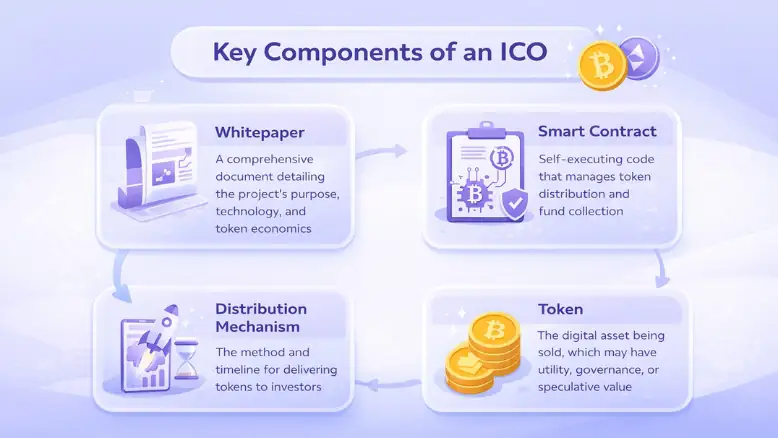
Key Components of an ICO
Whitepaper: A comprehensive document detailing the project’s purpose, technology, and token economics
Smart Contract: Self-executing code that manages token distribution and fund collection
Token: The digital asset being sold, which may have utility, governance, or speculative value
Distribution Mechanism: The method and timeline for delivering tokens to investors
Throughout our extensive work in this space, we’ve identified that successful ICOs typically share common characteristics: transparency in communication, clearly defined use cases, experienced development teams, and realistic roadmaps. The token itself serves multiple purposes depending on the project’s architecture.
Multi-Purpose Role of the Token in Project Architecture
| Token Type | Purpose | Example |
|---|---|---|
| Utility Token | Access to platform services or features | Filecoin |
| Security Token | Represents ownership or profit-sharing rights | tZERO |
| Governance Token | Voting rights on protocol decisions | MakerDAO (MKR) |
| Payment Token | Medium of exchange within the ecosystem | Binance Coin (BNB) |
The First ICO: Mastercoin and the 2013 Pioneer Era
The ICO history begins in July 2013 when J.R. Willett launched Mastercoin (later rebranded as Omni), widely recognized as the first-ever initial coin offering. This groundbreaking event raised approximately 5,000 BTC (valued at around $500,000 at the time) and established the template that thousands of projects would follow in the future of crypto fundraising.
Mastercoin’s vision was ambitious: to create a protocol layer on top of Bitcoin that would enable the creation of new currencies and assets. While the project itself never achieved mainstream adoption, its fundraising mechanism proved revolutionary. Investors sent Bitcoin to a specific address and received Mastercoin tokens in return, a simple but elegant solution that bypassed traditional financial intermediaries.
“The ICO was born from necessity—traditional funding avenues weren’t accessible to decentralized, open-source projects.”
— Industry observation from our eight years in blockchain analysis
The Mastercoin ICO demonstrated several critical insights that would shape the industry. First, it proved that a global, permissionless fundraising mechanism was technically feasible. Second, it showed significant investor appetite for early-stage blockchain projects. Third, it highlighted the importance of clear documentation and communication with token buyers.
Ethereum’s 2014 ICO: The Blueprint for Success
If Mastercoin planted the seed, Ethereum’s ICO cultivated the entire garden. In July 2014, the Ethereum Foundation launched what would become the most consequential token sale in ICO cryptocurrency history, raising 31,529 BTC (approximately $18.4 million at the time). This ICO didn’t just fund a project—it funded an entire ecosystem that would enable thousands of future ICOs.
Vitalik Buterin and his team presented a compelling vision: a blockchain platform with a Turing-complete programming language that would allow developers to create decentralized applications and smart contracts. The 42-day crowdsale attracted over 8,000 participants and established several best practices that became industry standards.
Ethereum ICO Metrics
| Metric | Value |
|---|---|
| Amount Raised | 31,529 BTC (~$18.4M) |
| Duration | 42 days (July 22 – Sept 2, 2014) |
| Initial ETH Price | $0.311 per ETH |
| Participants | ~8,000 investors |
| Peak ROI (2021) | Over 1,500,000% |
The Ethereum ICO’s success wasn’t just about the funds raised—it was about validation. It proved that sophisticated technical projects could attract significant capital through token sales. More importantly, Ethereum’s smart contract functionality would later become the foundation for the ICO boom, as most subsequent token sales were conducted using Ethereum’s ERC-20 standard.
The Quiet Years: 2014-2016 and Early Experiments
Following Ethereum’s landmark ICO, the cryptocurrency space entered a period of experimentation and maturation. Between 2014 and 2016, fewer than 50 projects conducted ICOs, but these early pioneers refined the model and explored different approaches to token distribution and utility.
During this period, our team tracked several notable projects that pushed boundaries. Factom raised $140,000 in software token sales in 2015, focusing on data integrity solutions. Augur, a decentralized prediction ICO market, raised $5.3 million in October 2015. These projects experimented with different token economics, vesting schedules, and community engagement strategies.
The quiet years were characterized by technical development rather than speculative frenzy. Projects focused on building actual products, and investors were generally more sophisticated, conducting thorough due diligence. This period laid crucial groundwork for what would come next, as developers learned how to structure token sales, manage community expectations, and deliver on roadmap promises.
Notable 2014-2016 ICOs
The 2017 ICO Boom: When Crypto Fundraising Exploded
The year 2017 marked an unprecedented explosion in ICO crypto activity. Our firm witnessed firsthand as the market transformed from a niche crypto fundraising mechanism into a global phenomenon that captured mainstream attention. Over 900 ICOs launched that year, collectively raising more than $6.2 billion—a figure that seemed almost incomprehensible at the time.
Several factors converged to create this perfect storm. Ethereum’s price surged from $8 in January to nearly $1,400 by January 2018, creating massive wealth among early adopters who were eager to invest in new projects. The ERC-20 token standard made launching an ICO technically accessible to nearly anyone with programming skills. Media coverage intensified, bringing ICOs to the attention of retail investors worldwide.
ICO Market Activity Overview
| Year | Number of ICOs | Total Raised | Notable Trend |
|---|---|---|---|
| 2018 | 1,253 | $11.4 billion | Peak and decline |
| 2019 | 372 | $3.7 billion | Regulatory pressure |
The 2017 boom democratized access to venture-style returns but also introduced significant risks. Projects with little more than a whitepaper and a website could raise millions of dollars in minutes. Terms like “FOMO” (Fear of Missing Out) became common as investors rushed to participate in hot sales, often with minimal due diligence.
Notable ICO Success Stories: From Ethereum to EOS
While many ICOs failed to deliver on their promises, several projects achieved remarkable success, validating the model and delivering substantial returns to early investors. Our analysis of these success stories reveals common patterns: strong technical teams, clear use cases, active development, and genuine community engagement.
EOS conducted the longest and largest ICO in history, running for a full year from June 2017 to June 2018 and raising an unprecedented $4.1 billion. Block.one, the company behind EOS, distributed tokens continuously throughout the year, creating sustained attention and allowing broader participation.
Top 5 Most Successful ICOs by ROI
Filecoin’s 2017 ICO raised $257 million to build a decentralized storage infrastructure, attracting investments from prominent venture capital firms alongside retail investors. Tezos raised $232 million for a self-amending blockchain protocol. Binance Coin, initially distributed through an ICO, evolved into one of the most valuable cryptocurrencies, powering the world’s largest cryptocurrency exchange.
The Dark Side: Scams, Fraud, and Failed Projects
The ICO boom’s dark underbelly revealed itself quickly. Our firm tracked hundreds of projects that either failed to deliver, disappeared with investor funds, or were outright scams from inception. Research suggests that up to 80% of ICOs conducted in 2017 were identified as scams, with many others simply failing due to poor execution or unrealistic promises.
The lack of regulation created a perfect environment for bad actors. Some projects conducted “exit scams,” raising funds and immediately disappearing. Others were more insidious, maintaining appearances while gradually abandoning development. Notable scams included Pincoin and iFan, which collectively stole $660 million from over 32,000 investors in Vietnam.
Regulatory Awakening: ICO Regulation Response
As ICO activity exploded throughout 2017 and early 2018, regulatory bodies worldwide began taking notice. The challenge was unprecedented: how to regulate a global, decentralized fundraising mechanism that didn’t fit neatly into existing securities law frameworks. This marked the beginning of comprehensive ICO regulation efforts globally.
China took the most aggressive stance, banning ICOs entirely in September 2017 and shutting down domestic cryptocurrency exchanges. South Korea initially banned ICOs but later softened its position. Switzerland emerged as a crypto-friendly jurisdiction, with FINMA publishing guidelines that categorized tokens into payment, utility, and asset tokens.
Global Regulatory Approaches (2017-2019)
The regulatory awakening forced the industry to mature rapidly. Projects began implementing Know Your Customer (KYC) and Anti-Money Laundering (AML) procedures, restricting participation from certain jurisdictions, and hiring legal counsel to ensure compliance with emerging ICO regulation standards.
Modern ICO Landscape: What Remains in 2024-2026
As we move through 2025 and into 2026, the ICO landscape bears little resemblance to its 2017 peak. Traditional ICOs have become relatively rare, replaced by more sophisticated and regulated mechanisms. Projects now typically combine multiple fundraising approaches: private sales to accredited investors, public IDOs with carefully structured tokenomics, and gradual token unlocks to prevent market dumping.
The regulatory environment has matured significantly. The European Union’s Markets in Crypto-Assets (MiCA) regulation, which came into full effect in 2024, provides a comprehensive framework for token offerings across EU member states. The United States continues to pursue enforcement actions while gradually developing clearer guidelines.
2024-2026 Token Launch Trends
Regulatory Compliance First: Projects prioritize legal frameworks before launch
Product Before Token: Working products required before crypto fundraising
Community Governance: DAOs and decentralized decision-making standard
Sustainable Tokenomics: Long-term value creation over short-term speculation
Cross-Chain Integration: Multi-chain launches becoming standard
Current successful token launches share distinct characteristics. They demonstrate clear product-market fit before fundraising, maintain transparent communication with communities, implement vesting schedules for team and early investors, and integrate with established DeFi protocols. Looking toward 2026, we’re observing emerging trends in upcoming ICO launches, including increased institutional participation, integration of artificial intelligence in tokenomics design, and growing adoption of Real World Asset (RWA) tokenization.
Lessons Learned: The Legacy of ICO History
After over eight years of observing and participating in the cryptocurrency fundraising ecosystem, our agency has distilled crucial lessons from the ICO era. The most fundamental lesson is that technology alone doesn’t justify investment—projects need clear use cases, sustainable business models, and competent teams. The ICO boom demonstrated how quickly capital can flow into speculative ventures, but the subsequent winter proved that lasting value requires substance.
The ICO phenomenon permanently altered how we think about fundraising, investment, and value creation. It democratized access to early-stage investment opportunities, previously reserved for wealthy individuals and institutions. It demonstrated that global, permissionless capital formation is possible, even if the early implementations were flawed.
Key Lessons from ICO Evolution
| Key Lesson | Impact on Industry |
|---|---|
| Regulation is Inevitable | Projects now prioritize compliance from inception |
| Community Matters | Engaged communities drive long-term success |
| Transparency is Essential | Open communication builds trust and credibility |
| Utility Over Speculation | Tokens need real use cases for sustained value |
| Execution Trumps Ideas | Whitepapers mean nothing without delivery |
Final Thoughts from Our Team
The ICO era represents one of the most significant experiments in financial innovation of the 21st century. From our vantage point, having worked in this space since its infancy, we’ve seen blockchain technology evolve from a fringe concept to a fundamental component of modern finance.
As we move through 2026, the lessons learned from ICOs continue to shape how projects approach fundraising, how investors evaluate opportunities, and how regulators balance innovation with protection. The future of token-based crypto fundraising looks more sustainable, more regulated, and more integrated with traditional finance—a maturation that serves the entire ecosystem well.
Key Statistics & Data Sources
Frequently Asked Questions
Q1.What is an ICO in simple terms?
Q2.When did the first ICO take place?
Q3.Why was Ethereum’s ICO so important?
Q4.Why did so many ICOs fail or turn out to be scams?
Q5.Are ICOs legal today?
Q6.What replaced ICOs after their decline?
Q7.Do ICOs still exist in 2025–2026?
Q8.Can investors still make high returns from token launches?
Q9.What is the biggest lesson from the ICO era?
Explore Services
Related Services
Reviewed by

Aman Vaths
Founder of Nadcab Labs
Aman Vaths is the Founder & CTO of Nadcab Labs, a global digital engineering company delivering enterprise-grade solutions across AI, Web3, Blockchain, Big Data, Cloud, Cybersecurity, and Modern Application Development. With deep technical leadership and product innovation experience, Aman has positioned Nadcab Labs as one of the most advanced engineering companies driving the next era of intelligent, secure, and scalable software systems. Under his leadership, Nadcab Labs has built 2,000+ global projects across sectors including fintech, banking, healthcare, real estate, logistics, gaming, manufacturing, and next-generation DePIN networks. Aman’s strength lies in architecting high-performance systems, end-to-end platform engineering, and designing enterprise solutions that operate at global scale.