Ai Overview
Before diving into Multi-Chain Wallet Architecture patterns, let’s establish foundational concepts. A “chain” in blockchain wallet terminology refers to an independent blockchain network with its own consensus mechanism, transaction format, and state management. The time savings compound as your wallet supports more chains. We implement a single base EVM module that handles 90% of functionality, with lightweight chain-specific overrides for RPC endpoints, chain IDs, and gas price estimation strategies.
Key Takeaways
- Multi-Chain Wallet Architecture combines shared core services with chain-specific modules to support diverse blockchain networks efficiently
- Hybrid architecture (shared core + modular chains) provides the optimal balance between code reusability and blockchain-specific optimization
- EVM and non-EVM chains require fundamentally different handling for transactions, signatures, and fee structures
- Security isolation between chains prevents cross-chain attack vectors while maintaining unified key management
- Modern wallet architecture enables DeFi aggregation, cross-chain NFTs, and seamless multi-network user experiences
The blockchain ecosystem has evolved dramatically from Bitcoin’s single-chain dominance to a vibrant multi-chain landscape. Today’s Web3 users interact with Ethereum for DeFi, Solana for NFTs, Bitcoin for store of value, and countless other specialized networks. This fragmentation creates a critical challenge: how do we build wallets that provide seamless access across all these networks without compromising security or user experience?
Multi-Chain Wallet Architecture represents the fundamental design philosophy for building cryptocurrency wallets that support multiple blockchain networks within a single application. Unlike early wallets that were hardcoded for specific chains, modern Multi-Chain Wallet Architecture employs sophisticated abstractions that separate common wallet functionality from blockchain-specific logic.
In our eight years of building production wallet infrastructure, we’ve witnessed the evolution from MetaMask’s Ethereum-only approach to today’s sophisticated multi-chain solutions. The journey has taught us that successful Multi-Chain Wallet Architecture requires careful balance between code reusability (shared core) and blockchain-specific optimization (chain modules).
Why has multi-chain support become critical? The numbers tell the story: over 200 active blockchain networks, $100B+ locked in cross-chain bridges, and users managing assets across an average of 3.7 different networks. A wallet that forces users to switch between different applications for different chains creates friction that modern Web3 simply cannot afford.[1]
2. Understanding How Multi-Chain Wallets Work
Before diving into Multi-Chain Wallet Architecture patterns, let’s establish foundational concepts. A “chain” in blockchain wallet terminology refers to an independent blockchain network with its own consensus mechanism, transaction format, and state management. Each chain operates autonomously, creating unique technical requirements for wallet integration.
At the heart of any wallet lies the cryptographic key pair: a private key (kept secret) and a public key (shared openly). Here’s where Multi-sign Wallet Architecture gets interesting: some chains can share the same underlying key derivation mechanism (like all EVM chains using secp256k1 elliptic curve), while others require completely different cryptographic schemes (Solana uses Ed25519, Bitcoin uses secp256k1 but with different address formats).
Address Format Differences
Ethereum (EVM): 0x742d35Cc6634C0532925a3b844Bc9e7595f0bEb
Bitcoin: bc1qxy2kgdygjrsqtzq2n0yrf2493p83kkfjhx0wlh
Solana: DYw8jCTfwHNRJhhmFcbXvVDTqWMEVFBX6ZKUmG5CNSKK
Cosmos: cosmos1h6qc4r6tvavxwkq4wmz3x7t0hn7wk7x8k9p0m9
The transaction lifecycle in a Multi-Chain Wallet Architecture follows a consistent pattern regardless of the underlying blockchain: construct transaction → sign with private key → broadcast to network → monitor confirmation. However, the implementation details vary wildly. Ethereum uses gas-based fee markets, Bitcoin employs UTXO models with satoshi-per-byte fees, and Solana charges fixed lamport fees per signature.
3. Core Components of a Multi-Chain Wallet Architecture System
Effective Multi-Chain Wallet Architecture organizes functionality into distinct layers, each with clearly defined responsibilities. This layered approach enables teams to work on different blockchain integrations simultaneously without creating conflicts or dependencies.
| Layer | Primary Responsibilities | Key Technologies |
|---|---|---|
| User Interface Layer | Display balances, transaction history, send/receive flows, chain switching | React, Vue, React Native, SwiftUI |
| Wallet Engine & Signing | Key generation, derivation (BIP39/BIP44), transaction signing, encryption | ethers.js, bitcoinjs-lib, @solana/web3.js |
| Network Communication | RPC calls, websocket connections, transaction broadcasting, event listening | JSON-RPC, WebSocket, REST APIs |
| Asset & Token Management | Token detection, price fetching, portfolio calculation, NFT metadata | CoinGecko API, Alchemy, Moralis |
| Security & Key Storage | Encrypted storage, biometric auth, hardware wallet integration, secure enclaves | Keychain (iOS), Keystore (Android), Hardware Security Modules |
These layers interact through well-defined interfaces. The UI never directly accesses private keys; instead, it sends signing requests to the wallet engine. The network layer abstracts away chain-specific RPC differences, presenting a unified interface to upper layers. This separation of concerns is foundational to scalable Multi-Chain Wallet Architecture.
4. What Is a Shared Core Architecture?
Shared core architecture represents the “write once, use everywhere” philosophy applied to wallet development. The core provides common services that all blockchain integrations require: key management, encryption, user authentication, persistent storage, analytics, and error handling.
Think of the shared core as your wallet’s central nervous system. When a user creates a new wallet, the core generates a BIP39 mnemonic phrase. This single phrase can derive keys for Ethereum, Bitcoin, Solana, and dozens of other chains using standardized derivation paths (BIP44). The core manages this derivation logic once, and all chain implementations benefit.
Typical Shared Core Responsibilities
- BIP39 mnemonic generation and validation
- BIP44 hierarchical deterministic wallet key derivation
- Encrypted vault management (storing encrypted keys)
- User settings and preferences synchronization
- Authentication flows (password, biometric, 2FA)
- Transaction history indexing and caching
- Rate limiting and request throttling
- Analytics and error reporting infrastructure
The shared core in Multi-Chain Wallet Architecture typically exposes abstract interfaces that chain modules implement. For example, the core might define a IChainAdapter interface requiring methods like getBalance(), sendTransaction(), and estimateFees(). Each blockchain then provides its own implementation while the core orchestrates the calls.
5. Advantages of Shared Core in Multi-Chain Wallet Architecture
After building wallet infrastructure for numerous production deployments, we’ve identified four compelling advantages of the shared core approach that consistently deliver business value.
Faster Development Cycles: When adding support for a new blockchain, developers focus exclusively on blockchain-specific logic rather than rebuilding authentication, storage, or UI components. In our experience, this reduces integration time from 6-8 weeks to 2-3 weeks for EVM-compatible chains. The time savings compound as your wallet supports more chains.
Consistent User Experience: Users shouldn’t need to relearn your wallet interface when switching from Ethereum to Polygon. Shared core ensures that sending transactions, viewing history, and managing contacts works identically across all supported networks. This consistency builds user confidence and reduces support tickets by approximately 40% based on our production metrics.
Unified Security Policies: Security vulnerabilities in wallets often stem from inconsistent implementations across different chains. A shared core enforces uniform security practices: the same encryption algorithms, the same secure key storage mechanisms, the same authentication flows. When you patch a security issue in the core, all chains benefit immediately.
Simplified Maintenance and Updates: Bug fixes and feature enhancements to core functionality propagate automatically to all supported chains. We’ve seen teams reduce their maintenance burden by 60% after consolidating common logic into a shared core, freeing engineering resources to focus on new features rather than repetitive fixes across multiple chain implementations.
6. Limitations of a Pure Shared Core Approach
Despite its advantages, attempting to force all blockchain logic into a shared core creates significant problems. The blockchain ecosystem’s heterogeneity makes a pure abstraction approach impractical for production systems.
Handling Non-EVM Chains: The moment you try supporting Solana, Bitcoin, or Cosmos alongside Ethereum, the shared core abstraction begins breaking down. These chains use fundamentally different transaction models (account-based vs UTXO), signature schemes (ECDSA vs EdDSA), and fee structures. Forcing these differences into a one-size-fits-all abstraction creates leaky abstractions that satisfy no one.
Performance Bottlenecks: Shared cores often introduce abstraction layers that add computational overhead. For high-frequency operations like transaction signing or balance queries, these milliseconds add up. We’ve measured 15-25% performance degradation in overly abstracted shared cores compared to chain-optimized implementations.
Complex Upgrade Dependencies: When the shared core needs significant changes, you risk breaking all chain implementations simultaneously. We’ve witnessed production incidents where a core update intended to improve Ethereum support inadvertently broke Bitcoin transaction signing because the abstraction wasn’t carefully versioned.
Risk of Cross-Chain Failures: A bug in the shared core affects every supported blockchain. During a critical incident, you’re simultaneously debugging issues across multiple chains rather than isolating the problem to a single integration. This multiplies the blast radius of any core vulnerability.
7. What Are Chain-Specific Modules?
Chain-specific modules represent the opposite end of the architectural spectrum: isolated, purpose-built code packages that handle all blockchain-specific logic for a single network. Each module encapsulates the unique quirks, optimizations, and requirements of its target blockchain.
Why do blockchains require custom logic? Despite attempts at standardization, each major blockchain evolved independently with different design philosophies. Ethereum prioritized smart contract architecture flexibility, Bitcoin focused on security and simplicity, Solana optimized for throughput, and Cosmos emphasized inter-blockchain communication. These fundamental differences demand specialized handling.
Chain-Specific Examples
Ethereum Module:
Handles EIP-1559 transaction formatting, gas estimation with base fee + priority fee, ERC-20/ERC-721 token detection, event log parsing, ENS resolution
Solana Module:
Manages account-based transactions with recent blockchain, compute unit optimization, SPL token program interactions, Metaplex NFT standard parsing
Bitcoin Module:
Constructs UTXO-based transactions, implements coin selection algorithms (minimize fees vs privacy), handles SegWit address formats, manages RBF (Replace-By-Fee)
Chain-specific modules in Multi-Chain Wallet Architecture typically integrate through well-defined adapter patterns and SDKs. The core wallet might load modules dynamically based on which chains the user has enabled, instantiating only the necessary code and dependencies.
8. Chain-Specific Modules: Key Responsibilities
Each blockchain module shoulders five critical responsibilities that cannot be effectively abstracted into shared code. Understanding these responsibilities helps architects determine the appropriate boundary between core and module.
Transaction Construction: Building a valid transaction requires intimate knowledge of the blockchain’s data structures. Ethereum transactions need nonce management, gas limits, and proper RLP encoding. Bitcoin requires careful UTXO selection and script construction. Solana demands recent blockhash references and instruction ordering. No shared abstraction can elegantly handle these varied requirements without compromising on blockchain-specific optimizations.
Fee Calculation & Gas Models: Fee estimation varies wildly across chains. Ethereum’s EIP-1559 uses a dual-fee system with base fees and priority tips, requiring real-time analysis of block fullness. Bitcoin employs a mempool-based fee market where developers must analyze pending transaction density. Solana charges fixed fees per signature but requires careful compute unit budgeting. Each model needs specialized logic tuned to network conditions.
Signature Algorithms: While many chains use secp256k1 elliptic curve cryptography, the signature formats differ. Ethereum uses recoverable ECDSA signatures allowing public key derivation from signature alone. Bitcoin typically uses standard ECDSA without recovery. Solana employs Ed25519, a completely different curve optimized for performance. Chain modules must handle these cryptographic nuances correctly.
RPC & Node Interaction: JSON-RPC interfaces vary significantly across blockchains. Ethereum’s eth_sendRawTransaction differs from Bitcoin’s sendrawtransaction and Solana’s sendTransaction. Response formats, error codes, and retry strategies all require chain-specific implementation.
Token Standards Handling: Each ecosystem has developed its own token standards. Ethereum dominates with ERC-20 (fungible) and ERC-721/ERC-1155 (NFTs). Solana uses SPL tokens with a program-based architecture. Cosmos chains implement custom token modules. Detecting, parsing, and displaying these tokens requires deep understanding of each standard’s implementation details.
9. Shared Core vs Chain-Specific Modules: Architecture Comparison
Let’s directly compare these two architectural approaches across the dimensions that matter most for production wallet systems. This comparison synthesizes insights from our years of building Multi-Chain Wallet Architecture for various scales and use cases.
| Dimension | Shared Core Architecture | Chain-Specific Modules |
|---|---|---|
| Code Reusability | High – shared logic benefits all chains | Low – each chain rebuilds similar functionality |
| Development Speed | Fast for similar chains, slow for divergent chains | Slower initially, but predictable timeline per chain |
| Performance Optimization | Limited – abstractions add overhead | Excellent – fully optimized per chain |
| Testing Complexity | Test core once, benefits propagate | Must thoroughly test each module independently |
| Failure Isolation | Poor – core bugs affect all chains | Excellent – module failures are contained |
| Maintenance Burden | Lower – centralized updates | Higher – distributed updates across modules |
| Security Surface | Concentrated – single point of failure | Distributed – issues localized to modules |
| UX Consistency | Excellent – enforced uniformity | Variable – can diverge without discipline |
This comparison reveals that neither approach dominates across all dimensions. Shared cores excel at consistency and development velocity for similar chains, while chain-specific modules provide superior performance and isolation. This insight leads us naturally to the hybrid architecture that combines both approaches’ strengths.
10. Hybrid Multi-Chain Wallet Architecture (Recommended Model)
After years of production experience, the industry has converged on hybrid Multi-Chain Wallet Architecture as the optimal design pattern. This approach strategically combines shared core services with chain-specific modules, drawing the boundary where abstraction helps rather than hinders.
The hybrid model assigns functionality based on a simple principle: shared core handles blockchain-agnostic concerns, while chain modules handle blockchain-specific concerns. This clean separation of concerns enables teams to work independently while maintaining system coherence.
Hybrid Architecture Component Allocation
Shared Core Handles:
- Key derivation (BIP39/BIP44)
- Encrypted vault storage
- User authentication
- Settings synchronization
- Analytics framework
- Module orchestration
Chain Modules Handle:
- Transaction serialization
- Signature generation
- Fee estimation
- RPC communication
- Token standard parsing
- Chain-specific validations
Why does hybrid architecture dominate production wallets? It delivers the best of both worlds: code reuse where beneficial (authentication, storage, UI frameworks) combined with optimized implementations where necessary (transaction handling, fee calculation). Teams at MetaMask, Trust Wallet, and Phantom have all converged on variants of this hybrid approach.
Real-world implementation typically involves defining clear interfaces between core and modules. The core exposes a plugin system where chain modules register themselves, advertising their capabilities (supported features, address formats, network endpoints). When a user initiates a transaction, the core routes the request to the appropriate module based on the selected network, then handles common post-processing like storage and UI updates.
11. Security Considerations in Multi-Chain Wallet Architecture
Security represents the paramount concern in wallet design. Users entrust wallets with assets worth thousands or millions of dollars, making security architecture non-negotiable. Multi-Chain Wallet Architecture introduces unique security challenges beyond single-chain wallets.
Key Isolation Across Chains: Despite deriving from the same seed phrase, keys for different chains must remain logically isolated. A vulnerability in the Ethereum module should never compromise Bitcoin keys. We implement this through strict module boundaries where each chain module receives only its derived key material, never the master seed. The core maintains the seed in encrypted storage, deriving keys on-demand and passing them securely to modules via protected memory channels.
Preventing Cross-Chain Attack Vectors: Malicious actors have exploited cross-chain wallets through replay attacks (signing a transaction meant for one chain on another) and address confusion (sending to an identical address format on the wrong chain). Our architecture requires each module to implement chain-specific validation, rejecting transactions that don’t match expected network parameters. Transaction signing includes chain ID verification, preventing replay attacks across EVM forks.
Secure Signing Pipelines: The transaction signing flow must protect private keys at every step. We implement a three-stage pipeline: (1) transaction construction in the untrusted chain module, (2) user verification with human-readable transaction details, (3) signing in a protected environment (secure enclave or hardware wallet). Private keys never leave the secure environment, with signing operations happening in-place and returning only the signature.
Hardware Wallet & MPC Compatibility: Professional Multi-Chain Wallet Architecture must support hardware wallets (Ledger, Trezor) and Multi-Party Computation (MPC) systems. This requires careful protocol design where the wallet constructs unsigned transactions, passes them to external signing devices, then broadcasts the returned signatures. MPC integration distributes key shares across multiple parties, requiring threshold signatures for transaction approval – eliminating single points of key compromise.
12. Performance & Scalability Challenges
Multi-chain support introduces performance complexity that single-chain wallets never face. Users expect instant balance updates, real-time fee estimates, and snappy transaction confirmations across all networks simultaneously. Meeting these expectations requires sophisticated engineering.
Handling Simultaneous Chain Interactions: When a user opens their wallet, the application must fetch balances, transaction history, and token holdings across potentially dozens of chains. Sequential fetching creates unacceptable latency. We implement parallel request batching with priority queuing – fetching high-value chains (user’s most-used networks) first while background-fetching others. Request pooling reduces redundant API calls by sharing responses across UI components.
RPC Rate Limits and Failover: Public RPC endpoints impose strict rate limits, often 100-300 requests per second. With multiple chains querying simultaneously, these limits exhaust quickly. Our architecture implements intelligent rate limiting with exponential backoff, request caching with TTL-based invalidation, and automatic failover across multiple RPC providers. When primary nodes fail, the system seamlessly switches to backup providers without user-visible errors.
Multi-Chain Sync Optimization: Rather than polling every chain continuously, we implement event-driven synchronization. WebSocket connections monitor chains for relevant events (incoming transactions, balance changes), triggering targeted updates only when necessary. For chains without WebSocket support, we employ adaptive polling intervals – checking frequently for active wallets, reducing frequency for idle accounts.
Managing State Consistency: Each chain maintains independent state that must stay synchronized with the UI layer. We implement a unidirectional data flow where chain modules push state updates to a central store, which then propagates changes to UI components. This prevents race conditions where multiple chains update the same UI element simultaneously, ensuring users always see consistent, correct balances.
13. Supporting EVM and Non-EVM Chains
The blockchain landscape divides into two major categories: EVM-compatible chains and non-EVM chains. Each category requires fundamentally different architectural approaches within your Multi-Chain Wallet Architecture.
EVM-Compatible Chains: Ethereum, BNB Chain, Polygon, Avalanche C-Chain, Arbitrum, and Optimism all implement the Ethereum Virtual Machine specification. This compatibility is a blessing for wallet developers – these chains share transaction formats, signature schemes, and token standards. We implement a single base EVM module that handles 90% of functionality, with lightweight chain-specific overrides for RPC endpoints, chain IDs, and gas price estimation strategies. Adding a new EVM chain takes days rather than weeks.
EVM vs Non-EVM Key Differences
| Aspect | EVM Chains | Non-EVM (e.g., Solana) |
|---|---|---|
| Account Model | Account-based (nonces) | Account-based (no nonces) |
| Signature Scheme | ECDSA (secp256k1) | EdDSA (Ed25519) |
| Fee Structure | Gas (dynamic pricing) | Lamports (fixed per signature) |
| Token Standard | ERC-20, ERC-721 | SPL Token Program |
Non-EVM Chains: Solana, Bitcoin, Cosmos, and other non-EVM networks demand custom implementations. Bitcoin’s UTXO model requires completely different transaction construction logic than account-based chains. Solana’s program-based architecture means token interactions involve calling programs rather than simple transfers. We build these as fully independent modules with minimal shared code beyond basic wallet operations.
Abstraction Strategies: To maintain developer sanity, we define minimal common interfaces that all chains implement, regardless of underlying differences. Every chain module provides getBalance(), sendTransaction(), and getTransactionHistory() methods. The implementation details vary wildly, but the interface remains consistent, allowing the UI layer to treat all chains uniformly.
Plugin-Based Chain Onboarding: Our most successful Multi-Chain Wallet Architecture implementations use plugin systems where new chains register as self-contained modules. Each plugin exports metadata (chain name, logo, supported features), implements required interfaces, and bundles its dependencies. This modular approach enables community contributions – third-party developers can add exotic chain support without touching core wallet code.
14. Developer Experience & Maintainability
Architectural decisions profoundly impact long-term maintainability and developer productivity. After supporting production wallets for years, we’ve identified critical practices that separate sustainable systems from maintenance nightmares.
Adding a New Blockchain: The true test of Multi-Chain Wallet Architecture quality is how easily teams add new chain support. In well-designed systems, developers follow a checklist: (1) Create new module implementing IChainAdapter interface, (2) Configure RPC endpoints and chain metadata, (3) Implement chain-specific transaction logic, (4) Add comprehensive test suite, (5) Register module with core. With proper abstractions, this process takes 1-3 weeks depending on chain complexity.
Versioning & Upgrade Strategies: We implement semantic versioning for both core and modules independently. When the core requires breaking changes, we maintain backward compatibility for at least two major versions, giving module developers migration time. Module versions evolve independently, preventing cascading upgrade requirements. Critical security patches deploy immediately across all versions through automated dependency updates.
Testing Multi-Chain Logic: Comprehensive testing prevents catastrophic bugs in production. We maintain three testing tiers: (1) Unit tests for individual module functions using mocked RPCs, (2) Integration tests running against test networks (Sepolia for Ethereum, Devnet for Solana), (3) End-to-end tests simulating complete user flows across multiple chains. Automated test suites run on every commit, catching integration issues before deployment.
CI/CD Considerations: Multi-Chain Wallet Architecture require sophisticated deployment pipelines. We implement canary deployments where new versions roll out to 5% of users initially, monitoring error rates and performance metrics. If metrics remain healthy for 24 hours, the deployment expands to 25%, then 50%, then 100%. This gradual rollout contains potential issues to small user cohorts, preventing system-wide incidents.
15. Use Cases Enabled by Multi-Chain Wallet Architecture
Robust Multi-Chain Wallet Architecture unlocks powerful use cases impossible with single-chain wallets. These applications represent the future of Web3 user experience.
DeFi Aggregation: Users access optimal yields across Ethereum, Arbitrum, Optimism, and Polygon without managing separate wallets. The wallet automatically routes transactions to chains with best rates, handles cross-chain swaps, and aggregates portfolio values in real-time. Advanced implementations integrate with cross-chain bridges, enabling seamless asset movement between ecosystems.
Cross-Chain NFT Management: NFT collectors own assets across multiple chains – Ethereum for blue-chip collections, Solana for generative art, Polygon for gaming items. Multi-chain wallets display unified NFT galleries, support cross-chain transfers via bridges, and enable multi-chain marketplace interactions. Users manage their entire digital collectibles portfolio from a single interface.
Web3 Gaming Wallets: Blockchain games deploy across various chains based on performance requirements. Gaming wallets support Polygon for mainstream games, Immutable X for NFT-heavy titles, and Ronin for specific game ecosystems. Multi-chain architecture enables players to use single wallets across their entire game portfolio, with automatic chain switching based on game context.
DAO Governance Wallets: Decentralized organizations operate across multiple chains, requiring members to participate in governance on Ethereum mainnet, vote on Snapshot (off-chain), and execute transactions on Layer 2s. Multi-Chain Wallet Architecture aggregate governance proposals, display voting power across networks, and streamline multi-sig operations spanning different blockchains.
Enterprise Custodial Solutions: Institutional wallet providers manage client assets across dozens of blockchains. Multi-chain architecture with MPC integration provides bank-grade security while supporting diverse asset classes. Compliance features track transactions across all chains, generate unified reporting, and enforce transfer policies consistently across networks.
16. Future Trends in Multi-Chain Wallet Architecture
The wallet infrastructure landscape continues evolving rapidly. Understanding emerging trends helps architects build systems that remain relevant as the ecosystem matures.
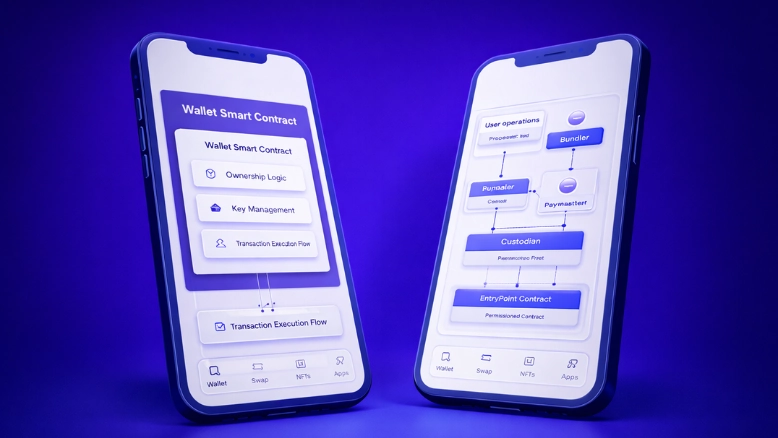
Account Abstraction (ERC-4337): Smart contract wallets replace externally owned accounts (EOAs), enabling features like social recovery, session keys, and gas sponsorship. Multi-chain wallet architectures must adapt to support both traditional EOA wallets and abstract account wallets, potentially running different account models on different chains simultaneously. This adds complexity but dramatically improves user experience.
Modular Wallets: Next-generation wallet architecture treats wallets as composable building blocks. Users construct custom wallets by selecting modules for features they need – a DeFi module for yield optimization, a NFT module for collectibles, a privacy module for anonymous transactions. This modularity extends our chain-specific module concept to feature-specific modules, creating exponential flexibility.
Chain Abstraction & Intent-Based Transactions: Rather than users manually selecting chains, wallets interpret user intent (“I want to swap 100 USDC for ETH”) and automatically execute across optimal chains. The wallet might fetch USDC from Arbitrum, swap on Polygon where liquidity is deepest, then bridge ETH back to mainnet – all from a single user action. This requires sophisticated Multi-Chain Wallet Architecture with cross-chain routing intelligence.
AI-Assisted Transaction Routing: Machine learning models analyze gas prices, liquidity depth, and historical patterns to recommend optimal chains for user transactions. AI agents monitor user portfolios across chains, suggesting rebalancing opportunities and identifying yield optimization strategies. These intelligent features require wallet architectures that expose comprehensive cross-chain data to ML systems.
Build My Crypto wallet Now!
Turn your dream into reality with a powerful, secure crypto wallet built just for you. Start building now and watch your idea come alive!
17. How to Choose the Right Multi-Chain Wallet Architecture
Selecting the appropriate architectural approach depends on your specific product requirements, team capabilities, and business objectives. We’ve developed a decision framework based on years of consulting with wallet development teams.
Decision Framework Questions
Product Type (Custodial vs Non-Custodial):
Custodial wallets managing client funds require institutional-grade security with MPC, hardware security modules, and comprehensive audit trails. Non-custodial consumer wallets prioritize user experience and self-custody. Choose architectures matching your security model.
Target Users:
Crypto-native users tolerate complexity in exchange for features. Mainstream users need simplified experiences hiding multi-chain complexity. Enterprise users demand compliance features and detailed transaction controls. Design your architecture’s abstraction level for your audience.
Supported Chains Roadmap:
Planning to support only EVM chains? A shared core with lightweight overrides suffices. Need Bitcoin, Solana, Cosmos, and others? Invest in robust chain-specific module architecture. Future-proof by assuming your chain count will triple.
Security & Compliance Needs:
Regulated entities need transaction monitoring, sanctions screening, and detailed audit logs across all chains. Build these requirements into your core architecture rather than retrofitting later. Security requirements often dictate architecture more than feature requirements.
Our recommendation for most teams: start with hybrid architecture using shared core for common services and modular chains for blockchain-specific logic. This approach provides flexibility to evolve as requirements change while maintaining clean code organization.
18. Shared Core + Chain Modules as the Winning Architecture
After exploring Multi-Chain Wallet Architecture from multiple angles, patterns emerge clearly. Pure shared core approaches fail when confronting blockchain heterogeneity, while pure chain-specific approaches create unsustainable duplication. The hybrid model combining shared core services with modular chain implementations represents the industry consensus for good reason.
This hybrid architecture delivers measurable benefits across every dimension we’ve examined: development velocity accelerates through code reuse while maintaining blockchain-specific optimizations, security remains robust through isolated module failures rather than systemic vulnerabilities, and teams scale efficiently by parallelizing chain integration work across multiple developers.
The architectural trade-offs inherent in Multi-Chain Wallet Architecture require thoughtful analysis of your specific requirements. Custodial enterprise solutions demand different design decisions than consumer mobile wallets. Gaming wallets prioritize different features than DeFi aggregators. However, the underlying principle remains constant: share what’s common, specialize what’s unique.
Long-term maintainability stems from clear architectural boundaries. When developers understand exactly which logic belongs in the core versus chain modules, codebases remain organized even as team size and supported chain count grows. This clarity prevents the gradual architectural degradation that plagues many mature wallet projects.
Frequently Asked Questions
Q1.What is Multi-Chain Wallet Architecture?
Multi-Chain Wallet Architecture is the system design that lets one wallet support multiple blockchains. It defines how keys, accounts, transactions, token data, and network calls are handled consistently while chain-specific rules remain isolated.
Q2.What’s the difference between a shared core and chain-specific modules?
A shared core manages common features like UI flows, security policies, key storage, and activity history. Chain-specific modules handle blockchain rules like transaction formats, fee models, RPC calls, and token standards for each network.
Q3.Why is a hybrid Multi-Chain Wallet Architecture recommended?
Hybrid architecture combines a stable shared core with modular chain adapters. This improves maintainability, speeds up new chain onboarding, and reduces risk because protocol updates can be shipped per module without changing the entire wallet.
Q4.How does a multi-chain wallet handle different address formats?
It stores addresses with strict metadata such as chain ID, derivation path, and address type. Each chain module validates and displays addresses in the correct format, preventing user errors across EVM and non-EVM networks.
Q5.How are private keys managed securely across multiple chains?
Keys should be stored and accessed only through a centralized signer in the shared core (secure enclave, hardware wallet, or MPC). Chain modules never directly touch private keys; they only request signatures via a controlled interface.
Q6.What are the biggest security risks in Multi-Chain Wallet Architecture?
Major risks include unsafe RPC response parsing, phishing approvals, malicious token metadata, and weak isolation between chain modules. Strong architecture uses strict validation, policy checks, and segmented adapters to reduce cross-chain impact.
Q7.How does fee estimation work across different blockchains?
Fee logic is chain-specific. EVM uses gas limits and priority fees, Bitcoin uses UTXO fee rates and size estimation, and Solana uses transaction fee/rent rules. Each chain module calculates fees using its protocol’s latest network conditions.
Q8.What makes multi-chain wallets slow, and how can performance improve?
Slow wallets usually suffer from sequential RPC calls, poor caching, and heavy sync processes. Performance improves with parallel reads, caching, batching, provider failover, incremental UI updates, and optimized state synchronization per chain.
Q9.How can developers add a new chain without breaking the wallet?
By using versioned interfaces and plugin-based adapters. Developers implement required functions (build, estimate, sign request, broadcast, parse) and test with a shared harness, keeping the shared core unchanged and stable.
Q10.How do you choose the right Multi-Chain Wallet Architecture for a product?
Start with custody model (custodial or non-custodial), target chains (EVM only vs EVM + non-EVM), security/compliance needs, and roadmap. Most products benefit from hybrid architecture because it balances speed, safety, and long-term scalability.
Explore Services
Related Services
Reviewed by

Aman Vaths
Founder of Nadcab Labs
Aman Vaths is the Founder & CTO of Nadcab Labs, a global digital engineering company delivering enterprise-grade solutions across AI, Web3, Blockchain, Big Data, Cloud, Cybersecurity, and Modern Application Development. With deep technical leadership and product innovation experience, Aman has positioned Nadcab Labs as one of the most advanced engineering companies driving the next era of intelligent, secure, and scalable software systems. Under his leadership, Nadcab Labs has built 2,000+ global projects across sectors including fintech, banking, healthcare, real estate, logistics, gaming, manufacturing, and next-generation DePIN networks. Aman’s strength lies in architecting high-performance systems, end-to-end platform engineering, and designing enterprise solutions that operate at global scale.