Ai Overview
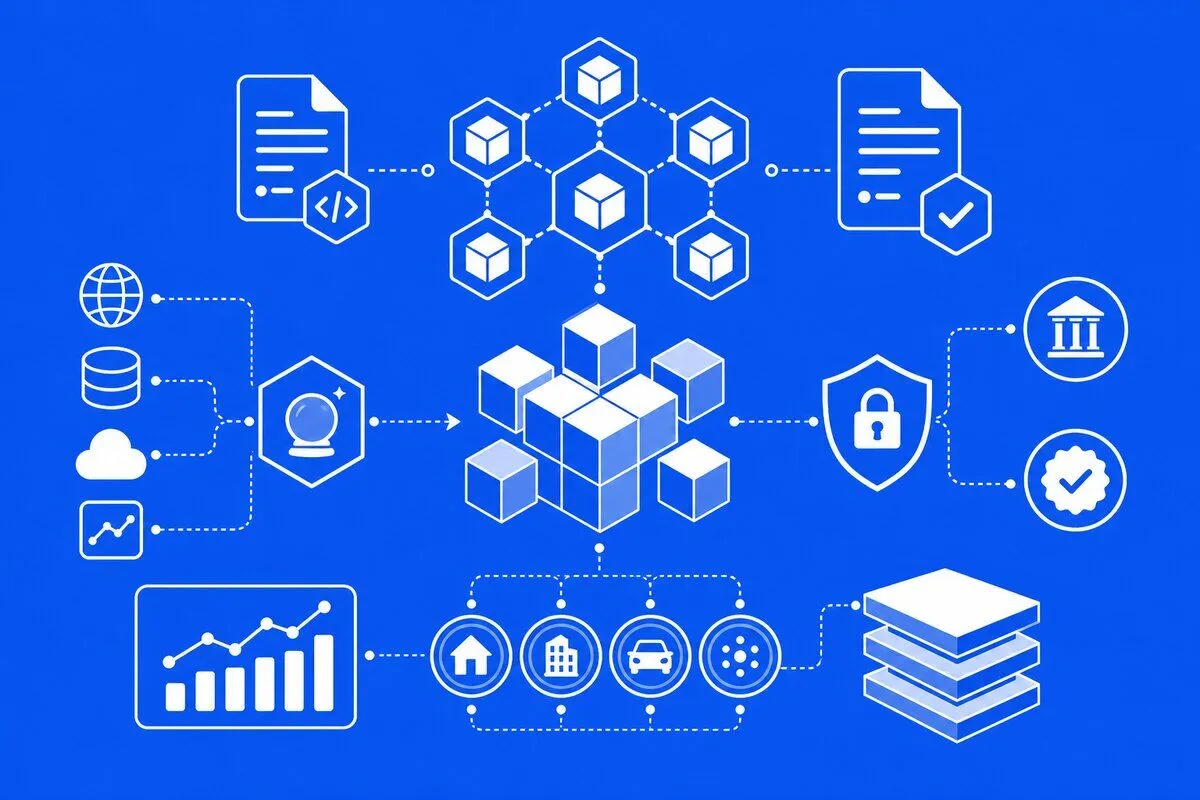
Cryptocurrency wallet Architecture refers to the complete system design that governs how a wallet operates internally. It defines how cryptographic keys are created, how they are structured, where they are stored, and how they are used to authorize transactions. It also determines how the wallet handles recovery, security threats, scalability and compliance requirements. This single decision determines security boundaries, infrastructure cost, compliance needs, and user experience.
Key Takeaways
| Topic | Description |
|---|---|
| Control vs Storage | Cryptocurrency wallet architecture defines control, not storage. Wallets manage cryptographic authority used to sign transactions, not the assets themselves. |
| Key Management | Key management is the most critical architectural layer. How keys or signing authority are generated, stored, and recovered determines long-term wallet security. |
| Custody Models | Different custody models create different risk profiles. Non-custodial, custodial and MPC wallets each trade sovereignty, usability and infrastructure complexity. |
| Infrastructure Reliability | Reliable infrastructure matters as much as cryptography. RPC routing, indexes and transaction tracking failures are common causes of wallet outages. |
| Multi-Chain Support | Multi-chain support increases architectural complexity. Proper isolation of derivation paths, account models and transaction logic is essential to avoid authority leakage. |
| Recovery Design | Recovery must be designed explicitly. Wallet recovery is a core architectural requirement, not an edge case. |
| Security | Security is an architectural property. Strong wallet security depends on trust boundaries, threat modeling and failure containment, not just encryption. |
| Survivability | Wallet architecture determines survivability. Features can evolve, but architectural decisions decide whether a wallet can safely scale and endure real-world failures. |
A cryptocurrency wallet is often described as a place to store digital assets, but this description is technically incorrect. Cryptocurrencies always exist on the blockchain. What a wallet actually manages is the cryptographic authority that allows a user to access, control and transfer those assets. The way this authority is created, protected and used is defined by cryptocurrency wallet Architecture.This distinction is widely recognized across the crypto ecosystem, where wallets are defined as tools that store private keys used to authorize blockchain transactions rather than holding cryptocurrency itself.
Wallet architecture is not about visual design or app features. It is the underlying system that determines how keys are generated, how addresses are derived, how transactions are signed, and how recovery works when something goes wrong. A weak architecture can result in permanent fund loss, while a strong architecture can securely support millions of users across multiple blockchains.
What Is Cryptocurrency Wallet Architecture?
Cryptocurrency wallet Architecture refers to the complete system design that governs how a wallet operates internally. It defines how cryptographic keys are created, how they are structured, where they are stored, and how they are used to authorize transactions. It also determines how the wallet handles recovery, security threats, scalability and compliance requirements.
In practical terms, a crypto wallet is a key management and transaction authorization system, not a container for coins.[1] This aligns with industry standards that describe wallets as tools for managing cryptographic keys rather than storing cryptocurrency directly. The architecture decides who ultimately has control over funds and how resilient that control is under real-world conditions.
Why Cryptocurrency Wallet Architecture Matters
Cryptocurrency wallet architecture determines whether digital assets remain secure under real-world conditions such as device loss, phishing attacks, infrastructure outages or malicious transactions. While user interfaces can be redesigned or upgraded over time, architectural decisions are difficult to reverse once a wallet is deployed at scale.
Most historical wallet failures did not occur because cryptography was broken but because architectural assumptions were incorrect. Poor key isolation, weak recovery models, unreliable RPC infrastructure or ambiguous transaction signing flows have caused permanent asset loss across the ecosystem. A well-designed cryptocurrency wallet architecture minimizes single points of failure, enforces clear trust boundaries and remains resilient as usage grows across chains, devices and jurisdictions.
Core Design Goals of Cryptocurrency Wallet Architecture
Every production-grade cryptocurrency wallet architecture is designed around a small set of non-negotiable goals:
- Authority control: Clearly define who can sign transactions, under what conditions and through which approval paths.
- Failure containment: Ensure that localized failures such as device compromise, RPC outages or backend issues do not cascade into total fund loss.
- Recoverability: Provide deterministic recovery mechanisms that allow users to regain access without exposing private keys during normal operation.
- Scalability: Support increasing transaction volume, asset diversity, and multi-chain expansion without requiring architectural redesigns.
- Security by default: Enforce safe behaviors even when users make mistakes, such as preventing blind signing or unsafe approvals.
- Operational reliability: Maintain consistent functionality during network congestion, partial outages, or degraded infrastructure components.
Architectures that prioritize convenience while ignoring these principles rarely remain secure or reliable at scale.
Cryptocurrency Wallet Architecture (Step-by-Step)
Designing a real-world wallet requires structured decisions. The following step-by-step breakdown reflects how production wallets are actually built, not theoretical models.

Step 1: Define the Wallet Type (This Decides Everything)
Every cryptocurrency wallet Architecture begins by defining wallet type. This single decision determines security boundaries, infrastructure cost, compliance needs, and user experience.
A non-custodial wallet, also called a self-custody wallet, allows users to act as their own bank. The wallet generates a pair of cryptographic keys and a seed phrase directly on the user’s device. Only the holder can authorize transactions and there is no third-party recovery if the keys are lost.
Custodial wallets, by contrast, delegate key management to a third party. They store private keys securely on servers and enforce withdrawal policies, approval flows and compliance controls. With a non-custodial wallet, no third party is involved and users manage their own private keys. Thus, users alone can access the assets stored in their crypto wallets. These differences define risk profiles, usability and security trade-offs.
A hybrid MPC or smart-account wallet splits or abstracts keys across devices, servers, or smart contracts. This architecture improves usability and security but requires significantly more infrastructure.
A hybrid MPC or smart-account wallet splits or abstracts keys across devices, servers, or smart contracts. This architecture improves usability and security but requires significantly more infrastructure.
At this stage, scope must also be defined. Wallets may support a single blockchain or multiple chains such as EVM networks, Bitcoin and Solana. Platform decisions such as mobile, web or browser extension support must be finalized early, along with whether the wallet focuses only on send/receive or includes DeFi features like swaps, bridges and staking.
Step 2: High-Level Component Architecture
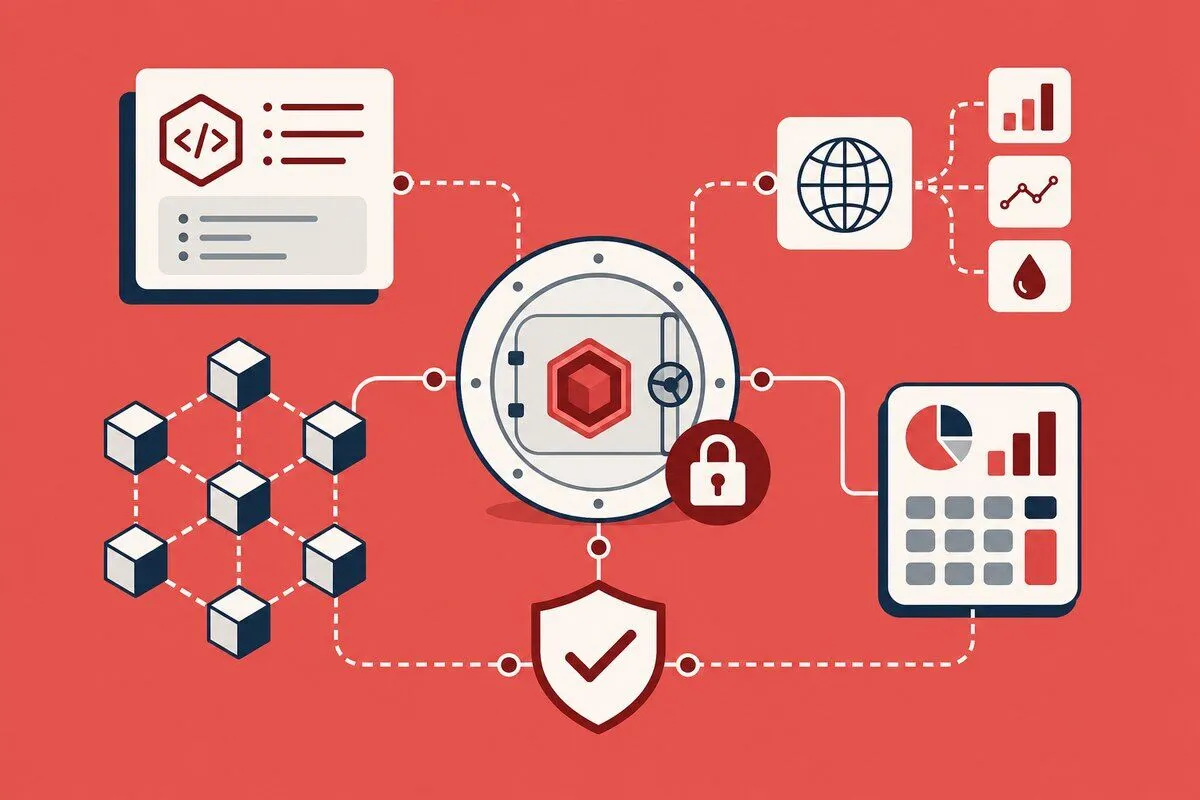
A production cryptocurrency wallet is never a single app. It is a system composed of multiple modules working together.
The client application (mobile, web or extension) handles key management, signing, address display, QR scanning, transaction building, local encryption and UI state.
Most wallets also include a backend layer, even for non-custodial designs. This backend commonly provides notifications, balance indexing, transaction history, remote configuration, analytics and optional compliance logic.
The blockchain access layer connects the wallet to the network through RPC providers or self-hosted nodes. Reliability mechanisms such as retries, rate limiting, WebSocket subscriptions and failover are critical here, as RPC instability is one of the most common causes of wallet failures.
Step 3: Key Management Architecture (The Most Critical Layer)
A cryptocurrency wallet does not technically store crypto assets; instead, it stores and manages the private keys needed to authorize transactions. The way keys are generated, protected, stored, and recovered directly determines the long‑term security and resilience of a wallet. Because a private key grants full control over the associated funds, incorrect or insecure key handling is one of the leading causes of wallet breaches and irreversible fund loss. Proper architectural design must ensure that private keys are isolated, backed up securely, and protected against compromise through malicious software or user error.
In practical wallet architectures, private keys are generated using deterministic methods (such as seed phrases and hierarchical deterministic structures) and stored in secure environments such as hardware‑backed secure elements or encrypted storage. A wallet must also include robust backup and recovery mechanisms so that users can regain access if a device is lost without exposing private keys to attackers.
Because private keys are irreplaceable once lost or compromised, access to funds cannot be restored. Key management isn’t just a feature; it is the core security foundation of any wallet architecture.
Key Management Architecture
| Wallet Model | Key Control | Recovery Method | Primary Risk |
|---|---|---|---|
| Non-custodial | User | Seed phrase | User error |
| Custodial | Provider | Account recovery | Custodian breach |
| MPC / Smart-account | Distributed | Policy / quorum | Infra complexity |
Threat Model in Cryptocurrency Wallet Architecture
A secure cryptocurrency wallet architecture must start with a clear threat model that anticipates how attackers might try to compromise keys, transactions or user interfaces. Wallets are frequently targeted by phishing attacks, where attackers create fake websites or apps to trick users into entering their private keys or seed phrases and by malware that steals sensitive information from devices or clipboard data used in transactions. These threats highlight why wallet architecture must assume that individual components can fail or be compromised and thus must limit the “blast radius” of any security breach.
For example, phishing scams aim to obtain credentials like private keys or recovery phrases by mimicking legitimate wallet providers often through emails or fraudulent websites which can lead to irreversible loss of funds since blockchain transactions cannot be undone.
Other common risks include direct software vulnerabilities that expose keys, and device loss or theft, which underscore why wallets must protect private keys with secure storage and recovery mechanisms.
Common threat categories include:
- Key exfiltration: Malware, compromised devices, insecure backups, memory scraping or weak entropy during key generation.
- Blind signing attacks: Users unknowingly approving malicious transactions or contract interactions.
- RPC manipulation: Malicious or unreliable RPC nodes returning incorrect balance data, fee estimates or transaction states.
- Indexer poisoning: Corrupted or lagging indexers providing inaccurate transaction history or asset visibility.
- Backend compromise: Abuse of notification systems, session handling, analytics pipelines or misconfigured internal APIs.
- Phishing and social engineering: Fake DApps, address substitution attacks, approval traps or impersonation attempts.
A robust cryptocurrency wallet architecture assumes that individual components will eventually fail and is designed to limit blast radius rather than depend on perfect security.
Step 4: Address and Account Layer (Chain-Specific Rules)
To support multi‑chain functionality, a well‑designed cryptocurrency wallet architecture must manage chain‑specific rules for each network it supports. For example, different blockchains use different derivation paths, address formats and cryptographic algorithms, such as Bitcoin’s UTXO‑based model versus EVM‑based account models on Ethereum and similar networks. A multi‑chain wallet typically derives private keys using standards like BIP‑32/BIP‑44 and generates distinct private/public key pairs for each blockchain based on those derivation paths. Because each chain has unique requirements (e.g., Bitcoin starts addresses differently from EVM chains) wallets must isolate derivation logic and address generation per chain to avoid authority leakage or collisions between networks. This architectural requirement ensures that support for multiple chains doesn’t inadvertently weaken security or confuse transaction semantics across networks.
Address Identity vs Authority (A Common Misconception)
Wallet addresses are often mistaken for user identities, but in reality they are cryptographic references derived from keys. Crypto wallet architecture must treat addresses as context-specific authorities, not persistent identities.
Across multi-chain environments, the same wallet interface may represent entirely different cryptographic systems. An EVM address, a Bitcoin UTXO set, and a Solana account do not share identical security or lifecycle assumptions. Conflating these models leads to incorrect UX decisions, privacy leaks and security vulnerabilities.
Step 5: Network and RPC Routing (Reliability Design)
Most wallet outages are caused not by cryptography but by unreliable RPC connections. A robust cryptocurrency wallet Architecture includes a provider routing system that maintains multiple RPC endpoints per chain.
This system continuously checks endpoint health, automatically fails over when nodes degrade, applies rate limiting, retries failed requests with backoff and separates read-only calls from transaction broadcasts. For EVM and Solana, Web Socket subscriptions are often used for real-time confirmation updates when stable.
Step 6: Token Data and Asset Visibility
What users perceive as “assets” is powered by a token registry system. This registry maps each chain to its supported tokens and includes metadata such as symbol, decimals, logo, contract address and verification status.
Spam filtering is essential at this layer. Modern wallets apply heuristics, blacklists and liquidity thresholds to hide scam or dust tokens.
At scale, most wallets rely on backend indexers to serve balances quickly, rather than querying each token contract directly from the client.
Step 7: Balance and Transaction History Architecture
Accurate balances and activity views require indexing. Wallets either integrate third-party APIs or run their own indexers.
Third-party services such as EVM indexers, Solana APIs or Bitcoin Electrum servers are often used initially. Larger wallets eventually build custom indexers by running nodes, parsing blocks, storing data in databases and exposing balance and transaction APIs.
A scalable indexer pipeline typically includes block listeners, parsers, queues, worker processes and caching layers.
Indexing Architecture and Data Trust Boundaries
Balance and transaction history are derived data, not on-chain truth. Cryptocurrency wallet architecture must define where indexing data is sourced, how it is validated and what happens when indexers fall behind or return inconsistent results.
Most wallets operate hybrid models where:
- On-chain data is authoritative
- Indexers provide performance and UX
- Clients verify critical fields independently
Architectures that blindly trust indexers risk displaying incorrect balances or confirming transactions that were never finalized.
Step 8: Transaction Engine (Send Is Not a Button)
A wallet’s “Send” action represents a full transaction engine. Inputs are validated for address format, chain rules, token decimals and amount limits. Fees are estimated using chain-specific logic such as gas models for EVM, compute units for Solana or sat/B for Bitcoin.
Transactions are built, simulated where possible, signed locally or via custody systems, broadcast to the network and tracked through pending, confirmed and final states. Reorganizations and dropped transactions must be handled gracefully and local transaction records should be created immediately for responsive UX.
Step 9: Security Architecture (Production Baseline)
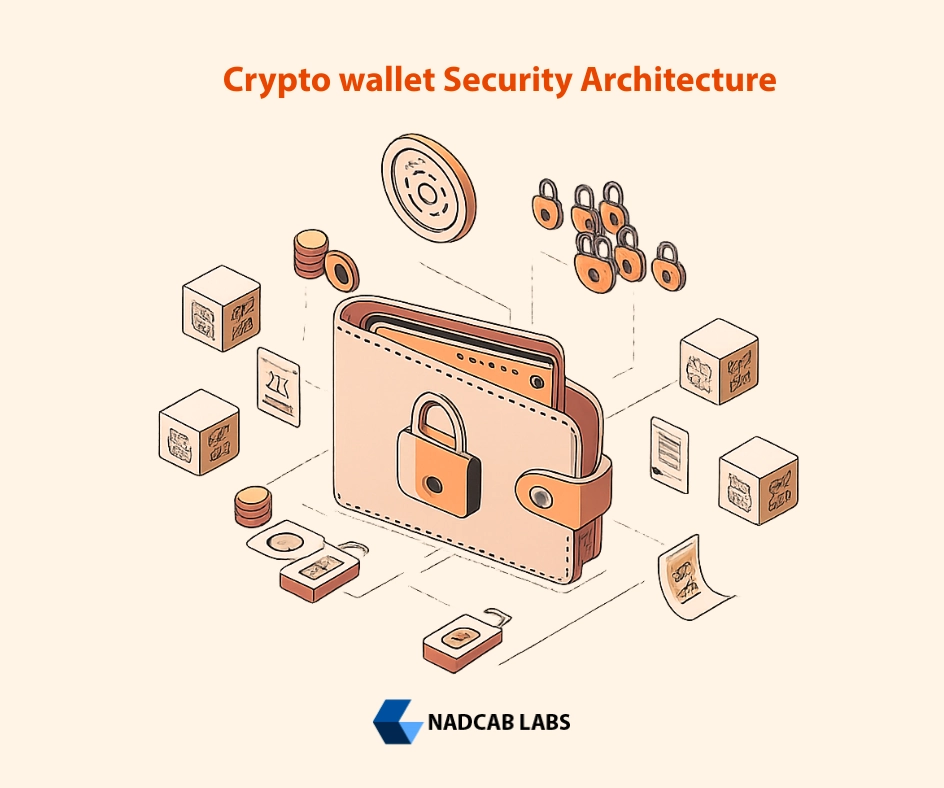
A minimum production-grade cryptocurrency wallet Architecture includes secure key storage, encrypted local databases, jailbreak or root detection, phishing protection and clear transaction signing interfaces.
Advanced wallets also implement domain allow lists for dApp browsers, scam address warnings, approval risk detection, rate limiting on backend APIs and abuse protection against spam tokens.
Recovery flows and lost-device scenarios must be explicitly designed, not treated as edge cases.
Recovery Architecture and Failure Scenarios
Recovery is not an edge case in cryptocurrency wallet architecture. It is a core design requirement.
Architectural recovery scenarios include:
- Device loss or destruction
- Seed phrase compromise
- Backend unavailability
- Partial MPC signer failure
- Account migration to new chains
Non-custodial wallets rely on deterministic seed regeneration. Custodial wallets rely on identity verification and internal ledgers. MPC and smart-account wallets require explicit recovery orchestration logic, often involving time delays, quorum rules or guardian systems.
Step 10: dApp Connectivity and Web3 Support
For Web3 wallets, dApp connectivity is essential. Wallet connect is commonly used for mobile connections, while in-app browsers provide embedded dApp access.
These systems require session permission models, per-dApp approval tracking and basic protections against malicious scripts. Smart-account wallets extend this with batch transactions, sponsored gas policies and session keys.
Step 11: Notifications and Real-Time UX
Users expect immediate feedback. Wallets implement transaction status notifications, confirmation alerts and optional price or portfolio change notifications.
Backend push systems map wallet activity to device tokens carefully to avoid privacy leaks while maintaining responsiveness.
Step 12: Observability and Reliability
To prevent wallets from “randomly breaking,” observability is critical. Production systems track RPC latency, error rates, broadcast success, confirmation times, indexer lag, crash analytics and user funnel drop-offs.
Feature flags and circuit breakers allow teams to disable unstable chains or features instantly when infrastructure degrades.
Reference Wallet Architecture Flow
UI → Transaction Builder → Fee Estimator → Signer → Broadcaster → Tracker → Indexer → Activity History → Notifications
Architecture Trade-Offs in Real-World Wallet Design
Different wallet models involve distinct trade-offs between security, control, and convenience. Custodial wallets simplify recovery and reduce user responsibility but concentrate trust in a third-party provider. Non-custodial wallets maximize control and security for the user but require self-responsibility for backups and key management. MPC wallets enhance user experience and security through distributed signing but introduce infrastructure complexity. Understanding these trade-offs helps teams design wallets aligned with their threat models, regulatory requirements, and target users. Importantly, if you don’t hold your private keys, you do not truly own your crypto assets.
What to Build First (Practical Sequence)
Most successful wallets start by implementing secure key generation and address derivation for a single chain. This is followed by native coin transfers and transaction tracking. Token support and registries come next, then activity history using third-party APIs. dApp connectivity, swaps, and bridges are layered on later. Scalability features such as provider routing queues monitoring and custom indexers are added as usage grows.
Build My Crypto wallet Now!
Turn your dream into reality with a powerful, secure crypto wallet built just for you. Start building now and watch your idea come alive!
Cryptocurrency Wallet Architecture Is the Foundation of Trust
Cryptocurrency wallet architecture defines who controls assets, how failures are contained and whether recovery is possible after something goes wrong. Features can be copied. Interfaces can be redesigned. Architecture determines survival.
As wallets evolve into full financial operating systems supporting payments, DeFi, identity and on-chain governance, architectural correctness becomes more important than speed to market. Teams that invest in robust cryptocurrency wallet architecture early avoid irreversible failures later.
Understanding wallet architecture is no longer optional. It is foundational knowledge for anyone building or relying on blockchain systems.
Frequently Asked Questions
Q1.What is cryptocurrency wallet architecture?
Cryptocurrency wallet architecture is the internal system design that defines how cryptographic keys are generated, stored and used to authorize blockchain transactions. It determines custody models, security boundaries, transaction handling, recovery mechanisms and how a wallet operates across different blockchains.
Q2.Why is cryptocurrency wallet architecture important?
Cryptocurrency wallet architecture is important because it directly determines who controls funds, how securely transactions are signed and whether assets can be recovered after failures. Poor architectural design can lead to irreversible fund loss even if cryptography itself is not broken.
Q3.How does cryptocurrency wallet architecture differ from a wallet app design?
Wallet app design focuses on user interface and user experience, while cryptocurrency wallet architecture focuses on key management, transaction signing, security models, infrastructure reliability and recovery logic. Architecture defines trust and control, whereas UI only affects usability.
Q4.What are the main types of cryptocurrency wallet architecture?
The main types of cryptocurrency wallet architecture are non-custodial wallets, custodial wallets and MPC or smart-account wallets. Each model differs in who controls private keys, how recovery works, and where security responsibilities are placed.
Q5.How does key management work in cryptocurrency wallet architecture?
In cryptocurrency wallet architecture, key management defines how private keys or signing authority are generated, stored, protected and used. Non-custodial wallets use locally generated seed phrases, custodial wallets store keys in secure server environments and MPC wallets distribute signing authority across multiple components.
Q6.What role do RPC nodes play in cryptocurrency wallet architecture?
RPC nodes act as the communication layer between a wallet and the blockchain. Cryptocurrency wallet architecture must handle RPC reliability, failover, rate limiting and validation because unreliable or malicious RPC responses are a common cause of wallet failures.
Q7.How do multi-chain wallets affect cryptocurrency wallet architecture?
Multi-chain wallets significantly increase architectural complexity. Cryptocurrency wallet architecture must isolate derivation paths, account models, transaction formats and security assumptions for each chain to prevent authority leakage or incorrect transaction signing across networks.
Q8.What security risks are addressed by cryptocurrency wallet architecture?
Cryptocurrency wallet architecture addresses risks such as key exfiltration, blind signing attacks, phishing, RPC manipulation, indexer poisoning and backend compromise. A strong architecture limits blast radius by enforcing clear trust boundaries and deterministic recovery paths.
Q9.How does recovery work in cryptocurrency wallet architecture?
Recovery in cryptocurrency wallet architecture depends on the custody model. Non-custodial wallets rely on deterministic seed phrase regeneration, custodial wallets use identity-based recovery and MPC or smart-account wallets use quorum-based or guardian-based recovery mechanisms.
Q10.Is cryptocurrency wallet architecture more important than wallet features?
Yes. Features can be changed or redesigned, but cryptocurrency wallet architecture defines long-term security, trust, and survivability. A wallet with strong architecture can evolve safely, while a wallet with weak architecture can fail permanently even with advanced features.
Explore Services
Related Services
Reviewed by

Aman Vaths
Founder of Nadcab Labs
Aman Vaths is the Founder & CTO of Nadcab Labs, a global digital engineering company delivering enterprise-grade solutions across AI, Web3, Blockchain, Big Data, Cloud, Cybersecurity, and Modern Application Development. With deep technical leadership and product innovation experience, Aman has positioned Nadcab Labs as one of the most advanced engineering companies driving the next era of intelligent, secure, and scalable software systems. Under his leadership, Nadcab Labs has built 2,000+ global projects across sectors including fintech, banking, healthcare, real estate, logistics, gaming, manufacturing, and next-generation DePIN networks. Aman’s strength lies in architecting high-performance systems, end-to-end platform engineering, and designing enterprise solutions that operate at global scale.