Ai Overview
We are living through one of the most consequential technological shifts in human history. Artificial intelligence is no longer confined to science fiction or academic research labs — it is now embedded in the tools we use every day, shaping how we write, design, learn, and make decisions. Organizations that have integrated AI applications into their operations report significant gains in speed, quality, and cost efficiency across departments.
Key Takeaways
- 01. The main goal of generative AI is to produce new, original content — text, images, audio, and code — by learning patterns from vast datasets.
- 02. AI platforms powered by generative models are fundamentally different from traditional AI systems that only classify or predict.
- 03. Transformer models, GANs, and VAEs are the core technologies enabling modern AI applications in generative AI.
- 04. Machine learning acts as the backbone that allows generative AI to continuously improve through exposure to more data.
- 05. Businesses across healthcare, finance, education, and retail are adopting AI applications to automate, personalize, and scale their operations.
- 06. Generative AI raises serious ethical questions around misinformation, intellectual property, data privacy, and algorithmic bias.
- 07. The future of AI platforms lies in multimodal capabilities — systems that can process and generate across text, vision, audio, and more simultaneously.
- 08. Responsible use of generative AI requires clear governance policies, human oversight, and robust ethical frameworks.
- 09. Generative AI is not a replacement for human creativity — it is an amplifier that extends what humans can imagine and produce.
- 10. Understanding generative AI today is essential for any business or professional preparing for the next decade of technological progress.
Introduction to Generative AI
We are living through one of the most consequential technological shifts in human history. Artificial intelligence is no longer confined to science fiction or academic research labs — it is now embedded in the tools we use every day, shaping how we write, design, learn, and make decisions. At the very heart of this revolution sits a powerful branch of AI known as generative AI. From composing emails and writing essays to producing photorealistic images and synthesizing music, generative Humanize AI redefined what machines are capable of.
But what exactly is generative AI? What is its main goal? And why are businesses around the world investing heavily in AI platforms and AI applications built on this technology? This blog unpacks all of that — and goes further to explore the technologies, challenges, real-world uses, and future trajectory of generative AI in plain, accessible language.
Whether you are a business leader evaluating AI tools, a technology enthusiast, or simply someone curious about the AI wave, this guide will give you everything you need to understand why generative AI matters and where it is heading next. For a broader perspective, it helps to first understand what artificial intelligence fundamentally is before diving into generative AI specifically.
What Is Generative AI?
Generative AI refers to a category of artificial intelligence systems designed specifically to create new content. Unlike earlier AI systems that were built to analyze, classify, or label existing data, generative AI models learn the underlying structure and patterns within data and then use that understanding to produce original outputs. These outputs can take many forms — written text, digital artwork, software code, voice recordings, video content, 3D models, and even synthetic data used to train other AI systems.
The term “generative” reflects the creative capability of these systems. For instance, a Plain Text Converter can help users cleanly extract and format the AI-generated content for various practical applications. When you type a prompt into a chatbot and receive a full essay in response, or when a design tool automatically generates a brand logo based on your description, you are witnessing generative AI in action. Popular AI platforms such as OpenAI’s ChatGPT, Google Gemini, Anthropic’s Claude, Midjourney, and Stable Diffusion are all built on generative AI foundations.
“Generative AI does not merely search or sort — it synthesizes, invents, and creates. That distinction is what makes it transformative rather than merely incremental.”
Understanding generative AI also means understanding its relationship with the broader AI landscape. To appreciate how these systems are put together, it is worth exploring how AI systems are architected from data to deployment, which reveals the layers of complexity behind even the simplest generative tool.
The Main Goal of Generative AI
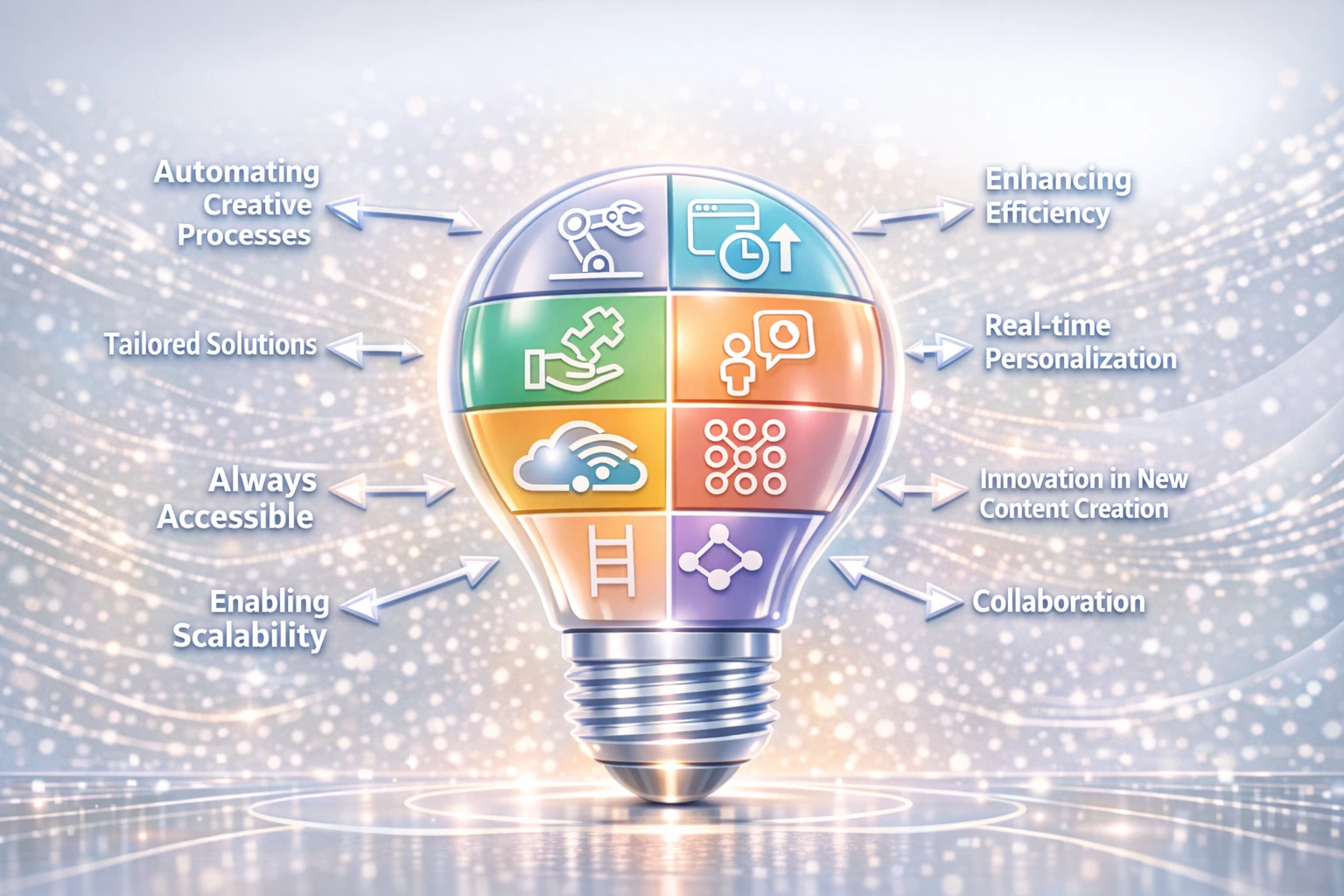
The primary goal of generative AI is to enable machines to create. More specifically, generative AI aims to learn the statistical patterns present in human generated data and then use those patterns to synthesize new content that is coherent, contextually appropriate, and indistinguishable from — or at least comparable to — content produced by humans.
This broad goal actually encompasses several more specific objectives:
- 1Content Automation: Reducing the time and cost required to produce written, visual, and audio content at scale by using AI applications that can generate drafts, variations, and final outputs autonomously. An AI Content Generator can further streamline this process by producing high-quality drafts within seconds.
- 2Personalization at Scale: Enabling AI platforms to generate customized content for millions of individual users simultaneously, from personalized marketing messages to tailored educational experiences.
- 3Augmenting Human Creativity: Acting as a creative co-pilot that helps writers, designers, engineers, and artists explore ideas faster, break through creative blocks, and push boundaries.
- 4Simulating Human Knowledge: Building systems that can engage in nuanced, contextually rich conversations, answer complex questions, and assist with specialized tasks across domains like law, medicine, and engineering.
- 5Accelerating Scientific Discovery: Generating hypotheses, synthesizing research, designing molecular structures, and simulating experiments at speeds no human team could match.
In its most ambitious form, the goal of generative AI is to create systems that are not just reactive tools, but genuinely intelligent creative partners that expand the frontier of what is achievable across every field of human endeavor.
How Generative AI Differs from Traditional AI
A major source of confusion for many people is the distinction between generative AI and older, more established forms of artificial intelligence. Traditional AI systems, sometimes called discriminative or analytical AI, are built to recognize, classify, and predict based on patterns in historical data. Generative AI, by contrast, goes beyond recognition to actually produce new data.
The table below illustrates the most important differences between the two paradigms:
| Parameter | Traditional AI | Generative AI |
|---|---|---|
| Primary Function | Classify, predict, analyze | Create, synthesize, generate |
| Output Type | Labels, scores, categories | Text, images, audio, code |
| Learning Approach | Supervised learning primarily | Unsupervised and self supervised learning |
| Model Architecture | Decision trees, SVMs, CNNs | Transformers, GANs, VAEs, Diffusion Models |
| Creativity Capability | None — purely analytical | High — can produce original content |
| Use Cases | Fraud detection, image recognition, spam filtering | Content creation, chatbots, drug discovery |
| Data Requirements | Labeled datasets | Massive unlabeled datasets |
| Human Interaction | Provides answers to defined queries | Engages in open ended, creative dialogue |
Key Technologies Behind Generative AI
Generative AI does not operate on a single technology. It is built on a convergence of several powerful machine learning architectures, each contributing specific capabilities. To understand generative AI fully, you need to understand the core building blocks — and for a detailed breakdown, the guide on AI system components and the core building blocks of modern AI systems is an excellent starting point.
Transformer Models
The architecture behind GPT, BERT, and most large language models. Transformers use attention mechanisms to understand context across long sequences of text, enabling coherent and contextually rich generation.
Generative Adversarial Networks (GANs)
Two neural networks — a generator and a discriminator — compete against each other. The generator creates content; the discriminator judges it. Through this adversarial process, the generator produces increasingly realistic outputs.
Variational Autoencoders (VAEs)
VAEs encode data into a compressed representation and then decode it back into a new form. They are particularly useful for generating variations of existing content and learning smooth, interpretable data distributions.
Diffusion Models
The technology behind tools like DALL·E and Stable Diffusion. Diffusion models learn to reverse a process of adding noise to data, effectively “denoising” a random signal into a high quality image or other output.
How Generative AI Learns From Data
Learning is at the core of every generative AI solution system. Unlike rule based software that is programmed with explicit instructions, generative AI acquires its capabilities entirely through exposure to data. The learning process begins with data ingestion — feeding the model enormous quantities of raw information drawn from books, websites, scientific papers, code repositories, and multimedia archives.
During training, the model adjusts billions of internal parameters called weights, progressively improving its ability to predict the next token, pixel, or data point in a sequence. This process requires extraordinary computational resources and is typically performed on clusters of specialized graphics processing units or tensor processing units over days, weeks, or even months.
Once trained, the model goes through a phase known as fine tuning, where it is exposed to curated, task specific datasets to sharpen its performance on particular applications. It is also at this stage that AI platforms introduce human feedback mechanisms — a technique called reinforcement learning from human feedback (RLHF) — to align the model’s outputs with human values and expectations. Understanding the role of AI tokens and how they function in language models is also valuable for grasping how generative AI processes and produces text.
The Role of Machine Learning in Generative AI
Machine learning is not just related to generative AI — it is its very foundation. Every generative AI model, regardless of the specific architecture it uses, is a machine learning model at its core. The defining characteristic of machine learning is that it allows software systems to improve their performance on tasks through experience, without being explicitly programmed for each scenario.
In the context of generative AI, machine learning enables the model to:
- Identify statistical regularities and patterns in massive, unstructured datasets
- Generalize from seen examples to produce coherent outputs for entirely new inputs
- Adapt to domain specific tasks through fine tuning on specialized corpora
- Self correct and improve through iterative feedback loops during training
- Balance exploration and exploitation when generating diverse, creative outputs
Deep learning — a subset of machine learning using multi layered neural networks — is the specific branch that powers most modern generative AI systems. The depth of these networks (often with hundreds of layers and billions of parameters) is what gives generative AI its remarkable ability to model complex, high dimensional data distributions.
Types of Content Generative AI Can Create
One of the most exciting aspects of generative AI is the sheer breadth of content types it can produce. Modern AI platforms are no longer limited to generating text — they span virtually every medium of human communication and creative expression. Businesses and creators now use these tools to create videos, marketing assets, tutorials, and visual content much faster than with traditional production workflows.
| Content Type | Examples | Key AI Tools |
|---|---|---|
| Written Text | Articles, emails, scripts, poetry, summaries | ChatGPT, Claude, Gemini |
| Images and Art | Photorealistic photos, illustrations, logos | DALL·E, Midjourney, Stable Diffusion |
| Source Code | Full functions, scripts, bug fixes, documentation | GitHub Copilot, CodeWhisperer |
| Audio and Music | Voice synthesis, background scores, sound effects | ElevenLabs, Suno, MusicGen |
| Video Content | Short clips, animations, talking avatars | Sora, Runway, Synthesia |
| 3D Models | Product designs, architectural renders, game assets | Shap·E, Point·E, Luma AI |
| Synthetic Data | Training datasets, simulations, test environments | Mostly GPT and diffusion based pipelines |
Why Businesses Are Adopting Generative AI
The business case for generative AI is compelling and growing stronger by the month. Organizations that have integrated AI applications into their operations report significant gains in speed, quality, and cost efficiency across departments. Content marketing teams that once needed days to produce a campaign brief can now generate and iterate in hours. Customer service operations that required large human teams are being supplemented by AI agents capable of handling thousands of concurrent conversations.
Beyond operational efficiency, generative AI is opening entirely new revenue streams and business models. Companies are building AI powered products, selling generative capabilities as a service, and using AI platforms to unlock personalization strategies previously impossible at scale. The competitive pressure is real — businesses that delay AI adoption risk falling behind rivals who are already leveraging these capabilities.
Real World Applications of Generative AI
Generative AI is not a theoretical concept — it is actively deployed across dozens of industries right now. Here are some of the most impactful real-world applications of AI applications and AI platforms built on generative AI:
- Healthcare: AI platforms are generating synthetic patient data for clinical research, assisting radiologists by flagging anomalies in medical images, and helping pharmaceutical companies identify promising drug candidates by generating and evaluating molecular structures.
- Financial Services: Banks and fintech firms use generative AI to automate report generation, create personalized financial advice for clients, detect sophisticated fraud patterns, and synthesize market research.
- Education: Adaptive learning platforms powered by generative AI create customized lesson plans, generate practice problems tailored to student skill levels, and provide instant, detailed feedback on assignments.
- E Commerce and Retail: Generative AI creates personalized product descriptions, generates virtual try-on experiences, and powers conversational shopping assistants that guide customers through purchase decisions.
- Legal and Compliance: Law firms use AI applications to draft contract clauses, summarize case law, generate compliance reports, and flag regulatory risks in lengthy documents.
- Gaming and Entertainment: Game studios use generative AI to create procedural world building, generate unique dialogue for non-player characters, and produce background music that adapts to gameplay in real time.
The intersection of generative AI with immersive technologies is also creating fascinating new territories. Exploring what role AI plays in the metaverse reveals how generative models are being used to create entire virtual worlds, AI companions, and dynamic digital environments.
Generative AI Applications Across Industries
Benefits of Generative AI in Different Industries
The advantages of adopting AI applications built on generative AI extend far beyond simple automation. The following table captures the most significant benefits across key industries:
| Industry | Key Benefit | Estimated Impact |
|---|---|---|
| Healthcare | Accelerated drug discovery timelines | Up to 50% faster early stage research |
| Financial Services | Automated regulatory report generation | 60–80% reduction in manual reporting time |
| Education | Personalized learning at scale | 30% improvement in student outcomes reported |
| Retail | AI driven personalization and customer engagement | 15–25% increase in conversion rates |
| Marketing | Rapid multi format content creation | 5x increase in content production velocity |
| Software Engineering | AI assisted code review and generation | Up to 55% faster code completion reported |
It is also worth noting that the generative AI market is having a transformative effect on quality assurance processes. The use of AI testing tools in software quality assurance is one area where AI applications are dramatically accelerating how teams validate and ship software.
Challenges and Limitations of Generative AI
Despite its remarkable capabilities, generative AI is not without significant challenges. Understanding these limitations is essential for any business or individual looking to deploy AI applications responsibly.
- Hallucinations: Generative AI models can produce confident but factually incorrect statements. This occurs because they generate outputs based on statistical patterns rather than verified knowledge databases — a critical limitation for high stakes applications in medicine or law.
- Bias and Fairness: Models trained on biased datasets will reproduce and even amplify those biases in their outputs. This can lead to discriminatory outcomes in hiring, lending, or criminal justice applications.
- Computational Cost: Training large generative AI models requires enormous computing resources, energy, and specialized hardware — creating significant environmental and financial costs that are inaccessible to most organizations.
- Intellectual Property Ambiguity: Generative AI trained on copyrighted material raises unresolved questions about ownership, licensing, and the rights of original content creators.
- Data Privacy Risks: AI platforms that are trained on or process sensitive personal data face strict regulatory scrutiny under frameworks like GDPR and CCPA.
- Output Reliability: The non deterministic nature of generative AI means the same prompt can produce different outputs each time, making quality assurance difficult in critical workflows.
Ethical Concerns Related to Generative AI
The ethical landscape surrounding generative AI is one of the most actively debated areas in technology today. As AI platforms become more capable and widely deployed, the stakes of getting ethics right grow exponentially.
Among the most pressing ethical concerns are the following. Deepfakes — AI generated synthetic media — can be used to create convincing fake videos of public figures, enabling unprecedented levels of misinformation, political manipulation, and reputational harm. The proliferation of AI generated content also threatens to overwhelm our ability to distinguish fact from fiction online, with serious consequences for democratic discourse.
There are also significant labor market implications. While generative AI creates new roles and opportunities, it also automates tasks previously performed by knowledge workers, writers, designers, and other creative professionals — raising urgent questions about displacement and economic inequality. Responsible deployment of AI applications requires not just technical safeguards but also thoughtful policy, transparency, and inclusive stakeholder engagement.
The Impact of Generative AI on Creativity and Innovation
One of the most profound — and often underappreciated — effects of generative AI is its impact on human creativity. Far from replacing creative professionals, the most powerful use case for generative AI is as a collaborator and amplifier of human imagination.
Architects are using AI platforms to generate and evaluate thousands of structural design variations in minutes. Authors are using generative AI to overcome writer’s block, explore narrative possibilities, and maintain consistent world-building across long projects, often refining outputs further to humanize AI and ensure a more natural flow.. Musicians are using AI to experiment with new harmonic progressions and sonic textures. In every domain, generative AI lowers the barrier between an idea and its realization — allowing creators to spend more time on the high-value work of judgment, taste, and refinement.
Innovation cycles are also accelerating dramatically. Research teams that once needed months to iterate on a hypothesis can now use AI applications to generate and test dozens of variants simultaneously. This compression of the innovation cycle is expected to produce breakthroughs across science, engineering, and medicine at a rate far beyond anything previously possible with human only teams.
The Evolution of AI Platforms
From narrow tools to autonomous, multimodal intelligence
2018
Single modality models, text only
2020
GPT and DALL·E era — text and images
2023
Multimodal AI — text, image, audio, video
2025+
Agentic AI — autonomous, multi step reasoning
Future Goals and Advancements of Generative AI
The trajectory of generative AI is pointing toward capabilities that would have seemed extraordinary even five years ago. The near term future holds several transformative advancements already visible on the horizon:
- Multimodal Intelligence: Next generation AI platforms will seamlessly process and generate across text, images, audio, video, and structured data simultaneously — creating truly unified intelligence that mirrors how humans perceive the world.
- Agentic AI Systems: Rather than responding to single prompts, future AI applications will operate as autonomous agents capable of planning, executing multi step tasks, using external tools, and adapting to new information over extended time horizons.
- Improved Reasoning: Advancements in chain of thought prompting, test time compute, and specialized reasoning architectures are steadily improving the ability of generative AI to solve complex logical, mathematical, and scientific problems.
- Personalized AI: Future AI platforms will maintain persistent memory and contextual awareness across sessions, enabling genuinely personalized interactions that adapt to individual user preferences, history, and goals over time.
- Scientific AI: Generative AI is poised to become a core tool in scientific discovery — designing experiments, interpreting results, generating hypotheses, and synthesizing knowledge across disciplines at superhuman speed.
How Generative AI Will Shape the Future of Technology
Looking further ahead, generative AI is not just another software trend — it represents a fundamental shift in the nature of computing itself. We are moving from an era of programmed software toward an era of learned capability, where systems acquire intelligence through exposure to human knowledge rather than explicit programming.
This shift will reshape every layer of the technology stack. AI platforms will become the primary interface between humans and digital systems. Natural language will replace code as the dominant mode of instructing computers. The role of human expertise will evolve from direct execution to oversight, curation, and judgment — roles that remain fundamentally human even in an AI saturated world.
Infrastructure, too, will evolve. The architecture that currently supports AI platforms — distributed training clusters, specialized silicon, and optimized inference services — will become as foundational as cloud computing is today. Understanding how these systems are architected from data to deployment is increasingly important for technologists and business leaders planning their AI strategy.
Best Practices for Using Generative AI Responsibly
The power of generative AI comes with a responsibility to deploy it thoughtfully. Whether you are an individual using AI tools or a business integrating AI platforms into core workflows, the following best practices are essential for responsible and effective use:
- Always verify outputs: Treat AI generated content as a starting draft, not a finished product. Cross reference factual claims with authoritative sources, especially for medical, legal, or financial content.
- Establish clear governance: Organizations should define policies governing what AI applications can and cannot be used for, who is responsible for reviewing outputs, and how sensitive data is handled.
- Invest in AI literacy: Teams using AI platforms should understand the basics of how these systems work, their limitations, and the types of errors they are prone to — this reduces misplaced trust and improves outcomes.
- Maintain human oversight: For high stakes decisions — in hiring, clinical diagnosis, loan approvals, or legal proceedings — always ensure a qualified human reviews and takes responsibility for AI assisted recommendations.
- Audit for bias regularly: Periodically evaluate AI application outputs across different demographic groups and use cases to identify and mitigate systematic biases before they cause harm.
- Be transparent with users: When deploying AI generated content or AI powered services, clearly disclose when and how AI is involved. Transparency builds trust and manages expectations.
- Respect intellectual property: Ensure that the content generated by AI tools does not infringe on existing copyrights and that your use of AI platforms complies with applicable licensing agreements.
Final Thoughts
Generative AI represents one of the most significant technological developments of our era. Its primary goal — to enable machines to create original, contextually appropriate content across every medium — is already being realized in ways that are transforming industries, workflows, and the very nature of human creativity. From the AI platforms powering AI enterprise automation to the AI applications reshaping education and healthcare, generative AI is not a future possibility. It is a present reality.
The journey ahead will require careful navigation of the ethical, technical, and societal challenges that accompany such transformative power. Businesses and individuals who invest in understanding generative AI now — its capabilities, its limitations, and its responsible use — will be best positioned to thrive in the AI enabled future taking shape around us.
Frequently Asked Questions
Q1.How much does it cost to use generative AI tools for a business?
The cost of generative AI tools varies widely depending on the platform, usage volume, and business size. Many AI platforms offer free tiers with limited features, while premium enterprise plans can range from a few hundred to several thousand dollars monthly. Costs typically depend on API calls, token usage, storage, and customization needs. Businesses should compare pricing models carefully before committing to any AI application for long term use.
Q2.Can generative AI work without an internet connection?
Most generative AI tools require an active internet connection because they rely on cloud based servers to process requests and generate outputs. However, some lightweight AI models can be downloaded and run locally on a device. These offline versions are generally less powerful than their cloud counterparts. As AI platforms evolve, more on device generative AI capabilities are being explored to support users in low connectivity environments.
Q3.Who legally owns the content created by a generative AI tool?
Ownership of AI generated content is still a debated legal area globally. In most jurisdictions, content produced entirely by an AI application without human creative input may not qualify for copyright protection. However, when a human meaningfully shapes the prompt or edits the output, partial ownership may apply. Businesses using AI platforms for content creation should consult legal experts and review the terms of service of the specific tool they use.
Q4.Is generative AI safe for children or students to use?
Generative AI can be beneficial for students when used with proper supervision and age-appropriate settings. Many AI platforms include content filters and safety guardrails to limit harmful outputs. However, children should be guided on how to verify AI-generated information, as it can sometimes be inaccurate or biased. Schools and parents should establish clear guidelines for responsible AI application usage to ensure a safe and productive learning experience.
Q5.What is the difference between ChatGPT and other generative AI platforms?
ChatGPT is one of the most well known generative AI tools, developed by OpenAI and designed primarily for conversational text generation. Other AI platforms like Google Gemini, Anthropic Claude, and Meta LLaMA each have different strengths, training data, safety policies, and use cases. While ChatGPT excels at dialogue, other tools may perform better in coding, image generation, or scientific reasoning. Choosing the right AI application depends on your specific needs.
Q6.How do I protect my sensitive data when using AI platforms?
Protecting sensitive data on AI platforms requires several precautions. Always review the privacy policy of any AI application before submitting confidential information. Avoid entering personal identifiers, financial data, or proprietary business secrets into public AI tools. Many enterprise AI platforms offer private deployment options or data encryption. Implementing role based access controls and regularly auditing AI tool usage within your organization are also key steps for maintaining data security.
Q7.Can generative AI understand and generate content in multiple languages?
Yes, many modern generative AI tools support multiple languages, including English, Spanish, French, German, Chinese, Hindi, and many more. Advanced AI platforms trained on multilingual datasets can translate, summarize, and create content across languages with reasonable accuracy. However, performance quality can vary, with some languages receiving stronger support than others depending on training data availability. Businesses targeting global audiences should test AI application outputs in each target language for quality assurance.
Q8.How accurate is generative AI when producing factual content?
Generative AI can produce highly convincing but sometimes factually incorrect content, a phenomenon often called hallucination. AI platforms generate outputs based on statistical patterns in training data rather than verified knowledge databases. This means they may confidently state inaccurate information. For factual or research-heavy tasks, always cross-reference AI-generated content with reliable sources. Using AI applications as a drafting assistant rather than a sole information source reduces the risk significantly.
Q9.What hardware or system requirements are needed to run generative AI locally?
Running generative AI locally on your own hardware requires significant computational resources. Most large language models need a modern GPU with at least 8 to 16 GB of VRAM, substantial RAM, and fast storage. Smaller, quantized AI models can run on standard consumer hardware with more modest specs. Cloud-based AI platforms eliminate these hardware concerns entirely, making them a more accessible option for businesses and individuals who lack high-performance computing infrastructure.
Q10.Can generative AI be fine tuned for a specific industry or niche?
Yes, fine-tuning is one of the most powerful capabilities offered by enterprise AI platforms. By training a generative AI model on industry-specific datasets, such as legal documents, medical records, or financial reports, businesses can significantly improve output relevance and accuracy for their niche. This process is known as fine-tuning or domain adaptation. Many AI application providers offer fine-tuning services or APIs that allow companies to customize base models for specialized use cases.
Explore Services
Related Services
Reviewed by

Aman Vaths
Founder of Nadcab Labs
Aman Vaths is the Founder & CTO of Nadcab Labs, a global digital engineering company delivering enterprise-grade solutions across AI, Web3, Blockchain, Big Data, Cloud, Cybersecurity, and Modern Application Development. With deep technical leadership and product innovation experience, Aman has positioned Nadcab Labs as one of the most advanced engineering companies driving the next era of intelligent, secure, and scalable software systems. Under his leadership, Nadcab Labs has built 2,000+ global projects across sectors including fintech, banking, healthcare, real estate, logistics, gaming, manufacturing, and next-generation DePIN networks. Aman’s strength lies in architecting high-performance systems, end-to-end platform engineering, and designing enterprise solutions that operate at global scale.