Ai Overview
The software delivery landscape is undergoing a profound transformation. Teams report that up to 60% of repetitive operational tasks can be fully automated, freeing engineers to focus on innovation and strategic initiatives rather than firefighting. Companies adopting AI in DevOps report 45% improvement in deployment frequency, enabling faster feature releases and quicker responses to market changes.
The software delivery landscape is undergoing a profound transformation. Traditional DevOps practices, which emerged to bridge the gap between development and operations teams, are now being reimagined through the lens of artificial intelligence. AI Applications and AI Platforms are no longer peripheral tools—they’ve become essential components of modern software delivery infrastructure.
Organizations like Netflix, Amazon, and Google have pioneered the integration of intelligent automation into their DevOps workflows. What once required extensive manual configuration, monitoring, and troubleshooting can now be handled by sophisticated machine learning algorithms. The result is faster deployments, higher reliability, and teams that can focus on strategic initiatives rather than repetitive operational tasks.
This comprehensive guide explores how intelligent automation is revolutionizing software delivery, from the foundational concepts to real-world implementation strategies that leading enterprises are adopting today.
AI in DevOps services a fundamental shift in how teams approach infrastructure management and software delivery. Rather than treating AI as an optional enhancement, forward thinking organizations are embedding intelligent systems at every stage of their delivery pipeline.
The Core Components of AI in DevOps:
The integration of these components creates a closed-loop system where operations become increasingly intelligent and self optimizing. What distinguishes modern AI Platforms from earlier automation tools is their ability to learn, adapt, and improve their decision-making over time.
The complexity of modern software systems has reached a point where human teams alone cannot effectively manage all operational tasks. Contemporary applications span multiple cloud providers, containerized microservices, serverless functions, and edge computing platforms. Tools like ctrlops help simplify this complexity by giving developers and small teams a clean, centralized interface to manage their entire server infrastructure without requiring deep DevOps expertise or extensive terminal command knowledge. This exponential increase in system complexity makes AI not just beneficial but essential.
Key Drivers for AI Adoption:
The implementation of AI Applications across DevOps operations delivers measurable business value that extends far beyond simple efficiency gains. Organizations report transformative improvements across multiple operational dimensions.
Automated decision making eliminates manual interventions. Teams report that up to 60% of repetitive operational tasks can be fully automated, freeing engineers to focus on innovation and strategic initiatives rather than firefighting.
With intelligent automation handling routine tasks, deployment frequency increases significantly. Companies adopting AI in DevOps report 45% improvement in deployment frequency, enabling faster feature releases and quicker responses to market changes.
Predictive capabilities identify issues before they impact production systems. Change failure rate decreases by 50%, and incident resolution times drop from hours to minutes through automated root cause analysis and remediation, along with an expiry tracker.
Intelligent resource management prevents waste. ML powered optimization reduces cloud infrastructure costs by optimizing instance sizing, right scheduling workloads, and identifying idle resources with precision unattainable by manual review.
AI Platforms detect sophisticated attacks that rule based systems miss. Behavioral anomaly detection identifies unauthorized access patterns, suspicious data exfiltration, and other threats that human analysts would struggle to detect among normal traffic volumes.
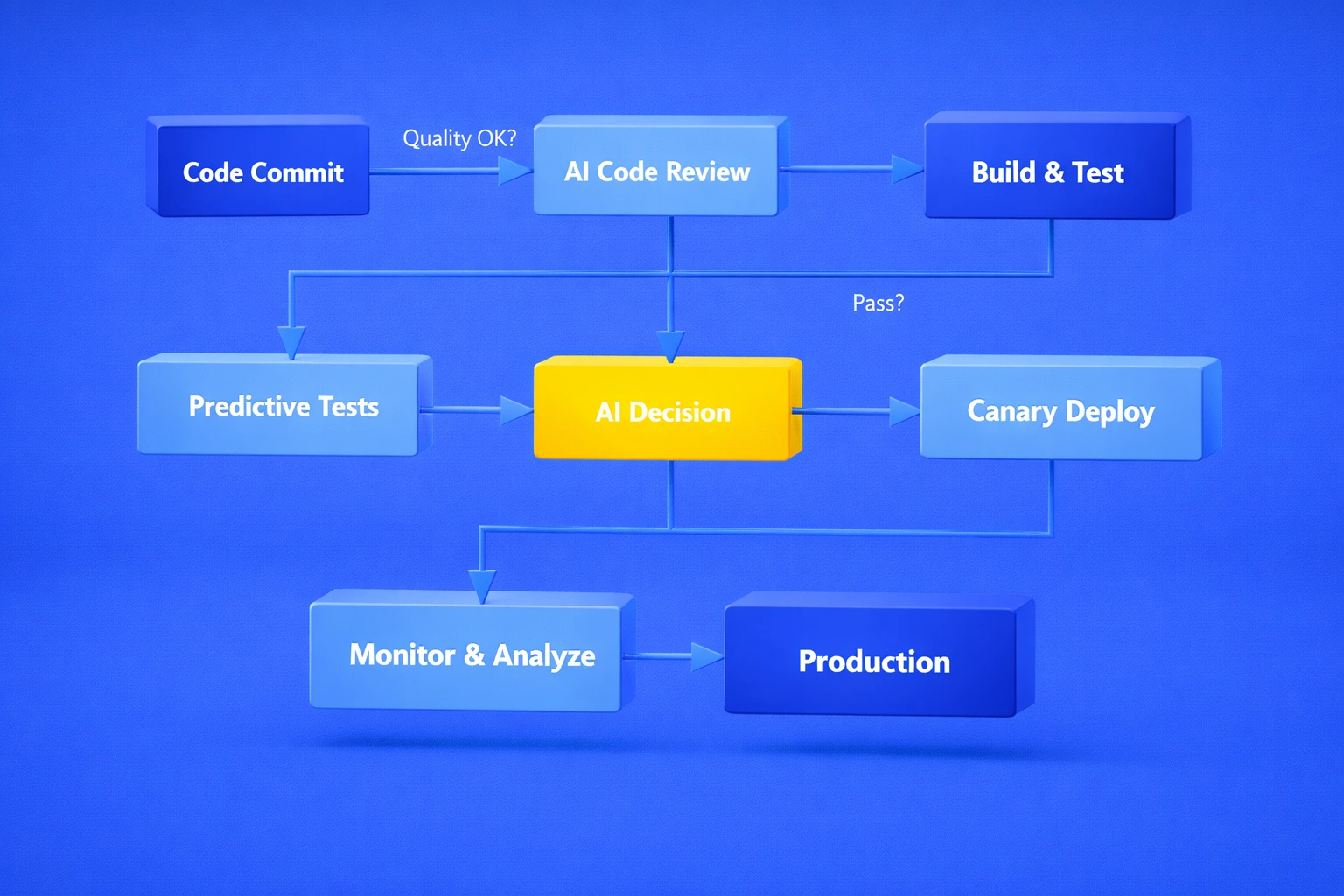
Continuous Integration and Continuous Deployment represent the backbone of modern software delivery. AI transforms these practices by introducing intelligent decision making at each stage of the pipeline, from code commit through production deployment.
AI Enhanced CI/CD Pipeline Flow
Modern DevOps pipelines consist of dozens or hundreds of discrete steps. An AI development company helps transform these linear workflows into intelligent systems that adapt to conditions, learn from history, and make sophisticated decisions autonomously.
Categories of AI Powered Pipeline Automation:
Intelligent Build Optimization
AI systems analyze code dependencies and determine optimal build parallelization strategies. Rather than using static configurations, these systems dynamically adjust resource allocation based on current build complexity, reducing build times by 30 to 50% on average.
Self Healing Pipelines
When pipeline steps fail, AI diagnoses root causes and either automatically remedies the issue or intelligently retries with adjusted parameters. This reduces manual intervention by detecting transient failures versus genuine problems.
Resource Orchestration
AI schedulers allocate build and test resources efficiently. They learn which workloads benefit from GPU acceleration, predict resource requirements for different code change types, and optimize allocation across shared infrastructure.
Dependency Management
ML systems track and predict how software dependencies evolve, automatically identifying when library upgrades will introduce incompatibilities before they reach production systems.
Machine Learning represents the intelligence engine powering modern DevOps systems. Unlike traditional rule based automation, ML systems learn patterns from historical data and continuously improve their decision-making accuracy.
The machine learning lifecycle in DevOps typically follows several critical phases. Teams collect extensive operational metrics, logs, and traces from production systems. This data is processed through feature engineering pipelines that extract meaningful signals from noise. Supervised learning models are trained to predict deployment success, infrastructure failures, and security threats. These models are validated against historical test cases, then gradually deployed to production environments where they continue learning from real world outcomes.
Machine Learning Applications in DevOps:
The shift from reactive to proactive operations represents one of the most significant transformations enabled by AI in DevOps. Rather than responding to failures after they occur, predictive analytics enable teams to address issues before end users are affected.
Predictive models analyze patterns in historical system behavior to forecast future issues. When storage usage trends indicate that a database will run out of space in three days, teams receive alerts with enough lead time for planned expansion. When CPU utilization patterns suggest imminent autoscaling events, infrastructure can be provisioned proactively. When code quality metrics indicate a deployment is likely to introduce regressions, it can be blocked for additional testing.
Effective predictive systems require multiple layers. Data collection engines aggregate metrics from all infrastructure components. Feature engineering pipelines transform raw metrics into meaningful signals that ML models can learn from. Ensemble models combine multiple prediction approaches to achieve higher accuracy than any single model. Finally, decision engines translate predictions into actionable alerts or automated remediation actions.
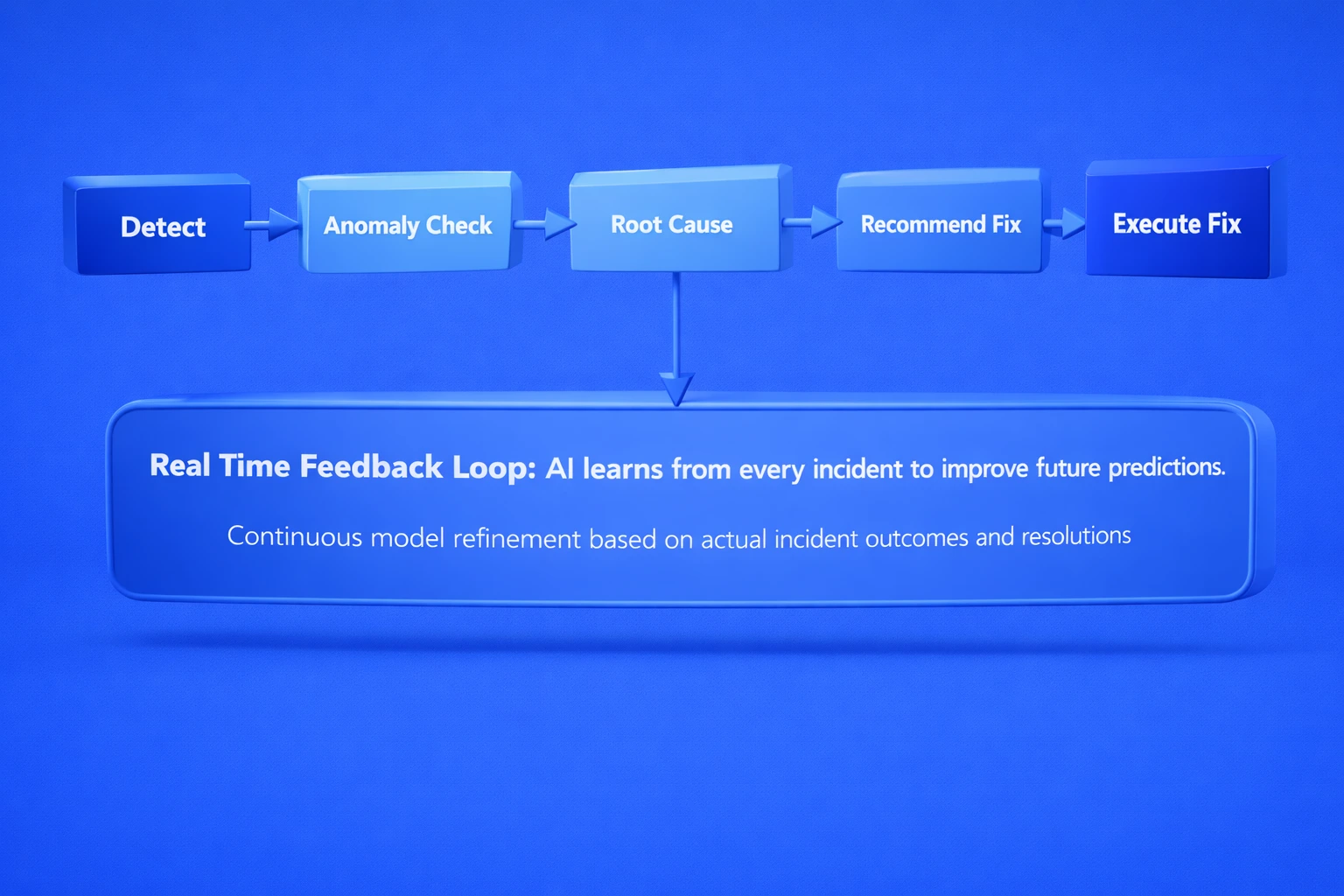
Traditional monitoring systems generate excessive alerts, a phenomenon known as alert fatigue. Teams struggle to differentiate critical issues from harmless noise, leading to missed genuine problems while engineers are overwhelmed by false positives.
Intelligent monitoring systems powered by AI Applications revolutionize this landscape. These systems learn what normal looks like for each application and infrastructure component. When deviations occur, sophisticated anomaly detection algorithms evaluate whether the deviation represents a genuine problem or expected variation.
Intelligent Incident Management Lifecycle
Infrastructure management in cloud environments presents unique challenges. Dynamic workloads, variable costs, and complex interdependencies between components make manual optimization difficult. AI Platforms excel in this domain by continuously analyzing infrastructure patterns and making intelligent scaling decisions.
Rather than reactive autoscaling triggered by current resource utilization, predictive scaling systems forecast demand changes based on historical patterns, scheduled events, and real time business metrics. This enables infrastructure to scale in advance of demand spikes, ensuring performance while minimizing costs.
The economics of intelligent infrastructure management are compelling. Organizations reducing idle resource costs by 25 to 40% often recover investment in AI Platforms within six to nine months, with ongoing savings extending indefinitely.
Software testing represents one of the most time consuming and resource intensive aspects of the development lifecycle. Traditional approaches rely on manually created test cases that struggle to keep pace with rapidly evolving code. AI transforms testing through intelligent automation and adaptive strategies.
Smart Test Generation: AI algorithms analyze code and automatically generate test cases covering edge cases and error conditions that human developers might overlook. These systems learn which test patterns are most effective at catching bugs in different code types.
Test Prioritization: Rather than running the complete test suite every time code changes, ML algorithms identify which tests are most relevant to the specific code modifications. This reduces testing time by 40% or more without sacrificing coverage.
Flaky Test Detection: AI systems identify tests that produce inconsistent results, a major source of developer frustration. These tests are either fixed or disabled, improving pipeline reliability and developer confidence.
Visual Testing Automation: Machine learning models trained on historical screenshots detect visual regressions automatically, catching UI issues that traditional functional tests miss.
The integration of security into DevOps workflows, known as DevSecOps, has become essential. However, traditional security scanning approaches struggle to keep pace with the speed of continuous deployment. AI Applications revolutionize security by automating detection and response at machine speed.
Intelligent security systems embedded in deployment pipelines analyze every code commit for vulnerabilities, misconfigurations, and policy violations. These systems learn from historical security incidents to recognize emerging threat patterns. When suspicious activity is detected in production systems, AI can isolate affected components automatically while alerting security teams.
AI Powered Security Capabilities in DevOps:
Static Analysis
AI enhanced tools identify code vulnerabilities including SQL injection, cross site scripting, and buffer overflows with minimal false positives
Dependency Scanning
ML models track thousands of open source libraries and alert teams when vulnerable versions are introduced
Runtime Protection
AI monitors application behavior in production and detects exploitation attempts or lateral movement by attackers
Compliance Automation
Systems automatically verify that deployments meet compliance requirements (SOC 2, HIPAA, PCI DSS) before reaching production
The ecosystem of AI powered DevOps tools continues to expand rapidly. Leading platforms provide integrated capabilities across monitoring, analysis, automation, and security. Organizations should evaluate AI productivity tools based on their specific technical needs and existing tool investments.
Representative AI DevOps Platforms and Their Strengths:
Leading technology companies have pioneered the application of AI in DevOps, demonstrating concrete business value. These real world examples illustrate how intelligent automation translates to measurable improvements in deployment velocity, reliability, and cost efficiency.
Challenge: Massive content delivery infrastructure with millions of concurrent users requires deployments multiple times per day. Manual testing and deployment validation created bottlenecks.
Solution: Implemented AI powered test selection and canary deployment systems. Predictive models identify which tests are relevant to specific code changes, reducing test execution time by 65%. Intelligent traffic management during canary deployments enables detection of regressions within minutes.
Results: Deployment frequency increased from 6 per day to 40+ per day. Change failure rate dropped to under 2%. Infrastructure costs decreased 30% through intelligent resource optimization.
Challenge: Regulatory compliance and security requirements create extensive testing and validation procedures. Incident response teams struggled with noise from thousands of daily alerts, missing critical issues.
Solution: Deployed intelligent monitoring platform with advanced anomaly detection. System learns normal behavior patterns across all infrastructure and application components. AI correlates symptoms to identify root causes.
Results: Alert volume reduced by 75% while increasing detection sensitivity. Mean time to resolution dropped from 3 hours to 15 minutes. Compliance audit findings decreased significantly due to improved change tracking and automated validation.
While the benefits of AI in DevOps are substantial, implementation presents significant challenges. Organizations must overcome technical, organizational, and cultural obstacles to realize full value.
Data Quality and Availability
ML models require high quality, comprehensive data to train effectively. Organizations with fragmented systems, poor logging practices, or incomplete historical data struggle to build effective models. Data collection and preparation often requires significant engineering effort.
Skills Gap
Implementing and maintaining AI systems requires expertise in machine learning, data engineering, and DevOps practices. This combination of skills is rare in the market, making hiring and training challenging.
Model Reliability and Explainability
AI models can be difficult to debug and explain to stakeholders. When models make incorrect decisions, understanding why and correcting the behavior requires specialized expertise. Black box decisions are problematic in production systems.
Integration Complexity
Integrating AI systems with existing tools and workflows requires careful planning. Legacy systems may lack APIs for data collection. Teams must manage multiple vendors and ensure interoperability.
Organizational Resistance
Teams may resist adoption if they perceive AI as threatening their roles. Without buy in from DevOps engineers and operations teams, implementation efforts will encounter resistance regardless of technical merit.
Successful implementation of AI in DevOps requires thoughtful planning and execution. Organizations that follow proven best practices achieve faster time to value and more sustainable long term success.
1. Start with Clear Business Objectives
Before implementing any AI tools, define specific, measurable business outcomes. Is the priority reducing deployment time, improving reliability, or cutting costs? Align tool selection and implementation strategy with these objectives.
2. Assess Data Readiness
Evaluate current data collection, quality, and accessibility. Implement comprehensive logging and metrics collection before deploying AI systems. Clean, well organized historical data is essential for effective models.
3. Build Internal Expertise
Organizations handling PII, financial, or government data often face strict storage requirements. A private cloud provides greater control over data location and compliance, a topic often covered in a DevOps Course.
4. Start with High Impact, Lower Risk Use Cases
Implement AI first in areas where decisions can be automated with clear validation criteria. Anomaly detection and cost optimization are good starting points because correctness is easier to evaluate.
5. Maintain Human Oversight
Even as automation increases, retain human review of critical decisions. Implement confidence thresholds that route uncertain decisions to experienced engineers for evaluation.
6. Establish Governance and Monitoring
Implement processes for monitoring model performance, detecting drift, and updating models as systems evolve. AI systems require continuous maintenance and refinement, not one time deployment.
The integration of AI in DevOps is still in its relative infancy. Emerging trends indicate the direction of evolution as the field matures. Organizations preparing today for tomorrow’s capabilities will gain significant competitive advantages.
Future systems will make increasingly sophisticated decisions independently, with humans maintaining strategic oversight. Organizations will transition from manual operations to oversight of intelligent, self managing systems.
ML models will be deployed to edge and on premises infrastructure, enabling real time decisions without cloud round trips. This improves latency, reliability, and privacy while reducing dependency on centralized systems.
AI systems will optimize across the entire technology stack simultaneously, making trade off decisions between application code, infrastructure resources, and network configuration holistically.
Large language models will generate deployment strategies, troubleshooting approaches, and infrastructure configurations based on natural language specifications and historical patterns.
Get expert guidance on implementing intelligent automation in your organization
The transformation of software delivery through AI is not a future possibility, it is an ongoing reality. Organizations across industries are experiencing measurable improvements in deployment velocity, system reliability, and operational costs by implementing intelligent automation.
The convergence of several factors—improved machine learning algorithms, abundant operational data, cloud based infrastructure, and competitive market pressures—creates an ideal environment for AI adoption. Organizations that begin their AI in DevOps journey today will establish competitive advantages that will compound over time.
Success requires more than technology, however. It demands thoughtful organizational planning, investment in team skills, commitment to continuous learning, and realistic expectations about implementation timelines. But for organizations willing to invest in these foundations, the returns are substantial and sustainable.
As AI Platforms and AI Applications mature, the distinction between traditional DevOps and intelligent DevOps will blur. The future belongs to organizations that embrace this transformation and build cultures of continuous optimization and learning.
Frequently Asked Questions
Q1.What is the difference between AIOps and traditional DevOps monitoring?
Traditional DevOps monitoring relies on predefined thresholds and rules to generate alerts. AIOps replaces this with machine learning models that learn normal behaviour dynamically and detect deviations automatically, dramatically reducing false positives and surfacing genuine anomalies that rule-based systems would miss entirely.
Q2.How much does it cost to implement AI in a DevOps pipeline?
Costs vary widely depending on the scale of the organisation, the number of pipeline stages being augmented, and whether you adopt commercial AI Platforms or build custom models. Many organisations start with SaaS-based AIOps tools at a few hundred dollars per month and scale investment as value is demonstrated. Custom ML development for specialised use cases requires larger upfront investment but often delivers superior ROI over a three to five year horizon.
Q3.Can small engineering teams benefit from AI in DevOps, or is it only for large enterprises?
AI Application benefits are accessible to teams of any size. Many AI-powered tools operate as SaaS products with usage-based pricing that scales with pipeline volume. Small teams often see the highest proportional benefit because AI compensates for the limited headcount available for on-call coverage and manual quality assurance.
Q4.How do AI models in DevOps get trained and updated over time?
Most commercial AI Platforms use a combination of pre-trained foundation models fine-tuned on your organisation’s historical pipeline data. As the pipeline generates new data, models are continuously retrained using automated MLOps pipelines that monitor model drift and trigger retraining when accuracy degrades below defined thresholds.
Q5.What risks should organisations be aware of when AI makes autonomous deployment decisions?
The primary risks are model errors leading to incorrect rollbacks or unwarranted deployments, and lack of explainability making post-incident analysis difficult. Mitigation requires implementing human-in-the-loop approval gates for high-risk actions, maintaining comprehensive audit logs of all AI decisions, and setting confidence thresholds below which the system defers to human judgment.
Q6.Does adopting AI in DevOps require replacing existing tools like Jenkins or GitLab?
No. Most AI Application platforms in the DevOps space are designed to integrate with existing toolchains as an intelligence layer rather than a replacement. They ingest data from Jenkins, GitLab, GitHub Actions, and other standard tools via APIs and webhooks, adding AI capabilities without requiring a full toolchain migration.
Q7.How does AI improve security specifically in a DevSecOps context?
AI enhances DevSecOps security through continuous static analysis that detects not just known vulnerability signatures but novel risky code patterns, automated secret detection in repositories, AI-generated software bill of materials for dependency risk assessment, and runtime behavioural analysis that identifies active exploit attempts faster than signature-based intrusion detection systems.
Q8.What skills do DevOps engineers need to work effectively with AI-powered tools?
Engineers need foundational ML literacy to understand model outputs and limitations, proficiency in observability tooling to ensure high-quality training data, and familiarity with MLOps concepts for managing model lifecycle. Deep data science expertise is not required for most operational AI use cases, but an ability to critically evaluate AI recommendations rather than accepting them uncritically is essential.
Q9.How is AI being used to improve release management and change advisory processes?
AI is replacing traditional change advisory board reviews with automated change risk scoring that evaluates the blast radius, historical failure rate, and deployment context of every proposed change in seconds. High-risk changes are automatically flagged for human review while low-risk changes proceed through automated approval gates, dramatically accelerating release cadence without compromising stability.
Q10.What is the expected ROI timeline for an AI in DevOps implementation?
Organisations typically see measurable ROI within three to six months for AIOps and test intelligence use cases, where cost savings from incident reduction and pipeline acceleration are easily quantifiable. Infrastructure optimisation use cases often show ROI within the first billing cycle. More complex AI implementations involving custom model development may require nine to eighteen months to reach full return, accounting for data preparation, training, and tuning phases.
Explore Services
Related Services
Reviewed by

Aman Vaths
Founder of Nadcab Labs
Aman Vaths is the Founder & CTO of Nadcab Labs, a global digital engineering company delivering enterprise-grade solutions across AI, Web3, Blockchain, Big Data, Cloud, Cybersecurity, and Modern Application Development. With deep technical leadership and product innovation experience, Aman has positioned Nadcab Labs as one of the most advanced engineering companies driving the next era of intelligent, secure, and scalable software systems. Under his leadership, Nadcab Labs has built 2,000+ global projects across sectors including fintech, banking, healthcare, real estate, logistics, gaming, manufacturing, and next-generation DePIN networks. Aman’s strength lies in architecting high-performance systems, end-to-end platform engineering, and designing enterprise solutions that operate at global scale.