Ai Overview
Multi-level marketing has existed for decades, but it has always struggled with trust issues. People question whether commissions are calculated fairly, whether payments arrive on time, and whether the whole system is transparent enough. The Howey Test in the United States examines whether something is an investment contract based on whether people invest money expecting profits from others’ efforts. The wrong partner can waste your budget and deliver a system that fails at launch.
Key Takeaways
- Blockchain tokens bring transparency and automation to traditional MLM structures
- Smart contracts eliminate manual commission calculations and payment delays
- Proper tokenomics design is critical for long-term sustainability
- Security audits and regulatory compliance should never be optional
- The right blockchain network affects transaction costs and user experience
- Community building and trust are essential for token-based MLM success
Introduction to Blockchain-Based MLM Systems
Multi-level marketing has existed for decades, but it has always struggled with trust issues. People question whether commissions are calculated fairly, whether payments arrive on time, and whether the whole system is transparent enough. Blockchain technology offers solutions to these problems that seemed impossible just a few years ago.
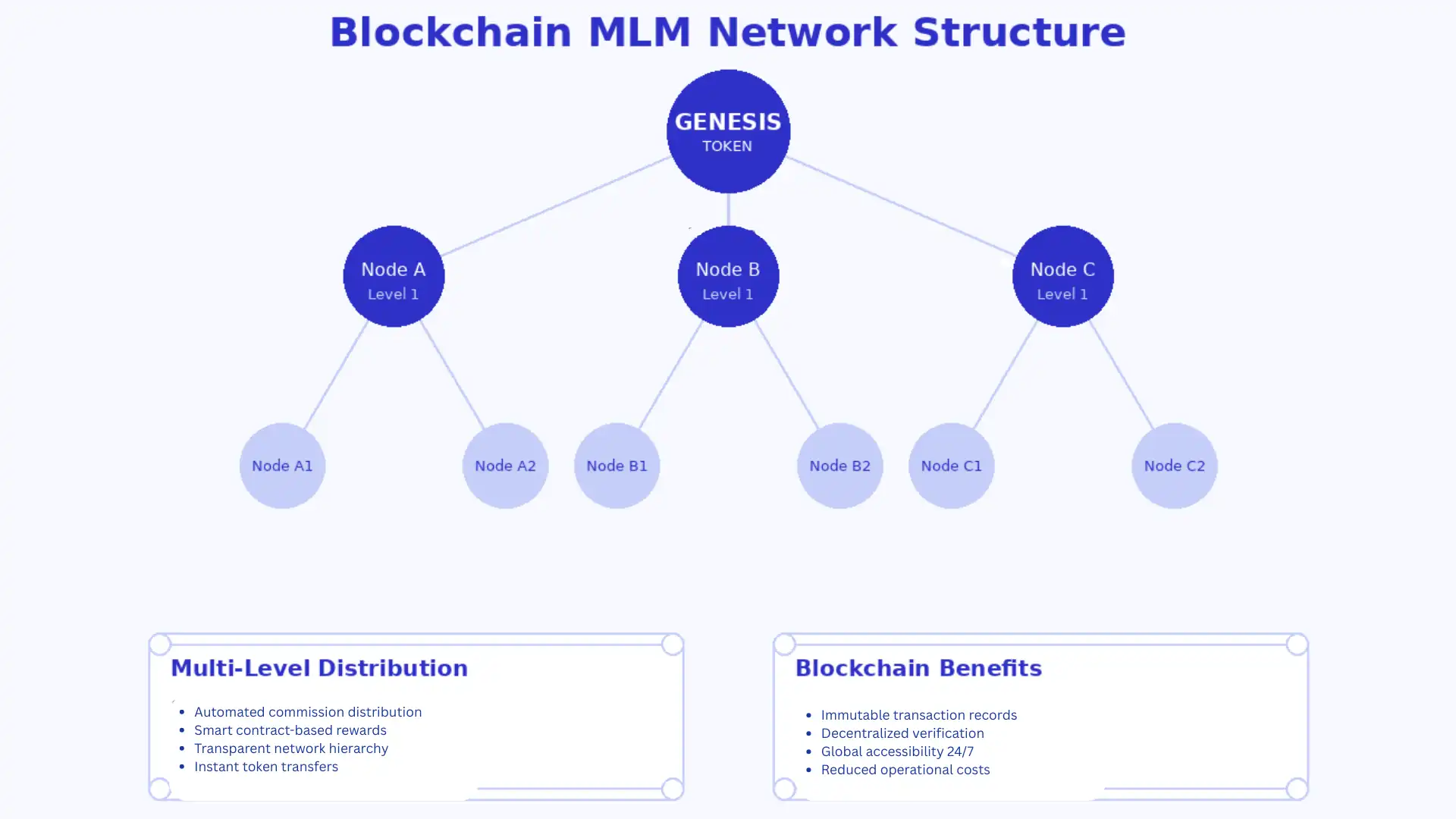
When you combine MLM with blockchain tokens, you create a system where every transaction is recorded permanently, commissions are paid automatically through smart contracts, and participants can verify their earnings in real time. This is not just an upgrade to existing MLM systems. It represents a fundamental shift in how network marketing can operate.
Expert Insight: Over the past eight years working with blockchain-based business models, we have seen how tokenization changes participant behavior. People trust systems more when they can see exactly how rewards are distributed. They engage more actively when tokens have real utility beyond just commission payments. The challenge is building these systems correctly from the start.
Understanding the Basics of an MLM System
Before diving into blockchain integration, you need to understand what makes MLM systems work. At its core, multi-level marketing[1] involves recruiting participants who then recruit others, creating a network structure. Each person earns commissions not just from their own sales but also from the sales made by people they recruited.
Traditional MLM systems rely on centralized databases to track membership hierarchies, calculate commissions across multiple levels, and process payments. The problem is that these systems operate as black boxes. Participants cannot independently verify their commission calculations. They must trust the company completely.
Technology becomes critical as networks grow. When you have thousands or millions of participants across dozens of levels, manual tracking becomes impossible. You need automated systems that can handle complex commission structures, process payments reliably, and scale as the network expands. This is where proper software architecture makes the difference between a functional system and one that collapses under its own weight.
What Is a Blockchain Token and Why Use It in MLM?
A blockchain token is a digital asset that lives on a blockchain network. Think of it as a digital certificate of value that you can transfer, trade, or use within a specific ecosystem. Unlike traditional currencies controlled by central banks, tokens operate on decentralized networks where transactions are verified by multiple parties.
In an MLM context, tokens serve multiple purposes. They act as the medium for commission payments, replacing traditional bank transfers or checks. They can represent voting rights in network decisions. They might unlock special features or discounts within the MLM ecosystem. Some tokens even appreciate in value as the network grows, giving participants an additional incentive beyond just earning commissions.
The Real Advantage: Programmability
You can write rules directly into the token’s smart contract that automatically distribute commissions when certain conditions are met. Someone makes a sale, and the smart contract immediately calculates commissions for everyone in their upline and sends the payments. No delays, no manual processing, no disputes about calculations.
Benefits of Launching an MLM System Using a Blockchain Token
The benefits extend far beyond just using a trendy technology. Transparency is the most obvious advantage. Every transaction gets recorded on the blockchain where anyone can verify it. Participants can check their commission calculations independently instead of relying solely on company reports.
Automation eliminates human error and processing delays. Smart contracts execute commission distributions the moment trigger conditions are met. There is no waiting for the finance department to process payments at the end of the month. There are no mistakes in calculating complex multi-level commission structures.
Global access becomes seamless. Traditional MLM systems struggle with international payments due to banking restrictions, currency conversions, and transfer fees. Blockchain tokens move across borders instantly at minimal cost. Someone in Singapore can receive their commission from a sale in Brazil within seconds.
From Our Experience: Trust building happens naturally when people can verify everything themselves. In our experience developing these systems, participant confidence increases dramatically when they can see their position in the network, track their downline’s activities, and verify commission calculations on the blockchain explorer.
Planning Your Token-Based MLM Business Model
The foundation of your system is choosing the right MLM compensation plan. Different plans create different incentives and growth patterns. Your choice affects everything from participant behavior to token distribution patterns.
Binary Plans
Limit each participant to two direct recruits, creating a balanced tree structure. This simplicity makes commission calculations straightforward and prevents extremely wide networks. However, spillover can occur where excess recruits get placed under existing members.
Matrix Plans
Set specific width and depth limits, like 3×9 or 5×7. This creates predictable network structures and prevents runaway growth in any single branch. The limitation is that high performers might feel restricted by the width cap.
Uni-Level Plans
Allow unlimited width, meaning participants can recruit as many direct members as they want. Commissions are typically paid on a certain number of levels deep. This offers maximum flexibility but can create very unbalanced networks.
Hybrid Plans
Combine elements from multiple structures. You might use a binary plan for building the network but add uni-level bonuses for top performers. This complexity requires more sophisticated smart contract logic but can optimize for different participant types.
Your decision should reflect your business goals. Are you optimizing for rapid network growth or sustainable long-term structure? Do you want to reward recruitment, sales volume, or both? These questions determine which plan fits your vision.
Choosing the Right Blockchain Network for Your MLM Token
The blockchain network you choose affects transaction costs, processing speed, and overall user experience. There is no universal best choice. Each network involves tradeoffs between decentralization, security, and performance.
Ethereum[2] remains the most established smart contract platform with the largest developer community. It offers maximum security and widespread wallet support. The downside is that gas fees can spike during network congestion, making small commission payments expensive. This is less of an issue after Ethereum’s transition to proof-of-stake, but it still requires consideration.
BNB Chain (formerly Binance Smart Chain) offers much lower transaction fees while maintaining compatibility with Ethereum’s tooling. Transactions confirm faster, making it suitable for frequent commission payments. The tradeoff is that it is more centralized than Ethereum, which some users see as less trustworthy.
Polygon operates as a Layer 2 solution for Ethereum, providing low fees and fast transactions while inheriting Ethereum’s security. It has gained significant adoption and offers a good balance between cost and decentralization. Integration is straightforward if you are already familiar with Ethereum development.
Also Read: How to Choose the Right Crypto MLM Software Company?
Pro Tip: Consider your user base when making this decision. If your participants are crypto-experienced, they might prioritize decentralization and security. If you are targeting mainstream users unfamiliar with blockchain, low fees and fast transactions become more important than ideological purity.
Designing Your MLM Token Economics (Tokenomics)
Tokenomics is where most projects either succeed or fail. You need to balance immediate incentives with long-term sustainability. Poor tokenomics leads to death spirals where token value crashes and the entire system collapses.
Start with total supply. Will you create a fixed supply like Bitcoin or an inflationary model that mints new tokens over time? Fixed supply creates scarcity, which can drive value appreciation. Inflationary models can fund ongoing rewards but risk devaluing existing tokens if not managed carefully.
Token utility determines whether people want to hold your token beyond just receiving commissions. Can tokens be used to purchase products or services? Do they grant voting rights on network decisions? Can they be staked for additional rewards? The more utility, the more reason participants have to hold rather than immediately sell.
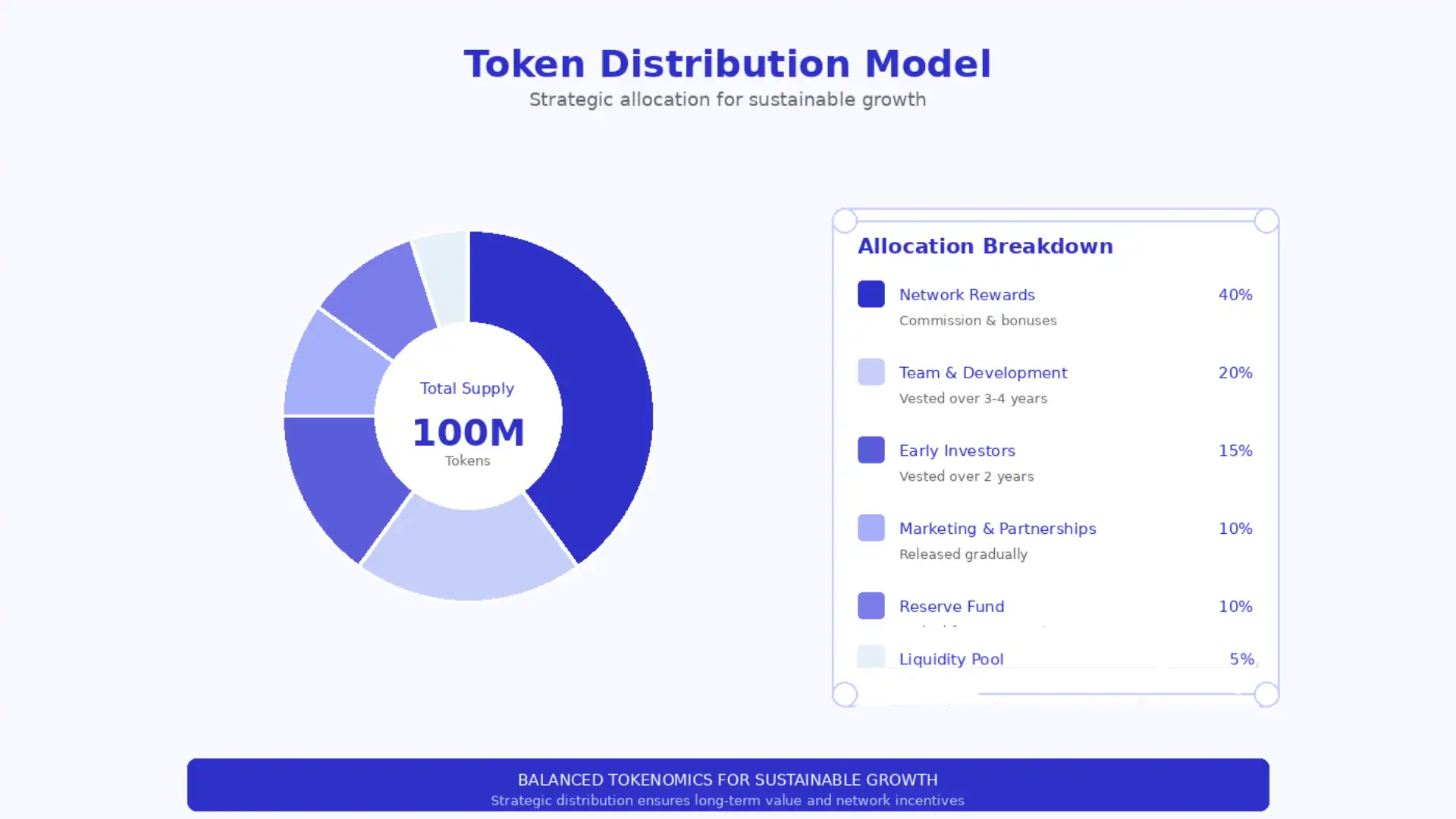
Distribution strategy affects both fairness and growth potential. You might allocate 40% for network rewards, 20% for the development team, 15% for initial investors, 10% for marketing, and 15% for a reserve fund. These percentages should reflect your priorities and growth stage—learn more about how requirements differ in our guide on startup vs enterprise crypto MLM.
Sample Token Distribution Model
Network Rewards (40%)
Distributed as commissions and bonuses
Team & Development (20%)
Vested over 3-4 years
Early Investors (15%)
Vested over 2 years
Marketing & Partnerships (10%)
Released gradually
Reserve Fund (10%)
Locked for emergencies
Liquidity Pool (5%)
For exchange listings
Vesting schedules prevent early stakeholders from dumping tokens immediately. Team tokens might vest over four years with a one-year cliff. This aligns long-term incentives and shows commitment to the project’s success.
Token Creation and Smart Contract Development
Creating the actual token requires writing smart contracts that define its properties and behavior. For most MLM systems, you will create an ERC-20 token on Ethereum or equivalent standards on other networks. These standards ensure compatibility with wallets and exchanges. For a detailed walkthrough, see our guide on how to develop an MLM smart contract.
The token contract specifies total supply, decimals (usually 18 for divisibility), name, and symbol. It includes functions for transferring tokens, checking balances, and approving others to spend tokens on your behalf. This is the basic structure, but MLM systems need additional complexity.
You need a separate MLM logic contract that handles network structure, commission calculations, and reward distributions. This contract tracks who recruited whom, maintains the network tree, and calculates commissions based on your chosen plan. When someone makes a qualifying action, this contract automatically distributes tokens to their upline according to predefined rules.
⚠️ Security is Paramount
Smart contracts are immutable once deployed, meaning bugs cannot be easily fixed. You need to implement access controls, prevent reentrancy attacks, handle edge cases properly, and include emergency pause mechanisms. One vulnerability can lead to total loss of funds. Review the essential features of MLM smart contracts to ensure your implementation covers all critical functionality.
Consider implementing upgradability patterns like proxy contracts. These allow you to fix bugs or add features after deployment while maintaining the same contract address. The tradeoff is added complexity and the need for secure governance around upgrades.
Integrating Blockchain Token with MLM Software
Your blockchain token needs to connect with user-facing MLM software that makes everything accessible to non-technical participants. Most people do not want to interact directly with blockchain explorers or command-line tools.
Wallet integration is the first requirement. Participants need a way to receive, store, and send tokens. You can integrate with existing wallets like MetaMask or build a custom wallet into your platform. Custom wallets offer better user experience but require additional security measures.
The dashboard should display real-time data from the blockchain. Show current token balance, pending commissions, network structure visualization, and transaction history. All this data comes from querying the blockchain and smart contracts, then presenting it in an intuitive interface.
Commission tracking needs to connect blockchain events with your database. When the smart contract emits an event showing commission distribution, your backend captures this, updates participant records, and triggers any necessary notifications. This creates an audit trail that matches blockchain reality.
Transaction initiation should be smooth. When a participant wants to recruit someone or make a purchase, the system should guide them through wallet confirmation without requiring blockchain knowledge. Clear messaging about what the transaction does and why it costs gas fees prevents confusion.
Setting Up Token Distribution and Reward Mechanisms
How you distribute tokens determines participant behavior and network growth patterns. Multiple distribution channels serve different purposes and attract different participant types.
Referral Bonuses
When someone recruits a new member, they immediately receive tokens as a reward. Instant gratification encourages active recruitment.
Performance Rewards
Bonuses for achieving certain sales volumes, building teams of specific sizes, or maintaining activity levels. Creates ongoing engagement.
Staking Mechanisms
Participants lock tokens for a period in exchange for additional rewards. Reduces circulating supply while rewarding long-term believers.
Rank Advancement
Progressive goals that unlock higher commission percentages or exclusive bonuses. Gamification keeps people engaged over extended periods.
Consider implementing a loyalty rewards program where holding tokens grants benefits like discounts on products, access to exclusive features, or enhanced commission rates. This creates holding pressure that counteracts selling pressure from commission distributions.
Security Measures and Smart Contract Auditing
Security is not optional in blockchain systems. One vulnerability can drain all funds, destroy participant trust, and end your project permanently. Multiple security layers are essential.
Smart contract auditing by reputable firms should be mandatory before launch. Auditors review your code for common vulnerabilities, logic errors, and potential exploits. They provide a detailed report with findings and recommendations. This costs money but prevents catastrophic losses.
Common vulnerabilities to watch for include reentrancy attacks where malicious contracts repeatedly call your functions before state updates complete, integer overflow and underflow issues that cause incorrect calculations, and access control failures that let unauthorized users call restricted functions.
Implement rate limiting and circuit breakers in your smart contracts. If unusual activity is detected, like an extremely high number of transactions in a short period, the contract can pause itself automatically. This contains damage while you investigate.
Critical Security Checklist
Transparency paradoxically improves security. Making your contract code open source lets the community review it and report issues. Many vulnerabilities are caught by external developers who examine public code.
Bug bounty programs incentivize security researchers to find and responsibly disclose vulnerabilities instead of exploiting them. Offer substantial rewards for critical findings. This turns potential attackers into allies.
Regulatory and Compliance Considerations for Crypto MLM
The regulatory landscape for cryptocurrency MLM systems is complex and varies dramatically by jurisdiction. What is legal in one country might be completely prohibited in another.
Securities laws are your primary concern. If your token is classified as a security, you face registration requirements, disclosure obligations, and restrictions on who can purchase. The Howey Test in the United States examines whether something is an investment contract based on whether people invest money expecting profits from others’ efforts.
Many MLM structures automatically trigger securities concerns because participants invest expecting profits from the network’s growth rather than their own efforts. This does not mean your project is illegal, but it means you need proper legal guidance to structure it correctly.
Anti-money laundering (AML) and know-your-customer (KYC) requirements apply to most crypto projects. You need systems to verify participant identities, monitor for suspicious transactions, and report certain activities to authorities. This conflicts with cryptocurrency’s privacy ethos but is legally necessary in most jurisdictions.
Some countries have specific anti-pyramid scheme laws that apply even to blockchain-based systems. These laws typically require that commissions come primarily from product sales rather than recruitment fees. Your compensation structure must reflect this.
Expert Legal Advice: From our experience working in this space for over 8 years, the safest approach is to consult with lawyers who specialize in both cryptocurrency and MLM regulations before launching. Legal costs are significant but far less than the cost of regulatory action after launch.
Testing, Deployment, and Network Launch
Proper testing prevents disasters. You cannot rush this phase regardless of pressure to launch quickly. Every hour spent testing prevents days of crisis management later.
Start with unit testing every function in your smart contracts. Test normal operations, edge cases, and failure modes. What happens if someone tries to recruit themselves? What if commission calculations result in amounts smaller than gas costs? What if the network tree becomes extremely unbalanced?
Integration testing verifies that your smart contracts work correctly with your frontend and backend systems. Can users successfully connect wallets? Do transactions get confirmed and reflected in the dashboard? Are commission distributions triggering correctly?
Testnet deployment is mandatory before mainnet launch. Deploy your entire system on a test network like Goerli or Mumbai where you can experiment without real money at stake. Recruit beta testers to use the system and report issues. Incentivize them to try breaking things.
The mainnet launch should be gradual. Start with a soft launch to a limited audience. Monitor everything closely during this period. Are transactions confirming as expected? Are gas costs reasonable? Is the user experience smooth?
Have rollback plans ready even though smart contracts are immutable. This might involve deploying updated contracts and migrating participants, or activating pause mechanisms to stop activity while you resolve issues. Document these procedures before you need them.
Marketing Strategies for a Token-Based MLM System
Building the technology is only half the challenge. You need participants to join your network, and that requires effective marketing that builds trust and demonstrates value.
Community Building
Start before launch. Create social media channels where potential participants can learn, ask questions, and connect. Active communities create launch momentum.
Content Marketing
Educate your audience about blockchain and your value proposition. Blog posts, videos, and tutorials build understanding. Focus on substance over hype.
Influencer Partnerships
Find influencers who align with your values and understand blockchain. Authentic partnerships matter more than follower counts.
Transparency
Be honest about risks and realistic expectations. Overpromising damages reputation. Under-promise and over-deliver builds lasting trust.
Scaling and Managing Your Blockchain MLM Platform
As your network grows, you will face new challenges that did not exist at launch. Successful scaling requires planning for these challenges before they become critical.
Blockchain scalability can become a bottleneck. As transaction volume increases, you might hit network capacity limits or see gas costs rise. Layer 2 solutions, sidechains, or migration to more scalable networks might become necessary. Plan these transitions carefully to avoid disrupting participants.
Database performance matters as your participant count grows. Network tree calculations that worked fine with 1,000 users might crash with 100,000 users. Implement caching, optimize queries, and consider distributed database architectures before performance degrades.
Customer support needs scale with user growth. When you have thousands of participants asking questions, reporting issues, and requesting help, manual support becomes impossible. Implement self-service tools, comprehensive documentation, and automated support systems. Still maintain human support for complex issues.
Scaling Wisdom from Years of Experience: Successful scaling is about anticipation. Monitor growth metrics closely and act before you hit capacity limits. Reactive scaling leads to downtime and frustrated participants.
Governance mechanisms become important as the network matures. How will you make decisions about upgrades, parameter changes, or feature additions? Token-based voting gives participants a voice but requires careful design to prevent plutocracy where the richest participants control everything.
Choosing the Right MLM Software Development Partner
Unless you have deep blockchain and MLM expertise in-house, partnering with experienced developers is crucial. The wrong partner can waste your budget and deliver a system that fails at launch.
Look for proven experience with both blockchain development and MLM systems specifically. Generic software companies or pure blockchain firms often miss critical MLM requirements. Ask for case studies of similar projects they have completed successfully.
Technical expertise should cover the full stack. You need smart contract developers who write secure, efficient code. Frontend developers who create intuitive user interfaces. Backend engineers who build scalable systems. DevOps specialists who ensure reliable deployment and monitoring.
Security consciousness should be evident in everything they do. Ask about their testing processes, security review procedures, and past vulnerability track record. Companies that take shortcuts on security will eventually cause disasters.
Key Questions to Ask Potential Development Partners
Communication quality matters as much as technical skill. You need partners who explain complex concepts clearly, provide regular updates, and respond promptly to questions. Poor communication leads to misaligned expectations and project failures.
Post-launch support should be clearly defined in your contract. Bugs will emerge after launch. Features will need updates. The blockchain ecosystem evolves constantly. Your development partner should commit to ongoing support, not just deliver and disappear.
Cost transparency prevents unpleasant surprises. Get detailed quotes that break down costs by component. Understand what is included and what incurs additional charges. The cheapest quote often leads to the most expensive result when quality issues require rebuilding.
Building a Successful MLM System with Blockchain Tokens
Launching an MLM system using blockchain tokens is complex but achievable with proper planning and execution. The technology offers real advantages over traditional MLM structures: transparency, automation, global accessibility, and trustless operation. These are not just buzzwords but fundamental improvements that change participant experience.
Success requires attention to multiple dimensions simultaneously. Your tokenomics must be sustainable long-term. Your smart contracts must be secure and efficient. Your user interface must be accessible to non-technical participants. Your marketing must build genuine community rather than hype. Your legal structure must comply with relevant regulations.
Key Success Factors
Solid Technology
Honest Tokenomics
Genuine Community
Long-term Thinking
Over eight years working in blockchain development, we have seen countless projects launch with great fanfare only to collapse within months. The difference between success and failure usually comes down to fundamentals: solid technology, honest tokenomics, genuine community, and long-term thinking.
If you are serious about launching a token-based MLM system, invest the time and resources to do it properly. Cutting corners might get you to market faster, but it will not create a sustainable business. Work with experienced partners who understand both the technology and the business model. Test extensively before launch. Be transparent with participants about how everything works.
The blockchain MLM space is still evolving. New technologies emerge that improve scalability, reduce costs, and enhance functionality. Regulatory frameworks are developing as governments figure out how to handle these hybrid systems. This creates both challenges and opportunities for those willing to navigate the complexity.
Your success ultimately depends on building something that delivers real value to participants. The blockchain technology enables better transparency and automation, but it does not create value by itself. You still need a compelling product or service, a compensation plan that rewards productive behavior, and a community that believes in your vision.
Your Roadmap to Success
- Start with a clear vision of what you want to achieve
- Build systematically from solid foundations
- Test everything thoroughly before launch
- Launch carefully and monitor closely
- Listen to participant feedback and iterate based on real usage
- Stay compliant with evolving regulations
- Focus on long-term sustainability over short-term gains
The opportunity to create a successful blockchain-based MLM system is real. The technology has matured to the point where these systems can operate reliably at scale. The challenge is executing properly across all the technical, business, legal, and community dimensions. Those who do so can build networks that benefit participants through transparency, fairness, and true ownership of their contributions.
Ready to Transform Your MLM Business?
With over 8 years of expertise in blockchain development and MLM systems, we can help you build a transparent, secure, and scalable token-based network marketing platform.
Frequently Asked Questions
Q1.What is a blockchain-based MLM system?
A blockchain-based MLM system combines multi-level marketing with blockchain technology. It uses tokens and smart contracts to automate commission payments, record transactions transparently, and reduce reliance on centralized databases. Participants can verify earnings in real time, ensuring trust, faster payments, and global accessibility.
Q2.How do blockchain tokens improve MLM transparency?
Tokens live on a decentralized blockchain where every transaction is recorded immutably. This eliminates black-box commission calculations common in traditional MLM systems. Participants can independently verify their earnings, track downlines, and monitor network activity, creating a system inherently more transparent and trustworthy.
Q3.What role do smart contracts play in MLM?
Smart contracts are programmable digital agreements that automatically execute when predefined conditions are met. In MLM, they calculate commissions, distribute rewards instantly, and enforce network rules without human intervention. This eliminates delays, errors, and disputes, ensuring a fair and automated payout system for all participants.
Q4.How should I choose a compensation plan for my MLM token system?
MLM compensation plans determine how commissions are distributed and networks grow. Options include binary (two recruits per member), matrix (fixed width and depth), uni-level (unlimited recruits), or hybrid models. The choice impacts network balance, recruitment incentives, and token distribution strategies, aligning with your growth and sustainability goals.
Q5.Which blockchain network is best for MLM tokens?
Ethereum offers security and wide adoption but higher gas fees. BNB Chain has low fees and fast confirmations but is more centralized. Polygon balances cost, speed, and security as a Layer 2 solution. The choice depends on participant familiarity, transaction frequency, and priorities like decentralization versus affordability.
Q6.What is tokenomics, and why is it critical in MLM?
Tokenomics defines supply, distribution, utility, and incentives for your MLM token. Poor tokenomics can devalue tokens and collapse the system. Sustainable design balances network rewards, team allocation, investor vesting, marketing, and reserves while ensuring participants are motivated to hold, use, and engage with tokens over time.
Q7.How do I ensure the security of an MLM smart contract?
Security is paramount. Conduct professional audits, implement multi-signature wallets, emergency pause mechanisms, and access controls. Avoid vulnerabilities like reentrancy attacks and integer overflows. Open-source contracts and bug bounty programs help identify risks, while proxy patterns allow secure upgrades without compromising system integrity.
Q8.How do participants interact with blockchain MLM software?
Users need wallets to send, receive, and store tokens. A user-friendly dashboard shows balances, commissions, network tree, and transaction history. Smart contract events sync with backend databases for notifications and record-keeping. Simplified interfaces ensure participants can engage without deep blockchain knowledge.
Q9.What legal and compliance considerations exist for blockchain MLMs?
Crypto MLMs face complex regulations. Securities laws, anti-money laundering (AML), KYC rules, and anti-pyramid scheme laws vary by jurisdiction. Legal guidance is essential to structure token offerings, compensation plans, and user verification correctly, ensuring the system operates legally while minimizing risk of regulatory action.
Q10.How can I successfully launch and scale a blockchain MLM system?
Launch gradually with unit, integration, and testnet testing. Focus on transparent tokenomics, secure smart contracts, and intuitive software. Build community, create content, partner with influencers, and monitor network growth. Scaling requires attention to blockchain capacity, database performance, customer support, and governance while prioritizing long-term sustainability.
Explore Services
Related Services
Reviewed by

Aman Vaths
Founder of Nadcab Labs
Aman Vaths is the Founder & CTO of Nadcab Labs, a global digital engineering company delivering enterprise-grade solutions across AI, Web3, Blockchain, Big Data, Cloud, Cybersecurity, and Modern Application Development. With deep technical leadership and product innovation experience, Aman has positioned Nadcab Labs as one of the most advanced engineering companies driving the next era of intelligent, secure, and scalable software systems. Under his leadership, Nadcab Labs has built 2,000+ global projects across sectors including fintech, banking, healthcare, real estate, logistics, gaming, manufacturing, and next-generation DePIN networks. Aman’s strength lies in architecting high-performance systems, end-to-end platform engineering, and designing enterprise solutions that operate at global scale.