Ai Overview
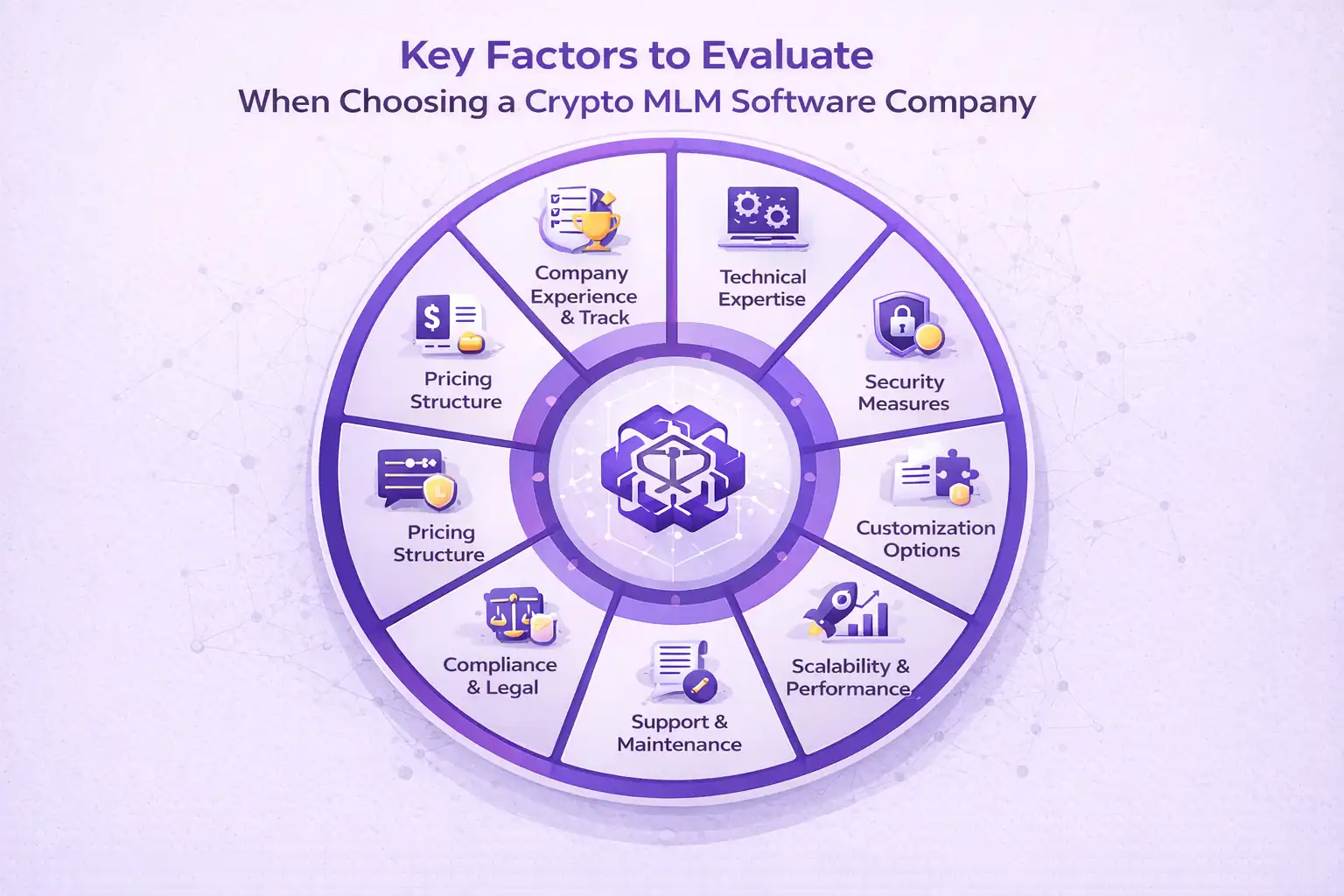
Crypto MLM software serves as the backbone of cryptocurrency-based network marketing businesses. Understanding the true cost of crypto MLM software requires looking beyond initial purchase prices to evaluate total cost of ownership over time. Different pricing models suit different business situations, and hidden costs can significantly impact your budget. Common pricing models include one-time licensing fees, subscription-based pricing, transaction-based fees, or hybrid approaches combining multiple elements.
Key Takeaways
-
-
Security is non-negotiable
Crypto MLM software must prioritize strong security, including encryption, secure wallet management, audit logs, and regular security audits, to protect user funds and business credibility.
-
-
-
Technical expertise determines long-term stability
A capable development team with deep blockchain, smart contract, and scalable architecture experience is essential for building a reliable and future-ready platform.
-
-
-
Compensation plan flexibility is critical
The software should accurately support binary, matrix, unilevel, board, or hybrid plans with room for customization as business models evolve.
-
-
-
Scalability protects future growth
A quality platform must handle rapid increases in users, transactions, and commission calculations without performance issues or system failures.
-
-
-
Blockchain integration must go beyond basics
Strong crypto MLM software includes secure wallets, smart contracts, multi-chain support, transparent transaction handling, and optimized fee management.
-
-
-
Compliance features reduce legal risk
Built-in KYC, AML, transaction monitoring, tax reporting, and data-privacy tools help businesses stay aligned with changing global regulations.
-
-
-
User experience directly impacts retention
Intuitive dashboards, mobile responsiveness, fast loading speeds, and clear commission visibility improve member trust and long-term engagement.
-
-
The cryptocurrency MLM industry has grown exponentially over the past decade, with thousands of businesses seeking reliable software solutions to manage their network marketing operations. Choosing the right crypto MLM software company can determine whether your business thrives or struggles with technical limitations, security vulnerabilities, and operational inefficiencies. This comprehensive guide draws on extensive industry experience to help you make an informed decision.
Understanding Crypto MLM Software and Its Significance
Crypto MLM software serves as the backbone of cryptocurrency-based network marketing businesses. These specialized platforms combine traditional multi-level marketing compensation structures with blockchain technology and cryptocurrency payment systems. The software manages distributor networks, tracks referrals, calculates commissions, processes cryptocurrency transactions, and provides administrative tools for running a compliant MLM operation.
The significance of selecting the right software company cannot be overstated. Over the past eight years of working with crypto MLM businesses, we have witnessed countless companies struggle with poorly chosen software solutions. Some faced security breaches that compromised user funds. Others dealt with scalability issues that prevented growth. Many encountered compliance problems because their software lacked proper regulatory features.
A quality crypto MLM software solution integrates multiple components including wallet management, smart contract functionality, payment gateway integration, genealogy tree visualization, commission calculation engines, and administrative dashboards. The software must handle complex compensation plans such as binary, matrix, unilevel, board, or hybrid structures while maintaining accuracy across thousands or millions of transactions.
According to research on multi-level marketing structures, the technical infrastructure supporting these businesses has become increasingly sophisticated as cryptocurrency adoption has grown. The right software company provides not just a product but a partnership that supports your business through market changes, regulatory updates, and technological evolution.
Evaluating Technical Expertise and Development Capabilities
Technical expertise represents the foundation upon which reliable crypto MLM software is built. When evaluating a software company, you need to assess their development team’s capabilities across multiple dimensions. The company should demonstrate proficiency in blockchain technology, cryptocurrency integration, secure coding practices, and complex database management.
Start by examining the company’s portfolio. Request case studies and live examples of platforms they have developed. Access these platforms yourself to evaluate user experience, loading speeds, and functionality. A company with genuine expertise will have multiple successful implementations they can showcase without hesitation.
Ask specific technical questions about their development stack. What programming languages do they use? How do they implement blockchain integration? Which cryptocurrency networks do they support? Do they develop custom smart contracts or use templates? What database systems power their solutions? Companies with deep technical knowledge will provide detailed, confident answers.
Technical Capability Why It Matters Questions to Ask Blockchain Integration Determines security, transaction speed, and cryptocurrency compatibility Which blockchains do you support? How do you handle network congestion? Smart Contract Development Ensures automated, trustless operations and commission distributions Do you write custom contracts? Have they been audited? Security Architecture Protects user funds and prevents unauthorized access What security measures do you implement? How do you store private keys? Scalability Design Allows business growth without performance degradation How many concurrent users can your system handle? API Development Enables integration with third-party services and customization Do you provide API access? What integrations are available? The development team size and structure also matter. A company with a single developer or a very small team may struggle to provide ongoing support, implement updates quickly, or handle multiple client projects simultaneously. Look for companies with dedicated teams for frontend development, backend development, blockchain integration, quality assurance, and ongoing maintenance.
Request information about their development methodology. Do they follow agile practices? How do they handle testing? What is their approach to code reviews and quality assurance? Professional development companies will have established processes that ensure code quality and minimize bugs in production environments.
Security Features and Protection Mechanisms
Security stands as the most critical consideration when choosing a crypto MLM software company. The platform will handle significant amounts of cryptocurrency, personal user information, and financial transactions. A single security breach can destroy your business reputation, result in legal liability, and cause irreparable financial damage to your members.
Begin your security evaluation by examining the company’s track record. Have any of their previous platforms experienced security breaches? How did they respond? What measures have they implemented to prevent future incidents? Companies with mature security practices will be transparent about past issues and the improvements they have made.
Examine the specific security features included in their software. Multi-factor authentication should be standard for all user accounts, especially administrator and high-value accounts. The system should implement role-based access controls that limit what different user types can access and modify. All sensitive data should be encrypted both in transit and at rest using industry-standard encryption protocols.
Wallet security deserves special attention. How does the software manage private keys? The best solutions use hierarchical deterministic wallets with secure key generation and storage. Private keys should never be stored in plain text or easily accessible locations. Some advanced systems implement multi-signature wallets for large transactions or administrator actions, adding an extra layer of security.
The software should include comprehensive audit logging that tracks all administrative actions, financial transactions, and system changes. These logs serve multiple purposes including security monitoring, compliance documentation, and dispute resolution. The logging system itself should be tamper-proof to prevent unauthorized modifications.
Essential Security Checklist
- Multi-factor authentication for all user types
- End-to-end encryption for sensitive data
- Secure private key management and storage
- Regular security audits by third-party firms
- DDoS protection and rate limiting
- SQL injection and XSS attack prevention
- Automated backup systems with encryption
- Intrusion detection and monitoring systems
- Secure API endpoints with authentication
- Regular security patches and updates
Ask about the company’s approach to security testing. Do they conduct regular penetration testing? Have their smart contracts been audited by reputable blockchain security firms? What vulnerability scanning tools do they use? Professional software companies invest in thorough security testing before deployment and ongoing monitoring after launch.
Consider the company’s response procedures for security incidents. They should have a documented incident response plan that outlines how they will detect, contain, investigate, and recover from security breaches. Ask about their communication protocols for notifying clients and users if a security incident occurs.
Compensation Plan Flexibility and Customization Options
The compensation plan forms the heart of any MLM business. Different businesses use different compensation structures based on their products, target markets, and business strategies. Your software must accurately implement your chosen compensation plan and potentially adapt as your business evolves.
Most crypto MLM businesses use one of several standard compensation plans or a hybrid combining multiple approaches. Binary plans limit each member to two direct recruits, creating a balanced tree structure. Matrix plans specify both width and depth, such as a three by seven matrix. Unilevel plans allow unlimited width with commissions paid on multiple levels. Board or table plans cycle members through different boards as they recruit new members.
The software company you choose should demonstrate experience with your preferred compensation plan type. However, experience alone is not sufficient. The platform must offer flexibility to customize plan parameters to match your specific business requirements. Can you adjust commission percentages? Can you set different commission rates for different levels? Can you create special bonuses for achieving certain milestones?
Compensation Plan Type Structure Best For Software Complexity Binary Two legs per member, spillover possible Fast growth and team building emphasis Moderate Matrix Fixed width and depth limits Controlled growth and team cooperation Moderate Unilevel Unlimited width, commissions on multiple levels Simple structures and straightforward compensation Low to Moderate Board/Table Members cycle through multiple boards High-ticket products and rapid cycling High Hybrid Combines multiple plan types Complex businesses with varied income streams Very High Beyond basic plan implementation, consider advanced compensation features. Can the system handle rank advancements with associated bonuses? Does it support matching bonuses where upline members earn a percentage of their downline’s earnings? Can you implement compression that redistributes commissions from inactive members to active ones?
The calculation engine must be accurate and transparent. Commission calculations in MLM systems can become extremely complex, especially with large networks and sophisticated compensation plans. The software should provide detailed breakdowns showing exactly how each commission was calculated. This transparency builds trust with your members and simplifies dispute resolution.
Timing and frequency of commission calculations and payments also matter. Some businesses pay commissions daily, others weekly or monthly. The software should support your preferred payment schedule. It should also handle various cryptocurrency payment options, allowing members to receive commissions in their chosen cryptocurrency.
Request a demonstration of how the software handles edge cases and complex scenarios. What happens when a member upgrades their package mid-cycle? How does the system handle refunds and chargebacks? Can it manage holdbacks where a percentage of commissions is held in reserve? These scenarios will inevitably occur in your business, and the software must handle them correctly.
User Experience and Interface Design
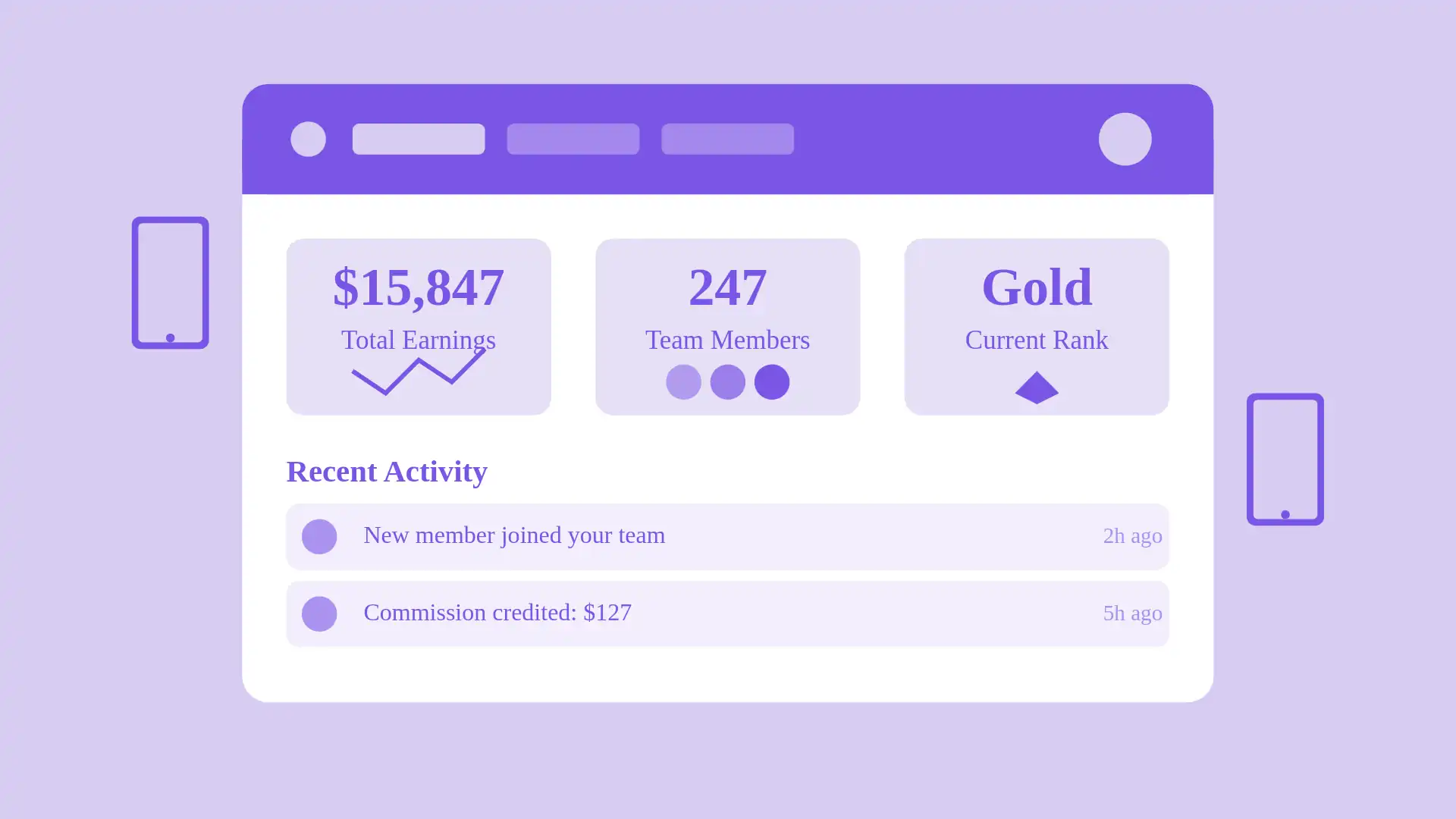
Even the most technically sophisticated software becomes useless if your members cannot navigate it effectively. User experience design directly impacts member satisfaction, retention, and your overall business success. The interface should be intuitive enough that new members can complete essential tasks without extensive training.Evaluate the software from multiple user perspectives. Members need simple registration processes, clear dashboard views of their network and earnings, easy methods to refer new members, and straightforward withdrawal procedures. Team leaders require additional tools for monitoring their downline performance, identifying growth opportunities, and communicating with their teams. Administrators need comprehensive controls for managing the entire system while maintaining security.
The dashboard serves as the primary interface for most users. It should present key information at a glance including current balance, pending commissions, network size, recent activities, and quick action buttons for common tasks. Information should be organized logically with clear visual hierarchy that guides users to important elements.
Navigation must be consistent and predictable across the entire platform. Users should never feel lost or uncertain about how to access specific features. The software should include a comprehensive help system with tutorials, FAQs, and contextual help that appears when users need assistance with specific features.
Mobile responsiveness has become essential rather than optional. A significant percentage of your members will access the platform primarily through smartphones or tablets. The interface must adapt seamlessly to different screen sizes while maintaining full functionality. Test the mobile experience thoroughly during your evaluation process.
Visual design contributes to user perception and trust. The interface should look modern and professional without being cluttered or overwhelming. Color schemes should be pleasant and accessible. Typography should be clear and readable. Charts and graphs for displaying network structures and performance metrics should be visually appealing and easy to interpret.
Loading speed significantly impacts user experience. The software should be optimized for fast page loads and responsive interactions. Real-time updates for critical information like commission calculations and network changes enhance the sense of an active, dynamic platform.
Blockchain and Cryptocurrency Integration Depth
The quality and depth of blockchain integration separates basic crypto MLM software from truly sophisticated solutions. Since cryptocurrency transactions form the foundation of your business operations, this integration must be robust, secure, and feature-rich.
Start by examining which blockchains and cryptocurrencies the software supports. Bitcoin and Ethereum support should be standard, but consider whether you need additional cryptocurrencies like Litecoin, Bitcoin Cash, Tron, or various stablecoins. The ability to add new cryptocurrencies as they gain popularity provides important future-proofing for your business.
Wallet integration represents a critical component. The software should provide secure wallet functionality for each user, allowing them to deposit, withdraw, and store multiple cryptocurrencies. Some platforms offer integrated wallets where private keys are managed by the system. Others support external wallet connections where users maintain control of their private keys through services like MetaMask or Trust Wallet.
Each approach has advantages and disadvantages. Integrated wallets provide simpler user experiences and faster internal transactions. External wallet connections give users more control and security over their funds. The best software companies offer both options, allowing you to choose based on your business model and target audience preferences.
Smart contract functionality enables automated, trustless operations. When properly implemented, smart contracts can automatically distribute commissions, enforce compensation plan rules, and manage fund flows without requiring manual intervention. This automation reduces administrative overhead and eliminates opportunities for human error or manipulation.
Example: Transaction Lifecycle in Crypto MLM Software
- Member Purchase: User initiates a purchase of an MLM package using cryptocurrency
- Payment Verification: System confirms blockchain transaction and validates payment amount
- Commission Calculation: Software calculates commissions for upline members based on compensation plan
- Smart Contract Execution: Automated distribution of commissions through smart contract
- Wallet Updates: User wallets reflect new balances in real-time
- Notification: Members receive notifications about earnings and network activity
- Audit Trail: Complete transaction history recorded immutably on blockchain
Transaction fees and gas costs require careful consideration. Cryptocurrency transactions incur network fees that vary based on network congestion and transaction complexity. The software should provide transparent information about fee structures and allow configuration of how fees are handled. Will your company absorb fees, pass them to users, or split them?
Some advanced platforms implement transaction batching or layer-two solutions to reduce fee costs. These optimizations become increasingly important as your network grows and transaction volume increases. Ask the software company about their approach to managing transaction costs at scale.
Real-time exchange rate integration allows users to view balances and transactions in their preferred fiat currency while conducting business in cryptocurrency. The software should pull exchange rate data from reliable sources and update frequently to provide accurate valuations. This feature significantly improves user experience, especially for members less familiar with cryptocurrency.
Consider the company’s approach to blockchain upgrades and network changes. Blockchains evolve over time with protocol updates, hard forks, and network improvements. Your software provider must stay current with these changes and ensure continued compatibility. Ask about their process for monitoring blockchain developments and implementing necessary updates.
Compliance and Regulatory Considerations
Regulatory compliance has become increasingly important in the cryptocurrency and MLM industries. Governments worldwide are implementing stricter regulations for both sectors. Your software must include features that help you maintain compliance with applicable laws and regulations.
Anti-money laundering and know your customer requirements apply to most cryptocurrency businesses. The software should include identity verification features that allow you to collect and verify user information during registration. Integration with third-party KYC service providers streamlines this process while ensuring thorough verification.
Transaction monitoring capabilities help identify suspicious patterns that might indicate money laundering or other illicit activities. The system should flag unusual transaction amounts, frequencies, or patterns for administrative review. Comprehensive reporting tools allow you to generate documentation required by regulatory authorities.
Different jurisdictions have varying regulations regarding MLM businesses. Some countries have specific licensing requirements. Others impose restrictions on compensation plan structures or marketing claims. While the software company cannot provide legal advice, they should have experience working with businesses in multiple jurisdictions and understand common compliance requirements.
According to resources on cryptocurrency regulation, many countries now require cryptocurrency businesses to register with financial authorities and implement robust compliance programs. Your software should support these compliance efforts rather than creating obstacles.
Data protection and privacy regulations like GDPR in Europe or CCPA in California impose specific requirements for handling personal information. The software must include features for obtaining user consent, managing data access requests, and securely deleting user information when required. Privacy policies and terms of service should be easily accessible and clearly presented to users.
Tax reporting represents another compliance consideration. Many jurisdictions require cryptocurrency transaction reporting for tax purposes. The software should generate detailed transaction reports that users and administrators can use for tax preparation. Some advanced platforms even integrate with tax preparation services or provide specialized crypto tax reporting.
Scalability and Performance Capabilities
Scalability determines whether your software can grow alongside your business. A platform that performs well with hundreds of users may experience severe problems when managing thousands or tens of thousands of active members. Evaluating scalability requires looking beyond current needs to future growth scenarios.
The underlying architecture fundamentally impacts scalability. Modern cloud-based architectures generally offer better scalability than traditional server setups. Cloud platforms allow dynamic resource allocation that automatically increases capacity during high-traffic periods and reduces costs during slower times. Ask whether the software uses cloud infrastructure and how it handles scaling.
Database performance becomes critical as your network grows. MLM genealogy trees can create complex database relationships that become increasingly difficult to query efficiently at scale. The software should use optimized database designs with proper indexing and caching strategies. Request information about the maximum network size their largest client has achieved and how the system performed.
Load testing provides concrete evidence of performance capabilities. Professional software companies conduct regular load testing to identify performance bottlenecks and optimize system response times. Ask for load testing results showing how the system performs under various user loads and transaction volumes.
Scalability Factor Poor Implementation Quality Implementation User Capacity System slows significantly above 1,000 users Handles 100,000+ users without degradation Transaction Processing Processes 10-50 transactions per minute Processes 1,000+ transactions per minute Page Load Times 3-10 seconds for complex pages Under 2 seconds for all pages Concurrent Users System crashes with 500+ simultaneous users Supports 10,000+ concurrent users Database Queries Genealogy queries take 10+ seconds All queries complete within milliseconds Commission calculation performance deserves special attention. As your network grows, calculating commissions across multiple levels for thousands of members becomes computationally intensive. The software should use efficient algorithms and potentially queue-based processing for commission calculations to prevent system slowdowns during calculation periods.
Content delivery networks and caching strategies improve performance for geographically distributed user bases. If your business operates internationally, these optimizations become essential for providing consistent user experiences regardless of user location. Ask how the software handles global distribution and whether they use CDN services.
Consider the company’s track record with scaling existing clients. Have they successfully helped businesses grow from small operations to large networks? Can they provide references from clients who have experienced significant growth? Companies with proven scaling experience will have encountered and solved the challenges you will eventually face.
Support Services and Ongoing Maintenance
Software deployment represents just the beginning of your relationship with the development company. Ongoing support and maintenance will determine your long-term success and satisfaction. The quality of support services varies dramatically between companies, and inadequate support can cripple your business operations.
Start by understanding the support structure. Does the company offer dedicated support teams or generic ticketing systems? What are their response time guarantees for different severity levels? Critical system failures require immediate attention, while minor feature requests can wait. The company should provide clear service level agreements that define response and resolution timeframes.
Support availability matters significantly. If your business operates globally, you need support available across multiple time zones. Twenty-four hour support may be essential, especially during your launch period or major promotions when issues have the greatest business impact. Ask about support hours and whether they charge extra fees for after-hours assistance.
Multiple support channels provide flexibility for different situations. Email support works well for non-urgent issues that require detailed explanations. Live chat offers quick resolution for simple questions. Phone support becomes valuable for complex problems requiring real-time discussion. The best companies provide all three channels along with comprehensive documentation.
Technical documentation quality reflects the company’s professionalism and commitment to client success. Request access to their documentation during evaluation. It should cover administrative functions, user guides, API documentation if applicable, troubleshooting procedures, and best practices. Poor documentation forces you to contact support for basic questions, wasting time and resources.
Training services help you and your team use the software effectively. Initial training should cover all administrative functions and common user scenarios. The company should provide training materials you can use to educate your members. Some companies offer ongoing training webinars covering new features and advanced techniques.
Critical Support Questions to Ask
- What are your guaranteed response times for critical, high, medium, and low priority issues?
- Do you provide support in multiple languages if needed?
- What happens if the primary support contact leaves your company?
- How do you handle emergency situations outside business hours?
- What percentage of support tickets are resolved within 24 hours?
- Can you provide references from clients regarding support quality?
- Do you charge separately for support or include it in licensing fees?
- How often do you release software updates and security patches?
Maintenance and update policies determine how the software evolves over time. Regular updates should include security patches, bug fixes, performance improvements, and new features. Ask about their update schedule and process. How do they test updates before deployment? Can you review updates in a staging environment before applying them to your live system?
Backup and disaster recovery procedures protect your business from data loss. The company should perform regular automated backups with secure storage in multiple locations. They should have documented disaster recovery procedures that specify recovery time objectives and recovery point objectives. Testthese procedures periodically to ensure they work when needed.
System monitoring and proactive maintenance prevent many problems before they impact users. Professional companies monitor system health metrics, performance indicators, and security logs continuously. They should identify and address potential issues before they cause outages or degraded performance.
Customization Options and White-Label Capabilities
Every MLM business has unique requirements, branding needs, and competitive differentiators. The ability to customize your software platform allows you to create a distinctive user experience that aligns with your brand identity and business strategy.
White-label capabilities allow you to present the software as your own product without visible references to the development company. This includes custom branding throughout the interface, custom domain names, and the ability to remove or replace any developer branding. Complete white-labeling creates a professional, cohesive brand experience for your members.
Visual customization options should extend beyond basic color schemes and logos. You should be able to modify layouts, adjust interface elements, customize email templates, and create custom landing pages. Some businesses require extensive visual customization to match existing brand guidelines or create unique user experiences.
Functional customization addresses business-specific requirements that standard features may not accommodate. Can you add custom fields to user profiles? Can you create custom reports tailored to your business metrics? Can you implement unique business rules for commission calculations or member qualifications? The extent of available customization determines how well the software adapts to your specific needs.
API access provides the highest level of customization potential. A comprehensive API allows you to integrate the MLM software with other systems, build custom applications, or create unique features that differentiate your business. Request detailed API documentation and examples of custom integrations other clients have built.
Consider the balance between customization and maintainability. Extensive custom modifications can make software updates more complex and potentially create compatibility issues. Discuss with the company how they handle custom modifications during update cycles. Some companies offer modular architectures that separate custom code from core functionality, simplifying update management.
Pricing Models and Total Cost of Ownership
Understanding the true cost of crypto MLM software requires looking beyond initial purchase prices to evaluate total cost of ownership over time. Different pricing models suit different business situations, and hidden costs can significantly impact your budget.
Common pricing models include one-time licensing fees, subscription-based pricing, transaction-based fees, or hybrid approaches combining multiple elements. One-time licensing typically involves a larger upfront payment but lower ongoing costs. Subscription models spread costs over time with monthly or annual fees. Transaction-based pricing scales with your business volume, charging small fees per transaction or member.
Each model has advantages and disadvantages. One-time licensing provides cost predictability and can be more economical long-term for successful businesses. However, it requires significant upfront capital. Subscription pricing reduces initial investment and often includes support and updates, but creates ongoing operational expenses. Transaction-based pricing aligns costs with revenue but can become expensive as your business grows.
Cost Component Typical Range What It Covers Initial Licensing $5,000 – $50,000+ Software license, source code (sometimes), initial setup Customization $2,000 – $20,000+ Visual branding, custom features, unique modifications Hosting & Infrastructure $100 – $2,000/month Servers, bandwidth, database services, security Ongoing Support $500 – $5,000/month Technical support, bug fixes, maintenance Updates & Upgrades $0 – $2,000/month New features, security patches, performance improvements Transaction Fees $0 – 0.5% per transaction Per-transaction charges (if applicable) Beyond base pricing, consider additional costs that may not be immediately apparent. Does the quoted price include source code access? Are there limits on users, transactions, or features? What happens when you exceed those limits? Some companies charge extra for additional administrators, API access, or premium support services.
Customization costs can add substantially to initial expenses. Get detailed quotes for any customizations you require. Some companies include basic customization in their base pricing, while others charge separately for every modification. Clarify what is included and what costs extra.
Hosting and infrastructure costs deserve careful consideration. Some companies include hosting in their pricing. Others require you to provide your own hosting infrastructure. Self-hosting provides more control but requires technical expertise and ongoing management. Managed hosting simplifies operations but creates ongoing dependencies on the provider.
Calculate multi-year costs under different growth scenarios. A pricing model that seems economical initially may become expensive as your business scales. Conversely, higher upfront costs may be justified if they result in lower long-term expenses. Create financial projections that factor in expected growth and compare total costs over three to five years.
Evaluate what happens if you want to switch providers in the future. Do you own the source code? Can you export all data in standard formats? Are there any contractual obligations that lock you into long-term commitments? Exit flexibility protects you from being trapped with inadequate software or unresponsive providers.
Company Reputation and Client References
The reputation and track record of a software company provide valuable insights into what you can expect as a client. Established companies with positive reputations offer more security and reliability than unknown providers with limited histories.
Research the company’s background and history. How long have they been developing crypto MLM software? Have they worked with businesses similar to yours? Do they specialize in this market or offer MLM software as one of many unrelated services? Specialization typically results in deeper expertise and better understanding of industry-specific requirements.
Online reviews and testimonials provide perspective from actual clients. Search for reviews on independent platforms rather than relying solely on testimonials featured on the company’s website. Look for patterns in feedback regarding strengths and weaknesses. Be cautious of companies with exclusively positive reviews or no independent feedback available.
Request detailed case studies from successful implementations. These should include information about the client’s business model, challenges addressed, solutions implemented, and results achieved. Quality case studies demonstrate real experience and provide concrete examples of the company’s capabilities.
Direct client references offer the most valuable insights. Request contact information for several current clients who have given permission to serve as references. Prepare specific questions about their experience including implementation process, support quality, software performance, and whether they would choose the same company again.
Questions to Ask Client References
- How closely did the final product match what was promised during sales discussions?
- Were there any significant problems during implementation? How were they resolved?
- How would you rate the quality and responsiveness of their support?
- Have you experienced any major system outages or security issues?
- Did customization requests take longer or cost more than initially quoted?
- How well has the software scaled as your business has grown?
- What would you change about the software if you could?
- Would you choose the same company again if starting over?
Investigate the company’s financial stability. Software companies that go out of business leave their clients stranded without support or updates. While financial information for private companies may be limited, you can look for indicators like office locations, team size, client portfolio size, and investment backing. Companies with diverse client bases and established operations pose lower risks.
Professional associations and industry certifications indicate commitment to quality and professional standards. Look for companies that participate in relevant industry organizations or maintain certifications in areas like security, quality management, or specific technologies.
Be cautious of red flags during your evaluation. Companies that are reluctant to provide references, cannot demonstrate previous work, make unrealistic promises, pressure you for quick decisions, or have numerous negative reviews online may create problems. Trust your instincts if something seems questionable.
Implementation Process and Timeline
Understanding the implementation process helps you plan your launch effectively and set realistic expectations. The process for deploying crypto MLM software typically involves multiple phases, each requiring specific activities and resources.
The discovery and planning phase establishes project scope and requirements. The software company should conduct detailed discussions about your business model, compensation plan, design preferences, feature requirements, and integration needs. This phase results in a comprehensive project plan with defined deliverables, timeline, and responsibilities.
Development and customization work occurs next. The company configures or develops your platform according to agreed specifications. This phase includes implementing your compensation plan, applying your branding, developing custom features, and setting up necessary integrations. Regular progress updates and demonstrations help ensure the project stays on track.
Testing represents a critical phase that should never be rushed. Comprehensive testing includes functionality testing of all features, security testing to identify vulnerabilities, performance testing under various load conditions, and user acceptance testing where you verify everything works as expected. Budget sufficient time for testing and addressing any issues discovered.
Data migration may be necessary if you are moving from another system. The company should provide migration tools or services to transfer user accounts, genealogy structures, transaction histories, and other essential data. Test the migration process thoroughly in a staging environment before migrating your live data.
Implementation Phase Typical Duration Key Activities Discovery & Planning 1-2 weeks Requirements gathering, project planning, design approval Development & Customization 4-12 weeks Platform setup, custom development, feature implementation Testing & Quality Assurance 2-4 weeks Functionality testing, security testing, bug fixes Training & Documentation 1-2 weeks Admin training, user guide creation, support documentation Launch & Stabilization 1-2 weeks Go-live, monitoring, immediate issue resolution Training ensures your team can effectively manage the platform. The software company should provide comprehensive administrator training covering all management functions, user support procedures, troubleshooting common issues, and best practices. Consider recording training sessions for future reference and new team member onboarding.
The launch phase requires careful coordination. Plan your go-live during periods of lower business activity if possible. Have support resources available to address any immediate issues. Monitor system performance closely during the first days after launch when unexpected problems most commonly occur.
Post-launch support provides crucial assistance during your initial operating period. The software company should offer enhanced support immediately after launch to quickly address any issues that arise as real users begin interacting with the system. This stabilization period typically lasts two to four weeks.
Realistic timeline expectations prevent frustration and poor planning. Simple implementations with minimal customization might be completed in six to eight weeks. Complex projects with extensive customization, third-party integrations, and sophisticated requirements could require three to six months. Rushing implementation increases the risk of problems that will cost more to fix later.
Marketing and Growth Tools
Software that includes integrated marketing and growth tools provides competitive advantages by helping you acquire members, engage your community, and scale your business more effectively. While core MLM functionality remains essential, marketing features increasingly differentiate superior platforms.
Referral tracking and affiliate marketing tools allow members to easily promote your business and track their marketing efforts. The software should generate unique referral links for each member, track visits and conversions, and attribute new registrations to the correct referrer. Some advanced platforms include landing page builders that let members create custom promotional pages.
Email marketing integration enables automated communications with your members. The system should send transactional emails for account activities like registrations, deposits, and commission payments.Using an email finder can help ensure you have accurate member contact information, improving delivery rates and the effectiveness of your campaigns. Marketing automation features allow you to create email campaigns, segment your member base, and send targeted messages based on member behavior or characteristics. Additionally, many businesses can rely on top email marketing platforms to manage these workflows efficiently and ensure high deliverability.
Social media integration simplifies member recruitment through social platforms. One-click sharing features let members easily share promotional content on Facebook, Twitter, Instagram, and other networks. Some platforms automatically generate social media posts when members achieve milestones or receive commissions, creating social proof and encouraging additional recruitment.
Analytics and reporting tools help you understand your business performance and identify growth opportunities. The software should provide comprehensive dashboards showing member growth, transaction volumes, commission payouts, active vs. inactive members, and other key performance indicators. Advanced analytics might include cohort analysis, churn prediction, or network visualization.
Member engagement features keep your community active and reduce attrition. Built-in messaging systems facilitate communication between upline and downline members. Gamification elements like achievement badges, leaderboards, and progress tracking motivate members to remain active and recruit more aggressively. Regular notifications about network activities, earnings, and milestones maintain engagement.
Content management capabilities allow you to easily update marketing materials, product information, and educational content without developer assistance. A simple content editor lets you create blog posts, announcements, tutorials, and promotional materials directly within the platform. Version control ensures you can revert changes if needed.
Integration Capabilities with Third-Party Services
Modern business operations rely on multiple specialized tools and services. Your crypto MLM software should integrate seamlessly with other platforms you use for customer relationship management, payment processing, communication, and analytics. Strong integration capabilities increase operational efficiency and data accuracy.
Payment gateway integration allows members to purchase packages or make deposits using methods beyond cryptocurrency. Credit card processing, bank transfers, and alternative payment services like PayPal provide flexibility that increases conversion rates. The software should support multiple payment gateways and easily add new ones as needed.
Customer relationship management systems help you manage member relationships and support operations. Integration with platforms like Salesforce, HubSpot, or Zoho synchronizes member data, tracks interactions, and creates unified views of each member across all touchpoints. This integration eliminates duplicate data entry and ensures information consistency.
Communication platform integration enhances member engagement and support. Connecting with services like Telegram, Discord, Slack, or WhatsApp allows automated notifications, community building, and member support through channels they already use. Some businesses build entire communities on these platforms with the MLM software providing the underlying infrastructure.
Analytics and business intelligence tools provide deeper insights into your business performance. Integration with Google Analytics, Mixpanel, or custom analytics platforms enables sophisticated analysis of user behavior, conversion funnels, and business metrics beyond what the MLM software natively provides.
Email service provider integration improves email deliverability and provides advanced email marketing capabilities. Connecting with services like SendGrid, Mailchimp, or Constant Contact ensures your transactional and marketing emails reach member inboxes. These services offer better deliverability, detailed analytics, and compliance with email regulations.
Accounting software integration simplifies financial management and reporting. Synchronizing transaction data with QuickBooks, Xero, or similar platforms automates bookkeeping, facilitates tax preparation, and provides accurate financial reporting. This integration eliminates manual data entry and reduces errors in financial records.
Mobile Application Availability
Mobile usage has become dominant in many markets, with significant percentages of users primarily or exclusively accessing services through smartphones. Native mobile applications provide better user experiences than mobile-optimized websites for crypto MLM platforms that members interact with frequently.
Evaluate whether the software company offers native mobile applications for iOS and Android. Native apps provide superior performance, offline functionality, push notifications, and access to device features like biometric authentication. They feel more professional and create stronger member engagement than web-based alternatives.
Mobile app feature parity matters significantly. Some companies offer mobile apps that include only basic functionality while requiring desktop access for advanced features. The mobile app should provide comprehensive functionality including registration, wallet management, network viewing, commission tracking, referral sharing, and account management.
Push notifications through mobile apps dramatically improve engagement and response rates compared to email. The app should send notifications for important events like new commissions, team member activities, system announcements, and milestone achievements. Configurable notification preferences let members control what alerts they receive.
Biometric authentication adds security while improving convenience. Mobile apps should support fingerprint and face recognition for quick, secure access. This feature significantly improves the user experience compared to repeatedly entering passwords while maintaining strong security.
Offline functionality allows members to view key information even without internet connectivity. While transactions require network access, the app should cache basic information like current balances, recent transaction history, and network structure for offline viewing. This capability proves valuable in areas with unreliable internet connections.
App store presence and ratings provide insights into mobile app quality. Check the iOS App Store and Google Play Store for the company’s apps. Review ratings, read user comments, and note how the company responds to negative feedback. Frequent updates indicate active maintenance and improvement.
Making Your Final Decision
After completing your evaluation across all these dimensions, you must synthesize the information and make a final decision. This process requires balancing multiple factors, some of which may conflict. No software solution will be perfect in every aspect, so prioritizing your requirements becomes essential.
Create a weighted scoring system that reflects your priorities. List the factors most important to your business such as security, scalability, cost, support quality, or specific features. Assign weights based on relative importance. Score each company you are considering on each factor. This structured approach provides objective comparison and prevents decisions based solely on superficial factors like sales presentations.
Consider both immediate needs and future requirements. The software that best serves a startup with fifty members might differ from what a growing business with five thousand members needs. Select a platform that accommodates your current situation while supporting anticipated growth and evolution.
Trial periods or proof-of-concept implementations reduce risk when possible. Some companies offer limited trials or pilot programs that let you test their software before full commitment. Even if not formally offered, request a demonstration environment where you can thoroughly test all functionality with your team.
Negotiate contract terms carefully. Ensure contracts clearly define deliverables, timelines, support obligations, and costs. Include provisions addressing what happens if the software does not meet agreed specifications or if the company fails to provide promised support. Consider including performance guarantees or milestone-based payments that protect your investment.
Trust your assessment of the relationship potential. You will work closely with this company for months during implementation and potentially years thereafter. If you sense communication problems, lack of transparency, or cultural mismatches during the sales process, these issues will likely intensify under the pressures of implementation and operation.
Document your decision rationale. Record why you selected a particular company, what alternatives you considered, and what factors drove your choice. This documentation proves valuable if you need to defend your decision to stakeholders or if you later need to evaluate whether the company has delivered on their promises.
Build Your Crypto MLM on a Strong Foundation
Ensure your platform is secure, scalable, and compliant before taking your network live.
Selecting the right crypto MLM software company represents one of the most important decisions you will make for your business. The software forms the foundation upon which everything else is built. Poor choices create ongoing problems that hamper growth, frustrate members, and potentially threaten business viability. Quality choices provide reliable platforms that support growth, enhance member experiences, and adapt to changing requirements.
Throughout eight years of working in this industry, we have observed that successful businesses typically share common characteristics in their software selection processes. They conduct thorough evaluations rather than making hasty decisions. They prioritize security and scalability over superficial features. They verify claims through testing and references rather than accepting sales promises at face value. They view software selection as a strategic partnership rather than a simple transaction.
The cryptocurrency and MLM industries continue evolving rapidly. Regulations change. Technologies advance. User expectations increase. Your software partner must evolve alongside these changes, providing updates that maintain compliance, incorporate new capabilities, and meet rising standards. Select a company positioned to support your business not just at launch but throughout years of growth and change.
Take the time necessary to make an informed decision. Rush decisions increase the likelihood of expensive mistakes. Involve key stakeholders in the evaluation process. Consult with legal and technical advisors when appropriate. The investment of time and effort in thorough evaluation will be rewarded with a software platform that serves your business effectively for years to come.
Remember that software selection represents a means to an end rather than an end itself. The ultimate goal is building a successful, sustainable business that provides value to members and generates appropriate returns. The right software partner becomes an enabler of that success, providing the technical foundation that allows you to focus on business development, member support, and market expansion.
Frequently Asked Questions
Q1.What's the difference between traditional and crypto MLM software?
Traditional MLM software runs on centralized servers where the company controls everything – commission calculations, payments, and user data. Crypto MLM software uses blockchain technology to create a transparent system. Every transaction is recorded on a public ledger, payments happen automatically through smart contracts, and users can verify everything themselves. Think of it like traditional banking versus digital wallets – one has middlemen, the other works peer-to-peer.
Q2.How much should I budget for crypto MLM software?
Your budget depends on what type of solution you choose:
White-label software: $5,000 – $25,000 upfront plus annual maintenance feesCustomized platform: $25,000 – $100,000 with monthly support costsFull custom build: $100,000 – $500,000+ with ongoing development
Don’t forget hidden costs:
- Blockchain transaction fees (gas fees)
- Security audits ($10,000 – $50,000 yearly)
- Compliance and legal setup
- Mobile app development (adds 30-50% more)
- Payment processor integrations
Most businesses spend 2-3 times their initial estimate over 3 years. Ask for a complete breakdown including all future costs.
Q3.What security features are absolutely necessary?
Look for these non-negotiable security features:
Smart contract audits: At least 2-3 independent audits from recognized firmsMulti-signature wallets: Require multiple approvals for company fund transfersRegular penetration testing: Quarterly security checks by external expertsBug bounty program: Active rewards for finding security vulnerabilitiesInsurance coverage: Protection against hacks and smart contract failures
Red flags to avoid:
- Company does its own security audits
- No public audit reports available
- Single person controls all private keys
- Vague answers about backup and recovery plans
Q4.Can crypto MLM software handle my complex compensation plan?
Most blockchain-based systems handle standard plans well, but complexity costs more. Here’s what works:
Easy to implement:
- Binary and matrix plans
- Unilevel structures
- Fast start bonuses
- Rank advancement systems
More challenging/expensive:
- Daily commission calculations (blockchain fees add up)
- Constant rule changes (requires smart contract updates)
- Manual exceptions and overrides
- Retroactive commission adjustments
Key question to ask providers: Can you show me the most complex plan you’ve built and explain how you’d handle changes to my plan rules?
Q5.How do I make sure my platform is legally compliant?
Compliance involves both software features and business practices:
Software must include:
- KYC/AML verification integration
- Geographic blocking capabilities
- Transaction monitoring tools
- Tax reporting features
- Data privacy controls (GDPR compliance)
You’ll also need:
- Legal advice for each country you operate in
- Money transmitter licenses (for US operations)
- Proper terms of service for crypto payments
- Compliance officer or team
- Regular regulatory updates
Remember: The software provides tools, but you’re responsible for staying compliant in your markets.
Q6.What if blockchain fees become too expensive?
Network congestion and high fees are real concerns. Good providers should offer:
Multiple blockchain options: Ability to switch between Ethereum, BSC, Polygon, etc.Layer 2 solutions: Integration with scaling solutions like Arbitrum or OptimismFee management: Options for who pays transaction fees (company or users)Transaction batching: Grouping payments to reduce costs
Questions to ask:
- What’s your backup plan during high fee periods?
- Can the platform switch to cheaper blockchains if needed?
- How do you handle small commissions when fees are high?
Q7.How long does implementation usually take?
Realistic timelines vary by project type:
White-label setup: 2-6 weeks
Custom platform: 2-4 months
Full custom build: 4-12 months
Factors that add time:
- Legal compliance setup (1-3 months)
- Security audits (1-2 months)
- Third-party integrations (2-6 weeks each)
- App store approvals (2-4 weeks)
- Testing and bug fixes (1-2 months)
Warning signs:
- Promises of full custom software in under 3 months
- No detailed project timeline with milestones
- Pressure to skip security checks
- Vague testing and quality assurance plans
Always add extra time for unexpected delays – most projects take 25-50% longer than initially estimated.
Q8.Do I need technical knowledge to operate crypto MLM software?
No, you don’t need to be a blockchain expert, but you do need basic operational understanding. Most modern crypto MLM platforms come with admin dashboards that handle user management, commissions, wallets, and reports through a visual interface.
However, you should still have:
-
A technical support team or vendor on standby
-
Clear documentation and training materials
-
An escalation process for blockchain or wallet-related issues
Think of it like running an e-commerce store—you don’t need to build the payment gateway, but you must understand how it works and what to do when something goes wrong.
Q9.Can crypto MLM software integrate with existing tools and platforms?
Yes, good crypto MLM software is built to integrate with external systems. Common integrations include:
-
CRM systems for lead and member management
-
Email and SMS platforms for notifications
-
Payment gateways and fiat on-ramps
-
Analytics and reporting tools
-
Mobile apps (iOS and Android)
Before choosing a provider, confirm whether integrations are available out of the box or require custom development, as integrations can significantly affect cost and timelines.
Q10.What happens if I need to upgrade or change the system later?
Upgrades depend on how the software is architected. Well-designed platforms allow modular upgrades, while poorly designed systems require costly rebuilds.
Ask providers about:
-
Smart contract upgrade mechanisms
-
Backward compatibility for existing users
-
Data migration and version control
-
Downtime during upgrades
Avoid platforms where any small change requires redeploying all smart contracts or freezing user activity. Flexibility today saves major costs and disruptions later.
Explore Services
Related Services
Reviewed by

Aman Vaths
Founder of Nadcab Labs
Aman Vaths is the Founder & CTO of Nadcab Labs, a global digital engineering company delivering enterprise-grade solutions across AI, Web3, Blockchain, Big Data, Cloud, Cybersecurity, and Modern Application Development. With deep technical leadership and product innovation experience, Aman has positioned Nadcab Labs as one of the most advanced engineering companies driving the next era of intelligent, secure, and scalable software systems. Under his leadership, Nadcab Labs has built 2,000+ global projects across sectors including fintech, banking, healthcare, real estate, logistics, gaming, manufacturing, and next-generation DePIN networks. Aman’s strength lies in architecting high-performance systems, end-to-end platform engineering, and designing enterprise solutions that operate at global scale.