Ai Overview
At its core, slippage is the difference between the price you see when you decide to make a trade and the price you actually get when the trade executes. It might seem small, but on a 10 BTC order, that is $200 in unexpected cost, and it compounds across every trade you make. Imagine you want to buy Bitcoin and the screen shows $98,500. Price volatility is significantly higher, with 5-10% daily moves being common for many assets.
Key Takeaways
- Slippage in crypto is the difference between the expected execution price and the actual fill price, caused by market volatility, low liquidity, and large order sizes moving through the order book during execution.
- The bid-ask spread is the visible, static cost of trading: the gap between the highest buy price and the lowest sell price. Every trader pays the spread on every trade, making it the most consistent and predictable trading cost.
- Price impact in crypto measures how much your individual trade moves the market price, determined by your order size relative to available liquidity at each price level in the order book or liquidity pool.
- Slippage vs spread is a distinction between dynamic and static costs: spread exists before you trade (visible in the order book), while slippage occurs during execution (revealed only after the trade completes).
- Price impact vs slippage represents a predictable versus unpredictable cost breakdown: price impact can be estimated from order book depth before trading, while total slippage includes price impact plus unpredictable market movements.
- On DEXs using AMM models, price impact follows a mathematical curve determined by trade size relative to liquidity pool depth, making it calculable but often significantly higher than on centralized exchanges with deep order books.
- Minimizing these costs requires a combination of trading on liquid platforms, using limit orders, splitting large orders, timing trades during peak liquidity hours, and setting appropriate slippage tolerance levels.
- Understanding how these three costs interact is essential for anyone building or operating a crypto exchange, as the platform’s liquidity infrastructure directly determines the trading costs experienced by its users.
What Is Slippage in Trading?
What is slippage in trading? At its core, slippage is the difference between the price you see when you decide to make a trade and the price you actually get when the trade executes. Imagine you want to buy Bitcoin and the screen shows $98,500. You click “buy” and your order fills at $98,520. That $20 difference is slippage. It might seem small, but on a 10 BTC order, that is $200 in unexpected cost, and it compounds across every trade you make.
Slippage exists because markets are not static. Between the moment you see a price and the moment your order reaches the matching engine and gets filled, other orders may have arrived first, prices may have shifted, or the available liquidity at your expected price may have been consumed. In fast-moving crypto markets, where prices can change multiple times per second, this gap between intention and execution is a constant reality that every trader must account for.
Slippage in Crypto vs Traditional Markets
Slippage in crypto tends to be more pronounced than in traditional markets for several reasons. Crypto markets trade 24/7 without the circuit breakers and trading halts that traditional markets use to manage volatility. Liquidity is fragmented across hundreds of exchanges rather than concentrated in a few regulated venues. Price volatility is significantly higher, with 5-10% daily moves being common for many assets. And the presence of automated bots that can front-run orders adds a dimension of slippage that is less prevalent in regulated traditional markets.
That said, the most liquid crypto pairs on major exchanges (BTC/USDT, ETH/USDT) now rival traditional market instruments in terms of spread tightness and execution quality. The gap between crypto and traditional markets has narrowed dramatically as institutional participation has increased and exchange infrastructure has matured.
Common Causes of Slippage in Crypto
Low Liquidity Issues
Low liquidity is the most common cause of slippage in crypto. When the order book is thin (few orders at each price level), even modest-sized trades must fill across multiple price levels, resulting in an average execution price that is worse than the initial quoted price. This is particularly problematic for smaller-cap tokens, newer trading pairs, and exchanges with limited market maker coverage. Effective exchange liquidity management is the primary defense against excessive slippage for platform operators.
High Market Volatility
During periods of high volatility (major news events, large liquidation cascades, market-wide sell-offs), prices move so rapidly that the price at order submission and the price at execution can differ significantly. Market makers often widen their quotes during volatile periods to protect themselves from adverse selection, reducing available liquidity precisely when slippage risk is highest. This creates a compounding effect: volatility increases slippage both by moving prices and by reducing the liquidity available to absorb orders.
Large Market Orders
Large market orders inherently cause slippage because they consume all available liquidity at the best price and then move to the next price level, and the next, until the full order is filled. A $100,000 market buy order on a pair with $50,000 of liquidity at the best ask price will fill half the order at the best price and the remainder at progressively worse prices. This order-size-driven slippage is the bridge between slippage and price impact, and it is entirely predictable from the order book depth.
Bid Ask Spread Explained in Simple Terms
What Is the Bid Ask Spread?
The bid ask spread explained simply: it is the gap between what buyers are willing to pay and what sellers are willing to accept. The bid is the highest price any buyer is currently offering. The ask is the lowest price any seller is currently accepting. The difference between these two numbers is the spread. If the best bid for ETH is $3,498 and the best ask is $3,500, the spread is $2, or approximately 0.057% of the price.
The spread is the most fundamental and consistent cost of trading. Unlike slippage, which varies with each trade, the spread is always visible in the order book and always applies. When you place a market buy order, you pay the ask price. When you place a market sell order, you receive the bid price. The spread is effectively the “toll” you pay for immediate execution, and it goes to the market makers and limit order traders who provide the liquidity you consume.
Crypto Trading Spread: How Exchanges Calculate It
The crypto trading spread is not set by the exchange itself. It is the natural result of the competitive quoting activity of market makers and limit order traders. Exchanges provide the infrastructure (the order book, the matching engine) and market participants determine the spread through their trading activity. When market makers compete aggressively to provide liquidity, spreads narrow. When liquidity providers withdraw or the market becomes volatile, spreads widen.
The spread in crypto exchange environments is typically measured in basis points (hundredths of a percent) for liquid pairs and in percentage terms for less liquid pairs. Major pairs like BTC/USDT on top-tier exchanges often have spreads of 1-2 basis points (0.01-0.02%), while smaller altcoin pairs might have spreads of 50-200 basis points (0.5-2.0%). This variation reflects the dramatically different liquidity profiles across assets and platforms.
Spread in Crypto Exchange Order Books
Role of Market Makers
Market makers are the primary determinants of the spread in crypto exchange order books. They continuously place buy and sell limit orders at competitive prices, providing the liquidity that other traders consume. The spread a market maker quotes reflects their assessment of risk: the probability of adverse price movement, the cost of inventory management, and the competitive pressure from other market makers. When multiple market makers compete on the same pair, spreads tighten as each tries to attract more order flow. The arbitrage detection systems explores how exchanges monitor the relationship between spreads, liquidity, and market maker behavior.
Spread and Trading Volume
Trading volume and spread have an inverse relationship: higher volume generally leads to tighter spreads. High volume attracts market makers because it means more trading opportunities and faster inventory turnover. More market makers means more competition, which narrows spreads. Conversely, low-volume pairs struggle to attract market makers, resulting in wider spreads and higher trading costs. This is why the crypto trading spread on BTC/USDT is a fraction of the spread on a newly listed altcoin pair.
Typical Spread Ranges by Asset Class
| Asset Category | Typical Spread | Liquidity Level | Price Impact Risk |
|---|---|---|---|
| BTC, ETH (major pairs) | 1-5 basis points | Very high | Low (for standard sizes) |
| Top 20 altcoins | 5-20 basis points | High | Moderate |
| Mid-cap tokens | 20-100 basis points | Moderate | Significant |
| Small-cap / newly listed | 100-500+ basis points | Low | Very high |
| DEX long-tail pairs | 200-1000+ basis points | Very low | Extreme |
Price Impact in Crypto: Meaning & Mechanics
Trading Price Impact Meaning
Trading price impact meaning is straightforward: it is the degree to which your individual trade moves the market price. If you place a large buy order, you push the price up. If you place a large sell order, you push the price down. The amount of that price movement caused specifically by your order is the price impact. It is a direct function of your order size relative to the available liquidity at and near the current market price.
Price impact in crypto is particularly significant because crypto order books tend to be thinner than traditional market order books, meaning that moderate-sized orders can have outsized effects on price. A $500,000 market order might cause negligible price impact on a major stock but significant price impact on a mid-cap crypto asset. Understanding how price impact works is essential for any trader executing meaningful size.
How Price Impact Works in Order Books
How price impact works in a centralized exchange order book is mechanical and predictable. The order book displays all resting limit orders at each price level. When a market buy order arrives, it fills against sell orders starting at the lowest ask price. If the order is larger than the available quantity at the best ask, it moves to the next price level and continues filling. Each successive price level is higher than the last, so the average execution price worsens as the order gets larger. The difference between the initial best ask and the final fill price (or the volume-weighted average price) is the price impact.
For example, if the order book shows 1 BTC available at $98,500, 2 BTC at $98,510, and 3 BTC at $98,520, a market buy for 4 BTC would fill 1 BTC at $98,500, 2 BTC at $98,510, and 1 BTC at $98,520, for a volume-weighted average price of $98,510. The price impact relative to the initial best ask is $10, or about 0.01%. This is a simplified example, but it illustrates the core mechanic behind price impact in crypto order books.
Price Impact in Crypto on DEX vs CEX
AMM-Based Price Impact
On decentralized exchanges using Automated Market Makers (AMMs), price impact in crypto follows a mathematical curve rather than discrete order book levels. The standard constant-product formula (x * y = k) determines the execution price based on the trade size relative to the total liquidity in the pool. As your trade size increases relative to pool size, the price impact increases exponentially. A trade that represents 1% of the pool’s liquidity might incur 2% price impact, while a trade representing 5% of the pool might incur 10% or more.
Liquidity Pool Depth Effect
The depth of the liquidity pool is the primary determinant of price impact on DEXs. Deep pools (millions of dollars in liquidity) provide better execution for larger trades. Shallow pools (thousands of dollars) produce severe price impact even for modest trades. This is why the choice of trading venue matters enormously: the same trade might incur 0.1% price impact on a well-funded DEX pool and 5% on a shallow one. The crypto exchange platform covers how platforms design their liquidity architecture to minimize these costs for traders.
Principle: Price impact is not a flaw in the system. It is the natural consequence of finite liquidity. Every order consumes some liquidity, and the cost of that consumption increases as order size grows relative to available depth. Understanding this relationship is fundamental to efficient trade execution in any crypto market.
Slippage vs Spread: Key Differences Explained
Slippage vs Spread: Side-by-Side Comparison
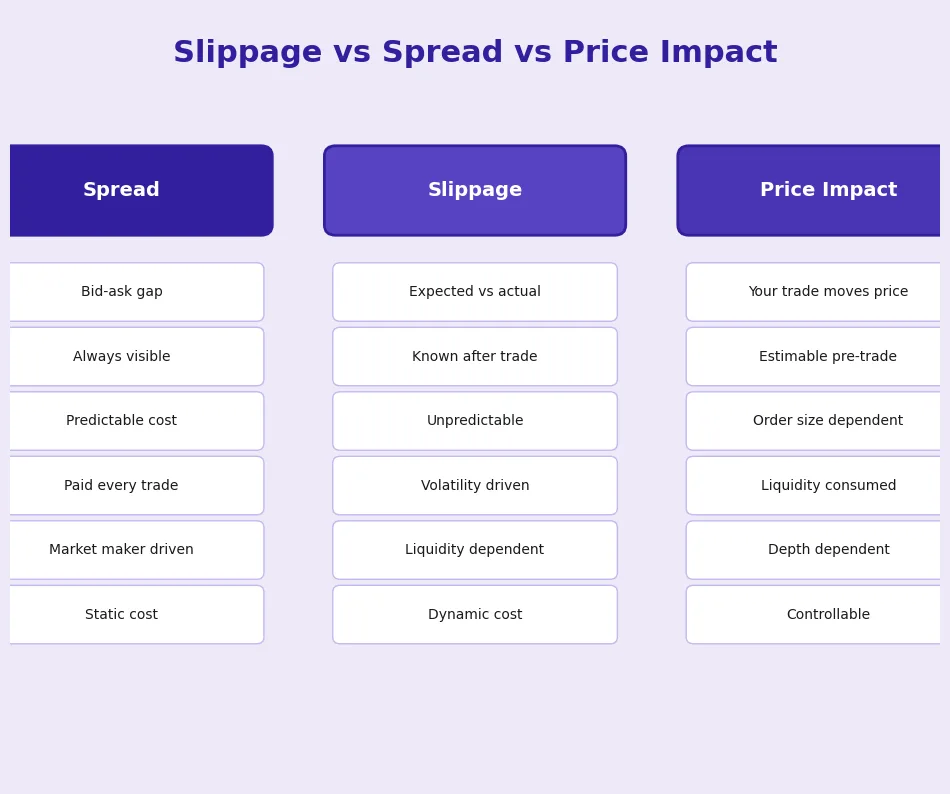
The slippage vs spread distinction is one of the most important concepts for traders to understand because it clarifies the different types of costs they face. The spread is a visible, predictable cost that exists at all times in the order book. You can see it before you trade, and you know you will pay it. Slippage, by contrast, is an invisible, variable cost that only reveals itself after execution. You cannot know the exact slippage before you trade because it depends on market conditions at the precise moment of execution.
Slippage vs Spread vs Price Impact
| Dimension | Spread | Slippage | Price Impact |
|---|---|---|---|
| Definition | Bid-ask gap | Expected vs actual execution price | Price movement caused by your trade |
| Visibility | Always visible in order book | Known only after execution | Estimable from order book depth |
| Predictability | Highly predictable | Unpredictable | Moderately predictable |
| Affected By | Market maker activity, volume | Volatility, liquidity, order size | Order size relative to liquidity |
| Prevention | Choose liquid pairs/exchanges | Limit orders, slippage tolerance | Split orders, TWAP/VWAP algorithms |
| Applies To | Every market order | Market orders primarily | Large orders on any venue |
Price Impact vs Slippage: What Traders Should Know
Price impact vs slippage is a subtle but important distinction. Price impact is the component of slippage that you can predict and control. If you know the order book depth, you can calculate exactly how much price impact your order will create. This is a deterministic cost that depends entirely on your order size and the available liquidity. Slippage includes price impact but adds the unpredictable element of market movement during execution. Your total execution cost is: spread + price impact + market movement slippage.
For small orders on liquid pairs, price impact is negligible and total slippage is primarily driven by spread and minor market movements. For large orders on less liquid pairs, price impact dominates and can represent the majority of total execution cost. Understanding price impact vs slippage helps traders choose the right execution strategy: small orders on liquid pairs can use simple market orders, while large orders require more sophisticated approaches.
When Spread, Slippage & Price Impact Overlap
In practice, spread, slippage, and price impact are not separate costs that add up neatly. They overlap and interact. The spread sets the baseline cost. Price impact adds to it based on order size. Market movement slippage adds further based on volatility and timing. During a volatile market event with thin liquidity, all three can compound: spreads widen (increasing the base cost), order book depth thins (increasing price impact), and rapid price movement adds slippage. This compounding effect is why trading costs can spike dramatically during market stress events.
Trading Cost Lifecycle
| Stage | Cost Component | What Happens | Controllable? |
|---|---|---|---|
| 1. Pre-Trade | Spread | Bid-ask gap exists before order | Choose liquid pairs/platforms |
| 2. Order Submission | Network latency | Price may move during transmission | Connection speed, order type |
| 3. Matching | Price impact | Order consumes liquidity levels | Order sizing, splitting |
| 4. Execution | Slippage (total) | Final fill price revealed | Slippage tolerance, limit orders |
| 5. Post-Trade | Exchange fee | Trading fee deducted | Fee tier, maker vs taker |
How Price Impact Works During Large Trades
Order Size and Market Depth
How price impact works during large trades is directly determined by the relationship between order size and market depth. Market depth refers to the total quantity of orders available at each price level in the order book. A “deep” market has substantial volume at each level, meaning large orders can be absorbed with minimal price movement. A “shallow” market has thin liquidity at each level, causing even moderate orders to move the price significantly.
Professional traders and institutional desks monitor market depth constantly and size their orders accordingly. The general rule is to keep individual order size below 5-10% of the visible depth within a reasonable price range to limit price impact. Orders that exceed this threshold require execution strategies (TWAP, VWAP, iceberg orders) that spread the execution over time or hide the full order size from the market.
Real Example of Price Impact in Crypto
Consider a real-world scenario: a trader wants to buy $500,000 worth of a mid-cap token. The order book shows $50,000 of liquidity within 0.5% of the current price, $150,000 within 1%, and $400,000 within 2%. A single market order for $500,000 would need to consume liquidity up to approximately 2.5% above the current price, resulting in a volume-weighted average execution price roughly 1.5% above the initial price. On a $500,000 trade, that is $7,500 in price impact alone, before accounting for spread or market movement slippage.
By contrast, the same trader could use a TWAP (Time-Weighted Average Price) algorithm to split the $500,000 into 50 orders of $10,000 each, executed over 30 minutes. Each individual order would have minimal price impact, and the overall execution cost would likely be a fraction of the single-order approach. This example illustrates why understanding price impact in crypto is not just theoretical knowledge but practical, money-saving expertise. For platforms serving institutional clients, partnering with experienced cryptocurrency exchange engineering specialists ensures that these advanced execution tools are built into the platform from the start.
Build a High-Liquidity Crypto Exchange with Minimal Slippage
Nadcab Labs builds scalable, secure crypto exchanges with optimized order matching, deep liquidity integration, and minimal price impact for seamless trading performance.
How to Minimize Slippage, Spread & Price Impact
| Strategy | Reduces | Implementation | Trade-Off |
|---|---|---|---|
| Use Limit Orders | Slippage, spread | Set maximum price you accept | May not fill |
| Split Large Orders | Price impact | TWAP, VWAP, iceberg orders | Slower execution, information leakage |
| Trade Liquid Pairs | All three costs | Choose high-volume pairs/exchanges | Limited asset selection |
| Time Your Trades | Slippage, spread | Trade during peak liquidity hours | May miss optimal entry/exit |
| Set Slippage Tolerance | Maximum slippage | Configure on DEX or exchange | Too tight = failed trades |
Frequently Asked Questions
Q1.What is slippage in crypto trading?
Slippage in crypto is the difference between the price you expect when placing a trade and the actual price at which the trade executes. It occurs because market conditions change between the moment you submit an order and the moment it fills. Slippage can be positive (you get a better price than expected) or negative (you get a worse price), though negative slippage is far more common and more discussed because it represents an unexpected cost to the trader.
Q2.What is the bid-ask spread in cryptocurrency?
The bid-ask spread is the gap between the highest price a buyer is willing to pay (the bid) and the lowest price a seller is willing to accept (the ask) for a cryptocurrency. This spread represents the most basic cost of trading on an exchange. A narrow spread indicates a healthy, liquid market, while a wide spread suggests low liquidity or high volatility. The spread in crypto exchange markets varies significantly between assets and platforms.
Q3.What is the difference between slippage and spread?
The spread is a static, visible cost: it is the gap between the best bid and best ask prices that exists in the order book at any moment. Slippage is a dynamic, execution-time cost: it is the difference between the expected price and the actual fill price, caused by market movement or insufficient liquidity during order execution. You pay the spread on every trade, while slippage occurs inconsistently depending on market conditions and order size.
Q4.What causes price impact in crypto?
Price impact in crypto is caused by the size of your trade relative to the available liquidity at each price level. When you place a market order that is larger than the available quantity at the best price, your order “eats through” multiple price levels in the order book, pushing the execution price further from the initial quote. The thinner the liquidity, the greater the price impact. On AMM-based DEXs, price impact is determined by the trade size relative to the liquidity pool depth.
Q5.How can I reduce slippage when trading crypto?
You can reduce slippage by trading on exchanges with deep liquidity, using limit orders instead of market orders, breaking large orders into smaller pieces, avoiding trading during high-volatility periods, setting slippage tolerance limits on DEX trades, and choosing trading pairs with tight spreads and deep order books. Trading during peak market hours when liquidity is highest also helps minimize slippage.
Explore Services
Related Services
Reviewed by

Aman Vaths
Founder of Nadcab Labs
Aman Vaths is the Founder & CTO of Nadcab Labs, a global digital engineering company delivering enterprise-grade solutions across AI, Web3, Blockchain, Big Data, Cloud, Cybersecurity, and Modern Application Development. With deep technical leadership and product innovation experience, Aman has positioned Nadcab Labs as one of the most advanced engineering companies driving the next era of intelligent, secure, and scalable software systems. Under his leadership, Nadcab Labs has built 2,000+ global projects across sectors including fintech, banking, healthcare, real estate, logistics, gaming, manufacturing, and next-generation DePIN networks. Aman’s strength lies in architecting high-performance systems, end-to-end platform engineering, and designing enterprise solutions that operate at global scale.