Ai Overview
A smart contract is a self-executing program that runs on a blockchain network. A commission from a direct recruit might be 10%, from a recruit’s recruit 5%, from a recruit’s recruit’s recruit 2%, and so on. “Gas” is the cost of executing transactions on a blockchain. To avoid volatility concerns, many platforms conduct payouts in “stablecoins” – cryptocurrencies designed to maintain a fixed value, usually $1 per coin.
Key Takeaways
- Smart contracts automate MLM operations through code that executes automatically when conditions are met, eliminating delays and human error in commission processing and payout execution.
- Blockchain transparency creates permanent, verifiable records of all transactions, allowing members to verify their earnings at any time rather than trusting company reports.
- Immutable smart contracts prevent companies from changing compensation plans or rules after members have joined, building trust through permanent rules that apply equally to everyone.
- Decentralized fund management through user-owned wallets reduces the risk of fund misuse and removes the company as a single point of failure in the system.
- Real-time payout processing reduces payment times from 5-10 business days to less than 60 seconds, dramatically improving member satisfaction and retention.
- Built-in fraud prevention through blockchain verification prevents fake referrals and double spending by requiring on-chain proof of actions before payments are released.
- Efficient contract design and Layer-2 blockchain solutions reduce transaction costs from dollars per transaction to cents or less, making platforms more profitable and attractive.
- Multi-level referral tracking is automated accurately regardless of organizational complexity, with correct commission percentages applied to every level instantly.
- Smart contracts can support binary, matrix, unilevel, and hybrid compensation plans flexibly, allowing platforms to adapt their business models without technical overhauls.
- Regulatory transparency through auditable smart contracts that enforce compliance rules puts blockchain MLM platforms in a stronger position with regulators compared to traditional systems.
Multi-level marketing (MLM) has been around for decades, but it has always faced a fundamental challenge: trust. Members worry about whether their earnings are calculated correctly, whether commissions are paid on time, and whether the system is genuinely fair. Smart contracts on blockchain networks are changing this equation entirely. They automate the most critical processes in MLM operations, from commission calculations to fund management, all while creating a transparent record that anyone can verify. This article explores how smart contracts are reshaping the MLM landscape and why they matter to modern network marketing platforms.
Understanding MLM Smart Contracts
What Are Smart Contracts and Their Role in MLM
A smart contract is a self-executing program that runs on a blockchain network. It contains code that automatically performs predefined actions when specific conditions are met. In simple terms, if you think of a traditional contract as something that requires lawyers and intermediaries to enforce, a smart contract is more like an automated referee that enforces the rules without needing anyone’s permission or involvement.
In MLM systems, smart contracts replace many of the backend processes that traditionally required manual oversight. Instead of a company employee calculating commissions and processing payments, a smart contract does this work automatically, instantly, and without the possibility of human error or manipulation.
The shift from manual MLM management to blockchain automation represents a significant evolution in how network marketing platforms operate. Traditional MLM systems are centralized, meaning one company controls all the data, processes, and fund movement. This creates inherent risks and trust issues. Smart contracts move control to code and consensus mechanisms, which many participants find more trustworthy because the rules are transparent and unchangeable once deployed.
Why Smart Contracts Matter in Modern MLM Systems
The modern MLM participant expects instant payouts, transparent earnings tracking, and verifiable commission calculations. Traditional systems struggle to deliver all three. Smart contracts make this possible because they operate on a completely transparent ledger where every transaction is recorded and visible. Members can verify their earnings at any time by checking the blockchain, rather than trusting company reports.
How Smart Contracts Replace Traditional MLM Backend Logic
Eliminating Human Intervention in Operations
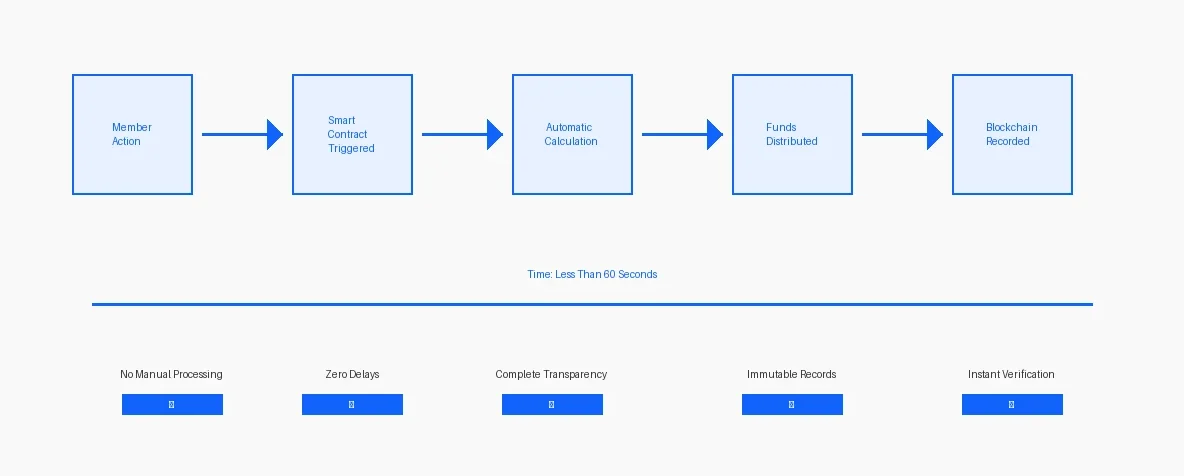
In traditional MLM operations, multiple people are involved in the payment process. A distributor makes a sale, the system records it, an administrator verifies the record, accounting processes the commission, and finally a payment specialist sends the funds. Each step creates opportunity for delay, error, or even manipulation. Smart contracts compress this entire workflow into instantaneous execution.
When a smart contract is deployed on a blockchain, it becomes permanently available and unchangeable. No administrator can modify it. No executive can decide to delay payouts. The contract simply executes according to its code. This removes what might be called “organizational risk” from the MLM participant’s perspective. They are no longer trusting a company; they are trusting transparent code and mathematics.
This elimination of human intervention does not mean completely removing human oversight. Rather, it shifts oversight from people who manage day-to-day operations to people who audit and verify the smart contract code before it goes live.
Ensuring Rule-Based Execution
One of the most important features of smart contracts is their reliability in following rules. Once a rule is coded into a contract, it will be followed exactly every single time. There is no interpretation, no flexibility, and no exceptions. For MLM systems, this is beneficial because it means all members are treated identically. The same commission formula applies to everyone, every time.
Rule-based execution also prevents what are sometimes called “gray areas” in traditional MLM structures. For example, in some organizations, how is a commission calculated when a product is returned? What happens if someone makes a purchase through multiple accounts? A smart contract has clear answers to these questions, and it applies them uniformly.
Automated Commission Distribution and Multi-Level Payouts
Instant Payout Execution
Perhaps the most noticeable feature of MLM smart contracts is instant payout execution. When a transaction meets the conditions specified in the contract, payment happens immediately. This is radically different from traditional MLM where payments might be batched, processed during business hours, or reviewed before release.
Instant payouts benefit both the platform and participants. Participants see their earnings appear in their wallets within minutes, which builds confidence and satisfaction. Platforms benefit because the faster they pay, the more attractive they become to new members. This is one reason many emerging MLM platforms built on blockchain are gaining traction quickly.
Multi-Level Commission Handling
Multi-level marketing, by definition, involves distributing commissions across multiple levels of the organization. A person might earn commissions from their own sales, their team’s sales, and their team’s team’s sales. Traditional systems struggle with this complexity, often experiencing delays as the system calculates commission for each level.
Smart contracts handle multi-level commission structures with the same speed regardless of complexity. The contract can be programmed to pay Level 1 commissions, Level 2 commissions, Level 3 commissions, and beyond, all within a single transaction. This is possible because blockchain networks are designed to handle complex calculations instantly.
| Payout Aspect | Traditional MLM | Smart Contract MLM |
|---|---|---|
| Processing Time | 5-10 Business Days | Less Than 60 Seconds |
| Manual Verification | Required | Automatic |
| Multi-Level Accuracy | Error-Prone | 100% Accurate |
| Dispute Resolution | Contact Support | Check Blockchain Record |
Accuracy in Reward Calculations
Accuracy is where smart contracts truly shine. Once deployed, a smart contract performs calculations the exact same way every single time. There is no possibility of a mathematical error, because the contract does not interpret anything. It simply follows its code.
In traditional systems, accuracy depends on people being careful and processes being followed correctly. A tired employee might make a mistake. A process step might be skipped. A system might have a bug. Smart contracts reduce these risks dramatically because the contract has been audited before deployment and does not change afterward.
Transparent Transaction Records and On-Chain Visibility
On-Chain Visibility of Earnings and Payouts
Every transaction processed through a smart contract is recorded on the blockchain, which is a permanent, public ledger. This means every earning, commission payment, withdrawal, and deposit can be seen by the participant at any time. This level of transparency is almost impossible to achieve in traditional systems.
When a member logs into a blockchain explorer (a tool for viewing blockchain data), they can see the exact timestamp of each transaction, the exact amount, which wallet the funds came from, and which wallet they went to. This creates an audit trail that is impossible to fake or manipulate.
Public Verification of MLM Activities
The transparency of blockchain also enables public verification. Unlike a centralized company database that only the company controls, blockchain records can be verified by anyone. This means if a member questions their earnings, they do not need to take the company’s word for it. They can verify the information themselves by looking at the blockchain.
This public verifiability also helps build credibility for MLM platforms. A platform that has nothing to hide welcomes blockchain transparency. A platform that resists transparency raises red flags for potential participants.
Reduced Disputes Between Members
Disputes often arise in MLM when members feel they have not been paid correctly. In traditional systems, resolving these disputes requires contacting customer support, providing documentation, waiting for investigation, and hoping the outcome is fair. With smart contracts, disputes are resolved by checking the blockchain. Either the transaction happened or it did not. Either the calculation is correct or it is not. There is no gray area, which means fewer disputes overall.
Related Reading
For a comprehensive understanding of MLM systems, regulations, and how they operate globally, we recommend reading our detailed guide on MLM meaning, types, benefits, and global regulation. This resource covers the foundational concepts that smart contracts are building upon.
Immutable MLM Rules and Protection from Manipulation
Fixed Compensation Plans
Once a smart contract is deployed to a blockchain, it cannot be changed. This permanence, called immutability, has profound implications for MLM platforms. It means the compensation plan that members agreed to when they joined will remain exactly the same. A company cannot increase its commission percentage by 10 points or alter the payout structure without deploying an entirely new contract.
This immutability protects members from one of the biggest concerns in traditional MLM: the fear that the company will change the rules to their disadvantage. With smart contracts, that fear is eliminated because changing the rules is essentially impossible without members noticing and potentially leaving for a new version of the platform.
Protection from Rule Manipulation
In traditional systems, company management might interpret rules differently at different times. One month, a certain type of sale counts toward a promotion. The next month, it does not. Rule changes can be made quietly and asymmetrically benefiting some members over others. Smart contracts prevent this because rules are code, and code either does what you programmed it to do or it fails completely. There is no room for interpretation.
Trust-Building Among Participants
The combination of fixed rules and transparent execution builds trust in ways that traditional MLM cannot achieve. Members trust that everyone is playing by the same rules, that those rules will not change, and that they can verify everything through the blockchain. This trust extends to members trusting each other as well. No one worries that someone else found a loophole or received special treatment.
Decentralized Fund Management and Reduced Control
No Centralized Control Over Funds
In traditional MLM, the company holds all the money. Members must trust that the company will distribute it correctly and on time. If the company faces financial difficulties or goes bankrupt, member funds might be at risk. With smart contract MLM on blockchain, funds are held in distributed wallets across the network, not controlled by any single entity.
This distribution of control is sometimes called “decentralization.” Instead of one company being the single point of failure, the network itself becomes the custodian of funds. Funds can only move according to the smart contract, which is enforced by the blockchain network, not by any individual or company.
Reduced Risk of Fund Misuse
Companies have sometimes misused MLM member funds, either through negligence or deliberately. A company might use member deposits for operational expenses. In extreme cases, a company might invest member funds in risky ventures. Smart contracts eliminate these possibilities because funds are programmed to move only to specific destinations according to the contract rules.
User-Owned Wallets Integration
Smart contract MLM platforms typically integrate with user-owned cryptocurrency wallets. Rather than the company controlling accounts on their server, members control their own wallets using private keys that only they possess. This means members have actual ownership of their earnings, not just a claim against the company.
Real-Time Payout Processing and Elimination of Delays
Faster Earnings Release Compared to Traditional MLM
Traditional MLM payout processes typically involve multiple stages: collection (daily or weekly), processing (batching transactions), verification (checking for fraud), and distribution (sending funds). Each stage adds time. A commission earned on Monday might not arrive until Friday of the following week.
Smart contract MLM processes payouts in real-time, or near-real-time. As soon as a transaction meets the contract conditions, payment happens. This is typically measured in minutes, not days. The speed difference is not marginal. It is transformative in how members experience the platform.
Elimination of Payout Delays
One of the most common complaints about traditional MLM is payout delays. Members earned money but must wait days or weeks to receive it. Smart contracts eliminate this complaint because delays would require the code to deliberately wait, which would be pointless and visible to everyone. The contract either pays immediately or it does not pay at all.
Smart Contract-Triggered Transactions
Transactions on smart contract MLM are triggered by actual events: a sale is recorded, inventory reaches a threshold, a referral is confirmed. Once the triggering event happens, the contract executes and funds move. This event-driven execution is much more efficient than batch processing because it processes transactions as they occur rather than waiting to bunch them together.
Security Features and Fraud Prevention Mechanisms
Protection Against Fake Referrals
One of the biggest problems in traditional MLM is fake referral fraud. Someone might claim they recruited members who do not actually exist or do not actually make purchases. Since traditional systems are centralized and opaque, detecting this fraud is difficult and requires human investigation.
Smart contracts can prevent fake referral fraud through several mechanisms. They can require on-chain proof of actions (like connecting wallets) before crediting referrals. They can track referral relationships transparently so that false claims are immediately visible. They can require certain behaviors (like actual purchases) to qualify for commissions, and they can verify this behavior on the blockchain.
Prevention of Double Spending
Double spending is a blockchain security concept: ensuring the same digital asset cannot be used twice. Smart contracts prevent double spending by working within blockchain consensus rules. Once a fund has been paid out, the blockchain records ensure it cannot be paid out again. This prevents the kind of fraud where a malicious actor tries to claim multiple payments for the same action.
Secure Contract Execution
Smart contracts execute according to their code, nothing more and nothing less. They cannot be overridden by an administrator deciding to make an exception. They cannot be hacked to pay out extra funds (though the code itself could have been written incorrectly). This security model is different from traditional systems where security depends on access controls, employee integrity, and operational procedures.
Example: Fraud Prevention in Action
A member creates a fake referral in a traditional MLM system. They claim their spouse joined the network, but the spouse has never actually used the platform. In a traditional system, this fraud might go undetected for months. With a smart contract MLM, when the member tries to claim a commission based on their spouse’s (non-existent) purchase, the smart contract checks the blockchain and finds no purchase record. The payment does not happen. The fraud is prevented automatically.
Multi-Level Referral Tracking and Accurate Downline Management
Accurate Tracking of Downlines
A member’s “downline” consists of everyone they directly recruited, everyone their recruits recruited, and so on. Tracking downlines in traditional systems is complex and prone to errors. Data might be stored inconsistently, records might be lost, or relationships might be unclear. Smart contracts record downline relationships on the blockchain, creating a permanent, unalterable record.
This permanent record is more than just accurate. It is also portable. If a member switches platforms, their downline history comes with them because it is recorded on a public blockchain, not locked in one company’s database.
Automatic Level-Wise Reward Allocation
MLM systems pay different commission rates for different organizational levels. A commission from a direct recruit might be 10%, from a recruit’s recruit 5%, from a recruit’s recruit’s recruit 2%, and so on. Smart contracts automate this level-wise allocation by simply following the formula programmed into the contract. The correct percentage is applied automatically at each level.
Scalability for Complex MLM Structures
Some MLM organizations grow into extremely complex structures with hundreds of levels and thousands of relationships. Managing this complexity in traditional systems is computationally expensive and error-prone. Smart contracts handle complex structures efficiently because they follow algorithms that process relationships and payments regardless of organizational size.
| Organizational Level | Traditional MLM (Manual Tracking) | Smart Contract MLM (Automated) |
|---|---|---|
| Direct Recruit | 10% Commission | 10% Commission (Automatic) |
| Level 2 | 5% Commission (if tracked) | 5% Commission (Guaranteed) |
| Level 3 | 2-3% Commission (often missing) | 2-3% Commission (Always Applied) |
| Level 4+ | Rarely Tracked | Tracked and Paid Automatically |
Customizable Compensation Plans and Smart Contract Flexibility
Supporting Multiple MLM Plan Types
MLM systems use different compensation structures: binary plans (two legs), matrix plans (fixed width and depth), unilevel plans (unlimited width), and hybrid plans combining multiple approaches. Smart contracts can be programmed to support any of these structures. The flexibility of code means a platform can change its compensation plan by deploying a new contract, rather than overhaul its entire technical infrastructure.
Smart Contract Flexibility
Unlike traditional systems which are often rigid and expensive to modify, smart contracts can be designed with flexibility built in. Some contracts include parameters that can be adjusted without changing the core logic. For example, a contract might allow the percentage paid to each level to be adjusted, or the minimum purchase required to qualify for commissions to be changed, all without redeploying the entire contract.
Easy Adaptation to Business Models
As an MLM business evolves, its compensation structure might need to change. With smart contracts, these changes are relatively straightforward. A new contract can be deployed that reflects the new business model, and members can migrate to it at their choosing. This flexibility has enabled many blockchain-based MLM platforms to experiment with compensation models in ways traditional systems cannot.
Gas Optimization and Cost Efficiency in Smart Contract Operations
Efficient Contract Design
“Gas” is the cost of executing transactions on a blockchain. Every operation consumes some amount of gas, and higher gas consumption means higher cost. Smart contracts designed inefficiently can become expensive to operate. Well-designed contracts use minimal gas by optimizing their code and eliminating unnecessary operations.
An efficiently designed MLM smart contract might cost a few cents per transaction, while a poorly designed one might cost dollars. Over millions of transactions, this difference becomes the difference between a profitable platform and an unprofitable one. This is why contract optimization is taken seriously by platforms building on blockchain.
Reducing Transaction Costs
Lower gas costs directly translate to lower transaction costs for members. A platform can reduce or eliminate transaction fees if its smart contracts are efficient. This is a competitive advantage because members are attracted to platforms that do not deduct fees from their earnings.
Importance of Optimized Blockchain Selection
Different blockchains charge different gas fees. Bitcoin transactions are more expensive than Ethereum transactions, which are more expensive than transactions on newer blockchains like Polygon or Arbitrum. Platforms choose blockchains based on cost-efficiency. A platform handling millions of small transactions might choose a low-cost blockchain, while a platform handling fewer but larger transactions might choose a more secure, well-established blockchain.
Auditability and Compliance Support Features
Smart Contract Audits
Before a smart contract goes live, it should be audited by security experts who review the code for bugs, vulnerabilities, and logic errors. This auditing process is more rigorous than traditional software audits because smart contract code is immutable and handles real money. Once deployed, a bug cannot be fixed. It can only be worked around or migrated to a new contract.
Professional smart contract audits involve both automated scanning tools and manual expert review. Auditors look for security vulnerabilities, inefficiencies, and logic errors. A properly audited contract provides confidence that it will execute as intended.
Transparent Compliance Checks
Smart contracts can be programmed to enforce compliance rules. For example, a contract can check that member payouts do not violate tax reporting thresholds, that recruitment patterns do not violate anti-pyramid scheme rules, or that commissions do not exceed regulatory limits. These checks happen transparently on the blockchain and cannot be bypassed.
Meeting Regulatory Expectations
Regulators worldwide are paying attention to blockchain-based MLM platforms. A platform that can demonstrate transparent, auditable contract logic and compliance checks is in a stronger position with regulators. Some jurisdictions have begun specifically recognizing blockchain-based systems as potentially more transparent and trustworthy than traditional centralized MLM platforms.
Build Trust-Driven MLM Smart Contracts
Launch secure, transparent, and automated MLM platforms using smart contracts. Eliminate manual errors, prevent fraud, and enable instant payouts.
Integration with Tokens and Cryptocurrency Payment Systems
Native Token Rewards
Many blockchain-based MLM platforms issue their own cryptocurrency tokens to represent value within the system. Members earn these tokens through sales and referrals, then can hold them, trade them, or convert them to other cryptocurrencies. Native tokens can incentivize loyalty because token holders benefit from the platform’s success through price appreciation.
Stablecoin-Based Payouts
To avoid volatility concerns, many platforms conduct payouts in “stablecoins” – cryptocurrencies designed to maintain a fixed value, usually $1 per coin. This combines the speed and transparency of cryptocurrency with the stability of traditional currency. Members receive instant payments without worrying that their earnings will lose value overnight due to crypto volatility.
Wallet Compatibility
Smart contract MLM platforms integrate with standard cryptocurrency wallets. Members do not need to use a special wallet or have all their funds locked in the platform. They can move their earnings to any wallet they choose, trade them on any exchange, or hold them however they prefer. This flexibility and ownership is fundamentally different from traditional MLM where all funds remain in company-controlled accounts.
Scalability and Performance in Large MLM Networks
Handling Large User Networks
Some MLM networks have millions of active members. Traditional systems struggle with this scale because each member represents more data to store, process, and maintain. Blockchain systems can handle this scale differently by distributing the processing across a network of nodes. As the network grows, it can add more nodes to maintain performance.
Layer-2 and Sidechain Support
“Layer-2” solutions are blockchain systems that sit on top of main blockchain networks, processing transactions more efficiently. For example, the Polygon network is a Layer-2 solution for Ethereum. An MLM platform might conduct millions of transactions on Layer-2, while settling only occasionally to Layer-1 for security. This approach achieves both scalability and security.
Future-Proof Contract Architecture
Well-architected smart contracts are built with upgradability in mind. Proxy patterns allow new features to be added without breaking existing functionality. This means an MLM platform can grow and evolve without requiring members to migrate to a completely new system.
Limitations and Challenges of MLM Smart Contracts
Smart Contract Bugs and Code Risk
Smart contract code is written by humans, and humans make mistakes. A bug in a smart contract is permanent and affects real money. History has many examples of smart contracts with bugs that resulted in millions of dollars lost. Even audited contracts can have subtle vulnerabilities that only appear under unusual conditions. This is a real limitation and ongoing risk in any smart contract system.
Blockchain Fees and Cost Considerations
While smart contracts are efficient, blockchain fees are still a factor, especially on congested networks. During periods of high network usage, transaction costs can spike. For an MLM platform conducting millions of transactions, fee spikes can significantly impact profitability. This is why platform selection and contract optimization are critical.
Legal and Regulatory Considerations
MLM is heavily regulated in most jurisdictions. Blockchain adds an additional layer of regulatory complexity. Some jurisdictions are unsure how to classify cryptocurrency-based MLM systems. Others have specific rules about cryptocurrency that affect how these platforms can operate. A platform must navigate these regulations carefully, which sometimes requires choosing not to operate in certain regions.
Future Evolution of MLM Smart Contracts
AI-Driven Automation and Intelligent Systems
The next generation of MLM smart contracts will incorporate artificial intelligence to handle more complex decisions. Instead of simple rule-based logic, contracts might use AI to detect fraud patterns, optimize payout structures, or predict member behavior. This would require oracles (services that bring external data onto the blockchain) to feed the AI with information to analyze.
Cross-Chain MLM Systems
Currently, most MLM platforms operate on a single blockchain. Future systems might operate across multiple blockchains, allowing members to interact with the same MLM network regardless of which blockchain they prefer. This would require advanced cross-chain communication technology that is still in development.
Evolution Toward Fully Decentralized Platforms
Today’s blockchain MLM platforms are semi-centralized: they use smart contracts but still involve company infrastructure. Future platforms might be fully decentralized, with governance distributed among all participants. Decisions about compensation plans, rule changes, and feature additions would be made through voting systems where all members participate. This represents a fundamental shift from company-controlled platforms to community-controlled platforms.
Conclusion: The Impact of Smart Contracts on Modern MLM
Summary of Key Features
Smart contracts have fundamentally changed what is possible in MLM systems. They enable instant, automated, transparent, and rule-based execution of complex commission structures. They eliminate human intermediaries, reduce fraud, and create permanent, verifiable records of all transactions. They move control from centralized company infrastructure to distributed blockchain networks.
Why Smart Contracts Are Essential for Next-Generation MLM
As MLM participants become more sophisticated and more skeptical, traditional systems struggle to maintain trust. Smart contracts solve this trust problem by replacing trust in institutions with trust in code and mathematics. Members no longer need to believe the company is being fair. They can verify it themselves. This shift represents the future of MLM.
Final Thoughts
The transition from traditional MLM to smart contract-based systems is not simple, but it is inevitable. Organizations that adapt and embrace blockchain automation will attract forward-thinking members who value transparency and instant payouts. Organizations that resist will find themselves competing with systems that seem faster, fairer, and more trustworthy by comparison. The question is not whether smart contracts will become standard in MLM, but when and how quickly that transition will occur.
Expand Your Blockchain Expertise
If you are interested in building or deploying smart contract systems for MLM or other applications, our cryptocurrency MLM services provide the technical expertise needed to bring your vision to reality. We work with clients to design, develop, and deploy blockchain systems that meet both technical and regulatory requirements.
Frequently Asked Questions
Q1.What are MLM smart contracts and how do they work?
MLM smart contracts are self-executing programs built on blockchain that automatically manage MLM operations. They define rules for registrations, referrals, commissions, and payouts. Once conditions are met, actions like reward distribution happen instantly without manual control, reducing errors, delays, and manipulation in MLM systems.
Q2.How do MLM smart contracts ensure transparency?
MLM smart contracts store all transactions and commission logic on the blockchain, making them publicly verifiable. Every payout, referral, and reward can be tracked in real time. This transparency helps users confirm earnings independently, reduces disputes, and builds trust between members and the MLM platform.
Q3.Are MLM smart contracts secure from fraud?
Yes, MLM smart contracts reduce fraud risks by using immutable blockchain code. Referral manipulation, fake accounts, and payout tampering are minimized because rules cannot be changed after deployment. Security audits and cryptographic validation further protect the system from unauthorized access or malicious activity.
Q4.How do smart contracts automate MLM payouts?
Smart contracts automate payouts by executing predefined commission rules instantly when conditions are fulfilled. Once a sale or referral is confirmed, rewards are distributed directly to user wallets without human intervention. This eliminates payout delays, reduces operational costs, and ensures accurate commission calculations.
Q5.Can MLM smart contracts support different compensation plans?
Yes, MLM smart contracts can be designed to support various compensation plans such as binary, matrix, unilevel, or hybrid models. Developers encode these structures directly into the contract logic, allowing automated and scalable reward distribution while maintaining accuracy across complex multi-level networks.
Q6.What are the limitations of using MLM smart contracts?
Despite benefits, MLM smart contracts have limitations such as blockchain transaction fees, limited upgrade flexibility, and dependence on accurate initial coding. Bugs in the contract can be costly if not audited properly. Regulatory compliance and user education also remain important challenges in smart contract-based MLM systems.
Explore Services
Related Services
Reviewed by

Aman Vaths
Founder of Nadcab Labs
Aman Vaths is the Founder & CTO of Nadcab Labs, a global digital engineering company delivering enterprise-grade solutions across AI, Web3, Blockchain, Big Data, Cloud, Cybersecurity, and Modern Application Development. With deep technical leadership and product innovation experience, Aman has positioned Nadcab Labs as one of the most advanced engineering companies driving the next era of intelligent, secure, and scalable software systems. Under his leadership, Nadcab Labs has built 2,000+ global projects across sectors including fintech, banking, healthcare, real estate, logistics, gaming, manufacturing, and next-generation DePIN networks. Aman’s strength lies in architecting high-performance systems, end-to-end platform engineering, and designing enterprise solutions that operate at global scale.