Ai Overview
A Bulletproof is a clever piece of mathematics that lets you prove something about a secret number without revealing that number. This is why the fee reduction was so dramatic: the range proof was the dominant cost driver, and Bulletproofs reduced it by more than 90 percent. For a 64-bit range proof, this translates to roughly 96 bytes of savings per proof.
Key Takeaways
- 01
Bulletproof in blockchain is a zero knowledge range proof that proves a hidden transaction amount is a valid positive number without revealing the actual amount or requiring a trusted setup ceremony. - 02
Bulletproof in Blockchain were introduced by Benedikt Bunz, Jonathan Bootle, Dan Boneh, and collaborators in a 2018 research paper and became the standard range proof used in Monero’s confidential transaction system. - 03
Unlike zk-SNARKs which require a trusted setup ceremony, Bulletproof in Blockchain derive their security from discrete logarithm hardness assumptions on elliptic curves without any setup process that could be compromised. - 04
Monero’s implementation of Bulletproof in Blockchain October 2018 reduced transaction sizes by approximately 80 percent and caused transaction fees to drop by roughly 96 percent almost immediately after the upgrade. - 05
Bulletproofs work using Pedersen Commitments to hide transaction amounts combined with an inner product argument that efficiently proves the committed value lies within a valid positive range. - 06
The proof size in Bulletproofs grows logarithmically rather than linearly with the number of inputs, which means batching multiple range proofs together produces dramatically smaller total proof sizes than proving each separately. - 07
Bulletproof Plus published in 2020 improves on the original by producing proofs that are approximately 96 bytes smaller and 5 to 15 percent faster to verify, further reducing Bulletproof in blockchain storage and computation costs. - 08
The main limitation of Bulletproofs is that verification is computationally slower than zk-SNARK verification, making them less suitable for high-frequency on-chain verification in smart contract environments where gas costs matter significantly. - 09
Bulletproofs are not quantum-safe because they rely on elliptic curve discrete logarithm security, but research into lattice-based replacements for the underlying commitment scheme is actively progressing in 2026. - 10
Indian Bulletproof in blockchain engineers working on privacy-preserving financial applications, supply chain systems, and confidential smart contracts need to understand Bulletproofs as a foundational privacy primitive in modern cryptographic toolkits.
What is a Bulletproof in Simple Words
A Bulletproof is a clever piece of mathematics that lets you prove something about a secret number without revealing that number. Specifically, it lets you prove that a hidden number is positive and within a certain range, which in the context of a financial transaction means proving that the amount is a real, valid, non-negative value without showing anyone what the amount actually is. This sounds simple but it is remarkably difficult to achieve without either revealing the number or generating proof data so large that it becomes impractical to include in a blockchain transaction.
The name Bulletproof in Blockchain comes from the research paper introducing the protocol, published by a team of cryptographers led by Benedikt Bunz, Jonathan Bootle, Dan Boneh, Pieter Wuille, Gregory Maxwell, and Andrew Poelstra in 2018. The name reflects the protocol’s design goals: short proofs, no trusted setup, and security grounded in standard cryptographic assumptions. When the paper says bulletproof, it implies the protocol is resistant to the main vulnerabilities that affected earlier range proof systems, specifically the large proof sizes and the trusted setup requirements that created potential points of compromise.
For Indian developers and blockchain enthusiasts trying to understand Bulletproof in blockchain without a deep mathematics background, the simplest mental model is this: imagine you seal a number in an envelope. You then perform a mathematical trick that proves to anyone examining the outside of the envelope that the number inside is between zero and a billion, without opening the envelope and without anyone being able to work backward from the trick to guess the number. That sealed envelope and mathematical trick together form a Bulletproof in Blockchain. The cryptographic machinery behind this trick involves elliptic curves, commitment schemes, and inner product arguments, each of which we explain clearly in the sections that follow.
Why Bulletproofs Were Created in Blockchain
Bulletproof in Blockchain were created to solve a specific and urgent problem in blockchain privacy: range proofs were necessary for confidential transactions, but the existing range proof systems produced enormous amounts of data that made privacy transactions far too large and expensive for practical everyday use. Before Bulletproofs, Monero used a range proof system based on Borromean ring signatures. While these proofs worked correctly, they grew linearly with the number of bits in the range, producing approximately 6 kilobytes of proof data per output in a standard Monero transaction.
To understand why this mattered so much, consider that a typical Monero transaction with two outputs would include around 12 kilobytes of range proof data alone. This made Monero transactions many times larger than standard Bitcoin transactions, which translated directly into higher fees and longer sync times. For users in India and other markets where fee sensitivity is high and network conditions are variable, this was a meaningful practical barrier to adoption. The blockchain was also filling up with proof data at a pace that concerned long-term scalability planners across the privacy coin community.
Bulletproof in Blockchain solved this by replacing the linearly growing proof with one that grows logarithmically. Where the old proof doubled in size every time you added a bit to the range, Bulletproof’s size grows only by a small constant factor for each doubling of the range. Even more powerfully, multiple Bulletproofs for multiple outputs in the same transaction can be aggregated into a single proof that is barely larger than proving a single output, multiplying the efficiency gain further. The result was a proof system that was simultaneously more secure than the old approach, smaller in every scenario, and requiring no trusted setup that could have undermined the network’s decentralization properties.
How Bulletproof in Blockchain Works?
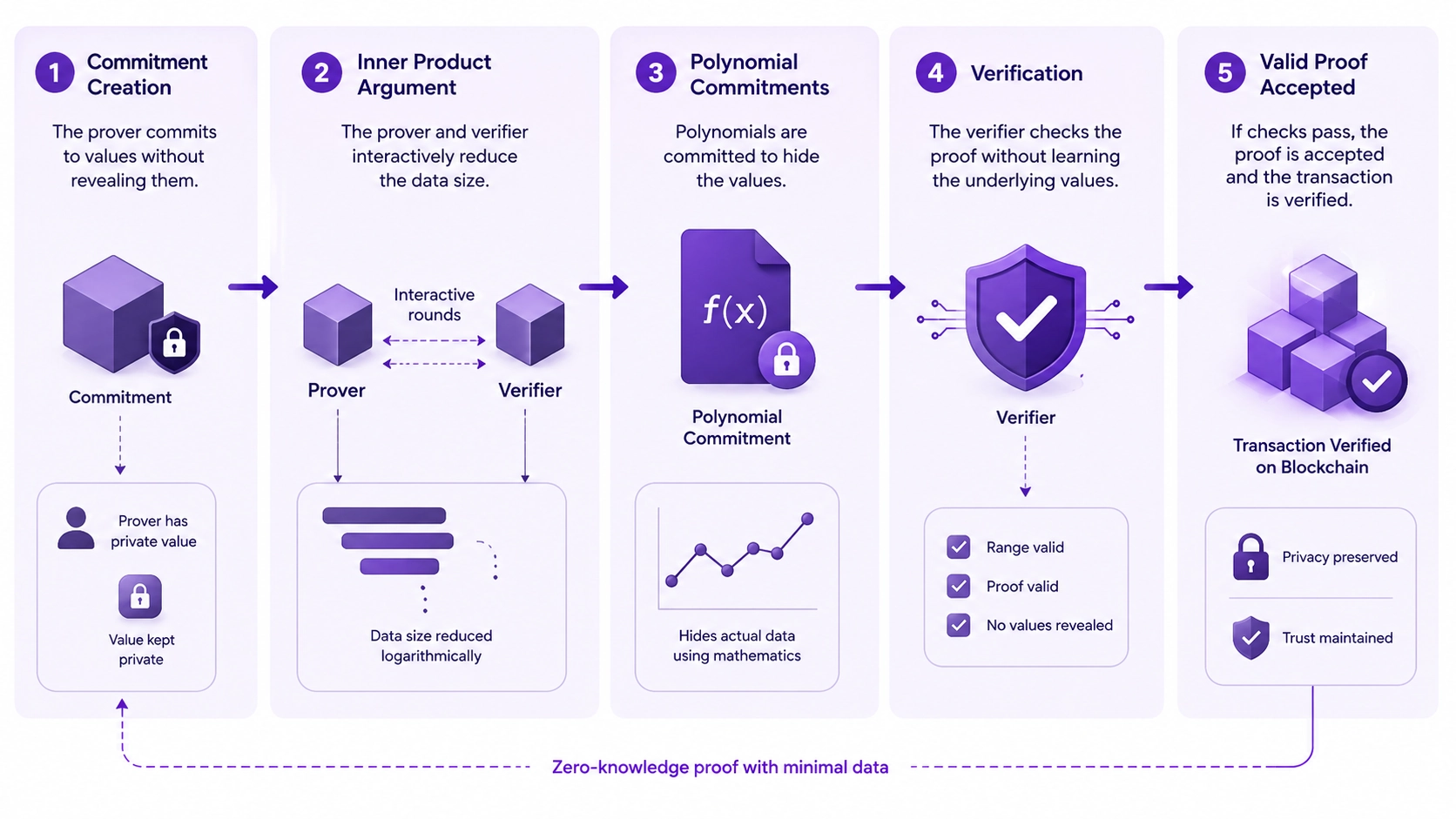
To understand how Bulletproof in blockchain works, you need to grasp three concepts that build on each other: Pedersen Commitments, range proofs, and inner product arguments. You do not need to understand the deep mathematics of each one, but understanding what each layer does and why it is needed makes the overall picture clear and gives you a solid foundation for working with these proofs in practice.
Pedersen Commitments are the foundation. A Pedersen Commitment takes a secret value v and a random blinding factor r and produces a public commitment C equals v times G plus r times H, where G and H are public elliptic curve generator points. The commitment perfectly hides v because it looks like a random curve point to anyone without r. It is binding because changing v after committing would require solving the elliptic curve discrete logarithm, which is computationally infeasible. In a confidential transaction, every input and output amount is replaced by its Pedersen Commitment. The network checks that the sum of input commitments equals the sum of output commitments, confirming conservation of value, without seeing any actual amounts.
The range proof part of Bulletproof in Blockchain then proves that the committed value is between zero and 2 to the power of 64. Without this proof, a malicious actor could commit to a negative value and use it to create money from nothing while the commitment arithmetic still appears to balance. The innovation in Bulletproofs is that this range proof is constructed using an inner product argument, a mathematical technique that recursively halves the problem size at each step, producing a proof that grows only logarithmically. Where old range proofs needed O(n) data for an n-bit range, Bulletproofs need only O(log n) data, producing dramatically smaller proofs for the same security level and range size.[1]
What is a Range Proof and How Bulletproof in Blockchain Use It
A range proof is a cryptographic proof that a secret value committed in a cryptographic commitment falls within a specific numerical range, without revealing the actual value. In the context of blockchain confidential transactions, the range is typically from zero to 2 to the power of 64, which covers all realistic positive transaction amounts. The necessity of range proofs in confidential transaction systems is not obvious at first glance, so it is worth explaining carefully before explaining how Bulletproof in Blockchain construct them.
In a confidential transaction system, the homomorphic property of Pedersen Commitments means you can verify that inputs equal outputs in commitment space without knowing any amounts. The problem is that this arithmetic works in a modular group where very large numbers wrap around and appear as small positive values. A commitment to negative one million is indistinguishable from a commitment to a large positive number near the group order. Without a range proof, an attacker could create a transaction where one output commits to a negative value, making the arithmetic balance while effectively creating new coins from nothing. The range proof closes this loophole by proving that every committed output is genuinely non-negative.
Bulletproof in Blockchain construct range proofs using the following approach: first, the secret value is expressed in binary form as a bit vector where each bit is proven to be zero or one using small polynomial constraints. Then, the inner product argument proves that these bits correctly encode a value within the target range.
The inner product argument is where Bulletproofs achieve their logarithmic size advantage. It works by recursively splitting the bit vector in half and running a compressed version of the proof at each level, with the recursion terminating after log n steps. Each step reduces the data requirements by half, producing a final proof size of approximately 2 log n curve points regardless of how many bits the range requires.
What is the Math Behind Bulletproofs in Blockchain
The mathematics behind Bulletproof in blockchain rests on three pillars: the elliptic curve discrete logarithm assumption, Pedersen Commitment homomorphism, and the inner product argument. Understanding each at a conceptual level is sufficient for most engineers working with these systems, even if the detailed proofs require graduate-level mathematics to verify from first principles. Here we explain each pillar clearly without requiring advanced mathematical prerequisites.
The elliptic curve discrete logarithm assumption is the bedrock security assumption. An elliptic curve is a specific type of algebraic curve defined over a finite field. Points on the curve form a mathematical group where you can add points together and multiply a point by a scalar. The discrete logarithm problem on this curve is: given two points P and Q on the curve, find the scalar k such that Q equals k times P. No efficient algorithm is known for solving this problem on the curves used in practice, which is why it serves as the hardness assumption underlying the security of Bulletproofs and most other elliptic curve cryptographic systems.
The inner product argument is the mathematical technique that gives Bulletproof in Blockchain their logarithmic proof size. Given two vectors a and b, the inner product is the sum of the products of their corresponding elements. The inner product argument lets a prover convince a verifier that they know two vectors whose inner product equals a specific claimed value, using a recursive halving technique that reduces the proof size at each step.
In the range proof context, the prover encodes the binary representation of the secret value as one vector and a powers-of-two vector as the other, with their inner product equal to the original value. Proving this inner product relationship logarithmically is the core efficiency innovation that makes Bulletproofs practical for blockchain use at the scale Monero and other networks operate in production today.
How Bulletproof in Blockchain Are Different From Other Zero Knowledge Proofs
Zero knowledge proofs are a broad family of cryptographic protocols, and Bulletproofs are one specific member of that family optimized for a specific task. Understanding where Bulletproofs fit within the broader ZKP landscape helps you choose the right tool for each privacy engineering challenge in a blockchain system. The key differentiators are proof size, trusted setup requirements, verification speed, and the types of statements that can be efficiently proven.
Bulletproof in Blockchain are interactive proofs made non-interactive using the Fiat-Shamir heuristic, which converts the random challenges from the verifier into hash function outputs that the prover computes themselves. This non-interactive version is what gets embedded in blockchain transactions. The proofs are succinct in the sense that their size grows logarithmically with the complexity of the statement, but they are not as succinct as zk-SNARKs, which produce constant-size proofs regardless of statement complexity. The tradeoff is that Bulletproofs require no trusted setup, while most zk-SNARK constructions like Groth16 require a circuit-specific trusted setup ceremony.
The verification time for Bulletproof in Blockchain is also slower than for zk-SNARKs. Verifying a Bulletproof requires computation proportional to the statement size because the verifier must perform calculations at each level of the recursive inner product argument. In contrast, verifying a Groth16 SNARK requires only a fixed number of elliptic curve pairing operations regardless of proof complexity. This makes Bulletproofs less suitable for use in smart contracts on gas-fee chains like Ethereum, where verification cost is measured in gas and even small increases in verification computation translate into significant user-facing costs. For chain-native proof verification in Monero’s off-chain verifier model, this slower verification is acceptable because the verifier is a full node without a per-computation fee model.
How Bulletproof in Blockchain Are Used in Monero Blockchain
Monero is the primary production blockchain that uses Bulletproofs, and its implementation provides the most complete real-world case study of how Bulletproof in blockchain performs at scale. Monero’s privacy model, called RingCT or Ring Confidential Transactions, hides the amount of every transaction using Pedersen Commitments. The Bulletproof range proof is the component that ensures each committed output amount is genuinely non-negative, preventing the creation of coins from thin air through negative amount exploits.
Before Bulletproofs were integrated in October 2018 through Monero’s hard fork at block 1685555, each Monero transaction used Borromean ring signatures as range proofs. A typical two-output transaction was approximately 13.2 kilobytes in size. After the Bulletproof upgrade, the same transaction type shrank to approximately 2.5 kilobytes, an 80 percent reduction. Transaction fees fell by approximately 96 percent almost immediately after the upgrade because fees on Monero scale with transaction data size, and the smaller transactions required much less per-transaction payment to incentivize miners to include them in blocks.
Monero’s Bulletproof implementation also demonstrates the aggregation advantage clearly. When a single transaction has multiple outputs, all the range proofs for those outputs can be batched into a single Bulletproof that is only slightly larger than a single-output proof. This aggregation means that as you add more outputs to a transaction, the per-output proof cost decreases, rewarding efficient multi-output transaction construction. For Indian users making batch payments or exchanges processing many transactions simultaneously, this aggregation feature makes Bulletproof-based privacy more economically attractive than any linearly scaling alternative that was available before its introduction.
How Bulletproof in Blockchain Reduce Transaction Size and Fees in Blockchain
The reduction in transaction size that Bulletproofs deliver is not just a technical improvement; it has direct economic consequences for every user of a blockchain that adopts them. Transaction fees in most blockchain systems are determined at least partly by transaction data size, because larger transactions consume more block space and impose more data processing and storage costs on nodes. When Bulletproofs cut the size of the range proof component of a confidential transaction by 80 percent or more, the resulting fee reduction is nearly proportional to the size reduction for transaction types where the range proof dominates the total size.
For a two-output Monero transaction, the range proof before Bulletproof in Blockchain was approximately 12 kilobytes out of a total transaction size of around 13.2 kilobytes. After Bulletproofs, the range proof component shrank to around 1.3 kilobytes, making the same transaction approximately 2.5 kilobytes total. This is why the fee reduction was so dramatic: the range proof was the dominant cost driver, and Bulletproofs reduced it by more than 90 percent. For users making regular privacy-preserving transactions on Monero, including Indian users using it for international remittances or business payments, this represented a shift from fees that were sometimes comparable to traditional payment systems to fees that were negligible by any standard.
| Metric | Before Bulletproofs | After Bulletproofs | Improvement |
|---|---|---|---|
| 2-Output Transaction Size | ~13.2 KB | ~2.5 KB | 81% smaller |
| Range Proof Size Per Output | ~6 KB | ~675 bytes | 89% smaller |
| Transaction Fee (USD equiv) | ~$0.50 to $2.00 | ~$0.02 to $0.05 | ~96% reduction |
| Proof Size Growth Type | Linear O(n) | Logarithmic O(log n) | Fundamentally better |
What Are Bulletproof in Blockchain Plus and How They Improve the Original Protocol
Bulletproof Plus is an improved version of the original Bulletproof protocol introduced in a 2020 research paper by Sanket Kanjalkar and Andrew Poelstra. Building on the same mathematical foundations as the original, Bulletproof in Blockchain Plus makes several algorithmic refinements that produce smaller proofs and faster verification without changing the security assumptions or removing the no-trusted-setup property that makes Bulletproofs so appealing for decentralized systems.
The key improvement in Bulletproof Plus comes from a more efficient formulation of the inner product argument. The original Bulletproof constructs the inner product argument over two independent generators, requiring a specific number of group elements in the proof. Bulletproof Plus reformulates the inner product argument using a weighted inner product, which allows the proof to drop approximately two group elements from the final proof compared to the original. For a 64-bit range proof, this translates to roughly 96 bytes of savings per proof. For a two-output Monero transaction with aggregated proofs, the savings are proportionally significant at the scale of millions of daily transactions across the network.
Monero implemented Bulletproof in Blockchain Plus in its August 2022 hard fork, replacing the original Bulletproof implementation with the improved version. The upgrade was backward-compatible in terms of the security guarantees it provided but incompatible at the protocol level, requiring all nodes and wallets to upgrade simultaneously through the hard fork mechanism. For Indian Monero users and exchange operators, this upgrade delivered immediate benefits in the form of slightly smaller transaction sizes, lower fees, and faster verification times, continuing the trend of privacy technology improvements that has made Monero’s practical transaction cost more competitive with traditional payment systems over successive protocol upgrades.
What Are the Limitations of Bulletproofs in Blockchain
Bulletproof in Blockchain are a significant advance in range proof technology but they are not the ideal solution for every blockchain privacy engineering challenge. Understanding their limitations honestly is important for engineers and architects choosing between different zero knowledge proof systems for specific applications. Selecting a proof system that is mismatched to the verification environment or performance requirements can result in either excessively high costs or insufficient functionality, both of which are expensive problems to fix after deployment.
The most significant practical limitation is verification speed. Verifying a Bulletproof requires O(n) work where n is related to the proof size, because the verifier must process each level of the inner product argument recursively. This is substantially slower than verifying a zk-SNARK, which requires only a constant number of pairing operations regardless of statement complexity. For blockchains like Ethereum where smart contracts verify proofs on-chain and each verification operation costs gas, this slower verification translates directly into higher user-facing transaction costs that can make Bulletproof-based applications economically uncompetitive compared to SNARK-based alternatives on that platform.
The second significant limitation is quantum vulnerability. Bulletproof in Blockchain rely on the elliptic curve discrete logarithm assumption, which is not considered secure against a sufficiently powerful quantum computer. If quantum computers capable of running Shor’s algorithm at the relevant scale become available, the security of Bulletproofs would be compromised. The timeline for this threat remains uncertain and contested, but it is a long-term architectural consideration that any blockchain privacy system committed to multi-decade operation must account for in its cryptographic roadmap. Research into post-quantum alternatives that preserve the Bulletproof in Blockchain structure while using lattice-based commitment schemes is active but not yet mature enough for production deployment in most blockchain contexts as of 2026.
How Bulletproof in Blockchain Compare to zk-SNARKs and zk-STARKs in Blockchain
Choosing between Bulletproofs, zk-SNARKs, and zk-STARKs is one of the most important architectural decisions when designing a privacy-preserving blockchain system. Each has a distinct profile of strengths and weaknesses that makes it more suitable for some use cases and less suitable for others. For Indian blockchain engineers designing systems from scratch, understanding this comparison prevents the common mistake of choosing a proof system based on name recognition rather than fit to the specific verification requirements and performance constraints of the target environment.
Bulletproof in Blockchain excel in scenarios where no trusted setup is acceptable, where range proofs are the primary use case, and where verification happens in an off-chain or non-fee context. They are the ideal choice for a privacy coin like Monero where every node verifies transactions independently with no gas cost model.
zk-SNARKs excel where fast on-chain verification is essential because smart contract gas costs matter, and where the circuit can be defined in advance so a trusted setup ceremony can be conducted. zk-STARKs occupy a different position: they require no trusted setup like Bulletproofs, but unlike both Bulletproofs and most SNARKs, they are potentially quantum-resistant because they rely on hash function security rather than elliptic curve assumptions. However, STARK proofs are significantly larger than both Bulletproofs and SNARKs, making them more expensive in terms of on-chain data.
| Feature | Bulletproofs | zk-SNARKs | zk-STARKs |
|---|---|---|---|
| Trusted Setup | Not Required | Required | Not Required |
| Proof Size | Small (log n) | Smallest (constant) | Larger |
| Verification Speed | Moderate | Fastest | Moderate |
| Quantum Resistance | No | No | Yes |
| Best Blockchain Use Case | Confidential transactions and range proofs | Smart contract on-chain verification | Long-term post-quantum privacy systems |
| Key Deployment | Monero, Grin, Mimblewimble | zkSync, Polygon zkEVM, Groth16 | StarkNet, StarkWare, Cairo |
What is the Future of Bulletproofs in Blockchain Privacy Technology
Bulletproof in blockchain has established itself as a production-grade privacy technology through years of deployment in Monero’s mainnet handling real financial transactions at scale. As the broader blockchain industry in 2026 accelerates toward institutional adoption, regulatory compliance requirements, and privacy-preserving smart contract execution, the role of range proofs and their underlying protocols is evolving rapidly. Bulletproof in Blockchain will not stand still as a technology; they will continue to be refined, extended, and potentially replaced in some contexts by successors that address their current limitations.
The most active area of research around Bulletproof in Blockchain successors is the post-quantum direction. The Bulletproof structure, specifically the inner product argument approach to logarithmic range proofs, can in principle be rebuilt on top of lattice-based commitment schemes rather than elliptic curve Pedersen Commitments. This would preserve the no-trusted-setup property and the logarithmic proof size while upgrading the security foundation to one resistant to quantum computer attacks. Several academic papers have explored lattice-based range proofs that follow the Bulletproof pattern, and while none have yet achieved the compact proof sizes and clean implementation profile that Bulletproofs offer on elliptic curves, the trajectory suggests that post-quantum Bulletproof-style proofs will be available for production use within the next several years.
For the Indian blockchain engineering community, the practical future of Bulletproofs involves two parallel tracks. First, existing deployments in Monero-compatible systems will continue to benefit from incremental improvements like Bulletproof in Blockchain Plus, which is already deployed, and any further algorithmic refinements that reduce proof size or improve verification speed. Second, the Bulletproof approach to range proofs will increasingly be considered for integration into enterprise blockchain systems handling confidential financial data, where proving that transaction amounts are valid without revealing them is a requirement for both business confidentiality and regulatory compliance simultaneously.
Frequently Asked Questions
Q1.1. What is a Bulletproof in blockchain in simple words?
A Bulletproof in Blockchain is a type of zero knowledge proof used in blockchain to prove that a hidden transaction amount is a valid positive number without revealing what that number actually is. It works without requiring a trusted setup ceremony, making it more decentralized and practical than older proof systems.
Q2.2. How is Bulletproof different from other zero knowledge proofs?
Bulletproof in Blockchain are different because they require no trusted setup, produce logarithmically small proofs as the number of inputs grows, and are specifically optimized for range proofs that verify hidden values fall within valid ranges. Other systems like zk-SNARKs require trusted setups and zk-STARKs produce larger proofs than Bulletproofs for the same tasks.
Q3.3. Why did Monero switch to using Bulletproofs?
Monero switched to Bulletproofs in October 2018 through its Bulletproof in Blockchain hard fork because they reduced transaction sizes by approximately 80 percent compared to the previous Borromean ring signature range proofs. This dramatically reduced transaction fees and improved network throughput while maintaining the same level of privacy and amount confidentiality for all users.
Q4.4. What is a range proof and why does blockchain need one?
A range proof is a cryptographic proof that a hidden committed value falls within a specific range, typically between zero and a large number like 2 to the power of 64. Blockchain confidential transactions need range proofs to prevent someone from committing to a negative amount, which would allow them to create coins from nothing while the transaction still appears to balance mathematically.
Q5.5. Do Bulletproofs require a trusted setup like zk-SNARKs?
No, Bulletproof in Blockchain do not require a trusted setup. This is one of their most important advantages over zk-SNARKs, which require a setup ceremony where if any participant keeps their secret parameter, called toxic waste, the entire proof system could be compromised. Bulletproofs derive their security from standard cryptographic assumptions about discrete logarithms without any ceremony.
Q6.6. How much do Bulletproofs reduce transaction fees on Monero?
When Monero implemented Bulletproof in Blockchain 2018, transaction fees dropped by approximately 96 percent almost immediately. This was because the proof data making up each transaction shrank by around 80 percent, and on-chain fees scale directly with transaction data size. For Indian users making international remittances via Monero, this was a meaningful cost reduction in a privacy-preserving payment system.
Q7.7. Can Bulletproofs be used on blockchains other than Monero?
Yes, Bulletproof in Blockchain can be used on any blockchain that implements confidential transactions or needs efficient range proofs. They have been implemented in the Grin blockchain, the Mimblewimble protocol, and research implementations for Ethereum confidential smart contracts. The Bulletproofs library is open-source and available for integration into any blockchain platform that needs transaction amount privacy.
Q8.8. What is Bulletproof Plus and how does it improve the original?
Bulletproof in Blockchain Plus is an improved version of the original Bulletproof protocol published in 2020 that achieves smaller proof sizes and faster verification times for the same security guarantees. For a single range proof, Bulletproof Plus is roughly 96 bytes smaller and about 5 to 15 percent faster to verify, which translates into tangible improvements in transaction throughput and storage efficiency across the network.
Q9.9. Are Bulletproofs quantum safe or post-quantum secure?
Standard Bulletproof in Blockchain rely on the hardness of the discrete logarithm problem on elliptic curves, which is not considered quantum-safe. A sufficiently powerful quantum computer running Shor’s algorithm could theoretically break the binding property of the underlying Pedersen Commitments. Research into lattice-based replacements for the commitment layer is ongoing, which would preserve the Bulletproof proof structure while upgrading the underlying hardness assumption to a quantum-resistant one.
Q10.10. Are Bulletproofs used in any Indian blockchain projects or applications?
Indian blockchain projects building on Monero-compatible privacy protocols or Mimblewimble-based chains inherit Bulletproof in Blockchain functionality as part of the base protocol. Indian fintech researchers and privacy-focused DeFi builders are also exploring Bulletproof integration for confidential transaction layers in permission-based enterprise blockchain systems, particularly for financial data sharing applications where transaction amounts must remain private between counterparties while still being verifiable by a regulator.
Explore Services
Related Services
Reviewed by

Aman Vaths
Founder of Nadcab Labs
Aman Vaths is the Founder & CTO of Nadcab Labs, a global digital engineering company delivering enterprise-grade solutions across AI, Web3, Blockchain, Big Data, Cloud, Cybersecurity, and Modern Application Development. With deep technical leadership and product innovation experience, Aman has positioned Nadcab Labs as one of the most advanced engineering companies driving the next era of intelligent, secure, and scalable software systems. Under his leadership, Nadcab Labs has built 2,000+ global projects across sectors including fintech, banking, healthcare, real estate, logistics, gaming, manufacturing, and next-generation DePIN networks. Aman’s strength lies in architecting high-performance systems, end-to-end platform engineering, and designing enterprise solutions that operate at global scale.