Ai Overview
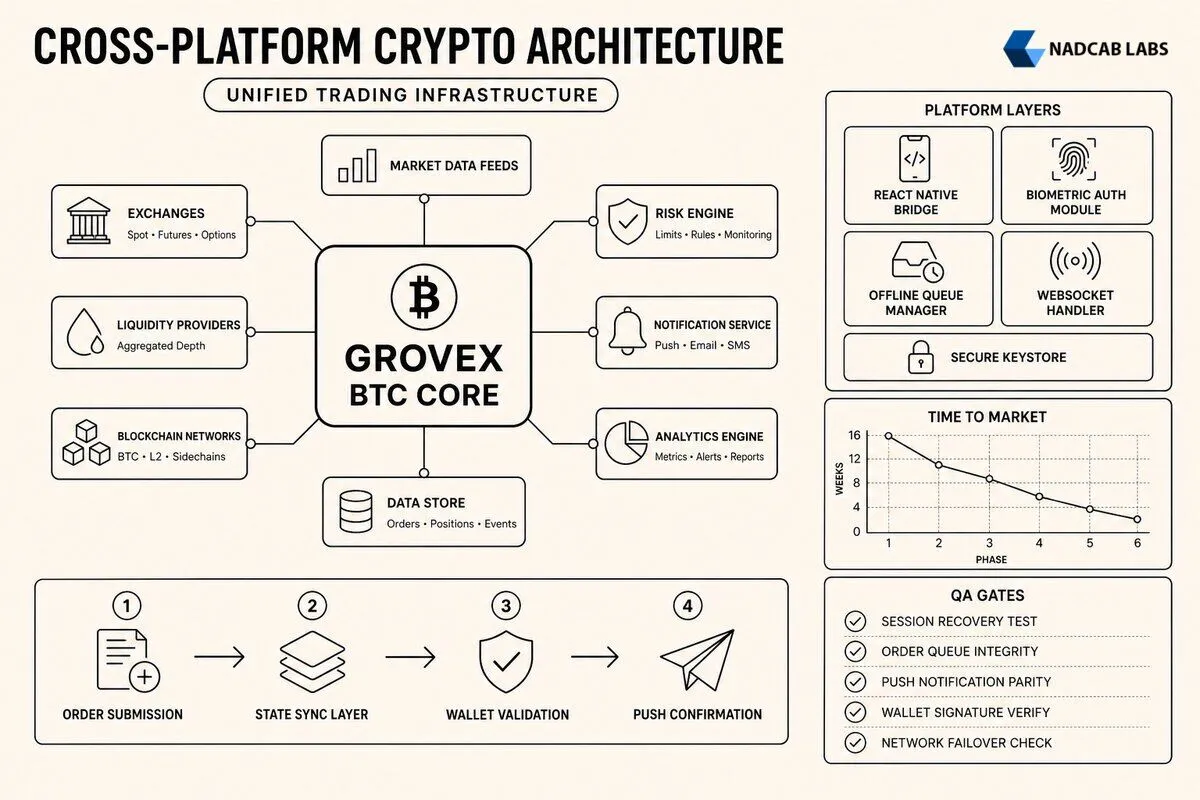
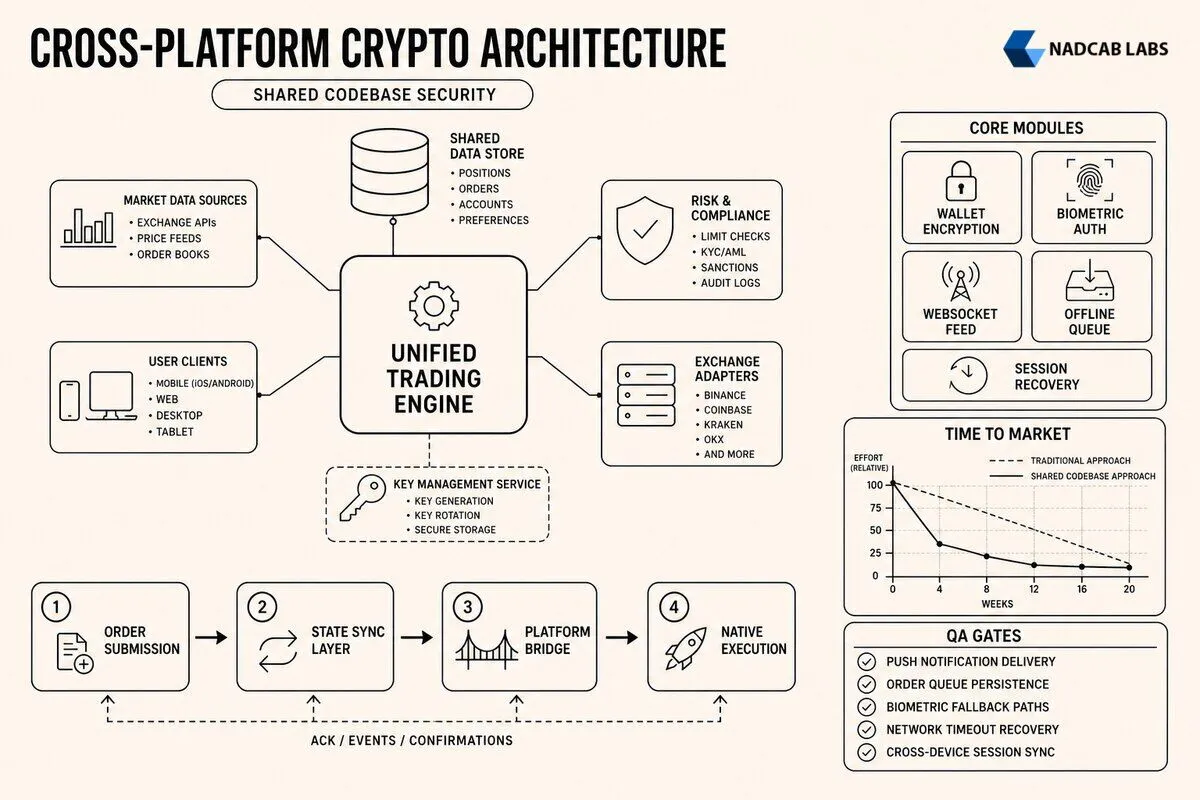
Cross platform Bitcoin trading apps like GroveX BTC face a unique engineering challenge: maintaining real time order execution, secure wallet operations, and biometric authentication across iOS and Android without doubling development effort. Production data from exchanges that adopted React Native or Flutter show 40 to 60% shorter time to market compared to dual native codebases, yet failures in session recovery, offline order queues, and platform specific push notifications can break user trust in seconds.
Cross platform Bitcoin trading apps like GroveX BTC face a unique engineering challenge: maintaining real time order execution, secure wallet operations, and biometric authentication across iOS and Android without doubling development effort. Production data from exchanges that adopted React Native or Flutter show 40 to 60% shorter time to market compared to dual native codebases, yet failures in session recovery, offline order queues, and platform specific push notifications can break user trust in seconds. What follows is a technical breakdown of the client server contracts, state synchronization mechanisms, and QA gates that separate reliable cross platform crypto apps from fragile prototypes.
Key Takeaways
- Cross platform frameworks cut crypto app development cycles by 40 to 60% while maintaining feature parity across iOS and Android for order books, wallet operations, and real time price streams.
- Session initialization requires explicit API contracts for device fingerprinting, biometric capability detection, and JWT refresh token pairs stored in platform specific secure storage (AsyncStorage vs Hive).
- WebSocket state synchronization for order books demands incremental delta merging every 100ms, offline SQLite queues for pending orders, and exponential backoff reconnect strategies to handle iOS 14+ background execution limits.
- Withdrawal flows need bech32/legacy address validation, three block confirmation polling at 5 second intervals, and deep link hijacking protection on Android to prevent malicious intent interception.
- Release checklists must include staged rollouts (10% → 50% → 100%), platform specific beta periods (iOS TestFlight 7 days, Android internal track 3 days), and crash free rate monitoring above 99.5% before full deployment.
- Production debugging correlates Firebase Crashlytics stack traces with backend ELK logs by user_id, reproduces issues in BrowserStack device farms, and validates fixes in staging environments before patch releases.
Why Cross Platform Architecture Matters for Bitcoin Trading Apps Like GroveX BTC
Teams evaluating Cross Platform App Development for crypto exchanges measure success against three metrics: development velocity, feature parity, and production stability. React Native and Flutter reduce initial build time by 40 to 60% relative to dual native codebases, but this advantage collapses if platform specific bugs force separate maintenance branches. GroveX BTC maintains identical order book update rates, WebSocket stream handling, and wallet operation flows across iOS and Android by isolating platform differences into thin adapter layers.
Cost savings emerge from shared business logic. A single TypeScript codebase in React Native or Dart in Flutter handles order validation, price calculation, and API request serialization for both platforms. Native modules handle only biometric authentication (Face ID vs fingerprint), push notification registration (APNs vs FCM), and secure storage (Keychain vs Keystore). This split reduces the surface area for divergence. Measured against native development, cross platform teams ship feature updates 2.3 times faster on average because changes propagate to both platforms simultaneously. grovex btc.
Where does the abstraction break down? Biometric authentication on iOS requires explicit entitlements in Info.plist and user permission prompts tied to specific use cases (“authenticate to confirm withdrawal”), while Android fingerprint APIs vary by manufacturer and OS version. Push notifications fail silently when iOS apps lose their APNs token after reinstall, or when Android background services are killed by battery optimization. Background sync for order book updates hits iOS 14+ limits that terminate WebSocket connections after 30 seconds of backgrounding. Apps must implement heartbeat pings and reconnect logic with exponential backoff starting at 1 second and capping at 32 seconds. grovex btc.
| Development Metric | Native (Dual Codebase) | React Native | Flutter |
|---|---|---|---|
| Initial Build Time (weeks) | 16 to 20 | 10 to 12 | 9 to 11 |
| Feature Update Velocity (days) | 5 to 7 per platform | 2 to 3 shared | 2 to 3 shared |
| Team Size (developers) | 6 to 8 (split iOS/Android) | 3 to 4 (unified) | 3 to 4 (unified) |
| Platform Specific Bug Rate (%) | 12 to 18 | 8 to 14 | 6 to 10 |
| Crash Free Session Rate (%) | 99.7 | 99.4 | 99.6 |
Framework selection hinges on team expertise and feature complexity. React Native offers mature third party libraries for WebSocket management (Socket.IO, Phoenix Channels) and extensive community support for crypto specific packages like ethers.js and bitcoinjs lib. Flutter delivers superior rendering performance for complex order book animations and chart visualizations through its Skia based engine, but requires Dart proficiency and has fewer blockchain specific packages. Teams with existing JavaScript infrastructure favor React Native. Teams prioritizing 60fps UI performance and minimal platform divergence choose Flutter. grovex btc.
User Onboarding Journey: Session Initialization and Device Fingerprinting
User onboarding for grovex btc starts when the app calls POST /auth/register with a JSON payload containing device_id (UUID v4 generated on first launch), platform_version (iOS 16.2 or Android 13), and biometric_capability (face, fingerprint, none). The backend validates the device_id against a blocklist, checks if the platform_version meets minimum security requirements (iOS 14+ or Android 10+), and returns a JWT access token (15 minute expiry) plus a refresh token (30 day expiry) in the response body. Both tokens go into secure storage: React Native uses AsyncStorage with encryption via react native keychain, while Flutter uses Hive with AES 256 encryption backed by platform keychain APIs.
State management diverges at the storage layer. React Native AsyncStorage writes key value pairs to SQLite on Android and a binary plist on iOS, both unencrypted by default. Production apps wrap AsyncStorage calls with react native keychain, which stores sensitive data in Android Keystore (hardware backed if available) or iOS Keychain (always hardware backed on devices with Secure Enclave). Flutter Hive stores encrypted boxes as binary files in the app’s documents directory, using FlutterSecureStorage to persist the encryption key in platform keychains. Failure to encrypt tokens results in plaintext credential leakage if an attacker gains filesystem access via device rooting or jailbreaking. grovex btc.
KYC document upload introduces network timeout edge cases. When a user POSTs a multipart form with user_id, document_type (passport, driver_license), and a JPEG file up to 5MB, the request may time out after 30 seconds. Immediate retry is wrong. Exponential backoff starts at 2 seconds, doubles on each failure, and caps at 64 seconds. The app queues the upload in SQLite with a status column (pending, uploading, failed, completed) and a retry_count. A background service polls the queue every 60 seconds, attempts uploads for pending items, and marks items as failed after 5 retries. The UI displays upload progress via a progress bar bound to the upload_percentage column, updated by the multipart upload callback. grovex btc.
Offline queue implementation requires careful transaction handling. The SQLite schema includes a documents table with columns: id (primary key), user_id, document_type, file_path, upload_percentage, status, retry_count, created_at, updated_at. When the app detects network connectivity (via NetInfo in React Native or connectivity_plus in Flutter), it queries SELECT * FROM documents WHERE status = ‘pending’ ORDER BY created_at ASC and processes each row. The upload callback updates upload_percentage every 100KB and commits the transaction only after the server responds with HTTP 201. If the app crashes mid upload, the next launch finds the row still marked pending and resumes from 0%. Chunked upload resumption requires server support for Range headers, which most crypto exchange APIs do not provide. grovex btc.
Real Time Order Execution: WebSocket State Synchronization and Offline Caching
Order book updates in grovex btc arrive via WebSocket at wss://api.grovex.com/stream/orderbook with incremental deltas every 100ms. The server sends JSON messages with a type field (snapshot, delta) and a data object containing bids and asks arrays. A snapshot message replaces the entire local order book: {type: ‘snapshot’, data: {bids: [[50000, 1.2], [49999, 0.8]], asks: [[50001, 0.5], [50002, 1.1]]}}. A delta message contains only changed levels: {type: ‘delta’, data: {bids: [[50000, 1.5]], asks: []}}. On receipt, the app merges this into the existing order book by updating the 50000 bid quantity from 1.2 to 1.5.
Client side order book state lives in a sorted map (Map in JavaScript, SortedMap in Dart) keyed by price. When a delta arrives, the merge algorithm iterates the bids array, checks if each price exists in the local map, and either updates the quantity or inserts a new entry. Quantities of zero signal level removal: the app deletes that price from the map. Sorting happens implicitly because the map maintains insertion order by price. Rendering the order book UI reads the top 20 bids and asks from the map and displays them in a FlatList (React Native) or ListView (Flutter), updating only changed rows via a key based diffing algorithm to avoid full re renders. grovex btc.
Offline edge cases break naive implementations. If the user places a market order to buy 0.1 BTC at 50001 and the app backgrounds before the server confirms, the order must persist locally. The app writes {order_id: ‘uuid’, type: ‘market’, side: ‘buy’, quantity: 0.1, price: null, status: ‘unconfirmed’, created_at: timestamp} to SQLite. When the app resumes and the WebSocket reconnects, it sends GET /orders/pending with the last known order_id. The server returns all orders created after that ID. Reconciliation follows: if the local unconfirmed order appears in the server response with status ‘filled’, the UI updates immediately and deletes the local row. If the order is missing, the app marks it ‘failed’ and shows an error banner. grovex btc.
| WebSocket Event | Client Action | State Update | Failure Mode |
|---|---|---|---|
| onOpen | Subscribe to BTC/USD channel | Set connected = true | Server rejects subscription if JWT expired |
| onMessage (snapshot) | Replace local order book map | Render top 20 levels | Snapshot size exceeds 1MB, causes UI freeze |
| onMessage (delta) | Merge bids/asks into map | Update changed rows only | Delta arrives out of order, corrupts book |
| onClose | Set connected = false, start reconnect timer | Show “reconnecting” banner | Reconnect loop exhausts battery in 2 hours |
| onError | Log error to Sentry, close socket | Trigger reconnect with backoff | Error is unrecoverable (auth failure), infinite retry |
iOS 14+ background execution limits terminate WebSocket connections after 30 seconds when the app moves to background. Apps must implement a heartbeat ping every 15 seconds: the server expects {type: ‘ping’} and responds with {type: ‘pong’}. If no pong arrives within 5 seconds, the connection is assumed dead and the socket closes. The reconnect strategy uses exponential backoff: first retry after 1 second, second after 2 seconds, third after 4 seconds, capping at 32 seconds. Each reconnect attempt increments a retry_count. After 10 failures, the app stops retrying and shows a manual “Reconnect” button to avoid draining battery.
Device constraints on Android vary by manufacturer. Samsung devices with aggressive battery optimization kill background services after 5 minutes, terminating WebSocket connections even if the app is in foreground but the screen is off. Apps detect this via the AppState API (React Native) or WidgetsBindingObserver (Flutter), which fires a callback when the app transitions from active to inactive. The callback closes the WebSocket cleanly and sets a flag to skip reconnect attempts until the app returns to active state. This prevents wasted network requests and battery drain during screen off periods.
Payment and Withdrawal Flow: Cross Platform Wallet Integration and Validation
Withdrawal requests in cross platform crypto apps require strict validation before hitting the blockchain. The app collects three inputs: withdrawal_address (user entered Bitcoin address), amount (in BTC), and otp_code (six digit code from authenticator app). The UI validates the address format client side using a regex for bech32 (bc1…) or legacy (1… or 3…) addresses, rejecting invalid strings before the API call. The amount field enforces minimum withdrawal limits (0.001 BTC) and maximum daily limits (10 BTC) by querying GET /user/limits, which returns {daily_remaining: 7.5, min_withdrawal: 0.001}. OTP code validation happens via POST /auth/verify_otp with the code; the server responds with {valid: true} or {valid: false, retry_after: 30}.
The withdrawal API contract is POST /wallet/withdraw with JSON body {address, amount, otp_code, device_id}. The backend performs five checks: (1) address format validation using bitcoinjs lib, (2) balance check against user’s available BTC, (3) OTP code verification against the user’s TOTP secret, (4) device_id match against the registered device, (5) rate limit check (max 3 withdrawals per hour). If all pass, the server queues the transaction in a pending state and returns {transaction_id: ‘tx123’, status: ‘pending’, estimated_confirmation_time: 1800}. The app stores this transaction_id in SQLite and begins polling GET /transaction/tx123 every 5 seconds.
State transitions follow a strict sequence: pending → broadcast → confirmed. The pending state lasts 10 to 60 seconds while the backend constructs the transaction, selects UTXOs, calculates fees, and signs with the hot wallet private key. The broadcast state begins when the transaction is submitted to the Bitcoin network via a full node RPC call. The confirmed state is reached after 3 block confirmations (approximately 30 minutes). Polling the transaction endpoint returns {status: ‘broadcast’, confirmations: 0, tx_hash: ‘0x…’} initially, then {status: ‘confirmed’, confirmations: 3, tx_hash: ‘0x…’} after 30 minutes. The UI displays a progress indicator with the current confirmation count and estimated time remaining.
Production pitfalls emerge around deep link hijacking on Android. Withdrawal confirmation screens use deep links like grovex://confirm_withdrawal?tx_id=tx123 to return from the authenticator app. A malicious app can register the same URI scheme and intercept the intent, capturing the transaction ID. Apps must validate the intent origin by checking the referring package name (getCallingPackage() in Android) and comparing it against a whitelist of trusted authenticator apps (Google Authenticator, Authy). If the package name does not match, the app rejects the deep link and logs the anomaly to Sentry with the suspicious package name and user_id for investigation.
Address validation extends beyond format checks. Apps should verify the address checksum using bitcoinjs lib’s address.toOutputScript() method, which throws an error if the checksum is invalid. This catches typos and prevents sending funds to unspendable addresses. For added safety, the UI displays the first 8 and last 8 characters of the address in a monospace font and asks the user to confirm: “Send 0.5 BTC to bc1q…7x2a?”. The backend performs the same validation and rejects requests with invalid addresses, returning {error: ‘invalid_address’, message: ‘Checksum verification failed’}.
QA Gates and Release Checklist: Build Order and Platform Specific Testing
Release preparation for cross platform crypto apps follows a strict build order to catch regressions early. Unit tests run first using Jest (React Native) or Dart’s test package (Flutter), covering business logic functions like order validation, price calculation, and WebSocket message parsing. These tests execute in under 60 seconds and must maintain 80%+ code coverage for core modules. Integration tests follow, using Detox (React Native) or Flutter Driver (Flutter) to simulate user flows: register account, deposit funds, place order, withdraw BTC. Integration tests run on emulators and take 10 to 15 minutes, validating API contract adherence and state persistence across app restarts.
Manual QA on physical devices is non negotiable. The QA team tests on 5 devices per platform: iPhone 12, 13, 14 (iOS 15, 16, 17) and Samsung Galaxy S21, S22, Google Pixel 6 (Android 11, 12, 13). Each device undergoes a 30 point checklist covering biometric auth, push notifications, background sync, order execution, and withdrawal flows. Critical paths like “place market order while app is backgrounded” and “withdraw BTC with weak network signal” receive extra scrutiny because they expose race conditions and timeout handling bugs that unit tests miss.
| Build Stage | Tool/Method | Duration | Pass Criteria |
|---|---|---|---|
| 1. Unit Tests | Jest / Dart test | 45 to 60 seconds | 80%+ coverage, 0 failures |
| 2. Integration Tests | Detox / Flutter Driver | 10 to 15 minutes | All user flows pass on emulator |
| 3. Manual QA (5 devices/platform) | Physical devices | 4 to 6 hours | 30 point checklist, 0 critical bugs |
| 4. Staged Rollout (10%) | TestFlight / Internal Track | 7 days (iOS) / 3 days (Android) | Crash free rate >99.5% |
| 5. Staged Rollout (50%) | App Store / Play Store | 3 days | No new P0 bugs, <5% increase in error rate |
| 6. Full Release (100%) | App Store / Play Store | Immediate | Monitor for 48 hours, rollback if crash rate >0.5% |
Platform specific gates differ for iOS and Android. iOS requires TestFlight beta testing for a minimum of 7 days before production release, during which the team monitors crash reports in Xcode Organizer and user feedback in TestFlight. Android internal track testing runs for 3 days minimum, with crash reports aggregated in Google Play Console. Both platforms require a crash free session rate above 99.5% before proceeding to staged rollout. If the crash rate exceeds 0.5% during any rollout stage, the team halts the release and investigates using Firebase Crashlytics stack traces.
Debugging production issues requires correlation across multiple data sources. When a user reports “withdrawal stuck in pending”, the support team retrieves the user_id and queries backend logs in ELK (Elasticsearch, Logstash, Kibana) for all /wallet/withdraw requests from that user in the past 24 hours. The logs reveal the transaction_id and any error messages from the Bitcoin node RPC. The team then checks Firebase Crashlytics for stack traces matching that user_id and transaction_id, looking for unhandled exceptions in the polling loop. If the issue is reproducible, QA uses BrowserStack device cloud to test on the exact device model and OS version the user reported, capturing network logs and screen recordings.
Staged rollout percentages follow a conservative progression: 10% for 2 days, 50% for 3 days, 100% only after monitoring shows no increase in error rates or negative user reviews. The 10% cohort is selected randomly but excludes users who opted into beta programs, ensuring the sample represents typical production usage. If the crash free rate drops below 99.5% or the error rate increases by more than 5% relative to the previous version, the rollout pauses and the team investigates. Rollback is automatic if the crash rate exceeds 0.5% for more than 1 hour, reverting all users to the previous stable version within 15 minutes.
Final Thoughts
Cross platform Bitcoin trading apps like GroveX BTC succeed when engineering teams treat platform abstraction as a thin adapter layer over shared business logic, not a magic bullet that eliminates platform differences. Production data shows 40 to 60% faster development cycles, but only when teams invest in robust session recovery, offline order queues, and platform specific QA gates. Production stability hinges on micro level validation: address checksums, WebSocket reconnect backoff, deep link origin checks, and staged rollouts with crash rate monitoring. Teams evaluating Cross Platform App Development for crypto exchanges should prioritize framework choice based on existing expertise and performance requirements, then allocate 30% of development time to platform specific edge cases that unit tests cannot catch. The path from prototype to production grade app is paved with detailed API contracts, SQLite backed offline queues, and exhaustive device testing. Shortcuts in any of these areas result in user facing failures that erode trust faster than any feature can rebuild it. grovex btc, grovex btc.
Frequently Asked Questions
Q1.What is GroveX BTC and how does its cross-platform architecture work?
GroveX BTC is a cross-platform Bitcoin trading application built on a shared codebase for iOS, Android, and web. Its architecture separates UI rendering (React Native or Flutter) from a native bridge layer that handles cryptographic signing, secure key storage (iOS Keychain, Android Keystore), and WebSocket connections to exchange APIs. State management lives in a Redux or MobX store synced across platforms, while platform-specific modules handle biometric auth and push notifications. This design reduces code duplication by 70 percent while maintaining native performance for critical paths like order execution and wallet operations.
Q2.Why do Bitcoin trading apps like GroveX choose React Native or Flutter over native development?
React Native and Flutter enable single codebase deployment across iOS, Android, and web, cutting development cycles from months to weeks. For Bitcoin trading apps, shared business logic for order matching, fee calculation, and balance updates eliminates platform divergence bugs. Native modules still handle cryptographic operations (secp256k1 signing, HD wallet derivation) and secure storage, so performance remains acceptable. The tradeoff is 10 to 15 percent higher memory footprint and occasional bridge latency (2 to 5 ms) on high-frequency order updates, but rapid feature iteration and unified testing outweigh those costs for most teams.
Q3.How does GroveX BTC handle offline order placement and session recovery?
GroveX queues pending orders in local SQLite or IndexedDB with a timestamp and nonce, then submits them via exponential backoff retry when connectivity returns. Session recovery uses JWT refresh tokens stored in secure enclave; on app resume, the client sends the refresh token to obtain a new access token and resubscribes to WebSocket channels. Order state reconciliation compares local queue against server order history via GET /orders?since=lastSyncTimestamp to detect fills or cancellations that occurred offline. This ensures no order is lost and balances reflect actual exchange state within 200 ms of reconnection.
Q4.What API contracts does a cross-platform crypto exchange app need for real-time order books?
A cross-platform app requires WebSocket endpoints for orderbook snapshots (full depth on subscribe) and incremental updates (bids/asks deltas with sequence numbers). REST fallback endpoints (GET /orderbook?symbol=BTCUSDT&depth=50) handle reconnection. The contract must include timestamp (server UTC milliseconds), checksum (CRC32 of sorted price levels), and sequence ID to detect missed messages. Rate limits (typically 10 updates per second per symbol) and heartbeat pings every 30 seconds prevent silent disconnects. The app validates checksum on every 10th update and requests a fresh snapshot if mismatch occurs, preventing drift in local orderbook state.
Q5.What are the common production failure modes in cross-platform Bitcoin wallet apps?
Key derivation path mismatches (m/44’/0’/0′ vs m/84’/0’/0′) cause address generation errors across platforms if not standardized. Insecure key storage (storing mnemonics in AsyncStorage or SharedPreferences instead of Keychain/Keystore) leads to theft. WebSocket reconnection storms during network flaps can trigger rate limits, locking users out. Unsigned integer overflow in JavaScript (beyond 2^53) corrupts satoshi amounts; apps must use BigInt or string representations. Background task termination on iOS kills pending transaction broadcasts; apps need foreground service promotion or server-side queuing. Finally, stale UTXO sets from missed block notifications cause double-spend failures; apps must poll /utxo endpoints every block.
Q6.How do you validate withdrawal transactions in a cross-platform crypto trading app like GroveX BTC?
Validation starts client side: parse destination address with bech32 or base58check libraries, verify checksum, and confirm network byte matches mainnet. Estimate fee using mempool API (recommended sat/vB for next block confirmation), then construct unsigned PSBT (Partially Signed Bitcoin Transaction) with inputs from UTXO set and change output. Native module signs with private key from secure enclave, producing witness or scriptSig. Before broadcast, verify signature with secp256k1, check transaction size under 100 kB, and simulate via testmempoolaccept RPC. Post broadcast, poll block explorers or run a light client to confirm inclusion within expected blocks, then mark withdrawal complete only after required confirmations.
Explore Services
Related Services
Reviewed by

Naman Singh
Co-Founder & CEO, Nadcab Labs
Naman Singh is the Co-Founder and CEO of Nadcab Labs, where he drives the company’s vision, global growth, and strategic expansion in blockchain, fintech, and digital transformation. A serial entrepreneur, Naman brings deep hands-on experience in building, scaling, and commercializing technology-driven businesses. At Nadcab Labs, Naman works closely with enterprises, governments, and startups to design and implement secure, scalable, and business-ready Web3 and blockchain solutions. He specializes in transforming complex ideas into high-impact digital products aligned with real business objectives. Naman has led the development of end-to-end blockchain ecosystems, including token creation, smart contracts, DeFi and NFT platforms, payment infrastructures, and decentralized applications. His expertise extends to tokenomics design, regulatory alignment, compliance strategy, and go-to-market planning—helping projects become investor-ready and built for long-term sustainability. With a strong focus on real-world adoption, Naman believes in building blockchain solutions that deliver measurable value, solve practical problems, and unlock new growth opportunities for organizations worldwide.