Ai Overview
The pseudonymous nature of blockchain addresses creates an immediate challenge. This arms-race dynamic is reshaping the compliance and investigative technology landscape at a pace that demands continuous investment in platforms. DOJ to recover a substantial portion of the $4. Automated transaction monitoring dramatically reduces the cost per alert compared to manual processes.
Key Takeaways
- Raw blockchain transparency reveals transaction records, but AI Application layers add the investigative depth needed to uncover hidden criminal infrastructure.
- AI Platforms can process millions of blockchain transactions in real time, identifying suspicious clusters and behavioral anomalies far beyond the capacity of human analysts.
- Network discovery in blockchain does not merely map transactions; it also identifies the underlying infrastructure, including wallets, exchanges, mixers, and smart contracts, used by threat actors.
- Behavioral pattern recognition powered by machine learning enables the simultaneous detection of typologies such as layering, smurfing, and chain hopping across multiple blockchains.
- Combining on-chain data with off-chain intelligence, such as social media signals, exchange KYC data, and dark web monitoring, yields a far more complete threat picture.
- Responsible AI in blockchain investigations demands explainable outputs, privacy by design, and transparent model logic that human analysts can interrogate and challenge.
- AI augments analyst judgment rather than replacing it; the final investigative decision always rests with a trained human who understands legal and contextual nuance.
- AI is now indispensable for combating AI-enabled crime, as threat actors increasingly use generative AI tools to create synthetic identities and automate money-laundering flows.
- Enterprise adoption of AI Platforms for blockchain compliance is accelerating, with financial institutions, regulators, and law enforcement all converging on shared intelligence frameworks.
- The next frontier of AI in blockchain intelligence involves multi-chain forensics, zero-knowledge proof analysis, and predictive threat modeling before illicit activity even completes.
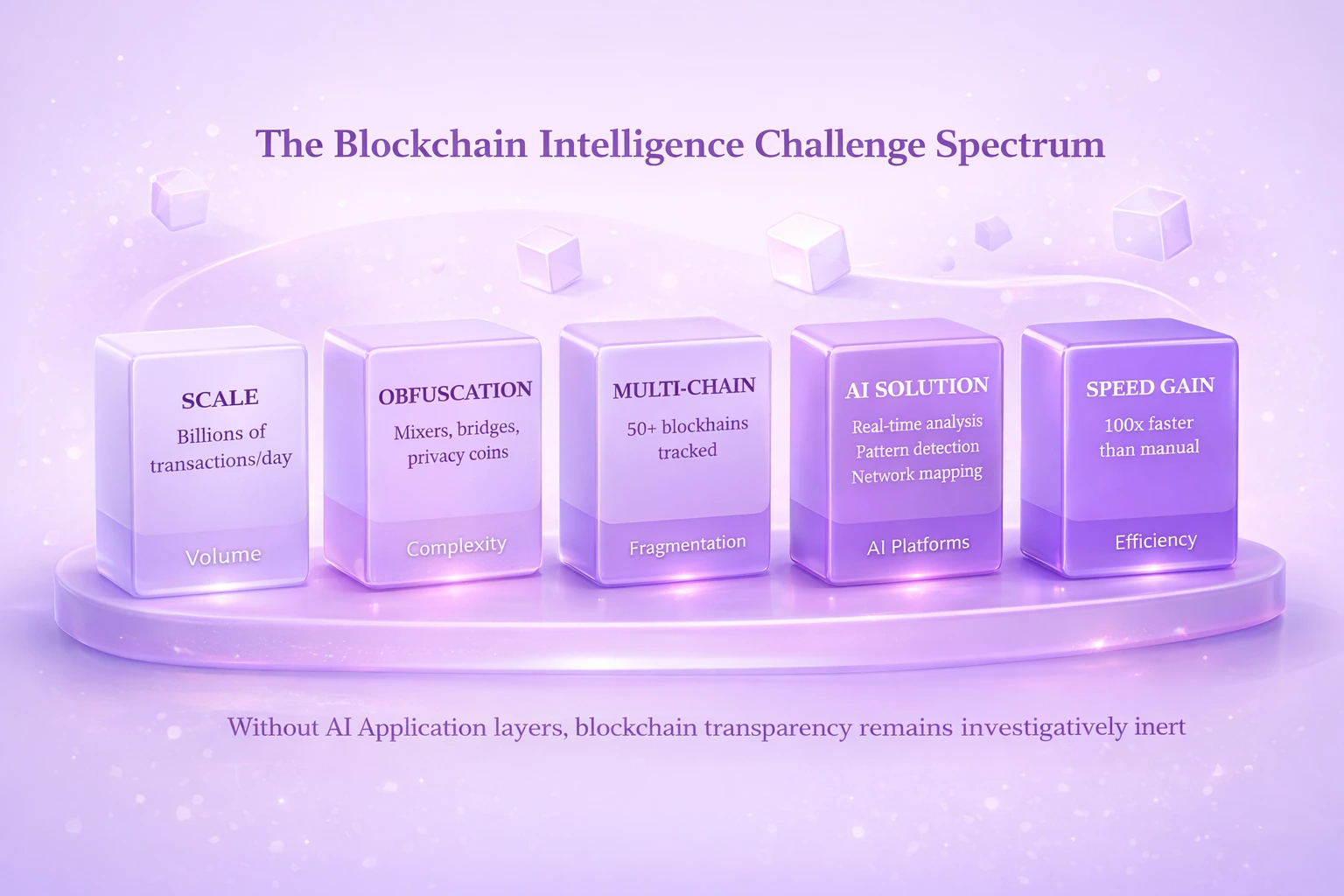
Blockchain was originally celebrated as a radical act of transparency. Every transaction is publicly recorded, immutably stamped, and openly accessible to anyone with an internet connection. Yet paradoxically, the sheer volume of that transparency has become one of the greatest investigative challenges of our era. When billions of transactions flow across dozens of chains every single day, transparency without intelligence is merely noise. This is precisely the gap that modern AI applications and AI Platforms are engineered to close.
From identifying ransomware payment flows to dismantling darknet market infrastructure, AI-powered blockchain intelligence tools are reshaping how financial investigators, compliance officers, and law enforcement agencies operate. The stakes could not be higher. Illicit cryptocurrency transactions exceeded $24 billion globally in 2023 alone, and threat actors are growing more sophisticated by the quarter. Meeting that challenge requires not just more analysts, but smarter tools built on robust AI foundations.
This blog explores how AI Application ecosystems are transforming blockchain intelligence across every dimension: from raw data ingestion and suspicious activity detection to network mapping, behavioral typology recognition, and the responsible governance frameworks that make high-stakes investigations defensible in court.
Why Raw Blockchain Transparency Is Not Enough
The pseudonymous nature of blockchain addresses creates an immediate challenge. A wallet address like 0x3a9f… tells an investigator nothing about its owner, intent, or relationship to other wallets without additional context. Compounding this, sophisticated bad actors deliberately exploit the design of blockchain systems to obscure their trails: they use mixing services, chain bridges, privacy coins, and layered smart contract interactions specifically to defeat naive transaction tracing.
Human analysts examining raw blockchain explorers face a crushing scale problem. Even a single mid-sized money laundering operation may involve thousands of wallet addresses, hundreds of transactions, and activity spread across five or more separate blockchains. Manual analysis at that scale is not merely slow; it is practically impossible without machine assistance. The result is that without sophisticated AI Application tooling, the vast majority of illicit blockchain activity goes undetected.
How AI Improves Suspicious Activity Detection
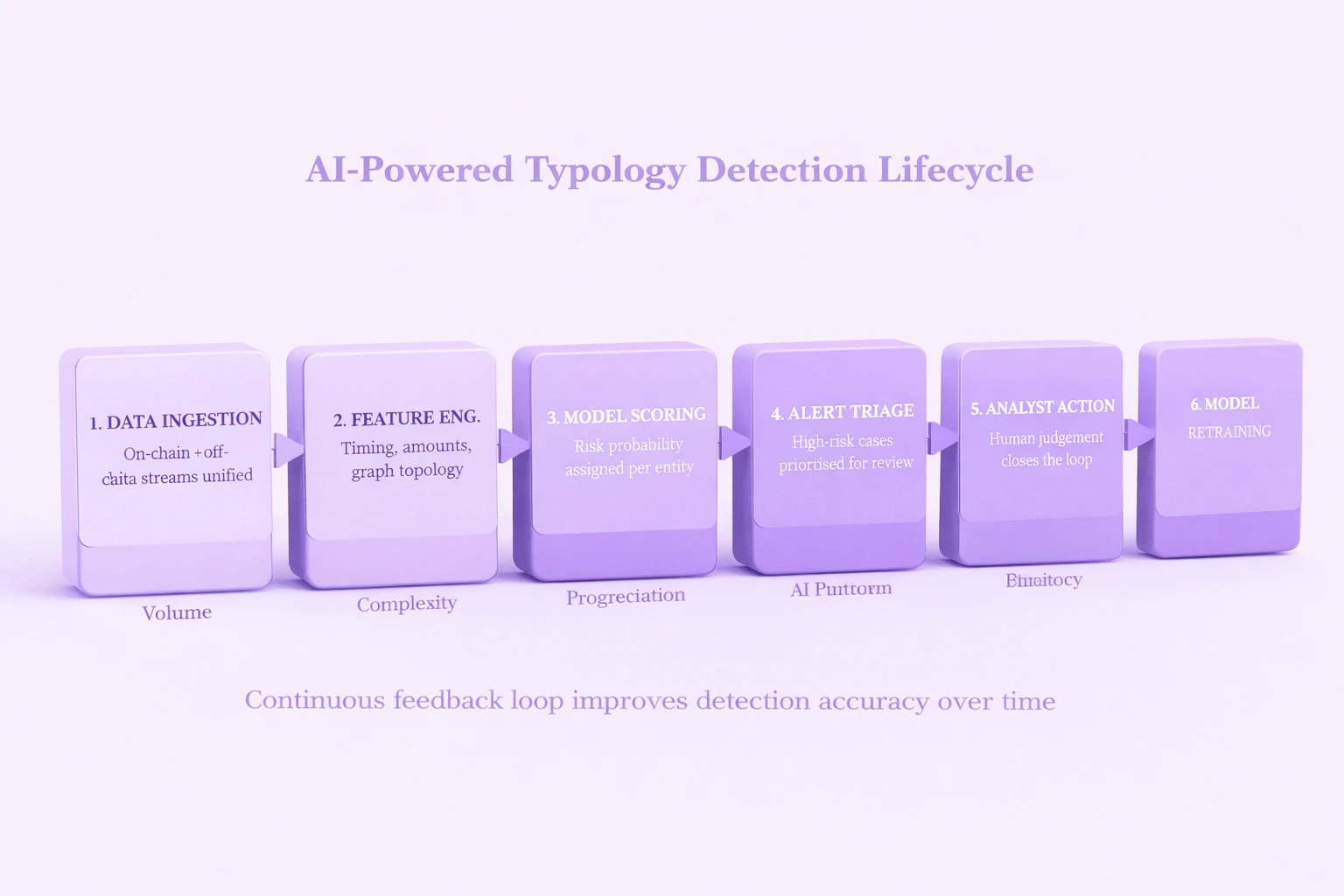
The most immediate value of AI Platforms in blockchain intelligence is their capacity to flag suspicious activity at a speed and accuracy that humans cannot match. Machine learning models trained on historical illicit transaction data can recognize familiar attack signatures even when they appear in novel configurations. These models operate continuously, scanning mempool activity and confirmed transactions around the clock without fatigue or cognitive bias.
Modern AI Application tools use a combination of supervised learning (trained on labeled datasets of known illicit activity), unsupervised clustering (identifying unusual behavioral groups without predefined labels), and graph neural networks (analyzing the relational structure of transaction flows). Together, these techniques allow the system to assign risk scores to wallets, flag unusual transaction sequences, and surface alerts that prioritize the highest-risk activity for human review.
Network Discovery: Mapping Infrastructure, Not Just Transactions
The most powerful insight AI solutions tools bring to blockchain intelligence is the shift from transaction-level analysis to infrastructure-level understanding. A transaction shows you that wallet A sent funds to wallet B. Network discovery shows you that wallets A, B, C, and D are all controlled by the same entity, operating from the same cluster of IP endpoints, and connected to a known darknet marketplace. That is an entirely different order of investigative value.
AI Platforms achieve this through entity clustering algorithms that analyze address co-spending patterns, timing correlations, common input ownership heuristics, and behavioral fingerprints. When two addresses consistently transact within seconds of each other, or when they always appear together as transaction inputs, the probability that they are controlled by the same entity is extremely high. At scale, these signals build remarkably detailed maps of criminal infrastructure.
| Discovery Technique | What It Maps | AI Method Used | Investigative Value |
|---|---|---|---|
| Entity Clustering | Wallets controlled by same owner | Common-input ownership heuristic | High |
| Mixer Detection | Obfuscation service usage | Pattern classification models | Very High |
| Cross-Chain Tracing | Funds moving across blockchains | Multi-graph neural networks | Critical |
| Smart Contract Mapping | Malicious contract interactions | Bytecode analysis and NLP | High |
| Infrastructure Attribution | IP addresses, exchanges, services | Off-chain data fusion | Very High |
Behavioral Pattern Recognition and Typology Detection
Financial crime typologies are not static. Criminals innovate constantly, and the behavioral signatures of money laundering, sanctions evasion, and terrorist financing evolve alongside regulatory countermeasures. This is where the adaptive capability of AI Platforms becomes critical. Rather than relying on rigid rule sets that bad actors can trivially engineer around, modern AI Application tools learn the underlying behavioral grammar of illicit activity and recognize it even when it appears in novel forms.
Common Illicit Typologies Detected by AI Application Systems
Combining On-Chain and Off-Chain Intelligence
One of the most powerful capabilities of mature AI Application ecosystems is their ability to fuse on-chain transaction data with off-chain intelligence sources. The blockchain tells you what happened. Off-chain data tells you who did it, where they are, and what they were saying before and after.
Off-chain intelligence sources include exchange KYC and AML records, IP address and geolocation data from node connections, dark web forum monitoring and threat intelligence feeds, social media activity linked to wallet promotion, court records and sanctions lists, and leaked credential databases. When an AI Platform correlates a suspicious wallet cluster with a set of dark web forum usernames that share overlapping linguistic patterns and a known exchange account, the investigative value is transformational.
| Intelligence Type | Source Examples | AI Processing Method | Key Insight Unlocked |
|---|---|---|---|
| On-Chain | Transaction ledgers, smart contracts, token flows | Graph analytics, ML classification | Fund movement, entity clusters |
| Exchange Records | KYC data, deposit/withdrawal logs | Identity resolution, record linking | Real-world identity attribution |
| Dark Web Monitoring | Forum posts, marketplace listings | NLP, semantic analysis | Threat intent, actor profiles |
| Social Intelligence | Twitter/X, Telegram, Discord | Sentiment analysis, account linking | Wallet promotion, scam signals |
| Sanctions and Court Records | OFAC lists, FinCEN advisories, court filings | Entity matching, watchlist screening | Regulatory compliance alerts |
Responsible AI: What It Means in High-Stakes Investigations
In law enforcement and regulatory compliance contexts, the standard of responsible AI goes far beyond general data ethics guidelines. When an AI Application’s output could lead to an asset freeze, a criminal prosecution, or a sanctions designation, every element of that output must be defensible. This means explainability is not a nice-to-have; it is a legal and operational requirement.
Three Pillars of Responsible AI in Blockchain Intelligence
Explainability
Every risk score, cluster assignment, and alert must be accompanied by a human-readable explanation of the signals that drove it. Investigators must be able to interrogate the AI’s reasoning.
Privacy by Design
Data minimization, purpose limitation, and strict access controls must be embedded in the architecture of AI Platforms, not added as a compliance afterthought following deployment.
Human-in-the-Loop
AI surfaces evidence and assigns probabilities. Final investigative judgments, charging decisions, and enforcement actions must always involve trained human analysts who understand legal context.
“An AI Platform that cannot explain why it flagged an address is not ready for evidentiary use. Explainability is the bridge between machine intelligence and legal accountability.”
Principle of Responsible Blockchain AI, Investigative Standards Framework
AI Augments, Not Replaces, Analyst Judgment
The narrative that AI will replace human analysts in blockchain investigations fundamentally misunderstands both the technology and the investigative process. AI Application tools are extraordinarily powerful at pattern detection, data fusion, and alert generation at scale. They are not, however, equipped to understand geopolitical context, evaluate witness credibility, interpret legislative ambiguity, or make the kind of holistic moral and legal judgments that distinguish a skilled investigator from a sophisticated algorithm.
| Capability | AI Platform | Human Analyst | Combined |
|---|---|---|---|
| Processing millions of transactions | Excellent | Poor | Optimal |
| Legal and contextual judgment | Poor | Excellent | Optimal |
| 24/7 continuous monitoring | Excellent | Not feasible | Optimal |
| Witness and source evaluation | None | Excellent | Optimal |
| Novel typology discovery | Good | Good | Optimal |
AI Is Critical for Combatting AI-Enabled Crime
The emergence of generative AI has fundamentally altered the threat landscape. Criminal organizations now routinely use AI tools to generate synthetic identities for account creation, automate the orchestration of complex laundering flows, produce convincing deepfake credentials for bypassing KYC, and even draft sophisticated phishing communications targeting exchange employees. Manual compliance processes and static rule-based systems are categorically incapable of keeping pace with this level of adversarial automation.
The only effective response to AI-enabled crime is AI-powered defense. Modern AI Platforms in the blockchain intelligence space are increasingly incorporating adversarial robustness techniques, meaning they are specifically trained to recognize when other AI systems are evading them. This arms-race dynamic is reshaping the compliance and investigative technology landscape at a pace that demands continuous investment in platforms.
AI vs AI: The New Threat Landscape in Blockchain Crime
THREAT: AI-Enabled Crime Tactics
- Synthetic identity generation at scale
- AI-orchestrated layering sequences
- Deepfake KYC document forgery
- Automated evasion of rule-based systems
DEFENSE: AI Platform Countermeasures
- Synthetic identity behavioral anomaly scoring
- Adaptive pattern models with live retraining
- Multi-modal document authenticity verification
- Adversarially robust evasion-resistant models
Privacy Concerns and Ethical Considerations
The same AI Application capabilities that make blockchain intelligence powerful also raise serious questions about surveillance overreach, false positives, and the disproportionate impact of algorithmic risk scoring on legitimate users. An AI Platform that flags a humanitarian organization’s donation wallet as suspicious because it shares transaction patterns with a known geography is not merely inaccurate; it is potentially harmful.
Ethical AI Application in this space requires strict adherence to the principle of data minimization, ensuring that only the data necessary for a specific investigative purpose is collected and retained. It also demands regular algorithmic audits to detect and correct model bias, transparent appeal mechanisms for entities that receive false positive designations, and governance frameworks that prevent scope creep beyond authorized investigative mandates.
The balance between public safety and individual privacy is not a technical problem with a technical solution. It is a governance challenge that requires ongoing dialogue between technologists, regulators, civil society, and the communities most affected by blockchain surveillance.
Real-World Examples of AI and Blockchain Integration
The practical impact of AI Platforms on blockchain intelligence is most clearly visible through landmark enforcement actions and compliance breakthroughs that would have been impossible without machine assistance.
Colonial Pipeline Ransomware Recovery
AI-powered blockchain tracing enabled the U.S. DOJ to recover a substantial portion of the $4.4 million ransom paid to DarkSide, tracing funds through multiple wallet hops within days rather than months.
Bitfinex Hack Fund Tracing
Graph analytics and behavioral pattern AI allowed investigators to trace 119,754 Bitcoin stolen in 2016 across thousands of wallets over five years, leading to a $4.5 billion asset seizure in 2022.
Hydra Darknet Market Takedown
Network discovery AI mapped the full cryptocurrency payment infrastructure of Hydra, the world’s largest darknet market, enabling coordinated international enforcement action in 2022.
Future Trends of AI in Blockchain Technology
The convergence of AI and blockchain intelligence is moving quickly, and the capabilities of tomorrow’s AI Platforms will be qualitatively different from those available today. Several emerging trends will define the next generation of tools.
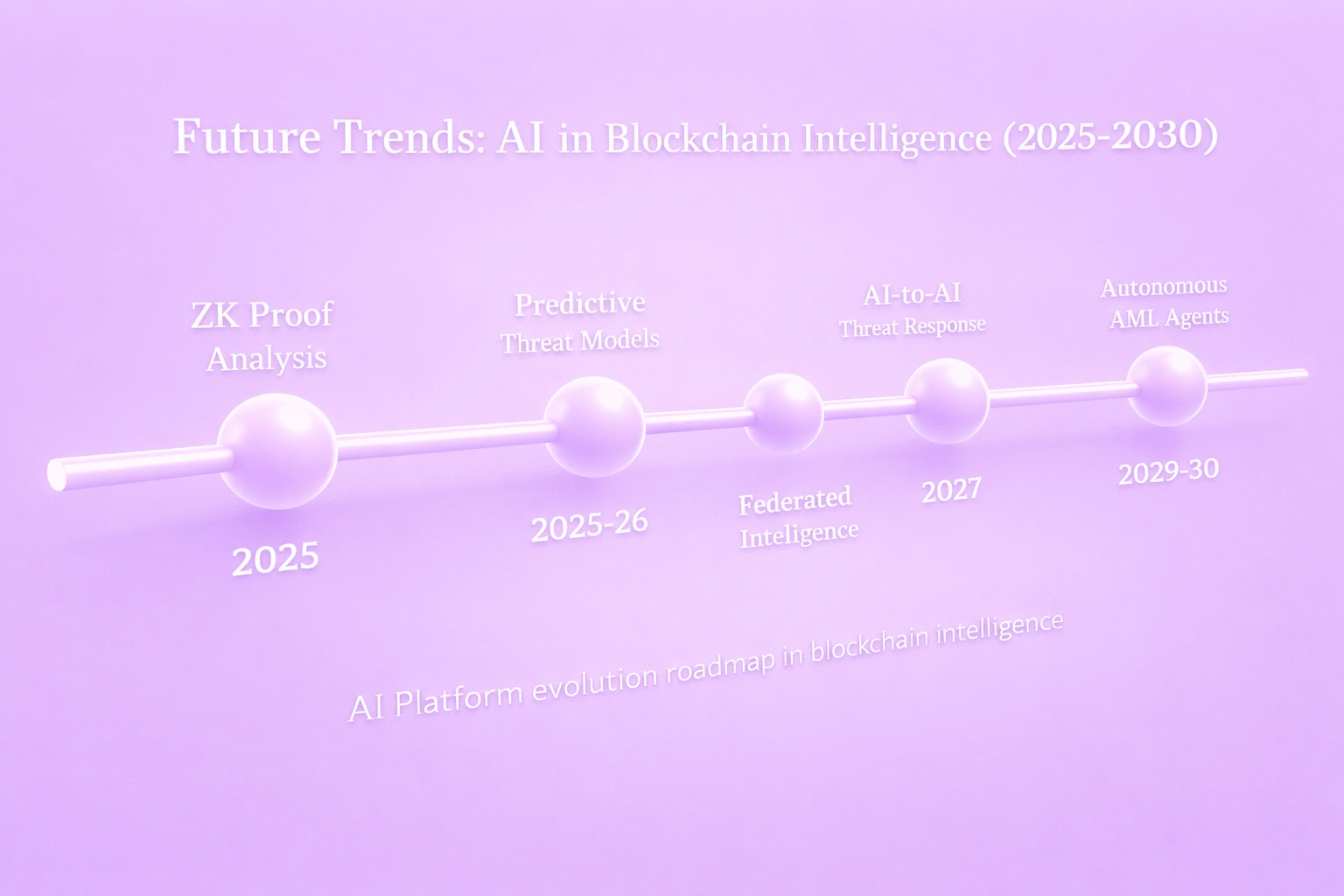
| Trend | Description | Expected Impact | Timeline |
|---|---|---|---|
| Zero-Knowledge Proof Analysis | AI techniques for analyzing ZK-based transactions without revealing underlying data | Breaks privacy coin obfuscation | 2025-2026 |
| Federated Intelligence Networks | Exchanges and regulators sharing model insights without sharing raw data | Global threat intelligence at scale | 2026-2027 |
| Predictive Threat Modeling | Forecasting illicit activity before transactions are complete based on early behavioral signals | Proactive rather than reactive enforcement | 2026-2028 |
| Autonomous AML Agents | AI agents that autonomously investigate, report, and escalate suspicious activity | Transforms compliance staffing models | 2028-2030 |
Impact on Businesses and Enterprises
For enterprises operating in the digital asset space, the adoption of AI Platforms for blockchain intelligence is rapidly transitioning from a competitive differentiator to a baseline regulatory expectation. Financial regulators in the EU, US, UK, and Asia-Pacific are increasingly explicit in their guidance that firms must deploy technology-assisted monitoring proportionate to the volume and complexity of their blockchain transaction activity.
Beyond compliance, enterprises deploying AI Application tools for blockchain intelligence gain tangible operational advantages. Automated transaction monitoring dramatically reduces the cost per alert compared to manual processes. Risk-scored customer due diligence enables more precise onboarding decisions. Real-time sanctions screening prevents costly violations. And detailed audit trails produced by AI systems make regulatory examinations faster and less disruptive.
Enterprise ROI of AI Application in Blockchain Compliance
Get Expert Guidance
Ready to Build AI-Powered Blockchain Intelligence Solutions?
Partner with experts who understand both the technical and regulatory dimensions of AI Application in blockchain compliance and forensics.
The Future of AI-Driven Blockchain Intelligence
The trajectory is clear. As blockchain ecosystems grow more complex, as criminal actors grow more sophisticated, and as regulatory expectations rise, the role of AI Application and AI Platforms in blockchain intelligence will only deepen. The tools available today represent a remarkable advance over what was possible even three years ago, but they are a foundation, not a ceiling. Multi-chain forensics, predictive threat modeling, federated intelligence networks, and eventually autonomous compliance agents will progressively redefine what is investigatively possible.
What will not change is the essential importance of responsible governance. Rigorous privacy protections, explainable outputs, meaningful human oversight, and institutional accountability must always match the power of AI-driven blockchain intelligence. These are not constraints on the technology; they are the conditions that make it trustworthy and legally defensible over the long term.
Organizations that invest in both the technical capability and the governance architecture of AI-powered blockchain intelligence today will be substantially better positioned to meet the compliance and investigative challenges of tomorrow. The window for building that capability thoughtfully and strategically remains open. But it will not remain open indefinitely.
Frequently Asked Questions
Q1.Can blockchain really be traced if someone uses a mixer or privacy coin?
Yes, increasingly so. While mixers and privacy coins significantly raise the difficulty of tracing, AI-powered heuristic analysis, timing correlation, and cross-exchange attribution have enabled investigators to successfully trace funds through many mixing services. Tornado Cash investigations and Monero tracing research demonstrate that obfuscation reduces but does not eliminate investigative reach.
Q2.How accurate are AI risk scores for blockchain wallets?
Accuracy varies significantly by provider, model vintage, and transaction context. Leading AI Platforms report false positive rates below 5% for high-confidence alerts when models are properly tuned on recent data. However, no model is perfect, and all risk scores should be treated as probabilistic inputs to human judgment rather than definitive conclusions.
Q3.Is my personal crypto wallet being monitored by AI systems?
Blockchain transactions are inherently public, so on-chain activity is technically observable. However, the focus of enterprise AI Application tools is on high-risk patterns and entities rather than mass surveillance of ordinary users. Regulated exchanges are required to apply AML screening, but purely peer-to-peer transactions are generally only investigated when there is specific investigative cause.
Q4.What is the difference between blockchain analytics and blockchain intelligence?
Blockchain analytics refers to the technical processing of on-chain data: transaction tracing, address clustering, and volume analysis. Blockchain intelligence is the broader discipline that fuses analytics with off-chain data, threat context, behavioral modeling, and investigative tradecraft to produce actionable findings. AI Application tools are enabling the transition from analytics to full intelligence.
Q5.How do smaller crypto exchanges afford enterprise-grade AI compliance tools?
The market has responded with tiered pricing models, API-based pay-per-query services, and compliance-as-a-service offerings that make sophisticated AI Platform capabilities accessible to smaller firms without the capital investment required for enterprise deployment. Several providers offer scaled pricing based on transaction volume.
Q6.Can AI detect rug pulls and DeFi scams before they happen?
Increasingly yes. AI Application tools trained on historical rug pull and exit scam patterns can flag early warning signals: unusual liquidity concentration, developer wallet behavior inconsistent with legitimate projects, smart contract code anomalies, and social sentiment divergence. These signals do not guarantee a scam, but they give informed investors and compliance teams meaningful advance warning.
Q7.What happens if I am wrongly flagged by a blockchain AI system?
If an exchange or financial institution freezes an account based on an AI flag, you generally have the right to appeal the decision and request a human review. Responsible AI Platforms require operators to have documented appeals processes. In regulated markets, supervisory authorities also provide escalation paths. The challenge is that appeal processes are not yet standardized across the industry.
Q8.Does blockchain AI work on newer chains like Solana and Avalanche as well as Bitcoin and Ethereum?
Leading AI Platforms now support dozens of chains including Solana, Avalanche, Tron, BNB Chain, Polygon, and others. Coverage and model maturity vary by chain; Bitcoin and Ethereum have the most developed analytical tooling given their longer history and larger research base. Newer chains are progressively being added as investigative demand grows.
Q9.Are there open-source AI tools for blockchain intelligence, or is it all proprietary?
There is a growing open-source ecosystem including tools like BlockSci, Breadcrumbs, and various academic graph analysis libraries. However, enterprise-grade AI Application platforms with production-ready models, real-time processing, and compliance reporting features remain predominantly proprietary. Open-source tools are valuable for research and smaller-scale investigation but lack the scale and model sophistication of commercial AI Platforms.
Q10.How does AI handle NFT-related financial crime like wash trading and money laundering through digital art?
AI models specifically trained on NFT marketplace data can detect wash trading patterns by identifying statistically improbable self-dealing between related wallets, artificial price inflation sequences, and the rapid cycling of funds through high-value NFT purchases. The NFT money laundering typology is relatively young, and model training datasets are still maturing, but AI Application tools are already substantially outperforming manual detection in this area.
Explore Services
Related Services
Reviewed by

Aman Vaths
Founder of Nadcab Labs
Aman Vaths is the Founder & CTO of Nadcab Labs, a global digital engineering company delivering enterprise-grade solutions across AI, Web3, Blockchain, Big Data, Cloud, Cybersecurity, and Modern Application Development. With deep technical leadership and product innovation experience, Aman has positioned Nadcab Labs as one of the most advanced engineering companies driving the next era of intelligent, secure, and scalable software systems. Under his leadership, Nadcab Labs has built 2,000+ global projects across sectors including fintech, banking, healthcare, real estate, logistics, gaming, manufacturing, and next-generation DePIN networks. Aman’s strength lies in architecting high-performance systems, end-to-end platform engineering, and designing enterprise solutions that operate at global scale.