Ai Overview
DeFi protocol upgrade governance mechanisms are the technical systems that enable decentralized communities to propose, vote on, and execute smart contract upgrades through on-chain or hybrid voting models, typically using proxy patterns, timelock contracts, and token-weighted governance to balance security with protocol evolution.
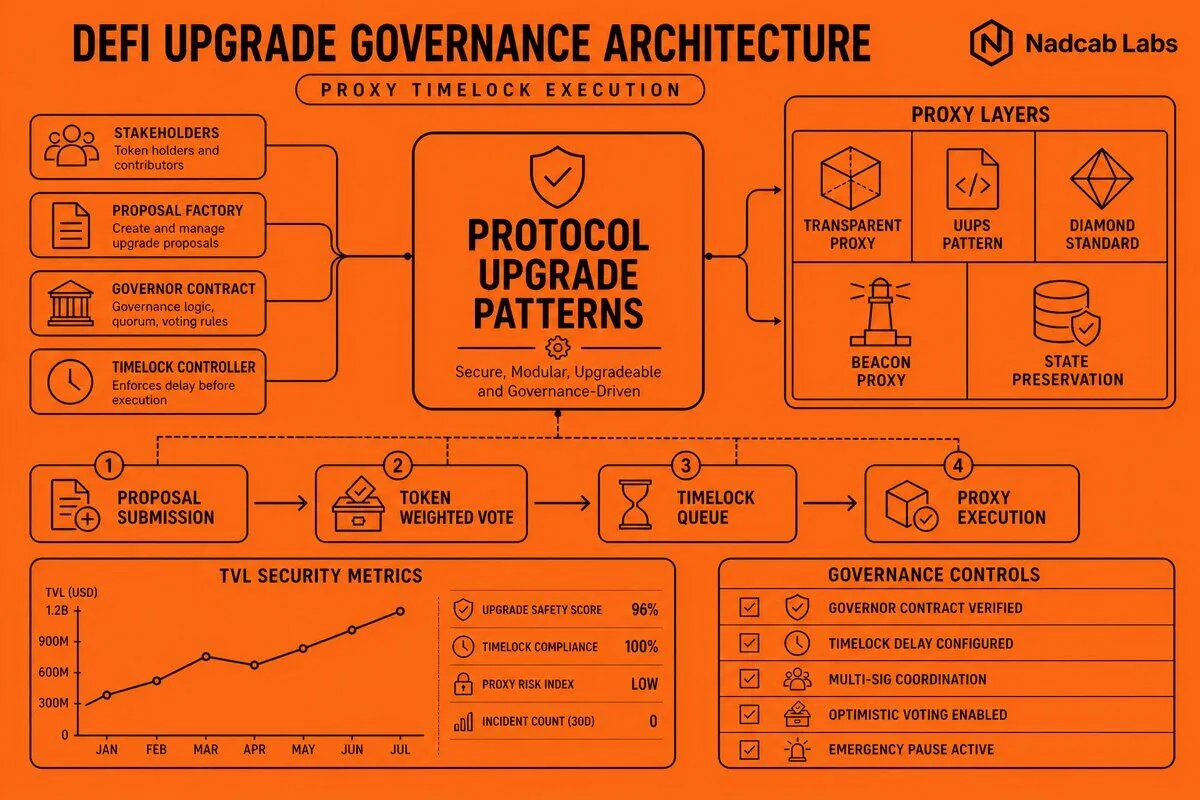
DeFi protocol upgrade governance mechanisms are the technical systems that enable decentralized communities to propose, vote on, and execute smart contract upgrades through on-chain or hybrid voting models, typically using proxy patterns, timelock contracts, and token-weighted governance to balance security with protocol evolution. These mechanisms determine how protocols like Compound, Uniswap, and Aave safely upgrade their core logic while maintaining state integrity and protecting billions in total value locked. For developers building production DeFi systems in 2026, understanding the interplay between upgrade architecture (transparent proxies, UUPS, diamond standard) and governance execution (Governor contracts, multi-sig coordination, optimistic voting) is essential for building protocols that can evolve without sacrificing decentralization or security.
Key Takeaways
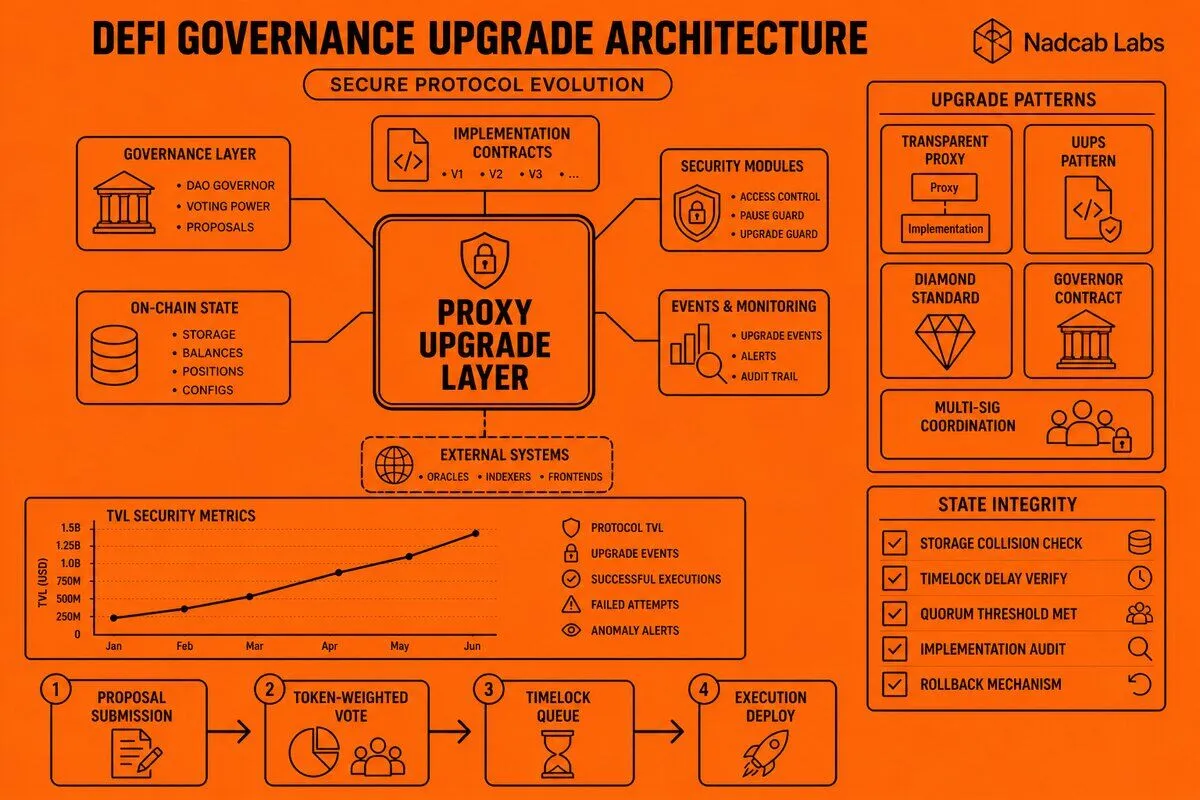
- Modern DeFi protocols use proxy patterns (transparent, UUPS, beacon, diamond standard) to separate implementation logic from state storage, enabling upgrades without data migration
- Governance models range from token-weighted voting with timelock delays to optimistic governance with challenge periods, each offering different security trade-offs for upgrade decisions
- Security frameworks require carefully calibrated timelock delays (typically 24-72 hours based on TVL), multi-sig guardian roles, and comprehensive pre-upgrade audit processes
- Real-world upgrades from Compound, Uniswap, and Aave demonstrate the importance of voter education, simulation environments, and post-upgrade monitoring for successful governance execution
- Implementation checklists must cover proposal drafting, community discussion, on-chain voting, timelock queueing, upgrade execution, and state verification to minimize governance attack surfaces
- Emergency pause mechanisms and rollback strategies provide safety nets while introducing acceptable centralization trade-offs during protocol maturity phases
What Are the Core Technical Upgrade Mechanisms in DeFi Protocol Governance for 2026?
DeFi protocols require upgradeable smart contract architectures because bugs, security vulnerabilities, and feature additions demand the ability to modify on-chain logic without losing user funds or historical state. The technical foundation for governance-driven upgrades rests on proxy patterns that separate the protocol’s business logic (implementation contract) from its persistent data storage (proxy contract). When governance approves an upgrade, only the implementation address changes while all user balances, protocol parameters, and historical transactions remain intact in the proxy’s storage.
Transparent proxy patterns, popularized by OpenZeppelin, use a proxy contract that delegates all calls to an implementation contract while storing an admin address with upgrade privileges. The proxy checks each incoming call: if the caller is the admin and the function signature matches an admin function, it executes locally; otherwise it delegates to the implementation. This pattern prevents function selector collisions between proxy admin functions and implementation functions, but it adds gas overhead to every transaction due to the admin check. For protocols with high transaction volumes, this 200-300 gas penalty per call becomes significant at scale.
UUPS (Universal Upgradeable Proxy Standard, EIP-1822) inverts the upgrade logic by placing the upgrade function in the implementation contract rather than the proxy. The proxy becomes a minimal delegatecall forwarder with no admin logic, reducing gas costs by 200-500 gas per transaction compared to transparent proxies. The implementation contract includes an upgradeTo() function that only authorized addresses (typically a governance contract or timelock) can call. This pattern requires developers to include upgrade logic in every implementation version, creating a risk: if a new implementation accidentally omits the upgrade function or introduces a bug in it, the protocol becomes permanently frozen. UUPS works best for mature protocols with rigorous testing pipelines and governance processes that catch implementation errors before deployment.
Beacon proxy patterns introduce a registry contract (the beacon) that stores the current implementation address. Multiple proxy instances point to the same beacon, allowing simultaneous upgrades of all instances with a single beacon update. This architecture suits protocols deploying many similar contracts (like lending pools or liquidity pairs) where governance wants to upgrade all instances atomically. When Aave governance approves a lending pool upgrade, changing the beacon address instantly updates hundreds of market contracts without individual transactions for each pool. The trade-off is added complexity: beacon upgrades affect multiple contracts simultaneously, amplifying the impact of bugs or malicious proposals.
The diamond standard (EIP-2535) represents the most modular upgrade approach, treating a protocol as a collection of function facets rather than a monolithic implementation contract. Each facet implements a subset of protocol functions, and the diamond proxy maintains a mapping from function selectors to facet addresses. Governance can upgrade individual functions without redeploying the entire protocol, add new functions without touching existing code, or remove deprecated functions to reduce attack surface. Synthetix uses a diamond-like architecture to upgrade specific protocol modules (staking, exchange, liquidation) independently, allowing faster iteration on individual features while keeping core functionality stable. The complexity cost is substantial: diamond implementations require careful storage slot management across facets, sophisticated testing to catch cross-facet interactions, and governance processes that can reason about granular function-level changes.
Storage collision prevention is critical across all proxy patterns. Solidity allocates storage slots sequentially starting from slot 0, so adding a new state variable to an implementation contract shifts all subsequent variables to different slots, corrupting existing data. Protocols prevent this by reserving storage slots using the unstructured storage pattern: critical upgrade-related variables (admin address, implementation address) live at deterministic pseudo-random slots calculated from hash functions, far from the sequential allocation zone. For example, OpenZeppelin’s transparent proxy stores the implementation address at bytes32(uint256(keccak256('eip1967.proxy.implementation')) - 1), a slot that sequential allocation will never reach. New implementation versions must append state variables to the end of the storage layout, never insert them in the middle or reorder existing variables.
For protocols considering which pattern to adopt, the decision matrix looks like this: transparent proxies for simplicity and safety when gas costs are acceptable; UUPS for gas optimization when the team has strong testing discipline; beacon proxies for protocols deploying many similar contracts; diamond standard for protocols requiring granular module upgrades and willing to manage the complexity overhead. Most protocols building with DeFi Development partners start with transparent or UUPS proxies, then migrate to more sophisticated patterns as protocol complexity grows and governance matures.
How Do Different Governance Models Secure Protocol Upgrades in 2026?
Token-weighted voting remains the dominant governance model for DeFi protocol upgrades, where voting power equals token holdings. A user with 100,000 governance tokens has 100,000 votes, creating a plutocratic system where large holders (often early investors, team members, or whale accumulations) control upgrade decisions. Compound’s Governor Bravo contract exemplifies this model: proposals require a minimum threshold (typically 1-2% of total supply) to submit, a voting period (usually 3-7 days), and a quorum requirement (4-10% of supply must vote) to pass. The security advantage is simplicity and capital alignment: voters with large stakes have strong incentives to protect protocol value. The attack surface is also clear: an attacker needs 51% of voting tokens to pass malicious upgrades, making governance attacks expensive but possible through token accumulation or flash loan manipulation.
Quadratic voting attempts to balance power by making each additional vote more expensive: the first vote costs 1 token, the second costs 4 tokens (2²), the third costs 9 tokens (3²), and so on. This mechanism reduces whale dominance by making it prohibitively expensive for a single entity to cast millions of votes, while allowing smaller holders to express strong preferences on issues they care about. Gitcoin uses quadratic voting for grant allocation, demonstrating its effectiveness in community funding decisions. For protocol upgrades, quadratic voting faces practical challenges: the vote-cost curve must be calibrated carefully to prevent Sybil attacks (splitting tokens across multiple addresses to game the curve) while maintaining meaningful differentiation between small and large holders. Few production DeFi protocols use pure quadratic voting for upgrades due to these complexities, though hybrid models incorporating quadratic elements for certain proposal types are gaining traction.
Conviction voting, pioneered by 1Hive’s Gardens framework, measures not just vote quantity but vote duration. Voters stake tokens on proposals, and voting power accumulates over time following a conviction curve: the longer tokens remain staked on a proposal, the more voting weight they carry. This mechanism rewards long-term commitment over short-term speculation, making it harder for attackers to quickly accumulate voting power through token purchases or flash loans. A proposal passes when accumulated conviction crosses a threshold determined by the funding amount requested (larger upgrades require higher conviction). Conviction voting works well for continuous proposal streams (like grant funding) but faces challenges for binary upgrade decisions: the time-weighted accumulation can delay critical security patches, and the complexity makes voter participation lower than simple token-weighted systems.
On-chain governance through Governor contracts (OpenZeppelin’s Governor, Compound’s Governor Bravo, Tally’s governance framework) executes the entire lifecycle on the blockchain: proposal submission, voting, timelock queueing, and upgrade execution all happen through smart contract transactions. This approach maximizes transparency and censorship resistance but incurs high gas costs (submitting a proposal can cost $50-200 on Ethereum L1) and lacks flexibility for complex discussions. Protocols using on-chain governance typically combine it with off-chain discussion forums (Commonwealth, Discourse) where the community debates proposals before formal on-chain submission. The security benefit is that vote outcomes are cryptographically verifiable and automatically enforceable through timelock contracts, eliminating the trust assumptions of off-chain coordination.
Off-chain governance using Snapshot dominates DeFi for gas efficiency: voting happens by signing messages off-chain, consuming zero gas for voters. Snapshot records vote signatures in IPFS and calculates outcomes based on token balances at a specific block height. The trade-off is execution risk: after Snapshot voting concludes, a trusted multi-sig or executor contract must manually implement the upgrade on-chain, introducing a trust layer. Protocols mitigate this through transparent multi-sig membership (publicly known signers), execution delays matching the off-chain voting period, and community monitoring of multi-sig actions. Many protocols use hybrid models: Snapshot for temperature checks and preliminary voting, Governor contracts for final binding votes on critical upgrades. This approach balances gas costs with security, using expensive on-chain votes only for high-stakes decisions.
Optimistic governance flips the voting model: proposals execute by default after a challenge period unless someone submits a fraud proof. This mechanism suits routine upgrades where governance expects few objections, reducing voter fatigue and gas costs. A protocol might use optimistic governance for parameter adjustments (changing fee rates, collateral ratios) while requiring standard voting for contract upgrades. The challenge period (typically 3-7 days) gives the community time to review proposals and submit disputes if they detect problems. Optimism’s governance uses this model for protocol upgrades: the Security Council can propose upgrades that execute automatically after a delay unless the Token House votes to block them. The security assumption is that at least one honest actor will monitor proposals and raise disputes for malicious changes, requiring lower active participation than standard voting but depending on vigilant monitoring.
| Governance Model | Timelock Requirement | Attack Surface | Gas Cost (L1) | Example Protocol |
|---|---|---|---|---|
| Token-Weighted On-Chain | 48-72 hours | 51% token accumulation | $150-300 per vote | Compound, Uniswap |
| Snapshot + Multi-sig | 24-48 hours | Multi-sig collusion (4 of 7 typical) | $0 for voters, $50-100 execution | Yearn, Curve (historical) |
| Optimistic Governance | 72-168 hours | Undetected malicious proposal | $50-100 proposal, $0 if no challenge | Optimism, MakerDAO (some params) |
| Conviction Voting | Variable (conviction-dependent) | Long-term token accumulation | $20-50 per stake/unstake | 1Hive Gardens |
| Hybrid (Snapshot + Governor) | 48-96 hours | Execution bridge manipulation | $0 preliminary, $150-300 final | Aave, Balancer |
Protocols must choose governance models based on their maturity stage, community size, and upgrade frequency. Early-stage protocols often start with multi-sig governance (5-7 trusted signers) to enable rapid iteration, then transition to token-weighted voting as the community grows and the protocol stabilizes. High-frequency parameter adjustments benefit from optimistic governance to reduce voter fatigue, while core contract upgrades warrant full on-chain voting with extended timelock delays. Understanding these trade-offs helps development teams avoid common pitfalls like governance attacks described in our analysis of Governance Attacks in DeFi.
What Security Framework Should DeFi Protocols Implement for Governance-Driven Upgrades in 2026?
Timelock contracts serve as the final security gate between governance approval and upgrade execution, enforcing a mandatory delay that gives the community time to review approved proposals, withdraw funds if they detect malicious changes, and coordinate emergency responses. The timelock delay duration is the most critical security parameter: too short and users cannot react to governance attacks; too long and the protocol cannot respond quickly to critical bugs or market conditions. Protocols calculate optimal delays using a formula that considers total value locked, average voter participation rates, and historical response times for community coordination.
For protocols with less than $50 million TVL, a 24-hour timelock provides sufficient exit window: users can monitor governance outcomes daily and withdraw funds before malicious upgrades execute. Protocols between $50-500 million TVL typically implement 48-hour delays, balancing user protection with operational flexibility. Large protocols exceeding $500 million TVL often use 72-hour or longer delays: Compound uses a 2-day timelock, Uniswap uses 2 days for routine upgrades and 7 days for critical changes, and MakerDAO uses variable delays up to 72 hours depending on proposal risk level. The delay must be long enough for independent security researchers to review upgrade code, for community members in different time zones to coordinate responses, and for users to execute complex exit strategies (unwinding leveraged positions, withdrawing from multiple pools).
Multi-sig coordination layers introduce controlled centralization to handle edge cases where pure token voting fails: emergency security patches, critical bug fixes requiring immediate deployment, and governance attacks where malicious proposals pass despite community objections. The standard pattern uses a guardian multi-sig (typically 5-9 signers) with veto power over timelock executions: if the multi-sig detects a malicious proposal during the timelock delay, they can cancel it before execution. This power is strictly limited to cancellation, not proposal creation, maintaining a check on governance without allowing multi-sig takeover of the protocol.
Acceptable centralization trade-offs depend on protocol maturity and TVL risk. Protocols in their first year often grant multi-sigs broad emergency powers including pause functions, parameter adjustments, and upgrade execution without governance approval. As the protocol matures and TVL grows, these powers progressively transfer to governance: first parameter adjustments move to token voting, then routine upgrades, finally emergency powers either transfer to governance or require dual approval (both multi-sig and governance must agree). Aave’s governance evolution demonstrates this path: early versions gave the team broad control, Aave v2 introduced governance with guardian oversight, and Aave v3 further restricted guardian powers to specific emergency scenarios. The goal is minimizing trust assumptions while maintaining the ability to respond to critical security events.
Emergency pause mechanisms provide circuit breakers for active exploits without requiring full governance votes. A designated pause guardian (often the same multi-sig serving as governance guardian) can freeze protocol functions when they detect ongoing attacks, preventing further fund loss while the community coordinates a response. The pause typically affects deposit and borrow functions but allows withdrawals, so users can exit but attackers cannot extract additional value. Pause durations are strictly limited (24-48 hours) and require governance approval to extend, preventing indefinite protocol freezing. Compound’s pause guardian can freeze specific markets for 24 hours, giving time to analyze exploits and prepare patches without requiring emergency governance votes.
Pre-upgrade audit requirements establish minimum security standards before governance can vote on proposals. Leading protocols require that any proposal modifying core contracts must include audit reports from at least two independent security firms, formal verification results for critical functions, and economic analysis of parameter changes. The audit reports must be publicly available during the governance voting period, giving community members time to review findings and assess risks. Some protocols encode these requirements in their governance contracts: proposals without attached audit hashes automatically fail, ensuring compliance. This process adds 2-4 weeks to upgrade timelines but dramatically reduces the risk of deploying vulnerable code through governance.
Protocol Upgrade Security Process Flow
Code + audit reports
7-14 day discussion
3-7 day voting period
48-72 hour delay
Veto window
Upgrade deployment
State + function checks
Rollback strategies provide safety nets when upgrades introduce unexpected bugs or security vulnerabilities. The simplest rollback mechanism is including a revert function in the new implementation that points the proxy back to the previous implementation address. This requires storing the previous implementation address in the proxy storage and restricting the revert function to governance or guardian control. More sophisticated protocols implement versioned upgrades: each implementation stores a version number, and the governance contract maintains a history of approved versions. If an upgrade fails, governance can vote to roll back to any previous version rather than just the immediate predecessor.
Post-upgrade monitoring protocols establish automated checks that detect anomalies after upgrade execution. Monitoring systems track key metrics: total value locked (should remain stable unless the upgrade explicitly affects it), transaction success rates (should not drop), gas costs per transaction type (should match pre-upgrade estimates), and protocol-specific invariants (like constant product formulas in AMMs). Significant deviations trigger alerts to the development team and community, enabling rapid response to subtle bugs that passed pre-deployment testing. Protocols also maintain incident response runbooks documenting the escalation path from anomaly detection to emergency pause to governance-approved fixes, ensuring coordinated responses during high-stress situations.
How Have Major DeFi Protocols Executed Governance Upgrades in Real-World Scenarios?
Compound’s Governor Bravo upgrade in 2021 demonstrates best practices for migrating governance systems. The original Governor Alpha contract had limitations: proposals required 1% of total COMP supply (1 million tokens) to submit, making it difficult for smaller community members to participate, and the voting mechanism lacked delegation features for users who wanted to participate in governance without actively voting on every proposal. Governor Bravo introduced delegation (users could delegate voting power to representatives while retaining token ownership), reduced the proposal threshold to 65,000 COMP (0.065% of supply), and added more flexible voting options.
The upgrade process followed a careful multi-phase approach. First, the Compound team deployed Governor Bravo to mainnet and completed security audits from Trail of Bits and OpenZeppelin, publishing results for community review. Second, they submitted a proposal through the existing Governor Alpha contract to transfer admin rights of the Timelock (which controls all protocol upgrades) from Governor Alpha to Governor Bravo. The proposal included detailed documentation explaining the changes, security audit results, and addresses of all deployed contracts for community verification. Third, during the 3-day voting period, the proposal received 59% participation (high for DeFi governance), with 99.9% voting in favor. Fourth, after the 2-day timelock delay, the proposal executed automatically, transferring admin control to Governor Bravo. The entire process took approximately 6 weeks from initial proposal to execution, demonstrating the time investment required for major governance changes.
Lessons learned from Compound’s upgrade include the importance of voter education: the team published multiple blog posts, hosted community calls, and created visual diagrams explaining the changes. High participation resulted from this education effort combined with the clear benefits (lower proposal threshold, delegation) that directly addressed community pain points. The upgrade also highlighted the chicken-and-egg problem of governance migration: Governor Alpha had to vote to replace itself, requiring the old system to work perfectly one final time. Protocols planning governance upgrades should design migration paths that minimize dependencies on potentially deprecated systems.
Uniswap v3 deployment governance in 2021 showcased off-chain coordination for major protocol launches. Unlike Compound’s governance system upgrade, Uniswap v3 was an entirely new protocol version with different AMM mathematics (concentrated liquidity) requiring fresh contract deployments rather than upgrades to existing contracts. The governance challenge was deciding whether to deploy v3, on which chains to deploy, and how to allocate development resources. The Uniswap team published a detailed proposal on the governance forum explaining v3’s technical improvements, gas efficiency gains, and capital efficiency benefits for liquidity providers.
The governance process used Snapshot for temperature checks followed by on-chain voting for final approval. The initial Snapshot vote asked: “Should Uniswap Labs deploy v3 to Ethereum mainnet?” The vote achieved 99.3% approval with 45 million UNI participating (4.5% of total supply). Following the successful Snapshot vote, the team deployed v3 contracts and submitted an on-chain governance proposal to add v3 to the official Uniswap interface. This proposal passed with similar participation rates. Subsequent proposals addressed multi-chain deployment: separate votes approved v3 deployments to Polygon, Arbitrum, and Optimism, each following the same Snapshot-then-on-chain pattern.
Multi-chain deployment considerations introduced new governance complexity: each chain required separate contract deployments, different gas optimization strategies, and chain-specific parameter tuning. The governance process evolved to include technical committees that researched each chain’s characteristics and provided recommendations to token holders, improving the quality of voting decisions. This pattern—combining expert technical analysis with broad token holder approval—has become standard for protocols expanding to new chains, as discussed in our guide to Omnichain DeFi architectures.
Aave governance v2 architecture introduced sophisticated delegation and proposition power separation. Earlier Aave governance gave voting power and proposal creation power to the same token holders, creating a high barrier to entry: you needed substantial AAVE holdings both to vote and to submit proposals. Aave v2 governance separated these powers: voting power determines vote weight on proposals, while proposition power determines who can submit proposals. Users can delegate these powers independently, creating a more flexible participation model where community members might delegate voting power to a trusted representative while retaining proposition power to submit their own ideas.
The governance v2 upgrade also introduced emergency admin functions with strict limitations. The emergency admin (a multi-sig controlled by Aave Genesis team members) can pause specific protocol functions during active exploits but cannot modify protocol parameters, upgrade contracts, or access user funds. This power is time-limited: pauses automatically expire after 24 hours unless governance votes to extend them, preventing indefinite protocol freezing. The emergency admin also cannot unpause functions; only governance can restore normal operations after a pause. This design balances security (rapid response to exploits) with decentralization (limited scope and duration of centralized control).
Aave’s governance in practice shows the importance of voter participation incentives. Early governance proposals suffered from low participation (2-3% of supply), raising concerns about governance legitimacy and attack vulnerability. Aave introduced “safety module” staking where users stake AAVE tokens to serve as protocol insurance, earning rewards in exchange for covering potential shortfalls. Staked AAVE retains voting power, creating a natural constituency of engaged governance participants who have both financial stake and regular protocol interaction. Following this change, governance participation increased to 5-8% for routine proposals and 15-20% for major upgrades, improving governance security through broader participation.
What Is the Step-by-Step Implementation Checklist for Governance-Aligned Protocol Upgrades in 2026?
The pre-upgrade phase begins with proposal drafting that includes three critical components: the technical specification (exact contract changes, new function signatures, storage layout modifications), the economic impact analysis (how the upgrade affects fees, yields, user incentives), and the security audit results. Technical specifications must be detailed enough for independent developers to reproduce the upgrade and verify its behavior. For proxy-based upgrades, this means publishing the new implementation contract source code, the upgrade transaction calldata, and the expected post-upgrade state. For parameter changes, specifications include current values, proposed values, and the mathematical reasoning behind the change.
Community discussion happens on governance forums (Commonwealth, Discourse, Telegram) where developers, users, and security researchers debate the proposal. Effective discussion periods last 7-14 days for major upgrades, giving international community members time to review proposals across time zones. During this phase, proposal authors should actively respond to questions, address concerns, and revise proposals based on feedback. Protocols with mature governance cultures establish discussion templates that prompt proposal authors to address common questions: What problem does this solve? What are the risks? What alternatives were considered? How was this tested? These templates improve discussion quality and help voters make informed decisions.
Formal governance submission moves the proposal on-chain (for Governor-based systems) or to Snapshot (for off-chain voting). The submission transaction includes the proposal description, the target contract addresses, the function signatures to call, and the calldata for each function. For upgrades involving multiple contract changes, proposals batch all changes into a single atomic transaction that either fully succeeds or fully reverts, preventing partial upgrades that could leave the protocol in an inconsistent state. Submission requires meeting the proposal threshold (typically 0.5-2% of total supply), which proposal authors often achieve by rallying community support before formal submission.
Voter education strategies determine participation rates and decision quality. Successful protocols publish multiple content formats: technical blog posts for developers, visual diagrams for general users, video explainers for community members who prefer multimedia, and Twitter threads for broad reach. The education content should explain not just what the proposal does but why it matters: how does it improve user experience, increase security, or enable new features? Protocols also host community calls where proposal authors present their work and answer live questions, creating opportunities for real-time discussion that forums cannot provide. For complex upgrades affecting protocol economics, some protocols commission independent analysis from research firms and publish results alongside the proposal, giving voters access to expert opinions.
The execution phase begins when voting concludes with a passing result. For on-chain governance, the proposal automatically queues in the timelock contract, starting the delay countdown. During this period, the community performs final verification: independent developers review the queued transaction calldata to ensure it matches the proposal description, security researchers conduct last-minute code reviews, and users decide whether to exit the protocol before the upgrade executes. Protocols should publish verification guides showing community members how to decode the timelock transaction and compare it against the proposal specification, democratizing the verification process beyond expert developers.
Multi-sig coordination (for protocols using guardian oversight) happens during the timelock delay. Guardian signers review the queued proposal, verify it matches the governance vote, and check for any security concerns that emerged during the delay period. If guardians detect problems, they coordinate through secure channels (encrypted chat, multi-sig interfaces like Gnosis Safe) to execute a veto transaction before the timelock expires. This coordination must happen quickly: if the timelock delay is 48 hours and a problem is detected at hour 46, guardians have only 2 hours to achieve consensus and submit the veto transaction. Protocols should establish clear communication channels and decision-making processes for guardian coordination, including escalation paths for reaching guardians in different time zones.
Upgrade transaction construction requires careful attention to gas optimization, especially for L1 deployments where execution costs can reach thousands of dollars. For proxy upgrades, the transaction calls the proxy’s upgrade function with the new implementation address. For parameter changes, the transaction calls setter functions on the target contracts. For complex upgrades involving multiple contracts, the transaction uses a batch executor contract that atomically executes all changes. Gas optimization techniques include using efficient calldata encoding (avoiding unnecessary zero bytes), batching multiple parameter changes into single transactions, and choosing optimal transaction timing (lower gas prices during off-peak hours).
L2 deployment considerations differ significantly from L1: gas costs are 10-100x lower, enabling more frequent upgrades and more complex governance transactions. However, L2 protocols face unique challenges around cross-chain governance: if the governance token lives on L1 but the protocol operates on L2, how do votes cross chains? Solutions include governance bridges (message passing from L1 to L2), L2-native governance tokens (separate supply on each chain), or snapshot-based voting (taking token snapshots on L1 to determine L2 governance outcomes). Protocols building multi-chain governance should consult with teams experienced in Right DeFi Development Company selection to avoid common cross-chain governance pitfalls.
Post-upgrade verification follows a systematic checklist. First, verify the upgrade executed successfully by checking that the proxy implementation address changed to the expected value. Second, validate state migration by comparing pre-upgrade and post-upgrade storage: user balances should be unchanged, protocol parameters should reflect the upgrade, and no unexpected state corruption should appear. Third, execute integration tests against the upgraded protocol: deposit, withdraw, borrow, repay, liquidate (depending on protocol type) to ensure all functions work correctly. Fourth, monitor key metrics for the first 24-48 hours: TVL, transaction success rate, gas costs, and protocol-specific invariants. Any significant deviations warrant immediate investigation and potential emergency response.
Protocol Upgrade Participation Rates (2026-2026)
Monitoring dashboards should track protocol health metrics continuously after upgrades. Essential metrics include total value locked (tracking deposits and withdrawals), transaction success rates (failed transactions may indicate bugs), gas consumption per transaction type (comparing against pre-upgrade baselines), and protocol-specific metrics like liquidation rates, utilization rates, or trading volumes. Protocols should establish alert thresholds: if TVL drops more than 10% in 24 hours post-upgrade, if transaction failure rates exceed 2%, or if gas costs increase more than 20%, automated alerts notify the development team for investigation. These monitoring systems often integrate with incident response platforms (PagerDuty, Opsgenie) to ensure 24/7 coverage during critical post-upgrade periods.
Incident response preparation includes pre-written emergency procedures for common post-upgrade scenarios: state corruption requiring rollback, unexpected bugs requiring emergency patches, or governance attacks requiring guardian intervention. Response procedures specify who has authority to make decisions (development team lead, governance guardians, community vote), what actions they can take (pause protocol, execute rollback, submit emergency proposal), and how to communicate with the community (Twitter announcements, Discord updates, governance forum posts). Protocols that invest in incident response preparation can respond to post-upgrade problems in hours rather than days, minimizing user impact and protocol damage. The relationship between governance security and broader protocol security is explored in our analysis of Ethereum Upgrade patterns.
The complete governance-aligned upgrade process typically takes 4-8 weeks from initial proposal to post-upgrade verification: 1-2 weeks for proposal drafting and audits, 1-2 weeks for community discussion, 3-7 days for voting, 2-3 days for timelock delay, and 1-2 weeks for post-upgrade monitoring. Protocols should resist pressure to accelerate this timeline unless facing genuine emergencies, as rushed upgrades significantly increase the risk of bugs, governance attacks, or community backlash. For teams evaluating the costs and timelines of implementing robust governance systems, our guide to defi exchange development cost provides detailed breakdowns of governance infrastructure investments.
Governance-aligned upgrades represent a fundamental shift from traditional software development where centralized teams deploy updates at will. The additional complexity, time investment, and coordination overhead are the price of decentralization: by distributing upgrade authority across token holders, protocols achieve censorship resistance and community ownership at the cost of slower iteration and higher coordination costs. For protocols with sufficient TVL and user base to justify these costs, governance-driven upgrades provide legitimacy and long-term sustainability that centralized upgrade mechanisms cannot match. Understanding how to measure the returns on these investments is covered in our analysis of ROI of DeFi protocol governance.
Final Thoughts
DeFi protocol upgrade governance mechanisms in 2026 represent a sophisticated blend of smart contract architecture, cryptoeconomic incentives, and community coordination. Successful implementations require technical excellence in proxy patterns and timelock contracts, thoughtful design of voting mechanisms that balance security with participation, and rigorous processes that give communities time to review and respond to proposed changes. The protocols that thrive are those that treat governance not as an afterthought but as a core architectural component, investing in voter education, security frameworks, and incident response capabilities from day one. As DeFi continues to mature and protocols manage billions in user funds, the quality of governance mechanisms becomes a primary competitive differentiator, separating protocols that can safely evolve from those that ossify or fail under the weight of their own technical debt. For development teams building the next generation of DeFi protocols, mastering governance-aligned upgrade patterns is not optional—it is the foundation of long-term protocol sustainability and community trust. The integration of governance with smart contract security, as explored in our guide to Bitcoin Smart Contracts, demonstrates how these principles extend across blockchain ecosystems beyond Ethereum.
Frequently Asked Questions
Q1.What are the 5 layers of DeFi and how does governance fit into protocol architecture in 2026?
The 5 DeFi layers in 2026 are: settlement (blockchain base), asset (tokens), protocol (smart contracts), application (user interfaces), and aggregation (cross-protocol tools). Governance operates primarily at the protocol layer, controlling smart contract upgrades, parameter changes, and treasury management. Modern governance mechanisms integrate across layers, enabling token holders to vote on protocol modifications while maintaining security through timelock delays and multi-signature requirements at the settlement layer.
Q2.What is DeFi governance and why do protocol upgrades require decentralized decision-making mechanisms?
DeFi governance is the process where token holders collectively control protocol changes through voting mechanisms. Protocol upgrades require decentralized decision-making to prevent single points of failure, maintain trustlessness, and align with blockchain’s core principles. Centralized upgrade control creates censorship risks and contradicts DeFi’s permissionless nature. Decentralized governance ensures community consensus before implementing critical changes like fee structures, collateral ratios, or smart contract logic modifications.
Q3.How do timelock contracts protect DeFi protocol upgrades from malicious governance attacks in 2026?
Timelock contracts enforce mandatory delays (typically 24-72 hours) between governance proposal approval and execution in 2026. This window allows users to review upcoming changes, exit positions if disagreeing, and community members to identify malicious proposals. Timelocks prevent flash loan governance attacks and rushed decisions by requiring proposals to remain publicly visible before implementation, creating accountability and enabling emergency intervention if vulnerabilities are discovered.
Q4.What is the difference between transparent proxy and UUPS proxy patterns for upgradeable DeFi protocols?
Transparent proxy stores upgrade logic in the proxy contract itself, with admin functions automatically routing to proxy while user calls go to implementation. UUPS (Universal Upgradeable Proxy Standard) places upgrade logic in the implementation contract, reducing gas costs and proxy complexity. UUPS requires implementation contracts to include upgrade functions, making it more gas-efficient but requiring careful implementation. Transparent proxies offer simpler security models but higher deployment costs.
Q5.When should DeFi protocols use optimistic governance versus standard voting for upgrade decisions in 2026?
Optimistic governance suits routine parameter adjustments and low-risk upgrades in 2026, assuming approval unless challenged within a dispute period. Standard voting applies to critical changes like smart contract logic overhauls, tokenomics modifications, or security-sensitive updates. Optimistic mechanisms reduce voter fatigue and gas costs for frequent minor changes, while standard voting ensures thorough community review for high-impact decisions. Protocols often combine both approaches based on proposal risk levels.
Q6.How do emergency pause mechanisms work in DeFi governance systems without compromising decentralization?
Emergency pause mechanisms use multi-signature wallets or guardian committees with limited powers to temporarily halt protocol functions during detected exploits. To preserve decentralization, pause authority is time-limited (typically 24-48 hours), requires multiple signers, and can only freeze operations—not modify state or withdraw funds. Governance token holders retain power to remove guardians, adjust pause parameters, or override decisions, ensuring emergency controls remain accountable to the community.
Explore Services
Related Services
Reviewed by

Aman Vaths
Founder of Nadcab Labs
Aman Vaths is the Founder & CTO of Nadcab Labs, a global digital engineering company delivering enterprise-grade solutions across AI, Web3, Blockchain, Big Data, Cloud, Cybersecurity, and Modern Application Development. With deep technical leadership and product innovation experience, Aman has positioned Nadcab Labs as one of the most advanced engineering companies driving the next era of intelligent, secure, and scalable software systems. Under his leadership, Nadcab Labs has built 2,000+ global projects across sectors including fintech, banking, healthcare, real estate, logistics, gaming, manufacturing, and next-generation DePIN networks. Aman’s strength lies in architecting high-performance systems, end-to-end platform engineering, and designing enterprise solutions that operate at global scale.