Ai Overview
A DeFi development company is a specialized software firm that builds decentralized finance applications, smart contracts, and blockchain infrastructure. A startup raises $2 million for their DeFi lending protocol. They hire a cheap development firm that promises delivery in 4 months at $200,000. A developer charging $50/hour versus $150/hour probably isn’t just cheaper, they’re less experienced.
Key Takeaways
- Verify smart contract security audits from reputable firms before hiring any DeFi development company
- Ask for detailed references from past clients and contact them directly about their actual experience
- Evaluate multi chain expertise since most DeFi platforms need to operate across Ethereum, Polygon, and other networks
- Review code repositories and request sample smart contracts to assess code quality firsthand
- Ensure transparent pricing with clear deliverables and avoid companies that hide costs or add surprise fees
- Look for companies offering ongoing support, maintenance, and monitoring after deployment
- Check if they understand regulatory compliance and can guide you through legal requirements
- Assess communication frequency and project management transparency before signing any agreement
- Verify their experience with your specific use case, whether it’s DEX, lending protocol, or staking platform
- Test their problem solving approach by discussing potential security risks and how they’d handle them
Selecting the wrong DeFi development company can cost you millions. Poor code, security vulnerabilities, missed deadlines, and regulatory missteps aren’t just technical problems, they’re business killers. When you’re building a decentralized finance platform, your development partner becomes your most critical decision. This guide shows you exactly how to choose the right DeFi development company without settling for mediocrity or overpaying for empty promises.
Quick Answer:
Choose a DeFi development company by evaluating their technical expertise in smart contracts, security audit track record, real world project experience, multi chain capabilities, transparent communication, proven development processes, and post launch support quality. Request references, review code samples, verify audits, and ensure they understand your business goals.
What is a DeFi Development Company?
A DeFi development company is a specialized software firm that builds decentralized finance applications, smart contracts, and blockchain infrastructure. Unlike traditional software developers, these companies understand cryptocurrency protocols, smart contract architecture, tokenomics, liquidity mechanisms, and security requirements specific to decentralized finance.
Think of them as specialized architects who build not just the house, but also the security system, plumbing, electrical work, and ensure everything passes safety inspections.
These companies typically provide:
- Smart contract development and deployment for protocols and tokens
- DeFi platform development including DEX, lending platforms, yield farming, and bridges
- Security audits and testing to identify vulnerabilities before launch
- Multi chain integration to enable cross network functionality
- Token economics design and mechanism optimization
- Ongoing maintenance and monitoring after platform launch
Why Choosing the Right DeFi Company Matters
Getting this decision wrong comes with real consequences. Consider what happens with a poor choice:
Scenario: You launch your DeFi platform built by an inexperienced team. Three months later, security researchers discover a critical vulnerability. Your protocol gets hacked. Users lose funds. Your reputation shatters. Lawsuits follow.
This isn’t hypothetical. Multiple projects have suffered exactly this fate.
The right DeFi development company prevents:
- Security breaches that destroy user trust and your business
- Missed deadlines that delay market entry and cost you competitive advantage
- Technical debt that makes future improvements impossible or expensive
- Regulatory issues from non compliance with evolving crypto regulations
- Poor scalability that fails under real trading volume
- Bad tokenomics that create unsustainable economics and user churn
A strong partner delivers working code on time, passes rigorous security audits, scales to handle millions of transactions, and provides support when issues arise.
Key Factors to Evaluate Before Hiring
Not all DeFi development companies are created equal. Here are the critical evaluation criteria.
1. Technical Expertise in Smart Contracts
Smart contracts are the core of DeFi. Bad contracts = bad platform. You need developers who deeply understand Solidity, contract architecture, gas optimization, and state management.
What to look for:
- Experience building contracts across multiple blockchains
- Understanding of different contract patterns: upgradeability, access control, reentrancy protection
- Ability to optimize gas costs (expensive transactions kill user adoption)
- Knowledge of OpenZeppelin standards and best practices
How to verify: Ask them to explain how they’d implement a specific contract feature relevant to your project. Listen for depth in their answer. Ask what OpenZeppelin contracts they commonly use. Request examples from their GitHub.
2. Security Audit Track Record
Security audits from reputable firms are non negotiable for DeFi. These independent reviews catch vulnerabilities before hackers do. Every serious DeFi platform gets audited by companies like Trail of Bits, Consensys Diligence, or OpenZeppelin.
What to verify:
- Has the company completed successful audits before?
- Which audit firms have they worked with? (Check if they’re tier 1 firms)
- What vulnerabilities have been found and how were they fixed?
- Do they have relationships with audit firms or can they recommend partners?
- Budget allocation for security in their project plan
Red flag: Any company that says “audits aren’t necessary for our code” or “we’ll audit later.” Quality DeFi companies budget for security from day one.
3. Real World Project Experience
Portfolio matters. Don’t hire a team that’s built three small projects to build your platform that manages $100 million in liquidity. Real world experience teaches lessons that theory doesn’t.
Evaluate their portfolio:
- Live projects they’ve built and their total value locked (TVL)
- Types of DeFi platforms: DEX, lending, staking, bridges, derivatives
- How many projects are still running successfully?
- Projects they’ve built from scratch vs. forked from existing code
- Team members involved in building your platform (check their past contributions)
How to verify: Ask for at least 5 references from companies they’ve worked with. Contact them directly. Ask about timeline accuracy, communication, and any issues that arose.
4. Multi Chain Capabilities
Modern DeFi requires multi chain support. Users want your protocol on Ethereum, Polygon, Arbitrum, Optimism, and others. Your development partner needs expertise across chains, not just one.
Key questions:
- Which blockchains have they deployed on?
- Do they understand layer 2 scaling solutions?
- Can they implement cross chain bridges?
- Experience with rollups (Arbitrum, Optimism, StarkNet)?
- Understanding of chain specific costs and optimization?
5. Communication and Transparency
You’ll be working closely with this team for months. Bad communication creates problems. Good communication prevents them.
Transparency signals:
- Clear project milestones and timelines
- Weekly status updates and progress visibility
- Honest about risks and challenges, not overconfident promises
- Clear escalation process for issues
- Documentation of decisions and technical choices
- Accessible point of contact (not a rotating cast of people)
Test communication: In your first call, ask detailed technical questions. Do they explain clearly? Do they ask follow up questions to understand your needs? Or do they rush to close a deal?
6. Development Process and Methodology
How they build matters as much as what they build. Chaotic development leads to bugs, delays, and cost overruns.
Good DeFi companies use:
- Agile methodology with regular sprints and demos
- Code review processes and testing standards
- Version control and deployment procedures
- Test coverage (unit tests, integration tests, end to end tests)
- Security focused development practices
- Documentation throughout the project
7. Post Launch Support and Monitoring
Launch day is not the end. Your platform needs monitoring, updates, bug fixes, and performance optimization. A good company offers ongoing support.
What’s included:
- 24/7 monitoring and uptime alerts
- Emergency response for critical issues
- Regular security updates and patches
- Performance optimization and scaling support
- Feature additions and technical improvements
- Clear SLA (service level agreement) and response times
DeFi Development Company Evaluation
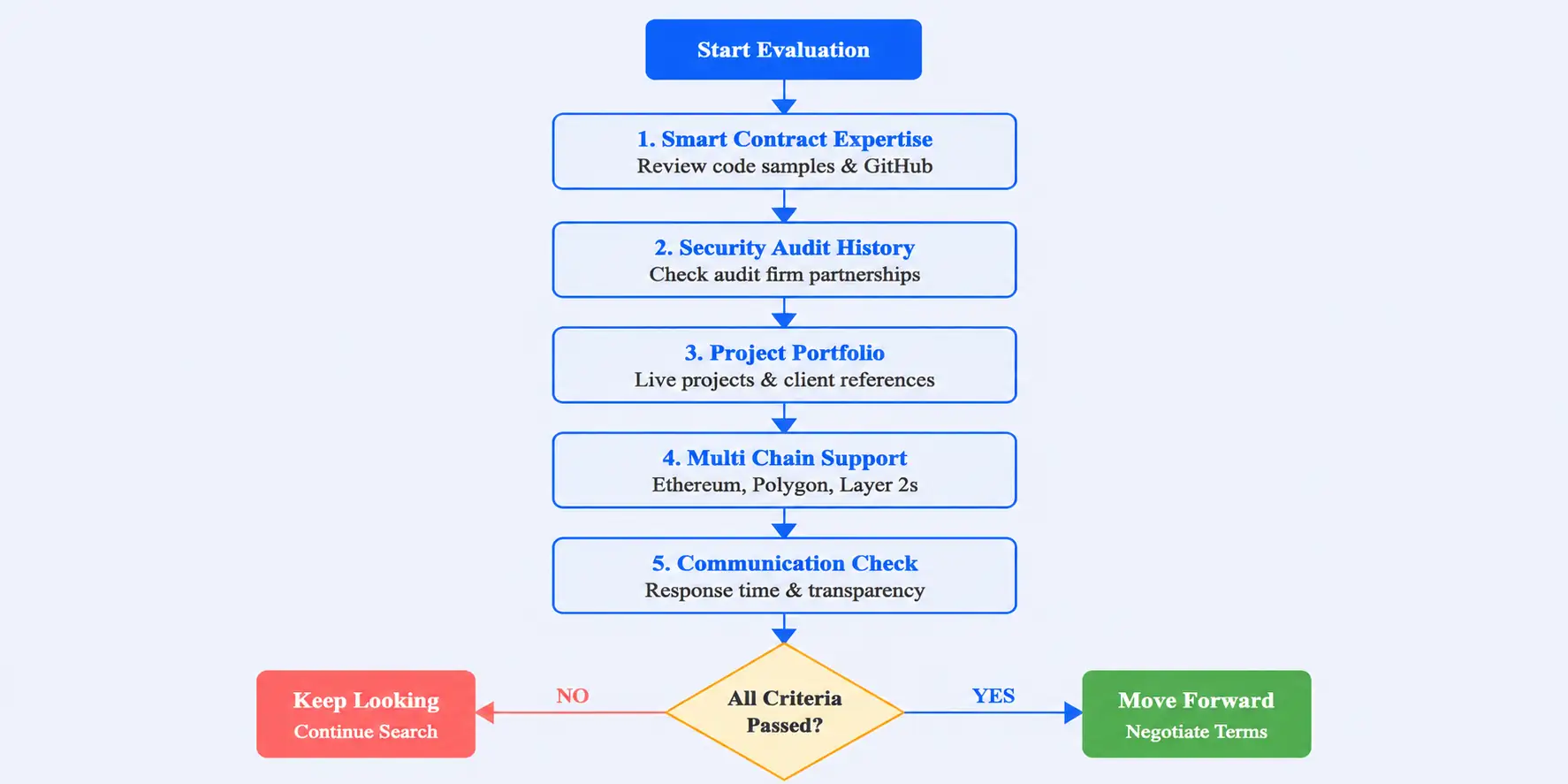
Step by Step Process to Choose the Right DeFi Development Company
Here’s a structured approach to make the decision systematically.
Step 1: Define Your Requirements (Week 1)
- What exactly are you building? (DEX, lending protocol, staking, etc.)
- Which blockchains do you need?
- What’s your budget and timeline?
- Who are your target users?
- What are your security requirements?
Step 2: Create a Shortlist (Week 2)
- Research companies online (GitHub, Twitter, forums, portfolio sites)
- Ask for recommendations in DeFi communities (Discord, Reddit)
- Review case studies and published projects
- Narrow down to 5 to 10 serious candidates
Step 3: Technical Assessment (Week 3)
- Request code samples (anonymized if needed)
- Review their GitHub repositories and commit history
- Conduct technical interviews with their lead developer
- Ask specific questions about your use case
- Request a technical proposal outlining their approach
Step 4: Verify References (Week 4)
- Request 3 to 5 client references
- Contact them directly, not through the company
- Ask about communication, timeline, challenges, and outcomes
- Check if they’d work with them again
Step 5: Security Assessment (Week 5)
- Review their audit history and relationships
- Ask how they handle security in development
- Understand their post launch support and monitoring
- Budget allocation for security and audits
Step 6: Final Selection (Week 6)
- Narrow down to 2 to 3 final candidates
- Request detailed proposals with milestones and pricing
- Compare and negotiate terms
- Get everything in writing with clear SLAs
- Sign agreement and begin onboarding
Comparison of Good vs Bad DeFi Development Companies
This table shows the clear differences in key areas:
| Evaluation Criteria | Good DeFi Development Company | Bad DeFi Development Company |
|---|---|---|
| Experience | 5+ years in DeFi, 20+ live projects, clear portfolio | Less than 2 years, few finished projects, vague portfolio |
| Security | Regular audits from tier 1 firms, security first approach | No audits, dismisses security concerns, no audit partnerships |
| Pricing | Transparent pricing, clear deliverables, no hidden fees | Vague pricing, surprise costs, unusual payment terms |
| Communication | Weekly updates, clear point of contact, responsive | Slow responses, unclear process, rotating contacts |
| Post Launch Support | 24/7 monitoring, SLA guarantees, ongoing updates | Support ends at launch, extra fees for fixes, unavailable |
| Risk Level | Low risk, proven track record, clear guarantees | High risk, unproven team, no guarantees or insurance |
Real World Example of a Hiring Mistake
Let’s look at a real scenario that shows what goes wrong:
The Mistake:
A startup raises $2 million for their DeFi lending protocol. They hire a cheap development firm that promises delivery in 4 months at $200,000. The team has some blockchain experience but never built a production DeFi platform.
What Happens:
- Month 2: Project falls behind. No explanation why.
- Month 4: Half finished. Timeline slips to 6 months.
- Month 6: Code is delivered but untested and poorly documented.
- Launch day: Platform runs but with critical bugs. Transactions sometimes fail silently.
- Week 1 post launch: Users report lost funds. Investigation reveals reentrancy vulnerability.
- Result: Project implodes. Company shuts down. Reputation destroyed.
What Went Wrong: They chose based on price, not competence. They didn’t verify experience. They skipped security audits. They didn’t check references. A $200,000 mistake cascaded into a $2,000,000 loss.
The right approach: Spend more upfront on a proven team. A quality company charges more but delivers working code, passes audits, and provides support. The difference between $200,000 and $500,000 in development costs is trivial compared to the cost of failure.
Questions to Ask Before Hiring a DeFi Development Company
Use these questions in your interviews to separate qualified partners from pretenders.
Technical Questions:
- “Walk me through how you’d architect our DeFi platform. What smart contracts would you use?”
- “What’s your approach to gas optimization and reducing transaction costs?”
- “How do you handle contract upgradability? What pattern do you use?”
- “Explain your testing strategy. What test coverage do you require?”
- “How do you prevent common vulnerabilities like reentrancy, overflow, and front running?”
- “Show me an example of a complex contract you’ve built. Explain the architecture.”
Security Questions:
- “Which audit firms have you worked with? Can we see audit reports?”
- “What vulnerabilities have been found in your past projects?”
- “How do you incorporate security into the development process?”
- “What’s your budget allocation for security audits in our project?”
- “How do you stay current with emerging security threats?”
Experience Questions:
- “How many live DeFi projects are currently running that you built?”
- “What’s the total value locked across your projects?”
- “Can you share 5 references from recent clients?”
- “Tell me about a project that failed. What did you learn?”
- “Which team members will work on our project? Show me their backgrounds.”
Process Questions:
- “Walk me through your development process from start to finish.”
- “How often do we communicate? What’s your update frequency?”
- “How do you handle scope changes and additional requirements?”
- “What happens post launch? What support do you provide?”
- “What are your SLAs for bug fixes and issue response?”
Cost Transparency and Hidden Risks
Cost is important, but it’s not the only factor. Many companies hide costs or add unexpected fees. Here’s how to avoid that.
Typical DeFi Development Costs:
| Project Type | Development Cost | Timeline |
| Simple token or ERC20 | $10,000 to $30,000 | 2 to 4 weeks |
| DEX or AMM | $100,000 to $300,000 | 3 to 6 months |
| Lending Protocol | $150,000 to $400,000 | 4 to 8 months |
| Complex multi chain platform | $300,000 to $1,000,000+ | 6 to 12 months |
What to Include in Your Budget:
- Development: Smart contracts, frontend, backend infrastructure
- Testing: Unit tests, integration tests, stress testing
- Security Audits: $20,000 to $100,000 depending on complexity
- Deployment: Testnet and mainnet deployment, monitoring setup
- Documentation: Technical documentation, user guides
- Post launch support: 3 to 6 months of free updates and fixes
Hidden Costs to Watch For:
- Extra charges for additional features or changes (get fixed scope)
- Separate audit fees not mentioned upfront
- Charges for post launch support or bug fixes
- Licensing fees for third party libraries
- Hosting and infrastructure costs
- Team scaling or extension costs
Pro Tip: Ask for a detailed cost breakdown showing exactly what’s included. Request a fixed price proposal with clear deliverables and milestone based payments.
Benefits of Choosing the Right DeFi Development Partner
Investing in a quality development partner delivers benefits that extend far beyond launch day.
Reduced Security Risk
Experienced teams catch vulnerabilities before they become exploits. Your users’ funds stay safe.
Faster Market Entry
Professional teams meet timelines. You launch on schedule and capture market opportunities.
Better Code Quality
Clean, efficient code scales to handle millions of transactions without performance issues.
Lower Total Cost of Ownership
Yes, quality costs more upfront. But you save massively on fixes, rewrites, and compensation.
Ongoing Support
Issues that arise after launch get fixed quickly. Monitoring and updates keep you running smoothly.
Competitive Advantage
A strong technical foundation lets you innovate quickly and stay ahead of competitors.
Common Mistakes to Avoid When Selecting a Company
Learn from what others did wrong so you don’t repeat their mistakes.
Mistake 1: Choosing Based Only on Price
The cheapest option is often the worst. You get what you pay for. A developer charging $50/hour versus $150/hour probably isn’t just cheaper, they’re less experienced.
Mistake 2: Not Checking References
Companies refer you to their best clients. Contact clients they don’t suggest. Ask hard questions. Don’t trust testimonials on their website.
Mistake 3: Skipping Security Audits
No shortcuts on audits. Every DeFi platform handling real funds needs independent security review. Budget for it from day one.
Mistake 4: Unclear Scope and Requirements
Vague specifications lead to misaligned expectations. Define exactly what you want before you hire. Get agreements in writing.
Mistake 5: Poor Communication Setup
If you can’t easily contact the team or they’re slow to respond, that’s a red flag. Communication during development is critical.
Mistake 6: Ignoring Post Launch Support
Don’t work with teams that disappear after launch. Issues will arise. You need accessible support for bug fixes and optimization.
Future Trends in DeFi Development
The DeFi landscape is evolving rapidly. Look for partners who stay ahead of trends.
1. Multi Chain as Standard
Single chain platforms are becoming obsolete. Users want liquidity and utility across networks. Your development partner should build multi chain by default, not as an afterthought.
2. Modular Blockchain Architecture
Modular blockchains (separation of settlement, execution, and data layers) are changing how DeFi gets built. Partners understanding this architecture have a huge advantage.
3. ZK Proofs and Privacy
Zero knowledge proofs enable privacy in DeFi without sacrificing transparency. This is becoming standard. Ask if your potential partner understands ZK technology.
4. Regulatory Compliance By Design
Regulations are tightening worldwide. Forward thinking companies build compliance into architecture rather than bolting it on later. This matters for your long term viability.
5. AI Assisted Development and Auditing
AI is improving code quality and security analysis. Look for teams leveraging these tools to improve safety and efficiency.
Build Secure DeFi Platforms with Confidence
Choosing the right DeFi development company is one of your most important decisions. You need a partner with proven expertise, security focus, and commitment to your success. Nadcab Labs brings 10+ years of blockchain development experience, track record of successful platform launches, comprehensive security practices, and dedicated post launch support. We’ve helped dozens of founders build trusted DeFi platforms from concept to production.
Let’s discuss your project requirements and show you how we approach DeFi development differently.
Making Your Final Decision
Selecting a DeFi development company isn’t a quick decision. It shouldn’t be. This partnership will define your product, timeline, budget, and ultimately, success or failure.
Remember:
- Don’t hire based on price alone.
- Verify experience through live projects and client references.
- Prioritize security and audit capabilities.
- Ensure clear communication and transparent processes.
- Get everything in writing with clear SLAs.
- Choose a partner for the long term, not just development.
Take your time. Do the evaluation properly. Ask tough questions. Check references. The extra time invested in hiring the right DeFi development company will pay massive dividends.
Now that you understand how to evaluate and choose the right DeFi development company, the next step is finding your partner and having detailed conversations about your specific needs.
Frequently Asked Questions
Q1.What's the typical timeline for DeFi platform development?
Timeline varies based on complexity. A simple token takes 2 to 4 weeks. A DEX or lending protocol takes 3 to 8 months. Complex multi chain platforms with advanced features take 6 to 12 months or longer. Always expect experienced developers to give realistic timelines with buffer for testing and security audits.
Q2.How much should I budget for security audits?
Budget depends on contract complexity and audit firm tier. A basic audit from a mid tier firm costs $15,000 to $30,000. Tier 1 firms (Trail of Bits, Consensys) charge $50,000 to $150,000 or more. For critical platforms handling large sums, investing in multiple audits is worth it. Never skip this step for DeFi.
Q3.Can I use open source DeFi code and just hire a team to customize it?
Yes, it’s viable for some use cases. Forking projects like Uniswap or Aave and customizing them can be faster and cheaper than building from scratch. However, you still need experienced developers to customize safely, understand the codebase deeply, and integrate your unique features. Security audits are still mandatory. This approach works well for teams with specific customization needs.
Q4.What happens if the development company goes out of business after I hire them?
This is a real risk. Protect yourself by: requiring they provide all source code and documentation, including it in your contract with clear ownership terms, maintaining regular code backups, hiring established companies with stable financials, and getting escrow arrangements for large projects. Ask about their continuity plan if team members leave. Having access to all code ensures you can continue development with another team if needed.
Q5.Should I hire a freelancer or an agency for my DeFi project?
Freelancers are cheaper but higher risk. Agencies provide stability, team resources, and accountability. For simple projects or MVP work, freelancers can work. For production DeFi platforms with significant funds at stake, hire an established agency. You need multiple skilled developers, project management, testing infrastructure, and support. The higher cost is justified by reduced risk and better outcomes.
Q6.What's the difference between a DeFi developer and a Web3 developer?
DeFi developers specialize in decentralized finance protocols, smart contracts, tokenomics, and financial mechanisms. Web3 developers work on a broader range of blockchain applications including NFTs, DAOs, metaverse, and other uses. For DeFi projects, hire a DeFi specialist. They understand financial protocols, security nuances, and specific architectures like AMM design or lending mechanics that general Web3 developers might not.
Q7.How do I evaluate if a DeFi development company really understands security?
Ask them to explain common vulnerabilities: reentrancy, integer overflow, front running, and oracle manipulation. If they can’t explain these clearly or minimize their importance, that’s a red flag. Look for partnerships with audit firms, security research papers they’ve published, and bug bounty programs on their projects. Real security focused teams talk about attack vectors and prevention constantly.
Q8.Can a DeFi development company help with tokenomics design?
Yes, quality companies offer this service. Smart tokenomics design affects your protocol’s success more than you’d think. Ask if they provide input on token distribution, emission schedules, incentive mechanisms, and economic sustainability. Some companies have dedicated tokenomics consultants. This expertise is valuable and worth paying for. Poor tokenomics can doom an otherwise excellent project.
Q9.What post launch support do I really need from a DeFi development company?
At minimum: 24/7 uptime monitoring, emergency response for critical issues, monthly security updates, and performance optimization. Ideally: quarterly smart contract reviews, gas optimization improvements, feature additions, and proactive issue detection. Budget for ongoing support costs. Most companies offer this through a retainer or managed services model. Don’t consider launching without a support agreement in place.
Q10.How do I handle IP ownership and code rights in my development contract?
Always get clear written agreement that you own all code and IP developed. Specify that the company cannot reuse your code for other projects. Request access to all source code, documentation, and development repositories. Include buyout terms if the company is acquired. Have your lawyer review contracts before signing. Clear IP ownership prevents disputes and ensures you can continue development with another team if needed. This is non negotiable for your business.
Explore Services
Related Services
Reviewed by

Aman Vaths
Founder of Nadcab Labs
Aman Vaths is the Founder & CTO of Nadcab Labs, a global digital engineering company delivering enterprise-grade solutions across AI, Web3, Blockchain, Big Data, Cloud, Cybersecurity, and Modern Application Development. With deep technical leadership and product innovation experience, Aman has positioned Nadcab Labs as one of the most advanced engineering companies driving the next era of intelligent, secure, and scalable software systems. Under his leadership, Nadcab Labs has built 2,000+ global projects across sectors including fintech, banking, healthcare, real estate, logistics, gaming, manufacturing, and next-generation DePIN networks. Aman’s strength lies in architecting high-performance systems, end-to-end platform engineering, and designing enterprise solutions that operate at global scale.