Ai Overview
Launching a cryptocurrency token or coin requires meticulous planning, technical execution, and strategic coordination across multiple phases. Projects should budget $5,000 to $50,000+ for professional audits, with costs scaling based on code lines, complexity, and firm reputation. According to industry data, projects allocating 15-25% of marketing budgets to influencer partnerships typically see 3-5x higher community growth rates during pre-launch phases.
Launching a cryptocurrency token or coin requires meticulous planning, technical execution, and strategic coordination across multiple phases. Understanding the realistic timeline for token and coin launch helps projects allocate resources appropriately, set achievable milestones, and manage stakeholder expectations throughout the development and deployment process. While timelines vary based on complexity, regulatory requirements, and technical specifications, most successful launches follow predictable patterns spanning several weeks to months.
The token launch timeline encompasses critical stages from initial concept development through post-launch optimization. Projects must navigate technical development including smart contract creation and testing, legal structuring addressing regulatory compliance, marketing campaigns building community awareness, and exchange listing processes establishing trading accessibility. Each phase carries dependencies and potential bottlenecks that can extend timelines if not properly anticipated and managed through experienced project coordination.
Key Takeaways
- Minimum Launch Timeline: Basic token launches require 4-8 weeks minimum, while complex blockchain projects with custom features may extend to 6-12 months depending on technical requirements and regulatory compliance needs.
- Pre-Development Planning Critical: Initial planning including concept validation, tokenomics design, legal structuring, and team assembly typically consumes 2-4 weeks before any code development begins.
- Smart Contract Development Duration: Creating, testing, and auditing smart contracts generally requires 3-6 weeks for standard implementations, with complex functionality potentially doubling this timeframe.
- Security Audits Non-Negotiable: Professional smart contract audits by reputable firms take 2-4 weeks and should never be rushed, as vulnerabilities can result in catastrophic losses post-launch.
- Legal Compliance Extends Timeline: Regulatory analysis, token classification determination, and compliance documentation preparation add 3-8 weeks depending on jurisdiction complexity and token characteristics.
- Community Building Requires Lead Time: Effective marketing and community development should begin 4-6 weeks pre-launch to build awareness, attract early adopters, and ensure successful token generation event participation.
- Exchange Listing Process Lengthy: Centralized exchange listings require 4-12 weeks for application review, technical integration, legal verification, and market making arrangements before trading commences.
- Post-Launch Support Essential: Ongoing monitoring, community management, liquidity provision, and iterative improvements continue indefinitely after launch, requiring dedicated resources and budget allocation.
Phase 1: Pre-Development Planning (2-4 Weeks)
Successful token launches begin with comprehensive planning establishing project foundations before any technical development commences. This critical phase defines project scope, validates market opportunity, designs economic models, and assembles the team required for execution. Rushing through planning to accelerate development typically results in fundamental flaws requiring expensive corrections later.
Concept Development and Market Validation
Projects should begin by clearly defining the problem being solved, target audience, and unique value proposition differentiating the token from existing alternatives. Market research validates whether genuine demand exists for the proposed solution and identifies competitive positioning. This analysis determines whether the project merits investment of time and capital required for launch.
Stakeholder alignment during this phase ensures founding team members, investors, and advisors share common vision regarding project goals, success metrics, and strategic priorities. Documenting these agreements prevents future conflicts that could derail development or create legal complications post-launch.
Tokenomics Design and Economic Modeling
Token economics design determines total supply, distribution schedule, vesting periods, utility mechanisms, and value capture models aligning stakeholder incentives with project success. This architecture profoundly impacts long-term sustainability, requiring careful consideration of supply-demand dynamics, inflationary or deflationary pressures, and token velocity implications.
Legal Structure and Regulatory Planning
Understanding cryptocurrency legality in target markets determines which regulatory frameworks apply to the token. Classification as utility, security, payment, or hybrid instrument triggers different compliance obligations affecting permissible distribution methods, investor restrictions, and ongoing reporting requirements.
Legal planning establishes corporate entities, defines governance structures, and prepares necessary documentation including terms of service, privacy policies, and token sale agreements. Engaging qualified legal counsel during this phase prevents regulatory violations that could result in enforcement actions, fines, or project shutdown.
Team Assembly and Resource Allocation
Building the project team involves recruiting or contracting blockchain developers, smart contract auditors, legal advisors, marketing specialists, and community managers possessing relevant expertise. Team capabilities directly impact timeline execution, with experienced professionals accelerating development while reducing error risks.
Budget allocation determines resource availability across development, legal compliance, security audits, marketing, and liquidity provision. Understanding crypto token cost helps projects raise adequate funding and avoid mid-project capital shortfalls delaying launch or compromising quality.
| Planning Activity | Duration | Key Deliverables |
|---|---|---|
| Concept Validation | 3-5 days | Problem statement, value proposition, competitive analysis |
| Tokenomics Design | 5-10 days | Supply model, distribution schedule, utility mechanisms |
| Legal Structuring | 7-14 days | Entity formation, regulatory analysis, documentation |
| Team Assembly | 7-10 days | Developer contracts, advisor agreements, role assignments |
Phase 2: Technical Development (3-8 Weeks)
Technical development turns conceptual designs into fully functional code, implementing token logic, distribution mechanisms, and platform integrations. Partnering with a reliable token development company ensures this phase follows rigorous engineering practices, including version control, code review, and comprehensive testing, guaranteeing that smart contracts function correctly across all scenarios.
Smart Contract Development
Smart contract creation involves writing code defining token properties, transfer rules, minting and burning functions, access controls, and any custom features required by tokenomics design. Developers typically leverage established token standards like ERC-20, ERC-721, or BEP-20 providing tested frameworks reducing development time and improving compatibility.
Standard token implementations may require only 1-2 weeks development, while complex contracts incorporating vesting schedules, governance mechanisms, staking functionality, or cross-chain bridges can extend to 4-6 weeks. Code quality directly impacts security, necessitating experienced developers following best practices and avoiding common vulnerabilities.
Testing and Quality Assurance
Comprehensive testing validates smart contract functionality across normal operations and edge cases that could expose vulnerabilities or unexpected behaviors. Unit tests verify individual function correctness, integration tests ensure component interactions work properly, and stress tests assess performance under high transaction volumes.
Testnet deployment allows developers to observe contract behavior in blockchain environments resembling production without risking real funds. This phase typically consumes 1-2 weeks for standard implementations and 2-4 weeks for complex contracts requiring extensive scenario coverage. Rushing testing invites catastrophic failures post-launch when vulnerabilities are exploited.
Security Audits
Professional security audits by specialized firms examine smart contract code for vulnerabilities, logic errors, and compliance with best practices. Auditors test for common exploits including reentrancy attacks, integer overflow, access control failures, and front-running vulnerabilities that could enable fund theft or contract manipulation.
Reputable audit firms require 2-4 weeks for thorough review depending on contract complexity and audit scope. Projects should budget $5,000 to $50,000+ for professional audits, with costs scaling based on code lines, complexity, and firm reputation. Multiple audit rounds may be necessary if initial reviews identify issues requiring remediation and re-verification.
Platform and Wallet Integration
Integrating tokens with wallets, block explorers, and decentralized applications ensures users can easily interact with and monitor their holdings. This involves submitting token information to services like MetaMask, Trust Wallet, and Etherscan, which may require verification and typically process within 1-2 weeks.
Cross-platform compatibility testing verifies tokens function correctly across different wallets, browsers, and mobile applications. This quality assurance prevents user experience issues that could hinder adoption and damage project reputation during critical early growth phases.
| Development Stage | Duration | Critical Outputs |
|---|---|---|
| Contract Coding | 1-6 weeks | Functional smart contract implementing tokenomics |
| Testing Phase | 1-4 weeks | Verified functionality, testnet deployment results |
| Security Audit | 2-4 weeks | Audit report, vulnerability remediation, certification |
| Integration | 1-2 weeks | Wallet compatibility, explorer listings, API connections |
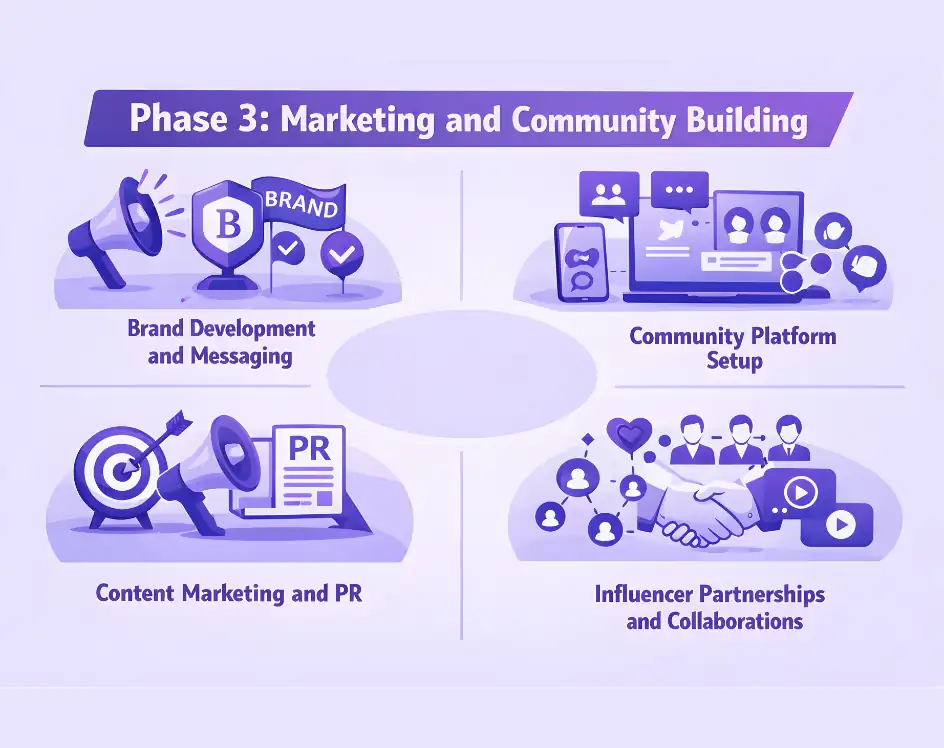
Phase 3: Marketing and Community Building (4-8 Weeks)
Marketing and community development create awareness, generate interest, and build the user base essential for successful token adoption. This phase should begin well before technical launch, allowing time to cultivate engaged communities that participate in token generation events and provide early liquidity.
Brand Development and Messaging
Establishing a strong project identity through strategic logo design, comprehensive visual guidelines, messaging frameworks, and clear positioning statements ensures a consistent and impactful brand presence across all touchpoints. Leveraging a professional logo design service as part of a broader branding strategy helps maintain visual consistency and clarity from the start. Professional branding not only distinguishes projects from competitors but also communicates clear value propositions to target audiences, strengthening recognition, trust, and long-term market positioning.
Website development showcasing project vision, team credentials, tokenomics, roadmap, and technical documentation serves as the authoritative information source for investors, users, and partners. High-quality websites typically require 2-4 weeks for design, development, and content creation.
Community Platform Setup
Creating social media presence across Twitter, Telegram, Discord, and Reddit provides channels for community engagement, announcement distribution, and support provision. Active community management fosters discussions, answers questions, and moderates conversations, maintaining positive environments. Utilizing social media tools can help streamline content scheduling and analytics, ensuring more consistent engagement.
Community building should commence 4-6 weeks before token launch, allowing time to grow follower bases, establish credibility, and generate organic interest. Projects typically aim for thousands of engaged community members before launching to ensure sufficient participation in token generation events and early trading.
Content Marketing and PR
Content creation including blog posts, videos, infographics, and educational materials, explains project value propositions, demonstrates use cases, and addresses common questions. High-quality content distributed across owned channels and industry publications builds thought leadership and attracts potential users.
Public relations campaigns securing coverage in cryptocurrency news outlets, podcasts, and industry publications expand reach beyond organic channels. Major outlets receive hundreds of pitches daily, requiring compelling stories and persistent outreach often facilitated by specialized PR agencies over 4-8 week campaigns.
Influencer Partnerships and Collaborations
Collaborating with cryptocurrency influencers, YouTubers, and thought leaders provides access to established audiences interested in new projects. According to industry data, projects allocating 15-25% of marketing budgets to influencer partnerships typically see 3-5x higher community growth rates during pre-launch phases.
Vetting influencers ensures alignment with project values and audience authenticity, as partnerships with low-quality or fraudulent promoters damage reputation more than helping visibility. Strategic influencer campaigns typically span 3-6 weeks coordinating content releases, AMAs, and promotion timing.
Phase 4: Token Generation and Distribution (1-4 Weeks)
The token generation event marks the technical creation of tokens and initiation of distribution to stakeholders through various mechanisms. This critical phase requires careful coordination ensuring smooth execution while complying with applicable regulations and managing participant expectations.
Mainnet Deployment
Deploying smart contracts to mainnet blockchain networks makes tokens functional and accessible to users. This process involves final configuration verification, transaction broadcasting, and contract address publication enabling interaction through wallets and applications.
Mainnet deployment for simple tokens can complete within hours, but complex projects with multiple contract interactions may require 1-2 days for comprehensive deployment and verification. Post-deployment monitoring ensures contracts function as expected under real-world conditions with actual user transactions.
Private Sale and Presale Execution
Private sales to early investors and presales to community members typically precede public launches, providing project funding while distributing tokens to committed stakeholders. These sales require legal compliance with securities regulations, investor verification procedures, and secure payment processing.
Private sale rounds may span 1-3 weeks allowing adequate time for investor due diligence, legal documentation execution, and fund collection. Presales offering community participation opportunities typically run shorter periods of 3-7 days creating urgency while maintaining accessibility.
Airdrop and Reward Distribution
Airdrops distributing tokens to existing community members, early supporters, or holders of related assets incentivize adoption and reward loyalty. Executing airdrops requires compiling recipient lists, verifying eligibility criteria, and batch transferring tokens efficiently to potentially thousands of addresses.
Smart contract-based claim mechanisms allow recipients to pull tokens rather than projects pushing distributions, reducing transaction costs and preventing waste on inactive addresses. Claim periods typically remain open 2-4 weeks providing adequate time for participation.
Vesting Schedule Implementation
Token vesting prevents immediate selling by team members, advisors, and early investors, aligning incentives with long-term project success. Vesting contracts lock tokens releasing gradually over predefined schedules, typically spanning 6-48 months depending on stakeholder category and agreement terms.
Implementing vesting requires additional smart contract development during the technical phase, with ongoing administration monitoring release schedules and processing distributions according to agreed timelines.
Phase 5: Exchange Listing and Trading Launch (4-12 Weeks)
Exchange listings enable public trading providing liquidity and price discovery essential for token utility and value realization. The listing process varies dramatically between decentralized and centralized exchanges, with centralized platforms requiring significantly longer timelines and more extensive documentation.
Decentralized Exchange Listings
Launching on decentralized exchanges like Uniswap, PancakeSwap, or Raydium provides immediate trading access with minimal gatekeeping. Projects create liquidity pools pairing their tokens with established assets like ETH or stablecoins, enabling automated market making through constant product formulas.
DEX listings can complete within days once tokens deploy to mainnet, requiring primarily liquidity provision and pool creation rather than extensive application processes. However, projects must provide sufficient initial liquidity preventing excessive price slippage that deters trading and damages perception.
Centralized Exchange Applications
Applying to centralized exchanges involves comprehensive submissions including project documentation, team information, legal opinions, audit reports, and community metrics demonstrating genuine traction. Major exchanges receive thousands of applications monthly, accepting only projects meeting strict quality and compliance standards.
Application review processes span 4-12 weeks from submission to listing decision, with tier-1 exchanges often requiring 3-6 months. Listing fees vary from zero for selective exchanges to hundreds of thousands of dollars for premium placements on major platforms. A recent survey found average listing fees on mid-tier exchanges reached $50,000-$150,000 in 2024.
Market Making and Liquidity Provision
Ensuring adequate liquidity requires providing sufficient token and base currency pairs enabling smooth trading without excessive price impact. Projects either provide liquidity directly or engage professional market makers maintaining tight spreads and order book depth.
Market maker agreements typically require 3-6 month commitments with monthly fees ranging from $10,000 to $100,000+ depending on market cap targets and exchange requirements. These partnerships significantly improve trading experiences encouraging adoption and reducing manipulation risks.
Regulatory Compliance and KYC
Centralized exchanges increasingly require comprehensive compliance verification before listing tokens, including legal opinions confirming regulatory status, KYC information on team members, and documentation demonstrating proper corporate structure and governance.
This compliance preparation can extend listing timelines by several weeks if not completed proactively during earlier development phases. Working with experienced coin and token development service providers helps projects navigate these requirements efficiently.
| Exchange Type | Timeline | Requirements | Typical Costs |
|---|---|---|---|
| DEX (Uniswap/PancakeSwap) | 1-3 days | Liquidity provision, pool creation | Liquidity only ($10K-$100K+) |
| Tier-3 CEX | 2-4 weeks | Application, basic documentation | $5K-$30K listing fee |
| Tier-2 CEX | 6-10 weeks | Comprehensive docs, audit, legal opinion | $50K-$150K listing fee |
| Tier-1 CEX | 3-6 months | Full compliance, significant traction, audit | $100K-$1M+ or merit-based |
Phase 6: Post-Launch Operations (Ongoing)
Token launch marks the beginning rather than conclusion of project development, with ongoing operations essential for maintaining momentum, addressing issues, and delivering on roadmap commitments. Post-launch success requires sustained effort across technical maintenance, community engagement, and strategic development.
Monitoring and Technical Support
Continuous monitoring tracks smart contract performance, transaction patterns, and potential security threats requiring rapid response. Establishing alert systems notifying teams of unusual activities enables proactive issue resolution before problems escalate.
Technical support channels assist users experiencing difficulties with wallets, transactions, or platform interactions. Responsive support builds confidence and loyalty while identifying common pain points informing product improvements.
Community Management and Engagement
Active community management maintains engagement through regular updates, AMAs, events, and discussions fostering vibrant ecosystems around tokens. Transparency regarding development progress, challenges encountered, and strategic decisions builds trust essential for long-term community support.
Incentive programs including staking rewards, liquidity mining, or governance participation encourage ongoing token utility rather than purely speculative holding. These mechanisms align community interests with project success while demonstrating token functionality beyond trading.
Marketing and Partnership Development
Sustained marketing efforts maintain visibility in competitive markets where new projects launch continuously. Content creation, PR campaigns, and paid advertising require ongoing investment preserving awareness and attracting new users as markets evolve.
Strategic partnerships with complementary projects, integration into larger ecosystems, and business development initiatives expand token utility and adoption. According to industry analysis, tokens securing major partnerships within six months of launch see 40% higher retention rates compared to isolated projects.
Roadmap Execution and Feature Development
Delivering on roadmap commitments demonstrates team capability and maintains community confidence. Ongoing efforts in crypto token development, feature enhancements, platform improvements, and ecosystem expansion often involve technical work that exceeds the scope and complexity of the initial launch.
Iterative improvements based on user feedback and market conditions keep projects competitive and relevant. Successful tokens evolve continuously rather than remaining static post-launch, adapting to changing market dynamics and user needs.
Accelerate Your Token Launch Timeline
Partner with experienced blockchain development professionals to streamline your token launch process, avoid common delays, and ensure successful deployment within optimal timeframes.
Factors Affecting Launch Timelines
Multiple variables influence how quickly projects can progress from concept to launch, with realistic timeline estimation requiring honest assessment of project complexity, team capabilities, and resource availability.
Technical Complexity
Simple ERC-20 tokens implementing standard functionality can launch within 4-6 weeks, while custom blockchain protocols with novel consensus mechanisms may require 12+ months. Feature complexity including cross-chain bridges, complex governance systems, or integration with external protocols multiplies development and testing requirements.
Regulatory Requirements
Projects operating in heavily regulated jurisdictions or issuing security tokens face extended timelines obtaining necessary approvals, completing compliance documentation, and implementing required safeguards. Regulatory analysis and legal structuring can add 2-6 months to launch schedules depending on jurisdiction complexity.
Team Experience and Resources
Experienced development teams familiar with blockchain technologies, smart contract security, and token economics execute significantly faster than teams learning while building. Resource availability including developer capacity, budget for audits and marketing, and access to legal counsel directly impacts timeline execution.
Market Conditions
Bull markets create urgency accelerating timelines as projects rush to capitalize on investor enthusiasm, while bear markets allow more deliberate development as reduced competitive pressure enables thorough preparation. Network congestion on popular blockchains can delay testing and deployment requiring flexibility in scheduling.
Final Thoughts
Understanding the realistic timeline for token and coin launch enables proper planning, resource allocation, and stakeholder communication throughout the development and deployment process. While minimum viable launches can complete within 4-8 weeks, most successful projects invest 3-6 months ensuring comprehensive planning, rigorous development, thorough security auditing, effective marketing, and proper exchange integration.
Rushing critical phases like security audits, legal compliance, or community building to accelerate launches often backfires through vulnerabilities, regulatory violations, or failed token generation events. Projects should establish realistic timelines accounting for dependencies, potential delays, and quality assurance requirements rather than optimizing purely for speed.
The most successful token launches balance urgency with thoroughness, moving efficiently through development while investing adequate time in activities preventing catastrophic failures or regulatory issues. Working with experienced service providers, following established best practices, and maintaining focus on long-term sustainability rather than short-term deadlines creates foundations for projects surviving beyond initial hype cycles.
Post-launch operations require sustained commitment often exceeding pre-launch efforts, with successful projects continuously developing, engaging communities, and delivering value demonstrating tokens serve genuine purposes beyond speculation. The timeline for token launch never truly ends, evolving into ongoing development and ecosystem building essential for achieving lasting impact and value creation.
Frequently Asked Questions
Q1.how long does token launch take?
minimum viable token launches require four to eight weeks, while comprehensive projects with marketing, audits, and exchange listings typically need three to six months. complex blockchain protocols may extend to twelve months or longer.
Q2.can tokens launch in one week?
technically possible but extremely risky. one-week launches skip critical security audits, legal compliance, community building, and testing phases, exposing projects to vulnerabilities, regulatory violations, and launch failures that damage long-term viability.
Q3.what delays token launches most?
security audits awaiting firm availability, exchange listing application reviews, regulatory compliance documentation, and smart contract bug remediation commonly extend timelines. inadequate planning and resource shortfalls also cause significant delays mid-project.
Q4.when should marketing begin?
marketing and community building should commence four to six weeks before token generation events, allowing adequate time to build awareness, grow engaged communities, and generate sufficient participation ensuring successful launches.
Q5.how long are security audits?
professional smart contract audits require two to four weeks for thorough review depending on code complexity. multiple audit rounds may extend timelines if initial reviews identify vulnerabilities requiring remediation and re-verification.
Q6.what affects exchange listing timeline?
application review processes, compliance verification, technical integration requirements, and exchange tier significantly impact timelines. decentralized exchanges list within days while tier-one centralized exchanges may require three to six months.
Explore Services
Related Services
Reviewed by

Aman Vaths
Founder of Nadcab Labs
Aman Vaths is the Founder & CTO of Nadcab Labs, a global digital engineering company delivering enterprise-grade solutions across AI, Web3, Blockchain, Big Data, Cloud, Cybersecurity, and Modern Application Development. With deep technical leadership and product innovation experience, Aman has positioned Nadcab Labs as one of the most advanced engineering companies driving the next era of intelligent, secure, and scalable software systems. Under his leadership, Nadcab Labs has built 2,000+ global projects across sectors including fintech, banking, healthcare, real estate, logistics, gaming, manufacturing, and next-generation DePIN networks. Aman’s strength lies in architecting high-performance systems, end-to-end platform engineering, and designing enterprise solutions that operate at global scale.