Ai Overview
The legality of cryptocurrency remains one of the most critical considerations for investors, developers, and businesses navigating the digital asset landscape. As the global crypto market surpassed $3 trillion in total capitalization during 2025, regulatory clarity has become paramount for sustainable industry growth and mainstream adoption. India implements a comprehensive taxation regime for cryptocurrency transactions including 30% flat tax on gains from crypto sales plus 4% cess.
The legality of cryptocurrency remains one of the most critical considerations for investors, developers, and businesses navigating the digital asset landscape. Understanding cryptocurrency laws across different jurisdictions proves essential as regulatory frameworks continue evolving rapidly worldwide. While some countries embrace digital assets with clear legal structures, others maintain restrictive approaches or exist in regulatory gray zones creating uncertainty for market participants.
Legal status of cryptocurrency varies dramatically by jurisdiction, with classifications ranging from property and commodities to securities and payment instruments. This classification determines applicable regulations, tax treatment, compliance obligations, and operational permissions affecting how individuals and entities can interact with digital assets. As the global crypto market surpassed $3 trillion in total capitalization during 2025, regulatory clarity has become paramount for sustainable industry growth and mainstream adoption.
Key Takeaways
- Legal Status Varies Globally: Cryptocurrency classifications span property, commodities, securities, payment instruments, and digital assets depending on jurisdiction, each triggering different regulatory requirements and compliance obligations.
- Regulatory Frameworks Evolving: Major economies including the United States, European Union, and Asian jurisdictions continue developing comprehensive crypto regulations balancing innovation with investor protection and financial stability.
- Token Classification Critical: Legal qualification of tokens as utility, security, payment, or hybrid instruments determines applicable securities laws, licensing requirements, and distribution restrictions across jurisdictions.
- Compliance Requirements Stringent: Virtual asset service providers must implement robust AML/KYC procedures, transaction monitoring, regulatory reporting, and consumer protection measures meeting international standards.
- Tax Treatment Established: Most jurisdictions tax cryptocurrency transactions as property sales, capital gains, or income depending on activity type, with reporting obligations and withholding requirements increasingly enforced.
- India’s VDA Framework: India legally recognizes cryptocurrencies as Virtual Digital Assets under Income Tax Act with 30% tax on gains, 1% TDS on transactions, and mandatory FIU-IND registration for exchanges.
- Securities Laws Apply Selectively: Tokens satisfying investment contract tests like Howey Test face securities regulations requiring registration, disclosure, and ongoing compliance regardless of technical labels.
- Global Coordination Increasing: International bodies including FATF drive harmonized standards for AML/CFT compliance, cross-border reporting, and virtual asset service provider oversight strengthening global frameworks.
Understanding Cryptocurrency Legal Classifications
The legal status of cryptocurrencies fundamentally determines which regulatory frameworks apply to their creation, distribution, trading, and use. Jurisdictions worldwide employ diverse classification systems reflecting different legal traditions, policy objectives, and regulatory philosophies. These classifications are not merely academic distinctions but carry practical implications for taxation, licensing, compliance obligations, and permitted activities.
Money and Legal Tender Status
Some jurisdictions recognize certain cryptocurrencies as functioning similarly to money despite not granting legal tender status. In the United States, while cryptocurrencies are not legal tender, they can serve as payment units including for wages under specific circumstances. The Financial Crimes Enforcement Network regulates entities facilitating cryptocurrency-to-fiat conversions, requiring money services business registration and compliance with anti-money laundering obligations.
Japan represents a notable exception where Bitcoin has been recognized since 2017 as having monetary functions equivalent to fiat currency. The Financial Services Agency regulates cryptocurrency exchanges as financial institutions, integrating digital assets into the broader banking regulatory framework. This recognition enables widespread acceptance of cryptocurrencies for payments while subjecting service providers to comprehensive oversight.
Money Surrogates and Non-Legal Payment Means
Many jurisdictions classify cryptocurrencies as money surrogates—instruments serving payment functions without official legal tender status. This classification acknowledges practical utility while distinguishing digital assets from state-issued currency. Denmark’s central bank, for example, has explicitly stated that Bitcoin is not currency and lacks intrinsic value comparable to precious metals.
The Netherlands tax service similarly does not recognize cryptocurrency as legal payment means, treating it instead as property for taxation purposes. This classification affects how transactions are reported, taxed, and regulated, typically subjecting crypto activities to capital gains or income tax frameworks rather than currency exchange regulations.
Electronic Money Classification
The European Central Bank’s 1998 definition of electronic money as “electronic storage of monetary value on technical devices” has influenced some regulatory approaches to cryptocurrencies. However, most jurisdictions distinguish decentralized cryptocurrencies from e-money products issued by regulated institutions.
Unlike payment systems like PayPal operating within traditional banking infrastructure, cryptocurrencies function without centralized issuers or bank account requirements. This fundamental difference generally excludes decentralized digital assets from e-money regulatory frameworks designed for prepaid instruments issued by regulated entities.
Financial Instruments and Securities
Germany’s Ministry of Finance recognized cryptocurrencies as “units of account” qualifying as financial instruments, though stopping short of granting legal tender status. This classification subjects certain cryptocurrency activities to financial services regulations without equating digital assets to fiat currency.
The United States Securities and Exchange Commission applies securities laws to tokens meeting investment contract criteria regardless of labeling. Following the DAO investigation, the SEC determined that many initial coin offerings constituted unregistered securities offerings, triggering enforcement actions and establishing precedent for token classification based on economic reality rather than technical characteristics.
| Classification | Jurisdictions | Key Characteristics | Regulatory Implications |
|---|---|---|---|
| Money/Currency | Japan, El Salvador | Recognized for monetary functions and payments | Banking regulations, exchange licensing, AML/KYC |
| Property/Asset | USA, UK, Australia | Taxable property with capital gains treatment | Property law, capital gains tax, inheritance rules |
| Commodity | USA (CFTC), Singapore | Tradable non-material economic goods | Commodity trading regulations, derivatives oversight |
| Security | USA (certain tokens), Switzerland | Investment contracts with profit expectations | Securities registration, disclosure, investor protection |
| Virtual Digital Asset | India, Hong Kong | Digital representation of value or rights | Specific VDA frameworks, taxation, VASP licensing |
| Prohibited | China, Algeria, Nepal | Banned or severely restricted | Criminal penalties, exchange bans, transaction prohibitions |
Token Legal Qualification and Classification
Determining the legal status of specific tokens requires analyzing their characteristics, rights conferred, and economic substance rather than relying on labels or marketing materials. Professional crypto token solutions providers assist projects in obtaining token legal opinions from qualified legal professionals assessing regulatory requirements.
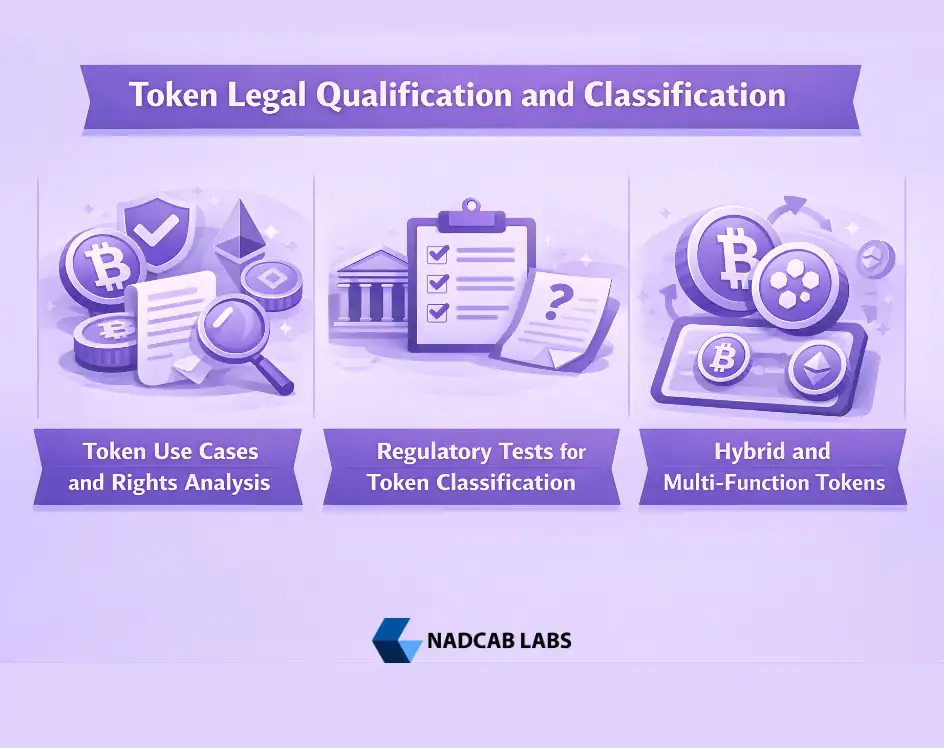
Token Use Cases and Rights Analysis
Token legal qualification begins by identifying rights and benefits token holders receive. These use cases determine which regulatory frameworks apply and what compliance measures issuers must implement. Common token use cases include:
- Protocol Tokens: Enable launching decentralized applications on blockchain platforms
- Access Tokens: Grant access to software functionality or platform services
- Loyalty Tokens: Provide discounts, reduced fees, or preferential treatment
- Community Tokens: Enable access to communities, events, or exclusive platforms
- Payment Tokens: Facilitate payments and value transfer
- Asset-Backed Tokens: Represent ownership rights in real assets
- Security Tokens: Provide dividends, profit participation, or equity rights
- Governance Tokens: Enable voting on project development and decisions
Understanding the difference between utility tokens vs security tokens proves critical as this classification determines whether securities regulations apply, what disclosures are required, and which distribution methods are permitted under applicable laws.
Regulatory Tests for Token Classification
Jurisdictions apply various tests determining token legal status. The United States Howey Test remains the most influential framework, examining whether there exists investment of money in common enterprise with reasonable expectation of profits derived from others’ efforts. Meeting all four criteria classifies tokens as securities regardless of technical implementation or marketing claims.
Switzerland’s FINMA applies a functional approach categorizing tokens as payment, utility, or asset tokens based on economic function. Singapore’s Monetary Authority similarly assesses whether tokens constitute capital markets products, payment systems, or other regulated financial services. These frameworks guide projects in structuring compliant token offerings and distributions.
Hybrid and Multi-Function Tokens
Many tokens combine multiple characteristics creating classification complexity. A token providing platform access while also enabling governance participation and potential value appreciation may satisfy multiple regulatory definitions simultaneously. In such cases, the most restrictive classification typically applies, meaning tokens with any security characteristics face securities regulation regardless of additional utility functions.
Projects must carefully structure tokens ensuring functionality aligns with intended classification. Marketing materials, distribution methods, and token economics all influence regulatory analysis. Misclassifying securities as utility tokens to avoid regulation constitutes fraud triggering enforcement actions and substantial penalties.
Global Cryptocurrency Regulatory Frameworks
Cryptocurrency regulation worldwide demonstrates increasing sophistication as jurisdictions develop tailored frameworks addressing digital asset risks while enabling innovation. Understanding these diverse approaches helps projects select favorable jurisdictions and implement appropriate compliance measures.
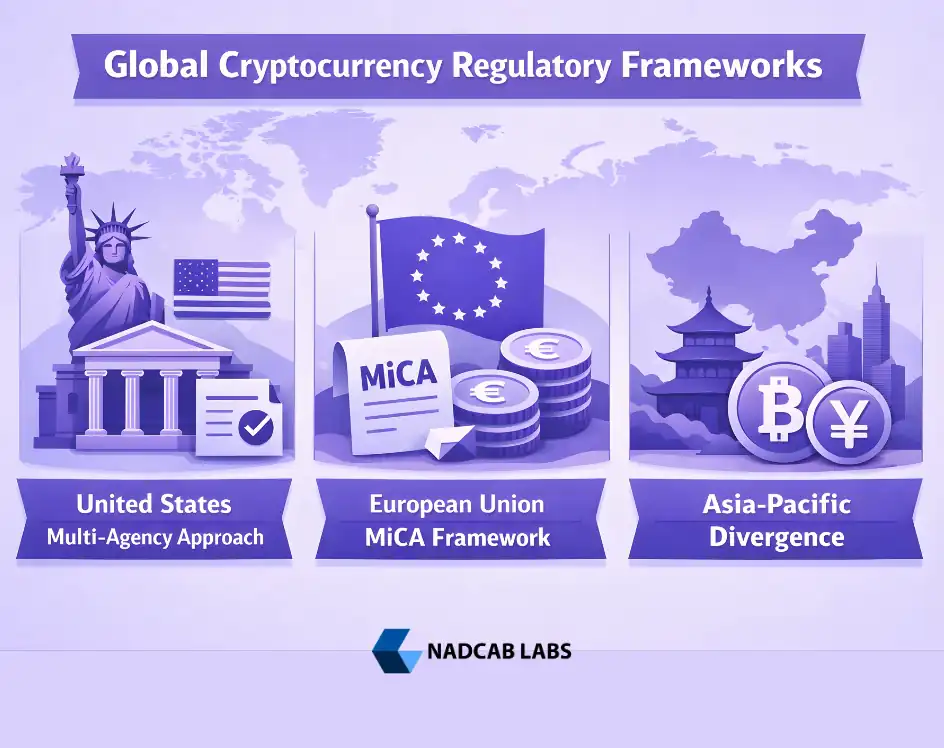
United States Multi-Agency Approach
The United States employs fragmented regulatory oversight where different agencies claim jurisdiction based on asset classification. The SEC regulates tokens qualifying as securities, the Commodity Futures Trading Commission oversees cryptocurrency derivatives and certain spot markets, while FinCEN enforces anti-money laundering requirements on virtual currency exchangers and administrators.
State-level regulation adds complexity with varying licensing requirements, consumer protection laws, and operational restrictions. New York’s BitLicense represents one of the most stringent frameworks requiring extensive capital reserves, cybersecurity measures, and compliance programs. This regulatory fragmentation creates challenges for businesses operating nationally, necessitating multi-jurisdictional compliance strategies.
European Union MiCA Framework
The Markets in Crypto-Assets Regulation establishes comprehensive harmonized rules across EU member states. Effective from 2024, MiCA creates legal certainty for crypto-asset issuers and service providers while implementing consumer protection and market integrity safeguards. The regulation distinguishes between asset-referenced tokens, e-money tokens, and other crypto-assets applying tailored requirements to each category.
Issuers of significant tokens face capital requirements, governance standards, and operational resilience obligations similar to financial institutions. Service providers must obtain authorization demonstrating adequate systems, controls, and resources. This unified framework eliminates regulatory arbitrage within the EU while potentially setting global standards given the bloc’s market significance.[2]
Asia-Pacific Divergence
Asian jurisdictions demonstrate diverse regulatory philosophies. Singapore maintains a progressive framework licensing digital payment token services while enforcing robust anti-money laundering and counter-terrorism financing controls. Hong Kong recently opened retail crypto trading under comprehensive licensing requiring extensive investor protection measures and operational standards.
Conversely, China maintains comprehensive prohibitions on cryptocurrency trading and mining while actively developing its central bank digital currency. India, after initially restricting crypto activities, now recognizes cryptocurrencies as Virtual Digital Assets subject to taxation and regulatory oversight through the Financial Intelligence Unit.
India’s Cryptocurrency Legal Framework
India’s approach to cryptocurrency regulation demonstrates the evolution from initial skepticism to structured legal recognition balancing innovation with oversight. As of 2026, India legally defines cryptocurrencies as Virtual Digital Assets under the Income Tax Act, 1961, providing legitimacy to holding, purchasing, and selling crypto while prohibiting use as currency.
Permitted and Prohibited Activities
Indian regulations permit purchasing, selling, and holding cryptocurrency assets as investments. Trading on domestic exchanges or FIU-IND registered international platforms remains legal. However, using cryptocurrency as payment for goods and services is prohibited, as is operating unregistered exchanges or facilitating anonymous transactions beyond regulatory thresholds.
This balanced approach enables participation in global crypto markets while maintaining oversight preventing financial crime and protecting consumers. The framework reflects India’s strategy of embracing blockchain innovation while ensuring ecosystem transparency and regulatory compliance.
Tax Treatment and Reporting
India implements a comprehensive taxation regime for cryptocurrency transactions including 30% flat tax on gains from crypto sales plus 4% cess. A 1% tax deducted at source applies to transactions exceeding ₹10,000 annually. No deductions are allowed except acquisition cost, and losses cannot offset other income categories.
Reporting requirements mandate disclosure of all cryptocurrency income in income tax returns. Foreign holdings may trigger obligations under the Black Money Act. Exchanges must share user data with tax authorities facilitating enforcement. This taxation framework, while criticized for high rates and loss restriction, provides legal clarity enabling compliant participation.
FIU-IND Registration and Compliance
Virtual Digital Asset Service Providers including exchanges, wallet providers, and DeFi platforms must register with the Financial Intelligence Unit under Prevention of Money Laundering Act provisions. Registration requirements include implementing comprehensive AML and KYC procedures, maintaining transaction records, filing suspicious transaction reports, and cooperating with law enforcement investigations.
These obligations align India’s cryptocurrency regulation with international standards set by the Financial Action Task Force. Registered entities must implement customer due diligence, monitor transactions for unusual patterns, and report high-value transfers to authorities. Non-compliance risks registration cancellation, financial penalties, and criminal prosecution.
| Regulatory Milestone | Year | Impact |
|---|---|---|
| RBI Banking Ban | 2018 | Banks prohibited from supporting crypto exchanges |
| Supreme Court Overturns Ban | 2020 | IAMAI vs. RBI restores banking access |
| Tax Framework Implemented | 2022 | Section 115BBH introduces 30% tax and 1% TDS |
| FIU-IND Registration Mandatory | 2023 | Exchanges required to register under PMLA |
| Digital Rupee Pilot Expanded | 2025 | CBDC integration with wallets and UPI |
Compliance Requirements for Cryptocurrency Businesses
Operating cryptocurrency businesses legally requires implementing comprehensive compliance programs addressing anti-money laundering, customer identification, transaction monitoring, and regulatory reporting obligations. Professional coin and token service providers help projects navigate these complex requirements across multiple jurisdictions.
AML/KYC Implementation
Virtual asset service providers must implement customer due diligence procedures identifying and verifying users before providing services. Know Your Customer programs collect personal information, verify identity through government-issued documents, screen against sanctions lists, and assess customer risk profiles determining appropriate monitoring intensity.
Enhanced due diligence applies to high-risk customers including politically exposed persons, users from high-risk jurisdictions, and accounts with unusual transaction patterns. Ongoing monitoring detects suspicious activities warranting investigation and potential suspicious transaction reporting to financial intelligence units.
Transaction Monitoring and Reporting
Cryptocurrency businesses deploy automated systems monitoring transactions for patterns indicating money laundering, terrorist financing, or other financial crimes. These systems flag unusual activities including rapid movement through multiple wallets, transactions with known criminal entities, structuring deposits to avoid reporting thresholds, and geographic anomalies.
Suspicious activity reports must be filed with authorities when monitoring identifies potential crimes. Currency transaction reports document high-value transactions exceeding regulatory thresholds. Travel rule compliance requires sharing originator and beneficiary information for qualifying transfers, increasingly enforced through international coordination.
Licensing and Registration
Many jurisdictions require cryptocurrency exchanges, wallet providers, and other service providers to obtain licenses or register with regulatory authorities. Requirements vary significantly but typically include demonstrating adequate capital reserves, implementing compliance programs, maintaining cybersecurity standards, and protecting customer assets.
The licensing process involves extensive documentation, background checks on principals, technical systems review, and ongoing supervision. Costs can range from tens of thousands to millions of dollars depending on jurisdiction and business scope. Operating without required licenses triggers enforcement actions including cease-and-desist orders, fines, and criminal prosecution.
Token Issuance Legal Requirements
Issuing tokens legally requires careful structuring addressing securities laws, consumer protection regulations, and tax obligations. The distribution method—whether private sales, public offerings, airdrops, or staking rewards—determines specific legal requirements and documentation needs.
Private Token Sales and SAFT Agreements
Private token sales to accredited investors may qualify for securities law exemptions reducing disclosure and registration burdens. Simple Agreement for Future Tokens frameworks structure these sales as investment contracts where investors receive tokens upon network launch. These agreements must comply with private placement exemptions including investor limitations, transfer restrictions, and disclosure requirements.
Legal documentation for private sales includes token purchase agreements defining terms, disclosure documents explaining risks, and investor qualification procedures verifying accreditation status. Proper structuring prevents private sales from being deemed public offerings triggering full registration requirements.
Public Token Offerings and Exchange Listings
Public token sales face the strictest regulatory scrutiny with most jurisdictions requiring securities registration or qualifying exemptions. Projects must prepare extensive disclosure documents similar to traditional securities prospectuses detailing business operations, token economics, risk factors, and financial information.
Exchange listings increasingly require legal opinions confirming regulatory compliance, technical audits verifying smart contract security, and demonstration of adequate liquidity and market making. Reputable exchanges conduct due diligence before listing tokens, refusing projects with legal uncertainties or compliance deficiencies.
Jurisdiction Selection for Token Issuance
Choosing appropriate jurisdictions for token issuance significantly impacts regulatory burden, costs, and market access. Crypto-friendly jurisdictions like Switzerland, Singapore, and certain Caribbean nations offer clearer frameworks, streamlined licensing processes, and favorable tax treatment attracting token projects.
However, jurisdiction selection must consider target markets, as tokens issued in permissive jurisdictions may face restrictions when sold to residents of stricter regulatory environments. Multi-jurisdictional strategies may be necessary for projects targeting global markets, requiring coordination across different legal systems and compliance regimes.
| Jurisdiction | Token Type Suitability | Key Advantages | Regulatory Body |
|---|---|---|---|
| Switzerland | All token types | Clear framework, FINMA guidance, favorable tax | FINMA |
| Singapore | Payment, utility tokens | Progressive regulation, strong financial infrastructure | MAS |
| Cayman Islands | Utility, governance tokens | VASP framework, tax neutrality, efficient licensing | CIMA |
| Malta | Security, asset tokens | Comprehensive framework, EU market access | MFSA |
| Estonia | Payment tokens | Digital-first approach, streamlined licensing | FIU |
Future Trends in Cryptocurrency Regulation
Cryptocurrency regulation worldwide continues evolving as authorities gain experience, technology advances, and markets mature. Several trends are shaping the future regulatory landscape affecting how digital assets are classified, regulated, and integrated into mainstream finance.
Global Regulatory Harmonization
International coordination is increasing as regulators recognize that fragmented approaches enable regulatory arbitrage and undermine effectiveness. The Financial Action Task Force updated its guidance requiring jurisdictions to regulate virtual asset service providers and implement travel rule requirements for qualifying transfers. Over 130 countries now have cryptocurrency regulations or are developing frameworks[4], demonstrating global consensus on need for oversight.
Organizations including the Basel Committee on Banking Supervision, International Organization of Securities Commissions, and Financial Stability Board coordinate standards development promoting consistency across jurisdictions. While complete harmonization remains unlikely given legal and political differences, these efforts gradually reduce compliance complexity for global operations.
Get Expert Guidance on Crypto
Get expert legal support for token classification, licensing, and compliance across major jurisdictions. Protect your crypto venture while scaling confidently in global markets.
Central Bank Digital Currencies Impact
Central bank digital currencies under development or deployment in over 100 countries may reshape cryptocurrency regulation. These government-issued digital currencies could compete with private cryptocurrencies while demonstrating blockchain technology’s viability for mainstream finance. Regulatory treatment may distinguish between CBDCs enjoying legal tender status and private cryptocurrencies facing stricter oversight.
DeFi and Smart Contract Regulation
Decentralized finance protocols challenge traditional regulatory frameworks designed for centralized intermediaries. Authorities increasingly assert that DeFi protocols, their developers, and governance token holders may bear compliance obligations despite decentralized architectures. Future regulations may address smart contract auditing requirements, protocol liability standards, and governance token classification.
Final Thoughts
The legality of cryptocurrency varies significantly across jurisdictions with classifications ranging from property and commodities to securities and digital assets. Understanding applicable legal frameworks proves essential for compliant participation whether as investor, developer, or service provider. While regulatory uncertainty persists in some areas, the trend globally moves toward greater clarity with comprehensive frameworks balancing innovation support and risk mitigation.
Token legal qualification determines which regulations apply, what compliance measures are required, and how distribution can proceed. Projects must conduct thorough legal analysis ensuring token characteristics align with intended classification and implementing appropriate safeguards. Investors should understand legal status in their jurisdictions affecting taxation, permitted activities, and available protections.
As cryptocurrency regulation worldwide matures, compliance becomes increasingly important for sustainable operations and mainstream adoption. Organizations implementing robust AML/KYC procedures, transaction monitoring, and regulatory reporting position themselves for long-term success. The future likely brings continued regulatory evolution requiring ongoing adaptation as authorities refine approaches balancing competing policy objectives.
Successful navigation of cryptocurrency’s complex legal landscape requires staying informed about regulatory developments, engaging qualified legal counsel, and implementing comprehensive compliance programs. As the global crypto market continues growing and integrating with traditional finance, legal compliance transforms from optional consideration to fundamental business requirement essential for sustainable participation in the digital asset economy.
Frequently Asked Questions
Q1.Is cryptocurrency legal worldwide?
Cryptocurrency legality varies by jurisdiction with most countries permitting possession and trading while some maintain restrictions or bans. over 130 countries have regulations or are developing frameworks, with legal status ranging from recognized property to prohibited activities.
Q2.How are cryptocurrencies classified legally?
Legal classifications include property, commodities, securities, payment instruments, virtual digital assets, or digital goods depending on jurisdiction and token characteristics. classification determines applicable regulations, taxation treatment, and compliance obligations for issuers and users.
Q3.What is token legal opinion?
Token legal opinion is professional assessment by qualified legal counsel analyzing token characteristics, determining regulatory classification, and advising on compliance requirements for issuance and distribution. opinions protect projects from misclassification risks and regulatory enforcement.
Q4.What are cryptocurrency tax obligations?
Most jurisdictions tax cryptocurrency transactions as property sales or capital gains with reporting requirements for trades, mining income, staking rewards, and airdrops. tax rates and treatment vary significantly across countries requiring jurisdiction-specific analysis.
Q5.How does howey test work?
The howey test determines whether arrangements constitute investment contracts by examining investment of money, common enterprise, profit expectations, and derivation from others’ efforts. satisfying all criteria classifies tokens as securities triggering registration requirements.
Q6.What is india vda framework?
India recognizes cryptocurrencies as virtual digital assets under income tax act subjecting gains to thirty percent tax plus four percent cess, one percent tds on transactions, and mandatory exchange registration with financial intelligence unit.
Explore Services
Related Services
Reviewed by

Aman Vaths
Founder of Nadcab Labs
Aman Vaths is the Founder & CTO of Nadcab Labs, a global digital engineering company delivering enterprise-grade solutions across AI, Web3, Blockchain, Big Data, Cloud, Cybersecurity, and Modern Application Development. With deep technical leadership and product innovation experience, Aman has positioned Nadcab Labs as one of the most advanced engineering companies driving the next era of intelligent, secure, and scalable software systems. Under his leadership, Nadcab Labs has built 2,000+ global projects across sectors including fintech, banking, healthcare, real estate, logistics, gaming, manufacturing, and next-generation DePIN networks. Aman’s strength lies in architecting high-performance systems, end-to-end platform engineering, and designing enterprise solutions that operate at global scale.