Ai Overview
Before we go any further, let us understand what big data analytics for logistics actually means in simple terms. This system analyzes more than 250 million address data points every day and evaluates around 30,000 route alternatives for each driver. For a company with hundreds or thousands of trucks, each costing upwards of $150,000, those extra years of service represent enormous capital savings.
Key Takeaways
- The global big data analytics in logistics market was valued at approximately $41.85 billion and is projected to reach $108.76 billion within the next few years, growing at a compound annual growth rate of around 17.3 percent. [1]
- DHL uses big data analytics for logistics to process over 2.1 billion data points daily across its global network, helping the company optimize delivery routes and reduce fuel consumption by up to 15 percent.
- UPS saved over 100 million miles annually through its ORION route optimization system, which uses big data in logistics to analyze more than 250 million address data points and 30,000 route alternatives per driver every day.
- McKinsey reports that companies using logistics data analytics for demand forecasting can reduce supply chain errors by 20 to 50 percent and cut lost sales by up to 65 percent.
- Amazon processes over 1.6 million packages daily using big data analytics for logistics, with its predictive shipping model analyzing browsing patterns, purchase history, and regional demand to pre-position inventory.
- Maersk uses IoT sensors and logistics data analytics across its container fleet of over 4.3 million TEU capacity, monitoring temperature, humidity, and location to reduce cargo damage and improve cold chain visibility.
- FedEx uses its SenseAware platform and data analytics in logistics to track over 19 million packages daily, providing real-time location, temperature, and light exposure data for sensitive shipments across 220 countries.
Logistics has always been about moving goods from one place to another as fast and as cheaply as possible. But in recent times, the sheer volume of data being generated across supply chains has completely changed the game. Every delivery truck, warehouse scanner, shipping container, and customer order creates a stream of data. When companies collect, organize, and study this data properly, they can find patterns and insights that were impossible to see before. This is where big data analytics for logistics comes into the picture, turning raw numbers into smarter decisions.
Think about it this way. A logistics company that ships thousands of packages every day can track the exact route every truck takes, how long each stop lasts, what the fuel consumption looks like, and even what the weather conditions are along each path. Without data analytics in logistics, all of this information just sits there doing nothing. But when you apply the right analytical tools and supply chain solutions, you can suddenly figure out which routes save fuel, which warehouses are overstocked, and which delivery windows are most popular with customers. That is the real power of logistics data analytics.
The growth of online shopping, global trade, and customer expectations for same-day or next-day delivery has made logistics optimization more important than ever. Companies that ignore data are falling behind, while those that invest in big data in logistics are pulling ahead. In this blog, we will walk through everything you need to know about how big data is reshaping the logistics world, from route optimization and demand forecasting to warehouse management and last-mile delivery improvements.
What Is Big Data Analytics for Logistics
Before we go any further, let us understand what big data analytics for logistics actually means in simple terms. Big data refers to extremely large sets of information that are too complex for traditional software to handle. In the logistics world, this data comes from sources like GPS trackers on vehicles, barcode scanners in warehouses, customer order databases, weather feeds, traffic reports, and even social media trends that can affect buying behavior.
Analytics is the process of examining this data to find useful patterns, trends, and insights. When you put the two together, you get a system that can tell logistics managers exactly where problems are happening, where money is being wasted, and where opportunities exist to do things better. These analytical systems have become a major focus for logistics companies worldwide.
1. The Three Types of Logistics Analytics
There are three main types of analytics used in the logistics industry. Descriptive analytics looks at what has already happened. It answers questions like “how many deliveries were late last month” or “which warehouse had the highest error rate.” This is the foundation of all data analytics in logistics because you need to understand the past before you can plan for the future.
Predictive analytics goes a step further by using historical data to forecast what might happen next. For example, a logistics optimization software tool might analyze three years of order data and determine that a particular product always sees a 40 percent spike in demand during a certain season. This allows the company to stock up ahead of time instead of scrambling at the last minute.
Prescriptive analytics is the most advanced form. It not only predicts what will happen but also recommends what actions to take. If a prescriptive system detects that a delivery route is likely to face heavy traffic due to a sporting event, it will automatically suggest an alternate route. This type of logistics optimization is where the biggest cost savings typically come from.
2. Why Traditional Methods No Longer Work
For decades, logistics companies relied on spreadsheets, manual scheduling, and the experience of their managers to make decisions. While this worked when the supply chain was simpler, the modern logistics landscape is far too complex for these old methods. The growth of e-commerce alone has created a situation where companies must handle millions of individual shipments instead of bulk cargo. Each shipment has its own destination, timeline, and requirements. The development of modern analytics tools was a direct response to this growing complexity.
Manual methods simply cannot process the billions of data points that a large logistics network generates every day. DHL, for instance, processes over 2.1 billion data points daily across its global operations. No team of analysts with spreadsheets could make sense of that volume. This is exactly why big data analytics for logistics has become essential, not just helpful.
Recommended Reading: Supply Chain Digital Transformation: Visibility, Automation & Risk Control
How Big Data Is Used in Route Optimization
One of the most visible applications of big data in logistics is route optimization. Every logistics company that operates a fleet of trucks, vans, or delivery vehicles needs to figure out the best possible route for each vehicle on each day. The difference between a good route and a bad route can mean hours of wasted time and hundreds of dollars in extra fuel costs.
1. The UPS ORION System
Perhaps the most famous example of logistics optimization through big data is the UPS ORION (On Road Integrated Optimization and Navigation) system. This system analyzes more than 250 million address data points every day and evaluates around 30,000 route alternatives for each driver. By processing all of this data, ORION finds the most efficient route for every truck in the UPS fleet.
The results speak for themselves. UPS saved over 100 million miles annually after implementing ORION. That translates to roughly 10 million gallons of fuel saved per year and a major reduction in carbon emissions. Building this system took years and required a massive investment in data infrastructure, but the return has been enormous.
2. Real-Time Traffic and Weather Integration
Modern logistics optimization software does not just plan routes in advance. It continuously updates routes based on real-time conditions. If there is an accident on a highway, a sudden snowstorm, or unexpected road construction, the system recalculates and sends updated directions to drivers immediately.
This kind of dynamic routing was nearly impossible a decade ago because the data processing power simply was not available. But today, with cloud computing and advanced algorithms, logistics data analytics can handle these calculations in seconds. The development of real-time data processing capabilities has made this kind of instant route adjustment possible across entire delivery networks. Companies like FedEx and DHL now use this kind of real-time adjustment across their entire delivery networks.
3. Fuel Cost Reduction Through Data
Fuel is one of the biggest expenses for any logistics operation. Big data analytics for logistics helps companies reduce fuel costs not just through better routing but also by monitoring driver behavior. Sensors in trucks can track things like harsh braking, excessive idling, rapid acceleration, and tire pressure. When this data is collected and analyzed, fleet managers can identify which drivers are using more fuel than necessary and provide targeted training.
Some companies have reported fuel savings of 10 to 15 percent simply by using data analytics to monitor and improve driving habits. Over a fleet of thousands of vehicles, those savings add up to millions of dollars per year. The rise of onboard diagnostics and telematics devices has made this level of monitoring accessible even for mid-sized logistics companies.
Demand Forecasting and Inventory Management
Getting the right amount of product to the right place at the right time is one of the oldest challenges in logistics. Order too much, and you waste money on storage. Order too little and you lose sales. Big data analytics for logistics has made demand forecasting dramatically more accurate than it was even five years ago.
1. How Predictive Models Work in Logistics
Predictive demand models take in data from dozens of sources. These include past sales records, seasonal trends, economic indicators, competitor pricing, weather forecasts, social media sentiment, and even local event calendars. A logistics optimization software platform processes all of these inputs through machine learning algorithms that get smarter over time. The development of these predictive tools has been one of the most impactful changes in modern supply chain management.
McKinsey reports that companies using this kind of logistics data analytics for demand forecasting can reduce supply chain errors by 20 to 50 percent and cut lost sales by up to 65 percent. Those are not small numbers. For a company doing billions of dollars in annual revenue, even a 10 percent improvement in forecasting accuracy can mean hundreds of millions in savings.
2. Amazon’s Predictive Shipping Model
Amazon takes demand forecasting to an entirely different level. The company processes over 1.6 million packages daily and uses big data in logistics to analyze browsing patterns, purchase history, wish lists, and regional demand signals. Based on this analysis, Amazon prepositions inventory in fulfillment centers closest to where demand is expected to be highest.
This means that when you place an order on Amazon, there is a good chance the product is already sitting in a warehouse just a few miles from your home. Amazon has even patented a concept called “anticipatory shipping,” where items begin moving toward likely buyers before they have even clicked the buy button. The success of this approach has given Amazon a massive competitive advantage in delivery speed.
3. Reducing Overstock and Stockout Situations
One of the most practical benefits of data analytics in logistics is the ability to balance inventory levels. Overstocking ties up capital and requires expensive warehouse space. Stockouts lead to lost customers and damaged brand reputation. By analyzing historical patterns alongside real-time sales data, big data systems can recommend exactly how much of each product to keep in each location.
Retail giant Walmart, for example, manages over 100 million SKUs across its supply chain and uses big data analytics for logistics to maintain optimal stock levels at each of its thousands of stores and distribution centers. The company has publicly stated that its data analytics capabilities have been a key factor in keeping its supply chain costs among the lowest in the retail industry.
Big Data Applications Across Logistics Operations
| Application Area | How It Works | Impact on Logistics Operations |
|---|---|---|
| Route Optimization | Analyzes GPS data, traffic patterns, weather conditions, and delivery windows to calculate the most efficient routes for each vehicle | UPS saved over 100 million miles annually and roughly 10 million gallons of fuel per year through its ORION system |
| Demand Forecasting | Uses historical sales data, seasonal trends, economic indicators, and social media signals to predict future product demand | McKinsey reports a 20 to 50 percent reduction in supply chain errors and up to 65 percent fewer lost sales |
| Warehouse Management | Tracks inventory movement, worker productivity, storage utilization, and order processing rates using sensors and scanners | Up to 99 percent inventory accuracy and a 25 percent reduction in order picking time |
| Predictive Maintenance | Monitors vehicle health through onboard sensors tracking engine temperature, oil quality, brake wear, and tire condition | Deloitte reports a 70 percent reduction in breakdowns and 25 percent lower maintenance costs |
| Last Mile Delivery | Combines customer location data, delivery preferences, traffic conditions, and package density to plan final delivery routes | Can reduce last-mile costs by 15 to 28 percent, which matters since the last mile accounts for 53 percent of total shipping costs |
| Cold Chain Monitoring | IoT sensors track temperature, humidity, and light exposure in real time for sensitive goods like food and pharmaceuticals | Maersk monitors over 4.3 million TEU capacity with IoT sensors to reduce cargo damage in cold chain shipments |
| Customer Sentiment Analysis | Mine delivery reviews, social media posts, and customer support tickets to identify service quality issues | Helps identify recurring delivery problems and improve customer satisfaction scores across specific regions |
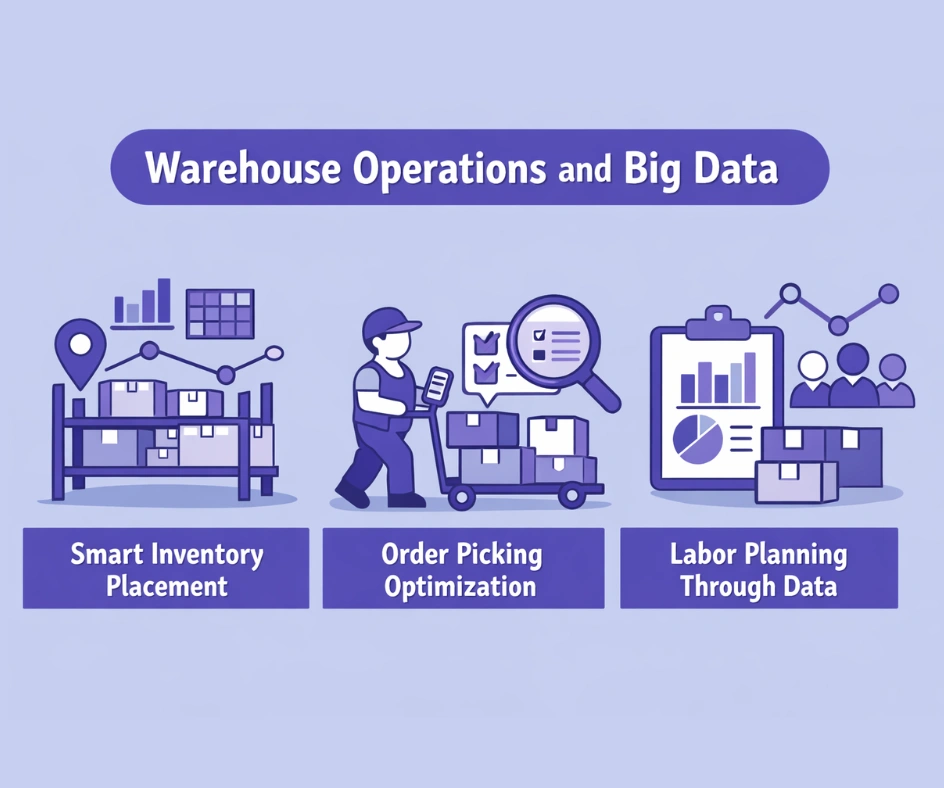
Warehouse Operations and Big Data
Warehouses are the beating heart of any logistics operation, and the arrival of big data tools has transformed how they function. A modern warehouse is packed with sensors, scanners, and tracking systems that generate massive amounts of data every minute. When this data is properly analyzed, it reveals opportunities to speed up operations, reduce errors, and lower costs.
1. Smart Inventory Placement
Big data analytics for logistics can determine exactly where each product should be stored within a warehouse. Items that are frequently ordered together get placed near each other. Fast-moving products go to locations closest to packing stations. Seasonal items get repositioned as demand patterns shift throughout the year.
This might sound simple, but in a warehouse with tens of thousands of different products, optimal placement can cut the distance workers walk by 30 to 40 percent. Over an entire year across multiple warehouses, this translates into significant time and labor savings. The introduction of automated storage and retrieval systems has made this even more effective by combining data-driven placement with robotic movement.
2. Order Picking Optimization
Order picking is the process of collecting items from shelves to fulfill customer orders, and it typically accounts for 50 to 60 percent of total warehouse labor costs. Logistics data analytics can optimize picking routes so that workers move through the warehouse in the most efficient path possible, collecting multiple orders at once when the items are in nearby locations. The development of smart picking algorithms has been a game-changer for warehouse productivity.
Advanced logistics optimization software uses algorithms similar to the traveling salesman problem to calculate optimal picking sequences. Companies that have implemented data-driven picking have reported a 25 percent reduction in picking time and a significant decrease in error rates. When you combine this with barcode scanning and voice-directed picking, the accuracy improvements become even more dramatic.
3. Labor Planning Through Data
Knowing how many workers you need on any given day is crucial for warehouse efficiency. Too many workers means wasted payroll. Too few means orders pile up and deliveries get delayed. Big data in logistics helps warehouse managers forecast daily workload based on incoming order volumes, expected shipment arrivals, and seasonal trends.
By analyzing months or years of historical data, the system can predict with high accuracy how many workers will be needed for each shift. Some companies have reduced their labor overstaffing by 15 to 20 percent through this kind of data-driven scheduling, while still meeting all delivery commitments on time.
Recommended Reading: Blockchain for Supply Chain Traceability
Last Mile Delivery and Data Analytics
The last mile of delivery, getting a package from the distribution center to the customer’s door, is the most expensive and most complicated part of the entire logistics chain. According to industry research, last-mile delivery accounts for roughly 53 percent of total shipping costs. This is also where customer satisfaction is won or lost, because the last mile is the only part of the supply chain that the customer directly sees and experiences.
1. Package Density and Delivery Clustering
Big data analytics for logistics helps companies group deliveries by geographic proximity. Instead of sending a driver on a scattered route across an entire city, the system clusters deliveries into tight zones where the driver can complete more stops in less time. This approach is called delivery clustering, and it relies on analyzing thousands of delivery addresses alongside traffic patterns and time window requirements.
The emergence of this clustering approach has allowed some delivery companies to increase the number of stops per driver per day by 20 to 30 percent. More stops per route means lower cost per package, which is the key metric that every last-mile logistics company is trying to improve.
2. Customer Preference Analysis
Data analytics in logistics is not just about trucks and warehouses. It also includes understanding what customers want from their delivery experience. Some customers prefer morning deliveries. Others want evening slots. Some are happy with standard delivery, while others will pay extra for same-day service. By analyzing customer order history and delivery feedback, logistics companies can tailor their services to match what customers actually want.
This kind of personalization used to be impossible at scale. But with big data in logistics, a company can analyze millions of customer interactions and automatically assign delivery preferences to each address. This improves first attempt delivery rates, which directly reduces the costly problem of failed deliveries that require a second trip.
3. Dynamic Pricing for Delivery Slots
Another application of logistics data analytics in the last mile is dynamic pricing for delivery windows. Suppose a logistics optimization software system knows that demand for same-day delivery spikes on certain days or in certain areas, it can adjust pricing accordingly. This helps balance demand across different time slots and prevents the system from being overwhelmed during peak periods.
Amazon, Instacart, and several grocery delivery platforms already use this approach. By analyzing real-time order volumes and delivery capacity, these platforms offer lower prices for less popular time slots and higher prices for the most demanded ones. This is data-driven demand management at its most practical level.
Real Time Tracking and Supply Chain Visibility
One of the biggest frustrations in logistics has always been the lack of visibility. Shippers did not know exactly where their goods were, and customers had no idea when their packages would arrive. Big data analytics for logistics has changed this completely by enabling real-time tracking across the entire supply chain.
1. IoT Sensors and Connected Devices
Internet of Things (IoT) sensors are now attached to everything from individual packages to entire shipping containers. These sensors transmit data on location, temperature, humidity, vibration, and light exposure in real time. Maersk, the world’s largest container shipping company, uses IoT sensors across its fleet of over 4.3 million TEU capacity to monitor cargo conditions throughout transit.
This constant stream of data feeds into logistics data analytics platforms that can spot problems before they become disasters. If a refrigerated container starts to warm up during a transoceanic shipment, the system alerts operators immediately so they can take action before thousands of dollars’ worth of food or medicine is ruined. The development of affordable IoT sensor networks has made this kind of monitoring feasible even for smaller logistics operations.
2. FedEx SenseAware Platform
FedEx developed its SenseAware platform specifically for high-value and sensitive shipments. The system uses data analytics in logistics to track over 19 million packages daily, providing real-time information on package location, temperature, and whether the package has been exposed to light (which could indicate it has been opened). This level of tracking is especially important for pharmaceutical companies and medical device manufacturers who need to verify that their products remain within specific temperature ranges throughout transit.
The data collected by SenseAware does not just help with individual shipments. When aggregated over time, it reveals patterns about which shipping lanes have the most temperature deviations, which handling points are most likely to cause damage, and which carriers provide the most consistent service. This kind of big data in logistics analysis helps FedEx continuously improve its network.
3. End-to-End Supply Chain Dashboards
Modern logistics optimization software brings all of this tracking data together into unified dashboards that give supply chain managers a complete picture of their operations. These dashboards display everything from ship positions on a map to warehouse stock levels to delivery truck locations, all updated in real time.
The value of these dashboards comes from their ability to connect data from different parts of the supply chain. A delay at a port, for example, automatically triggers an alert about potential stockouts at specific warehouses, which in turn triggers an adjustment in customer delivery promises. This kind of connected, data-driven decision-making was impossible without big data analytics for logistics.
Logistics Optimization Technologies and Their Adoption
| Technology | Primary Data Sources | Key Benefits | Industry Adoption Level |
|---|---|---|---|
| Machine Learning for Demand Forecasting | Historical sales, seasonal trends, economic data, social signals | 20 to 50 percent reduction in forecasting errors, better inventory planning | High among large enterprises, growing in the mid-market |
| IoT Sensor Networks | GPS location, temperature, humidity, vibration, light exposure | Real-time cargo visibility, cold chain protection, and damage prevention | Widely adopted in shipping and cold chain logistics |
| GPS and Telematics Systems | Vehicle location, speed, fuel consumption, engine diagnostics, driver behavior | Route optimization, 10 to 15 percent fuel savings, improved driver safety | Very high in the trucking and fleet management sectors |
| Robotic Process Automation | Order data, shipping labels, invoice records, and customs documentation | Faster document processing, reduced human errors in data entry tasks | Growing rapidly in freight forwarding and customs brokerage |
| Digital Twin Technology | Warehouse layouts, equipment data, order flow patterns, operational metrics | Allows testing of layout changes and process improvements in a virtual environment before real implementation | Early adoption phase, primarily among large 3PL providers |
| Natural Language Processing | Customer emails, delivery reviews, social media posts, support tickets | Automated customer service, sentiment analysis, and issue identification | Moderate adoption, mostly in customer-facing logistics companies |
| Blockchain for Supply Chain | Shipping records, customs documents, proof of delivery, and product origin data | Tamper-proof record keeping, improved traceability, and faster dispute resolution | Pilot and early adoption stage in global shipping and food logistics |
Predictive Maintenance for Logistics Fleets
Every logistics company that operates a fleet of vehicles knows the pain of unexpected breakdowns. When a truck breaks down on a delivery route, it does not just affect that one shipment. It causes a ripple effect across the entire schedule, delaying dozens of deliveries and potentially costing thousands of dollars. Big data analytics for logistics is now being used to predict when vehicles will need maintenance before problems actually occur.
1. How Predictive Maintenance Works
Onboard sensors in modern trucks continuously monitor engine temperature, oil pressure, brake pad thickness, tire tread depth, battery health, and dozens of other parameters. This data streams back to a central analytics platform in real time. The logistics data analytics system compares current readings against historical patterns and known failure signatures to identify vehicles that are likely to have problems soon.
Deloitte’s research on supply chain analytics found that predictive maintenance powered by big data can reduce vehicle breakdowns by 70 percent and lower maintenance costs by 25 percent. Instead of following rigid scheduled maintenance intervals (which often result in replacing parts too early or too late), companies can now maintain their vehicles based on actual condition data. The progress of these predictive systems has been a major advancement for fleet management.
2. Extending Vehicle Lifespan
When maintenance is done at exactly the right time based on data rather than guesswork, vehicles last longer. Parts that are replaced too early waste money. Parts that are replaced too late cause secondary damage that shortens overall vehicle life. Data analytics in logistics helps fleet managers find that sweet spot where maintenance is performed at the optimal moment, maximizing the useful life of every component.
Large fleet operators have reported that their data-driven maintenance programs have extended average vehicle lifespan by 15 to 20 percent. For a company with hundreds or thousands of trucks, each costing upwards of $150,000, those extra years of service represent enormous capital savings. The development of condition-based maintenance programs powered by data has been a major shift from the old calendar-based approach.
3. Reducing Roadside Breakdowns
Beyond the direct cost of repairs, roadside breakdowns create huge indirect costs. Emergency towing is expensive. Alternate vehicles must be dispatched. Deliveries get delayed. Customers get frustrated. In some cases, perishable goods are lost entirely. By using big data in logistics to predict and prevent breakdowns, companies avoid these cascading costs altogether.
The trucking industry in the United States alone generates roughly 750 million data points per day from GPS trackers, electronic logging devices, and onboard sensors. Companies that are successfully mining this data for maintenance insights are seeing a significant competitive advantage over those that are still reacting to breakdowns after they happen.
The Role of Machine Learning in Logistics Optimization
Machine learning is a branch of artificial intelligence that allows computers to learn from data without being explicitly programmed for every scenario. In logistics, machine learning is the engine that powers most advanced data analytics in logistics applications. It takes the raw data and turns it into actionable intelligence.
1. Pattern Recognition at Scale
Humans are good at spotting patterns in small data sets, but logistics generates data at a scale that no human team could analyze. Machine learning algorithms can process millions of data points and identify patterns that would take a human analyst months to discover. For example, a machine learning model might discover that deliveries to a specific industrial park are 40 percent more likely to be late on Mondays due to a combination of heavy inbound traffic and limited dock availability.
This kind of insight is incredibly valuable for logistics optimization because it allows companies to proactively adjust their operations. Once the pattern is identified, the logistics optimization software can automatically schedule deliveries to that location on different days or at different times, solving the problem before it even happens.
2. Continuous Improvement Through Learning
One of the most powerful aspects of machine learning in logistics data analytics is that the models get better over time. Every new data point that flows into the system helps the model refine its predictions. A demand forecasting model that was 85 percent accurate in its first month might be 95 percent accurate six months later, simply because it has more data to learn from.
This continuous improvement loop is why companies that start using big data analytics for logistics early gain a compounding advantage. Their models have more data, make better predictions, and drive better decisions with every passing month. Companies that wait to adopt these tools fall further behind as the gap in data maturity widens.
3. Anomaly Detection for Risk Management
Machine learning is also excellent at detecting anomalies, things that deviate from normal patterns. In logistics, anomalies could include unusual order volumes that might indicate fraud, unexpected temperature spikes in a cold chain shipment, or sudden changes in supplier lead times that could signal supply disruptions. The growth of anomaly detection capabilities has given logistics managers an early warning system that alerts them to potential problems before they escalate.
This is especially important in global supply chains where a disruption in one part of the world can have ripple effects across the entire network. By monitoring data streams from thousands of sources simultaneously, big data in logistics systems can flag issues that human operators would likely miss until it is too late to respond effectively.
Recommended Reading: AI Demand Forecasting in Supply Chain
Pros and Cons of Big Data Analytics in Logistics
Like any major technology shift, big data analytics for logistics comes with both advantages and limitations. The good news is that the advantages far outweigh the drawbacks, and most of the cons are temporary challenges that get easier to manage over time. Here is a balanced look at both sides.
Pros-
1. Massive Cost Savings Across Operations
The most immediate benefit of logistics data analytics is the cost reduction it delivers. From fuel savings through optimized routing to lower warehouse labor costs through smarter picking algorithms, big data touches every expense line in a logistics operation. UPS alone saves over 100 million miles per year through its data-driven route optimization, which translates directly into millions of dollars in fuel and time savings. Companies across the industry consistently report overall logistics cost reductions of 10 to 15 percent after implementing big data systems.
3. Better Customer Experience and On Time Delivery
Customers today expect fast, accurate, and transparent delivery. Big data in logistics makes this possible by enabling real-time tracking, accurate delivery time predictions, and proactive communication when delays occur. When a company can tell a customer exactly when their package will arrive and actually deliver on that promise, customer satisfaction and repeat business both increase significantly. The rise of customer-facing tracking tools powered by analytics has become a major competitive differentiator.
3. Smarter Decision Making at Every Level
Without data, logistics managers rely on experience and gut feeling to make decisions. With big data analytics for logistics, every decision from warehouse layout to fleet size to staffing levels can be backed by hard numbers. This removes guesswork and reduces the risk of costly mistakes. Managers can test scenarios using historical data before committing resources, and they can measure the impact of every change they make in real time.
4. Predictive Capabilities That Prevent Problems
One of the strongest advantages of data analytics in logistics is the ability to see problems coming before they happen. Predictive maintenance prevents vehicle breakdowns. Demand forecasting prevents stockouts. Weather and traffic analysis prevent delivery delays. This shift from reactive to proactive management is what separates data-driven logistics companies from their competitors and keeps supply chains running smoothly.
Cons-
1. Data Quality and Integration Can Be Difficult
The biggest challenge is often data quality. Logistics companies typically use multiple software systems that do not talk to each other. The warehouse management system stores data in one format, the transportation management system uses another, and the customer relationship management system has its own structure. Bringing all of this data together into a single analytics platform requires effort in data cleaning, standardization, and integration. However, once this foundation is built properly, it serves the company for years.
2. Initial Investment and Learning Curve
Building a big data analytics infrastructure requires investment in data storage, processing power, software licenses, and skilled personnel. There is also a learning curve as teams adjust to data-driven workflows. However, cloud-based analytics platforms have made this much more affordable by allowing companies to pay monthly rather than making large upfront investments. Most companies report payback periods of 12 to 24 months, with ongoing savings that continue to grow as the analytics models improve over time. The creation of user-friendly analytics platforms has also helped bridge the skills gap by making complex data accessible to non-technical users.
The Future of Big Data Analytics in Logistics
The logistics industry is still in the early stages of its data transformation. While companies like UPS, Amazon, DHL, and FedEx are already operating at an advanced level of data analytics in logistics, the vast majority of logistics companies are still just beginning their journey. Here is what the future likely holds.
1. Autonomous Vehicles and Data
Self-driving trucks and delivery drones are generating massive interest in the logistics industry. When autonomous vehicles become widespread, they will generate even more data than today’s driver-operated fleets. Every sensor reading, every navigation decision, every interaction with other vehicles on the road will create data points that feed back into logistics optimization software systems.
The development of autonomous logistics vehicles will make big data analytics for logistics even more critical. These vehicles will rely entirely on data for their operation, and the companies that have the best data infrastructure will be best positioned to deploy them successfully.
2. Digital Twins for Supply Chains
A digital twin is a virtual replica of a physical system. In logistics, companies are beginning to create digital twins of their entire supply chains, complete virtual models that simulate how goods flow through the network under different conditions. These digital twins are powered by real-time data from across the supply chain and allow managers to test changes in a virtual environment before implementing them in the real world.
For example, a company could use its digital twin to simulate what would happen if a key port were shut down for two weeks. The model would show exactly which shipments would be affected, which alternative routes could be used, and what the cost impact would be. This kind of scenario planning through big data in logistics gives companies a level of preparedness that was previously impossible.
3. Sustainability and Green Logistics
Environmental concerns are pushing logistics companies to reduce their carbon footprints. Big data analytics for logistics plays a direct role in this by optimizing routes to reduce fuel consumption, consolidating shipments to reduce the number of trips needed, and helping companies transition to electric vehicles by analyzing which routes and use cases are best suited for battery-powered trucks.
As governments around the world implement stricter emissions regulations, logistics data analytics will become an essential tool for compliance. Companies that can accurately measure and report their emissions using data will be better positioned to meet regulatory requirements and respond to the growing demand from consumers for environmentally responsible shipping.
Data-Driven Infrastructure Implementations in the Real World
The following projects reflect how data-driven architecture is already being applied across supply chain management, analytics platforms, and high-throughput data processing networks. Each implementation showcases the same distributed data principles discussed throughout this article, from real-time monitoring and automated analytics to performance optimization and data governance.
📊
Zebec Network: Data Driven Payment Infrastructure
Developed the Nautilus Chain, a modular blockchain supporting real-world asset payments and data-driven infrastructure integration. The network supports 4,400+ nodes, enabling per-second payroll streaming, cross-border payments, and real-time financial data processing across 138 countries through a distributed analytics infrastructure.
⚡
Everscale Network: High Throughput Data Processing
Engineered a distributed data ecosystem capable of processing over 100,000 transactions per second through dynamic sharding and multithreading. The network uses optimized consensus with validators and collators, delivering fault-tolerant, high-speed data infrastructure for logistics and enterprise applications.
Build Your Logistics Data Analytics Platform Today
Our specialized team brings deep expertise in big data analytics development for logistics and supply chain operations. From custom analytics dashboards to predictive optimization engines, we handle the full development lifecycle to deliver platforms that drive real operational results and cost savings for your business.
Final Thoughts
Big data analytics for logistics is no longer something that only the biggest companies in the world can afford or understand. The tools, platforms, and technologies that power logistics optimization are becoming more accessible every year. From route optimization that saves millions of miles and gallons of fuel, to demand forecasting that prevents costly stockouts and overstocking, to warehouse analytics that make every square foot of storage space work harder, data is transforming every corner of the logistics industry.
What makes this transformation so powerful is that it builds on itself. The more data a company collects, the smarter its analytics become. The smarter the analytics, the better the decisions. The better the decisions, the lower the costs and the happier the customers. Companies like UPS, Amazon, DHL, FedEx, and Maersk have shown what is possible when logistics data analytics is implemented at scale, and the results are measured in billions of dollars of savings and millions of improved customer experiences.
The challenges are real. Data quality issues, skills gaps, and implementation costs all need to be addressed. But the return on investment is proven, and the gap between data-driven logistics companies and those still relying on traditional methods is growing wider every year. For any company involved in moving goods, whether it is a global shipping giant or a regional delivery service, investing in big data in logistics is not a question of if but when. The companies that start building their data capabilities today will be the ones leading the industry tomorrow.
The development of logistics optimization software continues to accelerate, driven by advances in machine learning, IoT connectivity, cloud computing, and real-time data processing. As the global supply chain becomes more complex and customer expectations continue to rise, big data analytics for logistics will only become more important. The companies that embrace this transformation fully will find themselves with a powerful advantage that is very difficult for competitors to replicate.
Frequently Asked Questions
Q1.What is big data analytics for logistics?
Big data analytics for logistics is the process of collecting and analyzing large volumes of data from sources like GPS trackers, warehouse scanners, customer orders, weather feeds, and traffic reports to improve how goods are transported, stored, and delivered across supply chains.
Q2.How does big data improve delivery routes?
Big data improves delivery routes by analyzing millions of data points, including traffic patterns, weather conditions, delivery locations, and time windows. Systems like UPS ORION evaluate thousands of route alternatives for each driver daily, selecting the most fuel-efficient and time-saving path.
Q3.What are examples of logistics optimization software?
Popular logistics optimization software tools include UPS ORION for route planning, FedEx SenseAware for real-time tracking, and various enterprise platforms that combine warehouse management, transportation management, and demand forecasting into unified analytics dashboards.
Q4.Can small companies use logistics data analytics?
Yes, cloud-based analytics platforms have made logistics data analytics accessible to small and mid-sized companies. Instead of building expensive infrastructure, smaller companies can subscribe to software as a service platforms that provide powerful analytics tools on a monthly payment basis.
Q5.How does predictive maintenance help logistics fleets?
Predictive maintenance uses onboard sensors to continuously monitor vehicle health data like engine temperature, brake wear, and oil quality. Analytics systems compare this data against historical failure patterns to predict when a part will need replacement, preventing breakdowns before they happen.
Q6.What role does IoT play in logistics?
IoT sensors attached to packages, containers, and vehicles transmit real-time data on location, temperature, humidity, and vibration. This data feeds into analytics platforms that provide full supply chain visibility and enable immediate response to issues like temperature deviations or unexpected delays.
Explore Services
Related Services
Reviewed by

Aman Vaths
Founder of Nadcab Labs
Aman Vaths is the Founder & CTO of Nadcab Labs, a global digital engineering company delivering enterprise-grade solutions across AI, Web3, Blockchain, Big Data, Cloud, Cybersecurity, and Modern Application Development. With deep technical leadership and product innovation experience, Aman has positioned Nadcab Labs as one of the most advanced engineering companies driving the next era of intelligent, secure, and scalable software systems. Under his leadership, Nadcab Labs has built 2,000+ global projects across sectors including fintech, banking, healthcare, real estate, logistics, gaming, manufacturing, and next-generation DePIN networks. Aman’s strength lies in architecting high-performance systems, end-to-end platform engineering, and designing enterprise solutions that operate at global scale.