Ai Overview
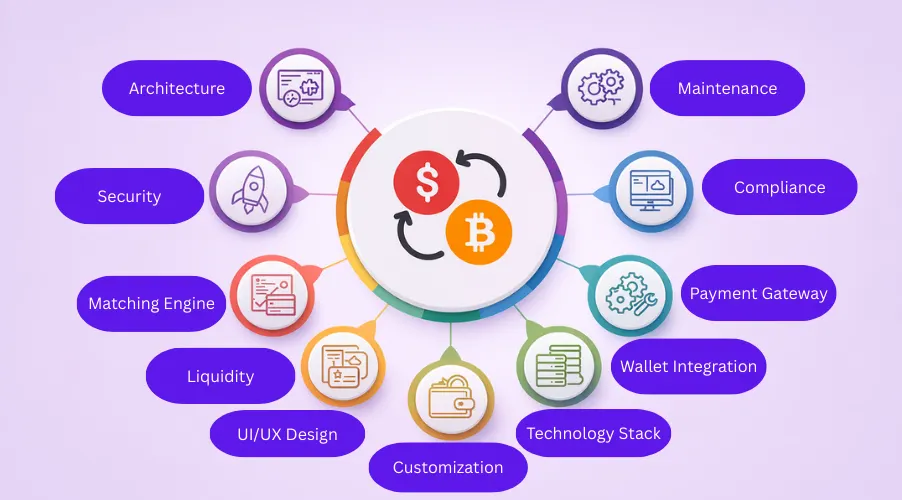
Building a crypto exchange is a serious investment. Before starting, it is important to understand the Factors affecting crypto exchange development cost. The total budget does not depend on one single element. Many startups think development cost is fixed, but that is not true.
Key Takeaways
- The overall crypto exchange development cost depends heavily on platform features, complexity, and required trading functionalities.
- Security infrastructure is one of the top factors affecting crypto exchange cost due to compliance and risk management requirements.
- Technology stack selection significantly influences crypto exchange development cost factors, especially regarding scalability and long-term performance.
- Custom design and advanced user interface requirements increase key factors in crypto exchange development cost considerably.
- Integration of third-party services like payment gateways and liquidity providers impacts factors affecting crypto exchange development cost.
- Choosing between centralized and decentralized architecture is among the top factors affecting crypto exchange cost structure.
- Development model selection, whether custom or white-label, directly changes crypto exchange development cost factors.
- Advanced trading features such as margin trading and automated bots increase key factors in crypto exchange development cost.
- Ongoing maintenance, upgrades, and technical support are critical factors affecting crypto exchange development cost over time.
- Regulatory compliance and security audits remain top factors affecting crypto exchange cost in competitive global markets.
Factors Affecting Crypto Exchange Development Cost
Building a crypto exchange is a serious investment. Before starting, it is important to understand the Factors affecting crypto exchange development cost. The total budget does not depend on one single element. It depends on multiple technical and business decisions. If these decisions are clear from the beginning, you can control expenses and avoid unexpected costs.
Many startups think development cost is fixed, but that is not true. The Top factors affecting crypto exchange cost include features, security level, technology choice, design quality, and third-party services. Every decision increases or decreases the overall budget. In this blog, we will explain the Crypto exchange development cost factors in a simple and practical way.
Key Factors in Crypto Exchange Development Cost
When planning a crypto exchange, you must focus on the core areas that directly impact development pricing. The Key factors in crypto exchange development cost are mostly technical and operational. If you manage these areas carefully, you can build a secure and scalable platform within a planned budget.
Below are the most important elements explained clearly and point to point.
Platform Features and Functional Requirements
Features are one of the biggest Factors affecting crypto exchange development cost. A basic exchange with simple buy and sell functionality will cost much less than an advanced trading platform.
If you add features like:
-
-
- Advanced trading charts
- Multiple order types (limit, market, stop-loss)
- Margin trading
- Futures trading
- Staking and earning options
- Multi-currency wallet support
-
Then the development time increases. More development time means higher cost.
A simple strategy to manage the budget is to start with core features only. Focus on essential modules such as user registration, KYC, wallet integration, trading engine, and admin dashboard. After launch, you can upgrade gradually.
The more complex the functional requirements, the higher the development effort. That is why platform features are always listed among the Top factors affecting crypto exchange cost.
Security Infrastructure and Compliance Needs
Security is not optional in crypto exchange development. It is a mandatory investment. Strong security systems are a major cost factor in Crypto exchange development because exchanges deal with real money and sensitive user data.
Key security components include:
-
-
- End-to-end data encryption
- Two-factor authentication (2FA)
- Anti-DDoS protection
- Secure wallet management (hot and cold wallets)
- Multi-signature wallets
- Regular security audits
-
If you choose high-level security architecture, the cost will increase, but it will protect your business from hacks and legal issues.
Compliance also affects cost. Depending on the country you target, you may need KYC, AML systems, and regulatory documentation. Integration of automated compliance tools increases development expenses.
Security and compliance are among the most critical Factors affecting crypto exchange development cost, but cutting corners here is risky. A secure platform builds trust and reduces long-term losses.
Technology Stack Selection
Technology stack means the programming languages, frameworks, and tools used to build the exchange. This is one of the Key factors in crypto exchange development cost because the tech choice directly affects development speed and scalability.
For example:
-
-
- A high-performance matching engine requires advanced backend technologies.
- Blockchain integration may require specialized developers.
- Cloud hosting services can increase operational costs.
-
If you choose modern and scalable technologies, initial development cost may be slightly higher. But in the long term, it reduces maintenance problems and improves performance.
On the other hand, using outdated or low-quality technology may reduce initial cost but create serious issues later.
To control budget, businesses should select a tech stack that balances performance and cost. Technology decisions are clearly one of the Top factors affecting crypto exchange cost because they influence both development and future upgrades.
UI/UX Design Complexity
User experience plays a big role in the success of a crypto exchange. A simple and clean design costs less compared to a highly customized and animated interface.
If you want:
-
-
- Custom dashboards
- Advanced trading view
- Smooth animations
- Mobile-responsive design
- Dedicated mobile apps
-
then design and front-end development costs increase.
UI/UX is often underestimated, but it is one of the practical Crypto exchange development cost factors. A professional interface improves user retention and builds trust.
However, the strategy should be smart. Instead of overdesigning, focus on clarity, fast navigation, and smooth trading flow. A simple but functional interface is enough in the early stage.
Third-Party Integrations
Third-party integrations are another major area among the Factors affecting crypto exchange development cost. A crypto exchange cannot work alone. It depends on external services.
Common third-party integrations include:
-
-
- Payment gateways
- Liquidity providers
- KYC verification services
- Blockchain nodes
- Market data providers
- Email and SMS services
-
Each integration comes with setup costs and sometimes recurring fees. If you integrate multiple liquidity providers and global payment systems, the overall cost increases. Businesses should carefully choose only the necessary integrations at the beginning. Extra integrations can be added later as the platform grows. Third-party services are clearly part of the Top factors affecting crypto exchange cost because they impact both development complexity and operational expenses.
| Category | Key Factors in Crypto Exchange Development Cost | Cost Impact Level |
|---|---|---|
| Platform Requirements | Advanced trading features, admin panel, order types | High |
| Security Infrastructure | Encryption, KYC/AML integration, security audits | High |
| Technology Stack | Blockchain integration, backend architecture | Medium–High |
| Development Model | Custom development vs white label solution | High |
| Maintenance & Support | Upgrades, monitoring, technical support | Medium–High |
Crypto Exchange Development Cost Factors Related to Architecture
Architecture is the backbone of any crypto exchange. It defines how the system operates, processes transactions, handles users, and manages data. The technical structure you choose plays a major role in overall expenses. Among all Crypto exchange development cost factors, architecture is one of the most important.
Let’s break down the main architectural elements that influence cost.
Centralized vs Decentralized Structure
One of the first decisions is whether you want to build a centralized exchange (CEX) or a decentralized exchange (DEX). This choice significantly impacts the Key factors in crypto exchange development cost.
A centralized exchange works with a central authority that manages transactions, user accounts, funds custody, and order matching. It requires:
-
-
- Strong backend infrastructure
- Advanced database management
- Custody wallet systems
- High-level security systems
- Regulatory compliance setup
-
Because everything is managed centrally, development is complex and requires experienced engineers. Security implementation is also expensive because the platform stores user funds. These requirements increase development cost.
On the other hand, a decentralized exchange works using smart contracts. Users control their funds through wallets, and transactions happen directly on the blockchain. This structure reduces custody risk but increases blockchain development complexity.
DEX platforms require:
-
-
- Smart contract development
- Blockchain integration
- Gas optimization
- Decentralized liquidity setup
-
While DEX platforms may reduce some infrastructure costs, smart contract auditing and blockchain security increase expenses. So both models have cost implications, and your business goals should decide the direction.
This structural choice is clearly one of the Factors affecting crypto exchange development cost because it defines technical depth and long-term operational needs.
Matching Engine Performance
The matching engine is the core of a crypto exchange. It matches buy and sell orders in real time. Its speed and accuracy directly impact user experience.
If you want a basic exchange with limited users, a standard matching engine may work. But if your goal is to support high-frequency trading and large trading volumes, you need:
-
-
- High-performance order matching
- Low-latency processing
- Scalable server architecture
- Load balancing systems
-
Developing a high-speed matching engine requires advanced coding, optimized algorithms, and powerful servers. This increases development and infrastructure cost.
Performance requirements are among the Top factors affecting crypto exchange cost because speed determines competitiveness. A slow exchange loses users. Therefore, investing in performance is not optional if you want long-term success.
Also, scalable architecture must be planned from the beginning. If scalability is ignored, future upgrades become expensive. Planning scalability early is a smart strategy to control cost over time.
Liquidity Management System
Liquidity is critical for any exchange. Without liquidity, users cannot execute trades easily. Poor liquidity leads to price gaps and a bad user experience.
There are different ways to manage liquidity:
-
-
- Internal liquidity pool
- External liquidity providers
- Market-making systems
- Liquidity APIs integration
-
If you choose to build your own liquidity system, development complexity increases. It requires:
-
-
- Order book management
- Market maker bots
- Risk control systems
-
If you integrate external liquidity providers, development becomes easier but you may pay ongoing integration and service fees. Liquidity strategy directly influences development complexity and operational cost. That is why it is considered one of the important Crypto exchange development cost factors. A strong liquidity plan ensures smooth trading, but it requires technical setup and smart financial planning. Ignoring this area can damage platform growth.
Crypto Exchange Development Cost Factors Based on Development Model
When businesses plan to launch a trading platform, one of the first questions they ask is about cost. The reality is that there is no fixed price. The development model you choose plays a major role in the final budget. Among the top factors affecting crypto exchange cost, the choice between custom development and white label solutions stands out as a major decision point.
Factors Affecting Crypto Exchange Development Cost in Custom Development
Custom development means building a crypto exchange from scratch. Everything is designed and developed according to your business requirements. While this gives you full control, it also increases development time and cost.
Custom platforms are ideal for businesses that want long-term scalability, unique branding, and advanced trading functionality. However, several crypto exchange development cost factors come into play when choosing this model.
Custom Module Development
One of the biggest key factors in crypto exchange development cost under custom development is module creation. In this model, every feature is built separately. This includes user registration, KYC verification, wallet integration, trading engine, admin panel, liquidity system, and reporting tools.
If your platform requires advanced modules like margin trading, staking, futures trading, or automated bots, the cost increases significantly. Each module needs separate coding, testing, and security auditing. The more complex the feature, the higher the development effort.
From a strategy point of view, businesses should first define only the essential features required for launch. Instead of building everything at once, start with core modules and upgrade later. This phased approach helps control budget and reduces financial pressure.
Custom integrations also affect cost. If you plan to integrate third-party payment gateways, liquidity providers, or blockchain networks, development becomes more complex. Each integration adds technical effort and testing requirements. In short, the number and complexity of modules are major factors affecting crypto exchange development cost in custom development.
Scalability Planning
Scalability planning is another critical element. A crypto exchange must handle high traffic, large transaction volumes, and real-time trading without downtime. Designing such an infrastructure requires advanced backend architecture.
Building a scalable system involves load balancing, distributed servers, cloud deployment, and database optimization. These technical decisions increase development cost but are essential for long-term growth. If scalability is ignored in the early stage, upgrading later becomes more expensive. That is why scalability planning is considered one of the top factors affecting crypto exchange cost for serious businesses.
From a strategic perspective, you should estimate future user growth. If you plan to target global markets, investing in scalable infrastructure from the beginning is wise. If your launch is small and local, you can start with moderate infrastructure and expand gradually.
Security also connects with scalability. As the platform grows, security risks increase. Advanced security systems such as multi-layer encryption, cold wallet integration, and DDoS protection add to development costs but are necessary for user trust.
So, when analyzing crypto exchange development cost factors, always include scalability and security planning in your calculation.
Advanced Trading Features
Advanced trading functionality significantly impacts pricing. Basic exchanges only support spot trading. However, modern traders expect more features like margin trading, futures, derivatives, staking, and automated trading bots.
Each advanced feature requires complex algorithms and strong backend logic. For example, building a high-speed matching engine demands technical expertise and performance testing. The more advanced your trading system, the more development hours are required.
Liquidity management is another area that affects cost. A strong exchange must offer smooth trade execution. This may require integration with liquidity providers, which increases both development and operational expenses. Risk management tools such as stop-loss orders, limit orders, and price alerts also add development effort. While these features improve user experience, they increase the overall budget.
From a business strategy point of view, you should analyze your target audience. If your users are beginners, basic features may be enough initially. If you are targeting professional traders, investing in advanced tools becomes necessary.
Clearly, trading functionality is one of the most important key factors in crypto exchange development cost in a custom model.
Factors Affecting Crypto Exchange Development Cost in White Label Solutions
White label development is different from custom development. In this model, you purchase a ready-made crypto exchange solution and customize it with your branding. This approach reduces development time and upfront cost.
However, even in white label solutions, there are important factors affecting crypto exchange development cost that you must understand.
Customization Level
White label solutions come with predefined features. But most businesses want changes in design, workflow, or feature configuration. The level of customization directly affects cost. Basic customization includes logo changes, theme adjustments, and minor feature edits. This keeps costs low. However, deep customization like adding new modules, modifying trading logic, or integrating custom payment systems increases expenses.
The more you modify the base system, the closer your cost moves toward custom development pricing. That is why customization level is among the major crypto exchange development cost factors in white label projects. Strategically, businesses should carefully evaluate their requirements before choosing white label. If your needs are very specific, heavy customization may not be cost-effective. But if your goal is fast market entry with limited features, white label can be a smart choice.
Another important consideration is scalability. Some white label providers limit system flexibility. If you plan future expansion, confirm whether the platform supports upgrades without high additional costs.
Licensing and Setup Fees
Licensing and setup fees are another major cost component in white label development. Unlike custom development, where you own the code, white label platforms often operate under licensing agreements.
You may need to pay a one-time setup fee, a monthly maintenance fee, or revenue-sharing model. These ongoing payments affect long-term financial planning. Some providers also charge extra for technical support, feature upgrades, and security updates. Over time, these recurring costs can become significant. Therefore, licensing terms are among the top factors affecting crypto exchange cost in white label solutions. Always review contracts carefully. Understand what is included in the package and what requires additional payment.
Another point to consider is hosting and infrastructure costs. Even with white label software, you still need secure servers, monitoring systems, and data storage. These operational costs must be added to your total budget.
From a strategic angle, calculate the total cost over 3–5 years instead of focusing only on the initial setup fee. Sometimes custom development may appear expensive initially, but it becomes more cost-effective in the long run compared to continuous licensing payments.
Key Factors in Crypto Exchange Development Cost for Long-Term Planning
When businesses calculate the budget for launching a trading platform, they often focus only on development costs. However, long-term planning is equally important. After launch, a crypto exchange requires continuous updates, monitoring, and operational support. These ongoing responsibilities are major factors affecting crypto exchange development cost in the long run.
If long-term expenses are not planned properly, even a well-built platform can face financial pressure. That is why understanding post-launch expenses is essential. In this section, we will clearly explain the long-term crypto exchange development cost factors that every business must consider.
Ongoing Maintenance and Upgrade Costs
Launching a crypto exchange is not the final step. Technology keeps evolving, and user expectations change rapidly. Regular maintenance is required to keep the system stable and efficient. One of the most important key factors in crypto exchange development cost is platform maintenance. This includes fixing bugs, updating APIs, improving performance, and ensuring compatibility with new devices and browsers. Without regular updates, the system may slow down or become vulnerable to security risks. Blockchain networks also upgrade frequently. If your exchange supports multiple cryptocurrencies, you must update wallet integrations and node connections regularly. These technical updates require skilled developers and testing teams, which adds to long-term cost.
Another major area is feature upgrad/blog/crypto-exchange-operational-maintenance-costses. As competition increases, exchanges need to introduce new trading tools, faster transaction processing, and better analytics dashboards. These improvements require development effort and increase overall expenses. Server maintenance is also part of the ongoing cost. As user traffic grows, you may need to upgrade hosting plans, increase server capacity, and improve database management. Ignoring infrastructure upgrades can result in downtime, which affects user trust and business revenue.
From a strategic point of view, businesses should allocate a fixed annual budget for maintenance and upgrades. Instead of treating maintenance as an extra expense, consider it a necessary investment for long-term growth. These continuous improvements are among the top factors affecting crypto exchange cost over time.
Security Monitoring and Risk Management
Security is one of the most critical elements of any crypto exchange. Since the platform handles digital assets and user funds, even a small vulnerability can cause heavy financial loss. Continuous security monitoring is a major component of long-term crypto exchange development cost factors. Cyber threats evolve daily. Hackers constantly search for weak points in trading platforms. Therefore, security systems must be monitored 24/7. Security monitoring includes intrusion detection systems, real-time transaction monitoring, and unusual activity alerts. These systems require advanced tools and skilled security professionals. Hiring cybersecurity experts increases operational cost but is essential for platform safety.
Regular security audits are another important expense. Conducting internal and external audits helps identify vulnerabilities before attackers exploit them. Smart contract audits, wallet security testing, and penetration testing are all part of this process. Risk management tools also play a key role. Features like withdrawal limits, multi-factor authentication, anti-phishing systems, and cold wallet storage require additional technical setup and monitoring. These systems protect user funds but add to development and operational expenses.
Regulatory compliance is another cost factor linked to security. Many regions require exchanges to follow KYC (Know Your Customer) and AML (Anti-Money Laundering) guidelines. Integrating identity verification systems and maintaining compliance records increases long-term cost.
From a business strategy perspective, security should never be treated as optional. Investing in strong security reduces the risk of hacks, legal issues, and reputation damage. Clearly, security monitoring and risk management are major factors affecting crypto exchange development cost in long-term planning.
Technical Support and Operational Expenses
After launch, users will need assistance. Technical support is a continuous responsibility. Providing fast and effective support improves user satisfaction and builds trust. Customer support teams handle account issues, transaction delays, verification problems, and general queries. Hiring trained support staff increases monthly operational expenses. If you operate globally, you may need 24/7 multilingual support, which further raises cost. Technical teams are also required to monitor system performance. DevOps engineers manage servers, track uptime, and ensure smooth operation. If any issue occurs, the technical team must resolve it immediately. This continuous monitoring adds to long-term expenses.
Payment processing and liquidity management are additional operational costs. Exchanges often partner with liquidity providers to maintain smooth trading. These partnerships may involve service fees or revenue-sharing models. Marketing and promotional activities also impact long-term budgeting. While not directly part of development, they are necessary for platform growth. As competition increases, marketing expenses become a significant operational factor.
Software licenses and third-party tools add further cost. Analytics software, monitoring tools, and security solutions often operate on subscription models. These recurring payments must be included in long-term planning. From a strategic standpoint, businesses should prepare a detailed operational cost structure before launch. Estimate monthly expenses for staffing, hosting, compliance, and marketing. Proper planning helps avoid financial stress later.
Overall, technical support and operational management are strong key factors in crypto exchange development cost that directly influence business sustainability.
Build Your Secure Crypto Exchange Today
Partner with us to create a reliable, compliant, and high-performance crypto exchange. Get expert development, robust security, and seamless user experience from start to launch.
Final Thoughts
Building a crypto exchange is only the beginning. Long-term planning plays a crucial role in overall budgeting. Ongoing maintenance, security monitoring, and operational management are continuous responsibilities that require dedicated investment.
When analyzing factors affecting cryptocurrency exchange development cost, always think beyond initial development. Maintenance upgrades keep the platform competitive. Security monitoring protects user funds and reputation. Technical support ensures smooth daily operations.
These long-term crypto exchange development cost factors determine whether your platform can grow sustainably. By planning ahead and allocating resources wisely, you can manage expenses effectively while building a secure and reliable crypto exchange.
Frequently Asked Questions
Q1.What are the main factors affecting crypto exchange development cost?
The main factors affecting crypto exchange development cost include platform features, security infrastructure, technology stack, development model (custom or white label), UI/UX complexity, and third-party integrations. Each of these elements directly influences the total budget required to build and launch a secure and scalable exchange.
Q2.How do top factors affecting crypto exchange cost impact the overall budget?
Top factors affecting crypto exchange cost such as advanced trading features, liquidity management systems, compliance requirements, and performance optimization significantly increase development complexity. The more advanced and secure the platform needs to be, the higher the overall development cost.
Q3.How do crypto exchange development cost factors differ between centralized and decentralized exchanges?
Crypto exchange development cost factors vary based on exchange type. Centralized exchanges require strong backend management, matching engines, and user data protection systems, while decentralized exchanges focus more on smart contract development and blockchain integration. Both models involve different technical and security-related cost considerations.
Q4.Why is security considered a key factor in crypto exchange development cost?
Security is one of the key factors in crypto exchange development cost because exchanges handle sensitive user data and large volumes of digital assets. Implementing multi-layer security, encryption, compliance standards, and regular audits increases development effort and overall cost but is essential for long-term reliability.
Q5.Does customization increase the factors affecting crypto exchange development cost?
Yes, higher customization levels significantly impact the factors affecting crypto exchange development cost. Custom trading features, advanced dashboards, unique UI/UX design, and tailored integrations require additional development time, which increases the total project budget.
Q6.How do ongoing operations influence crypto exchange development cost factors?
Crypto exchange development cost factors are not limited to initial development. Ongoing maintenance, security updates, server infrastructure, compliance upgrades, and technical support also contribute to long-term expenses, making operational planning an important part of total cost estimation.
Explore Services
Related Services
Reviewed by

Aman Vaths
Founder of Nadcab Labs
Aman Vaths is the Founder & CTO of Nadcab Labs, a global digital engineering company delivering enterprise-grade solutions across AI, Web3, Blockchain, Big Data, Cloud, Cybersecurity, and Modern Application Development. With deep technical leadership and product innovation experience, Aman has positioned Nadcab Labs as one of the most advanced engineering companies driving the next era of intelligent, secure, and scalable software systems. Under his leadership, Nadcab Labs has built 2,000+ global projects across sectors including fintech, banking, healthcare, real estate, logistics, gaming, manufacturing, and next-generation DePIN networks. Aman’s strength lies in architecting high-performance systems, end-to-end platform engineering, and designing enterprise solutions that operate at global scale.