Ai Overview
Crypto exchange operational costs are all recurring expenses required to keep a cryptocurrency trading platform running, serving users, and meeting regulatory obligations. For context, a mid-size exchange processing $50-$200 million in monthly trading volume typically spends $50,000-$120,000 per month on operations. The crypto exchange infrastructure cost typically ranges from $5,000-$15,000 per month for a small exchange to $50,000-$150,000+ for platforms serving global markets with high availability requirements.
Key Takeaways
- Crypto exchange operational costs encompass infrastructure, staffing, compliance, security, liquidity, and marketing, with total monthly expenses ranging from $30,000 for small platforms to $500,000+ for enterprise-grade exchanges operating across multiple jurisdictions.
- Crypto exchange infrastructure cost is the largest single expense category, covering cloud hosting (AWS, Azure), database management, CDN, bandwidth, and server scaling, typically consuming 20-30% of the total crypto exchange operational budget.
- Crypto exchange maintenance costs are distinct from operational costs: maintenance covers software updates, security patches, performance optimization, and disaster recovery that keep the platform technically sound, while operational costs cover the broader business functions.
- The cost to maintain a crypto exchange annually ranges from $200,000-$500,000 for mid-size platforms to $1M-$5M+ for large exchanges, driven by infrastructure renewal, licensing, security upgrades, and team retention.
- Ongoing expenses of crypto exchange include hidden costs like payment gateway fees, blockchain node operations, third-party integration fees, and scalability investments that are often underestimated in initial budgets.
- Compliance and regulatory expenses increase significantly with multi-jurisdiction operations, with licensing fees, legal consultation, and KYC/AML systems collectively costing $50,000-$1,000,000+ annually, depending on the number of markets served.
- Security is a non-negotiable expense category that should represent 10-15% of the total budget, covering audits, monitoring, cold wallet infrastructure, insurance, and dedicated security personnel.
- Optimizing the crypto exchange operational budget requires cloud cost optimization, compliance automation, strategic outsourcing, AI-driven monitoring, and efficient liquidity management, with the critical constraint that security spending must never be reduced.
What Are Crypto Exchange Operational Costs?
Crypto exchange operational costs are all recurring expenses required to keep a cryptocurrency trading platform running, serving users, and meeting regulatory obligations. These costs begin the moment the exchange goes live and continue for the entire lifetime of the platform. They include infrastructure hosting, team salaries, security systems, compliance programs, liquidity provision, marketing, and customer support. Unlike one-time creation costs, cryptocurrency exchange running expenses never stop and typically grow as the platform scales.
For context, a mid-size exchange processing $50-$200 million in monthly trading volume typically spends $50,000-$120,000 per month on operations. A large exchange with billions in monthly volume may spend $300,000-$500,000+ monthly. These are not theoretical numbers. They represent the real investment required to operate a competitive, secure, and compliant trading platform in the major financial markets.
Why Operational Cost Planning Impacts Long-Term Profitability
The difference between profitable and unprofitable exchanges often comes down to operational cost management. Revenue from trading fees is directly tied to volume, which fluctuates with market conditions. During bear markets, trading volumes can drop 70-80% while operational costs remain largely fixed. Exchanges that have not built efficient cost structures during bull markets find themselves burning cash during downturns. Conversely, exchanges that plan their crypto exchange operational budget carefully can maintain profitability through market cycles. The exchange cost analysis guide covers the full cost picture from creation through ongoing operations.
Core Components of Crypto Exchange Operational Costs
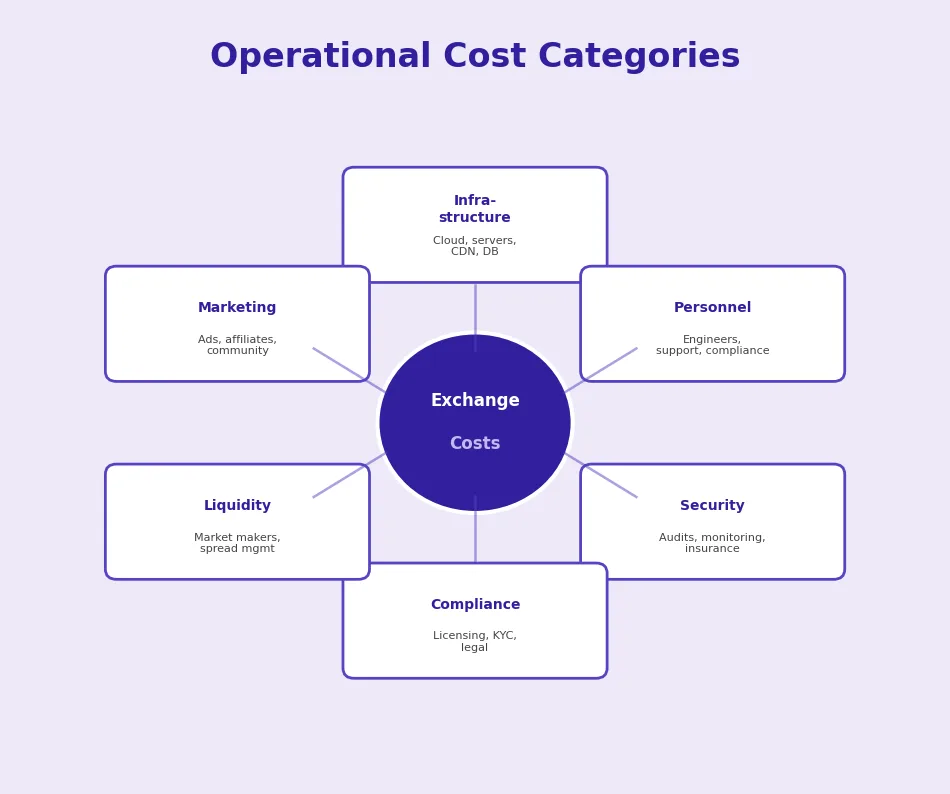
Crypto Exchange Infrastructure Cost
Infrastructure is the technical foundation that everything runs on. Cloud hosting through providers like AWS, Azure, or GCP forms the base, with costs driven by compute capacity, storage, bandwidth, and geographic distribution. Server scaling must handle both normal operations and the sudden spikes that occur during market volatility. Database management systems must support millions of transactions with sub-millisecond latency. CDN and performance optimization ensure that users worldwide experience fast, responsive interfaces. The crypto exchange infrastructure cost typically ranges from $5,000-$15,000 per month for a small exchange to $50,000-$150,000+ for platforms serving global markets with high availability requirements.
Liquidity and Market Making Expenses
Liquidity is what makes an exchange usable. Without adequate liquidity, spreads are wide, slippage is high, and traders leave. Liquidity provider partnerships require ongoing fees or revenue-sharing arrangements. Internal market-making systems need continuous monitoring and capital allocation. Spread management costs include the technology and personnel needed to maintain competitive quotes across all trading pairs. For new exchanges, liquidity bootstrapping is one of the largest early-stage ongoing expenses of crypto exchange operations.
Compliance and Regulatory Expenses
Compliance is one of the fastest-growing cost categories. Licensing fees vary significantly by jurisdiction but can range from $10,000 to $500,000+ per market. Legal consultation for regulatory interpretation, policy creation, and incident response adds $50,000-$200,000+ annually. KYC/AML integration systems (third-party providers like Jumio, Onfido, or Chainalysis) cost $2,000-$20,000+ per month depending on user volume. These costs are non-negotiable for exchanges operating in regulated markets.
Security and Risk Management Costs
Security spending should represent 10-15% of the total crypto exchange operational budget. This covers regular security audits ($20,000-$50,000 per engagement), smart contract audits ($15,000-$100,000+), cold wallet infrastructure ($10,000-$50,000 setup plus ongoing management), insurance premiums ($50,000-$500,000+ annually), bug bounty programs, and dedicated security personnel. Teams building crypto exchanges must treat security as a permanent investment, not a one-time expense.
Monthly Operational Cost Breakdown
| Cost Category | Small Exchange | Mid-Size | Large Exchange |
|---|---|---|---|
| Infrastructure | $5K-$15K | $20K-$60K | $80K-$200K+ |
| Personnel | $15K-$40K | $40K-$120K | $150K-$500K+ |
| Compliance | $3K-$10K | $10K-$40K | $50K-$150K+ |
| Security | $3K-$8K | $8K-$25K | $30K-$80K+ |
| Liquidity | $2K-$10K | $10K-$50K | $50K-$200K+ |
| Marketing | $2K-$10K | $10K-$50K | $50K-$300K+ |
| Total Monthly | $30K-$93K | $98K-$345K | $410K-$1.4M+ |
Cryptocurrency Exchange Running Expenses Breakdown
Daily and Monthly Cryptocurrency Exchange Running Expenses
Personnel costs are the single largest component of cryptocurrency exchange running expenses. Engineering teams (backend, frontend, blockchain, DevOps) typically require 5-20+ engineers depending on platform complexity. Compliance officers ensure regulatory adherence across all operating jurisdictions. Customer support teams handle user queries, disputes, and account issues. Each role commands competitive salaries that reflect the specialized knowledge required in this industry, with senior blockchain engineers earning $150,000-$250,000+ annually in major markets.
Technical support team costs go beyond basic customer service. They include 24/7 coverage across time zones, specialized training on trading products and blockchain operations, and the tools and platforms needed to manage support interactions at scale. Customer service operations encompass ticketing systems, live chat infrastructure, chatbot integration, and quality assurance programs that ensure consistent service delivery.
Marketing and User Acquisition Costs
Marketing is an essential ongoing expense of crypto exchange operations. The comprehensive exchange cost breakdown provides additional context on how marketing budgets fit within the total cost structure. Paid advertising across search, social, and crypto-specific channels drives user acquisition. Affiliate programs incentivize existing users and influencers to bring new traders. Community management on Discord, Telegram, and social media maintains engagement and brand presence. PR and branding activities build the reputation and trust that are essential for attracting institutional users and maintaining public confidence. Marketing costs vary widely but typically range from $5,000-$50,000+ per month, with user acquisition costs of $10-$100+ per active trader depending on market conditions and competition.
What Are Crypto Exchange Maintenance Costs?
Crypto exchange maintenance costs are the expenses specifically related to keeping the platform’s technology stack current, secure, and performing optimally. While operational costs cover the business of running the exchange, maintenance costs cover the technology that makes it function. This distinction matters because maintenance is often underestimated in budgets, yet neglecting it leads to security vulnerabilities, performance degradation, and technical debt that becomes exponentially more expensive to address over time.
Maintenance is a continuous investment, not a periodic expense. Every day the exchange operates, its code needs updates, its security needs monitoring, its servers need optimization, and its data needs management. The cost to maintain crypto exchange technology represents a permanent commitment that must be budgeted for from launch onward. The exchange platform guide covers the architectural decisions that affect long-term maintenance requirements.
Technical Maintenance Expenses
Software updates and feature enhancements include version upgrades for all dependencies, UI/UX improvements based on user feedback and competitive analysis, and API upgrades to support new trading features and third-party integrations. Security patches and system monitoring cover continuous penetration testing, vulnerability scanning, real-time fraud detection systems, and the personnel who manage these tools. Server monitoring and performance optimization encompass downtime prevention, backup management, and disaster recovery planning that ensures the platform can recover from any failure scenario.
Risk Warning: Underfunding maintenance is one of the most common and dangerous mistakes in exchange operations. Deferred updates create security vulnerabilities. Neglected monitoring allows problems to grow undetected. Skipped backups turn recoverable incidents into catastrophic losses. The cost of proactive maintenance is always a fraction of the cost of a major incident caused by neglected maintenance.
Cost to Maintain Crypto Exchange Annually
The annual cost to maintain crypto exchange technology includes infrastructure renewal (upgrading servers, storage, and networking as the platform scales), licensing renewals (regulatory licenses, software licenses, API subscriptions), security upgrades (new audit cycles, updated monitoring tools, expanded insurance), and team retention (competitive compensation to prevent talent loss in a competitive market).
Annual Maintenance Cost Estimates
| Maintenance Area | Mid-Size Exchange | Large Exchange |
|---|---|---|
| Infrastructure Renewal | $50K-$120K | $200K-$600K |
| License Renewals | $30K-$100K | $150K-$500K+ |
| Security Upgrades | $60K-$150K | $200K-$500K |
| Software Updates | $40K-$100K | $150K-$400K |
| Team Retention | $100K-$300K | $500K-$2M+ |
| Total Annual | $280K-$770K | $1.2M-$4M+ |
Factors That Increase the Cost to Maintain Crypto Exchange
Exchange type significantly affects costs: centralized exchanges (CEX) have higher compliance and custody costs, while decentralized exchanges (DEX) have higher smart contract audit costs. Trading volume drives infrastructure scaling requirements. The number of supported assets multiplies integration, monitoring, and compliance complexity. Geographic regulations add jurisdiction-specific compliance layers, each with its own licensing, legal, and reporting requirements. Working with experienced cryptocurrency exchange engineering teams helps optimize these cost structures from the architecture phase.
Ongoing Expenses of Crypto Exchange You Must Plan For
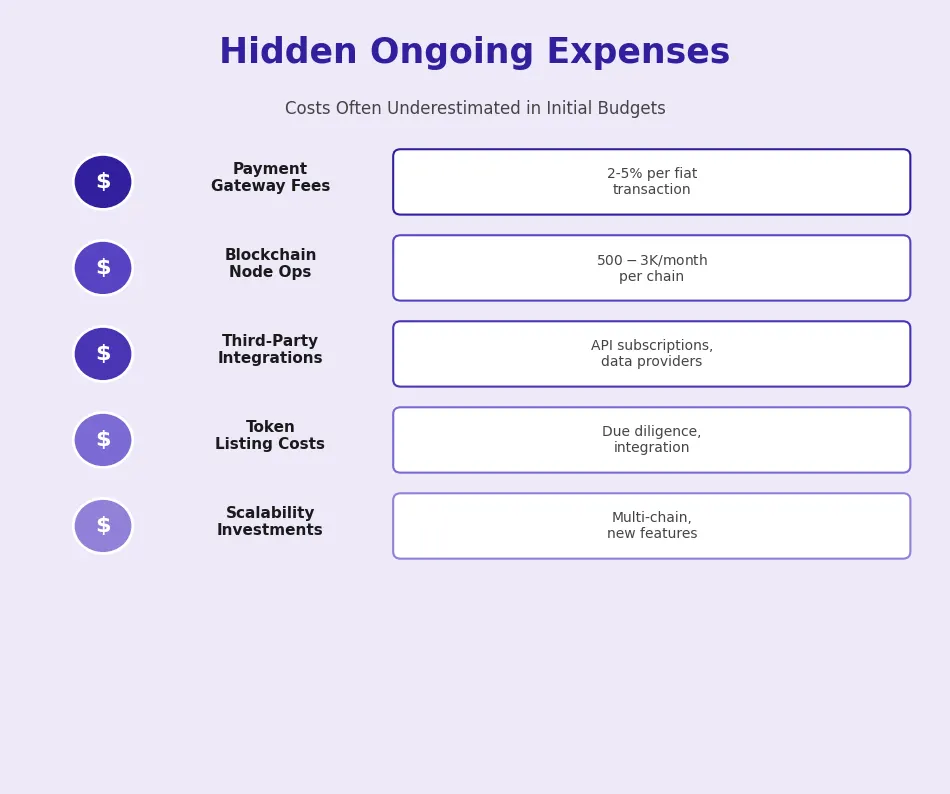
Hidden Ongoing Expenses of Crypto Exchange
Payment gateway fees consume 2-5% of every fiat transaction, adding up quickly at scale. Blockchain node operation costs $500-$3,000+ per month per supported chain, and exchanges supporting 10+ chains face significant aggregate costs. Third-party integrations (market data providers, analytics tools, communication platforms) each carry subscription fees that compound. These hidden ongoing expenses of crypto exchange operations are frequently underestimated in initial budgets, creating cash flow surprises in the first year of operation.
Scalability and Growth-Related Expenses
Growth introduces its own cost pressures. Adding new tokens requires technical integration, security assessment, compliance review, and liquidity arrangement for each asset. Multi-chain integration multiplies infrastructure, monitoring, and maintenance requirements. Advanced trading features (margin trading, futures, options) require additional risk engines, liquidation systems, and regulatory approvals. Each expansion creates permanent additions to the cryptocurrency exchange running expenses that must be factored into the growth strategy.
Exchange Cost Lifecycle
| Phase | Timeframe | Primary Costs | Focus |
|---|---|---|---|
| 1. Launch | Month 1-3 | Infrastructure, licensing, liquidity bootstrapping | Get operational, secure first users |
| 2. Growth | Month 4-12 | Marketing, scaling, new features | User acquisition, volume growth |
| 3. Scale | Year 1-2 | Team expansion, multi-chain, compliance | Market expansion, product breadth |
| 4. Mature | Year 2+ | Maintenance, optimization, retention | Profitability, cost efficiency |
How to Optimize Your Crypto Exchange Operational Budget
Smart Cost Allocation Strategies
Infrastructure optimization through reserved instances, auto-scaling policies, and right-sizing reduces cloud costs by 20-40% compared to on-demand pricing. Automation of compliance workflows (KYC processing, transaction monitoring, report generation) reduces manual labor and error rates. The strategic outsourcing versus in-house decision should be evaluated function by function: core engineering is typically kept in-house, while specialized functions like security auditing and certain compliance tasks can be effectively outsourced.
Launch & Manage Your Crypto Exchange Within a Smart Operational Budget
Build and maintain your crypto exchange with optimized operational costs, reduced maintenance expenses, and a smart long-term operational budget.
Reducing Crypto Exchange Operational Costs Without Compromising Security
Cloud cost optimization through spot instances for non-critical workloads, intelligent caching, and CDN optimization can reduce infrastructure bills significantly. AI-driven monitoring reduces the need for large 24/7 operations teams by automating alert triage and first-response. Efficient liquidity management through algorithmic market making and strategic liquidity provider partnerships reduces the cost of maintaining competitive spreads. The critical constraint in all optimization: security spending must never be reduced. The cost of a single breach far exceeds any savings from reduced security investment.
Cost Optimization Strategies
| Strategy | Potential Savings | Implementation Effort | Risk Level |
|---|---|---|---|
| Reserved cloud instances | 20-40% | Low | Low |
| Compliance automation | 30-50% | Medium | Low |
| AI-driven monitoring | 25-40% | Medium-High | Low |
| Strategic outsourcing | 15-30% | Medium | Medium |
Final Thoughts on Crypto Exchange Operational and Ongoing Maintenance Expenses
Running a cryptocurrency exchange is a capital-intensive operation that requires disciplined cost management, realistic budgeting, and continuous optimization. The crypto exchange operational costs outlined in this guide represent real, unavoidable investments that every exchange must make to operate securely, compliantly, and competitively. There are no shortcuts: underfunding security leads to breaches, underfunding compliance leads to regulatory action, and underfunding infrastructure leads to user-facing failures that destroy trust.
The most successful exchanges approach cost management as a strategic discipline, not a cost-cutting exercise. They invest heavily in the areas that drive competitive advantage (security, performance, liquidity) while relentlessly optimizing areas where efficiency gains do not compromise quality (infrastructure utilization, process automation, vendor management). Understanding and planning for both crypto exchange maintenance costs and broader operational expenses from the outset is what separates sustainable platforms from those that fail under the weight of unexpected expenses.
Frequently Asked Questions
Q1.How much does it cost to run a crypto exchange monthly?
Monthly crypto exchange operational costs vary significantly based on scale. A small to mid-size exchange typically spends $30,000-$80,000 per month on infrastructure, staffing, compliance, and security. Larger exchanges with high trading volumes and multi-jurisdiction operations can spend $150,000-$500,000+ monthly. These costs include cloud hosting, staff salaries, security monitoring, compliance tools, customer support, and marketing, with infrastructure and personnel being the two largest cost categories.
Q2.What is the difference between operational costs and maintenance costs for a crypto exchange?
Operational costs are the ongoing expenses required to run the exchange daily, including infrastructure, staff, compliance, liquidity, and marketing. Maintenance costs are specifically related to keeping the platform technically current and secure, including software updates, security patches, server monitoring, performance optimization, and disaster recovery. Operational costs keep the business running; maintenance costs keep the technology reliable and secure.
Q3.What are the biggest ongoing expenses for a crypto exchange?
The biggest ongoing expenses are infrastructure (cloud hosting, servers, CDN), personnel (engineering, support, compliance teams), security (audits, monitoring, insurance), compliance (licensing renewals, KYC/AML systems, legal counsel), and liquidity (market maker partnerships, spread management). For most exchanges, personnel and infrastructure together account for 50-70% of total ongoing costs.
Q4.How much does crypto exchange compliance cost annually?
Annual compliance costs range from $50,000-$150,000 for a single-jurisdiction operation to $300,000-$1,000,000+ for multi-jurisdiction exchanges. Costs include licensing fees, legal consultation, KYC/AML integration systems, transaction monitoring tools, regulatory reporting, and compliance officer salaries. Compliance costs tend to increase as regulators in major financial markets implement more comprehensive frameworks.
Q5.What security costs should crypto exchanges budget for?
Security budgets should cover regular penetration testing ($20,000-$50,000 per audit), smart contract audits ($15,000-$100,000+), continuous monitoring tools ($2,000-$10,000/month), cold wallet infrastructure ($10,000-$50,000 setup), insurance premiums ($50,000-$500,000+ annually depending on coverage), bug bounty programs ($10,000-$100,000+ annually), and dedicated security personnel ($150,000-$250,000+ per senior security engineer annually)
Q6.Can you reduce crypto exchange operational costs without compromising quality?
Yes, through several strategies: cloud cost optimization (reserved instances, auto-scaling, right-sizing), automation of compliance workflows, AI-driven monitoring to reduce manual oversight, efficient liquidity management, strategic outsourcing of non-core functions, and infrastructure optimization through CDN and caching. The key is reducing waste and inefficiency, not cutting essential capabilities. Security spending should never be reduced.
Explore Services
Related Services
Reviewed by

Aman Vaths
Founder of Nadcab Labs
Aman Vaths is the Founder & CTO of Nadcab Labs, a global digital engineering company delivering enterprise-grade solutions across AI, Web3, Blockchain, Big Data, Cloud, Cybersecurity, and Modern Application Development. With deep technical leadership and product innovation experience, Aman has positioned Nadcab Labs as one of the most advanced engineering companies driving the next era of intelligent, secure, and scalable software systems. Under his leadership, Nadcab Labs has built 2,000+ global projects across sectors including fintech, banking, healthcare, real estate, logistics, gaming, manufacturing, and next-generation DePIN networks. Aman’s strength lies in architecting high-performance systems, end-to-end platform engineering, and designing enterprise solutions that operate at global scale.