Ai Overview
The cryptocurrency industry has transformed from operating on financial fringes to becoming a mainstream asset class demanding rigorous regulatory oversight. Basic CDD procedures apply during initial onboarding and for transactions exceeding jurisdictional thresholds, typically following the Financial Action Task Force’s recommended threshold of $1,000. Financial institutions have paid over $26 billion in fines for AML violations, highlighting significant risks associated with inadequate compliance measures.
The cryptocurrency industry has transformed from operating on financial fringes to becoming a mainstream asset class demanding rigorous regulatory oversight. Crypto compliance represents the comprehensive set of laws, regulations, and best practices governing how organizations handle digital asset transactions, customer data, and reporting requirements across the blockchain ecosystem. As regulatory bodies intensify scrutiny of virtual assets, understanding robust compliance frameworks has become essential for any business operating in the digital asset space. This comprehensive guide covers key takeaways including KYC and AML protocols, global regulatory frameworks like MiCA and FATF standards, transaction monitoring through blockchain analytics, DeFi compliance challenges, crypto tax reporting requirements, smart contract security audits, and strategies for building sustainable compliance infrastructure.
Key Takeaways
- Compliance Now Mandatory: Crypto businesses must implement comprehensive compliance frameworks including KYC, AML, transaction monitoring, and tax reporting to operate legally across global jurisdictions.
- Global Regulatory Convergence: International bodies including FATF are driving harmonized standards requiring crypto platforms to meet traditional financial institution compliance obligations regardless of location.
- Technology-Driven Solutions: Advanced blockchain analytics, AI-powered monitoring tools, and automated compliance platforms enable real-time risk detection and regulatory reporting at scale.
- AML/KYC Foundation: Identity verification and anti-money laundering protocols form the core of crypto regulatory compliance, with biometric authentication and continuous monitoring becoming industry standards.
- DeFi Compliance Challenges: Decentralized finance platforms face unique regulatory hurdles requiring innovative solutions balancing decentralization principles with accountability requirements and oversight mechanisms.
- Tax Transparency Requirements: Jurisdictions worldwide now mandate detailed crypto transaction reporting, capital gains disclosure, and cross-border transfer documentation with automated tracking essential for compliance.
- Smart Contract Audits Critical: Third-party code audits ensure security vulnerabilities are identified before deployment, reducing regulatory risk and protecting users from exploits and financial losses.
The global crypto compliance and blockchain analytics market continues expanding at a compound annual growth rate exceeding 25%, reflecting heightened focus on regulatory adherence across the industry.[1] This growth is driven by increasing enforcement actions, stricter anti-money laundering requirements, and the evolving role of a token development company in building compliant blockchain ecosystems that align with regulatory expectations. The European Union’s Markets in Crypto-Assets regulation has now become fully enforceable, impacting over 300 crypto service providers and establishing the world’s first unified regulatory framework for digital currencies.
What is Crypto Compliance?
Crypto compliance encompasses the processes, tools, and internal controls that cryptocurrency businesses implement to meet regulatory requirements and effectively mitigate financial crimes. This includes adherence to anti-money laundering protocols, know-your-customer verification procedures, transaction monitoring systems, and reporting obligations varying based on jurisdictional requirements. The fundamental purpose extends beyond regulatory compliance to establishing trust, protecting consumers, and maintaining digital financial system integrity.
Businesses operating in the cryptocurrency ecosystem must recognize that compliance ensures protection against financial crimes, builds credibility with regulators and customers, and helps avoid substantial penalties and legal risks. The crypto regulatory compliance landscape continues evolving rapidly, with nearly 90 percent of countries recognizing the importance of regulatory frameworks for cryptocurrency operations. Organizations that proactively embrace compliance position themselves for sustainable growth in regulated markets.
Core Components of Compliance Framework
A comprehensive crypto compliance framework integrates several critical components working together to ensure regulatory adherence and risk mitigation. The primary pillars include customer due diligence, transaction monitoring, risk assessment protocols, regulatory reporting mechanisms, and data protection measures. Each component requires dedicated resources, specialized technology solutions, and ongoing attention to remain effective against evolving threats and regulatory expectations.
Organizations must view these components as interconnected systems where weakness in any single area can compromise the entire compliance posture. The development of automated compliance solutions has enabled businesses to manage increasingly complex requirements while maintaining operational efficiency. Investment in compliance infrastructure represents both regulatory necessity and competitive advantage in the digital asset marketplace.
Understanding KYC Compliance in Crypto
Know Your Customer procedures represent the legally mandated process for virtual asset service providers to identify and verify clients before enabling access to financial services. This verification serves as the first line of defense against illicit activities including money laundering and terrorist financing. KYC compliance in crypto has evolved from a recommended practice to a non-negotiable requirement in most major jurisdictions, driven by global standards from the Financial Action Task Force.
The fundamental KYC process involves four main stages establishing customer identity and creating risk profiles informing subsequent compliance actions. Document verification confirms authenticity of government-issued identification, while address proof validates residential information through utility bills or similar documentation. Biometric authentication adds additional security layers, and real-time document verification powered by artificial intelligence enhances both speed and accuracy of onboarding processes.
Customer Due Diligence Standards
Customer due diligence forms the foundation of any compliance program, requiring organizations to collect and verify identity information while assessing customer risk profiles. Basic CDD procedures apply during initial onboarding and for transactions exceeding jurisdictional thresholds, typically following the Financial Action Task Force’s recommended threshold of $1,000. The same principle applies beyond financial services, companies hiring for compliance-sensitive roles increasingly adopt a standard verification protocol to screen employees before granting access to systems handling regulated data. The development of sophisticated KYC and AML protocols has become essential for regulatory compliance across all digital asset platforms.
Enhanced due diligence represents deeper investigation required for higher-risk customers, triggered by identifying politically exposed persons, transactions with high-risk jurisdictions, or unclear sources of funds. This elevated scrutiny involves additional verification steps, more frequent monitoring, and comprehensive documentation of the customer relationship. Organizations must balance thorough verification with customer experience, implementing technology solutions that streamline processes without compromising security standards.
Ongoing Monitoring and Verification
KYC represents a continuous process rather than one-time verification, with ongoing monitoring serving as a critical compliance component. Leading virtual asset service providers integrate on-chain data with off-chain behavioral analytics to identify suspicious patterns and emerging risks. This combination of transaction monitoring with behavioral analysis enables organizations to detect anomalies indicating illicit activity, as explicitly mandated by regulators worldwide.
Centralized exchanges in North America have achieved 90 percent KYC compliance, demonstrating the industry’s commitment to meeting regulatory standards.[2] This high compliance rate reflects both regulatory pressure and recognition that robust verification processes build customer trust and institutional credibility. Regular re-screening of customer profiles, particularly for high-risk clients, ensures compliance programs remain current with evolving risk factors.
Crypto AML Compliance Requirements
Anti-money laundering frameworks in the cryptocurrency industry have become paramount as businesses face severe penalties for non-compliance. Financial institutions have paid over $26 billion in fines for AML violations, highlighting significant risks associated with inadequate compliance measures. Crypto AML compliance requires sophisticated systems capable of detecting suspicious patterns, tracing large transfers, and ensuring digital assets are not used to disguise unlawful gains through complex layering techniques.
Effective AML implementation begins with comprehensive risk assessment procedures evaluating transaction patterns, counterparty relationships, and jurisdictional factors. Organizations must establish clear thresholds triggering enhanced scrutiny and develop escalation procedures for suspicious activity. Automated monitoring systems have become essential for managing the volume and complexity of cryptocurrency transactions while maintaining regulatory accuracy.
Transaction Monitoring Best Practices
Crypto transaction monitoring involves systematic analysis of blockchain activity to detect and flag suspicious transactions indicating money laundering, terrorist financing, or other financial crimes. Effective monitoring systems leverage advanced blockchain analytics tools tracing fund flows across multiple chains, identifying connections to sanctioned entities, and assessing individual transaction risk levels. The growing sophistication of illicit actors requires equally sophisticated detection capabilities.
Organizations must balance sensitivity with specificity, calibrating alert thresholds to capture genuine risks while minimizing false positives that drain compliance resources. AML monitoring for crypto requires rules-based detection combined with machine learning algorithms identifying novel patterns escaping traditional monitoring approaches. Real-time monitoring capabilities have become particularly important as transaction speeds continue increasing across blockchain networks.
Suspicious Activity Reporting
When transaction monitoring systems identify potentially illicit activity, organizations must follow established procedures for investigation and reporting. Suspicious activity reports serve as critical communication channels between private sector entities and financial intelligence units, providing regulators with information needed to investigate financial crimes. The number of suspicious transaction reports tied to virtual assets increased by 25 percent in recent periods, reflecting improved detection capabilities and growing regulatory expectations.
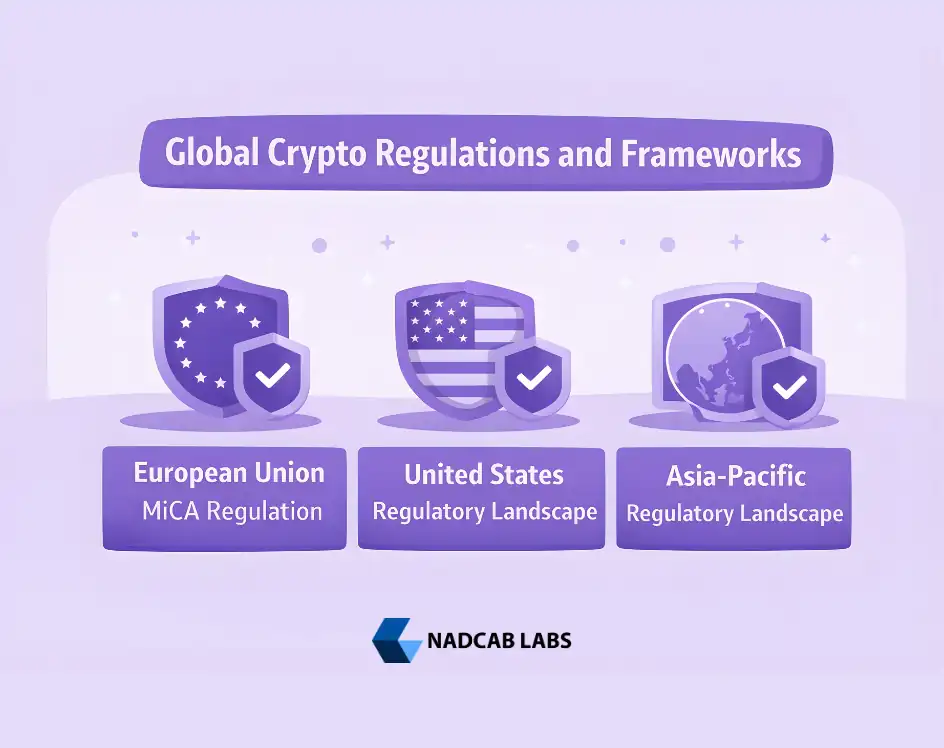
Global Crypto Regulations and Frameworks
The cryptocurrency regulatory landscape continues evolving across jurisdictions, with different regions adopting varied approaches to digital asset oversight. Understanding global crypto regulations enables organizations to develop compliance strategies accounting for cross-border operations while meeting local requirements. The fragmented nature of international regulation creates both challenges and opportunities for businesses seeking to operate in multiple markets.
The Financial Action Task Force sets global AML standards through its 40 Recommendations, extended to explicitly cover cryptocurrencies and virtual asset service providers. FATF’s Travel Rule, enshrined in Recommendation 16, requires identifying information about transaction originators and beneficiaries to travel with transfers. By mid-period, approximately 75 percent of jurisdictions had legislated for the Travel Rule, though fewer than half actively enforce these requirements.
European Union MiCA Regulation
The Markets in Crypto-Assets regulation represents the world’s first comprehensive legal framework for crypto assets, creating uniform rules across all 27 European Union member states. MiCA requires crypto asset service providers to obtain authorization, implement robust governance arrangements, and maintain adequate capital while protecting consumer interests. Over 40 CASP licenses have been issued since full implementation, with the Netherlands and Germany leading in license approvals.
The regulation covers issuers of unbacked crypto assets and stablecoins, trading venues, and custodial wallet providers. Over 65 percent of EU-based crypto businesses achieved MiCA compliance by the first quarter, demonstrating industry capacity to adapt to stringent regulatory requirements.[3] Understanding crypto market size and regulatory implications helps organizations anticipate compliance requirements and strategic opportunities.
United States Regulatory Landscape
The regulatory environment in the United States has undergone significant transformation, with multiple agencies asserting jurisdiction over different cryptocurrency market aspects. The Securities and Exchange Commission, Commodity Futures Trading Commission, Financial Crimes Enforcement Network, and state regulators all play roles in overseeing digital asset activities. Recent legislative developments including the GENIUS Act for stablecoins create clearer regulatory pathways for compliant businesses.
The SEC brought 33 crypto-related enforcement actions in recent periods, while the CFTC increased enforcement by 59 percent, reflecting continued regulatory attention to market integrity. Civil monetary penalties imposed by the CFTC reached $1.7 billion, representing a 38 percent increase. These enforcement trends underscore the importance of proactive compliance measures and financial consequences of regulatory failures.
Asia-Pacific Regulatory Landscape
Countries across Asia-Pacific have implemented diverse approaches to cryptocurrency regulation, ranging from comprehensive licensing frameworks to more restrictive measures. Singapore and Hong Kong have emerged as regional leaders establishing clear regulatory guidelines for virtual asset service providers, mandating strong KYC and monitoring practices. The development of these regulatory frameworks has influenced international crypto compliance requirements, with 68 percent of cross-border transactions facing compliance scrutiny due to inconsistent standards across jurisdictions.
FATF Travel Rule Implementation
The FATF Travel Rule represents one of the most consequential compliance requirements for virtual asset service providers, mandating collection and transmission of originator and beneficiary information during cryptocurrency transfers. This ensures personal data travels with transactions, enabling authorities to trace funds during criminal investigations. Implementation faces challenges including technology suitability, interoperability between different compliance solutions, and the sunrise issue where VASPs in some jurisdictions must comply while others remain unregulated.
Organizations fail to meet Travel Rule compliance at alarming rates, with 69 percent of crypto exchanges failing to achieve full compliance particularly when handling cross-border transactions. This compliance gap creates risks for individual organizations and the broader cryptocurrency ecosystem, potentially enabling illicit actors to exploit regulatory inconsistencies. Successful implementation requires investment in technology development and solutions interoperating with counterparties across different platforms while maintaining data security and privacy compliance.
DeFi Compliance and Decentralized Finance Regulation
Decentralized finance has emerged as one of the most challenging areas for crypto compliance. DeFi protocols operate without traditional intermediaries, using smart contracts to automate financial transactions in ways conflicting with regulatory frameworks designed for centralized institutions. The absence of identifiable controlling parties creates fundamental challenges for implementing KYC, AML, and reporting requirements that depend on centralized compliance functions.
DeFi compliance efforts take two distinct paths: industry-led self-regulatory frameworks where protocols agree on shared standards, and collaborative approaches with regulators balancing innovation with accountability. Decentralized finance regulation continues evolving, with DeFi platforms experiencing a 16 percent usage drop in the EU following MiCA implementation, reflecting regulatory pressure on decentralized services requiring compliant alternatives.
Smart Contract Audits and Security
Smart contract audits have become essential DeFi compliance components, ensuring protocol code functions correctly while meeting security and regulatory requirements. Security vulnerabilities led to substantial losses including $953.2 million from access control flaws alone. Regulatory authorities increasingly require smart contract audits as part of compliance frameworks, particularly for projects dealing with financial transactions and user data.
Comprehensive audits now incorporate legal compliance checks alongside traditional security assessments, verifying that automated processes align with regulatory requirements. Understanding different crypto token types and regulatory classifications helps developers design compliant smart contract implementations from the outset, reducing costly remediation after deployment.
Privacy-Preserving Compliance Solutions
The tension between compliance requirements and privacy-preserving nature of DeFi has driven innovation in compliance technologies. Zero-knowledge proofs enable users to demonstrate compliance with KYC checks without revealing personal data on-chain, potentially resolving conflict between regulatory requirements and decentralization principles. The development of decentralized identity solutions allows single verification to work across multiple protocols, reducing redundant data collection while maintaining compliance integrity.
Crypto Tax Compliance and Reporting
Tax compliance has emerged as one of the most complex cryptocurrency operation aspects, with tax authorities worldwide implementing new rules to enhance transparency and reduce evasion. Crypto tax compliance requires accurate tracking of all transactions including purchases, sales, mining rewards, and staking income, with each event potentially creating taxable obligations. Starting from the current calendar year, cryptocurrency exchanges must report sales transactions to tax authorities using standardized forms.
The Crypto-Asset Reporting Framework established by the OECD creates international standards for automatic exchange of cryptocurrency transaction information between tax authorities. Over 67 jurisdictions have committed to implementing CARF, with most targeting reporting commencement within the next two years. This framework will dramatically increase tax authority visibility into cross-border cryptocurrency holdings and transactions.
Blockchain Analytics for Compliance
Blockchain analytics tools have become indispensable for cryptocurrency compliance, enabling organizations to monitor transactions, assess risk, and detect suspicious activity across networks. The development of leading platforms including Chainalysis, Elliptic, and TRM Labs provides transaction tracing capabilities, risk scoring, and entity attribution supporting both compliance operations and law enforcement investigations. Artificial intelligence integration has enhanced detection capabilities while reducing false positive rates burdening compliance teams.
Crypto risk assessment involves evaluating wallets, transactions, and counterparties against known illicit activity indicators including sanctions violations, darknet market connections, and mixing service usage. Illicit crypto addresses received over $51 billion in recent periods, underscoring the scale of criminal activity compliance programs must detect and prevent through continuous monitoring.
Build Compliant Digital Asset Solutions
Navigate complex regulatory requirements with expert blockchain development services designed for global compliance standards.
Compliance Challenges and Risk Mitigation
Organizations navigating crypto compliance face numerous challenges requiring strategic planning and sustained investment. Combating financial crime remains paramount, with the borderless nature of digital assets enabling bad actors to move funds across jurisdictions beyond traditional oversight mechanisms. Data privacy vulnerabilities present ongoing challenges, with mid-period thefts exceeding $2.17 billion, potentially reaching $4 billion by year-end if trends continue.
Regulatory fragmentation creates significant challenges for organizations operating across multiple jurisdictions. Approximately 54 percent of global exchanges suspended operations in at least one jurisdiction due to regulatory conflicts. Organizations can mitigate challenges through flexible compliance technology investment, engagement with regulators across relevant jurisdictions, and participation in industry initiatives working toward regulatory harmonization.
Technology and Automation Solutions
Automated compliance solutions have become essential for managing the scale and complexity of cryptocurrency operations while maintaining regulatory adherence. RegTech development and integration streamlines KYC checks, flags suspicious activity, and reduces manual processing errors creating compliance risks. Artificial intelligence and machine learning enhance compliance capabilities across multiple functions including identity verification, transaction monitoring, and fraud detection, enabling organizations to scale efficiently.
Final Thoughts
Crypto compliance has evolved from peripheral concern to central requirement for organizations operating in the digital asset ecosystem. The combination of stricter enforcement, expanding reporting requirements, and growing institutional adoption has created an environment where robust compliance programs are essential for business sustainability. Organizations embracing comprehensive frameworks position themselves to capitalize on opportunities while maintaining regulator and customer trust.
The path forward requires continuous investment in technology, talent, and processes meeting evolving regulatory expectations. From KYC and AML protocols to transaction monitoring and tax reporting, each compliance component contributes to establishing digital assets as legitimate and trustworthy. The development of sophisticated compliance infrastructure represents both challenge and opportunity, separating organizations committed to responsible growth from those facing inevitable regulatory consequences.
Frequently Asked Questions
Q1.What is crypto compliance exactly?
Crypto compliance encompasses the processes, tools, and internal controls that digital asset businesses implement to meet regulatory requirements governing cryptocurrency transactions, customer verification, and reporting obligations across various jurisdictions.
Q2.What are main crypto compliance requirements?
Core requirements include Know Your Customer verification, anti-money laundering monitoring, transaction surveillance, suspicious activity reporting, Travel Rule compliance, and maintaining proper licensing with relevant regulatory authorities.
Q3.How does the Travel Rule work?
The Travel Rule requires crypto businesses to collect and share customer information including names and addresses for transactions exceeding jurisdictional thresholds ranging from €0 to $3,000 depending on location.
Q4.What is MiCA regulation for crypto?
MiCA is the EU’s comprehensive framework governing crypto-asset service providers, stablecoin issuers, and trading venues with unified requirements for licensing, conduct rules, and consumer protection across member states.
Q5.How does blockchain analytics help compliance?
Blockchain analytics tools trace transaction histories, monitor suspicious activities, identify connections to sanctioned entities, and maintain audit trails that satisfy regulatory examination and reporting requirements.
Q6.What are DeFi compliance challenges?
DeFi protocols lack centralized intermediaries making traditional compliance approaches difficult. Regulators push for identity-attestation mechanisms while the industry develops self-regulatory frameworks and privacy-preserving verification solutions.
Q7.How much do compliance failures cost?
US regulators have imposed $2.5 billion in crypto-related penalties. Individual fines can reach billions, while MiCA violations risk €15 million or 3% of annual revenue plus potential license revocation.
Explore Services
Related Services
Reviewed by

Aman Vaths
Founder of Nadcab Labs
Aman Vaths is the Founder & CTO of Nadcab Labs, a global digital engineering company delivering enterprise-grade solutions across AI, Web3, Blockchain, Big Data, Cloud, Cybersecurity, and Modern Application Development. With deep technical leadership and product innovation experience, Aman has positioned Nadcab Labs as one of the most advanced engineering companies driving the next era of intelligent, secure, and scalable software systems. Under his leadership, Nadcab Labs has built 2,000+ global projects across sectors including fintech, banking, healthcare, real estate, logistics, gaming, manufacturing, and next-generation DePIN networks. Aman’s strength lies in architecting high-performance systems, end-to-end platform engineering, and designing enterprise solutions that operate at global scale.