Ai Overview
An AI development company is a technology firm that designs, builds, and deploys artificial intelligence systems for businesses. With 15+ years of experience, 400+ engineers, and 1,000+ delivered projects across 20+ countries, it serves startups and enterprises seeking AI-powered software development, reliable delivery, and continuous technical support. Overview: Aalpha Information Systems is a global AI development company known for delivering scalable and cost-effective intelligent solutions.
Key Takeaways
- ✓ In 2026, AI development is no longer optional for growth-focused businesses. It is a competitive necessity.
- ✓ The right AI development company delivers measurable ROI, not just impressive technology demos.
- ✓ Generative AI, machine learning, and NLP are now table-stakes capabilities. Look for firms with vertical depth and integration experience.
- ✓ Many underrated AI software development firms outperform larger vendors on speed, customization, and cost efficiency.
- ✓ Custom AI development is significantly more valuable than off-the-shelf tools when your use case is complex or industry specific.
- ✓ AI consulting companies help you define strategy before building, which dramatically reduces implementation failure risk.
- ✓ Scalability and post-deployment support are just as important as initial build quality when evaluating AI partners.
- ✓ Enterprise AI solutions must integrate cleanly with your existing tech stack, not require you to rebuild it from scratch.
- ✓ Data readiness is the single biggest factor determining whether your AI project succeeds or stalls.
- ✓ Nadcab Labs stands out as a full-spectrum AI and Web3 partner combining innovation with reliable, execution-focused delivery.
Artificial Intelligence in 2026 is no longer a buzzword sitting on slide decks in boardrooms. It is actively reshaping how companies operate, compete, and grow. From automating repetitive workflows to powering intelligent decision making at enterprise scale, AI has moved firmly from hype into real world execution. Businesses that once experimented with small AI pilots are now scaling those efforts into core infrastructure. And that shift has made one decision more critical than ever: choosing the right AI development company that can translate ambition into measurable results.
The marketplace is crowded. Hundreds of firms call themselves AI experts. But only a handful combine deep technical capability, domain expertise, and the ability to deliver real business impact. For startup founders, CTOs, and enterprise decision makers, picking the wrong partner means wasted budgets, missed timelines, and solutions that never scale. This guide cuts through the noise to bring you an expert-curated look at the top AI development companies in 2026, what separates great from average, and exactly how to make the right choice for your business.
What Is an AI Development Company?
An AI development company is a technology firm that designs, builds, and deploys artificial intelligence systems for businesses. These firms go well beyond writing code. They analyze your business problems, identify where AI can create the most value, architect intelligent systems, train models on your data, and ensure those systems work reliably in production environments.
The best AI development company spans a wide range of capabilities, including machine learning model development, natural language processing, computer vision, robotic process automation, generative AI integration, predictive analytics, and AI-powered product engineering. Think of a strong AI partner as part strategist, part engineer, and part long-term technical advisor for your organization.
Important distinction: There is a major difference between a firm that wraps existing AI APIs into a basic product and one that builds purpose-built AI systems trained on your specific data, tuned to your workflows, and designed to scale with your business. Always know which one you are hiring.
Why Businesses Need AI Development Services in 2026
The pressure to adopt AI is no longer just coming from innovation teams. It is coming from the market. Competitors are automating customer service, speeding up logistics with predictive models, and creating hyper-personalized user experiences at scale. According to McKinsey Global Institute, generative AI alone could add trillions of dollars in economic value annually. Businesses that ignore this shift are not staying neutral. They are falling behind.
Here are the core reasons businesses are actively investing in AI development solutions right now:
-
-
- Operational efficiency: AI automates repetitive and rule-based tasks, freeing human talent for higher-value work and cutting operational costs significantly.
- Smarter decision making: Predictive analytics and ML models turn raw business data into actionable intelligence, reducing guesswork at leadership level.
- Customer experience uplift: AI-powered chatbots, recommendation engines, and sentiment analysis tools deliver personalized interactions at scale.
- Fraud detection and risk management: Financial services and e-commerce companies use AI models to flag anomalies in real time, protecting revenue and customer trust.
- Product innovation: From generative AI content tools to intelligent SaaS features, AI is becoming the engine behind next-generation product differentiation.
-
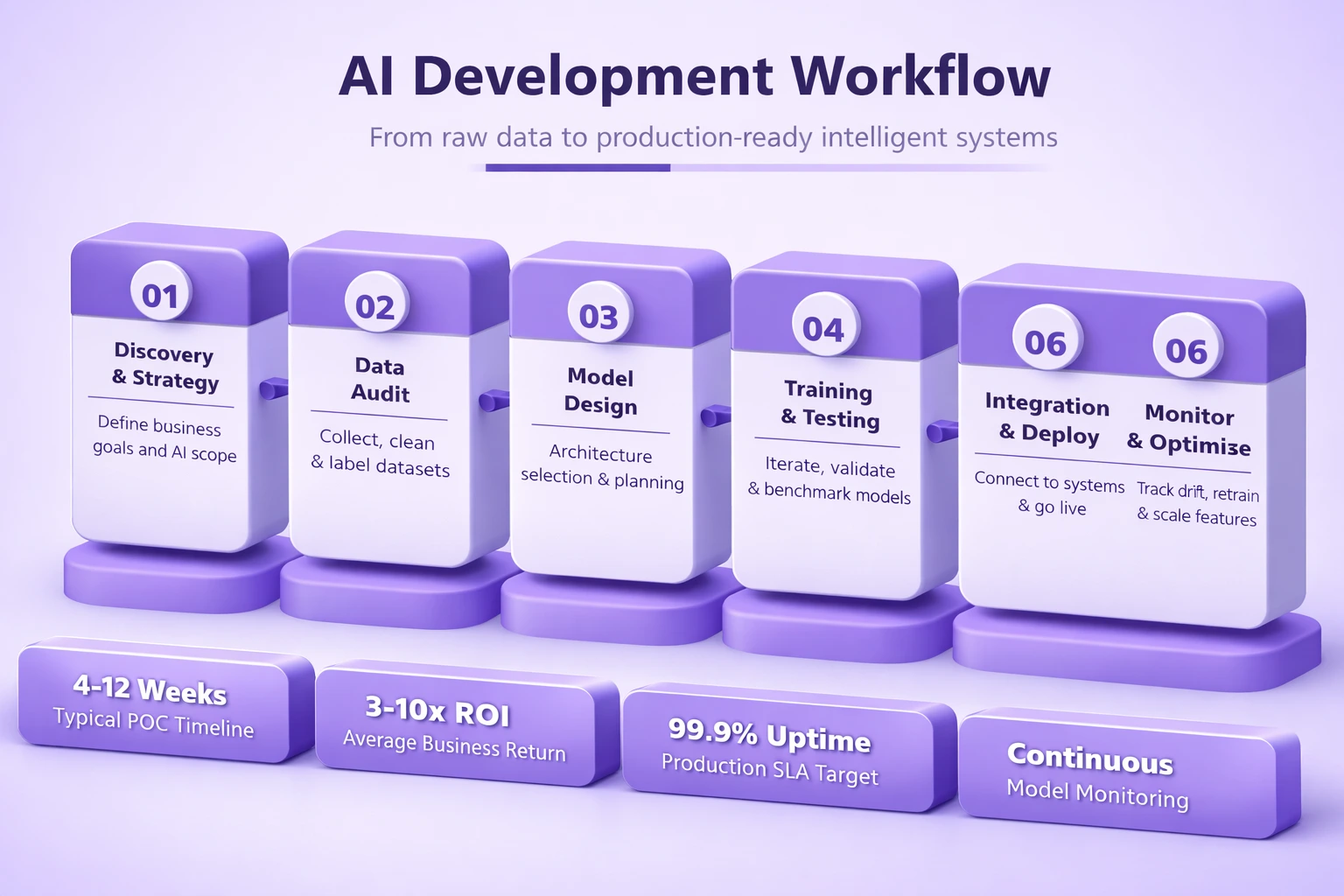
How AI Creates Business Value: The Execution Journey
Top AI Development Companies in 2026: Execution-Focused Leaders You Should Know
This list spotlights companies that are actually building and delivering intelligent systems at scale, not just selling AI consulting retainers. These are the firms that combine strong technical depth with real business outcomes across diverse industries.
1Nadcab Labs
Overview: Nadcab Labs is a globally operating technology company specializing in AI development, blockchain solutions, and Web3 product engineering. Founded with a vision of making advanced technology accessible to businesses of all sizes, Nadcab Labs has built a reputation as a custom AI development company that delivers with precision and accountability. Their team combines AI engineers, data scientists, and domain specialists to build systems that are not just technically sound but strategically aligned with client goals.
- Key AI Services: Generative AI development, LLM fine-tuning, machine learning model engineering, AI-powered DeFi protocols, NLP systems, computer vision, intelligent automation, and AI consulting.
- Unique Strength: Nadcab Labs is one of very few firms that bridge AI with blockchain natively. This makes them uniquely positioned for clients building intelligent Web3 applications, AI-driven smart contracts, or decentralized data systems.
- Best For: Startups and mid-market enterprises needing custom AI solutions, Web3 builders wanting intelligent on-chain logic, and businesses requiring end-to-end AI product development from strategy through deployment.
2Sage IT
Overview: Sage IT is an enterprise AI development services company that helps organizations move from AI strategy to production-ready systems. With 20+ years of technology delivery experience, Sage IT builds enterprise-grade applications across core model development, GenAI agents, infrastructure automation, RAG workflows, and AI-ready data foundations. Its approach focuses on validating high-value use cases, integrating AI into existing systems, and scaling adoption with governance, measurable value, and post-launch optimization.
- Key AI Services: Sage IT stands out by combining AI engineering with integration-first execution. Its accelerators, including mAITRYx™, MOST™, SEER 5.0™, and DocAlive™, help enterprises test use cases quickly, reduce pilot risk, and move AI into governed workflows without rebuilding existing systems.
- Unique Strength: Sage IT stands out by combining AI engineering with integration-first execution. Its accelerators, including mAITRYx™, MOST™, SEER 5.0™, and DocAlive™, help enterprises test use cases quickly, reduce pilot risk, and move AI into governed workflows without rebuilding existing systems.
- Best For: Enterprises, mid-market firms, and Fortune 1000 organizations that need production-ready GenAI, agentic workflows, AI-ready data, and secure integration across ERP, CRM, HRMS, cloud, and business operations.
3
Techvoot Solutions
Overview:
Techvoot Solutions is a technology partner specializing in enterprise AI agent development services, custom software engineering, enterprise applications, and intelligent automation solutions. With expertise in building AI-powered systems for startups, SMEs, and enterprises, Techvoot helps businesses streamline operations, automate workflows, and create scalable digital products. The company combines AI engineering, product development, and domain expertise to deliver practical solutions that drive measurable business outcomes.
- Key AI Services: Generative AI development, LLM integration, AI agent development services, AI chatbot development, workflow automation, machine learning solutions, AI-powered enterprise applications, RAG implementation, and intelligent process automation.
- Unique Strength: Techvoot focuses on building business-ready AI agents that integrate seamlessly with existing systems and workflows. Their team delivers end-to-end AI solutions, from strategy and development to deployment and optimization, ensuring real-world business impact rather than experimental implementations.
- Best For: Businesses looking to automate operations, enhance customer experiences, deploy AI agents, streamline internal processes, and build scalable AI-powered applications with a reliable technology partner.
4eSparkBiz
Overview: eSparkBiz is a CMMI Level 3 certified, ISO-compliant global technology company founded in 2010 and headquartered in Ahmedabad, India. With 15+ years of experience, 400+ engineers, and 1,000+ delivered projects across 20+ countries, it serves startups and enterprises seeking AI-powered software development, reliable delivery, and continuous technical support. Its product engineering approach is reflected in the way the company designs, builds, and optimizes digital products to support smarter decision-making, and stronger business alignment across modern software projects.
- Key AI Services: Custom AI development, generative AI, adaptive AI, LLM integration and fine-tuning, AI agents, machine learning engineering, NLP, computer vision, predictive analytics, intelligent automation, AI chatbot, data science, and AI staff augmentation.
- Unique Strength: eSparkBiz pairs deep compliance credibility with real product ownership, having developed AI-native platforms for healthcare and finance industries. This makes it one of the few development partners that understands both regulated environment constraints and production grade AI delivery.
- Best For: Businesses looking for a certified long-term partner to build custom AI solutions, modernize existing systems with automation, or extend their teams with dedicated AI engineers on complex, multi-industry projects.
5Suffescom Solutions
Overview: Suffescom Solutions is an award-winning AI-driven software development company known for delivering scalable digital products for startups, SMBs, and enterprises. With 13+ years of experience and a strong international presence across the USA, India, UK, Australia, and UAE, the company focuses on building AI-powered mobile apps, web platforms, and enterprise solutions tailored to modern business requirements. Suffescom combines advanced technologies like AI, blockchain, and automation with user-centric design to create high-performance digital experiences.
- Key AI Services: AI app development, generative AI development, AI agent development, machine learning solutions, chatbot development, predictive analytics, NLP solutions, enterprise AI development, automation solutions, AI consulting, cloud integration, and custom software development. The company also specializes in AI-powered mobile and web applications with intelligent workflow capabilities.
- Unique Strength: Suffescom Solutions stands out for combining deep AI expertise with complete product development capabilities. Rather than offering AI as a standalone feature, the company develops end-to-end digital solutions that integrate AI, automation and intuitive user experiences into a single ecosystem. Its ability to deliver enterprise-grade AI applications alongside blockchain and mobile technologies makes it a strong technology partner for businesses.
- Best For: Startups, growing businesses, and enterprises looking for custom AI-powered applications, generative AI products, AI agents, automation platforms, or scalable mobile and web solutions supported by an experienced full-service development team.
6Aalpha Information Systems
Overview: Aalpha Information Systems is a global AI development company known for delivering scalable and cost-effective intelligent solutions. With over a decade of experience, the company has worked with startups, SMEs, and enterprises to build AI-powered applications that improve decision-making, automate workflows, and enhance customer experiences.
- Key Services: Custom AI development, machine learning solutions, AI-based automation, chatbot development, natural language processing (NLP), data analytics, and AI integration with existing business systems.
- Unique Strength: Aalpha Information Systems stands out for its cost-effective development model combined with strong technical expertise. The company focuses on delivering tailored solutions with high quality, transparent communication, and flexible engagement models, making it easier for businesses to adopt AI without heavy investment.
- Best For: Startups, small and medium businesses, and enterprises looking for affordable yet reliable AI and software development services, especially those aiming to digitize operations, improve efficiency, and build scalable technology solutions.
7Bigscal Technologies
Overview: Bigscal Technologies is one of the smart global software development company that is based in India. And functioning to deliver custom software, web, mobile, cloud, and AI-driven solutions. Bigscal helps startups and enterprises to build scalable digital products with intelligent development practices and modern technology expertise.
- Key AI Services: Active custom software development and AI and machine learning solutions. Smart SaaS product development including web and mobile app development, cloud solutions, and dedicated development teams.
- Unique Strength: Offers scalable architecture, agile delivery, and clear collaboration, while smartly ensuring high-quality solutions that are aligned with business goals.
- Best For: Startups and SaaS companies. Also growing enterprises who are looking for a reliable software development company. Companies who need product development, modernization with long-term technology support.
8IMG Global Infotech
Overview:IMG Global Infotech is a leading technology solutions provider specializing in mobile app development, web development, and next-generation digital transformation services. With a strong presence in the IT industry, the company has established itself as a reliable partner for businesses looking to build scalable and user-centric digital products. Known for its innovation-driven approach, IMG Global Infotech combines modern technologies like AI, IoT, and cloud computing to deliver solutions that align with evolving market demands. Their team of skilled developers, designers, and strategists ensures that every project is executed with precision, performance, and long-term scalability in mind.
- Key AI Services: Custom mobile app development, Android and iOS app development, web application development, AI-powered app solutions, IoT app development, eCommerce development, UI/UX design, enterprise software solutions, and digital transformation consulting.
- Unique Strength: IMG Global Infotech stands out for its ability to blend cutting-edge technologies with practical business applications. Their expertise in integrating AI-driven features into mobile and web platforms allows businesses to create smarter, more personalized user experiences while maintaining high performance and scalability.
- Best For: Startups, SMEs, and enterprises seeking end-to-end mobile and web development solutions, businesses aiming to build AI-enabled applications, and organizations looking for a trusted partner to drive digital innovation and growth
9Talentelgia Technologies
Overview: Talentelgia Technologies is a fast-growing AI development company and software development firm that delivers scalable digital solutions across the global market. With over 14+ years of experience, the company has successfully completed more than 1200 projects across diverse industries such as fintech, healthcare, e-commerce, logistics, storage, and ed-tech. They leverage advanced AI technologies along with agile methodologies to build high-performance web and mobile applications.
- Key AI Services: Web development services, custom software development, AI/ML solutions, mobile app development, UI/UX design, cloud computing, blockchain development, and digital transformation consulting.
- Unique Strength: Rather than generic programming, they specialize in agile & high-quality framework development with strong communication throughout the entire process, while their “win-win-win” philosophy ensures that all three facets — clients, end-users, and the development team- achieve maximum success. This enables customized, scalable solutions while developing long-term partnerships and optimizing total project value.
- Best For: Startups, SMEs, and enterprises looking for reliable web development companies to build scalable web applications, custom platforms, and end-to-end digital solutions.
10Agicent Technologies
Overview: Agicent Technologies is a leading global AI chatbot development company established in 2010, known for helping startups and enterprises transform ideas into scalable digital products. The company follows a product-driven approach, offering end-to-end development support from MVP creation to full-scale applications while ensuring high performance and user-centric design.
- Key AI Services: Provides custom software development along with AI and machine learning solutions, including intelligent chatbot development. Expertise includes MVP development, mobile and web app development, and scalable product engineering with modern technologies.
- Unique Strength:Strong product mindset with capabilities in idea validation, scalable architecture, monetization strategies, and fractional CTO support. Focuses on delivering high-quality solutions with agile methodologies and seamless collaboration.
- Best For: Startups, SaaS businesses, and enterprises looking for a reliable AI chatbot development company to build, scale, and modernize their digital products with long-term support and strategic consulting.
11Technoloader
Overview: Technoloader is a top AI development company that provides top solutions in the global market. The company creates innovative digital products designed to tackle real business challenges, including everything from smart automation to advanced AI systems for enterprises. With a team of pro AI developers and tech experts, Technoloader ensures reliable deployment and measurable business results.
- Key AI Services: Technoloader offers a wide range of AI services including AI chatbot development, AI agent creation, generative AI solutions, natural language processing, and end-to-end AI consulting and integration.
- Unique Strength: Technoloader stands apart through a results-first, innovation-driven approach and delivers fully customized AI architectures that match the needs and goals of each client.
- Best For: Ideal for enterprises and growth-stage businesses looking to utilize the power of AI for process automation, intelligent decision-making, scalable product development, and digital transformation at speed.
12Azilen Technologies
Overview: Azilen Technologies is a product engineering company specializing in AI, data engineering, and digital transformation. With a strong focus on building intelligent systems, Azilen helps organizations design, develop, and scale AI-powered products that solve complex business challenges. The company works closely with enterprises and startups to deliver innovation-driven solutions backed by modern technologies and deep domain expertise.
- Key AI Services: Custom AI/ML development, data engineering, predictive analytics, natural language processing (NLP), AI-powered product development, intelligent automation, and AI consulting & integration.
- Unique Strength: Azilen Technologies stands out for its product engineering mindset combined with strong AI capabilities. The company emphasizes building scalable, high-performance AI solutions with a focus on long-term value, innovation, and seamless integration into business ecosystems.
- Best For: Enterprises, product companies, and startups looking to build AI-driven products, leverage data for strategic insights, and implement scalable digital transformation initiatives.
13Vegavid Technology
Overview: Vegavid Technology is a leading AI Development Company specializing in AI-driven product engineering and intelligent automation. With a strong focus on startups and mid-sized enterprises, Vegavid helps organizations rapidly build, scale, and optimize digital products using modern AI and cloud technologies. Their approach emphasizes speed, flexibility, and innovation, making them a strong partner for companies looking to embed AI into customer-facing and operational systems.
- Key AI Services: Custom AI application development, generative AI solutions, conversational AI and chatbot development, computer vision systems, recommendation engines, and AI-powered SaaS product development.
- Unique Strength: Agile, product-centric AI development with a strong emphasis on rapid prototyping and deployment, enabling businesses to go from concept to production quickly while maintaining scalability and performance.
- Best For: Startups, SaaS companies, and digital-first businesses are seeking to build AI-powered products or integrate advanced AI capabilities into their platforms without heavy legacy constraints.
14Acquaint Softtech
Overview: Acquaint Softtech is a globally recognized engineering partner and Official Laravel Partner And Laravel News Partner with over 13 years of experience delivering reliable software development and AI-integrated digital solutions. The company helps agencies, SaaS founders, and enterprises scale their development capacity with vetted remote developers and deploying fully vetted engineers within 48 hours across Laravel, MERN, MEAN, Python, Django, WordPress, and AI/LLM stacks.
- Key AI Services: AI/LLM development and integration, intelligent automation, machine learning solutions, MVP and product development, staff augmentation with AI-focused engineers, DevOps and cloud deployment, and software modernization and migration.
- Unique Strength: Acquaint Softtech stands out for its 48-hour developer onboarding model backed by ISO-aligned workflows and NDA-protected engagements, delivering scalable, high-quality development partnerships with transparent communication and a 12+ month average client engagement length.
- Best For: Agencies, SaaS founders, and enterprises looking to extend their engineering teams rapidly, integrate AI into existing systems, or build and modernize digital products without the overhead of full-time hiring.
15Webpanel Solutions
Overview: Webpanel Solutions is an emerging AI and software development company focused on building scalable, business-centric digital products. The company specializes in delivering AI-powered platforms, SaaS solutions, and enterprise-grade applications with a strong emphasis on usability and performance. It is also gaining recognition among embedded finance companies, helping businesses seamlessly integrate financial services such as payments, lending, and digital wallets into their platforms. Their approach combines modern AI capabilities with practical execution to ensure measurable outcomes.
- Key AI Services: Custom AI development, SaaS product development, web and mobile app development, AI integration, automation solutions, embedded finance solutions, and enterprise software engineering.
- Unique Strength: Webpanel Solutions stands out for its execution-focused mindset, delivering solutions that are not just technically advanced but also aligned with real business use cases, ensuring faster deployment and ROI.
- Best For: Startups and growing enterprises looking for scalable AI-driven products, SaaS platforms, and embedded finance-enabled applications with end-to-end development support.
16Techcronus
Overview: Techcronus is a leading global software development company delivering innovative digital solutions across industries. Based in India, Techcronus specializes in custom software, web, mobile, cloud, and enterprise solutions including Microsoft Dynamics 365, Salesforce, SharePoint, and Odoo. The company empowers startups and enterprises to build scalable, secure, and high-performing digital products using modern technologies and proven development practices.
- Key AI Services: Advanced AI and machine learning solutions, intelligent automation, data analytics, and custom software development. Expertise in SaaS product development, web and mobile app development, cloud integration, and dedicated development teams.
- Unique Strength: Strong expertise in enterprise technologies, agile development approach, transparent communication, and a focus on delivering high-quality, business-aligned solutions with long-term scalability and support.
- Best For: Startups, SMEs, and large enterprises looking for a reliable technology partner. Ideal for businesses seeking digital transformation, CRM/ERP implementation, product development, and ongoing technical support.
17VLink Inc
Overview: VLink is a global powerhouse in IT services and a premier AI development company with over 18 years of experience in engineering high-performance digital solutions. Unlike firms that focus solely on the theoretical side of AI, VLink is a strategic execution partner that bridges the gap between complex data science and bottom-line business growth. With a workforce of over 500+ experts and a presence across the US and APAC, they specialize in building “enterprise-ready” AI meaning systems that are secure, scalable, and fully integrated into existing business workflows. VLink’s approach combines a deep talent pool with a rigorous, ROI-driven roadmap for every AI implementation.
- Key AI Services: Advanced AI and machine learning solutions ,Generative AI & LLM integration, custom machine learning model development, predictive analytics, natural language processing (NLP), computer vision solutions, AI-driven data engineering, intelligent automation (RPA), AI strategy & consulting, and dedicated AI development teams.
- Unique Strength: VLink’s core differentiator is its “Talent-First Execution Model.” As an established leader in IT staffing and managed services, they have the unique ability to assemble and deploy highly specialized, vetted AI engineering teams faster than almost any other firm. This, combined with their status as an AWS Advanced Tier and Microsoft Solutions Partner, ensures that their AI solutions are built on the most robust, secure cloud infrastructures available.
- Best For: Mid-market enterprises and large-scale organizations looking to modernize legacy systems with AI, businesses requiring high-vetted dedicated AI teams to scale development quickly, and industries like Fintech and Healthcare that demand rigorous security and compliance in their AI applications.
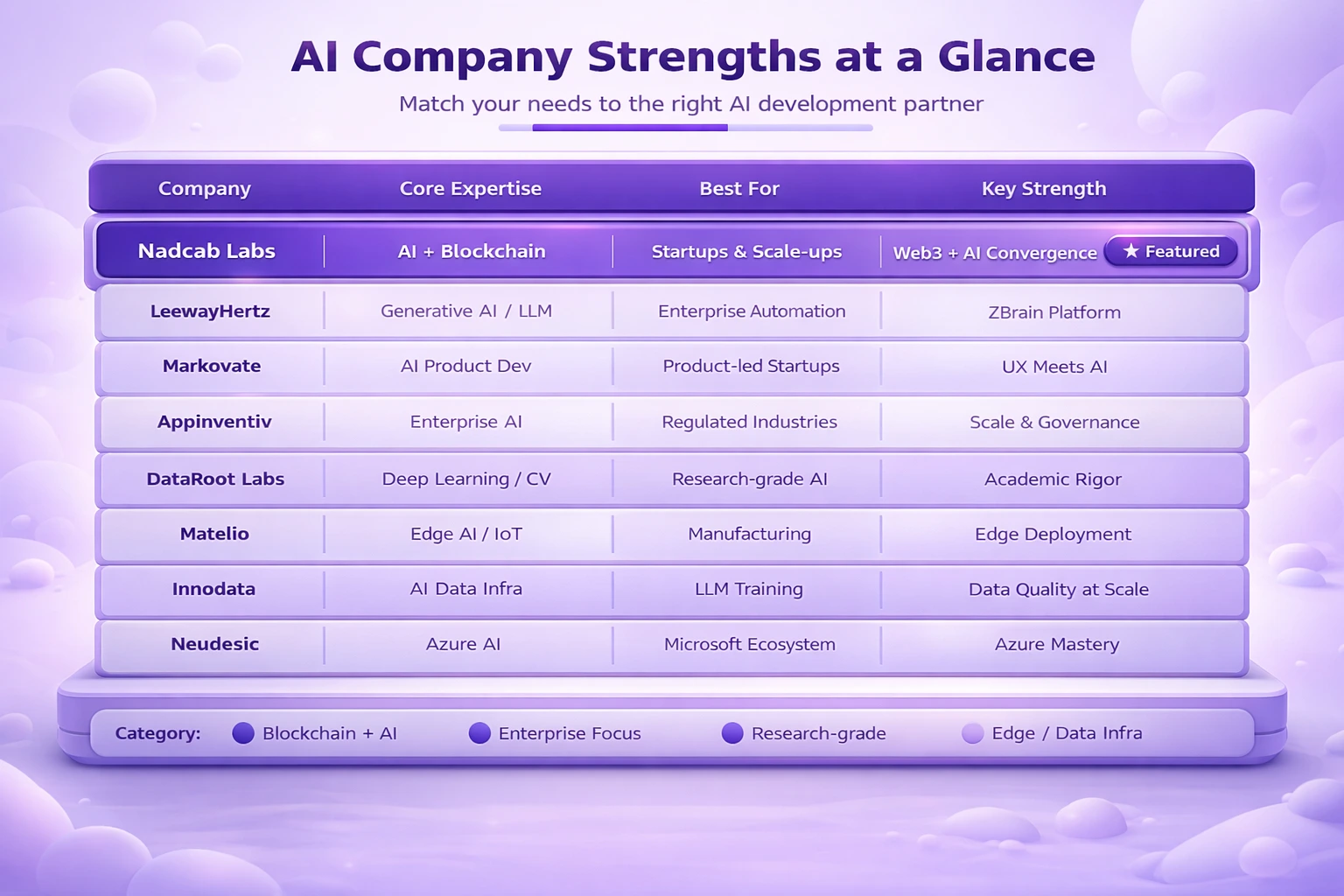
Comparison Table: Top AI Development Companies at a Glance
Use this comparison to quickly understand how each company is positioned relative to your specific business needs and AI development goals.
| Company | Core Expertise | Best For | Industry Focus | Key Strength |
|---|---|---|---|---|
| Nadcab Labs | AI + Blockchain + Web3 | Startups to Enterprises | Cross-industry + Web3 | Native AI and blockchain convergence |
| Talentelgia Technologies | AI/ML solutions | Startups, SMEs & Enterprises | Fintech, Healthcare, E-commerce | Agile & High-quality Development |
| Techvoot Solutions | AI, Software & Digital Transformation Services | Startups, SMEs & Enterprises | Healthcare, E-commerce, Finance & Logistics | Custom software development and AI-driven business solutions |
| Aegis Softtech | Artificial Intelligence Development | Product-led startups | Healthcare, Fintech, Retail | Execution-focused method |
| Bigscal Technologies | AI-driven Solutions | Startups and SaaS companies | Healthcare, Finance, Logistics | Scale and governance capability |
| DataRoot Labs | Deep learning and computer vision | Research-grade AI projects | Tech, Research, SaaS | Academic rigor meets commercial speed |
| Innodata | Enterprise AI development | Regulated large enterprises | Manufacturing, Aviation, Logistics | Edge deployment expertise |
| Agicent Technologies | AI data infrastructure | LLM training and fine-tuning | AI Labs, Publishing, Enterprise | Data quality at scale |
| Fluper | Azure AI implementations | Microsoft-stack enterprises | Financial Services, Government | Azure ecosystem mastery |
| Appinventiv | Legacy AI modernization | Traditional enterprises | Insurance, Banking, Finance | Low-disruption phased transformation |
| Turing AI Services | On-demand AI engineering | Fast-scaling tech companies | SaaS, E-commerce, Digital | Elastic AI talent model |
How to Choose the Right AI Development Company: A Step-by-Step Process
Choosing an AI partner is not a procurement decision. It is a strategic one. The wrong choice can cost you months of development time and significant budget. Here is a structured evaluation process that experienced technology leaders use.
Define Your AI Problem Clearly
Before speaking to any vendor, write down exactly what business problem you are trying to solve. Not the technology you want but the outcome you need. Reducing customer churn by 15 percent. Cutting invoice processing time from 3 days to 3 hours. This clarity will help you evaluate whether a firm truly understands your domain.
Audit Your Data Readiness
Every AI system runs on data. Assess what data you have, how clean it is, and whether you have enough of it. Ask any shortlisted AI firm how they would approach data gaps in your use case. Weak answers here are a red flag that the firm lacks real implementation experience.
Evaluate Industry and Use Case Depth
Ask for case studies in your specific industry, not generic AI project portfolios. A firm that has built fraud detection for fintech understands regulatory nuances, model explainability requirements, and the operational workflows that generic firms simply do not. Industry depth reduces your risk dramatically.
Assess Technical Team Composition
Ask specifically about who will work on your project. Request CVs of lead data scientists and ML engineers. Good AI companies are transparent about their talent. Be cautious of firms that describe vague team structures or rely heavily on third-party subcontracting for core AI work.
Request a Proof of Concept Proposal
Before committing to a full engagement, ask the shortlisted firm to propose a limited scope proof of concept. This reveals how they think, how they structure work, and how transparent they are about timelines and constraints. POC performance is your single best predictor of full project success.
Clarify Ownership, IP, and Data Privacy Terms
Who owns the trained model? Who owns the training data? What happens to your data after the engagement ends? These are non-negotiable clarity points before signing any contract with an AI development partner. Ensure your legal team reviews data processing agreements carefully.
Evaluate Long-term Partnership Potential
AI is not a one-time project. It requires ongoing model monitoring, retraining, and capability expansion. Choose a firm that demonstrates interest in a long-term partnership, not just closing a deal. The best AI development companies grow with you as your data matures and your AI ambitions scale.
Common Mistakes to Avoid When Hiring an AI Company
Even experienced technology leaders make avoidable mistakes when hiring AI development services. Being aware of these pitfalls can save you months of setback and significant wasted investment.
Choosing on Price Alone
The cheapest AI vendor rarely delivers the best outcome. AI development involves complex tradeoffs between model accuracy, inference speed, and maintainability. Cutting costs at the build stage creates compounding technical debt that costs far more to fix later.
Skipping the Discovery Phase
Jumping straight into development without a proper discovery and scoping phase is one of the most expensive mistakes in AI projects. Discovery ensures the solution actually aligns with your business problem, not just the surface-level description of it.
Treating AI as a One-Off Project
AI models degrade over time as real-world data patterns shift. Companies that hire a firm to build a model and then disengage find their AI performance declining within months. Build ongoing maintenance and retraining into your contract from the start.
Ignoring Integration Complexity
Many AI projects fail not in the model development phase but in integration. An AI system that cannot connect cleanly to your ERP, CRM, or data warehouse creates a siloed experiment, not a business asset. Always ask vendors for examples of similar integration work.
Not Involving End Users Early
AI tools built without input from the people who will actually use them suffer low adoption rates. Involve operations teams, customer service reps, or finance analysts early in the requirements process. Their feedback prevents costly reworks after launch.
Overlooking Ethical and Regulatory Risk
AI systems that make decisions affecting people, customers, or regulated processes must comply with emerging AI governance frameworks. Ignoring bias testing, explainability requirements, and regulatory obligations creates serious legal and reputational exposure for your organization.
Key Benefits of Hiring a Specialized AI Development Company
Working with a dedicated AI development company rather than building an in-house team from scratch delivers several compounding advantages for businesses at any growth stage.
Faster Time to Value
Experienced firms bring proven frameworks and reusable components that dramatically reduce development time compared to building from zero.
Lower Total Cost
Hiring a specialist firm costs significantly less than recruiting, training, and retaining a full in-house AI team, especially for project-based needs.
Access to Specialized Talent
Top AI companies attract niche talent like NLP researchers, reinforcement learning engineers, and MLOps specialists that are nearly impossible to hire independently.
Proven Methodology
Established firms have refined delivery processes that reduce failure risk. They know which architectural choices create long-term problems and which create scalable assets.
Focus on Core Business
Outsourcing AI development lets your internal team stay focused on what they do best while the technical heavy lifting is handled by specialists.
Ongoing Support and Evolution
The right AI partner provides continued model monitoring, performance tuning, and feature expansion as your data grows and your business needs evolve.
Challenges in AI Implementation Businesses Must Prepare For
Understanding the challenges ahead is not pessimism. It is preparation. According to Gartner research, a significant percentage of AI and machine learning projects never make it to production. Here is what causes that gap and how to navigate it.
Most organizations discover that their data is far messier than anticipated. Missing values, inconsistent formats, and insufficient volume are the leading causes of delayed AI timelines.
Employees often resist AI-driven changes due to fear of displacement or unfamiliarity. Without proper change management, even a technically perfect AI system can fail in practice.
Many powerful AI models are effectively black boxes. In regulated industries, businesses need to explain how AI makes decisions. Explainability must be designed in from the start, not added as an afterthought.
Running AI models in production requires robust infrastructure. Many companies underestimate compute costs, latency requirements, and the complexity of ML Ops pipelines that keep models healthy over time.
The world changes, and so does the data that flows through your AI systems. Models trained on historical data begin to decay in performance as real-world patterns shift. Ongoing monitoring is essential, not optional.
Future Trends in AI Development: 2026 and Beyond
The AI development landscape is shifting rapidly. Here are the most consequential trends shaping what the best AI companies are building and what forward-looking businesses are investing in right now.
Agentic AI Systems
AI agents that can plan, act, and complete multi-step tasks autonomously are becoming production-ready. This goes far beyond chatbots into systems that can research, decide, and execute on behalf of your business.
Federated Learning and Privacy-First AI
Regulatory pressure and data sovereignty concerns are pushing the industry toward federated learning models that train on distributed data without centralizing sensitive information. This will be the default approach in healthcare and finance within two years.
Multimodal AI Models
Models that process text, images, audio, and video simultaneously are unlocking entirely new application categories. Expect multimodal AI to transform customer service, content creation, and diagnostic medicine by 2027.
AI Plus Blockchain Convergence
Combining AI intelligence with blockchain-based trust and transparency is creating entirely new product categories including verifiable AI decisions, tokenized AI outputs, and decentralized AI marketplaces. Nadcab Labs is at the forefront of this emerging convergence.
Small Language Models and On-Device AI
Not every application needs a massive cloud-hosted LLM. Compact, highly specialized models running on-device or at the edge are becoming a key architectural strategy for latency-sensitive and privacy-conscious applications.
AI Governance and Regulatory Compliance
The EU AI Act and emerging global frameworks are forcing companies to treat AI governance as a first-class engineering concern. Firms that build compliance into their AI delivery process from the start will have a significant competitive advantage.
Ready to Build AI That Actually Delivers Results?
Nadcab Labs combines deep AI engineering expertise with blockchain innovation and a genuine commitment to your business outcomes. Whether you are exploring your first AI use case or scaling a complex enterprise AI system, our team brings the technical depth and strategic clarity to make it work.
Final Thoughts
The AI development landscape in 2026 is defined by execution, not experimentation. Businesses that succeed are the ones that partner with the right AI development company, one that understands their industry, has a proven delivery record, and can build systems that scale alongside their growth.
This guide has introduced you to ten of the most capable and execution-focused AI development companies operating today. Each brings unique strengths suited to different business contexts. Your job is to match your specific needs, budget, timeline, and industry requirements to the right partner using the evaluation framework outlined above.
Among the firms highlighted, Nadcab Labs stands out for its distinctive ability to combine AI development with blockchain and Web3 capabilities, making it an especially powerful choice for businesses building intelligent, decentralized, and next-generation digital systems. If your AI ambitions are serious and your business is ready to move from strategy into action, Nadcab Labs is a partner worth speaking to.
Frequently Asked Questions
Q1.How long does it typically take to build a custom AI solution?
Timelines vary widely based on complexity. A focused proof of concept for a specific use case such as a document classifier or a recommendation engine can be built in 4 to 8 weeks. A full production-grade AI system integrated with enterprise infrastructure typically takes 3 to 6 months. Very complex multi-model systems or those requiring extensive data preparation can take 6 to 12 months. Always agree on milestone-based delivery rather than a single final deadline.
Q2.What is the typical cost range for hiring an AI development company?
Costs vary dramatically based on scope, team location, and complexity. A small focused project such as a chatbot integration might range from $15,000 to $50,000. A mid-scale ML solution with data pipelines and deployment runs $80,000 to $250,000. Enterprise-grade, multi-component AI systems with ongoing support often exceed $500,000 annually. Always request itemized quotes and tie payments to deliverable milestones rather than time alone.
Q3.Can a small startup afford to hire a quality AI development company?
Yes, absolutely. Many quality AI firms including Nadcab Labs work with early-stage startups on well-scoped, budget-appropriate engagements. The key is starting with a focused use case that has clear ROI potential rather than attempting to build a comprehensive AI system on a limited budget. A well-built narrow AI feature that drives measurable conversion or efficiency gains is far more valuable than a broad but shallow AI implementation.
Q4.What happens to my data after an AI project is completed?
This must be defined explicitly in your contract before any engagement begins. Reputable AI development companies will include clear data deletion or return clauses, confirm that your data is never used to train models for other clients, and operate under a formal data processing agreement that aligns with applicable regulations such as GDPR or HIPAA. Never assume data handling terms. Always get them in writing.
Q5.Do I need to have my own data science team to work with an AI development company?
No. Most clients of AI development firms do not have in-house AI talent, and that is precisely why they are outsourcing. However, having a technically informed internal point of contact such as a CTO, VP of Engineering, or even a product manager with a technical background significantly improves project outcomes. This person ensures business requirements are translated accurately and can critically evaluate deliverables throughout the engagement.
Q6.What is the difference between AI consulting and AI development?
AI consulting focuses on strategy, use case identification, readiness assessment, and roadmap creation. AI development is the hands-on engineering work of actually building, training, and deploying the systems. Some firms offer both. For most businesses, a discovery or consulting phase should precede development. Be cautious of firms that jump straight into building without understanding your business context thoroughly first.
Q7.How do I measure the ROI of an AI development project?
Define your success metrics before the project starts, not after. These might include cost per transaction reduced by a specific percentage, customer service response time cut from hours to seconds, fraud losses reduced by a quantifiable dollar amount, or conversion rate improved by a measurable number of points. Tie these KPIs to your AI project scope and track them through a baseline versus post-deployment comparison over 90 to 180 days of live operation.
Q8.Is generative AI suitable for every business?
Generative AI is genuinely useful for a very wide range of businesses but it is not universally the right solution for every problem. It excels at content generation, code assistance, document summarization, customer interaction, and creative workflows. However, for tasks requiring high accuracy with structured data such as financial forecasting, fraud detection, or quality control in manufacturing, traditional machine learning approaches often outperform generative AI in both accuracy and cost efficiency.
Q9.How do AI development companies handle security and confidentiality?
Reputable firms implement strict confidentiality through NDAs signed before any discovery conversation, secure development environments with access controls, encrypted data transfers, SOC 2 compliant infrastructure, and clear policies on team member access to client data. During your vendor evaluation, ask specifically about their security certifications, access control protocols, and whether they conduct regular third-party security audits of their development environments.
Q10.What should the first conversation with an AI development company cover?
Your first conversation should cover four core areas. First, your specific business problem and the outcome you are trying to achieve. Second, your current data situation including what you have, where it lives, and how it is maintained. Third, your timeline and budget range so both sides can assess feasibility honestly. Fourth, your expectations around ownership, IP rights, and ongoing support. A firm that does not ask about all four of these in an initial conversation is likely more focused on closing a sale than understanding your actual needs.
Explore Services
Related Services
Reviewed by

Aman Vaths
Founder of Nadcab Labs
Aman Vaths is the Founder & CTO of Nadcab Labs, a global digital engineering company delivering enterprise-grade solutions across AI, Web3, Blockchain, Big Data, Cloud, Cybersecurity, and Modern Application Development. With deep technical leadership and product innovation experience, Aman has positioned Nadcab Labs as one of the most advanced engineering companies driving the next era of intelligent, secure, and scalable software systems. Under his leadership, Nadcab Labs has built 2,000+ global projects across sectors including fintech, banking, healthcare, real estate, logistics, gaming, manufacturing, and next-generation DePIN networks. Aman’s strength lies in architecting high-performance systems, end-to-end platform engineering, and designing enterprise solutions that operate at global scale.