Ai Overview
Web3 Castle Age merges classic strategy gaming with true digital ownership: every hero, castle piece, and resource is an NFT you control. The play-to-earn model rewards players with tradable tokens; top guilds in the USA, UK, UAE, and Canada are already forming professional esports squads. Smart contracts govern kingdom battles, ensuring provably fair outcomes and automated prize distribution without central server interference.
✓Key Takeaways
- 01. Web3 Castle Age merges classic strategy gaming with true digital ownership: every hero, castle piece, and resource is an NFT you control.
- 02. The play-to-earn model rewards players with tradable tokens; top guilds in the USA, UK, UAE, and Canada are already forming professional esports squads.
- 03. Smart contracts govern kingdom battles, ensuring provably fair outcomes and automated prize distribution without central server interference.
- 04. GameFi mechanics allow you to stake your in-game assets to earn passive yield, transforming gameplay into a diversified income stream.
- 05. Cross-game interoperability means your legendary sword from Web3 Castle Age might be usable in future RPGs within the same ecosystem.
- 06. Wallet integration (MetaMask, WalletConnect) is seamless, letting you manage assets securely while playing on desktop or mobile.
- 07. Community governance via DAOs gives players voting power on game updates, treasury allocation, and new feature rollouts.
- 08. Unlike traditional games, the economy is player-driven: resource scarcity, marketplace prices, and alliance power are determined by real user actions.
- 09. Advanced layer-2 solutions eliminate high gas fees, making micro-transactions for repairing troops or buying potions economically viable.
- 10. Audited smart contracts and transparent tokenomics build trust, addressing the “rug pull” fears that plagued early blockchain games.
Introduction to Web3 Castle Age
The strategy genre has found its most compelling evolution in Web3 Castle Age. For decades, players conquered kingdoms, forged alliances, and amassed armies – but the rewards stopped at the screen. Today, the Web3 applications landscape transforms those digital triumphs into real-world value. Imagine commanding a fortress where every brick you place, every hero you recruit, and every battle you win yields assets you truly own. This isn’t a distant future; it’s the present reality of blockchain gaming.
What is Web3 Castle Age?
At its core, Web3 Castle Age is a decentralized strategy game built on Ethereum-compatible networks. Players start with a small plot of digital land, construct buildings, train NFT-based troops, and engage in PvP kingdom battles. The “Web3” suffix denotes that game logic runs on smart contracts, and in-game items exist as non-fungible tokens. Whether you’re in London or Dubai, you access the same persistent world where scarcity, ownership, and economy are mathematically enforced. The genre appeals to both strategy enthusiasts and crypto-savvy earners.
Evolution from Traditional Castle Age to Web3
Remember the Flash-based Castle Age games of the late 2000s? You’d click to build, wait for timers, and occasionally buy premium currency with real money—which vanished the moment servers shut down. Web3 Castle Age flips that model. Assets you purchase or earn remain in your wallet forever. If the developer releases a new version, your NFT castle can migrate. This evolution mirrors the shift from centralized databases to distributed ledgers. Players in tech-forward markets like the UAE are rapidly adopting this model because it respects player effort and investment.
Why It Represents the Future of Play-to-Earn Gaming?
The play-to-earn sector needed a breakthrough beyond simple “click-to-earn” fatigue. Web3 Castle Age introduces deep strategy: resource management, diplomatic guild wars, and real-time battles where your tactical decisions directly impact your token balance. It’s not just about grinding; it’s about outsmarting opponents. This depth attracts a mature audience from the USA and Canada who seek both entertainment and financial upside. Combined with GameFi staking mechanisms, the game creates a sustainable economy where value flows to skilled players, not just early adopters.
Three Pillars of Web3 Castle Age
🏰 True Ownership
- Every hero, resource pack, and castle upgrade is an NFT in your wallet.
- Sell or trade assets on open marketplaces without asking permission.
- Assets persist even if the game client changes.
⚔️ Player-Driven Economy
- Resource scarcity determined by real player activity.
- Guild wars distribute token prizes via smart contracts.
- No central company printing infinite gold.
🗳️ Community Governance
- Holders vote on balance changes and new content.
- Treasury funds are managed by player-elected councils.
- Roadmap priorities decided by active guilds.
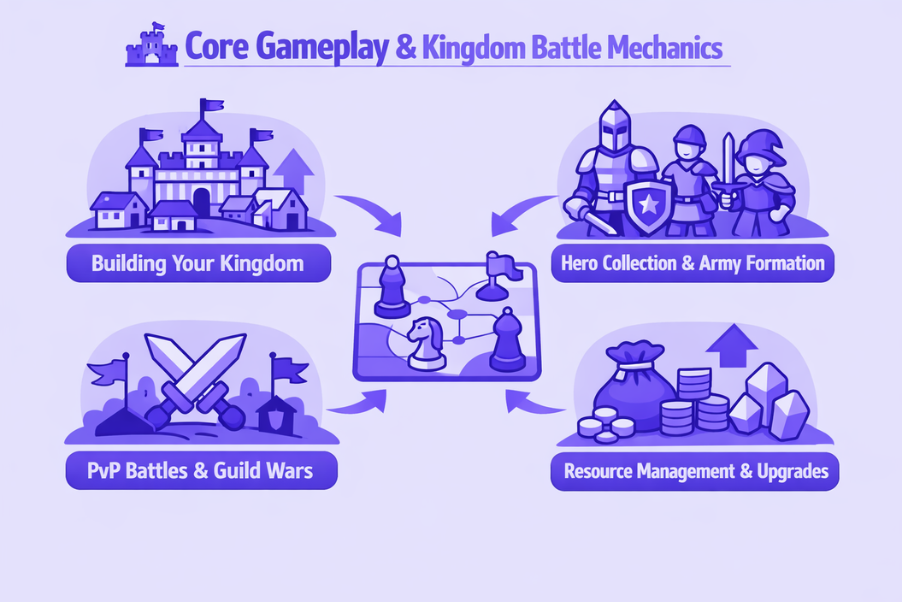
Core Gameplay and Kingdom Battle Mechanics
The heart of Web3 Castle Age lies in its strategic depth. Unlike shallow clickers, this game demands planning, diplomacy, and resource allocation. Players in competitive markets like the UK and Canada are treating it like digital chess mixed with real-time warfare. Let’s dissect the mechanics.
Building and Expanding Your Kingdom
Your journey begins with a Keep – an NFT that defines your base. Surrounding plots can be purchased or conquered. Each building serves a purpose: barracks train infantry, mage towers research spells, and markets facilitate trade with other players. Expansion requires resources (wood, stone, gold) which you mine from your land. Because land plots are NFTs with finite resources, prime locations near resource nodes become valuable assets. Guilds often pool funds to acquire contiguous territories, creating fortified regions.
Hero Collection and Army Formation
Heroes are the soul of your army. Each hero NFT has unique stats, abilities, and backstory. Some are better at defense, others excel in raids. You assemble armies by assigning heroes to lead troops – soldiers, archers, cavalry – which are also minted as semi-fungible tokens. The formation matters: a defensive line of pikemen backed by healers can repel stronger forces. Collecting legendary heroes from limited-edition packs is a primary driver of the in-game economy, with rare ones fetching high prices on secondary markets.
PvP Battles, Guild Wars, and Strategic Conquests
Real-time PvP battles occur on chain, meaning every attack and defense roll is verified. Players can scout enemy kingdoms, then launch attacks. Winning yields loot: a percentage of the defender’s resources or even a chance to capture an NFT hero. Guild Wars are the pinnacle: alliances of up to 50 players coordinate massive offensives on rival guilds’ fortresses. Winners split a treasury funded by entry fees and protocol emissions. Guilds from the UAE and USA have already formed professional rosters, streaming battles on Twitch.
Resource Management and Upgrades
Resources are the lifeblood. Woodcutter camps, mines, and farms generate base resources, but they deplete over time. Players must reinvest in upgrades or trade with those specializing in different resources. This creates a dynamic market: a player focusing on iron production might trade with another who farms wheat. Smart contracts facilitate trustless trades. Upgrade paths require strategic choices – do you invest in stronger walls or a larger army? These decisions ripple through the economy.
Core NFT Asset Types & Rarity
| Asset Type | Rarity Tiers | Utility | Market (USA/UK) |
|---|---|---|---|
| Hero Characters | Common, Rare, Epic, Legendary | Lead armies, cast spells, govern regions | $50 – $5,000 |
| Land Plots | Barren, Fertile, Resource-Rich, Citadel | Generate resources, build structures | $100 – $10,000+ |
| Equipment | Basic, Forged, Enchanted, Mythic | Boost hero stats, unlock abilities | $10 – $800 |
| Consumables | Potion, Scroll, Siege Engine | One-time battle boosts | $1 – $50 |
Play-to-Earn Model and In-Game Economy
The economic engine of Web3 Castle Age is designed for sustainability. Unlike early play-to-earn games that hyper-inflated, this model uses sinks and faucets balanced by player behavior. Our agency has analyzed tokenomics for similar projects; the key is that value flows to skill, not just time.
How Players Earn Rewards?
Earning happens through diverse activities. Daily quests award small amounts of the native $CASTLE token. Winning PvP battles yields token prizes and sometimes rare NFTs. Guild Wars distribute larger prize pools. “Loot farming” involves sending heroes on expeditions to discover hidden treasures. Players can also stake their idle heroes in the “Veteran’s Hall” to earn yield. The best earners in Canada and the UK treat it as a part-time job, optimizing their routes and battle strategies.
NFT Assets and Digital Ownership
True ownership means your assets live on-chain. When you forge a unique sword, its metadata – creator, stats, battle history – is immutable. You can lend it to a guildmate, sell it on a marketplace, or even use it in another compatible game if the developers support interoperability. This composability is the holy grail of Web3 gaming. For instance, a hero from Web3 Castle Age might guest-appear in a future Web3 Castle Age RPG spin-off.
In-Game Marketplace and Asset Trading
The marketplace is a bustling hub. Players list excess resources, heroes, and equipment for $CASTLE tokens. The protocol takes a small fee, which flows into the treasury. Price discovery is organic: if a powerful new raid boss appears, demand for fire-resistant armor spikes. This creates a living economy where traders can speculate. We’ve seen guilds in the UAE act as market makers, arbitraging price differences between regions.
Token Rewards and Monetization System
The dual-token system (governance and utility) is common. $CASTLE is the utility token for battles, upgrades, and entry fees. $THRONE is the governance token, earned by long-term staking and used for voting. This separation protects the game economy from short-term volatility. Players can convert earned $CASTLE to $THRONE to gain voting power. Monetization is player-friendly: you can play entirely free and earn, or invest in NFTs to accelerate progress.
Authoritative Principles for Sustainable Game Economies
Principle 1: Balance faucets (rewards) with sinks (upgrades, repairs) to control inflation.
Principle 2: Use bonding curves for NFT sales to align incentives between players and treasury.
Principle 3: Implement cooldowns on resource extraction to prevent bot farming.
Principle 4: Regularly audit smart contracts for economic exploits.
Principle 5: Cap daily token emissions to maintain scarcity.
Principle 6: Enable governance to adjust parameters based on community votes.
Blockchain Integration and Web3 Features
Under the hood, Web3 Castle Age leverages the full stack of decentralized tech. This isn’t just about adding NFTs; it’s about re-architecting trust. The Web3 gaming ecosystem on Ethereum and layer-2s provides the backbone.
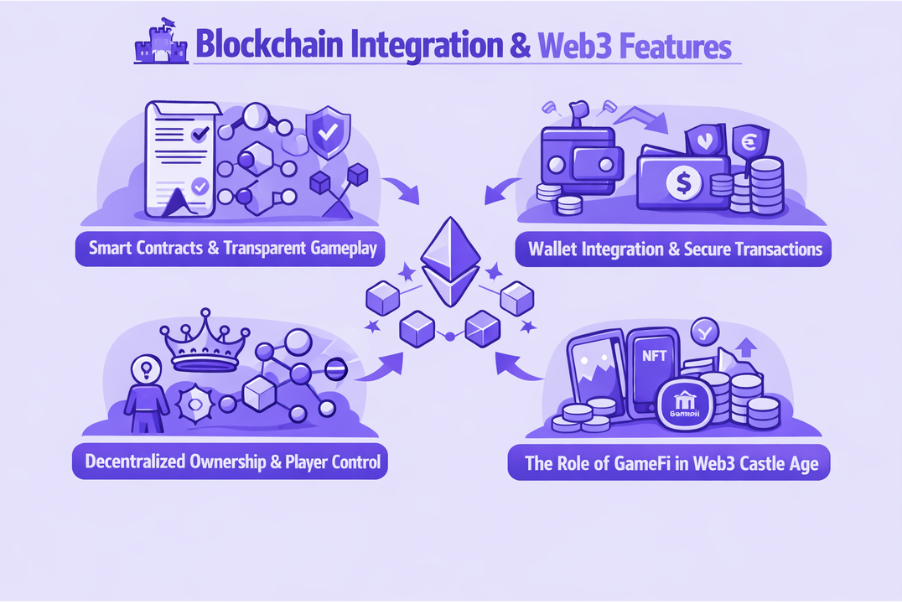
Smart Contracts and Transparent Gameplay
Every siege, every resource trade, every hero level-up is executed by smart contracts. The rules are open source, meaning players can verify that the chance to win a battle is exactly as advertised. No hidden modifiers, no secret algorithms. This transparency builds a high-trust environment, especially important for players in regulated markets like the UK and UAE who demand fairness. [1]
Wallet Integration and Secure Transactions
Connecting a wallet like MetaMask or WalletConnect is straightforward. The game never holds your private keys; you sign transactions directly. For minor actions like collecting daily rewards, the game uses “gasless” meta-transactions sponsored by the protocol. For high-value trades, you confirm via your wallet. This self-custody model means even if the game servers go down, your assets remain in your wallet.
Decentralized Ownership and Player Control
Because assets are on-chain, no central authority can confiscate them. If you win a legendary hero in a guild war, it’s irrevocably yours. This shift in power dynamic is profound. Players can form guilds that operate as DAOs, collectively owning territory and making decisions via snapshot voting. The game becomes a platform, not a walled garden.
The Role of GameFi in Web3 Castle Age
GameFi merges gaming with decentralized finance. In Web3 Castle Age, you can stake your idle resources in liquidity pools to earn yield. You can also take out loans against your NFT heroes to fund a war effort—repaying with spoils. This financial layer adds depth; guilds in Canada use these tools to manage treasury funds. The game effectively becomes a micro-economy with its own central bank (the treasury) and financial instruments.
Getting Started with Web3 Castle Age
Ready to claim your kingdom? Here’s a practical roadmap for beginners, whether you’re in the USA, UK, UAE, or Canada. The onboarding process is designed to be friendlier than early DeFi protocols.
How to Create an Account?
Most Web3 Castle Age games use a “sign in with Ethereum” approach. You visit the official site, click connect, and approve a signature request in your wallet. This creates a game account linked to your wallet address without a password. Some games offer email-based onboarding with a custodial wallet for absolute beginners, which you can later upgrade to self-custody.
Connecting Your Crypto Wallet
If you’re new, install MetaMask or Rainbow wallet. Fund it with a small amount of ETH (or MATIC, depending on the network) for gas fees. Then head to the game’s “Play Now” section. Approve the connection. The game will detect your wallet and may offer a free starter pack (a basic hero and some resources) to get you going.
Beginner Strategy Tips
Focus on completing daily quests first—they offer low-risk rewards. Join a guild immediately; guilds often share resources and protection. Don’t overspend on expensive heroes early; build a balanced army. Scout opponents before attacking; picking on weaker kingdoms yields easy loot. And always keep a reserve of tokens for repairs and upgrades.
Common Mistakes to Avoid
New players often neglect security. Never share your seed phrase. Be wary of fake marketplace links. Another mistake is over-investing before understanding the game mechanics—play for a week before buying high-value NFTs. Also, don’t hoard resources without upgrading; idle resources get stolen in raids. Finally, don’t ignore governance: voting shapes the game’s future.
3-Step Model for Choosing Your Play Style
Future Roadmap and Growth Potential
The horizon for Web3 Castle Age is expansive. With layer-2 scaling and cross-chain interoperability, the game is poised to onboard millions. Our agency’s outlook is bullish on titles that combine deep gameplay with sustainable tokenomics.
Upcoming Features and Updates
Roadmaps include “land expansion packs” with new biomes, hero evolution systems, and mobile-native client releases. Developers are testing AI-driven NPCs that can be hired by players. Also on the docket: full integration with VR platforms for immersive council meetings. The Web3 gaming ecosystem is maturing fast.
Community Governance and Player Participation
Already, major decisions like balancing hero classes are put to community votes. Players who hold $THRONE tokens propose changes. A recent vote in a top game determined the drop rate of a new resource. This participatory model ensures the game evolves with its user base, not just a corporate roadmap.
Long-Term Potential in the Web3 Gaming Ecosystem
As the broader Web3 gaming ecosystem expands, Web3 Castle Age could become a metaverse anchor. Imagine your castle visible from other games, or your heroes embarking on quests in different worlds. The asset interoperability will attract mainstream players from Canada and beyond. With professional esports leagues forming, the game’s longevity looks secure.
✅ Governance & Compliance Checklist for Guilds
Rule the Blockchain Battlefield with Web3 Castle Age
Build kingdoms, earn crypto rewards, and dominate strategic battles in immersive Web3 gaming world.
Frequently Asked Questions
Q1.What exactly is Web3 Castle Age?
Web3 Castle Age is a blockchain-based strategy game where players build kingdoms, collect NFT heroes, and wage war in player-versus-player battles. Unlike traditional mobile games, assets are tokenized as NFTs, giving players true ownership. Every sword, spell, and castle upgrade can be traded on open marketplaces. The game runs on smart contracts, ensuring transparent rule enforcement and provable scarcity for in-game items.
Q2.How do you earn money playing Web3 Castle Age?
Players earn through multiple channels: daily quest rewards in the native token, selling rare NFT heroes or resources on the marketplace, winning tournament prizes during guild wars, and staking in-game assets to earn yield. Top players in the USA and UK have reported consistent side income by farming resources and flipping high-demand legendary items. The play-to-earn model turns gaming time into tangible crypto rewards.
Q3.Do I need crypto to start playing Web3 Castle Age?
Yes, a crypto wallet like MetaMask is required to hold your assets and pay for occasional transaction fees (gas). However, many games offer “free-to-play” starter packs where you earn minimal rewards to cover initial costs. Once you accumulate in-game currency, you can reinvest in better heroes. The Web3 gaming ecosystem focuses on low barriers, so expect “gas-less” transactions on layer-2 solutions soon.
Q4.Is Web3 Castle Age available on mobile devices?
Absolutely. Most Web3 Castle Age titles are optimized for mobile browsers or available as downloadable apps from official stores. The user experience mirrors traditional mobile strategy games like Clash of Clans, but with integrated wallet connectivity. Players in Canada and the UAE are rapidly adopting these games due to seamless mobile onboarding and the ability to manage kingdoms on the go.
Q5.What makes the kingdom battles different from old Castle Age games?
The key difference is permanent consequence and reward. In Web3 Castle Age, winning a battle can yield NFT loot—genuine assets you can sell. Losing might damage your troops, but since you own them, you can repair or trade them. Smart contracts govern battle outcomes, eliminating “pay-to-win” manipulation by centralized servers. Every siege is verifiable, and guild wars distribute prize pools automatically via code.
Q6.How do NFTs work within the game’s economy?
NFTs represent unique assets: hero characters, castle skins, resource parcels, and even army units. Each NFT has immutable stats and a limited supply. When you forge a legendary sword, that item’s metadata lives on the Ethereum blockchain. You can list it on in-game marketplaces for the native token. This creates a player-driven economy where supply and demand set prices, not a central company.
Q7.What are the risks of playing Web3 Castle Age?
Volatility is the primary risk: the value of earned tokens can drop. Smart contract vulnerabilities, though rare with audits, pose a technical risk. Players should also beware of phishing sites mimicking popular games. Stick to official links, use hardware wallets for high-value assets, and never share seed phrases. As the Web3 gaming ecosystem matures, insurance protocols and decentralized dispute resolution are emerging to protect players.
Explore Services
Related Services
Reviewed by

Aman Vaths
Founder of Nadcab Labs
Aman Vaths is the Founder & CTO of Nadcab Labs, a global digital engineering company delivering enterprise-grade solutions across AI, Web3, Blockchain, Big Data, Cloud, Cybersecurity, and Modern Application Development. With deep technical leadership and product innovation experience, Aman has positioned Nadcab Labs as one of the most advanced engineering companies driving the next era of intelligent, secure, and scalable software systems. Under his leadership, Nadcab Labs has built 2,000+ global projects across sectors including fintech, banking, healthcare, real estate, logistics, gaming, manufacturing, and next-generation DePIN networks. Aman’s strength lies in architecting high-performance systems, end-to-end platform engineering, and designing enterprise solutions that operate at global scale.