Ai Overview
The intersection of blockchain technology and interactive entertainment has produced one of the most commercially exciting categories in the Web3 ecosystem. Unity is the world’s most widely used real-time 3D engine, powering approximately 50% of mobile games and a substantial proportion of independent PC and browser-based games globally.
Key Takeaways
- ◆ UWeb3 gaming dApp projects built with Unity and WebGL combine blockchain-verifiable asset ownership with browser-accessible gameplay that requires no native app installation from users.
- ◆ Unity’s WebGL build target enables Web3 game deployment directly in browsers, allowing players across the USA, UK, UAE, and Canada to play and own assets without downloading launchers.
- ◆ Smart contracts are the authoritative game logic layer for all ownership-sensitive operations, while Unity handles rendering, physics, and the majority of non-financial game mechanics.
- ◆ Wallet integration via MetaMask and WalletConnect is the primary authentication mechanism in decentralized gaming apps, replacing traditional username-password systems with cryptographic identity.
- ◆ NFT-based in-game assets give players verifiable ownership of characters, items, and land that persists outside the game, enabling secondary market trading on platforms like OpenSea.
- ◆ WebGL optimization is critical for Web3 gaming applications because blockchain wallet interactions add additional JavaScript overhead that can compound with an already-heavy WebGL bundle.
- ◆ Polygon and other Layer 2 networks are the preferred blockchain platforms for Web3 gaming dApps because gas fees on Ethereum mainnet make per-action game transactions economically unviable.
- ◆ Play-to-earn token economies require careful economic modeling before launch; poorly designed token emission schedules have caused catastrophic value collapses in several high-profile Web3 gaming platforms.
- ◆ Unity’s jslib plugin system is the technical bridge that enables WebGL-compiled Unity games to call browser JavaScript functions that interact with wallet extensions and Web3 libraries.
- ◆ Security auditing of game smart contracts is non-negotiable before mainnet launch, as game contracts managing real asset values have been successfully exploited for hundreds of millions in losses.
Introduction to Web3 Gaming dApps
The intersection of blockchain technology and interactive entertainment has produced one of the most commercially exciting categories in the Web3 ecosystem. Web3 gaming dApps represent a fundamental reimagining of the relationship between players and game economies, shifting from publisher-controlled asset databases to player-owned on-chain assets that exist permanently and can be traded freely. Teams seeking professional Web3 services for gaming applications are increasingly choosing Unity combined with WebGL as their primary technology stack, recognizing that this combination delivers the performance and visual quality of a professional game engine alongside the accessibility of browser-based deployment that reaches players without installation friction. After eight years of building blockchain gaming infrastructure for clients across the USA, UK, UAE, and Canada, our team has developed a comprehensive methodology for building Web3 game development projects that deliver both compelling gameplay and robust on-chain economics.
What Are Web3 Gaming dApps?
Web3 gaming dApps are interactive entertainment applications that integrate blockchain technology to provide players with verifiable ownership of in-game assets, transparent economic mechanics, and the ability to earn real value from their gameplay. Unlike traditional games where all assets are stored in publisher-controlled databases and can be revoked or deleted at any time, Web3 gaming apps store asset ownership on public blockchains where it can be independently verified, transferred, and traded without the publisher’s involvement or permission.
A Web3 gaming dApp might feature characters represented as NFTs that players truly own, in-game currencies implemented as fungible tokens that trade on decentralized exchanges, land plots whose ownership is recorded on the blockchain, and governance tokens that give players a voice in the protocol’s future direction. The “dApp” designation reflects the decentralized nature of these critical economic functions: while the game client and much of the gameplay logic may run on traditional servers or in the browser, the ownership and economic layers operate on censorship-resistant blockchain infrastructure that no single party can unilaterally modify or shut down.
How Web3 Is Transforming the Gaming Industry?
Web3 gaming platforms are reshaping the fundamental business model of interactive entertainment in ways that extend far beyond simple cryptocurrency integration. The traditional gaming model extracts value from players through purchase prices, subscriptions, and microtransactions, with all in-game value ultimately locked within the publisher’s ecosystem. Web3 gaming applications invert this model: players can earn tokens through skilled gameplay, own assets that appreciate in value outside the game, and participate in the governance of the game’s economic rules through token voting.
Real-world examples like Axie Infinity demonstrated that well-designed Web3 gaming dApp economies can generate meaningful income for players in regions where gaming earnings represent a significant supplement to local wages, including active player communities across Southeast Asia, South America, and Africa. The play-to-earn model gained particular attention in the UAE and Canadian markets as alternative investment opportunities during the 2021 blockchain adoption wave. However, the industry has also learned hard lessons about unsustainable token economies, and the current generation of Web3 gaming platforms emphasizes gameplay quality and sustainable economics alongside blockchain ownership features.
Benefits of Decentralized Gaming Applications
Decentralized gaming apps deliver concrete benefits to players, game studios, and the broader gaming ecosystem that justify the additional architectural complexity they require. For players, the primary benefit is true ownership: when a player earns or purchases an NFT item in a Web3 gaming dApp, that item is theirs in the same sense that physical collectibles are theirs, with the freedom to hold, sell, or use it in other compatible applications. For game studios, the benefit is a more aligned economic relationship with the player base: when players own appreciating assets, their financial interests align with the game’s success, creating organic community advocacy that traditional games struggle to generate. The interoperability promise of Web3 gaming, where a sword earned in one game could theoretically be used in another compatible game, remains partially aspirational but is actively being built by ecosystems like Immutable X and Enjin. For investors and publishers in the UK and USA markets, Web3 gaming dApps offer new revenue models including protocol fees on secondary market trading, which generate ongoing revenue without requiring additional purchases from players.
Overview of Unity Game Engine
Unity is the world’s most widely used real-time 3D engine, powering approximately 50% of mobile games and a substantial proportion of independent PC and browser-based games globally. Its cross-platform build system supports over 20 deployment targets from a single codebase, making it an exceptionally efficient choice for Web3 gaming projects that need to reach players across different platforms and regions. Unity’s component-based architecture makes it straightforward to add blockchain interaction layers as modular components that attach to game objects without requiring fundamental restructuring of the game’s architecture. The Unity Asset Store provides thousands of ready-made tools, environments, and systems that accelerate Web3 game development timelines, reducing the time spent building fundamental game systems and allowing teams to focus on the blockchain-specific mechanics that differentiate their Web3 gaming dApp. Unity’s C# scripting environment is mature and well-documented, with excellent tooling support in Visual Studio and JetBrains Rider that makes large-scale Web3 gaming application codebases manageable. For studios building Web3 gaming apps targeting the UK and USA gaming markets, Unity’s console certification pathways also provide an upgrade route to native console releases if the browser-based Web3 version demonstrates sufficient commercial traction.
Role of WebGL in Browser-Based Gaming
WebGL (Web Graphics Library) is a JavaScript API that enables hardware-accelerated 3D graphics rendering directly in the browser without plugins, using the device’s GPU through the OpenGL ES specification. For Web3 gaming dApps, WebGL is the enabling technology that makes it possible to deliver visually rich game experiences that run in the same browser environment where wallet extensions like MetaMask operate, enabling seamless blockchain interaction without the cross-application communication challenges that would arise if the game required a separate native launcher. Unity’s WebGL build target compiles C# game code to WebAssembly and JavaScript, producing a self-contained web application that includes the Unity runtime, game assets, and all game logic. This compiled output runs entirely client-side, requiring only a web server for asset delivery rather than a real-time game server, which dramatically reduces the operational infrastructure costs of Web3 gaming platforms compared to traditional multiplayer game backends. WebGL is supported across all major desktop browsers including Chrome, Firefox, Safari, and Edge on Windows and macOS, covering the vast majority of the player base that Web3 gaming dApps target in the USA, UK, UAE, and Canada.
Advantages of Combining Unity with WebGL for Web3
The combination of Unity and WebGL for Web3 game development creates a stack with advantages that neither technology delivers alone. Unity’s jslib plugin system is the critical enabling mechanism: it allows C# scripts running in the Unity WebGL context to call JavaScript functions that interact with wallet APIs, blockchain libraries like ethers.js, and any browser-based Web3 infrastructure. This bridge makes it possible to trigger a MetaMask transaction request from within a Unity game scene, receive the transaction hash in a C# callback, and update the game state based on the confirmed on-chain result, all within a single browser tab experience that requires no additional software from the player. The browser deployment model means players can access a Web3 gaming dApp by following a link from a tweet, a Discord message, or a search result, lowering acquisition friction dramatically compared to requiring an app store download. For Web3 game development teams, building in Unity means leveraging familiar tools, a large talent pool, and a well-understood build pipeline, reducing the project risk that comes with adopting unfamiliar technology stacks for complex blockchain-integrated gaming projects.
Smart Contracts and Game Logic
Smart contracts in a Web3 gaming dApp serve as the authoritative rulebook for all ownership-sensitive and economically significant operations. The key architectural principle is to put only what must be decentralized on-chain, and leave everything else in the Unity client or traditional servers. Operations that belong on-chain include: asset ownership records (which wallet owns which NFT), token balances and transfers, game economy mechanics like crafting that transform assets, marketplace listings and sales, staking and reward distribution, and governance voting. Operations that should remain off-chain include: real-time physics, collision detection, NPC AI, visual rendering, sound playback, and any non-financial game mechanic. This separation is not just an optimization decision but a security and economic one: every on-chain operation costs gas, and designing game contracts that write to storage for every in-game action would make the game prohibitively expensive to play. The most successful Web3 gaming platforms use a hybrid architecture where off-chain actions are aggregated into periodic on-chain state updates, or use Layer 2 scaling solutions with extremely low transaction costs that make more frequent on-chain updates economically viable.
Wallet Integration and User Authentication
Wallet integration is the user authentication system for Web3 gaming dApps, replacing traditional username-password combinations with cryptographic wallet signatures. The standard pattern presents the player with a “Connect Wallet” button in the Unity interface that triggers a JavaScript call through the jslib bridge, which invokes the wallet provider’s connection flow. MetaMask, the most widely used browser wallet, handles this through its window.ethereum object that is injected into every browser page when the extension is installed. WalletConnect expands this to support mobile wallets by displaying a QR code that players scan with their smartphone wallet app. Upon successful connection, the wallet provides the player’s public address to the game client, which typically requests a signature of a nonce message to prove address ownership without submitting any transaction. The signed nonce is verified server-side to create an authenticated game session that combines blockchain identity with traditional web session management. For Web3 gaming platforms targeting mainstream audiences in the UAE and UK, embedded wallet solutions like Privy, Magic Link, and Particle Network provide social login-powered wallet creation that generates a wallet from an email or social login, bypassing the MetaMask installation requirement for new players.
NFTs and In-Game Assets
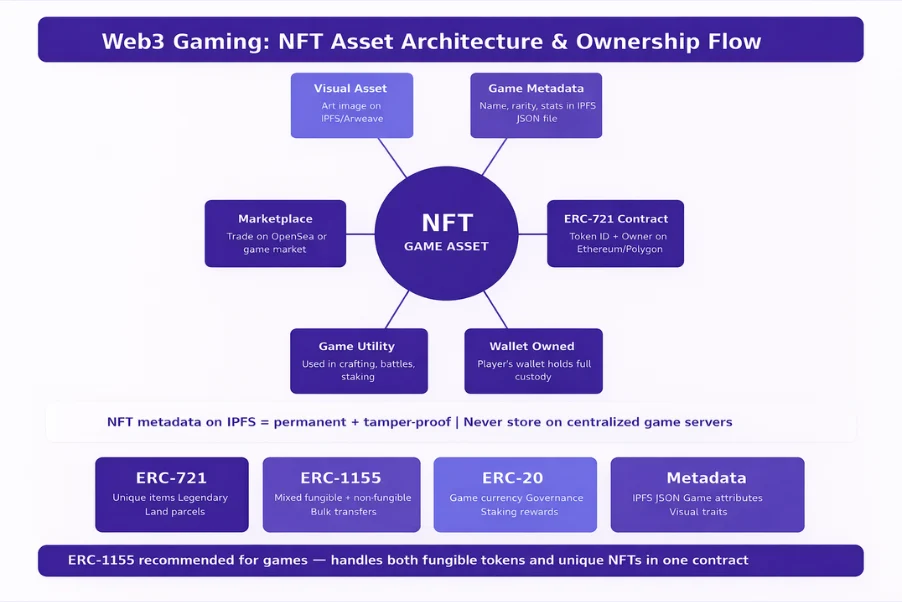
NFTs are the technical implementation of player-owned in-game assets in Web3 gaming dApps, providing cryptographic proof of ownership that exists independently of the game publisher’s servers. In Unity Web3 gaming projects, in-game items like characters, weapons, equipment, land parcels, and vehicles are represented as ERC-721 (unique items) or ERC-1155 (both unique and fungible items) tokens on the blockchain. The NFT contract stores only the essential ownership data on-chain: the token ID and its owner address. The actual game asset metadata, including name, image, description, and game-specific attributes, is stored as a JSON file referenced by the token’s tokenURI. This metadata is typically stored on IPFS or Arweave to ensure it is decentralized and permanent, preventing the publisher from unilaterally changing or deleting asset properties. Unity’s game client fetches NFT metadata through API calls to the blockchain and IPFS, rendering the appropriate visual representations of each player’s owned assets in the game world. The ERC-1155 multi-token standard is particularly valuable for gaming because it allows both fungible tokens (like in-game currency or consumable items) and non-fungible tokens (like unique legendary items) to be managed within a single contract, reducing deployment costs and simplifying the game’s contract architecture.
Decentralized Storage Solutions
Decentralized storage is the third infrastructure pillar of Web3 gaming dApps alongside smart contracts and wallet systems. Game asset metadata (the JSON files that define NFT properties) must be stored in a way that is permanent, tamper-proof, and not controlled by the game publisher, or else the “true ownership” promise of NFT-based assets is undermined. If a publisher stores NFT metadata on their own centralized servers, they can change or delete it at any time, making the player’s “owned” items meaningless. IPFS (InterPlanetary File System) is the most widely used decentralized storage solution for NFT metadata, using content addressing to ensure that files retrieved by their hash are always identical to the original. Arweave provides permanent, pay-once storage that guarantees data persistence for 200 years, making it an even stronger permanence guarantee than IPFS pinning services. For Web3 gaming dApps with large asset libraries, Filecoin provides incentivized distributed storage that works alongside IPFS to ensure popular content remains available. Unity game clients retrieve metadata from these decentralized sources through standard HTTPS gateways like IPFS public gateways or Pinata, integrating seamlessly with Unity’s web request system without requiring any special blockchain-specific handling for the storage retrieval step.
Essential Tools and Technologies Required
Core Web3 Gaming Technology Stack
Blockchain Platforms
- Polygon PoS (low gas gaming)
- Immutable X (gasless NFTs)
- Ethereum mainnet (high value)
- Arbitrum / Optimism L2s
- Avalanche (fast finality)
Unity SDKs & Libraries
- Thirdweb Unity SDK
- Moralis Unity SDK
- Web3.unity (ChainSafe)
- Nethereum (Ethereum .NET)
- Custom jslib bridges
Web3 APIs & Infra
- Alchemy / QuickNode RPC
- Moralis NFT & token APIs
- Pinata / NFT.Storage IPFS
- OpenZeppelin contracts
- Hardhat / Foundry testing
Blockchain Platforms (Ethereum, Polygon, etc.)
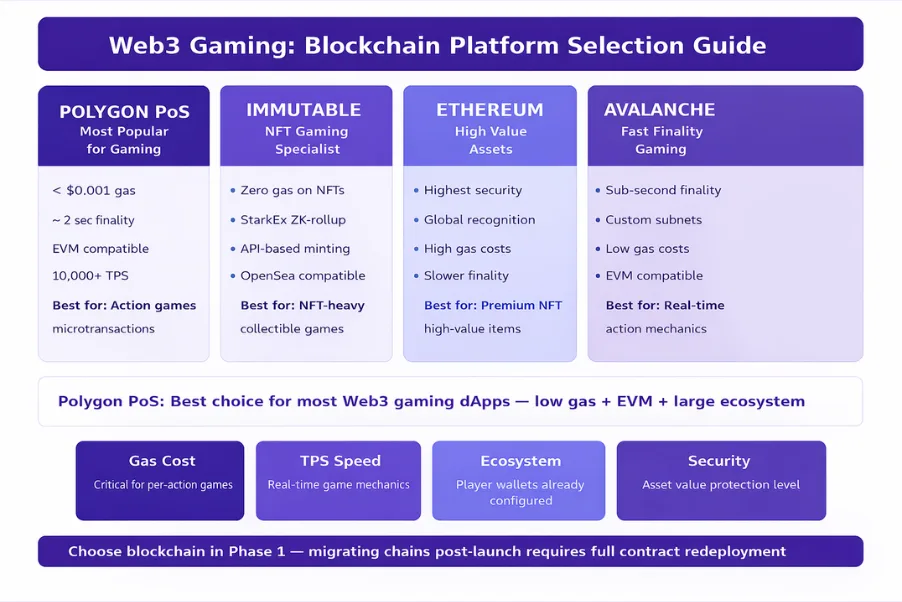
Blockchain platform selection is one of the most consequential architectural decisions in Web3 gaming dApp projects, directly affecting transaction costs, confirmation speed, ecosystem tooling, and player familiarity. Ethereum mainnet is the most secure and widely recognized blockchain for NFT assets, making it the preferred choice for high-value collectible items that players will hold as long-term investments. However, Ethereum mainnet transaction costs make per-action game interactions economically unviable for most game mechanics, limiting its use to high-value operations like primary NFT sales and marketplace trading.
Polygon PoS has become the most popular platform for Web3 gaming application building because its sub-cent transaction costs make frequent game interactions economically feasible, its full Ethereum compatibility means all Ethereum tooling works without modification, and its large existing user base in the USA and globally means players are already familiar with adding the network to MetaMask. Immutable X provides a zero-gas-fee Layer 2 specifically designed for gaming NFTs, using StarkEx ZK-rollup technology to batch thousands of NFT transfers into single Ethereum mainnet transactions, making it the optimal choice for games with very high-frequency NFT trading. Avalanche offers sub-second transaction finality that enables near-real-time on-chain game state updates, making it attractive for action games where responsiveness is critical.
Unity SDKs and Web3 Libraries
The Unity Web3 SDK ecosystem has matured significantly, providing production-ready integration libraries that eliminate most of the low-level blockchain interaction code that early Web3 game development teams had to write manually. Thirdweb’s Unity SDK is currently the most comprehensive and actively maintained option, providing a unified interface for wallet connection, NFT minting and reading, token operations, smart contract interaction, and gasless transaction support across all major EVM chains. ChainSafe’s web3.unity SDK is a well-established open-source option with a large community and extensive documentation, particularly strong for Ethereum and Polygon integrations. Moralis Unity SDK provides the richest data access layer through Moralis’s high-level APIs, enabling Unity games to easily fetch wallet token balances, NFT collections, and transaction history without writing raw RPC calls. Nethereum is a .NET Ethereum library that works within Unity’s C# environment, providing low-level Ethereum interaction for teams that need precise control over transaction construction and signing without relying on browser wallet extensions. Each SDK takes a different architectural approach to the Unity-to-blockchain bridge, and teams should evaluate them against their specific blockchain platform, wallet strategy, and gasless transaction requirements before committing.
WebGL Build Tools and Optimization
Unity’s WebGL build pipeline requires specific configuration and optimization to produce game bundles suitable for Web3 gaming dApp deployment. The standard Unity WebGL build generates a set of files including a JavaScript loader, a WebAssembly binary, a data file containing game assets, and an HTML host page. For Web3 gaming applications, the build configuration must include specific settings for the memory heap size (typically 256-512MB for games with moderate asset complexity), texture compression formats optimized for web delivery (using Basis Universal transcoding for cross-platform GPU support), and audio compression settings that balance file size against quality. The WebGL build must also be configured to disable certain Unity features that do not work in the browser environment, including threading (which requires specific COOP/COEP HTTP headers), some audio codecs, and direct file system access. For Web3 integration, the jslib plugin files that bridge Unity C# to browser JavaScript must be placed in the Assets/Plugins/WebGL directory and referenced correctly in the build to ensure they are included in the compiled output. Asset bundles and streaming assets enable progressive loading strategies that improve initial load times by deferring the download of assets that are not needed immediately when the game first opens.
APIs for Web3 Integration
Web3 API integration in Unity gaming applications follows the same patterns as any other Web3 application, with the Unity-specific wrapping layer handled through the jslib bridge and SDK abstraction. RPC APIs from providers like Alchemy and QuickNode provide the Ethereum JSON-RPC access that the game client uses to read blockchain state: checking NFT ownership, fetching token balances, and monitoring transaction confirmation. Moralis’s Gaming API provides Unity-native interfaces for common gaming data patterns: getting all NFTs owned by a wallet, fetching collection metadata, and retrieving transfer history for in-game asset provenance displays. The Indexing layer, using services like The Graph, enables complex queries across historical blockchain data that would be impractical to derive from raw RPC calls, such as all trades on a game’s marketplace within the last 30 days or the complete ownership history of a specific rare item. IPFS gateway APIs handle metadata retrieval for NFT assets, with pinning services like Pinata providing reliable retrieval performance for production-scale asset libraries.
Step-by-Step Process to Develop Web3 Gaming dApps
Web3 Gaming dApp Development Lifecycle
Phase 1: Concept & Token Economy
Define game genre, core loop, and blockchain integration depth. Design token emission schedule, NFT utility, and economic sink mechanisms. Model player acquisition and retention economics to validate sustainability before any contract is written.
Phase 2: Unity UI/UX Design
Design game scenes, HUD elements, and wallet connection flows in Unity. Create asset list for NFT items. Design inventory, marketplace, and wallet status UI components that blend blockchain data with gameplay UI naturally.
Phase 3: Smart Contract Development
Write ERC-721/1155 NFT contracts, fungible token contracts, marketplace contracts, and staking contracts using Hardhat or Foundry. Test extensively on local network and testnet. Commission security audit before mainnet deployment.
Phase 4: Blockchain-Unity Integration
Implement jslib bridge for wallet connection. Integrate chosen Web3 SDK (Thirdweb, ChainSafe, or Moralis). Build C# manager scripts that translate blockchain events into Unity game state updates and gameplay responses.
Phase 5: WebGL Build & Optimization
Configure Unity WebGL build settings for web deployment. Optimize texture compression, audio settings, and asset streaming. Test build across Chrome, Firefox, and Safari. Implement progressive loading for faster initial load experience.
Phase 6: Testing & Deployment
Run full test suite including unit tests, integration tests with testnet contracts, end-to-end gameplay testing with real wallet interactions, and load testing. Deploy contracts to mainnet, configure frontend hosting, and launch with monitoring dashboards active.
Planning Game Concept and Token Economy
Before opening Unity, define your economy. Will players earn a governance token? Can they stake assets? Sketch the flows: minting, trading, burning. Web3 gaming application development fails when tokenomics are an afterthought. Model your circular supply and demand, and consider how players in the UK or Canada will acquire their first NFT (fiat on‑ramp vs. free mint).
Designing Game UI/UX in Unity
Unity’s canvas system lets you design wallet connection screens, inventory UIs, and marketplace panels. For decentralized gaming apps, clarity is key: show confirmations, gas costs, and transaction statuses. Use scriptable objects to manage item data that will later be replaced by NFT metadata. Keep UI responsive – mobile browsers in the UAE and USA will access your WebGL game.
Developing Smart Contracts
Write contracts in Solidity or Rust (Solana). Include modules for minting, burning, and maybe a native token. Use OpenZeppelin templates to avoid common pitfalls. For our clients in Canada, we always add emergency pause and upgradeability. Test thoroughly on testnets (Goerli, Mumbai) before even thinking about mainnet. Web3 game development must treat contracts as immutable – audits are mandatory.
Integrating Blockchain with Unity
With SDKs like ChainSafe, you can call contract functions from C#. Example: when a player picks up a chest, the game invokes a “claimReward” method on your contract. Handle asynchronous blockchain calls gracefully – show loading spinners. For popular Web3 gaming platforms, we also index player inventories via The Graph for faster access.
Exporting Game to WebGL
Switch build target to WebGL in Unity. Adjust quality settings, enable compression (Brotli/gzip), and strip unused code. This produces a folder with index.html and JavaScript loaders. Deploy to IPFS or a traditional CDN. Ensure that wallet popups work – you may need to enable “Allow Popups” in browser settings.
Testing and Debugging the dApp
Test on all major browsers (Chrome, Firefox, Safari). Use browser dev tools to catch JS errors. Simulate high load – what if 10,000 players in the UK mint at once? Monitor RPC rate limits. We always run a bug bounty program before full launch; for high‑stakes projects in the USA, formal audits are a must.
Popular Wallets (MetaMask, WalletConnect)
MetaMask remains the dominant wallet for desktop Web3 gaming applications, with over 30 million monthly active users who are already familiar with its approve-and-sign interaction pattern. In Unity WebGL games, MetaMask integration is implemented through the jslib bridge that accesses window.ethereum, the MetaMask-injected provider object available in the browser’s JavaScript context. WalletConnect extends wallet support to mobile wallets and hardware wallets by implementing a relay protocol that enables cross-device communication between the game running in a desktop browser and a wallet application running on a smartphone, with the connection established through a QR code or deep link that the player scans or taps. Coinbase Wallet offers similar functionality with particularly strong adoption in the USA market.
For Web3 gaming apps targeting broader audiences who do not have any existing wallet, embedded wallet solutions from Privy, Magic Link, and Thirdweb provide email and social login-based wallet creation that generates and manages a non-custodial wallet behind the scenes, enabling players to start playing immediately while preserving the ability to export their keys and full custody later. The selection of supported wallets should be driven by the target player demographics: hardcore Web3 gamers expect MetaMask, mainstream gamers benefit from embedded wallets, and mobile-first markets may prefer WalletConnect-compatible mobile wallets.
Secure Transaction Handling
Secure transaction handling in Web3 gaming dApps requires a layered approach that protects players from both technical failures and malicious manipulation of game transaction flows. Transaction simulation before submission is the first line of defense: before asking a player to sign any transaction, the game client should simulate it using the blockchain provider’s simulation API to verify it will succeed and produce the expected state changes. This prevents players from paying gas for transactions that will revert and alerts them to unexpected behavior that might indicate a smart contract bug or a changed on-chain state since their last data refresh. Transaction status monitoring must inform players in a non-disruptive way when their submitted transactions are pending, confirmed, or have failed, without interrupting active gameplay.
A background transaction monitor that polls for confirmation and updates the game state asynchronously, with a non-modal notification that appears when confirmation is received, provides the right balance between keeping players informed and maintaining immersion. For high-value transactions like NFT purchases on the game marketplace, displaying a confirmation dialog that clearly describes the assets being exchanged, the price in both native token and estimated USD value, and the estimated gas cost gives players the information they need to make informed decisions without the technical jargon that causes confusion for new Web3 gamers.
Managing Gas Fees and Transactions
Gas fee management in Web3 gaming dApps is one of the most practically impactful UX concerns because poorly managed gas creates confusion, transaction failures, and player frustration. The most effective strategy for most Web3 gaming applications is to deploy on Layer 2 networks like Polygon where gas fees are negligible and eliminate gas as a significant player-facing concern. For games that must operate on Ethereum mainnet or other higher-fee networks, gasless meta transaction implementation through Biconomy or Gelato allows the protocol to absorb gas costs for common game actions, charging players only for high-value economic actions where gas cost is proportional to the transaction value.
Gas estimation should be done server-side with a buffer added to account for state changes between estimation and execution, and the estimate should be displayed in both native token and approximate fiat currency to give players a meaningful cost reference. Priority fee settings (EIP-1559 maxPriorityFeePerGas) should be automatically configured to target confirmation within 1-2 blocks, avoiding both slow confirmations from too-low fees and unnecessary overpayment from too-high fees. Batch transaction capabilities available through smart account implementations let players combine multiple low-value game actions into single transactions, reducing total gas overhead significantly for games with frequent on-chain interactions.
Reducing Load Time and File Size
WebGL bundle size reduction is the single highest-impact performance optimization for Web3 gaming dApps because load time directly determines how many players complete the journey from clicking a game link to reaching the wallet connection screen. The primary contributors to large WebGL bundle sizes are texture assets, audio files, and unused Unity engine modules. Texture compression using Basis Universal transcoding through the Unity Texture Compression setting reduces texture file sizes by 60-75% compared to uncompressed formats while maintaining visual quality across all GPU architectures. Audio compression using Vorbis for background music and ADPCM for short sound effects provides good quality at dramatically reduced file sizes. The Unity Managed Code Stripping setting at Medium or High aggressively removes unused C# libraries from the compiled output, often reducing bundle size by 20-40% for games that use only a portion of Unity’s standard library. Asset bundles enable on-demand loading of game content, allowing the initial bundle to contain only the essential assets needed for the first scene while deferring the download of later-game content until it is needed. For Web3 gaming apps serving players across the USA, UK, UAE, and Canada, CDN delivery with Brotli compression and aggressive browser caching headers ensures that returning players experience near-instant load times after their first visit.
Memory Management Techniques
Memory management in Unity WebGL games is more constrained than in native applications because browsers impose strict limits on WebAssembly memory usage, and the WebGL heap size must be configured at build time rather than growing dynamically. The WebGL Memory Size setting in Unity Build Settings must be large enough to hold all runtime-loaded assets, but setting it too high increases initial memory allocation and can cause browser tab crashes on devices with limited RAM. Effective memory management strategies include using object pooling for frequently instantiated game objects like projectiles, particles, and enemy units to avoid garbage collection spikes that cause frame rate drops. Addressable Assets with aggressive unloading policies release memory for scenes and assets that are no longer needed, keeping the runtime footprint within bounds. For Web3 gaming dApps, NFT metadata and image caches must implement LRU (Least Recently Used) eviction policies to prevent the metadata cache from growing unboundedly as players browse large NFT collections. Texture atlases reduce draw calls and GPU memory fragmentation for UI-heavy screens like the NFT inventory and marketplace, where many different item images must be displayed simultaneously.
Ensuring Smooth Gameplay in Browsers
Smooth gameplay in browser-based Web3 gaming applications requires managing the interaction between Unity’s frame update loop and the asynchronous blockchain operations that must not block the game’s rendering. The cardinal rule is that no blockchain call should ever block the Unity main thread; all Web3 operations must be implemented as coroutines or callback-based async patterns that allow the game to continue rendering while awaiting blockchain responses. Background blockchain polling for state updates like NFT ownership changes or token balance updates should use timers with appropriate intervals rather than continuous polling that would generate excessive RPC API calls. Frame rate targets should be set appropriate to the game genre: action games should target 60 FPS, strategy games can target 30 FPS, and the WebGL quality settings in Unity should be configured to maintain the target frame rate rather than rendering at maximum quality and accepting variable performance. Level of Detail (LOD) systems reduce polygon counts for distant objects automatically, maintaining frame rates in complex 3D scenes. Shader complexity should be appropriate for the target hardware: web players use widely varying GPU capabilities, from high-end gaming laptops to integrated graphics, requiring shader variants that scale gracefully across this performance range.
Security Best Practices in Web3 Gaming dApps
Smart Contract Security Measures
Smart contract security in Web3 gaming dApps is paramount because game contracts manage real financial value and are targets for sophisticated attackers who have proven willing to invest significant resources in finding exploitable vulnerabilities. The Ronin Bridge hack that drained $620 million from Axie Infinity’s ecosystem demonstrated that even large, well-funded Web3 gaming platforms are not immune to catastrophic smart contract exploits. The foundational security measures for game contracts include using OpenZeppelin’s audited base contracts rather than custom implementations for standard functionality, implementing access control using OpenZeppelin’s AccessControl or Ownable patterns rather than custom permissioning logic, using Solidity 0.8.x or higher for native overflow protection, and implementing reentrancy guards on all functions that transfer tokens or call external contracts. Economic manipulation attacks, where attackers game the token economy by exploiting price oracle vulnerabilities or flash loan attacks on game mechanics, require additional protections including time-weighted price oracles for any in-game pricing that references external market prices, and rate limiting on economic actions that could be exploited through automated bots.
| Security Check | Implementation | Tools | Priority |
|---|---|---|---|
| Reentrancy protection | ReentrancyGuard on all fund-touching functions | OpenZeppelin | Critical |
| Access control | Role-based permissions for admin functions | OZ AccessControl | Critical |
| Integer overflow | Solidity 0.8+ native protection | Compiler | Critical |
| Oracle manipulation | TWAP oracles for price-sensitive logic | Chainlink, Uniswap | High |
| Flash loan attacks | Same-block state change restrictions | Custom guards | High |
| Front-running | Commit-reveal schemes for randomness | Custom pattern | High |
| Formal audit | Third-party security audit before mainnet | Trail of Bits, Code4rena | Critical |
Preventing Hacks and Exploits
Web3 gaming dApps face a broader attack surface than simple token contracts because game logic introduces complex state interactions that can create unexpected exploit paths. Bot attacks are particularly prevalent in gaming: automated bots can grind play-to-earn games at superhuman efficiency, extracting token emissions faster than human players and destabilizing the token economy. Anti-bot measures include CAPTCHA requirements before claiming rewards, rate limiting on token-earning actions per wallet address per time period, and behavioral analysis that flags wallets exhibiting non-human activity patterns for review. Randomness manipulation is a critical concern for any game mechanic that involves random outcomes for valuable results (like loot drops or NFT attribute generation): using block hash as a randomness source is exploitable by validators who can reorder transactions, requiring Chainlink VRF or similar verifiable random function services for any high-stakes random outcome. Front-running attacks on marketplace transactions can be mitigated through commit-reveal purchase patterns or by accepting that front-running is unavoidable in public mempools and pricing marketplace mechanics accordingly.
Data Privacy and User Protection
Data privacy in Web3 gaming applications involves a unique tension between blockchain’s transparency properties and players’ reasonable expectation of privacy for their gaming activity. All on-chain data including wallet addresses, transaction histories, and asset ownership is publicly visible, which means players’ complete gaming economic activity can be tracked by anyone who knows their wallet address. Applications that implement off-chain player profiles linked to wallet addresses through server-side authentication must comply with GDPR requirements for UK and EU players, PIPEDA requirements for Canadian players, and CCPA requirements for California players. Personal data collected for off-chain features like player handles, email addresses for notifications, and gameplay statistics should be stored on traditional GDPR-compliant infrastructure separate from any blockchain data. Session-based wallet signatures should be time-limited and refreshed regularly rather than maintaining indefinite authentication sessions. For Web3 gaming platforms serving the UAE market, where data localization requirements are increasingly being clarified under Federal Law No. 45 of 2021 on Personal Data Protection, server infrastructure considerations for any off-chain data components are increasingly important compliance considerations.
Common Challenges in Web3 Game Development
Scalability Bottlenecks: High player concurrency creates RPC API rate limit issues when thousands of simultaneous players query NFT ownership and token balances. Solution: caching layer with appropriate TTL and a dedicated Alchemy or QuickNode paid plan with sufficient compute units.
Cross-Platform Compatibility: WebGL behavior differences between Chrome, Firefox, and Safari (particularly Safari’s strict memory limits and WebAssembly restrictions) require extensive cross-browser testing and often browser-specific workarounds in the Unity build configuration.
User Onboarding Friction: Requiring MetaMask installation before playing loses 70-80% of potential mainstream players. Embedded wallet solutions (Privy, Magic) that create wallets from email login dramatically improve conversion but add integration complexity.
Token Economy Sustainability: Play-to-earn economies require continuous economic modeling and parameter adjustment. Relying on token price appreciation to sustain player rewards creates Ponzi dynamics that collapse when growth slows. Genuine game utility must drive token demand.
Transaction UX Interruption: Wallet approval popups break gameplay immersion. Session key implementations and gasless meta transactions minimize the frequency of approval interruptions, but require additional smart contract complexity and auditing scope.
WebGL Bundle Size: Unity WebGL builds often produce 50-200MB uncompressed bundles that create prohibitive load times. Requires aggressive texture compression, asset streaming, and code stripping to achieve web-acceptable initial load times under 10 seconds.
Metaverse Integration
Metaverse integration represents the most ambitious long-term vision for Web3 gaming dApps: the creation of persistent, interconnected virtual worlds where player identities, assets, and economies exist across multiple game experiences rather than being isolated within individual applications. Unity is the leading game engine for metaverse applications, powering platforms like Meta’s Horizon Worlds in its development phase and numerous independent metaverse projects. The key technical enablers for Web3 metaverse integration are NFT interoperability standards that define how assets from one metaverse environment can be recognized and rendered in another. Universal player identity systems built on blockchain wallet addresses that provide a consistent identity across different applications, and decentralized economy connectors that allow tokens earned in one game world to be spent in another.
The practical realization of true cross-game asset interoperability remains a significant technical and design challenge, but progress is being made through standards bodies like the Metaverse Standards Forum and through shared ecosystem platforms like Immutable X that provide common infrastructure for multiple game studios. For game studios building with Unity and WebGL today, designing with interoperability in mind through standardized NFT metadata schemas and open token contract interfaces positions their assets for future metaverse compatibility as the standards mature.
AI in Web3 Gaming
Artificial intelligence is emerging as a powerful force multiplier for Web3 gaming applications, enabling smaller teams to create richer gaming experiences and enabling dynamic adaptation of game economies in ways that manual design cannot achieve. Procedural content generation using AI allows Web3 gaming dApps to create unique NFT assets with algorithmically varied attributes and visual appearances, ensuring that each NFT in a collection is genuinely distinct rather than merely combining a fixed set of visual traits. AI-driven NPC (non-player character) behavior enables more sophisticated game worlds where in-game entities respond dynamically to player actions and market conditions, creating emergent gameplay experiences that attract players who have seen everything traditional game design can offer.
Economy monitoring AI analyzes on-chain economic data to detect early signs of imbalance or exploitation in play-to-earn economies, enabling developers to make calibrated parameter adjustments before problems escalate to player-damaging crashes. Generative AI tools are already dramatically accelerating Web3 game development timelines by enabling small teams to produce game asset art, sound effects, and narrative content at a fraction of the cost and time previously required, making ambitious Web3 gaming projects feasible for studios in the UK, Canada, and UAE that would previously have needed significantly larger teams.
Growth of Play-to-Earn Ecosystems
The play-to-earn model is maturing from its turbulent first generation into a more sophisticated and sustainable second generation that prioritizes genuine gaming experiences alongside economic opportunities. First-generation play-to-earn games, typified by Axie Infinity, made token earning the primary gameplay loop, attracting players primarily as economic participants rather than gamers. This created fragile economies dependent on new player inflows for token price support. Second-generation Web3 gaming platforms are designed with the gameplay experience as the primary hook and economic earning as a complementary feature that enhances but does not replace the core gaming loop. Games like Parallel, Illuvium, and Shrapnel are building production-quality gaming experiences comparable to mainstream titles, adding blockchain-backed asset ownership and earning mechanics as enhancements rather than the entire value proposition. This approach targets the much larger population of mainstream gamers who want to play high-quality games and are open to blockchain asset ownership as an additional benefit, rather than the smaller population of economic participants who are primarily interested in earning regardless of gameplay quality. For investors and game studios in the USA and Canada evaluating the Web3 gaming sector, this maturation from Ponzi-adjacent token schemes to genuine gaming-with-ownership models represents the stabilization of the sector as a legitimate entertainment and investment category.
Authoritative Standards for Web3 Gaming dApp Architecture
Standard 1: All game smart contracts managing real asset value must undergo a formal third-party security audit from a recognized firm before mainnet deployment, regardless of contract simplicity or testing coverage.
Standard 2: NFT metadata must be stored on IPFS or Arweave with permanent pinning, never on centralized servers controlled by the game studio, to uphold the true ownership promise made to players purchasing game assets.
Standard 3: Token economies must be modeled and stress-tested with economic simulation software before launch. Any model requiring continuous new player inflows to sustain returns is not viable and must be redesigned before public release.
Standard 4: All in-game randomness used for valuable outcomes (loot drops, NFT attribute generation) must use Chainlink VRF or equivalent verifiable random function. Block hash randomness is exploitable by validators and must not be used.
Standard 5: WebGL builds must be tested on Chrome, Firefox, and Safari before launch. Browser-specific WebGL and WebAssembly behaviors have caused post-launch failures in Web3 gaming platforms that tested exclusively on Chrome.
Standard 6: Emergency pause functionality must be implemented in all game contracts through a multi-signature-controlled circuit breaker that can halt token transfers and critical game operations if an exploit is detected in production.
Standard 7: Player data collected for off-chain features must comply with GDPR for UK and EU players, PIPEDA for Canadian players, and CCPA for California players. Legal review of data practices is required before launching in regulated markets.
Standard 8: Anti-bot measures must be implemented before launch for any play-to-earn mechanic. Unprotected token emission has been exploited by automated bots that extract rewards faster than human players and destabilize game economies within days of launch.
Key Takeaways for Web3 Gaming dApp Teams
The most important principles to carry forward from this guide are the following. Gameplay quality is non-negotiable: blockchain features enhance a good game but cannot save a bad one. Token economy design requires economic expertise equal to or greater than the engineering expertise applied to smart contract implementation. Smart contract security is not optional when managing real player asset value; formal audits before mainnet deployment have prevented many high-profile exploits that would otherwise have occurred. WebGL optimization is a specialized discipline that differs meaningfully from native game optimization and requires specific techniques to achieve acceptable browser performance. Wallet onboarding is the first blockchain touchpoint for most players and must be as frictionless as possible, with embedded wallet solutions strongly recommended for mainstream audience targets. These principles, applied consistently across the six phases of Web3 gaming dApp production, provide the framework for building games that players love and economies that sustain themselves over time.
Getting Started with Web3 Gaming dApp Approach
Teams beginning their first Web3 gaming dApp project should start with a focused prototype that validates the core gameplay loop on a testnet before committing to mainnet deployment and the associated security audit costs. Begin with a simple NFT contract (using OpenZeppelin’s ERC-721 base) and a basic Unity WebGL project that can connect a MetaMask wallet and display owned NFTs in a game scene. This prototype validates the Unity-to-blockchain bridge implementation, confirms the team’s familiarity with WebGL build configuration and jslib plugin patterns, and provides a foundation for iterating on game design with blockchain features active from the start.
Choosing Polygon Mumbai testnet for the prototype keeps gas costs negligible during iteration. Integrating one of the established SDKs (Thirdweb Unity SDK is recommended for new projects as of 2025 for its comprehensive documentation and active maintenance) rather than building custom jslib code from scratch accelerates the prototype timeline significantly. With a working prototype validating the core concept, teams can approach economic design, security auditing, and production scaling with the confidence that comes from having shipped a working blockchain game client.
Build Your Web3 Gaming dApp with Unity
Our expert team builds production-grade Web3 gaming applications for studios across USA, UK, UAE, and Canada. From smart contracts to Unity WebGL integration.
Frequently Asked Questions
Q1.What is a Web3 gaming dApp and how is it different from a traditional game?
A Web3 gaming dApp is an interactive game that uses blockchain technology to provide players with verifiable, self-custodied ownership of in-game assets. Unlike traditional games where all items are stored in publisher-controlled databases and can be revoked at any time, Web3 gaming apps represent assets as NFTs on public blockchains. Players can trade, sell, or carry assets across compatible platforms independently of the game publisher’s permission. The game client may run traditionally but asset ownership is decentralized and permanent.
Q2.Why is Unity the preferred engine for Web3 gaming dApp projects?
Unity powers approximately 50% of mobile games globally and supports WebGL as a deployment target, making it the most practical choice for Web3 gaming because the game can run in a browser alongside wallet extensions like MetaMask. Unity’s jslib plugin system enables C# game scripts to call browser JavaScript functions that interact with wallets and Web3 libraries, creating a seamless bridge between the game engine and blockchain infrastructure. The large Unity talent pool also reduces hiring complexity for studios building Web3 gaming teams.
Q3.How does Unity communicate with blockchain wallets in a WebGL game?
Unity WebGL games communicate with wallets through a jslib plugin file, a JavaScript file placed in the Unity project’s Plugins/WebGL directory that defines functions callable from C# scripts. These JavaScript functions access window.ethereum (the MetaMask provider), call ethers.js methods for contract interaction, and use callback functions to return results to the Unity C# layer. The C# Web3Manager script wraps these calls in coroutines that handle the asynchronous nature of blockchain responses without blocking Unity’s main rendering thread.
Q4.Which blockchain should I use for a Web3 gaming dApp?
Polygon PoS is the most widely used blockchain for Web3 gaming dApps because its sub-cent transaction costs make per-action game interactions economically viable, it is fully EVM-compatible so all Ethereum tooling works without modification, and its large user base means players are already familiar with it. Immutable X is recommended for NFT-heavy collectible games because it provides zero gas fees for NFT transfers using ZK-rollup technology. Ethereum mainnet is appropriate only for the highest-value NFT assets where security justifies the gas cost overhead.
Q5.What are the most important security measures for Web3 game smart contracts?
The most critical security measures for game smart contracts are: formal third-party security auditing before mainnet deployment, reentrancy guards on all token-transfer functions, using Chainlink VRF instead of block hash for all randomness in loot drops or NFT attribute generation, implementing a multi-signature controlled emergency pause circuit breaker, and TWAP price oracles for any economy mechanics that reference external asset prices. The $620 million Ronin Bridge hack demonstrated that even well-funded Web3 gaming platforms are vulnerable to catastrophic exploits without comprehensive security practices.
Q6.How do you optimize a Unity WebGL build for a Web3 gaming dApp?
WebGL optimization for Web3 gaming requires several techniques applied together. Texture compression using Basis Universal reduces texture file sizes by 60-75%. Managed Code Stripping at Medium or High removes unused Unity engine modules from the compiled output. Asset bundles enable progressive loading that defers downloading later-game content until needed. Brotli compression on the web server reduces the compressed bundle size delivered to players. For Web3 specifically, NFT metadata and image caches must implement LRU eviction to prevent unbounded memory growth as players browse large asset collections.
Q7.What wallet options work best for mainstream Web3 game players?
MetaMask is the standard for experienced Web3 players on desktop but requires browser extension installation that loses 70-80% of mainstream players who encounter it for the first time. WalletConnect extends support to mobile wallets through QR code scanning, improving mobile player coverage. For mainstream audience Web3 gaming apps targeting players in the USA, UK, UAE, and Canada who have no prior crypto experience, embedded wallet solutions from Privy, Magic Link, or Thirdweb create wallets from email or social login, enabling players to start playing immediately without any cryptocurrency or extension installation prerequisite.
Explore Services
Related Services
Reviewed by

Aman Vaths
Founder of Nadcab Labs
Aman Vaths is the Founder & CTO of Nadcab Labs, a global digital engineering company delivering enterprise-grade solutions across AI, Web3, Blockchain, Big Data, Cloud, Cybersecurity, and Modern Application Development. With deep technical leadership and product innovation experience, Aman has positioned Nadcab Labs as one of the most advanced engineering companies driving the next era of intelligent, secure, and scalable software systems. Under his leadership, Nadcab Labs has built 2,000+ global projects across sectors including fintech, banking, healthcare, real estate, logistics, gaming, manufacturing, and next-generation DePIN networks. Aman’s strength lies in architecting high-performance systems, end-to-end platform engineering, and designing enterprise solutions that operate at global scale.