Ai Overview
Decentralized applications represent a fundamental shift in how software operates, moving control from centralized servers to distributed networks of users. This integration has become essential as organizations across USA, UK, UAE, and Canada recognize that purely on-chain solutions cannot yet meet real-world requirements for speed, cost-effectiveness, and user experience. A simple database query might cost fractions of a cent on a Web2 backend but dollars on Ethereum.
Key Takeaways
- Backend Systems Integration: dApps require hybrid architectures combining blockchain networks with traditional backend servers to balance decentralization with practical scalability and user experience requirements.
- API-Driven Architecture: APIs serve as critical middleware connecting smart contracts with database operations, enabling efficient data synchronization without exposing cryptographic keys or compromising decentralization principles.
- Smart Contract Middleware: Middleware solutions translate blockchain events into API calls and database operations, enabling complex workflows that combine on-chain transparency with off-chain efficiency and compliance requirements.
- Data Synchronization: Maintaining consistency between on-chain and off-chain data requires continuous polling, event listeners, and message queues that handle latency, network failures, and transaction reversions automatically.
- Security Architecture: Hybrid dApp architectures require sophisticated encryption, authentication mechanisms, and audit trails to address unique vulnerabilities created by combining centralized and decentralized systems.
- Blockchain Integration: Professional dapp development services implement standardized blockchain API integration patterns to enable reliable connections with Ethereum, Polygon, Solana, and other networks across enterprise markets.
- Regulatory Compliance: Organizations operating in USA, UK, UAE, and Canada must implement governance frameworks ensuring dApp backend infrastructure meets financial regulations, data protection laws, and industry standards.
- Oracle Patterns: Oracles safely deliver external data into smart contracts through decentralized networks, cryptographic proofs, and multiple data sources, reducing reliance on single backend servers and improving system resilience.
- Scalability Solutions: Hybrid dApps leverage layer-two solutions, sidechains, and cross-chain bridges to scale backend operations while maintaining blockchain security guarantees and reducing transaction costs for users worldwide.
- Future Evolution: Emerging trends including modular blockchains, zero-knowledge proofs, and AI-driven monitoring are reshaping how dapp backend infrastructure connects with traditional systems, creating opportunities for next-generation decentralized applications.
Introduction to dApps and Traditional Backend Systems
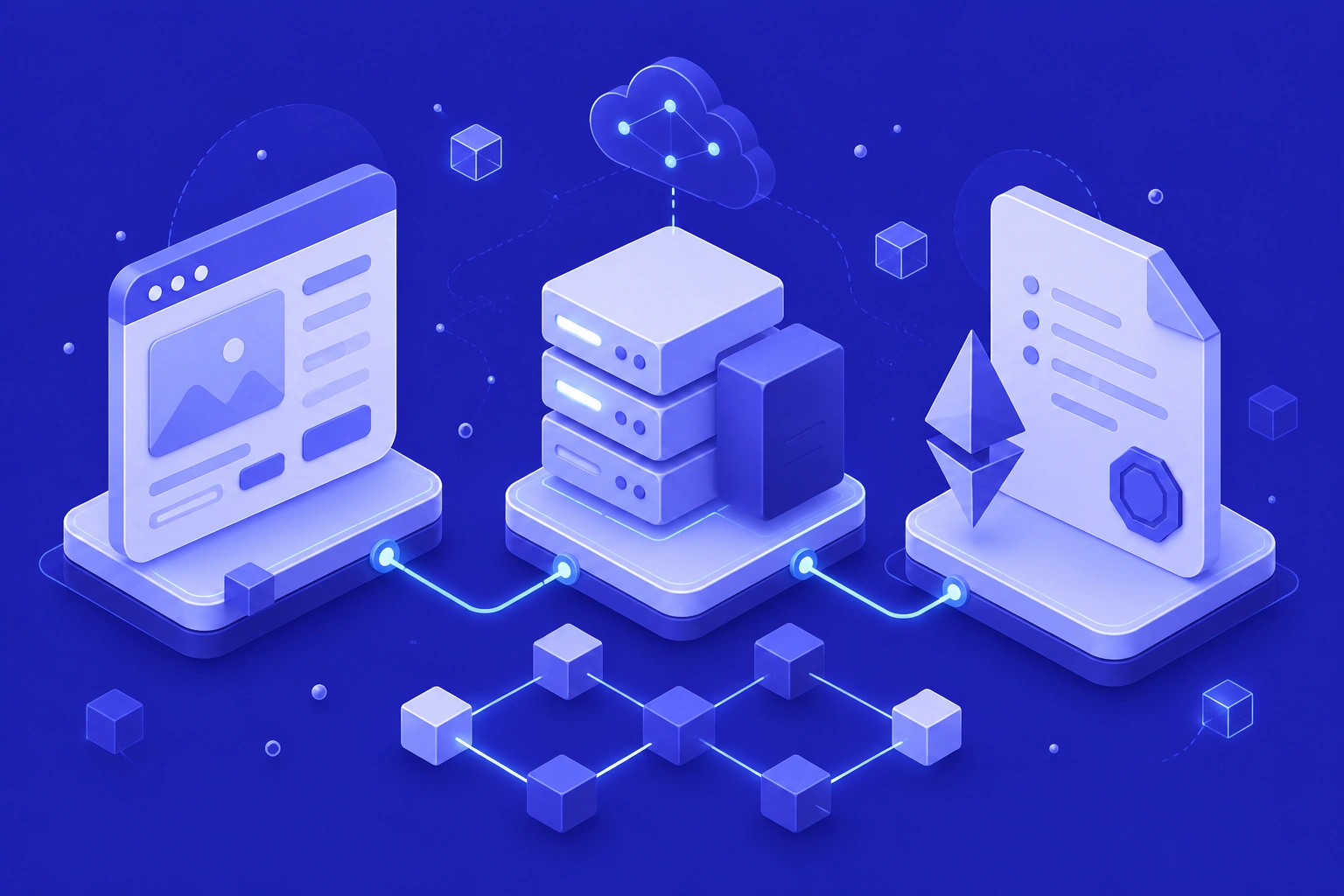
Decentralized applications represent a fundamental shift in how software operates, moving control from centralized servers to distributed networks of users. However, most successful dApps operating today are not purely decentralized. Instead, they employ hybrid architectures that combine the transparency and security guarantees of blockchain networks with the efficiency and functionality of traditional backend systems. This integration has become essential as organizations across USA, UK, UAE, and Canada recognize that purely on-chain solutions cannot yet meet real-world requirements for speed, cost-effectiveness, and user experience.
The journey of decentralized applications has demonstrated that blockchain alone cannot handle all aspects of modern applications. Smart contracts executing on-chain are expensive, slow compared to traditional servers, and cannot efficiently process complex business logic or access external data. Backend infrastructure solves these challenges by handling user authentication, maintaining databases, processing high-frequency transactions, and providing the connectivity between blockchain networks and existing business systems that enterprises require. Understanding how these two worlds connect is crucial for anyone building, investing in, or evaluating dApps.
This comprehensive guide explores the architecture, technologies, best practices, and future trends in connecting dApps with backend systems. Whether you’re a developer, entrepreneur, or enterprise technology leader, understanding this hybrid approach is essential for successfully implementing blockchain solutions in production environments. We’ll examine how APIs bridge these worlds, how data synchronizes across systems, and what security considerations must be addressed to protect users and assets in hybrid dApp architectures.
Understanding the Difference Between Web2 and Web3 Architecture
Web2 architecture, the foundation of most internet services today, operates on a client-server model where users interact with centralized servers controlled by companies. These servers manage all data, enforce business logic, process transactions, and authenticate users. This centralized approach enables rapid innovation and provides excellent user experience through optimized database queries and intelligent caching strategies. However, it creates single points of failure, requires users to trust companies with their data, and concentrates control and profit with platform operators. Most applications operating in traditional markets worldwide rely exclusively on Web2 architecture.
Web3 architecture introduces blockchain networks where data is distributed across thousands of nodes, transactions are cryptographically verified, and no single entity controls the system. Smart contracts provide immutable business logic that executes exactly as programmed without risk of manipulation by server administrators. This creates unprecedented trust, transparency, and censorship resistance. However, Web3 architecture trades efficiency for security and decentralization. Blockchain transactions are slow, expensive, and transparent in ways that may conflict with privacy requirements. Scaling blockchain networks to handle millions of users remains technically challenging and economically expensive.[1]
Hybrid dApp architectures leverage the strengths of both approaches. They utilize blockchain networks for critical transactions and data that require transparency and immutability, while delegating performance-sensitive operations, user management, and complex logic to backend systems. This balanced approach allows dApps to achieve both the trust guarantees of decentralized systems and the performance characteristics users expect from modern applications.
Why Modern dApps Still Need Backend Infrastructure
Despite the revolutionary potential of blockchain technology, purely on-chain applications face severe practical limitations that make backend infrastructure not just beneficial but essential. The first major limitation is cost. Executing smart contract code on blockchains like Ethereum incurs computational fees (gas costs) that make frequent operations economically prohibitive. A simple database query might cost fractions of a cent on a Web2 backend but dollars on Ethereum. For applications serving millions of users, these costs become unsustainable without an economical way to handle high-frequency operations off-chain.
Speed represents the second critical limitation. Blockchain networks are designed for security and decentralization, not raw transaction throughput. Ethereum processes roughly fifteen transactions per second, while Visa handles thousands simultaneously. Users expect modern applications to respond instantly to their actions, something blockchain networks cannot provide for all operations. Backend servers can respond to requests in milliseconds, enabling responsive user interfaces and real-time interactions essential for competitive applications. When immediate feedback is required, backend systems must handle these operations and later synchronize with blockchain networks.
User Authentication
Backend systems securely manage user login credentials, session tokens, and password resets, providing familiar authentication flows users expect without exposing private keys or compromising security.
Data Storage
Storing gigabytes of application data on blockchain is expensive and inefficient. Backend databases store user profiles, preferences, metadata, and large files off-chain while blockchain maintains critical transaction records.
Business Logic
Complex calculations, conditional logic, and multi-step workflows often execute more efficiently off-chain, with results recorded on-chain once final decisions are reached and verified.
Backend infrastructure also enables integration with traditional payment systems, legacy databases, and third-party services that organizations across USA, UK, UAE, and Canada depend on. Enterprises cannot migrate entire business operations onto blockchain overnight. Hybrid dApp backend infrastructure provides a bridge, allowing organizations to leverage blockchain benefits while maintaining existing systems. This pragmatic approach has driven mainstream adoption of blockchain technology in enterprises and institutions that require regulatory compliance, data privacy, and integration with established business processes.
Real-world examples illustrate these necessities clearly. DeFi platforms operating on Ethereum use backend servers to maintain order books, execute complex matching algorithms, and manage user interfaces that respond in real-time to market movements. NFT marketplaces depend on backend systems to store and serve artwork images, manage search indices, and handle payment processing that blockchain cannot economically support at scale. Professional dapp development services across enterprise markets consistently implement backend infrastructure as a standard practice, not an exception.
How Smart Contracts Interact With Backend Services
Smart contracts are self-executing programs that run on blockchain networks, but they cannot independently access external data or trigger off-chain actions. This fundamental limitation creates the need for sophisticated interaction patterns between smart contracts and backend services. The primary pattern used in production dApps is the event-driven architecture where smart contracts emit events that backend services listen to and respond to with database operations, API calls, or additional blockchain transactions. When a user initiates an action in a dApp frontend, the application sends a transaction to execute a smart contract function. Upon successful execution, the smart contract emits an event containing relevant data that backend services monitor.
Backend services use specialized listeners or indexers to watch blockchain networks for events. These services maintain a connection to blockchain nodes, continuously scanning new blocks for relevant events. When an event is detected, the backend automatically processes it, updating databases, triggering additional operations, or calling other APIs. This asynchronous pattern decouples frontend actions from blockchain confirmation, improving perceived performance while maintaining eventual consistency between on-chain and off-chain systems. The pattern also enables dApps to execute complex conditional logic that depends on multiple blockchain events occurring in sequence.
Another critical interaction pattern is request-response where frontend applications directly call smart contract functions and wait for blockchain confirmation. This pattern is used for time-sensitive operations where immediate feedback is required. However, because blockchain transactions cannot provide instant confirmation (they require blocks to be mined), applications typically employ optimistic updates in the frontend, assuming the transaction will succeed while simultaneously listening for confirmation events.
Advanced dapp development services also implement message queues and batch processing patterns where multiple blockchain operations are aggregated and processed together, reducing transaction costs significantly. Some dApps use sidechains or layer-two solutions to execute smart contracts more cheaply, then periodically settle final balances on the main blockchain. These sophisticated patterns require careful coordination between smart contract code and backend services to ensure atomic consistency across distributed systems.
The Role of APIs in dApp Integration
Application Programming Interfaces serve as the critical connective tissue enabling dApps to communicate with blockchain networks and backend services. APIs abstract the complexity of cryptographic operations, node management, and protocol implementation behind simple endpoints that frontend applications can call. Without APIs, every application would need to implement blockchain communication code independently, leading to redundant work, security vulnerabilities, and poor user experience. Instead, blockchain API integration through providers like Alchemy, Infura, and QuickNode has become the standard practice for professional dapp development services globally.
Backend APIs typically expose two categories of functionality. The first category provides read operations that allow applications to query blockchain state, retrieve account balances, check token ownership, and read data stored in smart contracts. These queries are fast and cheap because they don’t modify blockchain state. Applications can cache read results, improving performance further. The second category comprises write operations that submit transactions to blockchain networks, execute smart contract functions, and modify state. These operations require gas fees, longer confirmation times, and careful error handling because transactions can fail for numerous reasons including insufficient gas, nonce conflicts, or contract reverts.
Real-World Example: DeFi Protocol Integration
A DeFi lending protocol operates across USA, UK, UAE, and Canada with thousands of daily transactions. The frontend application cannot directly query blockchain data efficiently for every user action. Instead, a backend API aggregates account positions, collateral values, and interest calculations through smart contract calls, caching results in a database. When users deposit collateral, the frontend submits a transaction through the blockchain API, which the backend indexes via event listeners. The backend then updates user account status, calculates new interest rates, and returns updated UI data through RESTful endpoints. This hybrid approach provides responsive user experience while maintaining accurate on-chain accounting.
Professional dapp backend infrastructure increasingly uses GraphQL APIs rather than traditional REST endpoints because GraphQL enables frontend applications to request exactly the data they need without over-fetching irrelevant information. For blockchain data, GraphQL APIs often use subgraph indexers (like The Graph protocol) that parse blockchain transactions and smart contract events, organizing them into queryable indexes. This represents a significant advancement over direct blockchain node queries, providing flexibility and performance suitable for enterprise applications.
API authentication and rate limiting have become standard features ensuring dApps can operate reliably at scale. Backend APIs implement API keys, OAuth tokens, or even blockchain-based authentication using signed messages. Rate limiting prevents any single application from monopolizing resources, protecting service quality for all users. Advanced API architectures implement tiered access levels, where enterprise clients receive guaranteed throughput while free tiers accept occasional rate limiting. This ensures sustainable operations for dapp development companies and maintains availability for all customers operating in competitive global markets.
Connecting Blockchain Networks With Traditional Databases
Synchronizing data between blockchain networks and traditional databases represents one of the most complex challenges in hybrid dApp architectures. Blockchain systems maintain a distributed ledger where every transaction is permanent and transparent, while traditional databases are centralized, mutable, and private. Creating reliable synchronization between these fundamentally different systems requires careful architectural decisions and robust error handling to prevent data inconsistencies that could lead to financial losses or business disruption.
The synchronization process typically begins with event indexing, where backend services listen to blockchain networks for relevant smart contract events, parsing transaction logs and extracting structured data. Events are the most reliable source of truth for off-chain data because they are immutable once recorded on-chain. An indexing service processes these events in order, maintaining consistency with blockchain state. When a smart contract emits an event indicating a user deposit, the backend creates a corresponding record in the database. If the backend crashes, it can resume from the last processed block, replaying events to reconstruct the correct state without any data loss.
Block Polling
Indexer periodically queries blockchain nodes for new blocks and transactions, extracting relevant contract events and building a searchable index.
Event Processing
Events are parsed and transformed into database operations, updating user balances, transaction histories, and other derived data structures.
Consistency Verification
Periodically verify database state matches blockchain state by querying smart contracts and comparing calculated balances.
One critical consideration in database synchronization is handling blockchain reorganizations or chain reorgs. In proof-of-work systems like Bitcoin and Ethereum, short blockchain reorganizations are normal when multiple miners discover blocks simultaneously. If a smart contract event was included in a block that gets reorganized out of the main chain, the corresponding database record must be rolled back. Professional dapp development services implement reorg handling by maintaining a confirmation depth threshold, only considering blocks with multiple confirmations as final before updating databases. For critical operations, some dApps wait for deeper confirmation (often 12+ blocks) to minimize reorg risk.
Additionally, backend services must handle the bidirectional synchronization where off-chain data changes trigger blockchain transactions. When users update their profiles in a Web2 backend, these changes must be recorded on-chain if the dApp requires blockchain-based identity verification. Implementing this reverse synchronization requires careful orchestration, including transaction ordering, error recovery when blockchain operations fail, and maintaining audit trails across both systems. Organizations operating across USA, UK, UAE, and Canada markets must also consider regulatory requirements that may mandate data residency or immutability guarantees, further constraining synchronization strategies.
How Middleware Bridges Web2 and Web3 Systems
Middleware components form the translation layer that enables Web2 and Web3 systems to communicate despite their fundamental architectural differences. Middleware receives requests from Web2 applications, translates them into blockchain operations, executes those operations, and returns results in formats Web2 systems expect. Without middleware, every dApp would need to implement this translation logic independently, creating security risks and maintenance burdens. Enterprise middleware solutions have emerged as critical infrastructure for dapp development companies building production systems at scale.
One essential middleware function is transaction construction and signing. Web2 developers think in terms of SQL queries and REST requests, but blockchain operations require careful construction of signed transactions. Middleware abstracts this complexity, accepting simple requests like “transfer 100 tokens to address X” and handling all the cryptographic details including nonce management, gas estimation, signature generation, and confirmation monitoring. This abstraction is critical for security because it centralizes key management and reduces the risk of developers accidentally exposing private keys or constructing invalid transactions that waste gas.
Another critical middleware function is error handling and transaction recovery. Web2 applications expect operations to complete reliably or fail cleanly with error messages. Blockchain transactions complicate this expectation because operations can fail after being submitted, can be stuck in mempools indefinitely, or can execute with unintended consequences. Middleware must monitor transaction status, implement retry logic with exponential backoff, detect failed transactions, provide clear error reporting, and sometimes execute recovery operations. For example, if a swap transaction fails due to slippage, middleware might retry with adjusted parameters or notify the user appropriately.
Advanced middleware implementations also provide rate limiting, metering, and load balancing across multiple blockchain providers and nodes. This ensures dApp performance remains consistent even during network congestion or if one provider experiences downtime. Organizations operating in competitive markets like USA, UK, UAE, and Canada depend on this reliability for maintaining SLA commitments to enterprise customers. Professional dapp backend infrastructure implementations typically use industry-standard middleware solutions like Tenderly, OpenZeppelin Defender, or custom solutions built on platforms like AWS Lambda, providing security, reliability, and scalability at scale.
Authentication and User Identity Management in dApps
User authentication represents a fundamental difference between traditional Web2 applications and dApps. Web2 systems typically use usernames and passwords, with servers maintaining encrypted credentials and issuing session tokens after successful authentication. dApps, in contrast, use blockchain addresses and cryptographic signatures for authentication, leveraging users’ control of private keys as proof of identity. However, this approach creates challenges when dApps need to implement features that Web2 users expect, such as password recovery, multi-device access, or social authentication integrations. Hybrid authentication architectures balance these competing requirements.
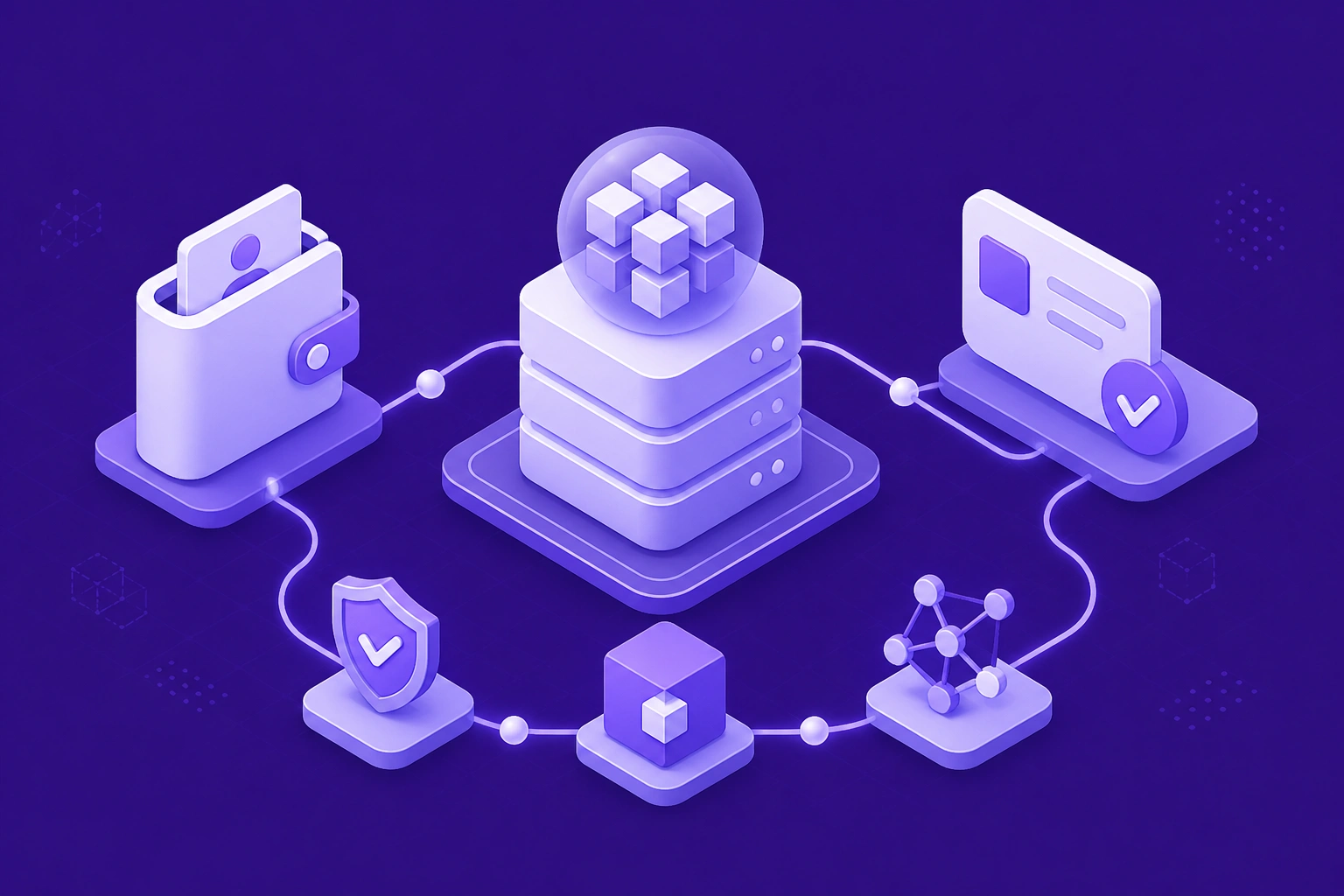
The most common hybrid authentication pattern uses message signing where users prove control of their private keys by signing authentication messages with their wallet. A user connects their Web3 wallet (MetaMask, Ledger, etc.) to a dApp frontend. The backend server issues a unique message containing a timestamp, nonce, and domain identifier. The user’s wallet signs this message using the private key associated with their blockchain address. The dApp submits this signature to the backend, which cryptographically verifies the signature, confirms it matches the user’s blockchain address, and issues a traditional Web2 session token. This approach provides strong authentication while maintaining the decentralized principle that only the user can authorize actions with their wallet.
Identity Management Considerations
dApps must decide whether to allow users to change their associated blockchain addresses. Some applications bind users to a single address for security, ensuring that historical actions remain associated with specific identities. Others implement account recovery and address linking where users can add new addresses to their account after proper verification. This flexibility improves user experience but introduces new security considerations and requires careful audit trail maintenance. Organizations in regulated markets must clearly document identity linking procedures to comply with regulatory requirements around customer identification and transaction tracing.
Social authentication integration adds another layer of complexity. Some dApps allow users to authenticate using traditional social media accounts (Google, Twitter, Discord), then link those identities to blockchain addresses. This approach improves user onboarding by allowing users to sign up without already owning cryptocurrency or understanding wallet management. However, it introduces centralized components that could compromise privacy. Professional dapp development services implement careful data minimization practices, avoiding unnecessary collection of social profile data and maintaining clear separation between social identities and blockchain addresses.
Multi-signature wallets and social recovery mechanisms are emerging as important identity management tools. Instead of relying on a single private key that could be compromised or lost, users can set up multi-signature wallets requiring multiple keys to approve transactions, or social recovery protocols where trusted contacts can help recover account access. These advanced mechanisms significantly improve security for valuable accounts while introducing new complexities in dApp backend infrastructure. Leading dapp development services across USA, UK, UAE, and Canada are increasingly implementing these features as standard for enterprise customers handling significant digital assets.
Blockchain and Backend Data Synchronization
Achieving reliable data synchronization between blockchain and backend systems requires sophisticated engineering to handle the fundamental differences between these systems. Blockchain provides strong consistency guarantees but is slow and expensive. Backend databases provide fast, cheap operations but depend on server administrators. Synchronizing these systems means constantly reconciling these differences while maintaining correctness. The most reliable approach uses blockchain as the source of truth for critical data while using backend databases as caches and read replicas that can be rebuilt from blockchain history if needed.
Implementing this requires several key practices. First, maintain an immutable transaction log on-chain that records all state-changing operations. This creates a complete audit trail and allows recovery of correct state even if backend databases become corrupted. Second, use deterministic event processing where identical events always produce identical database changes. This ensures that replaying historical events reproduces correct state from any point in time. Third, implement regular state verification where the system periodically queries blockchain to verify database state still matches, triggering reconciliation if discrepancies are detected. Fourth, handle edge cases like failed transactions, gas estimation errors, and transaction mempool mechanics that are unique to blockchain systems.
Read Operations
Query cached backend data for maximum performance. Refresh cache periodically from blockchain to ensure correctness.
Best for: User balances, historical transactions, derived metrics.
Write Operations
Write to blockchain for critical state. Update backend databases asynchronously via event listeners.
Best for: Fund transfers, permission changes, irreversible actions.
A sophisticated pattern called “eventual consistency with monitoring” has emerged as best practice for production systems. This approach accepts that on-chain and off-chain data may briefly diverge after transactions occur, but implements continuous monitoring to detect and resolve inconsistencies. When discrepancies are discovered, the system automatically corrects them by either replaying blockchain events or executing recovery transactions. This pattern accommodates the realities of asynchronous systems while maintaining data integrity across services. Professional dapp backend infrastructure implementations typically achieve consistency within seconds to minutes, which is acceptable for most applications while maintaining the scalability advantages of hybrid architectures.
Cross-chain synchronization adds additional complexity when dApps operate on multiple blockchains simultaneously. Synchronizing state across Ethereum, Polygon, and Solana, for example, introduces delays and potential race conditions. Advanced dapp development services implement careful orchestration, including atomic swap mechanisms where possible, or accept eventual consistency while monitoring for critical discrepancies. Organizations operating in USA, UK, UAE, and Canada that require stringent audit trails and regulatory compliance must carefully document synchronization strategies and maintain comprehensive logs of all state changes across all systems.
Security Challenges in Hybrid dApp Architectures
Hybrid dApp architectures introduce security challenges that purely Web2 or purely blockchain systems do not face. By combining both approaches, dApps inherit the attack surfaces from both worlds while creating new vulnerabilities at the integration points. A successful hybrid dApp security strategy requires defense-in-depth across all layers, from blockchain smart contracts through middleware to backend databases. Many security incidents affecting dApps stem from oversights in this hybrid architecture rather than flaws in blockchain technology itself.
One critical vulnerability is the trusted intermediary problem. Backend servers become trusted intermediaries that could potentially manipulate data, steal funds, or provide incorrect information. If a backend server is compromised, an attacker could prevent users from accessing their funds, manipulate balances in the database, or forge blockchain transactions. Mitigating this requires several strategies: first, minimize the amount of sensitive data stored on backend servers, keeping only what’s necessary for operation. Second, implement cryptographic proof mechanisms where blockchain contracts verify critical information independently rather than trusting backend assertions. Third, ensure users can verify their balances independently through blockchain explorers without relying on the application’s reporting. Fourth, maintain comprehensive audit logs enabling detection and investigation of suspicious activity.
Security Risk Matrix
| Attack Vector | Impact Level | Mitigation Strategy |
|---|---|---|
| Private Key Exposure | Critical | Hardware security modules, encrypted key storage, key rotation, audit logging. |
| Transaction Manipulation | Critical | Multisig verification, off-chain signature aggregation, transaction encoding standards. |
| Data Inconsistency | High | Periodic verification, deterministic event processing, blockchain as source of truth. |
| API Credential Theft | High | Rate limiting, IP whitelisting, request signing, credential rotation. |
| Front-Running | Medium | Private transaction pools, commit-reveal schemes, encrypted mempools. |
| Replay Attacks | Medium | Nonce management, chain-specific signatures, unique identifiers. |
API security represents another critical concern. Backend APIs serve as interfaces between users and blockchain networks, making them attractive attack targets. Attackers may attempt to forge API requests, replay previous requests, or manipulate parameters. Implementing strong API authentication through cryptographic signatures or OAuth tokens helps mitigate these risks. Rate limiting prevents brute force attacks and ensures fair resource allocation. IP whitelisting restricts API access to trusted sources. Request signing and encryption protect against man-in-the-middle attacks. Professional dapp backend infrastructure implementations employ industry-standard API security practices including detailed logging, anomaly detection, and incident response procedures.
Additionally, synchronization vulnerabilities can create security issues. If on-chain and off-chain data become inconsistent without detection, users might manipulate this inconsistency for profit. For example, if a database incorrectly reports a user’s balance as lower than their on-chain balance, the user could potentially withdraw more than they actually own. Regular verification and consistency checks help detect these issues before they result in financial losses. Organizations operating in regulated environments like USA, UK, UAE, and Canada must implement additional controls including regular security audits, penetration testing, and formal verification of critical smart contracts to minimize security risks in hybrid systems.
Scalability Benefits of Hybrid dApps
One of the primary advantages of hybrid dApp architectures is the ability to achieve scalability that purely on-chain systems cannot match. Blockchain networks intentionally trade throughput for security and decentralization, with individual chains processing only thousands of transactions per second at best. Backend systems, in contrast, can easily handle millions of operations per second through proper infrastructure design. Hybrid architectures leverage this difference, moving high-frequency operations off-chain while keeping critical transactions on-chain. This enables dApps to scale to mainstream adoption levels while preserving blockchain security guarantees for important assets and operations.
Layer-two solutions like Polygon, Optimism, and Arbitrum exemplify this hybrid approach at the protocol level. These systems process transactions on faster, cheaper sidechains or rollup networks, then periodically batch and settle results on Ethereum’s main chain. Dapp backend infrastructure can similarly use layer-two solutions, handling most operations off-chain and settling final results on the main chain. This approach provides users with fast, cheap transactions while maintaining security guarantees from the main blockchain. Professional dapp development services increasingly offer multi-chain deployment, allowing users to choose between main chain security and sidechains for reduced costs based on their risk tolerance.
Scalability Architecture Options
On-Chain Only
Throughput: 15-100 TPS. Cost: High. Latency: 12-60 seconds. Best for: Critical operations, regulatory compliance.
Layer-Two
Throughput: 1000-4000 TPS. Cost: Low. Latency: 1-2 seconds. Best for: User operations, frequent transactions.
Backend Only
Throughput: 10000+ TPS. Cost: Minimal. Latency: Milliseconds. Best for: Cache, search, derived data.
Sharding and cross-chain bridges enable further scalability improvements for dApps operating across multiple blockchain networks. Instead of concentrating all operations on a single blockchain, applications can shard users or data across multiple chains, then use bridges to enable interoperability when necessary. This approach distributes load and costs across multiple networks. However, it introduces complexity because operations that span multiple chains must be carefully coordinated to prevent race conditions or inconsistent state. Advanced dapp backend infrastructure handles this complexity through careful transaction orchestration and monitoring.
Organizations operating in growth markets like USA, UK, UAE, and Canada increasingly demand scalability that enables real-world applications at mainstream adoption levels. Hybrid dApp architectures provide the technological foundation for this scalability. As blockchain technology matures, scalability continues improving through protocol-level innovations like Ethereum 2.0 consensus changes and rollup improvements. However, hybrid architectures remain essential for the foreseeable future, enabling dApps to serve users reliably at global scale while maintaining blockchain security guarantees.
Popular Technologies Used for dApp Backend Integration
The ecosystem of tools and platforms for dapp backend infrastructure has matured significantly, with professional solutions available for virtually every integration challenge. Selecting appropriate technologies is critical for building reliable, maintainable dApps at scale. Leading dapp development services across USA, UK, UAE, and Canada standardize on proven platforms rather than building everything from scratch, reducing development time and improving reliability. Understanding the landscape of available technologies helps developers and organizations make informed decisions about their technical architecture.
Blockchain API providers form the foundation of most dApp backend infrastructure. Alchemy, Infura, and QuickNode offer JSON-RPC endpoints to multiple blockchain networks, providing reliable access to blockchain data and transaction submission with built-in rate limiting, monitoring, and failover mechanisms. These services have become industry standard because they eliminate the need for dApps to operate their own blockchain nodes, reducing operational complexity and costs significantly. Advanced offerings include webhooks, queue services, and enhanced APIs that provide additional functionality like token transaction filtering, NFT metadata, and historical data access.
The Graph (Indexing)
Decentralized indexing protocol enabling efficient querying of blockchain data through GraphQL. Eliminates need for custom indexers and improves query performance significantly.
Ethers.js / Web3.js (Libraries)
JavaScript libraries that abstract blockchain complexity, providing higher-level APIs for transaction construction, signing, and smart contract interaction.
Hardhat / Truffle (Development)
Development frameworks providing testing, compilation, and deployment tools for smart contracts, essential for professional dapp infrastructure.
OpenZeppelin (Smart Contract Library)
Battle-tested smart contract implementations for common patterns like token standards, access control, and upgradeable contracts, reducing security risks.
Tenderly (Monitoring)
Comprehensive monitoring platform providing real-time transaction tracking, error detection, and debugging tools for production dApps.
IPFS (Decentralized Storage)
Distributed file system enabling decentralized storage of large files without centralized servers, complementing blockchain data storage.
Message queue systems like Kafka and RabbitMQ have become essential infrastructure for dapp backend systems handling event processing at scale. These systems decouple blockchain event detection from database updates, allowing backends to process events asynchronously and reliably even under high load. When blockchain events are detected, they are placed in message queues where consumers process them in order, updating databases and triggering other operations. This architecture ensures events are never lost even if backend services crash, maintaining consistency across systems.
Cloud platforms like AWS, Google Cloud, and Azure provide the infrastructure foundation for most production dApps, offering serverless computing, managed databases, and networking services that scale automatically. Professional dapp development services across enterprise markets typically run on cloud infrastructure, leveraging autoscaling and high availability features to deliver reliable service to users worldwide. However, some dApps also utilize decentralized infrastructure protocols like Arweave for permanent storage or rely on distributed node operators for redundancy and censorship resistance.
Best Practices for Connecting dApps With Backend Systems
Implementing dApp backend infrastructure reliably requires following well-established best practices developed through years of production experience. These practices reduce risks, improve performance, and make systems more maintainable. Professional dapp development services consistently apply these patterns across all projects, recognizing that shortcuts or deviations often lead to problems that are expensive to remediate. Adopting best practices from the beginning establishes solid foundations for successful long-term projects.
The first essential practice is treating blockchain as the source of truth for critical data. Rather than trusting backend databases to maintain accurate balances or transaction history, systems should be able to reconstruct correct state by replaying blockchain transactions and events. This requires storing sufficient on-chain data that backends can completely verify their state. When discrepancies between on-chain and off-chain data are detected, the system should prioritize blockchain state and update databases accordingly. This principle protects against database corruption, backend bugs, or malicious server manipulation compromising data integrity.
Another critical practice is implementing robust error recovery mechanisms. Blockchain operations can fail for numerous reasons including insufficient gas, contract reverts, mempool congestion, or network issues. Backend systems must handle these failures gracefully, retrying with appropriate backoff, providing clear error reporting to users, and sometimes executing recovery transactions. Professional dapp development services implement sophisticated transaction lifecycle management that tracks pending transactions, detects failures, retries appropriately, and cleans up orphaned state.
Organizations across USA, UK, UAE, and Canada increasingly recognize that successful dApps require operational excellence in addition to technical correctness. This means implementing 24/7 monitoring, maintaining incident response procedures, conducting regular security audits, and staying updated with blockchain network changes and protocol upgrades. Professional dapp development services provide ongoing operational support ensuring systems remain secure and performant over time.
Future Trends in Web2 and Web3 Backend Integration
The landscape of dApp backend infrastructure continues evolving rapidly as blockchain technology matures and enterprise adoption accelerates. Understanding emerging trends helps organizations plan technology strategies and position themselves advantageously in competitive markets. Several significant trends are reshaping how dApps connect with backend systems, each offering new possibilities while introducing novel challenges.
Modular blockchain architectures represent a significant architectural evolution. Rather than monolithic blockchains where a single network handles consensus, settlement, execution, and data availability, modular designs separate these concerns. Protocols like Cosmos, Polkadot, and newer Ethereum roadmap items enable customized chains for specific use cases. dApp backend infrastructure will increasingly deploy customized blockchains tailored to their specific needs, rather than building on general-purpose chains. This enables optimization for throughput, latency, and cost, though it introduces complexity in managing multiple chains simultaneously.
Emerging Technology Implications
Zero-knowledge proofs are transforming how dApps prove blockchain state without exposing private data. Rather than publicizing entire transaction details, dApps can generate cryptographic proofs demonstrating facts about transactions without revealing sensitive information. This addresses privacy concerns and enables regulatory compliance while maintaining blockchain properties. As ZK technology matures and costs decrease, expect mainstream adoption in privacy-sensitive applications like healthcare, financial services, and identity management.
Artificial intelligence integration in dApp infrastructure is another emerging trend. Backend systems increasingly use ML models to detect anomalies, identify suspicious transactions, predict user behavior, and optimize resource allocation. AI-powered monitoring can identify security threats and data inconsistencies faster than traditional monitoring. Predictive analytics help estimate transaction costs and execution times, improving user experience. As AI capabilities mature, expect sophisticated autonomous systems managing significant portions of dApp infrastructure without human intervention.
Cross-chain interoperability is becoming increasingly important as users and assets span multiple blockchain networks. Rather than forcing users to choose a single chain, advanced dApp architecture enables seamless interaction across Ethereum, Polygon, Solana, and other networks simultaneously. Backend infrastructure must orchestrate cross-chain operations carefully, managing risks from bridge failures or inconsistencies across chains. This trend accelerates adoption of bridging protocols like Wormhole and Axelar, though security challenges remain significant.
Additionally, managed backend-as-a-service platforms are emerging to abstract blockchain complexity further. Services like Thirdweb, Alchemy, and others increasingly offer higher-level functionality including user management, payments processing, and governance features, reducing the need for dApps to build everything from scratch. This democratizes dApp creation, enabling smaller teams and less technical entrepreneurs to launch professional applications. However, it introduces dependencies on third-party services that could affect availability and control. Professional dapp development services must carefully evaluate these trade-offs when selecting technology partners.
Final Thoughts
The integration of dApps with traditional backend systems has become the dominant architectural pattern for blockchain applications operating at scale in production environments. Rather than viewing blockchain and backend infrastructure as competing approaches, successful dApps recognize their complementary strengths and design architectures leveraging both. This hybrid approach enables dApps to provide the security, transparency, and censorship resistance of blockchain technology while maintaining the performance, cost-efficiency, and user experience characteristics of traditional systems.
Throughout this guide, we have explored the technical, architectural, and operational considerations of building hybrid dApp systems. From understanding fundamental differences between Web2 and Web3 architectures through implementing secure data synchronization, managing authentication, and handling security challenges, each aspect of dApp backend integration presents both opportunities and risks. Professional dapp development services operating across USA, UK, UAE, and Canada have refined these practices through real-world experience, developing proven patterns that can be applied to new projects.
The key to successful dApp backend infrastructure is recognizing that blockchain is not a replacement for databases, but rather a specialized tool suited for specific problems. Critical operations requiring transparency, immutability, and decentralization belong on-chain. Frequent operations requiring speed and low cost belong off-chain in backend infrastructure. Clear architectural decisions about which operations belong where, combined with careful implementation of synchronization, consistency, and security mechanisms, create systems that are both powerful and reliable.
As blockchain technology matures and institutional adoption accelerates, the sophistication of dApp backend architecture will continue increasing. Emerging technologies like zero-knowledge proofs, AI-driven monitoring, and modular blockchains will create new possibilities for optimization and innovation. Organizations building dApps today have the advantage of accessing battle-tested patterns and mature tooling that make complex systems more manageable. Those who carefully design their architecture, implement best practices, and maintain focus on security and reliability will be well-positioned to capitalize on blockchain’s transformative potential.
The future of blockchain technology belongs to applications that thoughtfully integrate decentralized networks with the practical realities of modern software systems. Understanding how dApps connect with traditional backend systems is the foundation of building applications that are both technologically advanced and commercially viable. As you plan your blockchain initiatives, remember that success requires careful architectural design, security-first implementation, and ongoing operational excellence.
Frequently Asked Questions
Q1.How do decentralized applications connect with traditional backend systems?
Decentralized applications connect with traditional backend systems through APIs, middleware, and hybrid architectures that bridge Web2 and Web3 technologies. These connections enable dApps to leverage the security of blockchain networks while maintaining the efficiency and user experience of conventional databases. Backend servers act as intermediaries, translating blockchain transactions into database operations and vice versa. This integration allows dApps to store off-chain data, manage user sessions, and process complex business logic that cannot run entirely on-chain. Many successful dApps operating in USA, UK, UAE, and Canada markets use this hybrid approach to balance decentralization with practical scalability requirements.
Q2.Why do dApps need backend infrastructure if they're decentralized?
While blockchain networks provide immutability and transparency, dApps require backend infrastructure to handle tasks that are impractical or expensive to perform entirely on-chain. Backend servers manage user authentication, store large datasets off-chain, process rapid API requests, and maintain connections with traditional payment systems. Smart contract interactions can become prohibitively expensive for frequent operations, making backend integration essential for user experience. Additionally, backend infrastructure enables dApps to integrate with existing business systems, comply with regulatory requirements, and provide features like search functionality and advanced filtering that blockchain networks cannot efficiently support.
Q3.What role do APIs play in connecting dApps with backend systems?
APIs serve as the communication layer between decentralized applications and traditional backend services. They enable dApps to read and write data from blockchain networks, trigger smart contract executions, and interact with databases without exposing sensitive keys or compromising decentralization. Blockchain API integration allows developers to abstract complex cryptographic operations behind simple REST or GraphQL endpoints. APIs also facilitate real-time data synchronization, webhook notifications, and conditional executions based on on-chain and off-chain events. Professional dapp development services across enterprise markets leverage standardized APIs to ensure reliable, scalable connections between Web3 and Web2 infrastructure.
Q4.How do smart contracts interact with backend services and APIs?
Smart contracts interact with backend services through oracle patterns, middleware layers, and hybrid execution models. Oracles fetch external data and feed it into smart contracts, while middleware translates blockchain events into API calls and database operations. When a smart contract requires real-world data or must trigger off-chain processes, it emits events that backend services listen to and respond to automatically. This bidirectional communication enables complex workflows like automated fund transfers, conditional settlements, and data-driven contract executions. Proper smart contract integration requires careful security considerations, including signature verification, encryption, and audit trails to maintain trust across distributed systems.
Q5.What are the main security challenges when connecting dApps to traditional backends?
Hybrid dApp architectures face unique security challenges including private key management across centralized and decentralized systems, API credential exposure, and synchronization vulnerabilities. Attackers may target the centralized components expecting weaker security controls, or exploit inconsistencies between on-chain and off-chain data. Backend servers must implement robust authentication, encryption, and rate limiting while maintaining audit logs for compliance. Additionally, middleware and bridges introduce new attack vectors if not properly secured. Organizations in regulated markets like USA and UK must address data privacy requirements while managing blockchain transparency, requiring sophisticated encryption strategies and clear governance frameworks.
Q6.How does backend data synchronization work with blockchain systems?
Backend data synchronization with blockchain systems involves maintaining consistency between on-chain records and off-chain databases through continuous polling, event listeners, and message queues. When transactions occur on-chain, backend services detect these changes and update corresponding database records. Conversely, when off-chain data changes, the system ensures blockchain state reflects these updates through smart contract transactions. This bidirectional synchronization must handle latency, network failures, and transaction reversions (in proof-of-work systems). Advanced dApp backend infrastructure uses event streaming, distributed ledgers, and consensus mechanisms to ensure data integrity across systems, preventing orphaned records and maintaining audit trails essential for compliance.
Q7.What are the emerging trends in Web2 and Web3 backend integration?
Emerging trends include the rise of modular blockchain architectures that separate consensus, settlement, and execution layers, enabling more flexible backend integrations. Zero-knowledge proofs and privacy-preserving technologies are increasingly used to balance transparency with confidentiality requirements. Cross-chain bridges and multi-chain orchestration platforms are becoming standard for dApps operating across multiple blockchains. Additionally, AI-driven monitoring and anomaly detection are enhancing security in hybrid systems. The dapp development company landscape is shifting toward managed backend-as-a-service solutions that abstract blockchain complexity while providing enterprise-grade infrastructure, particularly in growth markets like Canada and UAE where institutional adoption is accelerating.
Explore Services
Related Services
Reviewed by

Aman Vaths
Founder of Nadcab Labs
Aman Vaths is the Founder & CTO of Nadcab Labs, a global digital engineering company delivering enterprise-grade solutions across AI, Web3, Blockchain, Big Data, Cloud, Cybersecurity, and Modern Application Development. With deep technical leadership and product innovation experience, Aman has positioned Nadcab Labs as one of the most advanced engineering companies driving the next era of intelligent, secure, and scalable software systems. Under his leadership, Nadcab Labs has built 2,000+ global projects across sectors including fintech, banking, healthcare, real estate, logistics, gaming, manufacturing, and next-generation DePIN networks. Aman’s strength lies in architecting high-performance systems, end-to-end platform engineering, and designing enterprise solutions that operate at global scale.