Ai Overview
Price-time priority in crypto exchange is the fundamental rule that governs how orders are matched on a trading platform. A retail trader’s limit order at $100 has exactly the same priority as an institutional trader’s limit order at $100 if it arrived at the same time. Price-time priority directly improves market liquidity by incentivizing competitive pricing.
Key Takeaways
- Price-time priority in crypto exchange is the industry-standard order matching rule that fills orders at the best price first, and among orders at the same price, the earliest submitted order gets priority.
- The crypto exchange matching engine is the core system that processes every order, maintaining the order book, applying matching rules, executing trades, and updating balances in real time with sub-millisecond latency.
- The order matching algorithm operates in a deterministic sequence: validate the order, check margins, place it in the price-time priority queue, attempt matching against the opposite side of the book, and execute partial or full fills.
- A fair order matching system built on price-time priority rewards two market-positive behaviors: offering competitive prices (which tightens spreads) and committing to those prices early (which adds transparency and depth).
- The crypto exchange order book and the matching engine form an integrated system where the order book provides the data layer and the engine provides the execution logic, both requiring extreme performance optimization.
- Centralized crypto exchange matching offers sub-microsecond latency and millions of orders per second throughput, making it the dominant model for professional and institutional trading environments.
- Challenges in implementing the price-time priority algorithm include handling volume spikes, preventing order manipulation (spoofing, layering, quote stuffing), and maintaining deterministic execution under concurrent load.
- The future of crypto exchange matching systems involves AI-based optimization, adaptive matching parameters, and hybrid architectures that combine centralized performance with decentralized transparency.
Introduction to Price-Time Priority in Crypto Exchanges
What Is Price-Time Priority in Crypto Exchange?
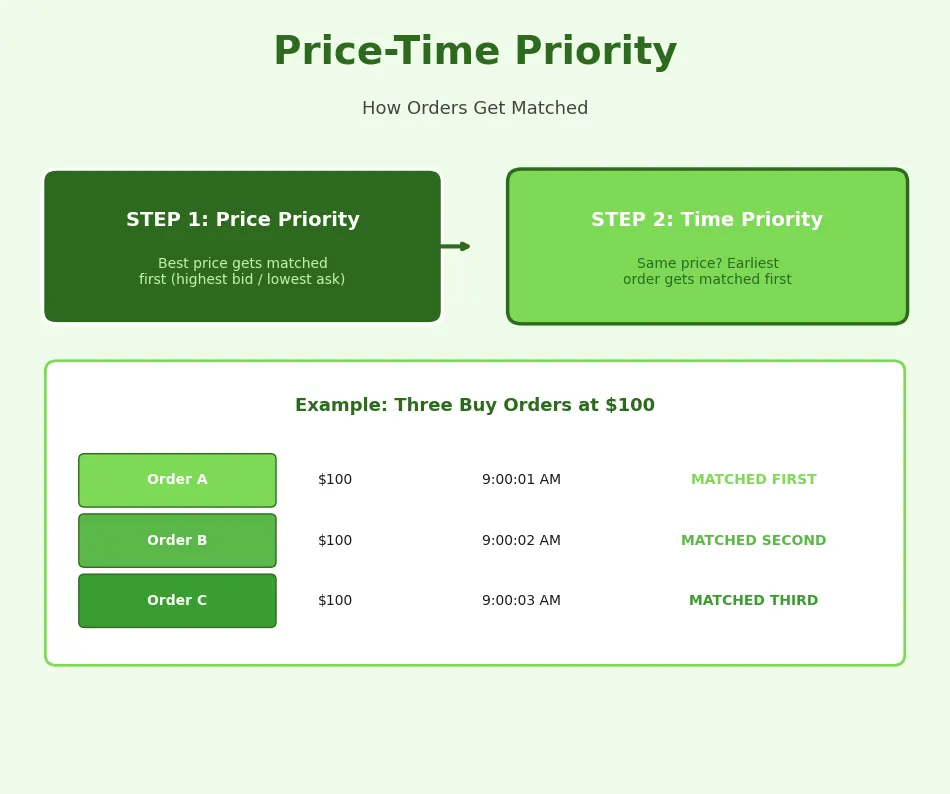
Price-time priority in crypto exchange is the fundamental rule that governs how orders are matched on a trading platform. It works on a simple, transparent principle: the order offering the best price gets matched first. If multiple orders exist at the same price, the order that arrived first in the queue gets matched before later arrivals. This two-tier prioritization creates an objective, measurable system that every participant can understand and rely on.
Think of it like a line at a ticket counter where your position is determined by two factors. The first factor is how much you are willing to pay (or accept). If you offer a higher price to buy, you move to the front of the buyer’s line. The second factor is when you joined the line. Among everyone willing to pay the same price, the person who arrived earliest gets served first. The price-time priority algorithm applies this intuitive logic to every order across every trading pair on the exchange, processing millions of decisions per second.
This matching rule is so fundamental that it underpins virtually every major centralized crypto exchange matching system operating globally in 2026. It is the same principle used by traditional stock exchanges, commodities markets, and derivatives platforms. Its adoption across crypto reflects the maturation of digital asset markets and the demand for institutional-grade trading infrastructure that professional participants expect.
Why Price-Time Priority Matters for Fair Order Matching
A fair order matching system must answer one fundamental question: when two traders both want to trade, who gets to trade first? Without a clear, transparent answer, markets become unpredictable and vulnerable to manipulation. Price-time priority provides that answer in a way that benefits the entire market ecosystem.
By prioritizing price, the system encourages traders to offer competitive prices. Buyers who bid higher get filled first, pushing prices closer to fair value. Sellers who ask lower get filled first, improving availability. This price competition naturally creates tight bid-ask spreads, which benefit every participant through reduced trading costs. By adding time as the secondary priority, the system rewards commitment. Traders who commit to a price earlier, adding visible liquidity to the crypto exchange order book, receive priority over those who arrive later.
Role of Price-Time Priority in Modern Trading Platforms
In modern trading platforms, price-time priority serves as more than just a matching rule. It is the foundation on which market microstructure, trading strategy, and platform design are built. Market makers calibrate their quoting strategies around price-time priority, knowing that their willingness to offer the best price determines their fill rates. Institutional traders design their execution algorithms to optimize their position in the time queue. And exchange operators design their crypto trading engine to enforce these rules with absolute precision and consistency.
The role extends to market integrity. Because price-time priority creates a deterministic, auditable order of execution, regulators can verify that all participants are treated fairly. There is no discretion in the matching process, no preferential treatment, and no ambiguity. Every fill can be traced back to the specific matching rule that produced it. This transparency is essential for building crypto exchanges that meet institutional and regulatory standards across global financial markets.
Understanding the Crypto Exchange Matching Engine
What Is a Crypto Exchange Matching Engine?
A crypto exchange matching engine is the core software system responsible for receiving orders, maintaining the order book, applying matching rules, executing trades, and broadcasting results to all connected systems. It is the single most critical component of any trading platform, and its performance, reliability, and correctness determine the quality of the entire trading experience. Every other system on the exchange (wallet, API, risk engine, compliance) depends on the matching engine functioning flawlessly.
The matching engine operates as a highly optimized, single-threaded processing loop that guarantees deterministic execution. Every order enters a queue, is processed in strict sequence, and produces the same result regardless of how many times the sequence is replayed. This determinism is essential for auditability, disaster recovery, and regulatory compliance. For a deeper technical exploration of matching engine internals, the crypto exchange matching engine guide covers the engineering details comprehensively.
How the Crypto Exchange Matching Engine Processes Orders
Order Validation Process
Before an order enters the matching engine, it passes through a validation layer that verifies account authentication, checks available balance or margin, validates order parameters (price, quantity, order type), and applies pre-trade risk controls (position limits, rate limits, price collars). Only orders that pass all validation checks are forwarded to the matching engine’s processing queue. This validation layer protects both the trader and the exchange from erroneous or malicious orders.
Order Queue Management
The order queue is the gateway to the matching engine. Orders enter the queue in strict arrival order, each assigned a unique sequence number that determines their position in the time-priority hierarchy. The queue must handle extremely high throughput (potentially millions of messages per second) while maintaining strict ordering guarantees. Any reordering, duplication, or loss of messages would violate the integrity of the price-time priority algorithm and compromise market fairness.
Trade Execution Logic
The trade matching logic at the core of the engine takes each incoming order and attempts to match it against existing orders on the opposite side of the crypto exchange order book. A buy order is matched against the lowest-priced sell orders (asks), and a sell order is matched against the highest-priced buy orders (bids). If the incoming order’s price meets or exceeds the best opposing price, a trade is executed at the resting order’s price. If the incoming order is larger than the resting order, the engine fills the resting order completely and moves to the next order in the queue, continuing until the incoming order is fully filled or no more matching orders exist.
Centralized Crypto Exchange Matching vs Other Models
Matching Model Comparison
| Feature | Centralized (Price-Time) | AMM (Liquidity Pool) | Hybrid (Off-chain + On-chain) |
|---|---|---|---|
| Matching Speed | Sub-millisecond | Block time (seconds) | Sub-millisecond match, on-chain settle |
| Price Discovery | Order book driven | Algorithmic (bonding curve) | Order book driven |
| Fairness Model | Price-time priority | First-come-first-served (tx ordering) | Price-time with on-chain audit |
| Throughput | Millions of orders/second | Limited by block capacity | High matching, moderate settlement |
| Custody | Custodial (exchange-held) | Self-custodial | Variable |
| Best For | Professional, institutional trading | Permissionless, long-tail assets | Performance + transparency |
Centralized crypto exchange matching remains the dominant model for professional trading because it offers the performance, determinism, and fairness guarantees that institutional participants require. AMM models serve different use cases, primarily permissionless access and long-tail asset trading. Understanding these trade-offs is critical for anyone evaluating crypto exchange platform architecture.
How the Order Matching Algorithm Works
What Is an Order Matching Algorithm?
An order matching algorithm is the precise set of rules and logic that a crypto trading engine uses to determine how incoming orders are paired with existing orders to produce trades. The algorithm defines the priority hierarchy (which orders get matched first), the price formation rules (at what price does the trade execute), and the handling of partial fills (what happens when an incoming order is larger or smaller than the matching resting order). The order matching algorithm is the beating heart of every fair order matching system.
Step-by-Step Order Matching Algorithm Process
Matching Best Bid and Best Ask
The first step in every matching cycle is comparing the best bid (highest buy price) with the best ask (lowest sell price). If the best bid is equal to or greater than the best ask, a trade can occur. The trade executes at the resting order’s price (the order that was already in the book), which is the standard convention that rewards liquidity providers. If the best bid is lower than the best ask, no trade is possible, and the incoming order either rests in the book (limit order) or is cancelled (fill-or-kill).
Applying Price-Time Priority Rules
When multiple resting orders exist at the same price level, the price-time priority algorithm selects the order with the earliest timestamp for matching. This time-based tiebreaker is what gives the algorithm its name and its fairness properties. The logic is straightforward: iterate through orders at the best price level in time order, filling each one before moving to the next. Only after all orders at the best price are exhausted does the engine move to the next price level. This strict prioritization ensures deterministic, predictable execution in the order execution mechanism.
Executing Partial and Full Order Matches
Partial fills occur when the incoming order’s size is different from the resting order’s size. If a buy order for 10 BTC matches against a sell order for 3 BTC, the sell order is fully filled, and the buy order becomes a partially filled order with 7 BTC remaining. The engine then moves to the next resting order at that price level (or the next price level if no more exist) and continues matching. Full fills occur when the incoming and resting orders are the same size, resulting in both orders being completely executed and removed from the book.
Order Matching Lifecycle
| Step | Action | Component | Outcome |
|---|---|---|---|
| 1. Receive | Order arrives via API or UI | API Gateway | Order enters processing pipeline |
| 2. Validate | Check balance, parameters, risk limits | Risk Engine | Order accepted or rejected |
| 3. Queue | Assign sequence number, enter queue | Message Queue | Deterministic ordering established |
| 4. Match | Apply price-time priority rules | Matching Engine | Trade(s) generated or order rests in book |
| 5. Execute | Update balances, generate fill reports | Settlement Engine | Balances updated atomically |
| 6. Broadcast | Send trade confirmations and market data | Market Data Feed | All participants see updated state |
Price-Time Priority Algorithm vs Other Matching Algorithms
Matching Algorithm Comparison
| Algorithm | Priority Rule | Advantages | Disadvantages |
|---|---|---|---|
| Price-Time Priority | Best price first, earliest time second | Fair, transparent, rewards liquidity | Speed advantage for faster participants |
| Pro-Rata | Best price first, proportional by size | Reduces speed arms race | Encourages large resting orders |
| Price-Size-Time | Best price, then largest size, then time | Rewards meaningful liquidity | Can disadvantage small traders |
| Batch Auction | Collects orders, executes at clearing price | Eliminates speed advantage entirely | No continuous trading, latency |
Principle: The choice of order matching algorithm is one of the most consequential decisions in exchange design. Price-time priority remains the dominant standard because it balances fairness, simplicity, and market efficiency in a way that no alternative has been able to surpass for continuous trading markets.
Fair Order Matching System in Crypto Exchanges
How Price-Time Priority Ensures Fair Order Matching
A fair order matching system requires three properties: transparency (everyone knows the rules), consistency (the rules are applied identically to every order), and auditability (every match can be verified against the rules). Price-time priority delivers all three. The rules are simple and publicly documented. The matching engine applies them deterministically to every order without exception. And the complete sequence of events can be replayed and verified by auditors, regulators, and the exchange itself.
Fairness also means that the system does not favor any particular participant or class of participant. A retail trader’s limit order at $100 has exactly the same priority as an institutional trader’s limit order at $100 if it arrived at the same time. The only factors that determine priority are price and time, both of which are objective, measurable, and available to all participants. This level playing field is what makes price-time priority in crypto exchange the trusted standard for professional trading.
Impact on Market Liquidity and Transparency
Price-time priority directly improves market liquidity by incentivizing competitive pricing. Market makers who post the tightest spreads get filled first, which encourages them to provide the best possible prices. This competition among liquidity providers narrows spreads, reduces trading costs for everyone, and creates a more efficient market. The visible crypto exchange order book, which displays all resting orders at each price level, provides transparency that allows all participants to make informed trading decisions. For deeper insights into order book mechanics, the crypto exchange order book covers the subject comprehensively.
Real-Time Order Execution in Crypto Trading Engine
Real-time execution in a crypto trading engine means that the time between a trader submitting an order and receiving a fill confirmation is measured in microseconds, not milliseconds. Achieving this level of performance requires the matching engine to process each order in a tight, optimized loop with minimal memory allocation, no disk I/O, and no blocking operations. The trade matching logic must be implemented in low-level, high-performance code (typically C++ or Rust) that minimizes computational overhead per order.
The entire order execution mechanism, from API receipt through validation, queuing, matching, settlement, and broadcast, must be engineered as a cohesive pipeline where each stage adds minimal latency. Even small inefficiencies compound at scale: adding 10 microseconds per order at 1 million orders per second adds 10 seconds of accumulated delay. This relentless focus on performance is what separates production-grade matching engines from prototypes.
Technical Architecture Behind Trade Matching Logic
Integration of Order Book and Matching Engine
The crypto exchange order book and the matching engine are so tightly integrated that they are often implemented as a single, unified system. The order book is a specialized data structure (typically a sorted map of price levels, where each level contains a time-ordered queue of orders) that the matching engine reads from and writes to during every processing cycle. The integration must be zero-copy (no unnecessary data duplication) and lock-free (no thread synchronization overhead) to achieve maximum throughput.
For platforms offering multiple asset classes, understanding the variety of order types and execution models is essential. The crypto exchange trade types guide covers the full range of order types that the matching engine must support.
Performance and Latency in Crypto Exchange Matching Engine
Performance optimization in a crypto exchange matching engine happens at every level of the stack. At the network level, kernel-bypass technologies (DPDK, RDMA) eliminate operating system overhead for packet processing. At the application level, in-memory data structures with cache-friendly layouts minimize memory access latency. At the algorithm level, optimized search and insertion operations on the order book minimize the computational cost per order. The cumulative effect of these optimizations is the difference between a matching engine that processes 10,000 orders per second and one that processes 10 million.
Scalability of Order Matching Algorithm
Scalability in the order matching algorithm context means maintaining consistent latency as the number of trading pairs, active orders, and order flow rates increase. The most common approach is to run separate matching engine instances per trading pair (or group of pairs), allowing horizontal scaling as new pairs are added. Each instance maintains its own order book and processes orders independently, with a shared infrastructure layer for risk management and account balances. For teams evaluating partners to build these systems, working with experienced cryptocurrency exchange engineering specialists ensures the architecture supports long-term growth.
Matching Algorithm Selection Criteria
Selecting the right matching algorithm depends on your exchange’s target market, user base, and product strategy. Here is a framework for evaluating the decision.
Algorithm Selection Framework
| Criteria | Choose Price-Time | Choose Pro-Rata | Choose Batch Auction |
|---|---|---|---|
| Target Users | Professional, institutional | Derivatives markets | Fairness-first platforms |
| Speed Importance | High (continuous market) | Moderate | Low (eliminates speed race) |
| Liquidity Need | Tight spreads, deep books | Large resting orders | Periodic clearing |
| Complexity | Standard implementation | More complex fill logic | Requires auction design |
Challenges in Implementing Price-Time Priority Algorithm
Handling High Trading Volume
The primary engineering challenge in implementing the price-time priority algorithm is maintaining consistent performance under extreme load. During major market events, order flow can spike to 10-50x normal levels within seconds. The matching engine must absorb this spike without degrading latency, dropping orders, or producing incorrect matches. This requires extensive capacity planning, stress testing under realistic scenarios, and architectural patterns that gracefully handle overload conditions.
Preventing Order Manipulation
While price-time priority creates a fair baseline, sophisticated traders may attempt to game the system through spoofing (placing orders they intend to cancel to mislead others), layering (building false depth on one side of the book), quote stuffing (flooding the engine with orders to slow competitors), or front-running (using latency advantages to trade ahead of detected large orders). The fair order matching system must incorporate surveillance and prevention mechanisms that detect and penalize these behaviors without impeding legitimate trading.
Maintaining Deterministic Trade Execution
Deterministic execution means that replaying the same sequence of orders always produces the same sequence of trades. This property is essential for auditability, regulatory compliance, and disaster recovery. Maintaining determinism requires eliminating all sources of non-determinism: no floating-point arithmetic in price calculations (use fixed-point or integer math), no reliance on wall-clock time for ordering decisions (use sequence numbers), and no concurrent access to shared state without strict ordering guarantees. Achieving determinism while maintaining high throughput is one of the hardest engineering challenges in building a crypto trading engine.
Future of Crypto Exchange Matching Systems
AI-Based Matching Optimization
AI and machine learning are beginning to enhance crypto exchange matching engine operations, not by changing the matching rules themselves but by optimizing the surrounding systems. AI models predict volume spikes and pre-scale infrastructure. Machine learning optimizes order routing across multiple matching engine instances. Anomaly detection identifies manipulation patterns that static rules miss. These AI enhancements improve the performance and integrity of the trade matching logic without compromising the deterministic guarantees of the price-time priority algorithm.
Advanced Crypto Exchange Matching Engine Innovations
Innovation in matching engine technology is accelerating. FPGA (Field Programmable Gate Array) based matching provides hardware-level speed that software alone cannot achieve. Multi-asset matching engines that handle spot, futures, options, and structured products within a single engine are becoming standard. And advanced order types (iceberg, TWAP, conditional, bracket) require increasingly sophisticated trade matching logic that extends the basic price-time priority framework with additional execution intelligence.
Launch Your Crypto Exchange with a Powerful Price-Time Priority Matching Engine
We build high-speed crypto exchanges with advanced price-time priority matching for fair and seamless trade execution.
Launch Your Exchange Now
Evolution of Fair Order Matching Mechanisms
The evolution of the fair order matching system in crypto is trending toward greater transparency, more sophisticated fairness mechanisms, and hybrid architectures. Verifiable matching (where the matching engine produces cryptographic proofs that the price-time priority algorithm was followed correctly) is emerging as a way to combine centralized performance with decentralized trust. Speed bumps (intentional delays that neutralize latency advantages) are being explored as a way to make price-time priority even fairer for participants without colocation advantages.
The most significant evolution may be the convergence of centralized and decentralized models. Hybrid exchanges that match orders off-chain (using centralized crypto exchange matching for speed) and settle on-chain (for transparency and self-custody) are increasingly viable as blockchain scalability improves. These hybrid architectures preserve the price-time priority in crypto exchange model that professional traders depend on while adding the transparency that the crypto-native community values.
Frequently Asked Questions
Q1.What is price-time priority in a crypto exchange?
Price-time priority in crypto exchange is the standard order matching rule that determines which orders get filled first. Orders at the best price (highest bid or lowest ask) are matched before orders at worse prices. When multiple orders exist at the same price level, the order that was submitted earliest gets priority. This two-tier system ensures that traders who offer the best prices and act fastest receive the most favorable execution.
Q2.How does a crypto exchange matching engine work?
A crypto exchange matching engine receives incoming buy and sell orders, validates them against account balances and risk parameters, and then matches compatible orders based on predefined rules. The engine maintains the order book, applies the price-time priority algorithm to determine matching sequence, executes trades, updates balances, and broadcasts trade confirmations. High-performance engines process millions of orders per second with sub-millisecond latency.
Q3.What is an order matching algorithm?
An order matching algorithm is the set of rules that determines how buy and sell orders are paired to execute trades. The most common algorithm is price-time priority, which prioritizes orders by best price first and earliest submission time second. Other algorithms include pro-rata matching (distributes fills proportionally among orders at the same price) and volume-weighted matching. The choice of order matching algorithm directly affects market fairness and liquidity.
Q4.Why is price-time priority considered fair?
Price-time priority is considered fair because it rewards two behaviors that benefit the entire market: offering the best price and committing to that price first. Traders who provide the most competitive prices get filled before others, which encourages tight spreads. Among traders at the same price, those who placed their orders earliest get priority, which rewards commitment and transparency. This system creates a level playing field based on objective, measurable criteria.
Q5.What is the difference between price-time priority and pro-rata matching?
Price-time priority fills orders sequentially based on price and submission time, meaning the first order at the best price gets completely filled before the next order. Pro-rata matching distributes fills proportionally among all orders at the same price based on their size. Price-time priority rewards speed and early commitment, while pro-rata rewards size and discourages order splitting. Most crypto exchanges use price-time priority for spot and derivatives trading.
Q6.How does the order book relate to the matching engine?
The order book is the data structure that stores all open buy and sell orders organized by price level, while the matching engine is the processing system that reads the order book, applies matching rules, and executes trades. The order book provides the input data, and the matching engine provides the execution logic. They work as an integrated system where the matching engine continuously updates the order book as orders are placed, matched, modified, or cancelled.
Explore Services
Related Services
Reviewed by

Aman Vaths
Founder of Nadcab Labs
Aman Vaths is the Founder & CTO of Nadcab Labs, a global digital engineering company delivering enterprise-grade solutions across AI, Web3, Blockchain, Big Data, Cloud, Cybersecurity, and Modern Application Development. With deep technical leadership and product innovation experience, Aman has positioned Nadcab Labs as one of the most advanced engineering companies driving the next era of intelligent, secure, and scalable software systems. Under his leadership, Nadcab Labs has built 2,000+ global projects across sectors including fintech, banking, healthcare, real estate, logistics, gaming, manufacturing, and next-generation DePIN networks. Aman’s strength lies in architecting high-performance systems, end-to-end platform engineering, and designing enterprise solutions that operate at global scale.