Ai Overview
India’s ERP software market is projected to exceed $1. 6 billion in 2025, driven by manufacturing companies, SMEs, and enterprises upgrading from disconnected tools to integrated platforms. This guide covers the top 10 ERP software companies in India in 2026, with factual details on what each platform does well, who it is suited for, and what to consider before selecting one. It is not cost-effective for small or mid-size businesses.
India’s ERP software market is projected to exceed $1.6 billion in 2025, driven by manufacturing companies, SMEs, and enterprises upgrading from disconnected tools to integrated platforms. With GST e-invoicing now mandatory for businesses above INR 5 crore turnover and digital transformation accelerating across sectors, choosing the right ERP company has become one of the most important operational decisions a business can make.
This guide covers the top 10 ERP software companies in India in 2026, with factual details on what each platform does well, who it is suited for, and what to consider before selecting one.
Key Takeaways
- Market Size: India’s ERP software market is projected to exceed $1.6 billion in 2025, with manufacturing and SME adoption driving the majority of growth.
- GST Compliance Is Non-Negotiable: From April 2025, GST e-invoicing applies to businesses above INR 5 crore turnover. Any ERP selected must generate IRN, QR codes, and e-way bills natively.
- Cloud ERP Is the Standard: Most new ERP deployments in India are cloud-based, offering lower upfront costs, remote access, and automatic updates without on-premises infrastructure.
- Custom ERP for Unique Needs: Businesses with non-standard workflows — such as complex manufacturing processes or multi-entity structures — benefit most from custom-built ERP solutions.
- Open-Source Option Exists: ERPNext is a widely used open-source ERP in India that eliminates licensing costs while offering full manufacturing, accounting, and CRM modules.
- Implementation Timeline: A typical ERP implementation in India takes 2 to 6 months depending on scope, number of modules, and level of customization required.
- SME Cost Range: SaaS ERP subscriptions in India start from approximately INR 2,000 per month. Full implementation projects for SMEs typically cost between INR 6 lakh and INR 30 lakh.
- Manufacturing Needs Specific Modules: Manufacturing ERP must include Bill of Materials (BOM), Material Requirements Planning (MRP), production scheduling, shop floor tracking, and quality control.
- Phased Implementation Reduces Risk: Starting with core modules such as accounting, inventory, and HR before adding advanced modules is the most cost-effective approach for SMEs.
Why Indian Businesses Need ERP Software in 2026
India has over 6.3 crore registered MSMEs, and the majority still rely on a combination of Tally, Excel, and manual records for operations. As GST e-invoicing requirements expand, OEMs demand digital traceability, and competition increases, this approach breaks down. ERP software connects finance, inventory, production, HR, and compliance into one system so every department works from the same data.
To understand what enterprise resource planning software is and how it works as a unified system, the full explanation of what is Enterprise Resource Planning covers the definition, core modules, deployment types, and business benefits in detail. This context helps in evaluating which platform actually fits a given business before committing to an implementation.[1]
Top 10 ERP Companies in India: Quick Comparison
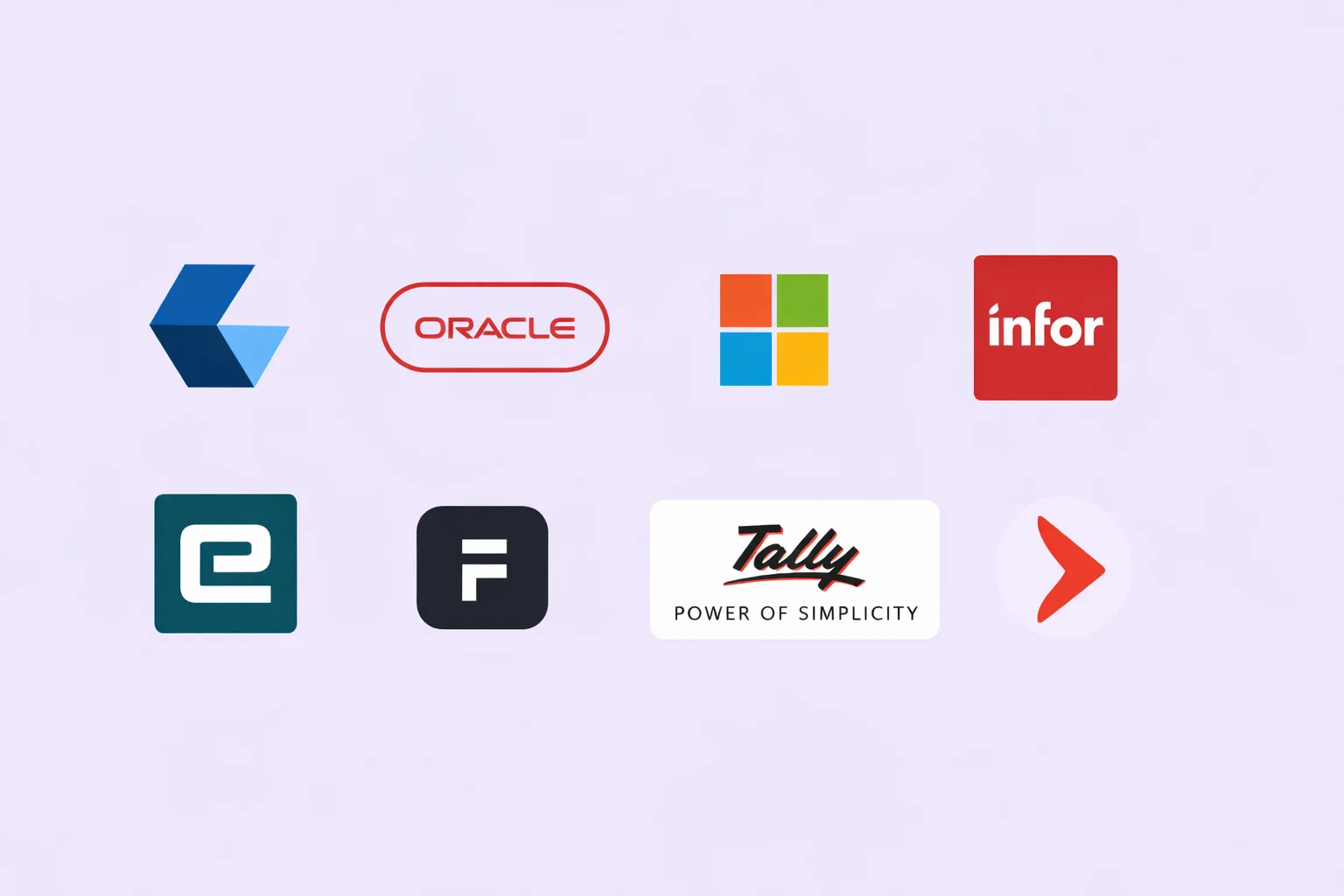
| # | Company | Best For | Deployment |
|---|---|---|---|
| 1 | Nadcab Labs | Custom ERP for unique workflows | Cloud / On-premises |
| 2 | Oracle India | Large enterprises, finance-heavy operations | Cloud |
| 3 | Microsoft Dynamics 365 | Mid to large businesses, Microsoft ecosystem | Cloud / Hybrid |
| 4 | Infor ERP | Industry-specific manufacturing | Cloud |
| 5 | Epicor ERP | Manufacturers, distributors | Cloud / On-premises |
| 6 | ERPNext | SMEs, open-source preference | Cloud / Self-hosted |
| 7 | Marg ERP | Pharma, distribution, trading SMEs | Desktop / Cloud |
| 8 | Focus Softnet | SMEs in trade, retail, and services | Cloud / On-premises |
| 9 | Tally Solutions Pvt Ltd | Accounting-focused SMEs | Desktop / Cloud |
| 10 | Matiyas Solutions | Indian SMEs and manufacturers | Cloud |
1. Nadcab Labs
Nadcab Labs is a technology development company based in India that builds custom ERP software tailored to specific business requirements. Unlike off-the-shelf ERP products, Nadcab Labs designs and develops ERP systems from the ground up based on a client’s actual workflows, modules needed, and integration requirements. This makes it particularly suitable for businesses with non-standard processes that generic ERP platforms cannot accommodate without heavy modification.
As a full-service ERP software development company, Nadcab Labs covers the complete scope of ERP delivery: requirement analysis, architecture design, module development, data migration, testing, deployment, and post-launch support. Custom ERP development is the right choice when a business has unique manufacturing workflows, complex multi-entity structures, or specific compliance requirements that pre-built systems cannot handle without extensive workarounds.
- Type: Custom ERP development
- Best for: Businesses needing fully tailored ERP with specific modules
- Deployment: Cloud or on-premises based on client requirement
- Key strength: Full ownership of the codebase, no vendor lock-in
2. Oracle India
Oracle offers its cloud ERP platform, Oracle Fusion Cloud ERP, to large enterprises in India through its local operations. Oracle’s ERP is one of the most comprehensive financial and operational management platforms available, covering general ledger, accounts payable and receivable, fixed assets, project management, procurement, and supply chain in a fully integrated cloud system.
Oracle’s platform is best suited for large Indian enterprises with complex financial structures, multi-currency requirements, or operations across multiple countries. It includes AI-powered automation for financial close, intelligent cash management, and predictive analytics built directly into the platform. Implementation is complex and typically requires specialized Oracle implementation partners. It is not cost-effective for small or mid-size businesses.[2]
- Type: Cloud ERP for enterprises
- Best for: Large enterprises with complex finance and supply chain needs
- Deployment: Cloud only
- Key strength: Comprehensive financial management, AI-powered automation
3. Microsoft Dynamics 365
Microsoft Dynamics 365 is a cloud-based ERP and CRM platform that integrates tightly with the wider Microsoft ecosystem including Teams, Office 365, Power BI, and Azure. In India, it is widely used by mid-size to large businesses that already operate on Microsoft infrastructure and want to extend that into ERP functionality without switching to a completely separate vendor environment.
Dynamics 365 offers separate apps for Finance, Supply Chain Management, Sales, Customer Service, and HR that can be deployed individually or together. Its Power BI integration provides strong real-time reporting without additional tools. The platform supports hybrid deployment, which is useful for Indian businesses that are not fully ready to move all operations to the cloud. Implementation typically takes 4 to 9 months depending on scope.[3]
- Type: Cloud and hybrid ERP
- Best for: Mid-to-large businesses using Microsoft tools
- Deployment: Cloud and hybrid
- Key strength: Deep Microsoft ecosystem integration, strong reporting
4. Infor ERP
Infor CloudSuite is an industry-specific ERP platform that offers vertical editions for discrete manufacturing, wholesale distribution, healthcare, and retail. For Indian manufacturing companies, Infor’s manufacturing ERP includes production scheduling, supply chain management, back-office process automation, predictive analytics, and role-based dashboards. Its strength is that it comes pre-configured for specific industries rather than requiring extensive customization to fit industry workflows.
Infor’s limitation is cost and UI complexity. It is typically used by larger manufacturing organizations rather than SMEs, and its interface requires more training than some Indian-built alternatives. Implementation timelines are generally longer than cloud-native competitors.
- Type: Industry-specific cloud ERP
- Best for: Large manufacturing and distribution businesses
- Deployment: Cloud
- Key strength: Industry-specific pre-configuration, predictive analytics
5. Talentelgia Technologies
Talentelgia Technologies, an India-based technology development company that provides businesses with custom software, AI, mobile apps, and enterprise development solutions in the USA, UAE & worldwide. Rather than generic one-size-fits-all solutions, the company specialises in creating bespoke, scalable digital products based on specific business needs. This is why Talentelgia is mainly the right choice for startups, enterprises, and growing businesses that need flexible architectures with intelligent automation processes and custom workflows as per operations.
With the entire end-to-end development lifecycle under one roof, Talentelgia boasts a full-service technology company encompassing business analysis, UI/UX design, software architecture, application development, cloud deployment, API integration, testing & maintenance, and long-term technical support. The company is focused on modern technologies, i.e., AI-based applications, SaaS platforms, cloud systems, e‑enterprise mobility, and automation solutions.
- Industry: Custom software and AI development company
- Ideal for: Businesses looking for scalable web, mobile, AI, or SaaS solutions
- Deployment: On-cloud, hybrid / on-premises as per business needs
- Best Feature: Tailored development strategy with modular architecture & new AI integration features
6. Epicor ERP
Epicor is a highly configurable ERP solution designed specifically for manufacturers, distributors, and supply chains. It covers production planning, BOM management, quality control, inventory tracking, and delivery scheduling. Its manufacturing focus is deeper than many general-purpose ERP platforms, making it a strong choice for Indian companies in discrete manufacturing, process manufacturing, or distribution where production visibility is the primary requirement.
Epicor supports both cloud and on-premises deployment, which gives Indian manufacturers the choice of keeping data on their own infrastructure if required. Local and global compliance support is included, and the platform provides real-time operational visibility from shop floor to management dashboard.[4]
- Type: Manufacturing ERP
- Best for: Discrete and process manufacturers, distributors
- Deployment: Cloud and on-premises
- Key strength: Deep manufacturing modules, real-time production visibility
7. ERPNext
ERPNext is an open-source ERP solution developed by Frappe Technologies, and it is one of the most widely used ERP platforms among Indian SMEs and startups. Being open-source means there are no licensing costs. Businesses pay only for hosting, implementation, and support. The platform covers accounting, inventory, manufacturing, CRM, HR, and project management in a single unified system.
ERPNext is particularly suitable for growing businesses that need a modern, adaptable, and cost-effective ERP system. Its GST compliance modules are well-maintained for the Indian market. The platform is cloud-based by default but can also be self-hosted. The main limitation is that ERPNext implementation requires technical knowledge, which means most Indian SMEs use an ERPNext implementation partner rather than deploying it independently.
- Type: Open-source cloud ERP
- Best for: Indian SMEs and startups seeking affordable, customizable ERP
- Deployment: Cloud or self-hosted
- Key strength: No licensing cost, full module coverage, GST compliance
8. Marg ERP
Marg ERP is an Indian ERP and accounting software company with strong penetration in the pharmaceutical, distribution, and retail trading sectors. It is one of the most widely used ERP solutions among Indian SMEs for managing inventory, GST billing, distributor management, and financial reporting. Marg ERP is known for being affordable and easy to use, with a focus on Indian compliance requirements including GST and e-invoicing.[5]
The platform is primarily desktop-based, though cloud versions are available. It is not a full-scale manufacturing ERP and is better suited for businesses whose primary need is inventory management, GST billing, and basic financial reporting rather than complex production planning or multi-entity management.
- Type: Accounting and inventory ERP for SMEs
- Best for: Pharma distributors, trading businesses, retail SMEs
- Deployment: Desktop primary, cloud available
- Key strength: GST compliance, pharma distribution workflows, affordability
9. Tally Solutions Pvt Ltd
Tally Solutions is one of the most recognized names in India’s business software market. TallyPrime is the current product, used by millions of small and medium-sized businesses across India for accounting, GST filing, invoicing, payroll, and financial reporting. Its user-friendly interface and strong compliance capabilities have made it the default choice for Indian SMEs that primarily need accounting-focused business software.
Tally is not a full-scale ERP in the traditional sense. It excels at financial management and compliance but lacks deep manufacturing modules such as BOM management, production planning, and shop floor tracking. Businesses whose primary need is accounting, GST compliance, and basic inventory management will find Tally sufficient. Manufacturers needing full production control will need a different platform.
- Type: Accounting and compliance software
- Best for: SMEs focused on accounting, GST, and basic inventory
- Deployment: Desktop and cloud
- Key strength: Widest adoption in India, strong GST compliance, ease of use
10. Matiyas Solutions
Matiyas Solutions is an ERP company in India that specializes in manufacturing ERP solutions for Indian SMEs and manufacturers. The company delivers tailored ERP systems built on ERPNext and provides implementation, customization, training, and ongoing support. Matiyas focuses specifically on the manufacturing sector, which means their implementations are pre-configured with workflows relevant to Indian factory operations rather than requiring generic ERP to be customized from scratch.[6]
As an ERPNext implementation partner, Matiyas provides the technical implementation expertise that most SMEs cannot handle independently. Their focus on the Indian manufacturing context means compliance, local tax rules, and industry-specific workflows are addressed during implementation rather than left to the client to configure.
- Type: ERPNext implementation partner and manufacturing ERP specialist
- Best for: Indian SMEs and manufacturers using ERPNext
- Deployment: Cloud
- Key strength: Manufacturing focus, Indian compliance, ERPNext expertise
How to Choose the Right ERP Software in India
The right ERP depends on business size, industry, and the specific problems being solved. Here is a practical framework for narrowing down options.
Define Your Primary Use Case First
If the primary need is accounting and GST compliance, Tally Solutions or Marg ERP will serve most Indian SMEs without requiring a full ERP implementation. If the need is production planning, BOM management, and shop floor visibility, a manufacturing ERP such as Epicor, Infor, or a custom solution is necessary. Matching the tool to the actual need prevents paying for modules that will never be used.
Check GST and E-Invoicing Compliance
From April 2025, businesses above INR 5 crore turnover must generate e-invoices with IRN codes and e-way bills through the GST portal. The ERP must support this natively. Relying on third-party bolt-ons for compliance is a significant operational risk. Confirm directly with the vendor that these features are built into the core platform and are maintained as GST rules change.[7]
Evaluate Total Cost of Ownership
The listed software price is rarely the full cost. A complete ERP implementation includes software licensing or subscription, customization and development, data migration from existing systems, user training, and ongoing support. For SMEs, full implementation projects typically cost between INR 6 lakh and INR 30 lakh. Understanding the complete cost upfront prevents budget surprises midway through implementation.
Consider Whether Cloud ERP Fits Your Operations
Cloud-based ERP requires no on-premises hardware investment and provides access from any location. This suits most Indian SMEs and growing businesses. On-premises deployment is still relevant for larger manufacturers with strict data security requirements or businesses in locations with unreliable internet connectivity. Most major ERP vendors in India now offer cloud-first options, but confirm data hosting location and uptime guarantees before signing contracts.
Need a Custom ERP Built for Your Business?
Nadcab Labs develops custom ERP software tailored to your industry workflows, compliance requirements, and integration needs — covering finance, inventory, HR, manufacturing, and procurement modules built specifically for how your business operates.
Frequently Asked Questions
Q1.Which ERP software is best for India?
There is no single best ERP for India. The right choice depends on business size and industry. TallyPrime and Marg ERP suit SMEs focused on accounting and GST. ERPNext is best for SMEs needing affordable full-featured ERP. Epicor and Infor suit manufacturers. Microsoft Dynamics 365 and Oracle suit large enterprises. Custom ERP from a development company suits businesses with unique processes.
Q2.What is the cost of ERP in India?
SaaS ERP subscriptions in India start from INR 2,000 per month for basic tools. Full ERP implementation projects for SMEs typically cost between INR 6 lakh and INR 30 lakh, including software, customization, data migration, and training. Large enterprise deployments can cost significantly more. Total cost of ownership depends on the number of modules, users, and level of customization required.
Q3.Is ERPNext free for Indian businesses?
ERPNext is open-source software, which means the source code is free to use. However, businesses still need to pay for hosting, implementation, customization, and ongoing support. Most Indian SMEs use an ERPNext implementation partner such as Matiyas Solutions to deploy and configure the system rather than managing it independently. Total costs are significantly lower than licensed ERP alternatives.
Q4.Which ERP is best for manufacturing India?
For large manufacturers, Epicor and Infor CloudSuite offer the deepest manufacturing modules including BOM, MRP, production scheduling, and quality control. For Indian SMEs in manufacturing, ERPNext with a certified implementation partner provides good manufacturing coverage at a lower cost. Businesses with highly specific manufacturing workflows benefit most from a custom-built ERP solution.
Q5.Does ERP software support GST in India?
Most ERP software sold in India includes GST compliance features. From April 2025, businesses above INR 5 crore turnover must generate GST e-invoices with IRN codes and e-way bills. The ERP must support this natively without relying on external tools. Tally, Marg, ERPNext, Microsoft Dynamics 365, and most other platforms listed in this guide include built-in GST e-invoicing support.
Explore Services
Related Services
Reviewed by

Aman Vaths
Founder of Nadcab Labs
Aman Vaths is the Founder & CTO of Nadcab Labs, a global digital engineering company delivering enterprise-grade solutions across AI, Web3, Blockchain, Big Data, Cloud, Cybersecurity, and Modern Application Development. With deep technical leadership and product innovation experience, Aman has positioned Nadcab Labs as one of the most advanced engineering companies driving the next era of intelligent, secure, and scalable software systems. Under his leadership, Nadcab Labs has built 2,000+ global projects across sectors including fintech, banking, healthcare, real estate, logistics, gaming, manufacturing, and next-generation DePIN networks. Aman’s strength lies in architecting high-performance systems, end-to-end platform engineering, and designing enterprise solutions that operate at global scale.