Ai Overview
Many finance and product teams want a virtual card program that gives staff and users controlled online spending, without pushing money out of their crypto treasury flow first. Teams need a way to fund cards from stablecoins, issue cards fast, set limits, and see exactly where money is going. This gets even harder when the business serves multiple groups at once. An exchange may need cards for internal software spend and user rewards.
Key Takeaways
- A virtual card program helps teams spend from stablecoin-funded treasury without forcing manual off-platform payment workflows.
- Separate cards for people, vendors, or budgets make overspend easier to prevent and reconciliation easier to manage.
- Nadcab Crypto Cards supports USDT and USDC funding across Ethereum, Polygon, BNB Smart Chain, Tron, and Solana.
- API-driven issuing, webhooks, API keys, and IP whitelists let developers automate card creation and controls safely.
- White-label cards make sense when the card experience is part of your product, not just an internal finance tool.
Many finance and product teams want a virtual card program that gives staff and users controlled online spending, without pushing money out of their crypto treasury flow first. The problem is usually not card demand. It is control. Teams need a way to fund cards from stablecoins, issue cards fast, set limits, and see exactly where money is going.
This gets even harder when the business serves multiple groups at once. An exchange may need cards for internal software spend and user rewards. A Web3 wallet may want branded cards inside its app. An agency may need one card per client or campaign. In each case, leaders want fewer manual transfers, clearer permissions, and better visibility than shared corporate cards usually provide.
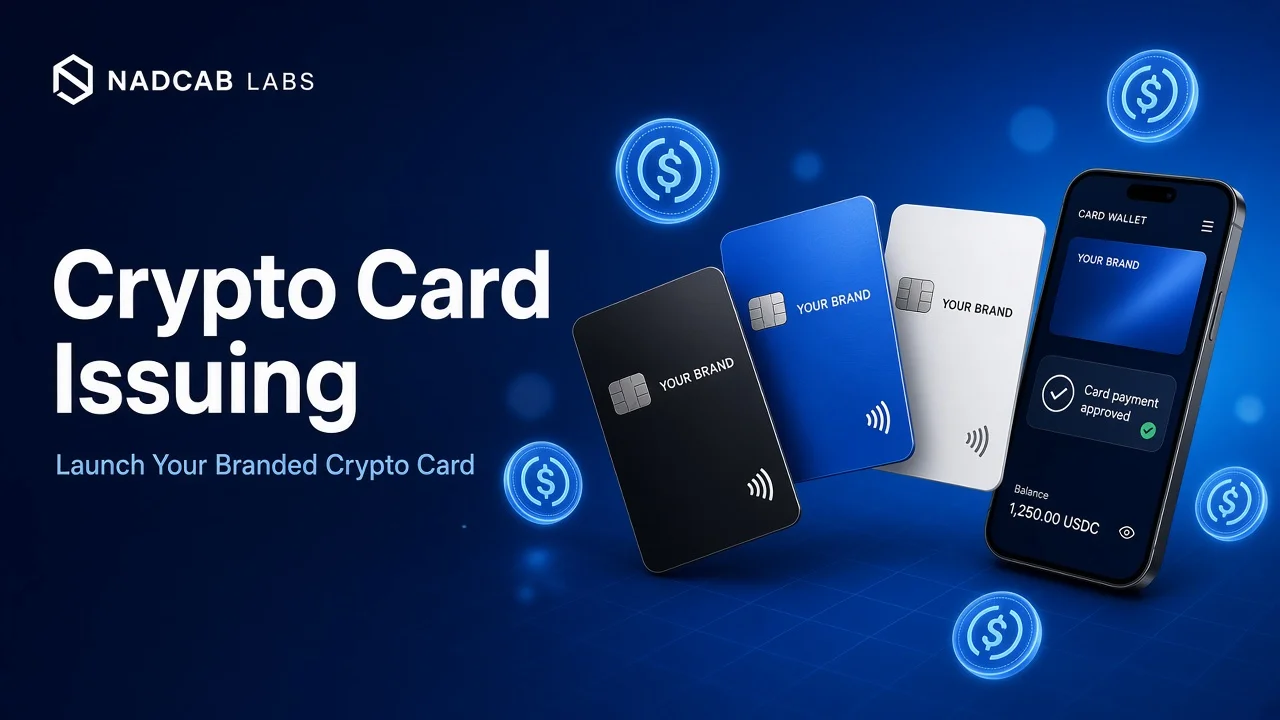
A stablecoin-funded setup solves that bridge between onchain balances and everyday card acceptance. With Nadcab Crypto Cards, businesses can issue branded virtual and physical Visa and Mastercard cards, fund them with USDT or USDC across five supported networks, and manage controls through a console or API. That makes the card layer practical for real operations, not just for a pilot demo.
Why teams need a virtual card program tied to stablecoin balances
Traditional spend workflows often break the moment a crypto-native business needs to pay for ordinary online services. Treasury may hold stablecoins, while vendors bill in local currency. Staff may need cards for ads, SaaS tools, travel, test purchases, or subscriptions. Without a structured card layer, finance teams end up reimbursing employees, moving funds manually, or sharing one card across too many people.
A virtual card program fixes that operational gap. Instead of asking users or staff to leave the crypto workflow, the business can fund cards from USDT or USDC and let spending happen where cards are accepted. Nadcab supports deposits on Ethereum, Polygon, BNB Smart Chain, Tron, and Solana, which is useful when treasury is already split across different chains. You can fund your wallet with USDT or USDC and keep the top-up process aligned with how your finance team already operates.
The main value is not just convenience. It is control at the card level. Teams can issue separate cards for departments, vendors, projects, campaigns, or individual staff members. Each card becomes a budget container with its own limits and transaction history.
This matters in a few common scenarios:
- Exchange operations: one card for compliance software, one for infrastructure tools, one for paid acquisition.
- Wallet products: one branded card experience for users without building the issuing stack from scratch.
- Fintech teams: faster launch of a controlled spend feature inside an existing app.
- Agencies: separate cards for each client account to avoid reconciliation headaches.
For a deeper look at the issuing model behind these programs, Nadcab also explains the launch path in Crypto Card Issuing: How to Launch Your Own Branded Crypto Debit Card Program.
How a stablecoin-funded virtual card program works end to end
At a practical level, the program has four moving parts: business approval, treasury funding, card issuance, and spend controls. The exact compliance flow depends on jurisdiction, but programs are KYC-based for cardholders and require approved KYB for the business.
1. Business approval comes first
Before issuing cards, the business completes KYB. If you are issuing cards to users or staff, those cardholders are verified under the program rules. This is important for founders planning timelines: card programs are not just a UI feature. They sit inside a compliance framework, and requirements vary by jurisdiction.
2. Treasury is funded with stablecoins
Once the business account is active, treasury can deposit USDT or USDC. Nadcab supports deposits on five networks, which reduces friction when internal wallets are not all on the same chain. That gives operations and finance teams a direct path from stablecoin treasury to card balances, rather than converting funds through a patchwork of manual steps.
3. Virtual cards are issued for immediate online use
Virtual cards are available as soon as they are issued, so a team can create a card and use it for online payments right away. This is especially useful for urgent vendor onboarding, one-time purchases, or replacing a compromised card without waiting for physical delivery.
4. Spend happens in local currency at the point of sale
Cardholders can spend in 44+ local currencies anywhere the cards are accepted, online and in store. That means the team can keep stablecoin-funded treasury on the backend while paying merchants in the form merchants already expect.
5. Finance controls and monitors the program
Controls such as freeze, spend limits, and full transaction history can be managed from the console or via API. This is where the program becomes operationally useful. Instead of checking statements after the fact, finance can shape how spend is allowed before it happens.
- Complete KYB for the business and prepare KYC flow for cardholders.
- Deposit USDT or USDC on Ethereum, Polygon, BNB Smart Chain, Tron, or Solana.
- Issue a virtual card for a person, team, vendor, or workflow.
- Set card limits and internal ownership rules.
- Monitor transactions and adjust controls as spending patterns emerge.
- Expand to bulk issuance or physical cards if the use case grows.
Teams that want to test the workflow first can start a free trial account and validate how issuing, funding, and controls fit into existing operations.
Best use cases for exchanges, Web3 wallets, fintech apps and agencies
Exchanges
Exchanges often manage treasury actively but still face very ordinary vendor payments. A virtual card program helps isolate software subscriptions, travel bookings, ad budgets, contractor tools, and team purchases. Instead of one operations card being shared across departments, each budget owner can receive a separate card with a defined limit.
There is also a product angle. An exchange that wants a branded card experience for users can extend the same card infrastructure outward once internal operations are proven.
Web3 wallets
Wallet teams usually care about user continuity. If a user already stores or moves stablecoins inside the app, adding a branded virtual card experience can make spending feel like a native extension rather than a disconnected banking flow. Nadcab’s White-Label card program supports your own logo, colors, card name, and a cardholder web app on your own domain.
If your product team is deciding how much wallet logic to own directly, this article on Crypto Wallet API vs RPC is a useful architectural companion.
Fintech apps
For fintech teams, the attraction is speed to market. A virtual card feature can be embedded into an app as a controlled spend product without building the full issuing and compliance stack internally. That is particularly useful when the business wants to ship branded cards and API-driven operations together.
Agencies and distributed teams
Agencies often need client-level segregation. One card per client, campaign, media buyer, or software stack makes reconciliation simpler. If a campaign ends, the card can be frozen rather than leaving a shared card exposed across old subscriptions.
| Business type | Common spend problem | How a virtual card program helps |
|---|---|---|
| Crypto exchange | Shared cards across multiple departments | Separate cards by team, vendor, or budget owner |
| Web3 wallet | No direct bridge from stablecoins to card acceptance | Branded card experience funded from USDT or USDC |
| Fintech app | Slow launch of embedded spend features | API-based issuing and controls under one program |
| Agency | Messy client reconciliation and subscription sprawl | One card per client or campaign with limits and freeze controls |
Virtual card controls that reduce overspend and improve visibility
A card program becomes far more useful when each card is treated as a policy tool, not just a payment credential. Good controls reduce accidental overspend, simplify reviews, and limit the blast radius when a card is exposed.
Freeze cards instantly
If a card is no longer needed, or if a suspicious merchant charge appears, finance or operations can freeze the card from the console or API. This is helpful for offboarding staff, ending short-term projects, or stopping repeat billing before it grows into a reconciliation issue.
Set spend limits by purpose
Not every card should carry the same budget. A finance lead might create one card with a larger recurring limit for infrastructure tools, while a campaign manager gets a lower ceiling for test spend. Limits turn budget rules into payment rules.
Use transaction history for cleaner reviews
Full transaction history supports month-end review, internal reporting, and exception handling. Instead of sorting through a mixed statement from one shared card, each card shows a narrower, more meaningful stream of activity.
Bulk issuance for structured teams
Nadcab supports bulk issuing up to 100 cards at a time. That is useful when rolling out cards to a sales team, a support operation, a network of contractors, or a set of campaign owners. Rather than creating cards one by one, operations can launch a controlled card set in one go through the platform or API.
For teams focused on accounts payable workflows, Nadcab’s article on stablecoin-funded virtual cards for AP automation shows how these controls support repeatable business payments.
Branded card issuing: when to choose white-label over generic cards
Some businesses just need internal spend controls. Others want the card itself to be part of the product experience. That is where branded issuing matters.
White-label is usually the better choice when:
- You want your own logo, colors, and card name.
- You want users to access the cardholder experience on your own domain.
- You are building a user-facing card product, not only an internal finance tool.
- You want billing for the plan handled from your wallet inside one operating flow.
Generic cards may be enough if the only goal is staff purchasing. But once the card becomes part of acquisition, retention, or brand trust, the product team usually wants a more native presentation. Nadcab handles issuing and compliance while the business controls the user-facing brand layer, which is the practical reason many teams look at white-label early.
You can review the card plans and pricing if you are comparing a simple internal rollout with a more branded launch. The starting point matters too: card issuing begins from $1 on the Custom plan, which helps teams test structure before committing to a wider rollout.
White-Label program
Your brand on the card. Your app on your domain.
Upload your logo, pick your colors and name your card, then launch a cardholder app on your own domain with two DNS records. Nadcab runs issuing and compliance while you own the customer relationship.
Custom card designYour domainMonthly or yearly plansPay from your wallet
How developers automate issuing with cards API, webhooks and access controls
For product and engineering teams, the difference between a useful card program and a fragile one is automation. Manual card creation may work for the first five users. It breaks down when cards need to be tied to app events, approvals, onboarding, or policy logic.
Nadcab provides a REST API, including endpoints such as POST /v1/cards, along with webhooks, API keys, and IP whitelists. That gives developers the building blocks to connect issuing into internal systems or customer-facing apps.
Typical automation patterns
- Create a virtual card when a verified user enables a spend feature.
- Issue cards automatically for a new department or cost center.
- Freeze a card when an account is offboarded or a policy threshold is hit.
- Listen to webhooks for transaction updates and sync them into internal reporting.
- Restrict API access with keys and IP whitelisting for tighter operational security.
Simple issuing flow example
POST /v1/cards
Authorization: Bearer API_KEY
Content-Type: application/json

{
  "type": "virtual",
  "cardholder_id": "verified_user_123",
  "label": "Marketing SaaS Budget",
  "spend_limit": {
    "amount": "500",
    "currency": "USD"
  }
}
This kind of pattern is especially powerful for product teams building exchange or wallet features. The card does not have to live outside your product workflow. It can be triggered by onboarding, approval logic, or treasury events. If you want to explore the issuing side directly, the card issuing area and API entry point is the practical place to start.
For businesses building the broader product stack around cards, Nadcab also offers services for crypto wallet development, cryptocurrency exchange development, and Web3 development services.
What to know about 3-D Secure, wallet provisioning and acceptance
Card acceptance is not only about issuing a card number. It is also about how the card behaves during checkout, how it can be added to wallets, and whether the customer experience fits modern commerce expectations.
3-D Secure on supported BINs
Some online merchants require an extra authentication step. Nadcab supports 3-D Secure on supported BINs, which can improve compatibility for certain e-commerce flows. Product and support teams should still map where strong authentication appears in the user journey so there are no surprises during rollout.
Apple Pay and Google Pay readiness
Apple Pay and Google Pay ready BINs are important when users expect mobile wallet convenience. For internal team cards, that can mean faster in-store use without distributing physical plastic immediately. For user-facing programs, it helps the card product feel current from day one.
Broad merchant acceptance and local currency spend
Users spend in 44+ local currencies anywhere cards are accepted, online and in store. From an operations perspective, that matters because treasury can remain stablecoin-funded while the user or employee sees a familiar card payment experience at checkout.
Practical rollout tip: test a small set of real merchants during your pilot, including one subscription service, one e-commerce merchant, one travel or booking flow, and one in-store wallet payment. That usually surfaces user experience issues faster than a synthetic QA checklist alone.
Because card and identity rules continue to evolve, especially around stablecoins, finance and compliance teams should track jurisdiction-specific changes. Nadcab’s article on proposed stablecoin ID rules in the US is a useful example of the direction regulators may take.
Transparent pricing
See exactly what your card program will cost
- 0% fee on card transactions
- Card issuing from $1 on the Custom plan
- Virtual cards instantly; physical cards with ATM withdrawals on KYC Growth plans and above
- Visa and Mastercard BINs with 3-D Secure on supported BINs
How to roll out from pilot to bulk card issuance for teams
The best launches usually start small. A pilot helps teams prove funding, permissions, merchant acceptance, and reporting before they scale to a wider population.
Pilot first, then expand
Start with one clearly defined use case. For example, issue cards only for software subscriptions or only for the marketing team. Keep the scope narrow enough that finance can review every transaction pattern during the first weeks.
Document ownership rules early
Decide who can request cards, who approves them, who sets limits, and who reviews exceptions. A virtual card program works best when card ownership mirrors internal budget ownership.
Move to bulk issuance once the policy is stable
After the pilot, scale with bulk card creation. This is where Nadcab’s ability to issue up to 100 cards at a time becomes useful. Teams can structure a rollout by region, function, or business unit without rebuilding the process each time.
| Pilot phase checklist | Why it matters |
|---|---|
| Choose one spend category first | Keeps review manageable and exposes issues quickly |
| Fund wallet from your preferred stablecoin network | Validates treasury operations in a real environment |
| Issue a small set of virtual cards | Tests permissions, controls, and cardholder onboarding |
| Review transaction history weekly | Improves limits and policy before wider launch |
| Expand to bulk issuance or physical cards | Scales only after the workflow is proven |
If the team later needs ATM cash withdrawals, physical cards are available on KYC Growth plans and above. That makes sense for field teams, travel-heavy roles, or mixed online-and-offline spend environments. But for many businesses, virtual cards alone already solve the biggest control and visibility problems.
Keep reading
Final Thoughts
A stablecoin-funded virtual card program gives modern teams a cleaner way to connect crypto treasury with everyday spending. Instead of moving funds out of your existing workflow and losing control in the process, you can issue cards directly against a managed program, apply limits, freeze cards when needed, and review full transaction history in one place.
For exchanges, wallets, fintech apps, and agencies, the value is practical: faster issuance, better spend separation, stronger visibility, and a clearer path from pilot to scale. Nadcab Crypto Cards fits that model well because it combines branded issuing, stablecoin funding across five networks, console controls, API automation, and white-label options under one compliant program structure. If your team wants to test the workflow before a broader launch, the free trial is a simple starting point.
Frequently Asked Questions
Q1.What is a stablecoin-funded virtual card program?
It is a card issuing setup where a business funds card activity using stablecoins such as USDT or USDC, then issues virtual cards for staff or users to spend through standard card rails. This helps teams keep treasury in their crypto workflow while still paying online merchants in local currency at checkout.
Q2.Who should use a virtual card program tied to stablecoin balances?
It is a strong fit for crypto exchanges, Web3 wallets, fintech apps, and agencies that need tighter control over online spend. Common use cases include subscriptions, ad budgets, vendor payments, user-facing card features, and project-level budgeting where one shared company card creates too much risk or poor visibility.
Q3.Can virtual cards be controlled by policy or API?
Yes. A well-designed program lets teams freeze cards, set spend limits, and review full transaction history from a console or through API calls. With developer tools such as REST endpoints, webhooks, API keys, and IP whitelists, the card workflow can be tied to onboarding, approvals, and internal reporting systems.
Q4.Do stablecoin-funded card programs support 3-D Secure and mobile wallets?
They can. Nadcab Crypto Cards supports 3-D Secure on supported BINs and offers Apple Pay and Google Pay ready BINs. That matters because some online merchants require extra authentication, while wallet readiness helps cardholders use virtual cards more easily for mobile and in-store purchases where supported.
Q5.How do I start with Nadcab Crypto Cards?
Start by creating an account at https://cc.nadcab.com/login and use the free trial to test the workflow. After KYB approval for your business and KYC for cardholders under the program rules, you can fund your wallet with USDT or USDC, issue virtual cards, set controls, and expand to branded or white-label rollout as needed.
Explore Services
Related Services
Reviewed by

Aman Vaths
Founder of Nadcab Labs
Aman Vaths is the Founder & CTO of Nadcab Labs, a global digital engineering company delivering enterprise-grade solutions across AI, Web3, Blockchain, Big Data, Cloud, Cybersecurity, and Modern Application Development. With deep technical leadership and product innovation experience, Aman has positioned Nadcab Labs as one of the most advanced engineering companies driving the next era of intelligent, secure, and scalable software systems. Under his leadership, Nadcab Labs has built 2,000+ global projects across sectors including fintech, banking, healthcare, real estate, logistics, gaming, manufacturing, and next-generation DePIN networks. Aman’s strength lies in architecting high-performance systems, end-to-end platform engineering, and designing enterprise solutions that operate at global scale.