Ai Overview
Buying Bitcoin directly is considered risky, so a lot of big funds picked what looked like an easier route — instead of holding the coin, buy shares of the companies whose business is built around crypto. According to CryptoSlate’s reporting, Cathie Wood’s ARK Invest bought roughly $77 million worth of crypto-linked shares in June — about $44 million into Coinbase (COIN), $25.
Buying Bitcoin directly is considered risky, so a lot of big funds picked what looked like an easier route — instead of holding the coin, buy shares of the companies whose business is built around crypto. But the latest data through early July 2026 suggests that route isn’t nearly as safe as it’s been made out to be.
According to CryptoSlate’s reporting, Cathie Wood’s ARK Invest bought roughly $77 million worth of crypto-linked shares in June — about $44 million into Coinbase (COIN), $25.25 million into Circle (CRCL), and $8.2 million into Bullish (BLSH). All of this happened during a month when Bitcoin logged its worst month in four years.
The real story is in the volatility numbers
Looking at daily price data through July 2, 2026, this “equity route” cost investors far more this year than expected. Across nine US-listed crypto stocks, 30-day annualized realized volatility — a measure of how much a price actually moved day-to-day, scaled to a full year — ranged from 68% to 90%, roughly double Bitcoin’s 37.6%.
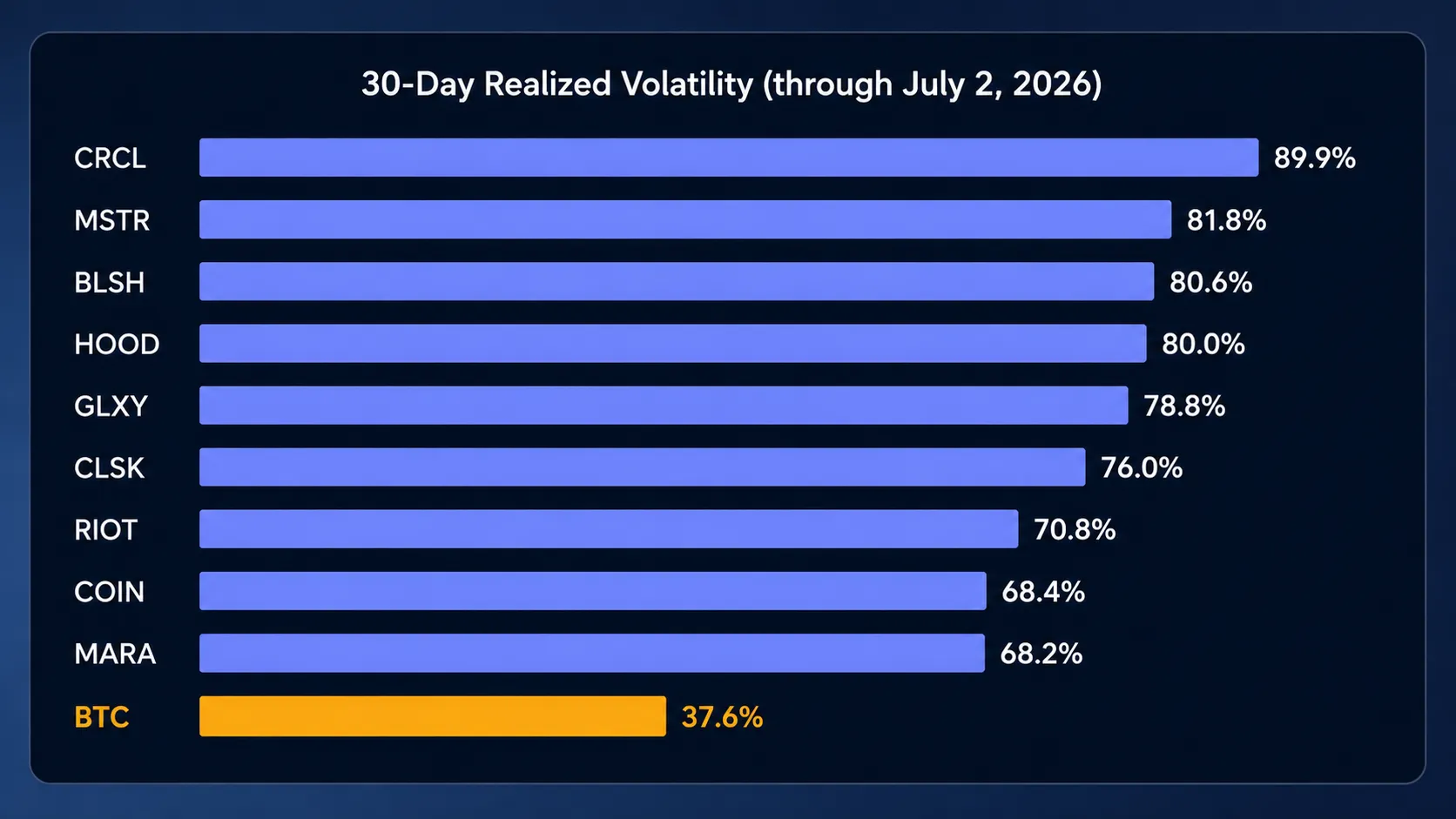
Volatility bar chart
Here’s where it gets interesting: correlation. Correlation measures how tightly an asset moves with Bitcoin, on a scale of 1.00 (perfect lockstep) down to 0 (no relationship). Over the past 90 trading days, Circle, Robinhood, and Bullish moved loosely with Bitcoin, with correlations of just 0.55 to 0.58. The rest of their daily swings came down to company-specific risk — quarterly earnings, regulation, financing, and dilution from new share issuance.
In other words, investors buying crypto stocks are getting only partial exposure to Bitcoin, plus a full extra layer of equity-market risk on top.
Only one of these stocks actually tracks Bitcoin
Strategy (formerly MicroStrategy) is the most leveraged bitcoin-proxy in the group. Its beta of 1.59 means it moves about 1.59% for every 1% move in Bitcoin — and it falls just as hard on the way down. During the June selloff, it fell as much as -51.4% from its 2026 high.
This is where a key concept comes in: mNAV, or market Net Asset Value. It compares a company’s market cap to the value of the Bitcoin it holds on its balance sheet. In late June, Strategy’s mNAV fell below 1 for the first time — meaning the market was valuing the entire business at less than the cash value of its Bitcoin stack. The company held 847,363 BTC as of its June 22 disclosure, worth roughly $85 billion. Falling below 1 breaks the flywheel that Strategy’s financing model depends on, and the company responded by rolling out a share buyback program.
The miners’ story is different — this one’s really about AI
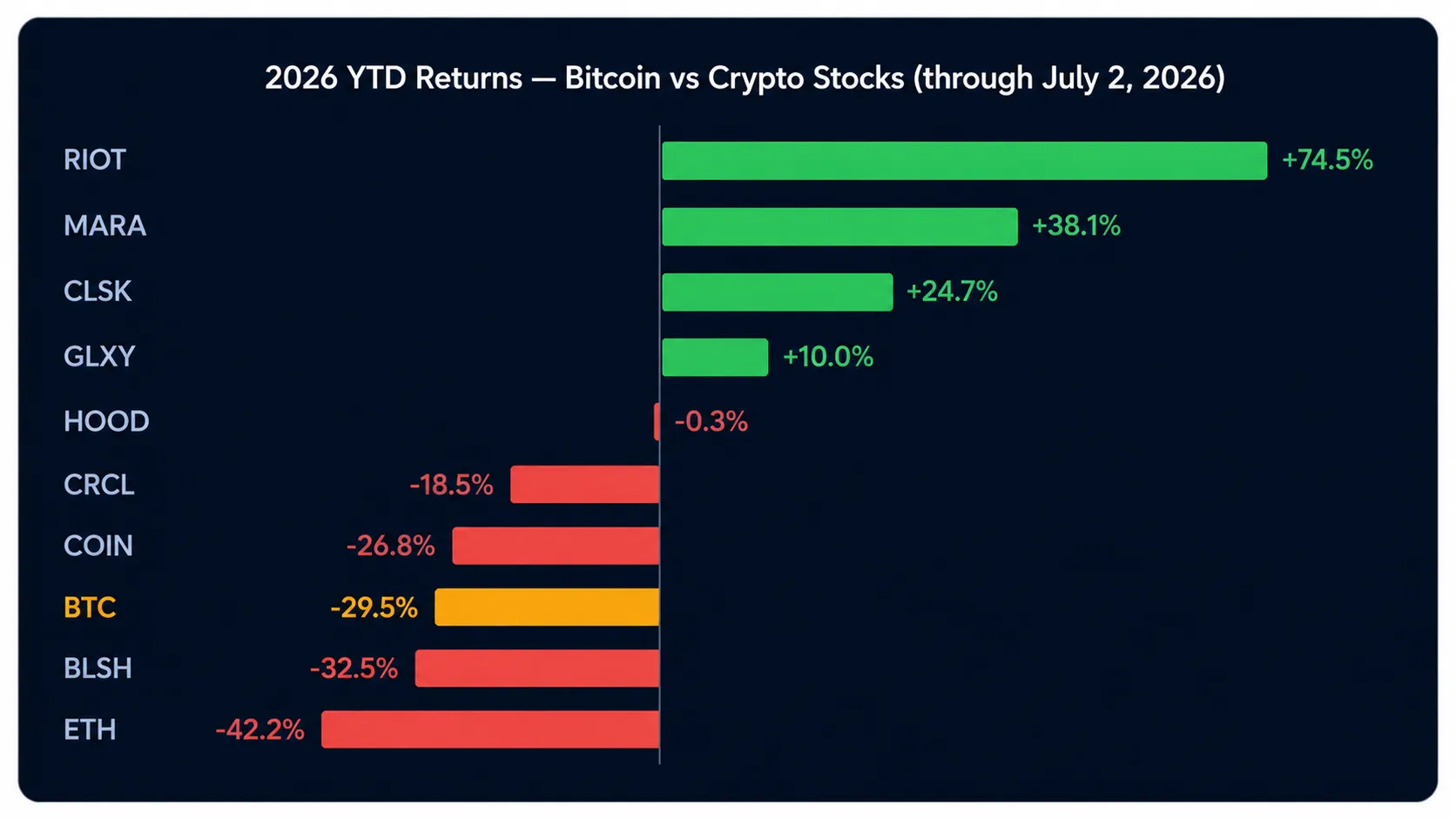
RIOT, MARA, CleanSpark (CLSK), and Galaxy (GLXY) posted the group’s strongest returns this year — RIOT up roughly 74.5%, MARA 38.1%, and CleanSpark 24.7%. But the outperformance came mostly from the sector’s ongoing pivot into AI and high-performance computing infrastructure, not Bitcoin’s price. Several miners signed tens of billions of dollars in compute contracts and sold off part of their Bitcoin treasuries along the way.
Robinhood and Circle — two different ways to decouple
Robinhood looked the least like Bitcoin in the group — its drawdown this year was just -8.5%, the shallowest of the bunch. That’s thanks to its diversified business: options, stocks, and derivatives revenue that cushions its crypto exposure. Circle, on the other hand, shows that being a stablecoin issuer isn’t the same as being a bitcoin trade — its price moved almost entirely on competitive and regulatory shifts, not Bitcoin’s swings.
The takeaway for investors
From MSTR’s leveraged bitcoin-proxy model to COIN’s diversified marketplace business, every crypto stock in this group has its own risk profile. Funds that think they’re buying a “safer version” of Bitcoin by holding the stock are actually adding a full extra layer of equity-market risk on top of their Bitcoin exposure — dilution, premium compression, financing pressure, and capital-plan risk that a Bitcoin holder never faces. The crypto stocks that held up best this year did it by building their own revenue streams, with Bitcoin acting as just one small input rather than the main driver.
Related Reading
Data Table: 2026 YTD Snapshot
| Asset | 2026 Return | Drawdown | 30-Day Vol | BTC Beta | BTC Correlation |
|---|---|---|---|---|---|
| BTC | -29.5% | -36.4% | 37.6% | 1.00 | 1.00 |
| COIN | -26.8% | -35.3% | 68.4% | 1.26 | 0.75 |
| HOOD | -0.3% | -8.5% | 80.0% | 0.96 | 0.58 |
| CRCL | -18.5% | -51.4% | 89.9% | 1.18 | 0.55 |
| MSTR | -32.5% | -51.4% | 81.8% | 1.59 | 0.85 |
| MARA | +38.1% | -16.5% | 68.2% | 1.20 | 0.65 |
| RIOT | +74.5% | -22.9% | 70.8% | 1.07 | 0.56 |
| CLSK | +24.7% | -32.9% | 76.0% | 1.03 | 0.67 |
Frequently Asked Questions
Q1.Is buying crypto stocks safer than buying Bitcoin directly?
Not really. The data shows 30-day realized volatility for stocks like Coinbase, Circle, Strategy, and Robinhood is roughly double Bitcoin’s, because these stocks carry both Bitcoin’s price risk and the company’s own business risk on top.
Q2.What is Strategy's (MicroStrategy) mNAV, and why does it matter?
mNAV, or market Net Asset Value, compares a company’s market value to the value of the Bitcoin it holds. In late June 2026, Strategy’s mNAV dropped below 1 for the first time, meaning the market valued the whole business at less than its Bitcoin stack — which pressured its financing model and led to a share buyback program.
Q3.Why does Circle's stock track Bitcoin so loosely?
Circle is mainly a stablecoin issuer, so its stock reacts to stablecoin market competition and regulation rather than Bitcoin’s price. That is why it shows one of the lowest correlations to Bitcoin in the group, around 0.55.
Q4.Which crypto stock behaves most like Bitcoin?
Strategy (MSTR) is the most leveraged bitcoin-proxy, with a beta of 1.59 and a correlation of 0.85. Coinbase (COIN) is the most balanced trade in the group, with a beta of 1.26 and volatility close to Bitcoin’s own.
Q5.Why did Bitcoin miners like RIOT and MARA outperform Bitcoin in 2026?
Miners such as RIOT, MARA, and CleanSpark posted large gains mostly because of their pivot into AI and high-performance computing data-center contracts — not because of Bitcoin’s price, which was actually down for the year.
Explore Services
Related Services
Reviewed by

Aman Vaths
Founder of Nadcab Labs
Aman Vaths is the Founder & CTO of Nadcab Labs, a global digital engineering company delivering enterprise-grade solutions across AI, Web3, Blockchain, Big Data, Cloud, Cybersecurity, and Modern Application Development. With deep technical leadership and product innovation experience, Aman has positioned Nadcab Labs as one of the most advanced engineering companies driving the next era of intelligent, secure, and scalable software systems. Under his leadership, Nadcab Labs has built 2,000+ global projects across sectors including fintech, banking, healthcare, real estate, logistics, gaming, manufacturing, and next-generation DePIN networks. Aman’s strength lies in architecting high-performance systems, end-to-end platform engineering, and designing enterprise solutions that operate at global scale.