Ai Overview
The Web3 ecosystem has long struggled with a fundamental paradox: how do you build trust in a trustless environment? Traditional blockchain tokens excel at representing transferable assets, but they fail to capture the non-transferable aspects of identity, reputation, and relationships that form the foundation of social and economic life.
Key Takeaways
- Soulbound Tokens are non-transferable blockchain tokens that permanently bind identity credentials, reputation, and achievements to specific wallet addresses (Souls)
- Soulbound Tokens Web3 applications enable trustworthy decentralized identity verification without centralized authorities, creating a foundation for reputation-based systems
- SBT Identity Web3 implementations prevent identity fraud by making credentials impossible to buy, sell, or transfer, ensuring authentic holder verification
- Web3 Identity Security significantly improves through SBTs by enabling Sybil resistance in DAOs, secure voting systems, and tamper-proof credential verification
- Soulbound Token Use Cases span digital credentials, academic certificates, professional licenses, employment verification, reputation systems, and social recovery mechanisms
- Non-transferable Blockchain Tokens like SBTs solve the fundamental problem of trust in pseudonymous Web3 environments by creating verifiable identity claims
- SBTs Identity Verification enables selective disclosure through zero-knowledge implementations, allowing credential verification without exposing unnecessary personal data
- Web3 Digital Identity Tokens through SBTs are evolving toward cross-chain portability, privacy preservation, and standardized interoperability protocols
- Enterprise adoption of SBTs is accelerating for employee credentials, compliance attestations, and B2B trust relationships
What Are Soulbound Tokens (SBTs)?
The Web3 ecosystem has long struggled with a fundamental paradox: how do you build trust in a trustless environment? Traditional blockchain tokens excel at representing transferable assets, but they fail to capture the non-transferable aspects of identity, reputation, and relationships that form the foundation of social and economic life. Soulbound Tokens emerged as the solution to this challenge, introducing a new primitive that can represent the uniquely personal attributes that define who we are rather than just what we own.
The concept of Soulbound Tokens draws inspiration from video game mechanics where certain powerful items become permanently bound to the character who acquires them. In the Web3 context, Soulbound Tokens Explained simply are digital tokens that cannot be transferred once received, creating permanent on-chain records of credentials, achievements, and identity attributes. This seemingly simple modification to standard token mechanics unlocks entirely new categories of Web3 applications focused on identity and trust.
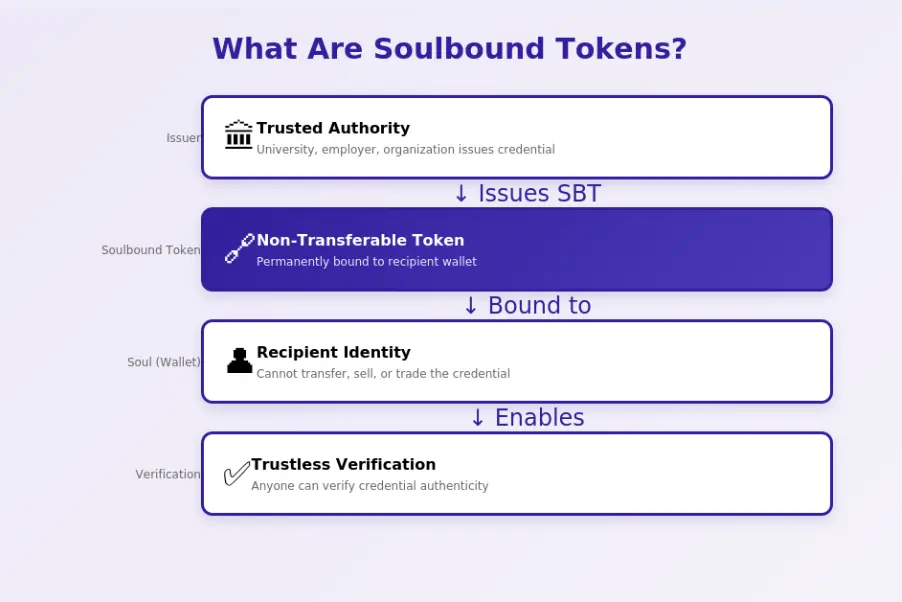
Definition of Soulbound Tokens
Soulbound Tokens are blockchain-based tokens that are permanently and irrevocably linked to a specific wallet address, referred to as a “Soul.” Unlike standard tokens that can flow freely between addresses, SBTs remain with their original recipient forever (or until explicitly revoked by the issuer or burned by the holder, depending on implementation). This non-transferability is enforced at the smart contract level, making it technically impossible to send an SBT to another address through normal means.
The term “Soulbound” captures the essence of these tokens: they represent aspects of identity and reputation that should be inseparable from the individual. Just as real-world credentials like university degrees, professional certifications, and employment histories cannot be meaningfully transferred to another person, SBTs create digital equivalents that maintain the same integrity. A medical license SBT issued to a qualified physician cannot be sold to an unqualified person, preserving the credential’s meaning and trustworthiness.
The concept was formalized by Ethereum co-founder Vitalik Buterin along with researchers Glen Weyl and Puja Ohlhaver in their influential 2022 paper “Decentralized Society: Finding Web3’s Soul.” This paper proposed SBTs as fundamental building blocks for a “Decentralized Society” (DeSoc) where social relationships, reputation, and trust could be represented on-chain without requiring centralized identity providers.
Difference Between SBTs and NFTs
While both SBTs and NFTs are tokens on blockchain networks, they serve fundamentally different purposes and operate under different rules. Understanding these differences is crucial for determining when each token type is appropriate. NFTs represent ownership of assets, whether digital art, virtual land, or collectibles, and their value often comes from their tradability on secondary markets. The ability to buy, sell, and speculate on NFTs is a feature, not a bug.
SBTs, conversely, derive their value precisely from being non-transferable. A university degree SBT is valuable because it proves the holder actually earned that degree, which would be meaningless if degrees could be purchased from previous holders. The non-transferability ensures that the credential accurately represents the current holder’s actual qualifications rather than purchased achievements.
This distinction affects every aspect of how these tokens function in practice. NFT marketplaces enable price discovery and liquidity; SBTs have no secondary market because they cannot be traded. NFT value can appreciate or depreciate based on market conditions; SBT value is tied to the issuer’s reputation and the credential’s relevance. NFTs focus on ownership verification; SBTs focus on identity and reputation verification.
Important: The choice between SBTs and NFTs should be driven by the fundamental question: does this attribute belong to the holder personally (use SBT), or does it represent an asset that could legitimately transfer between parties (use NFT)? Credentials, reputation, and identity attributes typically call for SBTs.
Key Features of Soulbound Tokens
Several distinctive features define Soulbound Tokens and enable their unique applications in Web3 ecosystems. Non-transferability is the defining characteristic, implemented through smart contract logic that prevents standard transfer operations. When someone attempts to transfer an SBT, the transaction reverts, keeping the token permanently in the original recipient’s wallet.
Verifiability ensures that anyone can confirm the existence and authenticity of an SBT by querying the blockchain. The on-chain record includes the issuer’s address (allowing verification of the issuing authority), the issuance timestamp, and any metadata associated with the credential. This transparency enables trustless verification without contacting the issuer directly.
Optional revocability allows issuers to invalidate credentials when circumstances change. A professional license SBT might be revoked if the holder loses their license, or an employment credential might be revoked when someone leaves a company. Revocation mechanics must be carefully designed to balance issuer control with appropriate holder protections.
Composability enables SBTs to work with other Web3 primitives and protocols. Smart contracts can query SBT holdings to gate access, determine voting rights, or unlock functionality. This programmable integration makes SBTs powerful building blocks for complex decentralized applications that require identity verification.
How Soulbound Tokens Enhance Identity in Web3?
Identity in Web3 has traditionally been limited to cryptographic addresses, pseudonymous by default and disconnected from real-world attributes. While this pseudonymity offers privacy benefits, it also creates challenges for building trust, establishing reputation, and verifying claims. SBT Identity Web3 solutions bridge this gap by enabling verifiable identity claims while preserving the decentralized nature of blockchain systems.
SBTs for Decentralized Identity Verification
Traditional identity verification relies on centralized authorities: governments issue IDs, universities grant degrees, and employers provide references. Each verification requires trusting these intermediaries to maintain accurate records and respond to verification requests. This centralization creates single points of failure, privacy risks, and barriers to access for those without established relationships with these institutions.
Soulbound Tokens and Digital Identity transform this model by placing verifiable credentials directly in users’ control while maintaining issuer authenticity. When a university issues a degree SBT, the credential lives in the graduate’s wallet, verifiable by anyone at any time without contacting the university. The cryptographic link to the university’s issuing address provides authenticity guarantees equivalent to traditional verification.
This decentralized model offers several advantages: verification works 24/7 without issuer involvement, credentials remain accessible even if issuers cease operations, users control their identity data rather than relying on third parties to store and share it, and verification costs approach zero compared to traditional credential verification services.
Preventing Identity Fraud with Non-Transferable Tokens
Identity fraud costs billions annually and undermines trust in digital systems. Traditional credentials suffer from forgery (creating fake credentials), impersonation (using someone else’s legitimate credentials), and credential mills (purchasing credentials from disreputable issuers). Non-transferable Blockchain Tokens address each of these vectors through their fundamental properties.
Forgery becomes extremely difficult because SBTs include cryptographic proof of the issuer’s identity. Creating a fake credential would require compromising the issuer’s private keys, a significantly higher barrier than forging a paper certificate or PDF. Verifiers can easily confirm that credentials came from legitimate issuers by checking the issuing address.
Impersonation is prevented by the binding of SBTs to specific wallet addresses. Even if an attacker obtains someone’s credential information, they cannot transfer the actual SBT to their own wallet. Verification processes that require proving SBT ownership (through signing messages with the holding wallet) ensure that only the legitimate holder can use the credential.
Credential mills remain a challenge but become more transparent: issuers build on-chain reputations over time, and patterns of suspicious issuance become visible through blockchain analytics. The community can collectively evaluate issuer credibility in ways impossible with traditional paper credentials.
Web3 Digital Identity and Trust Mechanisms
Web3 Identity Security extends beyond individual credentials to comprehensive trust mechanisms built from multiple SBTs. A “Soul” accumulates tokens from various issuers over time, building a rich identity profile without any single authority controlling the complete picture. Educational credentials, employment history, community memberships, and reputation scores all contribute to a holistic digital identity.
This composable identity enables trust to flow through networks in new ways. A job applicant might prove their qualifications through education SBTs, demonstrate relevant experience through employment SBTs, and show community standing through reputation SBTs, all without revealing unnecessary personal information or relying on traditional background check services.
Trust mechanisms can become algorithmic and programmable. Smart contracts can automatically verify required credentials, calculate trust scores based on SBT portfolios, and gate access to services based on verified attributes. Organizations building professional crypto exchange platforms increasingly consider SBT integration for enhanced customer verification.
Security Advantages of Soulbound Tokens
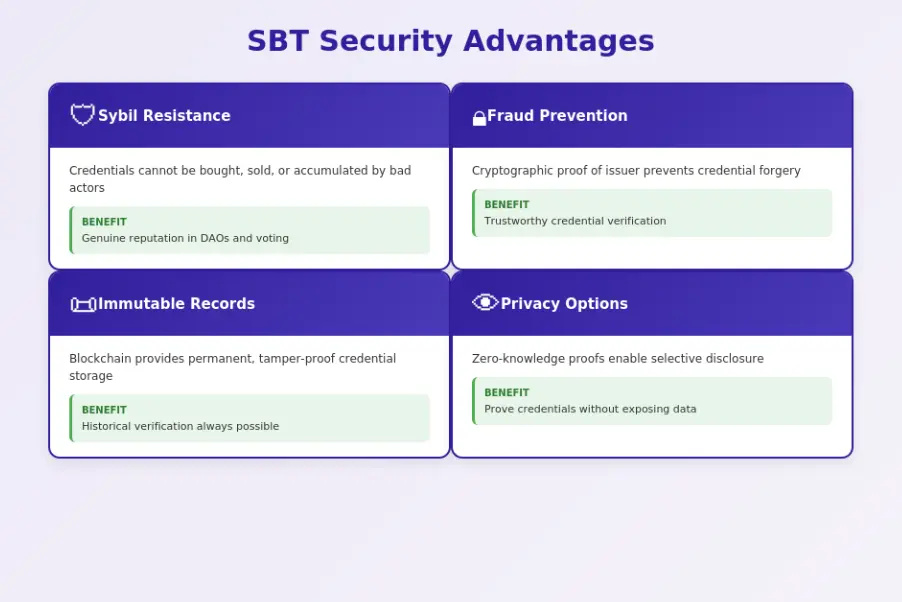
Security in Web3 encompasses more than protecting assets from theft; it includes ensuring the integrity of identity systems, preventing gaming of governance mechanisms, and maintaining trust in decentralized protocols. SBTs provide unique security properties that address challenges impossible to solve with transferable tokens alone.
Immutable Identity Verification on Blockchain
Blockchain immutability extends to SBTs, creating permanent records of credential issuance that cannot be altered retroactively. Once an issuer creates an SBT, the fact of its issuance is permanently recorded on the blockchain, providing an auditable trail that persists indefinitely. This permanence creates strong accountability for both issuers and holders.
The immutable record enables historical verification: future verifiers can confirm that a credential existed at a specific point in time, even if the issuer has since ceased operations. This permanence is particularly valuable for credentials with long-term relevance, such as academic degrees or professional certifications that should remain verifiable throughout a holder’s career.
Tampering becomes virtually impossible because changing on-chain records would require controlling a majority of the network’s validation power. The same security model that protects cryptocurrency transactions protects SBT integrity, providing enterprise-grade security for identity credentials.
Privacy and Data Protection with SBTs
Privacy considerations for SBTs are nuanced and require careful implementation. Standard SBTs on public blockchains are visible to anyone, potentially exposing sensitive information about holders. A naive implementation might reveal education history, medical credentials, or employment details to any observer, creating privacy risks that could outweigh the verification benefits.
Privacy-preserving SBT implementations address these concerns through several approaches. Zero-knowledge proofs enable holders to prove they possess certain credentials without revealing the credentials themselves. Instead of showing a specific medical license, a holder might prove “I have a valid medical license from an accredited issuer” without revealing which license or which state issued it.
Selective disclosure extends this capability by letting holders reveal only specific attributes. An age-gated service might verify that a holder is over 21 without learning their exact birth date or other personal information. This granular control over information disclosure aligns with privacy-by-design principles and emerging data protection regulations.
Reducing Risks in DAO Governance and Reputation Systems
Decentralized Autonomous Organizations face persistent governance challenges, particularly Sybil attacks where adversaries create multiple fake identities to gain disproportionate voting power. Traditional solutions like one-token-one-vote enable wealthy participants to buy governance power, while purely democratic one-person-one-vote requires robust identity verification.
SBTs enable sophisticated governance mechanisms that balance these concerns. Voting power might depend on credentials demonstrating genuine community contribution: participation SBTs, contribution SBTs, or tenure SBTs. Since these cannot be purchased on secondary markets, governance rights more accurately reflect actual stakeholder engagement rather than financial capacity.
Reputation systems built on SBTs create accountability for behavior within decentralized communities. Positive contributions can earn reputation SBTs that unlock privileges, while negative behavior might result in “negative” SBTs that restrict access. This permanent accountability changes incentive structures in favor of long-term community building over short-term exploitation.
| Feature | Soulbound Tokens (SBTs) | Traditional NFTs |
|---|---|---|
| Transferability | Non-transferable (bound to wallet) | Fully transferable |
| Primary Purpose | Identity, credentials, reputation | Asset ownership, collectibles |
| Secondary Market | None (by design) | Active trading markets |
| Value Source | Issuer reputation, credential relevance | Market demand, rarity |
| Sybil Resistance | High (credentials cannot be bought) | Low (tokens can be accumulated) |
Use Cases of Soulbound Tokens in Web3
Soulbound Token Use Cases span numerous industries and applications where verifiable, non-transferable credentials provide value. From educational institutions to enterprise identity management, SBTs are finding practical applications that demonstrate their utility beyond theoretical concepts.
Digital Credentials and Academic Certificates
Educational credentials represent one of the most straightforward and impactful SBT applications. Universities can issue degree SBTs to graduates, creating permanent, verifiable records of academic achievement. Unlike paper diplomas or PDF certificates, these credentials cannot be forged, lost, or damaged, and verification is instant and free.
The benefits extend throughout the credential lifecycle. Students receive tamper-proof records of their achievements. Employers can verify qualifications instantly without contacting universities or paying verification services. Universities reduce administrative burden and fraud exposure. The entire system becomes more efficient and trustworthy.
Professional certifications similarly benefit from SBT implementation. Technical certifications, professional licenses, and continuing education credits can all be represented as SBTs, creating comprehensive professional credential portfolios that follow individuals throughout their careers. Expiring certifications can include revocation mechanisms that automatically update status.
Enterprise Identity Verification Solutions
Enterprise adoption of SBTs addresses longstanding challenges in B2B trust relationships and employee credential management. Companies can issue SBTs to employees representing roles, clearances, and certifications, enabling automated verification across organizational boundaries without exposing sensitive HR systems.
Supply chain verification benefits from SBTs that attest to supplier qualifications, compliance certifications, and audit results. Buyers can verify that suppliers hold required certifications without relying on self-reported information or expensive third-party verification services. The permanent, transparent nature of blockchain records creates accountability throughout supply chains.
Compliance and regulatory attestations translate naturally to SBTs. Companies can receive and display SBTs representing SOC 2 compliance, ISO certifications, or industry-specific accreditations. Regulators and partners can verify these attestations instantly, streamlining compliance workflows. Teams building comprehensive trading platform solutions evaluate SBT integration for streamlined KYC processes.
Reputation Systems and Social Recovery Mechanisms
Reputation systems powered by SBTs create accountability in pseudonymous environments. Community members earn reputation SBTs through positive contributions, which cannot be purchased or transferred from established accounts. This creates genuine meritocracy where standing reflects actual contribution rather than financial resources.
Social recovery mechanisms use SBT-based trust networks to recover lost wallet access. Instead of relying on seed phrases alone, users can designate “guardians” whose SBTs (representing trusted relationships) enable collaborative wallet recovery. A threshold of guardians can approve recovery requests, combining security with practicality.
Credit and lending in DeFi can evolve beyond over-collateralization using SBT-based reputation. Borrowers with strong reputation SBTs might access under-collateralized loans based on demonstrated creditworthiness. This unlocks DeFi capital efficiency while managing risk through verifiable reputation rather than pure collateral requirements.
Real-World SBT Implementation Examples
- Binance: Binance Account Bound (BAB) tokens for verified users
- Galxe: On-chain credential infrastructure with SBT issuance
- Gitcoin Passport: Sybil resistance through credential aggregation
- POAP: Proof of Attendance Protocol for event credentials
- Ethereum Attestation Service: General-purpose attestation framework
How to Implement Soulbound Tokens?
Implementing Soulbound Tokens requires understanding smart contract architecture, choosing appropriate standards, and integrating with broader Web3 infrastructure. The technical implementation varies based on requirements, but core patterns have emerged that enable reliable SBT creation and management.
SBT Smart Contract Architecture
SBT smart contracts typically extend existing token standards with modifications that prevent transfers. The most common approach modifies ERC-721 (the NFT standard) by overriding transfer functions to revert, making tokens non-transferable. This leverages existing tooling and infrastructure while adding the soulbound property.
Key architectural decisions include: whether tokens can be revoked (and by whom), whether holders can burn their own tokens, how metadata is stored and updated, and how issuance is controlled. Each decision affects the token’s utility and security properties, requiring careful consideration of use case requirements.
Issuance mechanisms range from permissioned (only designated issuers can mint) to permissionless (anyone can issue attestations) to hybrid (whitelisted issuers with community verification). The appropriate model depends on the credential type and required trust level. Educational credentials likely need permissioned issuance, while peer endorsements might use permissionless mechanisms.
Integrating SBTs in Web3 Platforms
Integration involves both smart contract interactions and user interface considerations. Applications must query SBT holdings to verify credentials, handle the display of non-transferable tokens appropriately, and potentially gate functionality based on SBT ownership. Standard wallet interfaces may need adaptation to properly represent credentials that cannot be sent.
Verification workflows integrate SBTs by checking token ownership at relevant points. A DAO might verify governance SBTs before allowing votes; a DeFi protocol might check reputation SBTs before extending credit; an application might verify credential SBTs before granting access. These checks can be on-chain (in smart contracts) or off-chain (in application logic).
User experience design for SBTs differs from traditional tokens. Users need clear indication that certain tokens cannot be transferred, understanding of what credentials they hold, and tools for selective disclosure where privacy is important. Well-designed credential wallets present SBTs as identity documents rather than tradeable assets.
Tools and Services for SBT Deployment
The SBT ecosystem includes various tools and services that simplify creation and management. Platforms like Galxe, Otterspace, and Sismo provide infrastructure for creating and issuing SBTs without deep smart contract expertise. These platforms handle contract deployment, metadata management, and issuance workflows.
For custom implementations, frameworks and libraries exist that provide tested SBT base contracts. OpenZeppelin and similar security-focused libraries offer building blocks that can be extended for specific requirements. Using audited base contracts reduces security risks compared to implementing from scratch.
Verification services enable applications to integrate SBT checking without building custom infrastructure. APIs that aggregate SBT data across chains, indexing services that track issuance and revocation, and verification widgets that embed in existing applications all reduce integration friction.
| Phase | Stage | Activities | Deliverables |
|---|---|---|---|
| 1 | Requirements | Define credential types, issuance rules, revocation needs | Specification document |
| 2 | Design | Select standards, design smart contracts, plan metadata | Technical architecture |
| 3 | Build | Implement contracts, build issuance tools, create UI | Working system |
| 4 | Audit | Security review, test issuance and revocation flows | Audit report |
| 5 | Launch | Deploy contracts, onboard issuers, begin credential issuance | Production system |
Future Trends in Soulbound Tokens and Web3 Identity
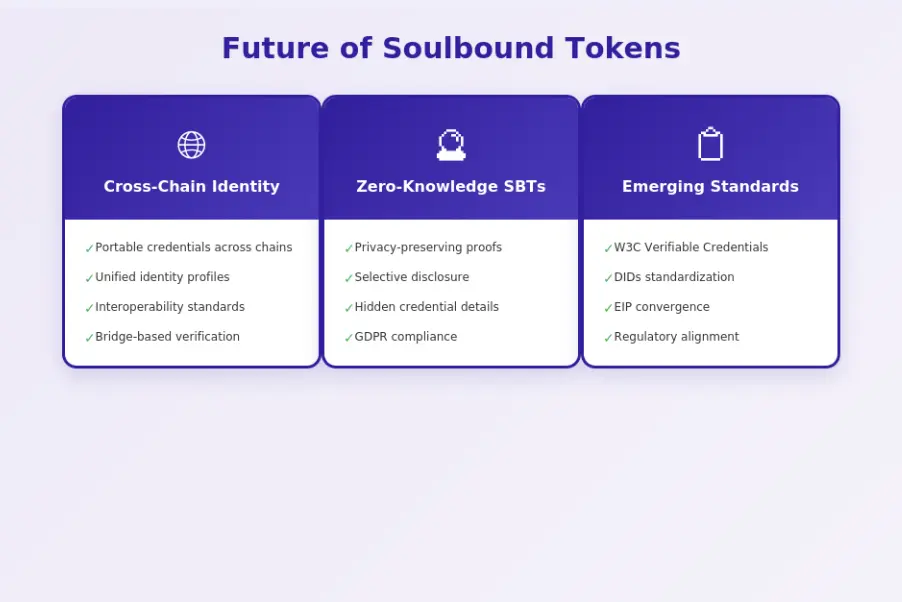
The SBT ecosystem continues evolving rapidly, with innovations addressing current limitations and expanding possibilities. Understanding emerging trends helps organizations prepare for the future of decentralized identity while making informed decisions about current implementations.
Cross-Chain Identity Portability
Current SBT implementations typically exist on single chains, creating fragmented identity profiles across different networks. Cross-chain identity portability would allow credentials issued on one chain to be recognized and verified on others, creating unified identity experiences regardless of which blockchain an application uses.
Technical approaches include bridge-based attestation verification, shared identity layers that multiple chains reference, and standardized protocols that enable cross-chain credential queries. Projects like Ceramic Network and Lens Protocol are building infrastructure that could enable portable identity profiles across Web3.
Interoperability standards remain a significant challenge. Different chains use different address formats, smart contract languages, and consensus mechanisms. Creating credentials that work seamlessly across this heterogeneous landscape requires coordination across communities and technical innovation in bridging mechanisms.
Zero-Knowledge Soulbound Tokens
Zero-knowledge proofs enable proving possession of credentials without revealing the credentials themselves. Applied to SBTs, this technology allows selective disclosure where verifiers learn only what they need to know. A user might prove “I have a valid driver’s license” without revealing their name, address, or license number.
ZK-SBTs address the privacy concerns of public blockchain credentials. Instead of exposing all credentials to any observer, holders control exactly what information is shared in each verification context. This granular privacy control makes SBTs practical for sensitive credentials that would otherwise be too private for public blockchains.
Implementation complexity is decreasing as ZK tooling matures. Libraries like circom and snarkjs, along with ZK-rollup infrastructure, make privacy-preserving credentials increasingly practical. Projects like Polygon ID and Semaphore demonstrate working implementations of privacy-preserving identity on blockchain.
Emerging Standards for Decentralized Identity
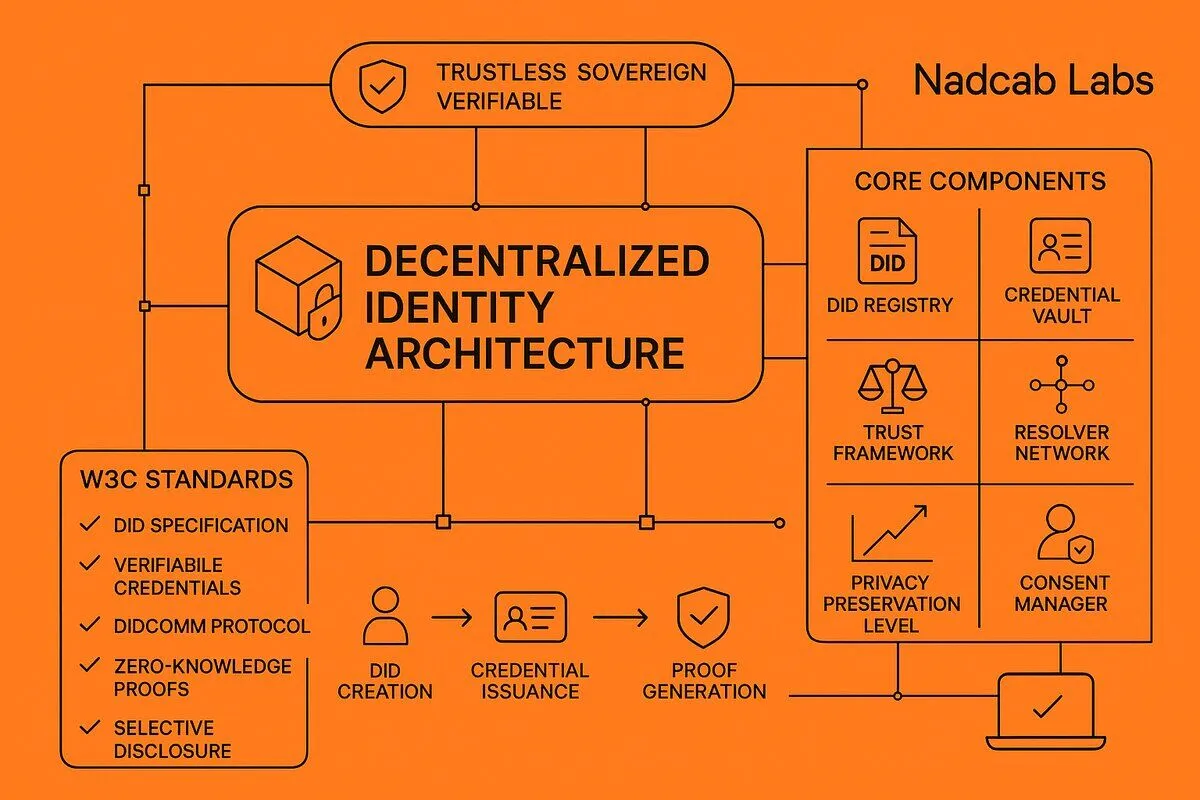
Standardization efforts are consolidating around interoperable approaches to decentralized identity. W3C Verifiable Credentials provide a general framework that SBTs can implement, enabling compatibility with broader identity ecosystems. DIDs (Decentralized Identifiers) offer standard ways to reference identities across systems.
Ethereum-specific standards continue evolving. EIP-5192, EIP-5484, and EIP-4973 represent different approaches to soulbound mechanics, each with tradeoffs. The ecosystem may converge on dominant standards or maintain multiple approaches for different use cases. Monitoring standards evolution helps ensure implementations remain compatible with emerging best practices.
Regulatory engagement is increasing as decentralized identity gains mainstream attention. Standards that accommodate regulatory requirements (like GDPR’s right to erasure) while maintaining decentralization benefits will likely see preferential adoption. Privacy-preserving approaches that enable compliance without centralization are particularly promising.
Final Thoughts
Soulbound Tokens represent a fundamental evolution in how Web3 handles identity, reputation, and trust. By introducing non-transferable credentials to blockchain ecosystems, SBTs solve problems that transferable tokens cannot address, enabling trustworthy identity verification in previously trustless environments.
The Impact of SBTs on Web3 Identity and Security
The impact of Web3 Digital Identity Tokens extends across multiple dimensions. Security improves through Sybil resistance, fraud prevention, and accountable reputation systems. Privacy advances through selective disclosure and zero-knowledge implementations. Efficiency increases as verification becomes instant and free rather than slow and expensive.
The philosophical impact is equally significant. SBTs enable a Web3 that recognizes humans as more than their financial holdings, incorporating social capital, credentials, and relationships into on-chain primitives. This richer representation of identity supports more nuanced and human-centered decentralized applications.
Opportunities for Businesses and Builders
Organizations across industries have opportunities to leverage SBTs for competitive advantage. Early adopters of credential issuance can establish themselves as trusted authorities in their domains. Platforms that integrate SBT verification can offer superior trust and security compared to competitors relying on traditional identity methods.
The tooling and infrastructure ecosystem presents opportunities for builders creating SBT platforms, verification services, and privacy-enhancing technologies. As adoption grows, demand for specialized services will increase, creating market opportunities for those who build essential infrastructure early.
Long-Term Evolution of Decentralized Identity
The long-term trajectory points toward comprehensive decentralized identity systems where SBTs play a central role alongside other primitives. Individuals will accumulate rich identity profiles across multiple issuers, portable across chains and applications. Verification will become seamless and privacy-preserving, enabling trust without surveillance.
Challenges remain, including privacy concerns, standardization needs, and regulatory uncertainty. However, the fundamental value proposition of verifiable, non-transferable credentials is compelling enough to drive continued innovation and adoption. Organizations that understand and prepare for this evolution will be well-positioned for the decentralized future.
| Standard | Approach | Key Feature | Status |
|---|---|---|---|
| EIP-5192 | Minimal SBT | Simple non-transferability | Final |
| EIP-5484 | Consensual SBT | Holder must accept | Draft |
| EIP-4973 | Account-bound | Mutual agreement | Draft |
| W3C VC | Verifiable Credentials | Cross-platform standard | Recommendation |
Build SBT Identity Solutions
Implement Soulbound Tokens for secure, verifiable Web3 identity credentials and reputation systems.
Soulbound Tokens mark a pivotal advancement in Web3 infrastructure, enabling the trust and identity layers that decentralized systems have long needed. From educational credentials to enterprise verification to DAO governance, SBTs provide the primitives for building a more trustworthy decentralized future. Organizations and builders who engage with this technology now will shape and benefit from the identity systems of tomorrow.
Frequently Asked Questions
Q1.How are Soulbound Tokens different from NFTs?
The fundamental difference is transferability: NFTs can be bought, sold, and transferred between wallets, while SBTs are permanently bound to the receiving address. NFTs represent ownership of assets, whereas SBTs represent identity attributes, credentials, and reputation. This non-transferable nature makes SBTs suitable for verification purposes where authenticity of the holder matters.
Q2.What are the main use cases for Soulbound Tokens?
Key use cases include digital credentials (degrees, certifications, professional licenses), reputation systems (DAO voting rights, credit scores), identity verification (KYC attestations, age verification), employment records, medical histories, and social recovery mechanisms. SBTs enable trustworthy verification of claims without revealing unnecessary personal information.
Q3.How do Soulbound Tokens improve Web3 security?
SBTs improve security by creating verifiable, tamper-proof identity credentials that cannot be transferred to bad actors. They enable Sybil resistance in DAOs (preventing fake accounts), secure reputation systems, and trustworthy credential verification. The permanent linkage to wallets makes identity fraud significantly more difficult compared to transferable tokens.
Q4.What is a "Soul" in the context of Soulbound Tokens?
A “Soul” refers to the wallet address that holds Soulbound Tokens. This could represent an individual, organization, or institution. Multiple SBTs from different issuers can accumulate in a single Soul, building a comprehensive identity profile. The term comes from video games where soulbound items cannot be traded between players.
Q5.How do I create or issue Soulbound Tokens?
Creating SBTs involves deploying smart contracts that implement non-transferability (typically by overriding transfer functions to revert). Popular frameworks include modified ERC-721 contracts, purpose-built SBT standards, and platforms offering no-code SBT issuance. The process includes defining token metadata, implementing issuance logic, and optionally adding revocation capabilities.
Explore Services
Related Services
Reviewed by

Aman Vaths
Founder of Nadcab Labs
Aman Vaths is the Founder & CTO of Nadcab Labs, a global digital engineering company delivering enterprise-grade solutions across AI, Web3, Blockchain, Big Data, Cloud, Cybersecurity, and Modern Application Development. With deep technical leadership and product innovation experience, Aman has positioned Nadcab Labs as one of the most advanced engineering companies driving the next era of intelligent, secure, and scalable software systems. Under his leadership, Nadcab Labs has built 2,000+ global projects across sectors including fintech, banking, healthcare, real estate, logistics, gaming, manufacturing, and next-generation DePIN networks. Aman’s strength lies in architecting high-performance systems, end-to-end platform engineering, and designing enterprise solutions that operate at global scale.