What Is Web3? An Introduction to the Decentralized Internet
If you have been hearing the term “Web3” everywhere and wondering what all the buzz is about, this web3 comprehensive guide will break it down for you. Web3 explained in simplest terms is the next evolution of the internet, one that shifts control from centralized corporations back to individual users. It is built on blockchain technology, leveraging smart contracts, tokens, and decentralized protocols to create a trustless, permissionless digital ecosystem. Think of it as an internet where you own your data, your digital identity, and your assets without needing permission from any single entity.
The concept of the decentralized internet was first articulated by Ethereum co-founder Gavin Wood in 2014, and it has since grown into a multi-billion-dollar ecosystem. Businesses across the USA, UK, UAE, and Canada are actively exploring Web3 solutions to reimagine customer engagement, operational efficiency, and data governance. As an agency with over 8 years of hands-on experience building decentralized systems, we have witnessed firsthand how Web3 is transforming the relationship between users and platforms.
This Web3 guide is designed for both beginners exploring the basics and experienced professionals looking for advanced concepts. Whether you are asking “what is Web3” for the first time or evaluating how blockchain architecture fits your business strategy, this resource covers the complete landscape of Web3 technology, its ecosystem, real-world applications, and future trajectory.
How Web3 Works: Core Concepts Explained?
Understanding how does Web3 work requires grasping a few foundational principles. At its core, Web3 replaces the client-server architecture of traditional internet services with distributed peer-to-peer networks. Instead of a single company storing your data on centralized servers, information is distributed across thousands of nodes running blockchain protocols. Every transaction, identity verification, and data exchange is recorded on an immutable ledger that anyone can audit but no single party can manipulate.
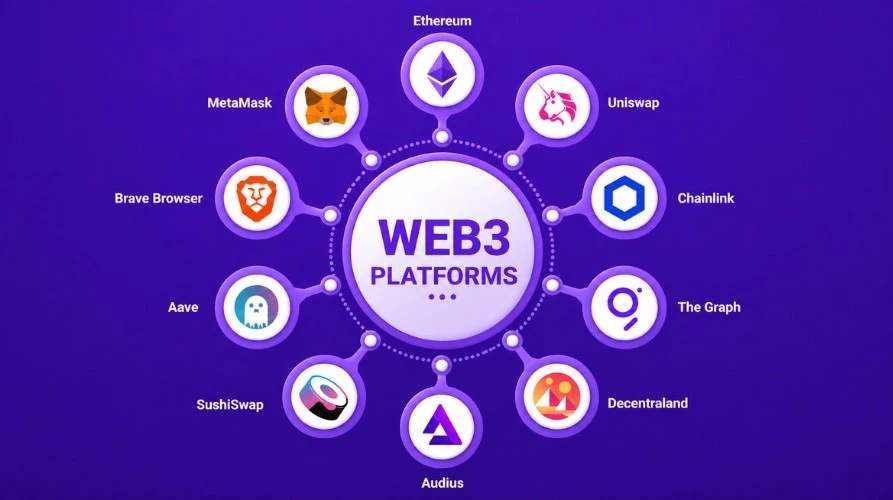
The Web3 architecture consists of several interconnected layers. The base layer is the blockchain itself, which provides consensus and security. On top of this sit smart contracts, which are self-executing programs that automate agreements without intermediaries. Users interact with these layers through decentralized applications (dApps) accessed via Web3 wallets like MetaMask or Trust Wallet. These wallets serve as both identity credentials and asset management tools, replacing traditional usernames and passwords with cryptographic key pairs.
Consensus mechanisms like Proof of Stake (PoS) and Proof of Work (PoW) ensure that all participants in the network agree on the state of the ledger. This is what makes the system trustless: you do not need to trust a bank, a government, or a corporation. You trust the math and the protocol. For businesses in the USA, UK, UAE, and Canada, this represents a paradigm shift in how digital services are built, deployed, and monetized.
Web1 vs Web2 vs Web3: Key Differences
The difference between Web2 and Web3 becomes clear when you trace the internet’s evolution. Web1 (roughly 1990 to 2004) was the read-only web, consisting of static pages and limited interactivity. Web2 (2004 to present) introduced social media, user-generated content, and platform economies controlled by centralized companies. Web3 is the read-write-own web, where users not only create content but also own their data, digital assets, and governance rights. This transition represents a fundamental restructuring of value creation and distribution online.
| Parameter | Web1 (1990-2004) | Web2 (2004-Present) | Web3 (Emerging) |
|---|---|---|---|
| Content Model | Read-Only | Read-Write | Read-Write-Own |
| Data Ownership | Website Owners | Centralized Platforms | Individual Users |
| Architecture | Static HTML | Cloud / APIs | Blockchain / P2P |
| Trust Model | Institutional | Platform-Based | Trustless / Protocol |
| Monetization | Banner Ads | Data Harvesting / Ads | Token Economies |
| Identity | Anonymous | Email / Social Login | Crypto Wallet / DID |
| Governance | None | Corporate Policies | DAO-Based / Community |
As this Web3 guide illustrates, the progression from Web1 to Web3 is not merely a technological upgrade. It is a philosophical shift in how value, identity, and governance operate across the digital realm. Companies across the USA, UK, and Canada that built empires on Web2 data models are now investing heavily in Web3 infrastructure to stay relevant in this new paradigm.
Key Components of the Web3 Ecosystem
The Web3 ecosystem is a layered infrastructure comprising multiple technologies that work together to power the decentralized internet. Understanding these components is essential for anyone exploring Web3 basics for beginners or evaluating enterprise adoption strategies. Each component serves a distinct function, from consensus and computation to storage and user interaction.
These components collectively form the Web3 architecture that enables everything from decentralized finance to digital identity systems. Organizations in the UAE and Canada are increasingly adopting this architecture to build next-generation platforms.
Blockchain Technology as the Foundation of Web3
Blockchain is the bedrock upon which the entire Web3 ecosystem operates. At a fundamental level, blockchain is a distributed digital ledger that records transactions across a network of computers in a way that makes alteration nearly impossible. Each block of data is cryptographically linked to the previous one, creating an unbroken chain of verified information. This is what enables the trustless, transparent, and censorship-resistant properties that define the decentralized internet.
Different blockchain networks offer varying trade-offs. Ethereum remains the most widely used platform for building dApps, while Solana offers higher throughput for performance-sensitive applications. Polkadot enables cross-chain interoperability, and newer chains like Avalanche and Arbitrum are gaining traction in specific verticals. The benefits of Web3 technology are directly tied to the capabilities and limitations of the underlying blockchain. For enterprise use cases in the USA, UK, and UAE, permissioned blockchains like Hyperledger offer privacy features while maintaining the advantages of distributed ledger technology.
As blockchain infrastructure matures, we are seeing convergence between public and private chains, enabling hybrid architectures that balance transparency with confidentiality. This is critical for industries like healthcare, finance, and government services where regulatory compliance and data privacy are non-negotiable requirements.
Smart Contracts and Their Role in Web3
Smart contracts are arguably the most transformative innovation within the Web3 stack. These are programs stored on the blockchain that execute automatically when predetermined conditions are met. They eliminate the need for intermediaries like lawyers, escrow agents, and settlement services. Once deployed, a smart contract cannot be altered, which provides certainty and auditability for all parties involved. This capability is central to understanding how Web3 advanced concepts work in practice.
Solidity is the primary programming language for Ethereum smart contracts, while Rust powers contracts on Solana and NEAR Protocol. The ability to program financial logic, governance rules, and access control directly on the blockchain has unlocked entirely new business models. From automated lending protocols to decentralized insurance platforms, smart contracts are the engine behind every major Web3 application.
Real-World Example
A freelance designer in Canada completes work for a client in the UK. Instead of invoicing through traditional payment systems with 3 to 5 day settlement times and cross-border fees, they use a smart contract on Ethereum. The contract automatically releases payment in USDC the moment the deliverable is verified on-chain, saving time and reducing costs for both parties.
Decentralized Applications (dApps) Explained
Decentralized applications, or dApps, are software applications that run on blockchain networks rather than centralized servers. This is a key distinction from traditional apps hosted on AWS, Azure, or Google Cloud. Because dApps operate on distributed networks, they inherit the properties of the underlying blockchain: transparency, censorship resistance, and permissionless access. Web3 applications span every category from finance and gaming to social media and supply chain management.
The user experience of interacting with a dApp typically involves connecting a Web3 wallet, which authenticates the user and enables transactions. Unlike Web2 applications where the company controls the backend, dApps leverage open-source smart contracts that anyone can verify. This transparency builds trust and allows community-driven auditing of the code. As of 2025, there are thousands of active dApps across DeFi, NFT marketplaces, decentralized social platforms, and gaming ecosystems.
For Web3 explained for beginners, think of dApps as the apps on your phone, but instead of Apple or Google controlling them, they run on open networks where no single company can shut them down or change the rules unilaterally. This is a foundational concept in understanding why is Web3 the future of the internet for builders and users alike.
Web3 Wallets: Managing Digital Identity and Assets
In the Web3 ecosystem, your wallet is your identity. Unlike Web2, where you sign in with an email and password managed by a platform, Web3 wallets use cryptographic key pairs to authenticate users. Your public key is your address (like an account number), and your private key is your proof of ownership. This model eliminates the need for centralized identity providers and gives users full sovereignty over their digital presence. Non-custodial Web3 wallet adoption climbed significantly in 2025, reflecting growing user demand for self-managed identity.
Popular wallets include MetaMask (browser-based), Trust Wallet (mobile), Ledger (hardware), and Phantom (Solana ecosystem). Each wallet type offers different trade-offs between convenience and security. Hardware wallets are considered the gold standard for protecting large holdings, while browser and mobile wallets offer seamless interaction with dApps. Multi-chain wallets are becoming standard, allowing users to manage assets across Ethereum, Solana, Polygon, and other networks from a single interface.
For businesses in the USA, UK, UAE, and Canada, wallet integration is a critical consideration when building Web3 products. Understanding how wallets work is one of the most important Web3 basics for beginners, as every interaction with the decentralized internet begins and ends with your wallet.
Role of Cryptocurrencies and Tokens in Web3
Cryptocurrencies and tokens are the economic backbone of Web3. While often conflated, they serve distinct purposes. Cryptocurrencies like Bitcoin and Ether function as native assets of their respective blockchains, used primarily for transaction fees and network security. Tokens, on the other hand, are created using smart contracts and can represent anything: utility access, governance rights, fractional ownership of real-world assets, or even digital identity credentials.
The token economy is what enables Web3’s unique value proposition. In DeFi, tokens provide liquidity and yield. In DAOs, they grant voting power. In gaming, they represent in-game assets that players truly own. The tokenization of real-world assets (RWAs) is one of the fastest-growing sectors, with estimates suggesting that tokenized assets could represent 10% of global GDP by 2030. Stablecoins alone processed $5.7 trillion in transfers in 2024, demonstrating their mainstream utility.
Token Model Selection Criteria
Step 1: Define Utility
Determine whether your token provides access, governance, or value transfer. Align the token model with your product’s core use case and user incentives.
Step 2: Assess Regulatory Fit
Evaluate whether the token qualifies as a utility or security token in your target markets (USA, UK, UAE, Canada) to ensure compliance from day one.
Step 3: Plan Distribution
Design a sustainable tokenomics model with clear vesting schedules, emission rates, and buyback mechanisms to maintain long-term value and community trust.
DeFi, NFTs, and DAOs: Major Web3 Use Cases
The three pillars of Web3 use cases that have achieved the most traction are decentralized finance (DeFi), non-fungible tokens (NFTs), and decentralized autonomous organizations (DAOs). Each addresses a different dimension of the centralization problem. DeFi replaces banks and brokerages with open protocols. NFTs establish verifiable digital ownership. DAOs create transparent governance structures that operate without traditional corporate hierarchies.
DeFi was the dominant sector in 2024, accounting for 32% of daily dApp users. Protocols like Aave, Uniswap, and Compound allow users to lend, borrow, and trade assets directly from their wallets. NFTs have evolved beyond digital art into real estate tokenization, intellectual property licensing, and gaming assets. DAOs, with total treasury values exceeding $40 billion in early 2025, are increasingly being adopted by enterprises exploring community-driven governance models.
These Web3 examples in real life demonstrate that the technology is no longer theoretical. Businesses across the USA, UK, UAE, and Canada are deploying DeFi protocols for treasury management, launching NFT-based loyalty programs, and using DAO structures for decentralized project governance. The convergence of these three pillars is creating entirely new economic models.
Web3 Security, Privacy, and Data Ownership
One of the most compelling benefits of Web3 technology is the fundamental shift in data ownership. In Web2, your personal data is the product, harvested by platforms and sold to advertisers. In Web3, you control your own data through cryptographic keys and decentralized identity (DID) standards. This means no corporation can sell your browsing history, no platform can delete your content, and no data breach can expose credentials you never shared with a centralized server.
However, Web3 security is not without challenges. Smart contract vulnerabilities have resulted in billions of dollars in losses across the industry. Phishing attacks targeting wallet users, rug pulls in unaudited DeFi protocols, and bridge exploits between chains are real risks. This is why code auditing, formal verification, and security-first engineering practices are essential for any Web3 project. Firms across the UK and Canada are investing heavily in smart contract auditing services to mitigate these risks.
Privacy-enhancing technologies like zero-knowledge proofs (ZKPs) are also becoming a standard part of the Web3 toolkit. ZKPs allow users to verify information without revealing the underlying data, enabling use cases like anonymous voting, private transactions, and confidential identity verification. This combination of transparency and selective privacy is what makes Web3’s approach to data genuinely innovative.
Challenges and Limitations of Web3
No honest web3 comprehensive guide would be complete without addressing the real challenges holding back mainstream adoption. While the technology is powerful, significant barriers remain that businesses and users must navigate. As an agency that has guided clients through these obstacles over 8+ years, we present these industry-standard considerations that every Web3 stakeholder should understand.
1
Scalability Constraints: Most L1 blockchains still struggle with high transaction volumes. Network congestion leads to elevated gas fees, pricing out everyday users from participating in the ecosystem.
2
User Experience Complexity: Managing seed phrases, gas fees, and network switching creates friction that discourages non-technical users from adopting decentralized solutions.
3
Regulatory Uncertainty: Differing frameworks across the USA, UK, UAE, and Canada create compliance complexity for businesses operating across multiple jurisdictions.
4
Smart Contract Vulnerabilities: Bugs in deployed contracts are immutable and can result in catastrophic financial losses. Rigorous auditing is a non-negotiable requirement.
5
Energy Consumption Concerns: While Proof of Stake has reduced energy usage significantly, some networks and mining operations still draw criticism for their environmental footprint.
6
Interoperability Gaps: Cross-chain communication remains fragmented, with bridge hacks being among the most costly attack vectors in the Web3 security landscape.
7
Talent Shortage: The global shortage of blockchain engineers and Solidity programmers creates bottlenecks in building and maintaining decentralized systems at enterprise scale.
8
Market Speculation Risks: Token price volatility and speculative hype cycles can distort genuine innovation signals, making it harder for serious projects to gain sustained traction.
Acknowledging these challenges is not a weakness; it is a sign of maturity. The projects and organizations that succeed in Web3 are those that plan for these obstacles and implement robust mitigation strategies from day one.
Real-World Applications of Web3 Across Industries
Web3 applications are actively transforming industries beyond just finance and gaming. Healthcare organizations are using blockchain to secure patient records and enable consent-driven data sharing. Supply chain companies leverage distributed ledgers for end-to-end traceability. Real estate firms are tokenizing property assets to enable fractional ownership, lowering barriers to investment for retail participants across the USA, UK, UAE, and Canada.
In the creative economy, musicians and artists use NFTs to monetize their work directly without label or gallery intermediaries. Decentralized social platforms like Lens Protocol are gaining traction among users who want ownership of their social graphs. The convergence of AI with Web3 is creating intelligent dApps that personalize user experiences while keeping data decentralized. According to industry forecasts, the Web3 economy is set to contribute $1.1 trillion toward global GDP by 2032.[1]
Web3 Compliance and Governance Checklist
| Compliance Area | Key Requirements | Applicable Regions |
|---|---|---|
| KYC/AML Verification | User identity verification, transaction monitoring, suspicious activity reporting | USA, UK, UAE, Canada |
| Token Classification | Determine if token is a security, utility, or payment instrument under local law | USA (SEC), UK (FCA) |
| Data Protection (GDPR) | Right to erasure considerations for on-chain data, consent management | UK, EU |
| Smart Contract Auditing | Third-party security audits, formal verification, bug bounty programs | Global Standard |
| Stablecoin Regulation | Full reserve backing, regular audits, federal/state licensing compliance | USA (GENIUS Act), EU (MiCA) |
| DAO Governance | Legal entity wrapper, voting transparency, treasury management protocols | USA, UAE, Canada |
Establishing robust governance and compliance frameworks is essential before deploying any Web3 solution. The regulatory landscape is evolving rapidly, and organizations that build compliance into their architecture from the start will have a significant competitive advantage.
Future of Web3: Trends, Opportunities, and Adoption
Is Web3 the future of the internet? The data strongly suggests yes. The global Web3 market was valued at approximately $4.63 billion in 2025 and is projected to grow to $176.32 billion by 2034, exhibiting a CAGR of nearly 50%. This growth trajectory is being fueled by institutional adoption, regulatory clarity, and genuine technological maturation across DeFi, tokenization, and decentralized infrastructure networks (DePINs). Around 70% of individuals in emerging markets intend to use at least one Web3 service, signaling massive untapped demand.
Several trends are defining the next phase of Web3 evolution. The convergence of AI and blockchain is producing intelligent, autonomous agents that can execute complex workflows on-chain. Modular blockchains are poised for breakout growth in consumer-facing applications by 2026. Tokenized real-world assets are moving from pilot programs to production-scale deployments, with institutions preparing packaged products with insurance and defined risk profiles.
Real-World Example
A logistics firm headquartered in the UAE uses a blockchain-based supply chain tracking system to verify the provenance of goods moving between Dubai, London, and Toronto. Each handoff is recorded on-chain, providing immutable audit trails that satisfy customs requirements in all three jurisdictions while reducing verification time from days to minutes.
Ready to Build Your Web3 Product? Let Our Experts Guide You.
From smart contract engineering to full-stack dApp deployment, our team delivers enterprise-grade Web3 solutions for businesses across the USA, UK, UAE, and Canada.
Frequently Asked Questions
Web3 represents the third generation of the internet, built on decentralized technologies like blockchain, smart contracts, and peer-to-peer networks. Unlike Web2, where centralized platforms control user data, Web3 gives individuals ownership of their digital assets and identities. It works by replacing traditional server-client models with distributed ledgers, ensuring transparency and eliminating intermediaries. Users interact through decentralized applications (dApps) using crypto wallets, enabling trustless transactions across global networks without relying on a single authority.
The core difference between Web2 and Web3 lies in control and data ownership. Web2 is dominated by centralized platforms such as Google, Facebook, and Amazon that collect, store, and monetize user data. Web3 shifts this paradigm by using blockchain technology to distribute power among users. In Web3, individuals control their own information, digital assets, and online identities. This decentralized internet model removes the need for intermediaries, offers greater privacy, and enables permissionless innovation across finance, healthcare, and supply chains.
Many industry leaders and analysts consider Web3 the future of the internet due to its potential to solve key issues like data monopolies, privacy breaches, and centralization risks. With the global Web3 market projected to exceed $81.5 billion by 2030, adoption is accelerating across the USA, UK, UAE, and Canada. While challenges like scalability and regulation remain, the benefits of Web3 technology in enabling transparent governance, decentralized finance, and user empowerment make it a strong contender to reshape the digital landscape fundamentally.
Web3 examples in real life include decentralized finance (DeFi) platforms like Uniswap and Aave, NFT marketplaces such as OpenSea, and decentralized autonomous organizations (DAOs) like MakerDAO. In healthcare, dApps are being used to secure patient records. Supply chain management benefits from blockchain-based tracking systems like VeChain. Even social media is evolving with platforms like Lens Protocol. These Web3 applications are transforming how users interact, transact, and manage assets without intermediaries across multiple industries worldwide.
Blockchain technology serves as the foundational infrastructure for Web3. It provides a decentralized, immutable ledger that records transactions transparently without a central authority. Every interaction on Web3, whether it involves token transfers, smart contract execution, or identity verification, relies on blockchain for security and consensus. Different blockchains like Ethereum, Solana, and Polkadot power various parts of the Web3 ecosystem, offering different trade-offs between speed, cost, and decentralization that support diverse use cases and applications.
Working in Web3 requires a blend of technical and conceptual skills. Proficiency in Solidity, Rust, or JavaScript is essential for building smart contracts and dApps. Understanding blockchain architecture, cryptographic principles, and consensus mechanisms is also critical. Beyond coding, professionals need knowledge of tokenomics, DeFi protocols, and governance models. The Web3 basics for beginners include learning wallet management, understanding gas fees, and exploring decentralized platforms firsthand. The industry is hiring across the USA, UK, UAE, and Canada for roles in engineering, product, and community management.
Web3 faces several challenges that slow mainstream adoption. Scalability remains a concern, as many blockchains struggle with high transaction volumes and rising gas fees. User experience is often complex, requiring knowledge of crypto wallets, seed phrases, and network switching. Regulatory uncertainty across the USA, UK, UAE, and Canada creates compliance hurdles for businesses. Additionally, security vulnerabilities in smart contracts have led to significant financial losses. Energy consumption of certain blockchain networks and interoperability issues between different chains also present ongoing obstacles to widespread Web3 adoption.
Author

Aman Vaths
Founder of Nadcab Labs
Aman Vaths is the Founder & CTO of Nadcab Labs, a global digital engineering company delivering enterprise-grade solutions across AI, Web3, Blockchain, Big Data, Cloud, Cybersecurity, and Modern Application Development. With deep technical leadership and product innovation experience, Aman has positioned Nadcab Labs as one of the most advanced engineering companies driving the next era of intelligent, secure, and scalable software systems. Under his leadership, Nadcab Labs has built 2,000+ global projects across sectors including fintech, banking, healthcare, real estate, logistics, gaming, manufacturing, and next-generation DePIN networks. Aman’s strength lies in architecting high-performance systems, end-to-end platform engineering, and designing enterprise solutions that operate at global scale.