Ai Overview
In the Web3 world, most tokens can be bought, sold, or transferred between wallets. But what if there were tokens that could never leave your wallet? Tokens that represent who you are, what you have achieved, and what credentials you hold? These are Soulbound Tokens, a new type of digital identity blockchain asset designed to stay with you forever.
In the Web3 world, most tokens can be bought, sold, or transferred between wallets. But what if there were tokens that could never leave your wallet? Tokens that represent who you are, what you have achieved, and what credentials you hold? These are Soulbound Tokens, a new type of digital identity blockchain asset designed to stay with you forever.
Soulbound Tokens (SBTs) are non-transferable tokens that represent a person’s identity, achievements, and reputation on the blockchain. Unlike regular NFTs that can be traded on marketplaces, SBTs are permanently bound to a specific wallet address. This makes them ideal for representing things that cannot and should not be bought or sold, such as academic degrees, professional certifications, medical records, and membership credentials. The development of SBTs opens new possibilities for building trust and verifiable identity in decentralized systems.
Key Takeaways
- Non-Transferable Tokens: SBTs are permanently bound to a wallet and cannot be sold, traded, or moved to another address.
- Digital Identity Blockchain: SBTs represent verifiable credentials, achievements, and reputation on-chain without centralized control.
- Web3 Identity Solution: They enable decentralized identity verification for applications ranging from education to healthcare to governance.
- Sybil Attack Prevention: SBTs help DAOs prevent manipulation by linking voting rights to verified identities rather than purchasable tokens.
- Technical Standards: Ethereum standards like ERC-5114 and ERC-5484 provide frameworks for implementing soulbound token smart contracts.
- Proof of Attendance: Unlike tradeable POAPs, SBTs prove that the wallet owner actually attended an event or earned a credential.
- Recovery Mechanisms: Social recovery systems allow users to recover their SBTs if they lose access to their wallet.
- Privacy Considerations: On-chain visibility of SBTs raises important questions about selective disclosure and data protection.
- Building Trust: SBTs create Web3 trust systems where reputation is earned through genuine participation, not purchased.
Soulbound Tokens Explained: The Origin and Concept
The concept of Soulbound Tokens was introduced by Ethereum co-founder Vitalik Buterin, lawyer Puja Ohlhaver, and economist E. Glen Weyl in their whitepaper titled “Decentralized Society: Finding Web3’s Soul.” Published in early times, this paper laid the foundation for how non-transferable NFTs could transform digital identity and reputation management in the Web3 ecosystem.
The term “soulbound” comes from the popular online game World of Warcraft. In the game, certain items become permanently attached to a player’s character once picked up and cannot be sold or traded. The development of this gaming concept into blockchain technology creates tokens that are forever bound to a user’s digital identity. When you receive an SBT, it stays in your wallet permanently, representing credentials or achievements that are uniquely yours.
What is a Soul in Web3?
In the SBT framework, a “Soul” is simply a blockchain wallet or account that holds Soulbound Tokens. Think of your Soul as a digital passport, and SBTs as the various stamps, visas, and credentials you collect over time. A university can issue a diploma SBT to your Soul. An employer can issue work history SBTs. A conference organizer can issue proof of attendance tokens. Each of these builds your on-chain identity and reputation.
People can have multiple Souls representing different parts of their lives. You might have a “Professional Soul” for work credentials, a “Medical Soul” for health records, and a “Community Soul” for DAO memberships and event attendance. This separation allows you to control which aspects of your identity you share in different contexts. The development of this multi-Soul approach gives users flexibility in managing their digital presence across the broader token ecosystem.
How Soulbound Tokens Work?
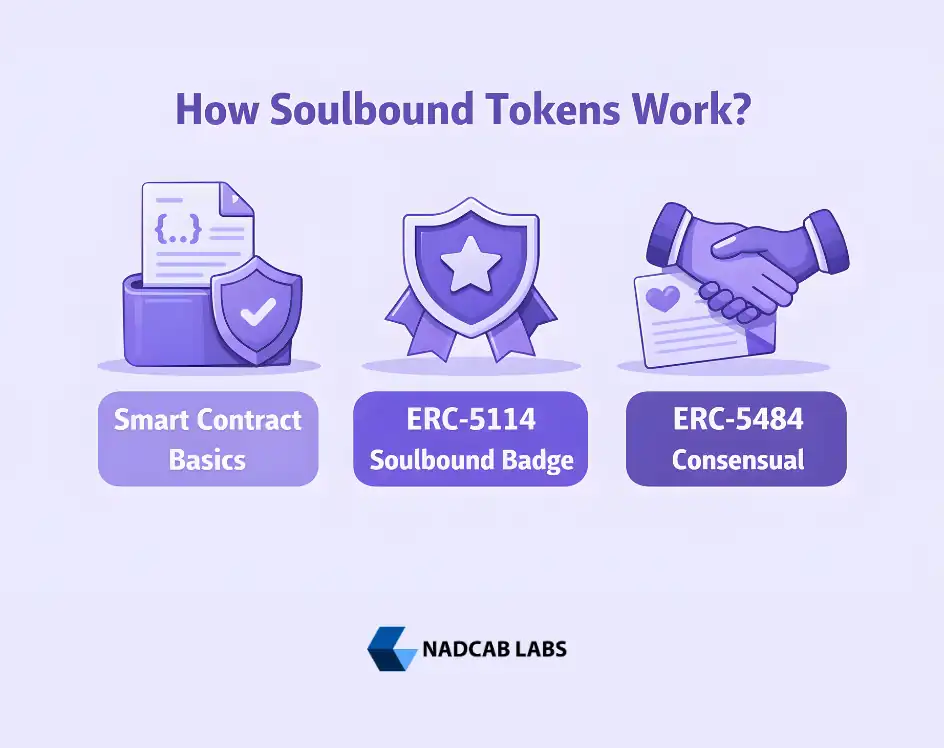
At their core, SBTs are built on the same blockchain infrastructure as regular NFTs. The key difference is that the transfer function is disabled. When an SBT is minted, it goes directly to the recipient’s wallet address and cannot be moved to any other address. This non-transferability is enforced by the smart contract code.
Smart Contract Basics
Creating a basic soulbound token smart contract involves modifying the standard ERC-721 NFT contract. The development process requires overriding the transfer functions to prevent any movement of the token after minting. When someone attempts to transfer an SBT, the smart contract rejects the transaction with an error message indicating that the token is non-transferable.
However, simply blocking transfers is not enough for most real-world use cases. Additional features like revocation, expiration, and consent mechanisms are needed. This is where specialized soulbound token standards come into play.
ERC-5114 Soulbound Badge
The ERC-5114 standard introduces the concept of a “Soulbound Badge” that is permanently bound to a specific NFT when minted. This badge serves as a persistent identifier of credentials or achievements. The standard ensures that the token’s metadata and URI cannot be changed after minting, making it ideal for digital certificates blockchain applications where permanence is critical.
ERC-5484 Consensual
The ERC-5484 standard addresses an important concern: what happens if someone issues an unwanted SBT to your wallet? This standard requires mutual consent before issuance and specifies immutable burn authorization. At the time of minting, the contract determines who can destroy the token: the issuer only, the owner only, both parties, or neither. This makes ERC-5484 suitable for use cases like credit history blockchain records or membership credentials that might need to be revoked under certain conditions.
Soulbound Tokens vs NFTs: Understanding the Difference
While both SBTs and NFTs are non-fungible tokens on the blockchain, they serve fundamentally different purposes. Understanding these differences is essential for anyone looking to choose blockchain for token projects.
Transferability
The most obvious difference between SBTs and NFTs is transferability. NFTs can be freely bought, sold, and transferred between wallets. This makes them suitable for representing ownership of digital art, collectibles, and tradeable assets. SBTs, on the other hand, cannot be transferred. Once minted to a wallet, they stay there permanently. This makes them suitable for representing credentials, achievements, and personal attributes.
Value Proposition
NFTs often hold monetary value and are treated as investment assets. People buy NFTs hoping their value will increase over time. SBTs hold no monetary value in the traditional sense. Their value comes from what they represent about the holder. A university diploma SBT proves you earned a degree. A professional certification SBT proves you passed an exam. These credentials have value, but that value cannot be extracted by selling the token.
Proof of Ownership vs Proof of Achievement
NFTs prove ownership. If you hold a particular NFT in your wallet, you own that digital asset. But ownership can be bought. SBTs prove achievement. If you hold a diploma SBT, it means you actually completed the educational program. This cannot be purchased because the issuing institution would only mint the SBT to someone who genuinely earned it. This distinction creates a Web3 reputation system where status must be earned, not bought.
Soulbound Tokens Use Cases: Real-World Applications
The potential applications for Soulbound Tokens span nearly every industry that requires identity verification or credential management. Here are some of the most promising use cases being developed.
Blockchain Academic Credentials
Universities and educational institutions can issue diploma and certificate SBTs to graduates. These digital certificates blockchain tokens provide instant, tamper-proof verification of academic credentials. Employers can verify a job applicant’s degree by simply checking their wallet address. This eliminates the need for background checks and reduces fraud. The development of skill verification blockchain systems makes the hiring process faster and more reliable.
Medical Records Blockchain
Healthcare providers can issue SBTs representing a patient’s medical history, vaccinations, allergies, and treatment records. When switching doctors or seeking emergency care, patients can grant access to their medical Soul, providing instant access to critical health information. Such systems could dramatically improve healthcare delivery while giving patients control over their data.
Professional Credentials Web3
Professional licensing bodies can issue SBTs for certifications, licenses, and continuing education credits. Lawyers, doctors, engineers, and other professionals could carry their credentials in their wallet. These professional credentials Web3 systems would make verification instant while ensuring that only qualified individuals hold valid licenses.
Credit History Blockchain
Financial institutions could issue SBTs representing credit history and repayment records. In decentralized finance (DeFi), these reputation tokens could enable undercollateralized lending by providing on-chain proof of creditworthiness. This would bring traditional credit scoring into the Web3 ecosystem while potentially making it more transparent and user-controlled.
Proof of Attendance Tokens
Event organizers can issue SBTs to attendees as digital mementos. Unlike tradeable POAPs (Proof of Attendance Protocol tokens), soulbound attendance tokens prove that the wallet holder actually attended the event. This preserves the token’s value as genuine proof of presence rather than something that can be purchased on a secondary market.
DAO Governance and Sybil Attack Prevention
One of the most important applications of Soulbound Tokens is in DAO governance Web3 systems. Traditional DAOs face serious challenges with their voting mechanisms, and SBTs offer potential solutions.
The Problem with Token-Based Voting
Most DAOs use a “one token, one vote” system where voting power is determined by how many governance tokens you hold. This creates a plutocracy where wealthy individuals or “whales” can dominate governance decisions. Even worse, DAOs are vulnerable to Sybil attacks where one entity creates multiple wallets to manipulate votes.
How SBTs Enable Reputation-Based Governance
SBTs offer an alternative model for DAO voting blockchain systems. Instead of basing voting power on purchasable tokens, DAOs can assign voting rights based on SBTs that represent genuine participation and contribution. A member who has attended governance meetings, contributed to proposals, and been active in the community would accumulate reputation tokens that grant voting power.
The development of this approach helps prevent Sybil attacks because reputation must be earned over time through genuine participation. Creating multiple wallets does not help if each wallet needs to earn its own reputation from scratch. Projects like Optimism have already implemented soulbound NFTs for their Citizens’ House governance body, ensuring that voting power reflects genuine community contribution rather than financial investment.
Web3 Trust Systems
Beyond voting, SBTs enable broader Web3 trust systems. DAOs can use SBTs to verify member credentials, assign roles based on proven skills, and create working groups of people with specific expertise. This moves decentralized governance closer to meritocracy while maintaining the permissionless nature of Web3.
Challenges and Considerations for Soulbound Tokens
Despite their potential, Soulbound Tokens (SBTs) come with notable challenges that must be resolved before they can achieve widespread adoption. Anyone exploring partnerships with crypto providers offering token development solutions should be aware of these limitations and carefully evaluate how they might impact implementation and scalability.
Key Recovery and Lost Souls
What happens if you lose access to your wallet? With regular tokens, you simply lose your assets. But with SBTs, you would lose your entire on-chain identity, including irreplaceable credentials like academic degrees and professional certifications. The proposed solution is social recovery, where a user designates trusted “guardians” who can collectively approve restoring the Soul to a new wallet. The development of robust recovery mechanisms is crucial for SBT adoption.
Privacy Concerns
Because SBTs live on a public blockchain, anyone who knows your wallet address can potentially see your credentials, affiliations, and achievements. This transparency, while useful for verification, raises privacy concerns. Solutions being explored include zero-knowledge proofs that allow holders to prove claims without revealing the underlying data, and the ability to control which SBTs are visible to different parties.
Unwanted Token Issuance
Without proper consent mechanisms, malicious actors could issue unwanted SBTs to someone’s wallet, permanently attaching negative credentials or spam. Standards like ERC-5484 address this by requiring consent before issuance, but implementation varies across projects.
Build Your Soulbound Token Project
Nadcab Labs helps organizations implement Soulbound Token solutions for digital credentials, identity verification, and reputation systems across Web3 applications.
The Future of Soulbound Tokens and Decentralized Identity
Soulbound Tokens represent a significant step toward building a decentralized identity Web3 infrastructure. They address a fundamental limitation of current NFTs: the inability to represent things that are inherently personal and non-transferable.
SBT standards and infrastructure are still in early stages. As the technology matures, we can expect more sophisticated implementations that balance transparency with privacy, and permanence with flexibility. The vision of a “Decentralized Society” where people carry verifiable credentials in their wallets is gradually becoming more achievable.
For those interested in receiving airdrop tokens and participating in Web3 ecosystems, understanding SBTs is increasingly important. Many projects are beginning to use soulbound credentials for access control, governance participation, and community verification.
Final Thoughts
Soulbound Tokens are transforming how we think about digital identity and reputation in the Web3 ecosystem. By creating non-transferable tokens that represent who we are rather than what we own, SBTs enable new forms of trust, verification, and governance that were not possible with traditional blockchain tokens.
The development of SBT technology continues to advance through standards like ERC-5114 and ERC-5484, with real-world implementations emerging in education, healthcare, governance, and professional credentialing. While challenges around privacy, recovery, and adoption remain, the foundation for decentralized identity Web3 systems is being built. As more institutions and communities adopt soulbound credentials, we move closer to a future where your blockchain identity reflects your genuine achievements, skills, and contributions rather than just your financial holdings.
Frequently Asked Questions
Q1.What are Soulbound Tokens in crypto?
Soulbound Tokens are non-transferable digital tokens on blockchain that represent a person’s identity, credentials, achievements, and reputation. Unlike regular NFTs, SBTs cannot be sold, traded, or moved from the wallet they were issued to.
Q2.How do Soulbound Tokens work?
SBTs work by disabling transfer functions in smart contracts. When an issuer mints an SBT to your wallet, the token becomes permanently attached. Any attempt to transfer it to another address is rejected by the smart contract.
Q3.What is the difference between SBTs?
The main difference between SBTs and NFTs is transferability. NFTs can be freely bought, sold, and transferred between wallets. SBTs are permanently bound to one wallet and represent earned credentials rather than tradeable assets.
Q4.Can Soulbound Tokens be revoked?
Some SBT standards like ERC-5484 include revocation mechanisms. Depending on the smart contract design, tokens can be burned by the issuer, the owner, both parties, or neither. This allows for credential updates or corrections.
Q5.What happens if I lose wallet?
Losing wallet access means losing your SBTs and on-chain identity. Social recovery mechanisms allow designated guardians to help restore your Soul to a new wallet. Proper key management and backup procedures are essential.
Q6.Are Soulbound Tokens secure and private?
SBTs are cryptographically secure on blockchain, but they raise privacy concerns since credentials are publicly visible. Zero-knowledge proofs and selective disclosure features are being developed to address privacy while maintaining verifiability.
Q7.How do SBTs prevent Sybil attacks?
SBTs help prevent Sybil attacks by linking voting rights to verified identities rather than purchasable tokens. Since reputation must be earned through genuine participation, creating multiple wallets provides no advantage for manipulation.
Explore Services
Related Services
Reviewed by

Aman Vaths
Founder of Nadcab Labs
Aman Vaths is the Founder & CTO of Nadcab Labs, a global digital engineering company delivering enterprise-grade solutions across AI, Web3, Blockchain, Big Data, Cloud, Cybersecurity, and Modern Application Development. With deep technical leadership and product innovation experience, Aman has positioned Nadcab Labs as one of the most advanced engineering companies driving the next era of intelligent, secure, and scalable software systems. Under his leadership, Nadcab Labs has built 2,000+ global projects across sectors including fintech, banking, healthcare, real estate, logistics, gaming, manufacturing, and next-generation DePIN networks. Aman’s strength lies in architecting high-performance systems, end-to-end platform engineering, and designing enterprise solutions that operate at global scale.